

Your siding choice can quietly eat a share of your trailer’s payload before you have hung a single cabinet. On a tiny house, the cladding is not just the pretty outer layer — it is one of the heaviest components of the shell, and every pound of it is a pound you cannot spend on batteries, water tanks or belongings. This guide weighs the four options side by side, so you can pick your look with your eyes open.
1. At a Glance: Siding Weight & Durability in Brief
The siding weight and durability comparator below was built to help builders navigate what it calls the “Weight vs. Beauty” trade-off. You enter one number — your total wall area — choose one of four materials, and the tool returns the total siding weight, the percentage of your trailer’s payload it consumes, a durability rating and a maintenance verdict. The four candidates cover the full range of the decision, from featherweight vinyl to fiber cement, a material the tool greets with an explicit “WARNING: Very Heavy.” If you are still shaping the look of the build, browse these tiny house exterior design ideas alongside the numbers — the prettiest option only works if the trailer can legally carry it.
| Material | Weight per sq ft | Durability (tool rating) | Maintenance |
|---|---|---|---|
| Vinyl Siding | 0.6 lbs/sf | Moderate (Cracks) | Wash Only |
| Metal (26ga Steel) | 1.0 lbs/sf | Extreme (50+ yrs) | Zero maintenance |
| Cedar Lap / T&G | 1.5 lbs/sf | High (If maintained) | Stain every 2–3 years |
| Fiber Cement (Hardie) | 2.5 lbs/sf | Extreme (Fire/Rot proof) | Paint every 10–15 years |
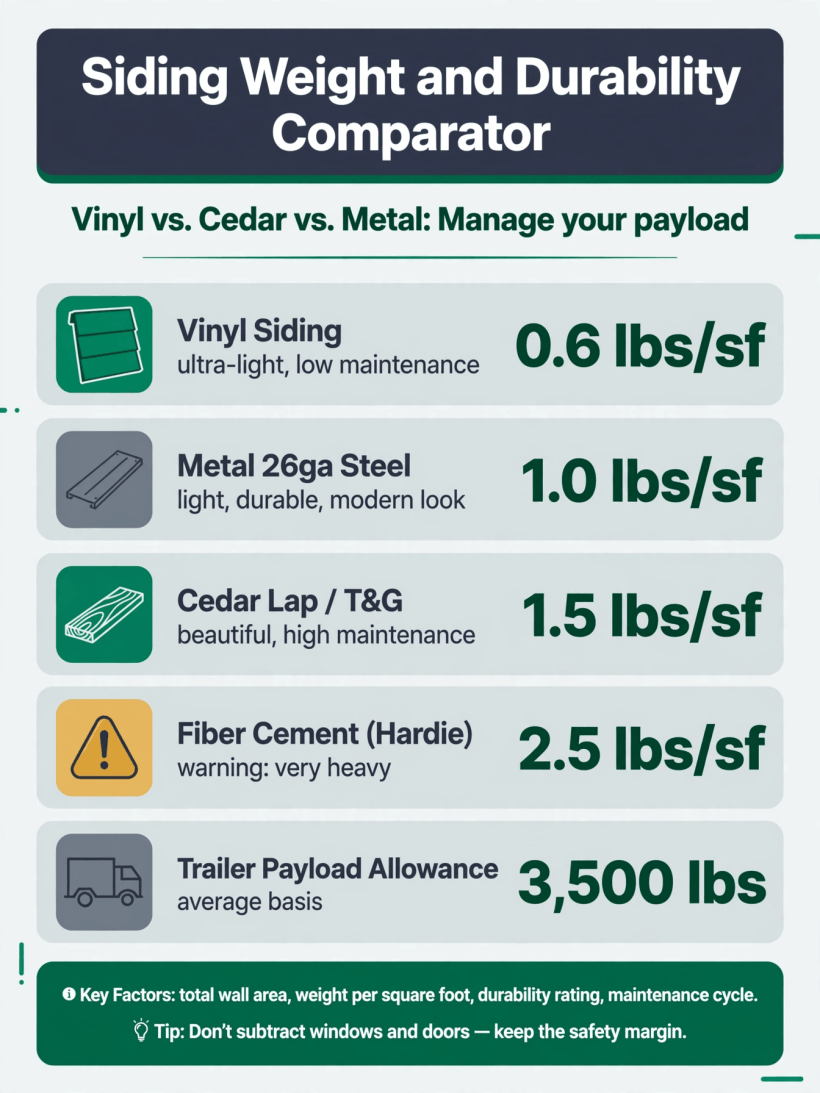
The four materials at a glance: vinyl is the lightest at 0.6 lbs per square foot, fiber cement the heaviest at 2.5 — more than four times as much wall weight before a single window is framed.
2. Why Siding Weight Matters on a Trailer
A house on a foundation barely notices its cladding. A house on a trailer notices every pound. The trailer has a fixed payload allowance — the comparator works on an average of 3,500 lbs — and that allowance has to cover everything: framing, insulation, roofing, interior fit-out, water, batteries and the people who live there. Siding wraps the entire exterior, so even a small difference in pounds per square foot multiplies across hundreds of square feet of wall into hundreds of pounds of real weight.
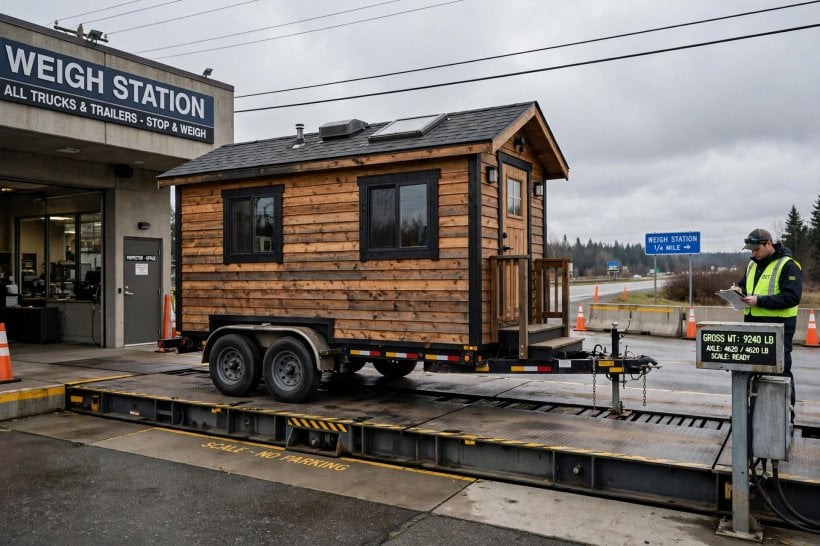
That is why the tool visualises the result as a “Payload Eater” Meter rather than a bare number. A percentage is harder to ignore than a pound figure: watch the bar climb past half of capacity and the meter flags the danger in red. Siding chosen early and weighed honestly leaves payload for the things that make the house livable. Siding chosen by looks alone can consume the budget silently, and the overload only shows up at the weigh scale — or never shows up at all, which is worse. For the full picture, work through how to calculate the weight of a tiny house so the siding figure sits inside your total build weight, not beside it.
3. Vinyl Siding: The Lightest Option on the Scale
Vinyl is the featherweight of the four. At 0.6 lbs per square foot it is, in the tool’s words, “ultra-light, cheap, low maintenance,” and its recommendation is equally direct: “Best for budget & weight savings.” On a build where the payload budget is tight — a smaller trailer, a heavy interior fit-out, a big battery bank — vinyl buys back hundreds of pounds compared with the heavier options, and it asks for almost nothing in return: the maintenance verdict is simply “Wash Only.”

The compromises are durability and character. The comparator rates vinyl’s durability as “Moderate (Cracks)” — three of its five stars — the lowest score of the four materials. And the tool flags a quirk every vinyl owner should know before they park: vinyl can melt if you park too close to a reflective window, when concentrated reflected sunlight warps the panels. None of that makes vinyl a bad choice; it makes it a deliberate one. If your priorities are minimum weight and minimum upkeep, vinyl is the rational pick, and the sections below show exactly what you give up — and what you gain — by stepping up to heavier materials.
4. Metal Siding (26ga Steel): The Sweet Spot
Metal is where the comparator’s enthusiasm peaks. Weighing 1.0 lb per square foot, 26-gauge steel is described in the tool’s own material breakdown as the “Sweet Spot” for tiny homes — “lightweight, fire-resistant, and zero maintenance” — and its recommendation reads “Top Choice. Balance of weight/durability.” Its durability rating matches fiber cement at the top of the scale: “Extreme (50+ yrs),” a full five stars, at well under half of fiber cement’s weight.
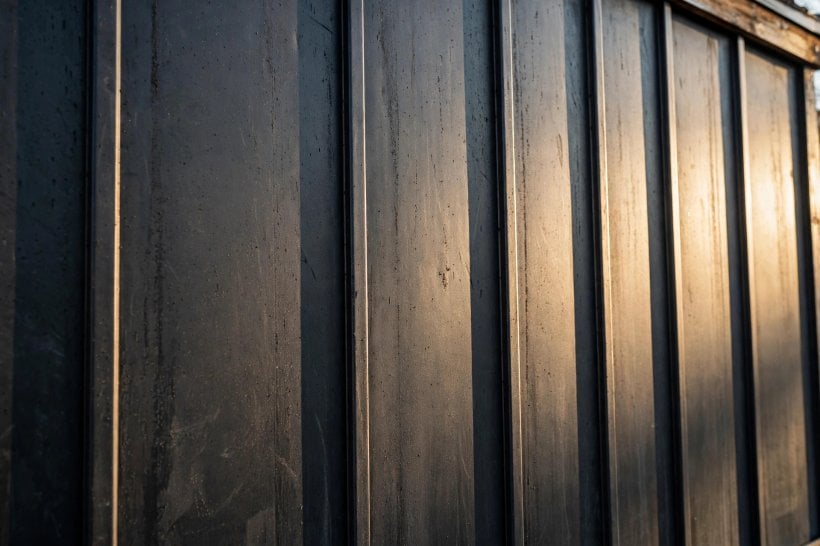
The modern look is part of the appeal — clean standing seams suit the contemporary tiny house aesthetic — and the one flaw the tool names is cosmetic: metal can “oil can,” developing a wavy look in heat as the thin panels expand. For most builders that is a fair trade for a wall that never needs staining, painting or washing beyond a rinse, and that shrugs off the fire and rot risks that sit at the top of the durability scale for the heavier board. If metal appeals for the walls, the same logic applies overhead; our metal roofing installation material calculator runs the panel counts and materials for the roof.
5. Cedar Lap and T&G: Beauty With a Maintenance Clock
Cedar is the material people fall in love with, and the comparator understands why: “Medium weight, beautiful, high maintenance.” At 1.5 lbs per square foot it sits in the middle of the weight table — two and a half times heavier than vinyl, but still a full pound per square foot lighter than fiber cement. The tool’s breakdown says it plainly: cedar adds warmth. Real wood grain, natural colour variation and that unmistakable smell give a tiny house a cabin character no manufactured panel quite reproduces.

The price is work. Cedar requires staining every 2–3 years to prevent graying and rot, and its durability rating — “High (If maintained),” four stars — carries that condition in brackets. Skip the staining cycle and the durability you paid for quietly drains away as the surface grays and moisture gets in. The tool’s verdict balances both truths: “Beautiful, but watch the weight & work.” If cedar’s look is the one you want with a different finish and upkeep profile, the shou sugi ban yakisugi siding visualizer shows the charred-wood take on the same material, and our guide to tiny house siding options in cedar, metal and composite compares the wider field in depth.
6. Fiber Cement (Hardie): The Heavyweight Warning
Fiber cement is the durability champion and the payload villain of this comparison, and the tool does not soften either fact. It is the only material whose selector carries a warning — “WARNING: Very Heavy” — and the numbers back it up: 2.5 lbs per square foot, the highest in the table by a wide margin. The breakdown quantifies what that means in practice: fiber cement adds roughly 1,000 lbs more than vinyl across a build, “often pushing 10k trailers over their legal limit.”
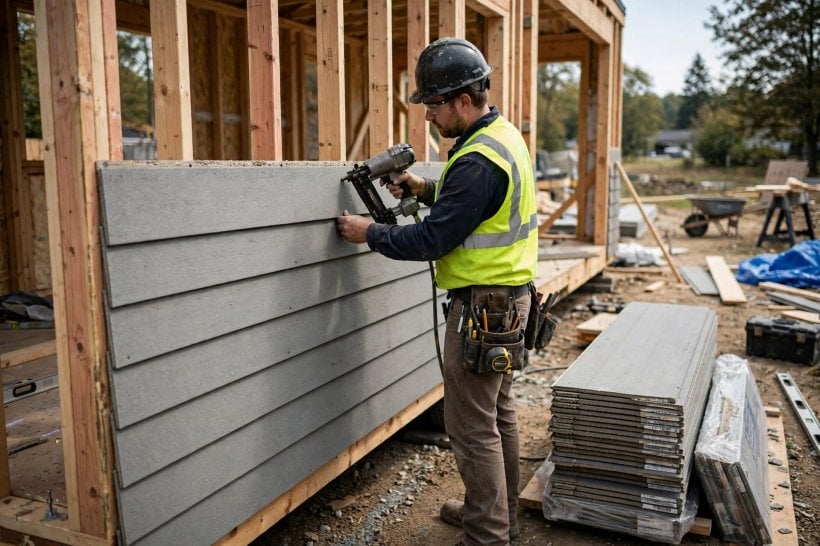
And yet the durability case is real. Fiber cement earns the joint-top rating of “Extreme (Fire/Rot proof)” — five stars — and its maintenance demand is modest: paint every 10–15 years. On a foundation home, that combination usually wins the argument outright. On a trailer, the recommendation tells the other half of the story: “Caution: Adds massive weight penalty.” Choosing fiber cement means engineering the rest of the build around it — a trailer with payload to spare and a deliberately light interior. That decision starts with the chassis itself, so read how to frame a tiny house on a trailer before committing to the heaviest skin in the table.
7. Durability Ratings: What the Stars Actually Mean
The comparator scores durability out of five stars, and the labels behind the stars matter more than the scores themselves. Vinyl’s three stars come with the word “Moderate” and its failure mode in brackets: it cracks. Cedar’s four stars are conditional — “High (If maintained)” — which means the rating is a promise you have to keep, not a property you buy once. Metal and fiber cement share the top mark, but for different reasons: metal’s “Extreme (50+ yrs)” is a lifespan claim, while fiber cement’s “Extreme (Fire/Rot proof)” names the two specific threats it is immune to.
Read the ratings as a set of trade-offs rather than a league table. The two five-star materials sit at opposite ends of the weight scale, so “most durable” and “lightest durable” are different answers — metal gives you the top rating at 1.0 lb per square foot, fiber cement at 2.5. Durability also interacts with the rest of the envelope: a wall is only as weatherproof as its weakest detail, which is why the roof junctions deserve the same care — see the metal roof skylight flashing guide for how the flashing details protect the assembly. A tiny house also lives a harder life than a static one: road vibration, towing weather and tight parking spots all test the skin in ways a foundation house never faces.
8. The Maintenance Clock: Wash, Stain, Paint or Nothing
Weight is the cost you pay once, on build day. Maintenance is the cost you pay forever, and the tool tracks it with its Maintenance Clock — the long-term price of your choice, shown next to the payload figure so the two are never separated. The four materials spread across the whole spectrum. Metal asks for nothing at all: “Zero Maint.” Vinyl asks for a wash. Fiber cement asks for paint every 10–15 years — a rare but real job. Cedar asks for stain every 2–3 years, the shortest cycle in the table, repeated for as long as you own the house.

That cycle deserves honest thought before you romanticise it. Staining a tiny house is a weekend, not a renovation — the walls are small — but it is a weekend that returns on schedule, in the right weather, with ladders, brushes and a free Saturday, for decades. Some owners genuinely enjoy that ritual of care, and for them cedar’s clock is a pleasure rather than a burden. Others know they will let it slide, and for them the cedar durability rating’s bracketed condition — “if maintained” — is the most important text in the whole tool. Match the material to the owner you actually are, not the one you hope to become.
9. Mistakes That Push a Tiny House Over Its Limit
The most common mistake is choosing siding by photograph. The second most common is weighing it too late — after the trailer is bought, the frame is up and the interior is planned — when the only remaining fixes are expensive ones. A subtler error is built into the tool’s single instruction: “Don’t subtract windows/doors for safety margin.” Builders love to shave the wall area down by deducting every opening, but that shaved figure is your safety margin disappearing; the honest area is the full wall, and the openings simply leave you a small, welcome buffer.
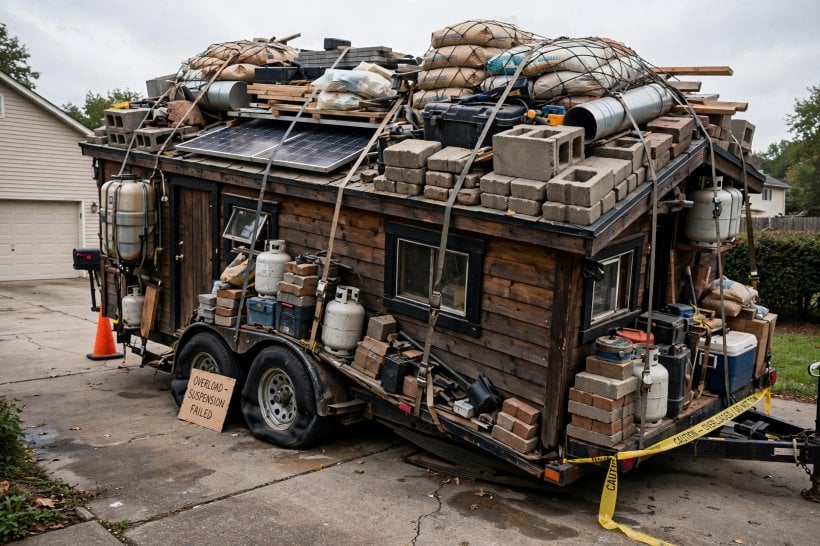
Two more mistakes complete the set. The first is treating the siding number in isolation: 36% of payload on cladding might be fine on a minimalist build and fatal on one with a full kitchen, large water tanks and a big battery bank — the percentage only means something against the whole build. The second is ignoring the maintenance verdict until year three, when the cedar is graying, the staining weekend never happened, and the “High (If maintained)” rating has quietly expired. Run the numbers before the build, keep the safety margin, and re-check the total whenever the design changes — weight creep is real, and it almost always creeps upward.
10. How to Use the Comparator: Area, Material, Results
The tool asks for two things. First, your total wall area in square feet — the full exterior wall surface, windows and doors included, per the safety-margin rule above. Second, your material: vinyl, metal (26ga steel), cedar lap / T&G, or fiber cement. Press “Compare Options” and it returns four results: the total siding weight in pounds, the trailer payload impact as a percentage of the average 3,500 lb allowance, the durability stars with their label, and the maintenance verdict — plus a one-line recommendation for the material you picked.
Try it with the tool’s own example area of 500 square feet and the trade-off stops being abstract. Vinyl comes back at about 300 lbs, roughly 9% of payload. Metal lands near 500 lbs, about 14%. Cedar reaches about 750 lbs, around 21%. Fiber cement tops the table at roughly 1,250 lbs — about 36% of the entire payload allowance spent on the skin alone. Run the siding weight and durability comparator with your real wall area, then run it again with the material you are torn between. The two payload bars, side by side, are usually the moment the decision makes itself.
Final Considerations
There is no universally right answer in this table — there is a right answer for your trailer, your payload budget and your tolerance for upkeep. Vinyl protects the payload and asks for a wash. Metal earns the tool’s “Top Choice” by pairing a five-star durability rating with a one-pound footprint and zero maintenance. Cedar sells beauty at a fair weight and a recurring weekend of work. Fiber cement offers the toughest skin in the comparison and demands you engineer everything else around its weight. Decide which of those bargains fits the house you are actually building, then scroll down and let the comparator confirm it with your own numbers.
Siding Weight & Durability
This tool helps builders navigate the “Weight vs. Beauty” trade-off. Siding is one of the heaviest components of a tiny house shell. This calculator visualizes exactly how much of your trailer’s precious payload capacity is “eaten” by heavy materials like Fiber Cement or Cedar, versus lightweight options like Vinyl or Metal.
It features a “Payload Eater” Meter and a Maintenance Clock to show the long-term cost of your choice.
Siding Weight & Durability
Vinyl vs. Cedar vs. Metal: Manage your payload.
1. Exterior Dimensions
Don’t subtract windows/doors for safety margin.
2. Select Material
Based on avg 3,500lb payload allowance
Material Breakdown
Vinyl is the lightest (0.6 lbs/sf) but melts if you park too close to a reflective window. Metal (1.0 lbs/sf) is the “Sweet Spot” for tiny homes—lightweight, fire-resistant, and zero maintenance, though it can “oil can” (wavy look) in heat.
Cedar (1.5 lbs/sf) adds warmth but requires staining every 2-3 years to prevent graying/rot. Fiber Cement (2.5 lbs/sf) is extremely durable but adds ~1,000 lbs more than vinyl—often pushing 10k trailers over their legal limit.


1 Comment