

How long do tiny houses last? Anywhere from 10 years to over a century — depending on build type, materials, climate, and maintenance. A well-built foundation tiny house lasts as long as any conventional home; a tiny house on wheels faces the additional lifespan limit of its trailer. This guide breaks down realistic lifespans by build type and what you can do to maximize yours.
This is a practical durability guide — for the cost side, see our tiny house price breakdown.
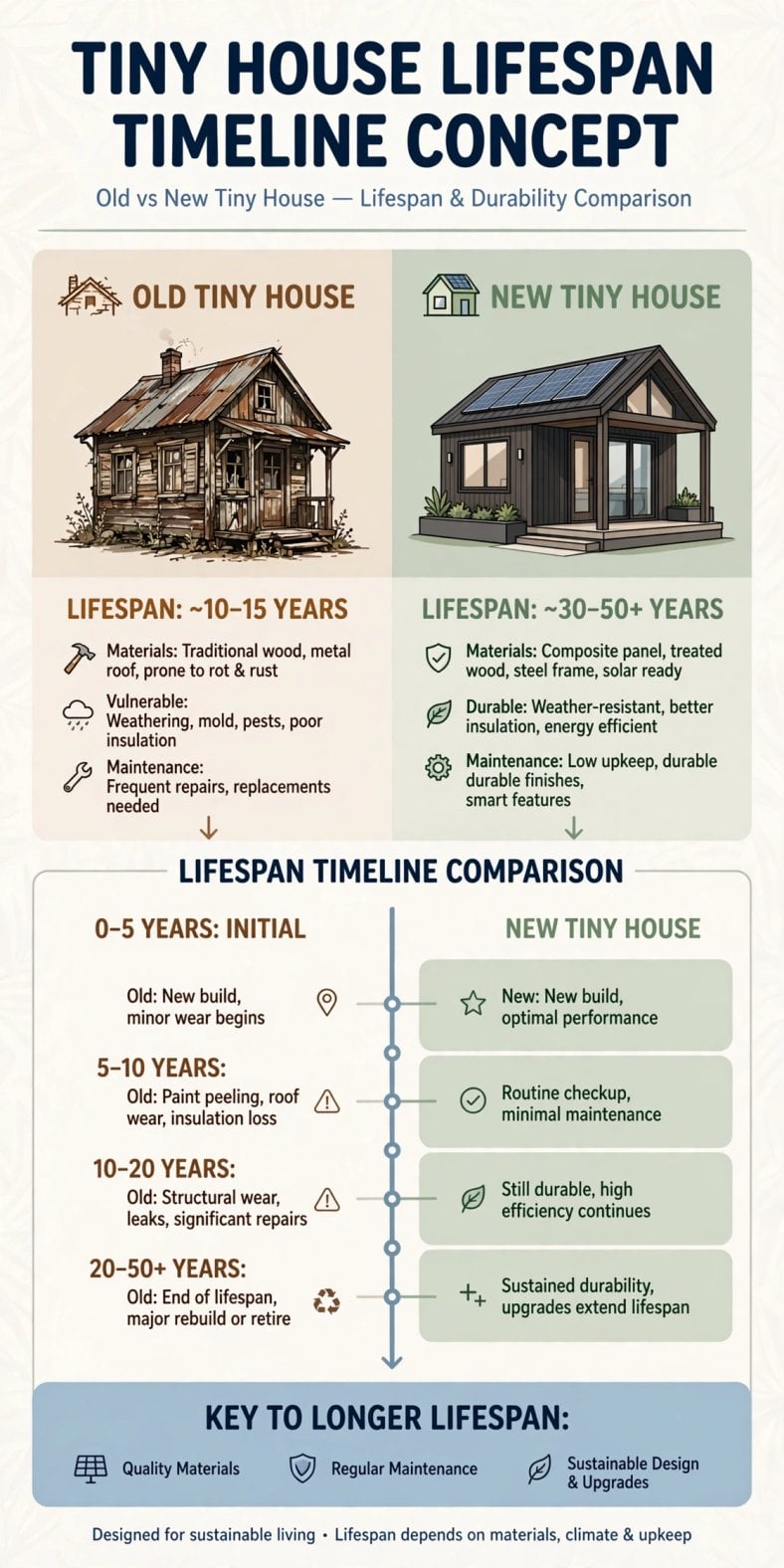
The Short Answer
Foundation tiny house (well-built): 50–100+ years — same as conventional homes. The structure doesn’t know it’s small.
Professionally built THOW: 25–50 years for the house; 15–30 years for the trailer. The trailer is usually the limiting factor.
DIY THOW (variable quality): 10–30 years — highly dependent on build quality, moisture management, and maintenance.
The rule: Build quality and maintenance matter more than size. Small doesn’t mean short-lived — cheap does.
Foundation Tiny Houses: Built Like Houses Because They Are
Structural lifespan: A foundation tiny house built to residential code with quality materials has the same lifespan expectations as any site-built home — 50 to 100+ years.
What lasts: Concrete foundations (100+ years), quality framing (75+ years with moisture control), metal roofing (40–70 years), brick/stone siding (100+ years).
What doesn’t: Asphalt shingles (15–30 years), water heaters (8–12 years), appliances (10–15 years), exterior paint (5–10 years), sealants and caulking (5–15 years).
THOWs: The Trailer Question
Trailer lifespan: A quality steel trailer lasts 15–30 years depending on climate, maintenance, and whether it’s galvanized. Rust is the enemy — inspect annually.
The mismatch: The house structure can outlast the trailer by decades. This creates the central THOW longevity question: what happens when the trailer dies but the house is fine?
Re-trailering: Houses can be lifted and placed on new trailers ($5,000–$15,000) — extending total lifespan indefinitely. Budget for it as a 20-year event.
What Wears Out First
Roofing: The first major system to need replacement in most tiny houses — 15–30 years for shingles, longer for metal. Small roofs are cheap to replace ($2,000–$6,000).
Water systems: Water heaters, pumps, and plumbing fixtures — 8–15 year lifespans. PEX plumbing itself lasts 40+ years; it’s the fixtures and appliances that cycle.
Exterior envelope: Siding, trim, windows, and doors face weather constantly. Quality materials + maintenance = 25–50 years; neglect = 10–15.
Trailer components: Tires (5–7 years regardless of miles), brakes, bearings, lights, and the coupler — maintain on a vehicle schedule, not a house schedule.
Moisture: The #1 Killer
Why tiny houses are vulnerable: Small volumes mean moisture concentrates fast — cooking, showering, and breathing in 400 square feet generate serious humidity.
The damage: Rot, mold, and structural decay. Moisture damage is the most common cause of premature tiny house death — and it’s preventable.
Prevention: Proper ventilation (HRV/ERV or continuous bath fans), vapor barriers correctly placed for your climate, quality flashing, and prompt leak repair. A $200 humidity monitor is the cheapest insurance.
Climate Effects on Lifespan
Humid climates: Accelerate rot, mold, and corrosion. Demand excellent ventilation, moisture-resistant materials, and vigilant maintenance. Lifespan penalty: potentially 20–30% without mitigation.
Desert climates: UV destroys roofing, siding, and sealants faster. But low moisture means structural longevity — trade UV maintenance for rot freedom.
Freeze-thaw climates: Punish foundations, plumbing, and exterior materials. Proper frost-depth foundations and winterization are non-negotiable.
Coastal climates: Salt air corrodes metal — including trailers — aggressively. Galvanized or aluminum trailers, stainless fasteners, and frequent washing extend life significantly.
The Maintenance Schedule That Extends Life
Monthly: Check humidity levels, inspect under sinks and around water connections, test smoke/CO detectors.
Seasonally: Inspect roof and flashing, clean gutters, check exterior caulking, service HVAC filters, inspect trailer (tires, lights, coupler).
Annually: Deep roof inspection, exterior paint/touch-up assessment, water heater flush, trailer brake and bearing check, full moisture inspection (attic, crawlspace, wall cavities where accessible).
Every 5 years: Reseal exterior penetrations, evaluate roofing condition, inspect trailer frame for rust, assess appliance efficiency.
Build Quality: The Lifespan Multiplier
Professional builds: Certified manufacturers build to standards with warranties — the quality floor is higher and more consistent. This is what you’re paying for.
DIY builds: Lifespan ranges from excellent (skilled builder, quality materials, proper detailing) to poor (moisture mistakes, structural shortcuts). The variance is enormous.
The critical details: Flashing, waterproofing, ventilation design, and structural connections matter more than finishes. Pretty houses with bad flashing die young; plain houses with great envelopes live long.
Materials That Maximize Lifespan
Framing: Pressure-treated sill plates, quality lumber, proper structural connections. Steel framing for THOWs where weight allows.
Exterior: Metal roofing, fiber-cement or metal siding, quality windows with proper flashing. These cost more upfront and pay back in decades.
Trailer: Galvanized steel, adequate weight rating (with margin), quality axles and coupler. The trailer is not where to economize.
Renovation Cycles
10–15 years: Cosmetic refresh — paint, flooring, fixtures, soft furnishings. The “looks tired” phase, not structural.
20–30 years: Systems renewal — roofing, water heater, appliances, possibly HVAC. Budget $10,000–$25,000 for a comprehensive refresh.
30–50 years: Major systems — potential re-siding, window replacement, trailer replacement (THOWs). The “second life” investment.
Planning: Budget 1–2% of the home’s value annually for maintenance and renewals. Tiny houses cost less in absolute terms — but the percentage rule still applies.
Signs Your Tiny House Is Nearing End of Life
Structural: Sagging, racking, soft floors, cracked framing, trailer frame corrosion beyond surface rust. These are serious — get professional assessment.
Envelope failure: Chronic leaks that repairs don’t fix, widespread rot, failed flashing throughout. Sometimes the economical answer is a rebuild, not repair.
The economic test: When annual repair costs exceed 5–10% of replacement value for multiple years, replacement usually beats continued repair.
Extending Lifespan: The Big Levers
Moisture management: The single highest-leverage factor. Ventilation, flashing, prompt leak repair — do these and you solve 70% of premature aging.
Trailer care (THOWs): Annual inspection, rust treatment, bearing service, tire replacement on schedule. The trailer is a vehicle — maintain it like one.
Proactive replacement: Replace roofing, sealants, and wear items on schedule — not after failure. Preventive maintenance costs a fraction of damage repair.
Siding Lifespans Compared
Vinyl: 20–40 years. Cheap and low-maintenance, but brittle with age and UV. Fine for budget builds.
Wood: 20–40 years with maintenance; 10–15 without. Beautiful but demanding — painting/staining on schedule is mandatory.
Fiber-cement: 40–60+ years. The durability sweet spot — rot-proof, fire-resistant, holds paint well. Costs more upfront.
Metal: 40–70 years. Excellent longevity, minimal maintenance. Can dent, but doesn’t rot or burn.
Roofing Lifespans Compared
Asphalt shingles: 15–30 years. Cheapest upfront, shortest life. On a tiny roof, the savings are small — consider upgrading.
Metal roofing: 40–70 years. The tiny house standard for good reason — longevity, low maintenance, and recyclable.
Membrane (TPO/EPDM): 20–30 years. Common on flat or low-slope tiny roofs. Inspect seams annually.
The tiny roof advantage: Replacement costs $2,000–$6,000 — a fraction of conventional re-roofing. Don’t defer it; small roofs are cheap to renew.
Foundation Types and Lifespans
Concrete slab: 75–100+ years. Simple, durable, minimal maintenance. The longevity champion.
Crawlspace: 50–75+ years for the foundation; requires moisture management underneath. Inspect annually for water and pests.
Piers: 30–50+ years depending on materials — concrete piers last; wood posts in ground contact don’t. Keep wood away from soil.
Skids/runners: 15–30 years. Common for movable small structures; pressure-treated and kept off wet ground lasts longer.
Evaluating a Used Tiny House’s Age
Ask for: Build year, builder, materials list, maintenance records, and any moisture or repair history. Gaps in history are red flags.
Inspect: Roof condition, exterior envelope, trailer frame (rust?), floor firmness, moisture meter readings in walls, and all water connections.
Price by remaining life: A 15-year-old THOW on its original trailer has different value than the same house re-trailered at year 12. Factor replacement timelines into the price.
Insurance and Lifespan
Insurability over time: Older tiny houses — especially THOWs — can become harder to insure. Some carriers limit coverage by age or require inspections.
Actual cash value vs. replacement: Understand which you have. ACV policies pay depreciated value — on an aging tiny house, that may be far less than replacement cost.
Documentation: Maintenance records, upgrade receipts, and re-trailering documentation all support insurability and claims. Keep them.
When Renovation Beats Replacement
Renovate when: The structure and envelope are sound but systems and finishes are tired. A $15,000–$30,000 renovation buys another 15–20 years.
Replace when: Structural failure, envelope failure throughout, or repair costs exceeding 50%+ of replacement value. Also when the layout fundamentally doesn’t work.
The 100-Year Tiny House
What it takes: Foundation construction, quality envelope (metal roof, fiber-cement siding), excellent moisture detailing, and committed maintenance across generations.
Precedent: Small cottages, cabins, and workers’ housing from a century ago still stand — tiny houses are not a new building type, just a new name. Build like they did (but better) and yours lasts too.
The mindset: Build for the next owner, not just yourself. Every quality decision compounds across decades.
Warranties: What Builders Promise
Structural warranties: Reputable builders offer 5–10 year structural warranties. Read the terms — what’s covered, what’s excluded, and the claim process.
Systems warranties: Appliances and components carry manufacturer warranties (1–5 years typically). Register everything at installation.
Trailer warranties: Trailer manufacturers warranty frames and components separately — typically 1–5 years. Understand the coverage before you need it.
Resale Value vs. Lifespan
The distinction: Lifespan is how long it lasts; resale value is what someone pays. THOWs depreciate like vehicles even while structurally sound — lifespan and value diverge.
Maximizing resale: Maintenance records, quality materials, neutral finishes, and documentation (re-trailering, upgrades) all support resale value independent of age.
Foundation advantage: Foundation tiny houses on owned land typically hold value better — real property appreciates (or holds) while the structure depreciates slowly.
Documenting for Longevity
The maintenance log: Record every inspection, repair, and replacement with dates — a simple spreadsheet or notebook. Future buyers, insurers, and your future self will thank you.
Photo documentation: Photograph the structure during construction (framing, flashing, waterproofing) and after major work. Hidden details matter most when they’re hidden.
Manuals and warranties: Keep every appliance manual, warranty card, and builder document in one folder — physical or digital. Organized records add measurable resale value.
The Maintenance Mindset
Small house, small jobs: Tiny house maintenance tasks are proportionally small — a roof inspection takes 20 minutes, not a weekend. The barrier is remembering, not doing.
Calendar it: Put seasonal maintenance on your calendar like appointments. The houses that last longest belong to owners who treat maintenance as non-negotiable routine.
The payoff: An hour a month and a weekend a season — that’s the real price of a tiny house that lasts 50 years instead of 15. It’s the best hourly rate in homeownership.
Frequently Asked Questions
How long do tiny houses last?
Foundation tiny houses: 50–100+ years (like conventional homes). Professionally built THOWs: 25–50 years for the house, 15–30 for the trailer. DIY builds vary enormously (10–30 years) based on quality and maintenance.
What wears out first on a tiny house?
Roofing (15–30 years), water heaters and appliances (8–15 years), exterior paint and sealants (5–15 years), and trailer components — tires (5–7 years), brakes, and bearings. The structure itself lasts longest with moisture control.
Can you replace a tiny house trailer?
Yes — houses can be lifted and placed on new trailers for $5,000–$15,000, effectively resetting the trailer lifespan clock. Budget for this as a ~20-year event for THOWs.
Do tiny houses depreciate or fall apart faster than regular houses?
They don’t inherently fall apart faster — but THOWs face trailer lifespan limits and depreciation like vehicles. Foundation tiny houses age exactly like conventional homes. Maintenance quality dominates all other factors.
How can I make my tiny house last longer?
Control moisture (ventilation + flashing + prompt leak repair), maintain the trailer on a vehicle schedule, replace wear items proactively, and budget 1–2% of value annually for maintenance. Moisture management alone prevents most premature failures.
Final Considerations
Tiny houses last as long as the care put into building and maintaining them. A well-built foundation tiny house will outlive its owner; a well-maintained THOW will serve for decades with one trailer replacement. The enemies are moisture, neglect, and cheap critical components — all defeatable with knowledge and modest ongoing investment. Build it right, keep it dry, maintain it on schedule, and your tiny house won’t just last — it’ll age gracefully, gaining the character that only decades of good shelter can give.
1 Comment
Pingback: Tiny house vs rv living: An Honest Comparison