

Are steel framed tiny houses better than wood — or do the fasteners work themselves loose over time? It’s the framing debate that splits the tiny house world: steel promises strength and precision, wood promises familiarity and forgiveness. And the fastener question is real, especially for houses on wheels that experience road vibration. Here’s the honest comparison.
For how framing choices affect longevity, see our tiny house lifespan guide.
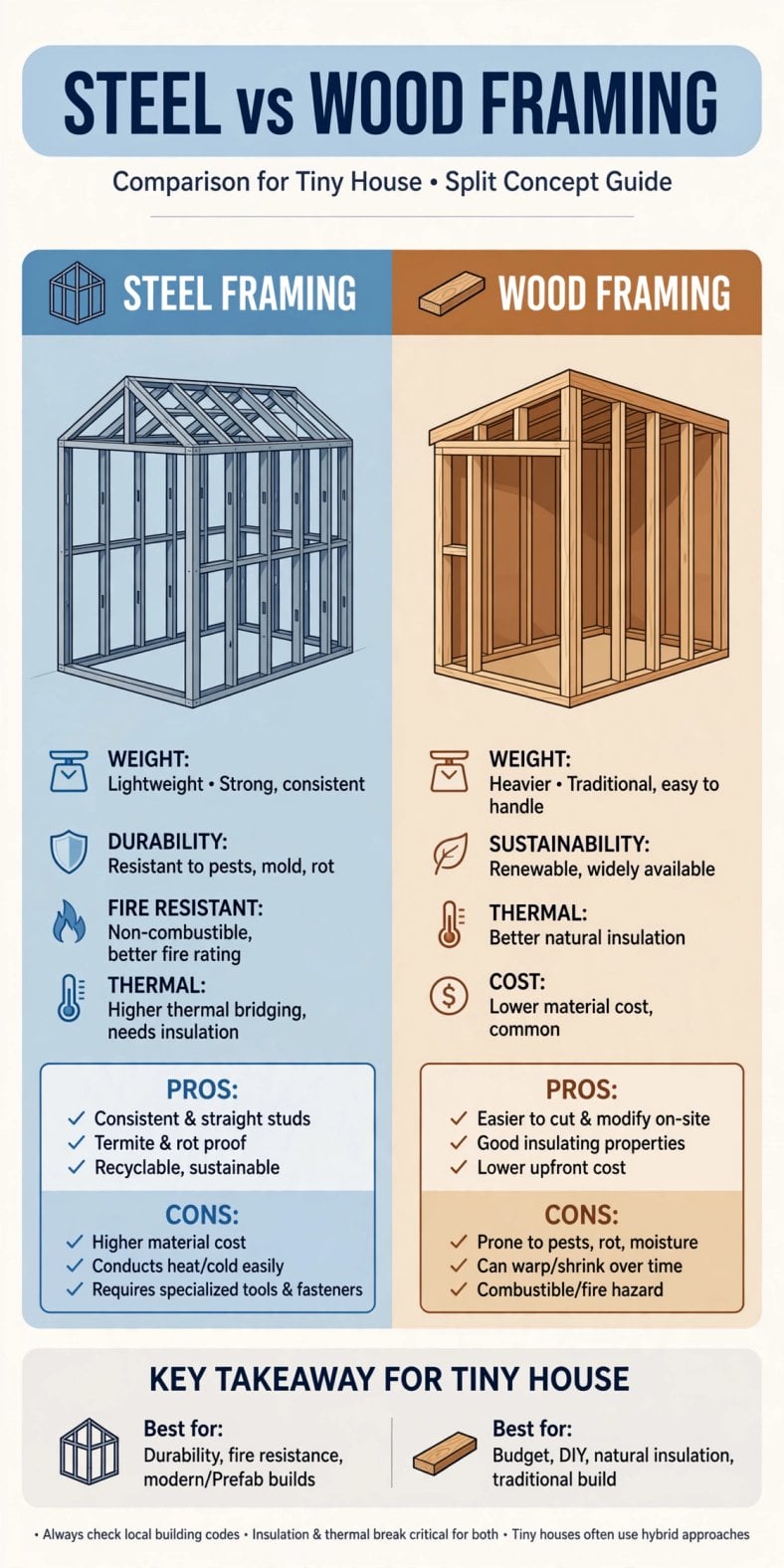
The Short Answer
Steel wins on: Strength-to-weight ratio, dimensional stability, pest and rot resistance, and precision. Ideal for THOWs where weight matters.
Wood wins on: Cost, DIY-friendliness, thermal performance, ease of modification, and builder availability. Ideal for foundation builds and DIY.
Fasteners: Properly specified steel fasteners don’t “work themselves loose” under normal conditions — but road vibration in THOWs demands proper fastening design regardless of frame material.
Strength Compared
Steel: Higher strength-to-weight ratio — a steel frame can be lighter AND stronger than an equivalent wood frame. This matters enormously for THOWs where every pound counts against trailer capacity.
Wood: Strong enough for any tiny house when properly engineered. Wood’s strength is well-understood, with centuries of residential precedent.
The practical difference: For foundation tiny houses, both are more than adequate. For THOWs near weight limits, steel’s weight savings (500–1,500 lbs) can be decisive.
Weight: Steel’s Killer Advantage
The numbers: A steel-framed tiny house shell typically weighs 20–30% less than an equivalent wood-framed shell. On a 10,000 lb build, that’s 1,000–2,000 lbs saved.
Why it matters: Trailer weight ratings are hard limits. Weight saved on framing is weight available for finishes, systems, water, and belongings — or a smaller, cheaper trailer.
Foundation builds: Weight barely matters. The steel weight advantage is mostly irrelevant on a foundation — which is why wood dominates there.
Cost Compared
Material cost: Steel framing typically costs 10–30% more than wood framing for the same structure. The premium varies with steel markets.
Labor cost: Steel requires specialized skills and tools — fewer builders, higher rates. Wood framing labor is widely available and competitive.
Total picture: A steel-framed tiny house often costs $3,000–$8,000 more in framing than wood. For THOWs, the weight savings may justify it; for foundation builds, rarely.
Do Fasteners Work Themselves Loose?
The concern: THOWs experience road vibration during moves. The fear: screws and bolts gradually loosening, compromising structural integrity over time and moves.
The reality for steel: Properly designed steel connections — with appropriate fasteners, torque specs, and locking methods (lock washers, thread-locking compounds, proper bolt tension) — don’t loosen under normal conditions, including road transport.
The reality for wood: Wood connections can also loosen — nails back out, screws lose grip as wood shrinks and moves. This is well-known in wood construction and managed with proper fastening schedules.
The verdict: Fastener loosening is a design and execution issue, not a material destiny. Either material fails with bad fastening; either succeeds with proper specification. The key is hiring builders who understand dynamic loads.
Thermal Bridging: Steel’s Weakness
The problem: Steel conducts heat ~400x better than wood. Every steel stud is a thermal bridge — conducting heat out in winter and in during summer, bypassing your insulation.
The impact: Without mitigation, steel-framed walls can lose 30–50% of their nominal R-value to thermal bridging. That’s enormous in a tiny house.
The fixes: Exterior continuous insulation (rigid foam outside the steel frame), thermal breaks, and careful detailing. These work but add cost and complexity.
Wood’s advantage: Wood is a natural insulator (R-1.25 per inch). Wood-framed walls achieve close to their nominal R-value without heroic measures.
Fire Performance
Steel: Non-combustible — doesn’t burn. But steel loses strength at high temperatures (above ~1,000°F), which can cause structural failure in intense fires.
Wood: Combustible, but chars predictably — a wood stud retains structural capacity longer than you’d expect as the char layer insulates the core.
The practical take: In tiny houses, fire safety depends far more on detectors, extinguishers, escape routes, and ignition prevention than on frame material. Both need the same fire safety measures.
Pests and Rot
Steel: Immune to termites, carpenter ants, and rot. In termite-heavy regions or damp climates, this is a genuine long-term advantage.
Wood: Vulnerable to both — but pressure treatment, borate treatments, and good moisture management make wood framing highly durable. Most wood houses never have structural pest issues.
Where steel wins clearly: High-termite areas, flood-prone locations, and persistently damp climates. The immunity is real and valuable.
DIY-Friendliness
Wood: The DIY champion — basic carpentry tools, widely available knowledge, forgiving material, easy to modify on the fly. Most DIY tiny houses are wood-framed for good reason.
Steel: Demanding — requires metal cutting tools, understanding of steel connections, and precision. Mistakes are harder to fix. Most steel tiny houses are professionally built.
The rule: If you’re DIYing, wood is the pragmatic choice unless you have steel experience. If you’re hiring, let the builder’s expertise guide the choice.
Dimensional Stability
Steel: Doesn’t shrink, warp, twist, or swell with moisture changes. What you build is what you keep — walls stay straight, doors keep fitting, finishes don’t crack from movement.
Wood: Moves with moisture — shrinking as it dries, swelling in humidity. Properly dried lumber and good detailing manage this, but some movement is inevitable.
Why it matters in tiny houses: Small spaces amplify the effects — a sticking door or cracked tile is more noticeable at tiny scale. Steel’s stability is a genuine livability advantage.
Moisture Behavior Compared
Steel: Doesn’t absorb moisture, rot, or grow mold on the framing itself. But condensation on steel surfaces (from thermal bridging) can cause moisture problems in the wall cavity — the detailing matters enormously.
Wood: Absorbs and releases moisture — buffering small fluctuations but vulnerable to sustained wetness. The entire wood construction tradition is about managing this behavior.
The detailing imperative: Both materials fail with bad moisture detailing and succeed with good detailing. Steel forgives bulk water but punishes condensation; wood forgives condensation but punishes bulk water.
Modifying and Renovating Later
Wood: Easy to modify — cut openings, add framing, sister joists, run new wiring. Any carpenter can work with it. Renovations are straightforward and affordable.
Steel: Harder to modify — cutting and reworking steel framing requires metalworking tools and knowledge. Changes cost more and fewer contractors will do them.
Plan ahead: If you anticipate future modifications (and most owners do), wood’s flexibility is a significant long-term advantage.
Insurance and Code Acceptance
Code: Both steel and wood framing are code-accepted for residential construction. Steel has well-established prescriptive standards — no exotic engineering needed for typical tiny houses.
Insurance: Frame material rarely affects tiny house insurance directly — insurers care more about certification, value, and use. Don’t expect a steel discount.
Resale: Wood-framed houses have broader buyer familiarity; steel-framed houses may require more buyer education. Neither is a dealbreaker.
Environmental Impact
Wood: Renewable, carbon-sequestering, lower embodied energy. Sustainably harvested lumber is among the greenest structural materials available.
Steel: Highly recyclable (most structural steel contains recycled content) but energy-intensive to produce. The recycling story is excellent; the production story less so.
The lifecycle view: For environmentally motivated builders, sustainably sourced wood usually wins — unless the steel enables a lighter THOW that saves transport fuel over its life.
Hybrid Approaches
Steel trailer + wood house: The most common hybrid — steel where weight and strength matter most (the trailer), wood where thermal performance and workability matter (the house). Proven and practical.
Steel frame + wood infill: Steel structural frame with wood secondary framing — captures steel’s precision for the primary structure while keeping wood’s workability for partitions and finishes.
Strategic steel: Wood framing with steel in high-stress locations — flitch beams, steel connectors, hurricane ties. The best of both without full commitment.
What Builders Actually Recommend
THOW specialists: Often recommend steel (or aluminum) framing for weight-critical builds — they’ve seen the trailer-scale math play out.
Foundation builders: Overwhelmingly recommend wood — the thermal, cost, and labor advantages are decisive when weight doesn’t matter.
DIY advisors: Almost universally recommend wood for first-time builders — the learning curve, tool requirements, and forgiveness factor all favor wood.
The Vibration Question: Deep Dive
What vibration does: Road transport subjects THOWs to sustained vibration and shock loads — fundamentally different from the static loads houses are designed for.
Steel connections: Bolted steel connections with proper preload, lock washers or prevailing-torque nuts, and thread-locking compounds resist vibration loosening effectively. This is solved engineering — bridges and machinery handle far worse.
Wood connections: Screwed and nailed wood connections can loosen as wood compresses and moves under cyclic loading. Construction adhesives plus mechanical fasteners (the belt-and-suspenders approach) dramatically improve vibration resistance.
What actually fails: In practice, it’s rarely the primary structural connections that loosen — it’s secondary attachments: trim, fixtures, cabinet hardware, and inadequately secured systems. Design the whole house for motion, not just the frame.
Making Your Decision
Choose steel if: Building a THOW near weight limits, in termite/flood zones, wanting maximum dimensional stability, or hiring a builder experienced in steel.
Choose wood if: Building on a foundation, DIYing, prioritizing thermal performance and budget, or wanting maximum future flexibility.
Either way: Invest in proper connection design, quality fasteners, and a builder who understands your specific application. The material choice matters less than the execution quality.
Fastener Best Practices for THOWs
Use structural screws, not just nails: Structural screws have higher pull-out resistance and don’t back out like nails under vibration. They’re the THOW standard for critical connections.
Adhesive + mechanical: Construction adhesive combined with screws creates redundant connections — if one loosens, the other holds. This is the single best vibration defense for wood framing.
Torque and locking for steel: Bolts torqued to spec with lock washers, nylon-insert nuts, or thread-locking compound. Mark bolt heads with torque seal paint — a broken paint line reveals any movement instantly at inspection.
Inspect after moves: Check critical connections after every transport — a 30-minute inspection catches loosening before it becomes structural. Make it part of the moving routine.
The Aluminum Alternative
Why aluminum: Lighter than steel, corrosion-proof, and non-magnetic — some premium THOW builders use aluminum framing for the ultimate weight savings.
The trade-offs: More expensive than steel, lower strength (requiring larger members), specialized welding, and galvanic corrosion risks where aluminum meets steel. It’s a niche choice for weight-obsessed builds.
Who it’s for: Builders chasing every possible pound — usually for larger THOWs that would otherwise exceed trailer ratings. For most projects, steel or wood is the saner choice.
Frequently Asked Questions
Are steel framed tiny houses better than wood?
Neither is universally better. Steel wins on strength-to-weight, dimensional stability, and pest resistance — ideal for THOWs. Wood wins on cost, thermal performance, DIY-friendliness, and builder availability — ideal for foundation builds and DIY projects.
Do steel frame fasteners loosen over time?
Not when properly specified and installed. Lock washers, thread-locking compounds, proper torque, and appropriate fastener types prevent loosening — including under road vibration. Loosening indicates bad fastening design, not an inherent steel flaw.
Is steel framing worth the extra cost for a tiny house?
For THOWs near trailer weight limits — often yes, the weight savings justify the premium. For foundation builds — rarely, since weight doesn’t matter and wood’s thermal advantages dominate. Run the specific numbers for your project.
Can you DIY a steel framed tiny house?
Yes, but it’s significantly harder than wood DIY — you need metalworking tools, steel connection knowledge, and precision. Most DIY builders choose wood; most steel tiny houses are professionally built. Be honest about your skills.
Which lasts longer — steel or wood framing?
Both can last 75–100+ years with proper design and maintenance. Steel’s advantages (no rot, no pests) matter most in harsh environments; wood’s track record is proven everywhere. Maintenance quality dominates material choice for longevity.
Final Considerations
Steel vs. wood framing isn’t a battle with a winner — it’s a choice between different sets of strengths. Steel gives you lightness, precision, and immunity to rot and pests, at the cost of thermal bridging, higher prices, and specialized labor. Wood gives you affordability, thermal sanity, DIY accessibility, and universal builder availability, at the cost of weight and vulnerability to moisture and pests. Match the material to the project: steel for weight-critical THOWs, wood for foundation builds and DIY. And whatever you choose, invest in proper fastening design — because the fasteners only loosen when the design lets them.