

Tiny house vs. RV living — the small-living world’s oldest debate. They look similar from the highway: small homes on wheels, promising freedom and a simpler life. But live in each for a season and the differences are profound — construction quality, daily comfort, total cost, legal parking, longevity, and even the social fabric of each lifestyle all diverge sharply. This is the honest comparison, from someone who respects both paths and has seen where each one leads.
For the wheeled-vs-foundation question specifically, see our tiny house lifespan guide.
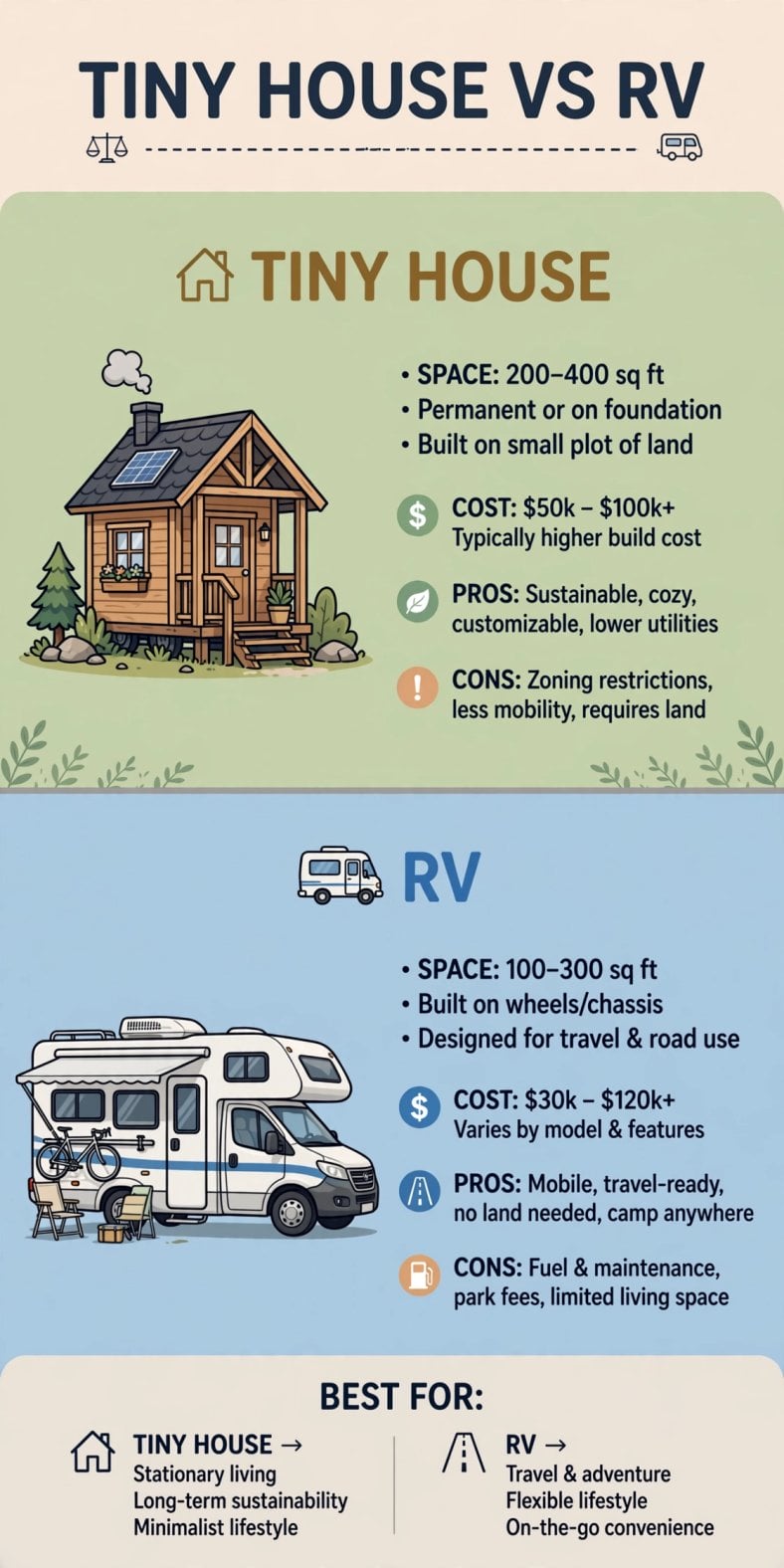
The Short Answer
Choose a tiny house if: You want a real home that happens to be small — residential construction, full-time comfort, long-term living in mostly one place.
Choose an RV if: You want mobility first — frequent travel, changing scenery, the road as your lifestyle, with housing as the enabler.
The core difference: Tiny houses are houses optimized for staying; RVs are vehicles optimized for moving. Everything else follows from that.
Construction: Houses vs. Vehicles
Tiny houses: Residential construction — 2×4 framing, house windows and doors, residential roofing, standard plumbing and electrical. Built like a house, because it is one.
RVs: Vehicle construction — lightweight materials, thin walls, RV-specific components, designed for weight savings over durability. Built like a vehicle, because it is one.
What you feel: Tiny houses feel solid, quiet, and substantial. RVs feel light, creaky, and temporary — fine for travel, wearing for full-time living.
Comfort for Full-Time Living
Space: Tiny houses (200–400 sq ft) offer genuinely livable space — full-size appliances, real stairs, comfortable ceiling heights. RVs (100–300 sq ft) optimize for travel, not dwelling.
Insulation: Tiny houses can be insulated to residential standards (R-13 to R-21+ walls). Most RVs have minimal insulation (R-5 to R-7) — miserable in extreme temperatures without upgrades.
Systems: Tiny houses use residential plumbing, electrical, and HVAC — reliable and serviceable. RVs use proprietary 12V/propane systems — functional but finicky long-term.
Cost Comparison
Purchase: Quality tiny houses: $60,000–$150,000. Quality RVs (motorhomes/fifth wheels): $40,000–$150,000+. Comparable price ranges, different value propositions.
Operating costs: RVs cost more to move (fuel, wear) and maintain as vehicles (engine, chassis, tires). Tiny houses cost more to site (land, foundations, utilities) but less per stationary year.
Depreciation: Both depreciate, but RVs depreciate faster and more predictably — 20–30% in the first few years. Tiny houses (especially foundation) hold value better.
Mobility: The Decisive Factor
RVs: Designed to move — hook up and go in an hour. Built for thousands of travel miles. This is their superpower and their reason for existing.
THOWs: Movable, but moving is a project — $2,000–$8,000 per professional move, route planning, permits for oversize loads. Designed for occasional relocation, not touring.
The test: If you’ll move monthly, get an RV. If you’ll move every few years (or never), get a tiny house. The middle ground is where people make expensive mistakes.
Legal and Parking Realities
RVs: Clear legal category in all 50 states — RV parks, campgrounds, and boondocking frameworks exist everywhere. Parking is a solved problem (with costs).
Tiny houses: Legal gray zones persist — zoning, minimum size requirements, and classification battles vary by jurisdiction. Parking is the harder problem.
The irony: RVs are easier to park legally almost everywhere — the established category wins on practicality, even if tiny houses win on livability.
Longevity and Durability
Tiny houses: 25–50+ years (THOW) or 50–100+ (foundation) with maintenance. Residential construction ages like a house.
RVs: 10–20 years of full-time use typically. Lightweight construction, constant vibration, and weather exposure wear RVs faster. Full-time RV living accelerates aging.
The math: Over 20 years, you might buy two RVs or one tiny house. Factor replacement cycles into the true cost comparison.
Financing and Insurance
RVs: Established RV loan market — easier financing, standardized insurance products, clear titling. The mature ecosystem is a genuine advantage.
Tiny houses: Harder financing (as covered in our lending guides), less standardized insurance, classification-dependent everything. The frontier tax.
Community and Lifestyle
RV community: Massive, established, welcoming — full-time RVers have decades of community infrastructure: rallies, forums, workamping networks, mail services.
Tiny house community: Smaller, newer, passionate — strong online presence, growing village movement, but less road-tested infrastructure for the mobile life.
Daily life: RVers live in motion — new places, constant logistics. Tiny house dwellers live in place — deeper roots, local community, gardening. Different rhythms, different rewards.
Who Should Choose a Tiny House
The settler: You want to live small in a place you love — with a garden, community ties, and a home that feels permanent.
The comfort-seeker: Full-time living comfort matters more than mobility. You want residential systems, real insulation, and solid construction.
The long-term thinker: You’re planning decades, not years. The tiny house’s longevity and value retention reward patience.
Who Should Choose an RV
The traveler: The road is the point — new horizons regularly, minimal attachment to place, adventure as lifestyle.
The flexible: Seasonal work, following weather, visiting family across the country. Mobility isn’t a feature; it’s the requirement.
The tester: Not sure about small living? An RV is a lower-commitment experiment — easier to buy, easier to sell, easier to park while you decide.
The Hybrid: Best of Both
Tiny house + travel trailer: Stationary tiny house as home base, small RV or trailer for travel. The expensive but complete solution.
Park model: The middle ground — RV-classified but residential-feeling, designed for semi-permanent placement. Worth considering for the undecided.
Seasonal switching: Some people RV in winter (following warmth) and tiny-house in summer. Complex but glorious for the right temperament.
Size and Layout Differences
Typical tiny house: 200–400 sq ft, 8.5 ft wide, 13.5 ft tall — residential proportions with lofts, full kitchens, and real bathrooms.
Typical RV: 100–300 sq ft, 8 ft wide, lower ceilings — every inch optimized for travel weight and aerodynamics, with slide-outs adding temporary space.
What it means daily: Tiny houses feel like small homes; RVs feel like efficient vehicles. The psychological difference exceeds the square footage difference.
Utilities: Hookups vs. Systems
RVs: Designed for hookups (30/50 amp, city water, sewer) with self-contained tanks for boondocking. The systems assume you’ll plug in regularly.
Tiny houses: Designed for permanent utility connections or robust off-grid systems — larger solar arrays, bigger water storage, residential electrical panels.
Winter Living: The Real Test
Tiny houses: With residential insulation and heating, winter living is comfortable — comparable to any small home. Skirting and pipe protection handle the rest.
RVs: The hard mode of small living. Thin insulation, single-pane windows, and exposed tanks make sub-freezing living a constant battle — possible, but demanding and expensive to heat.
The verdict: If you’ll winter in cold climates while stationary, the tiny house wins decisively. Full-time winter RVing in the north is for the hardy.
Working: From the Road vs. From Home
RV remote work: Changing locations means changing internet — cellular boosters, Starlink, and campground WiFi roulette. Productive but logistically active.
Tiny house remote work: Stable location means stable internet — fiber, cable, or fixed wireless. Set up once, work reliably. The dedicated office nook is easier to carve out.
The trade: RV workers trade connectivity stability for location freedom; tiny house workers trade freedom for reliability. Know which you need.
Pets in Tiny Houses vs. RVs
Space: Both are tight for large dogs — but tiny houses usually offer more floor space and often a yard. RVs confine pets to the vehicle footprint.
Travel with pets: RVs win — pets travel with you naturally. THOW moves are stressful for animals and infrequent by design.
Daily life: Tiny house pets get routine — same yard, same walks, same neighbors. RV pets get novelty — new smells everywhere, but less stability. Most animals prefer routine.
The Environmental Footprint
Embodied energy: Tiny houses use more material per unit but last longer — the lifetime footprint often favors the longer-lived structure.
Operating footprint: Both sip energy compared to conventional homes. Tiny houses with good insulation and permanent solar edge out RVs with propane dependence.
Travel footprint: Frequent RV travel burns significant fuel — a cross-country RV trip can emit more than a year of stationary tiny house living. Stationary tiny houses are the greenest small-living option.
Switching From One to the Other
RV to tiny house: The common progression — travelers who find their place and want to settle. Sell the RV (expect depreciation), buy or build the tiny house. Many do this in their 40s–60s.
Tiny house to RV: Less common but real — settlers seized by wanderlust. Harder logistically (selling a tiny house takes longer than selling an RV).
The lesson: Neither choice is permanent. Life stages change — the road calls, then home calls. Choose for now, not forever.
Noise and Neighbors
Tiny houses: Residential construction dampens sound — you hear less of neighbors and they hear less of you. On private land, noise is a non-issue.
RVs: Thin walls transmit everything — campground neighbors, highway noise, rain on the roof (deafening in a downpour). Earplugs are standard full-timer equipment.
The difference: Underappreciated until experienced. Sound insulation is one of the largest quality-of-life gaps between the two.
Customization Potential
Tiny houses: Highly customizable — custom builds, DIY modifications, residential materials. Your tiny house can be exactly yours, inside and out.
RVs: Limited by weight, structure, and systems. Cosmetic customization is easy; structural changes are constrained by the vehicle’s engineering.
The implication: If self-expression through your space matters deeply, tiny houses offer a bigger canvas.
The Decision Matrix
Score each 1–5: How much will you move? How important is residential comfort? How long is your timeline? How much does financing ease matter? How cold are your winters?
High mobility + short timeline: RV. Low mobility + long timeline: Tiny house. Mixed answers: Consider the park model middle ground or a phased approach.
The gut check: After scoring, notice which answer you hoped for. The matrix informs; your honest preference decides.
What Owners Say After Five Years
Tiny house owners: The most common reflection is satisfaction with comfort and regret about underestimating land challenges — finding and keeping a good spot dominates the complaints, not the house itself.
RV full-timers: The most common reflection is love for the freedom and fatigue with the logistics — the constant planning of routes, reservations, and maintenance wears over years.
The pattern: Tiny house complaints center on place (land, legality, community); RV complaints center on motion (logistics, wear, instability). Choose which set of problems you’d rather solve — because both lifestyles have them.
Frequently Asked Questions
Is it cheaper to live in a tiny house or an RV?
It depends on mobility. Stationary living: tiny houses usually win (lower operating costs, better longevity). Frequent travel: RVs win (designed for it). Over 10+ stationary years, tiny houses are typically far cheaper all-in.
Can you live full-time in an RV?
Yes — hundreds of thousands do. But RVs are designed for travel, not dwelling: thinner insulation, lighter construction, and faster wear under full-time use. It’s viable but less comfortable than a tiny house for stationary living.
Do tiny houses hold value better than RVs?
Generally yes. RVs depreciate 20–30% in the first years like vehicles. Foundation tiny houses on land can hold or appreciate; THOWs depreciate but typically slower than RVs. Construction quality is the differentiator.
Which is easier to finance — tiny house or RV?
RVs, by a wide margin. The RV loan market is mature and standardized; tiny house financing is a patchwork of RV loans, personal loans, and specialty lenders. If financing ease matters, RVs win.
Can I park a tiny house in an RV park?
Sometimes — many RV parks accept tiny houses on wheels, especially certified ones, but policies vary by park. Call ahead; don’t assume. Some parks restrict by age, appearance, or certification.
Final Considerations
Tiny house vs. RV isn’t a rivalry — it’s a choice between two different answers to the small-living question. The tiny house says: live deliberately in a real home, smaller and better. The RV says: live freely, with the horizon as your backyard. Be honest about which life you’re actually choosing — the settler or the traveler — and the right vehicle (or house) becomes obvious. And remember: the wrong choice isn’t fatal. RVs sell, tiny houses move, and plenty of people try one before finding their way to the other.