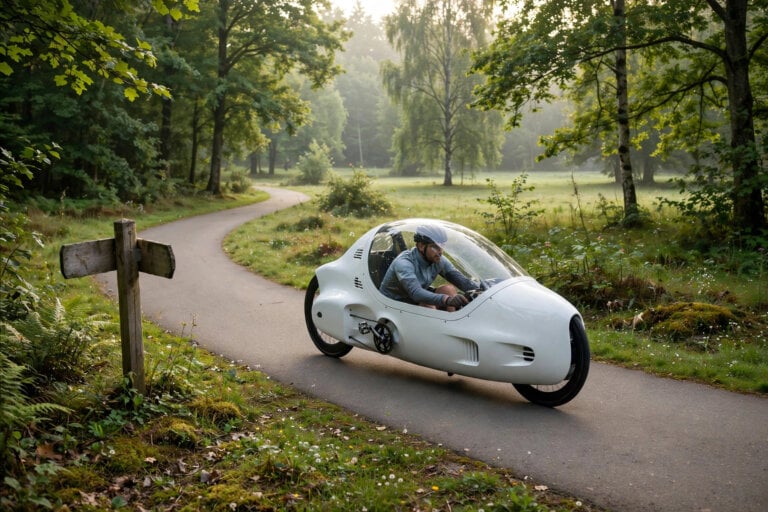
Velomobile regulations, in one line: if it pedals and stays under the e-bike limits — under 750W in the US, 250W and 25 km/h in Europe — it is a bicycle in most of the world, bike paths included; here’s the state-by-state, EU and UK position, the four-wheel question, and the five-minute check that settles it locally.

Browsing: Live
Liberate your living experience – unlock the boundless potential of off-grid living. Break free from the constraints of conventional housing and embrace a life of unparalleled freedom, simplicity, and regeneration. Craft your sanctuary, where the rhythms of nature harmonize with your deepest desires.
How to commute in winter on a velomobile or e-bike: a shell that’s 40°F inside at 20°F out, carbide studs at $60–120 a tire, fat tires at 10–15 PSI, and a battery planned at 60% of summer range.
The Environmental Impact of Velomobiles: a velomobile uses 8–15 Wh per mile against an electric car’s 250–350, carries a 0.5–1.5 kWh battery instead of 60–100 kWh, and emits roughly 3–10 g of lifecycle CO₂ per mile — here’s the honest comparison, limits included.
Carve your first spoon and bowl from fresh logs with a kit under $100: a $25–40 sloyd knife, a $30–50 hook knife, an axe, strop and glove. Birch, maple, cherry and alder, a 1×2×10″ spoon blank, 3/8–1/2″ bowl walls, and a slow 1–2 week paper-bag dry.
Eco-friendly weed control for rock gardens, built as a system: a geotextile barrier under 3–4 inches of gravel does 90% of the work, a 10-minute weekly pull handles the rest, and flame, smothering, living mulch and corn gluten keep the whole rockscape clean in 15–20 hours a year.
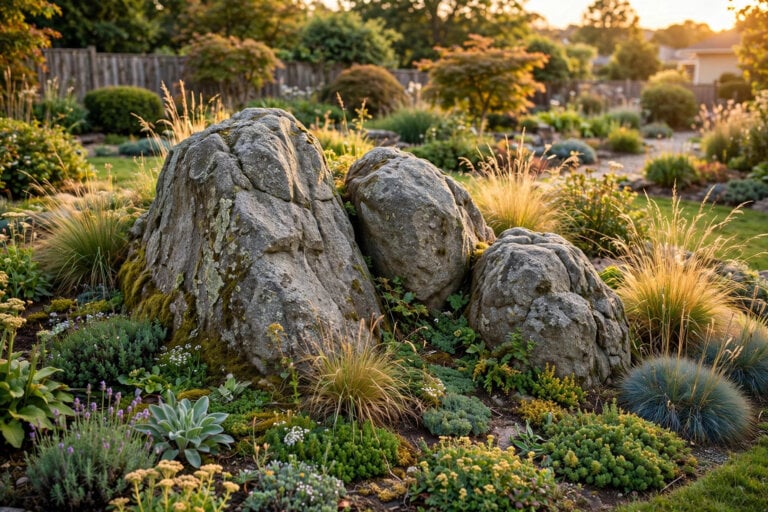
Laying out big landscape rocks the geological way: bury one-third of every boulder, group in odd numbers of 3, 5 and 7 with a 3-ft hero and 18-inch companions, space clusters touching to 2 ft apart, move 800-lb stones by excavator, and set each one 6 inches deep in its pocket.
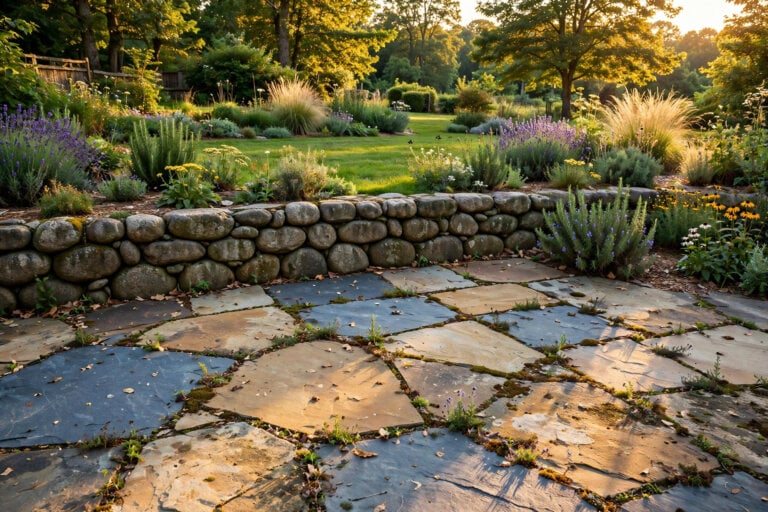
Flagstone vs fieldstone, decided by shape and origin: quarried flagstone plates 1–3″ thick pave patios and paths at $200–500 a ton, while rounded fieldstone at $100–300 a ton stacks into walls — plus the mixed projects, buying rules and the project-by-project picker.
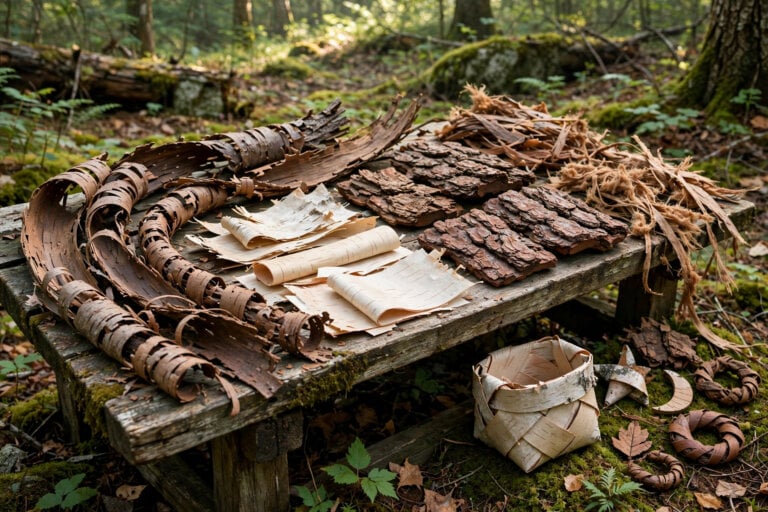
Tree bark crafts turn the forest floor into a craft store: shagbark slabs, birch sheets pressed flat for 2–4 weeks, heat-treated at 200°F for 2 hours, folded into 2-hour baskets, mosaics, cordage and garden pieces — gathered from fallen bark only, never stripped from a living tree.
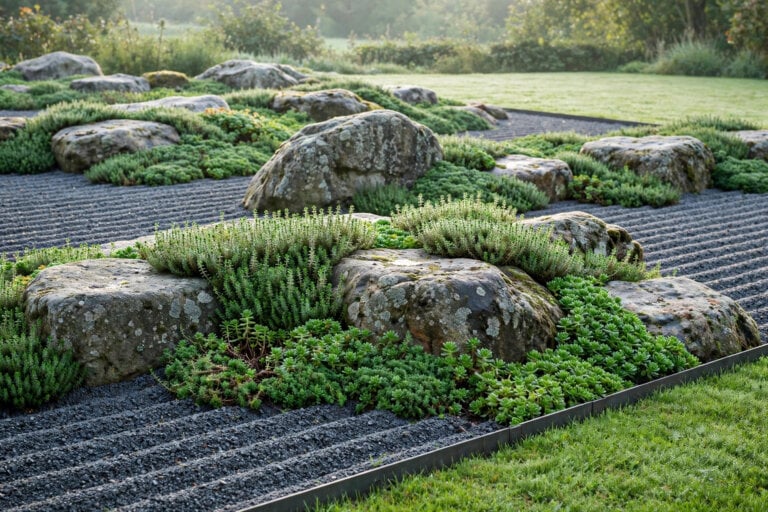
Rock and succulent garden design built on contrast, negative space and repetition: 1–3 hero boulders buried one-third deep, a 3–4″ decomposed granite floor, a 70/30 succulent-to-soft planting mix, a 12–18″ raised mound for cold climates, and the 15×15 ft courtyard composition.
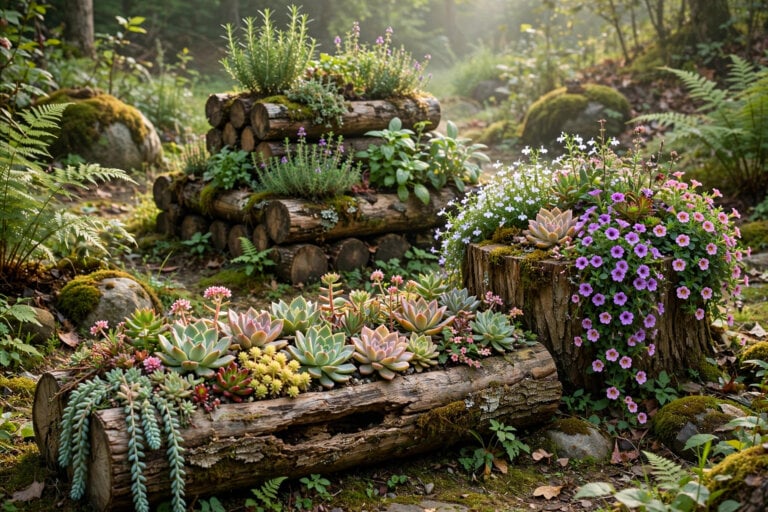
Creative log planters in four forms — hollowed logs 12–20″ wide, stump bowls 8–12″ deep, shallow log slices and tiered log towers — with drainage, plant palettes, honest 3–8-year lifespans and the nurse-log succession that keeps the cycle going.
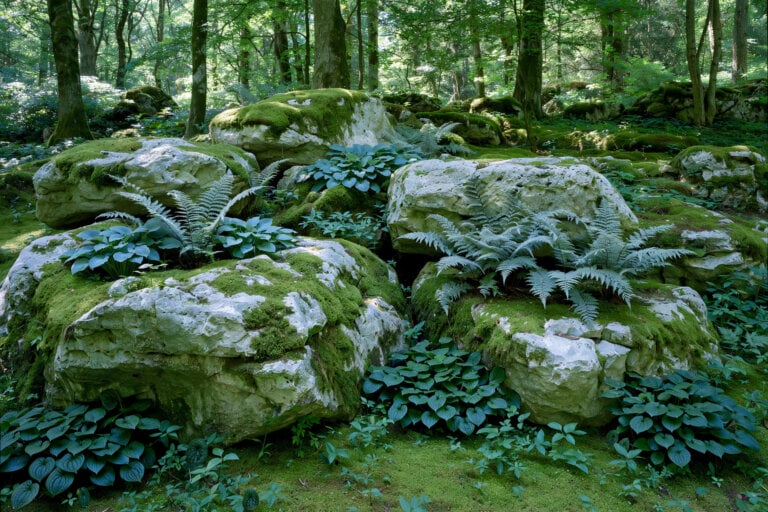
Rock gardens for shade, designed from the light map up: four shade types from deep shade under 2 hours of sun to the woodland’s 3–5, pale limestone that brightens, ferns in the stone pockets, a moss carpet at pH 5–5.5, white moonlight flowers, and a Japanese maple ceiling.
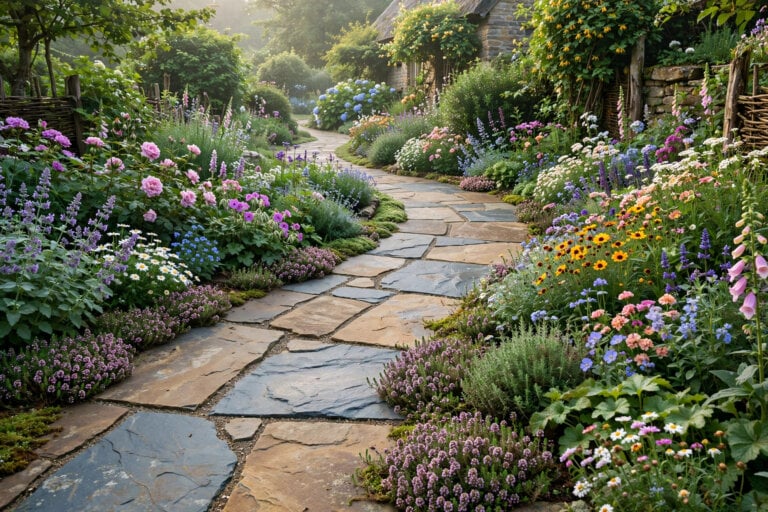
Dry-stack stone path building, step by step: choose 2-inch flagstone 18–36 inches across, excavate 6–8 inches for a compacted crushed-stone base, bed each stone level in sand, fill 1/2–1.5-inch joints, edge it structurally — and repair any stone in five minutes, forever.
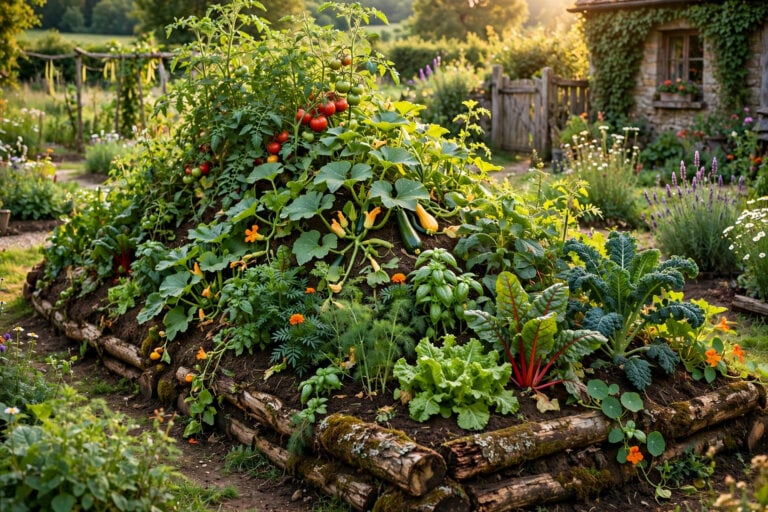
Bury hardwood logs under a 4×8×3 ft mound and the bed waters and feeds itself: rotting wood holds water for weeks, watering drops 50–75% after year two, fertility peaks in years 3–8 — plant beans in year one, everything after, and rebuild in 10–15 years.
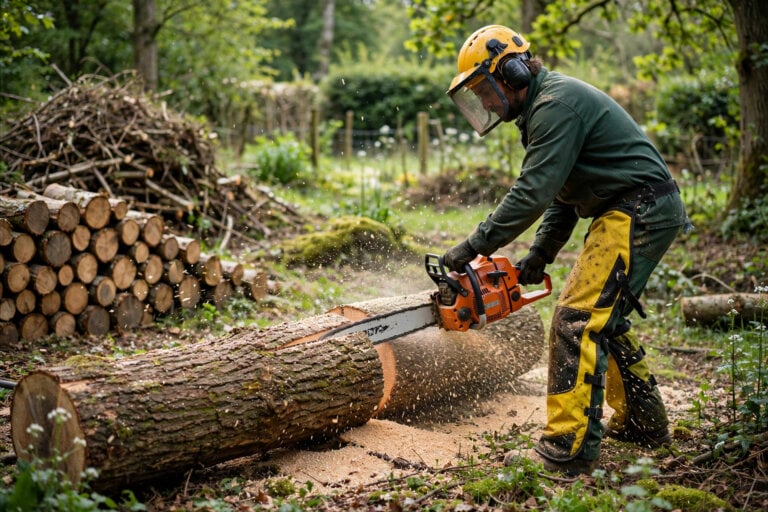
Best chainsaws for landscaping, matched to the wood: battery for 80% of work (40–60V, 16″ bar, $250–400), gas for felling (45–55cc, 18″ bar, $400–550), the 2″ bar rule, chaps first at $80–120, and a chain filed every tank, plus the kickback discipline and the $300 arborist rule for scary trees.
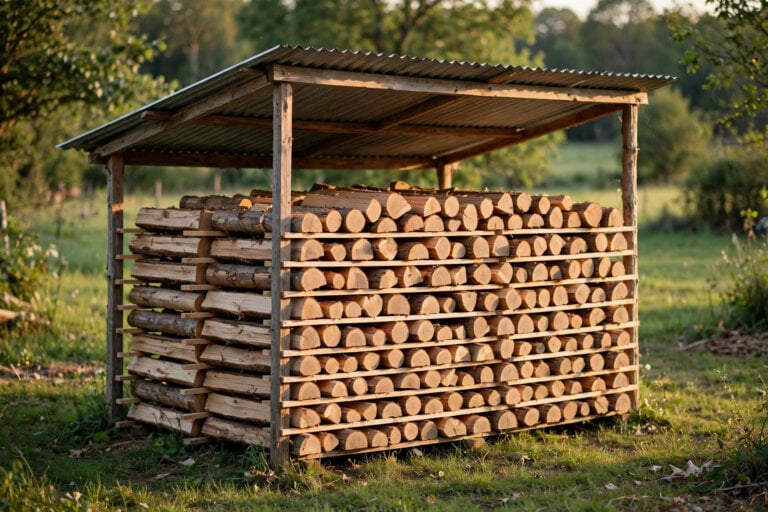
How to cure and dry wood logs without cracks, rot or insects: seal the ends within hours (end grain dries 10× faster), debark fresh, stack stickered 6″+ off the ground under a roof, spray borate, and wait one year per inch — a $30 pin meter under 20% says when they’re ready.
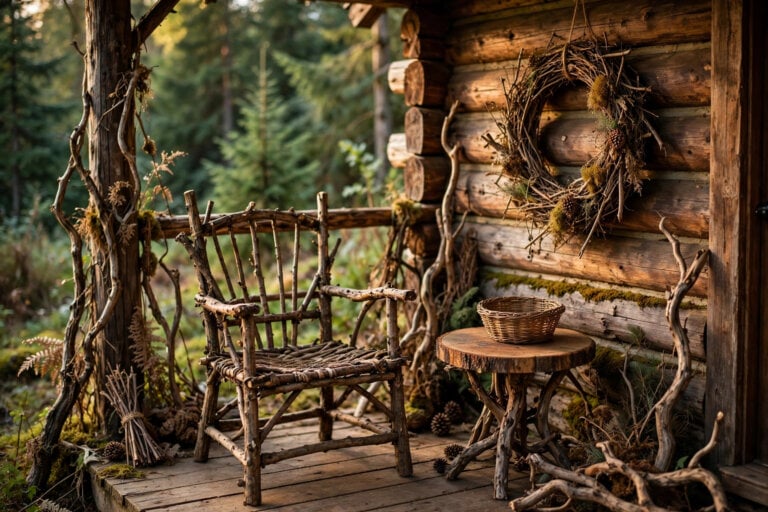
Fallen limb crafts turn storm-fall and prunings into furniture, garden structures and woven decor for zero dollars: dry branches 3–6 months stickered, join with mortises or 2.5-inch screws, weave 6–8 ft willow whips, and finish outdoor pieces in spar varnish or oil.
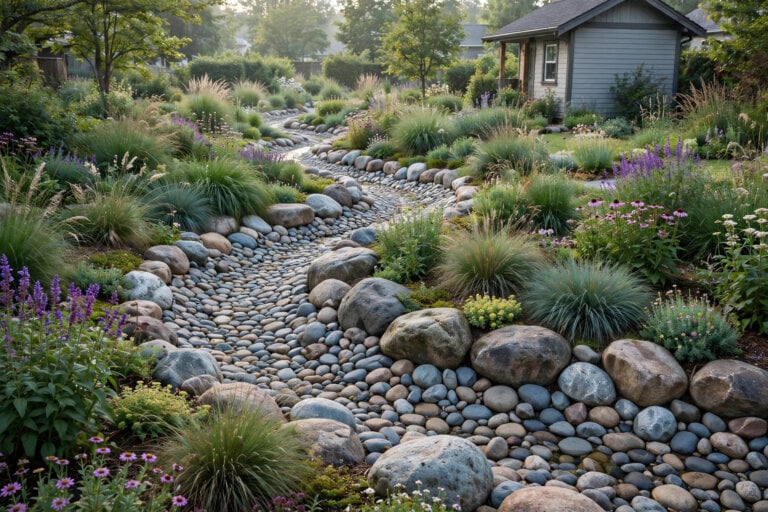
Build a river rock dry creek bed that works as drainage and reads as nature: a 2–3 ft channel, 8–12 in deep on a 1–2% fall, sized for 600 gallons per 1,000 sq ft of roof per inch of rain, lined with woven geotextile, cobbled, riffled every 6–8 ft and planted with sedges.
Small backyard rockscaping that feels bigger: one bold boulder, diagonal lines, gravel rooms and dense planting in three layers under a single tree.
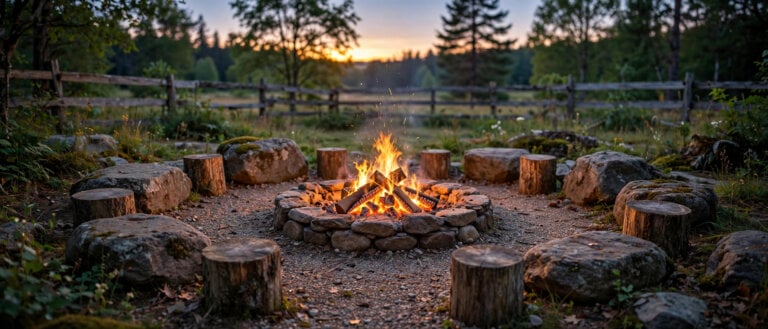
Fire pit seating with boulders and stump logs: a 3–4 ft social fire sited 10+ ft from structures, 5–8 flat-topped boulders at 18–24″ buried one-third deep, stump stools at 16–18″ on gravel pads, benches 4–6 ft out on the windward side — all on a 10–12 ft gravel circle.
Protecting outdoor log crafts, by the numbers: an unfinished piece lasts 2–5 years outdoors against 15–25 finished, end grain drinks 10× the moisture, semi-transparent stain runs 2–3 years between coats — and upkeep costs about 10% of a full refinish.
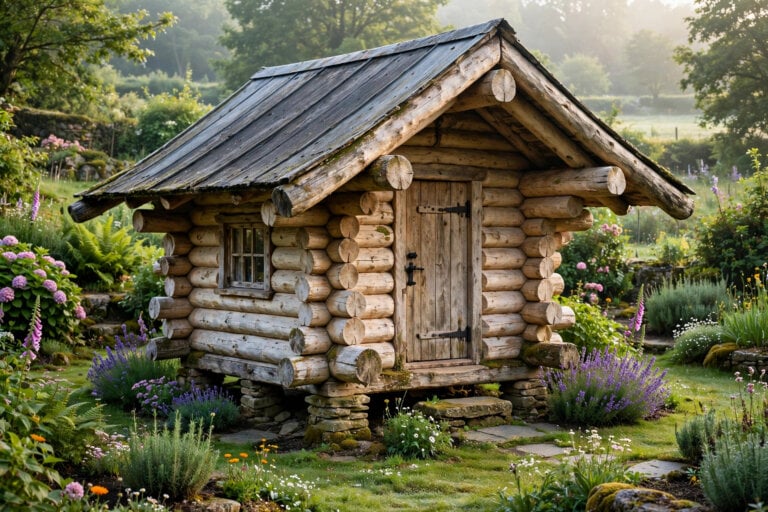
DIY log cabins start with a shed: an 8×10 to 10×12 ft round-log structure on piers level within 1/4″, saddle-notched 6–10″ logs, an 8/12 roof with 18–24″ overhangs, and chinking after the first heating season — every cabin skill at garden scale.
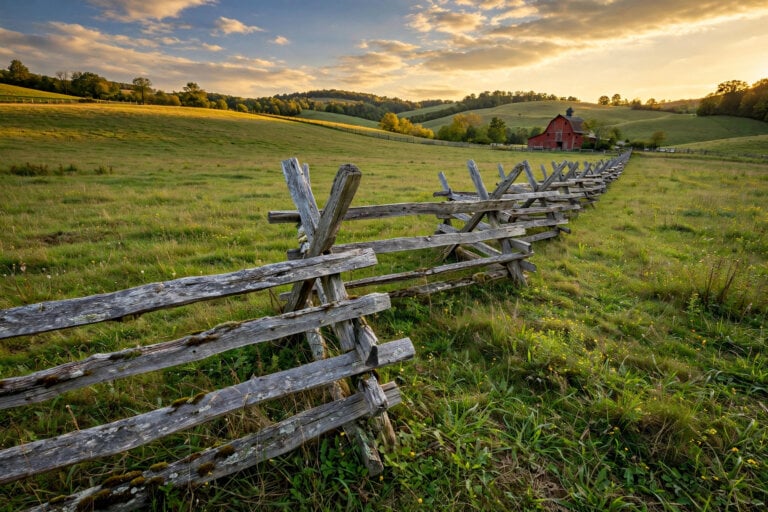
Rustic log fencing, built the traditional way: rive 4–8 rails per green log, set rot-resistant posts 2.5–3 ft deep in gravel — never concrete — at 8–10 ft spacing, hang rails 3–4 ft high, and let black locust stand its 25 years while the fence silvers.
Native plants for rock gardens, layered properly: groundcovers at 6–8-inch spacing, perennials and grasses in drifts of 5–9, little bluestem roots 6 feet deep, gravel mulch 2–3 inches over lean soil — watered deep for one year, then rainfall only.
How to source free landscaping rocks from the waste streams: construction sites where contractors pay dump fees to remove excavated stone, quarry waste piles at $20–40 a ton, farm field-edge piles and riverbeds where collection is legal — plus the 150–170 lb-per-cubic-foot transport math and the four-pile sort that turns a haul into a stone yard.
Rock garden waterfall, built like real water: a 1,500–3,000 GPH pump at your head height, 45-mil EPDM liner and weir stones foamed so water sheets.
Permeable rock pavers for driveways and patios: PICP, open-grid, stone and stabilized gravel over an 8–12″ open-graded reservoir base — 70–100% of rain infiltrates on-site, at $8–20/sq ft installed, with a 25+ year lifespan and one annual joint vacuuming.
How to build a gravel path with rock borders that stays put: route it on the desire line, excavate 4–6 inches, compact 2–3 inches of road base over woven geotextile, set the borders first, then spread 2 inches of pea gravel — the weekend build whose upkeep is a 30-minute year.
DIY log slicing for crack-free wood cookies: pick a fresh 4–12-inch hardwood log, cut 1–2-inch slices square, seal both faces within hours, dry stickered for 2–6 months, relief-cut cookies over 8 inches — then sand 60 to 220 grit and finish both faces.
Fallen log landscaping in full: nurse logs that sprout seedlings, snags for woodpeckers, hugelkultur beds — and the wild 20% every garden needs.
Japanese zen rock garden in full: triad stone groups buried one-third deep, angular gravel raked in lines and waves — stillness you re-make weekly.