

Choosing a place to live is the biggest decision behind any tiny house move — bigger than the floor plan, bigger than the build. Get the location right and daily life falls into place; get it wrong and even a beautiful home feels like a compromise you live with daily. Below are the ten factors that decide a location, in order — then the quiz turns your answers into one clear top match.
The Location Decision: At a Glance
The quiz below asks ten questions about your lifestyle, budget, politics, and terrain preferences, and matches you with the best tiny house friendly regions in the USA. Every question maps back to one of the ten factors in this guide: cost of living, job opportunities, climate, community, health care, education, safety, culture, transportation, and the real estate market. Read the factors first and each answer gets sharper — honest answers about money, weather, and people are what make a top match worth trusting. Answer on instinct alone and the result is a guess; answer with these factors in mind and it becomes a plan.
| Topic | What It Covers | Key Fact or Figure |
|---|---|---|
| 1. Cost of Living | Housing, food, transportation and utilities | Thrifty, balanced or premium |
| 2. Job Opportunities | The job market, income and room to grow | Fast, reliable internet is an answer |
| 3. Climate | The weather you will live in daily | Four weather answers to choose from |
| 4. Community and Social Life | Neighbors, values and belonging | Three social atmospheres |
| 5. Access to Health Care | Facilities, specialized care and services | Well-being is a deciding factor |
| 6. Education Systems | Public schools to private institutions | For families and lifelong learners |
| 7. Safety | Crime rates and community strength | A secure environment matters |
| 8. Cultural Offerings | Arts, entertainment and weekends | Three weekend styles |
| 9. Transportation | Airports, driving, walking and biking | Within 1 hour of a major airport |
| 10. Real Estate Market | Property values, rentals and placement | Zoning verified before land |
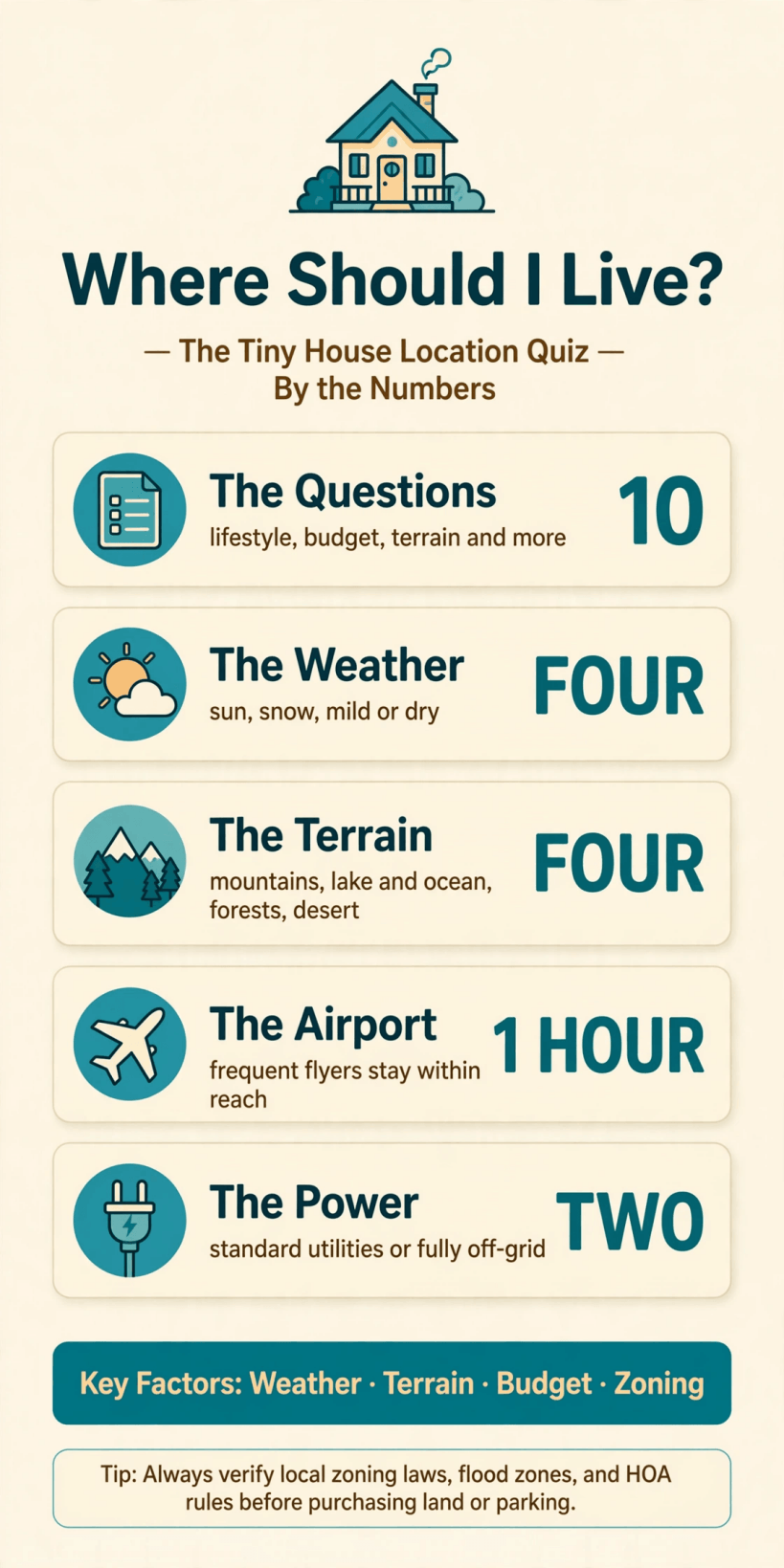
Ten questions, four weather answers, four terrains, two ways to power a home — and ten factors that turn a quiz result into a real place on the map.
1. Cost of Living: Balancing Your Budget
Money decides more of this choice than romance admits. The cost of living weighs housing costs against food prices, transportation, and utilities — the expenses that add up quietly, month after month. A region can look perfect on a map and still drain a budget within a year, while a plainer place leaves money over for the life you actually want to live. The honest question is the one the quiz puts plainly: will you prioritize affordability, or pay a premium for a desirable location? Neither answer is wrong — but they lead to very different maps.
That is why the budget question offers three postures. Thrifty makes cheap land the first priority, and suits buyers whose freedom comes from low overheads. Balanced trades some cost for amenities — the village, the services, the shorter drives. Premium accepts high cost in exchange for high culture and convenience. For tiny house living the same logic governs our guide to super-affordable tiny homes: the cheaper the ground and the monthly burn, the longer the lifestyle sustains itself. Decide your posture before you fall for a landscape.
2. Job Opportunities: Working Where You Live
A fulfilling career is a key part of a happy life, and a location has to hold yours. Weigh the job market, the industry trends, and the opportunities for growth before you weigh anything scenic. Some regions concentrate employers; others reward the self-directed. Whether you are a remote worker, a freelancer, or an entrepreneur, the right map is the one where your income survives the move — ideally, where it grows.
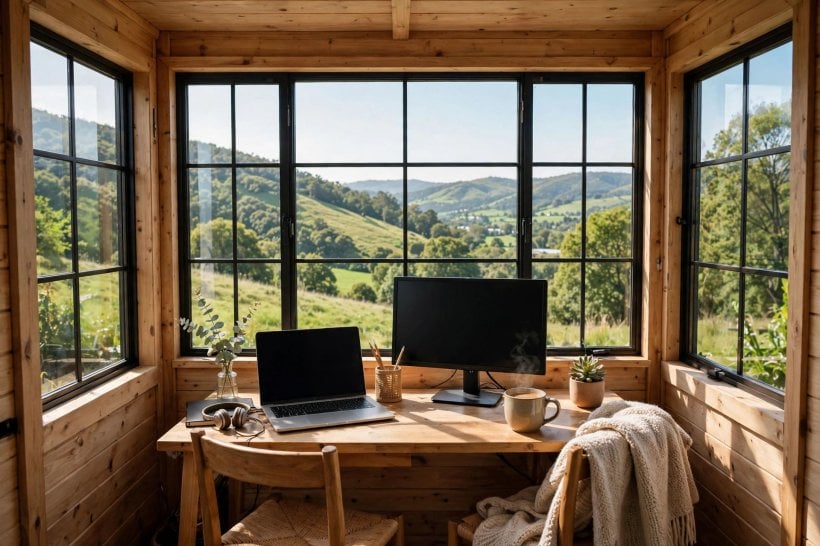
For remote workers the deciding utility is the connection. The connectivity question splits two ways: the digital nomad who needs fast, reliable fiber or cable internet for Zoom calls, and the flexible worker who can run happily on satellite or cellular data. That single answer redraws the map — true off-grid country opens up only when your work can travel by satellite, while fiber-dependent work keeps you nearer towns and their infrastructure. Be honest about your connection; a dream location with failing internet is a resignation letter written slowly.
3. Climate: Finding Your Ideal Weather
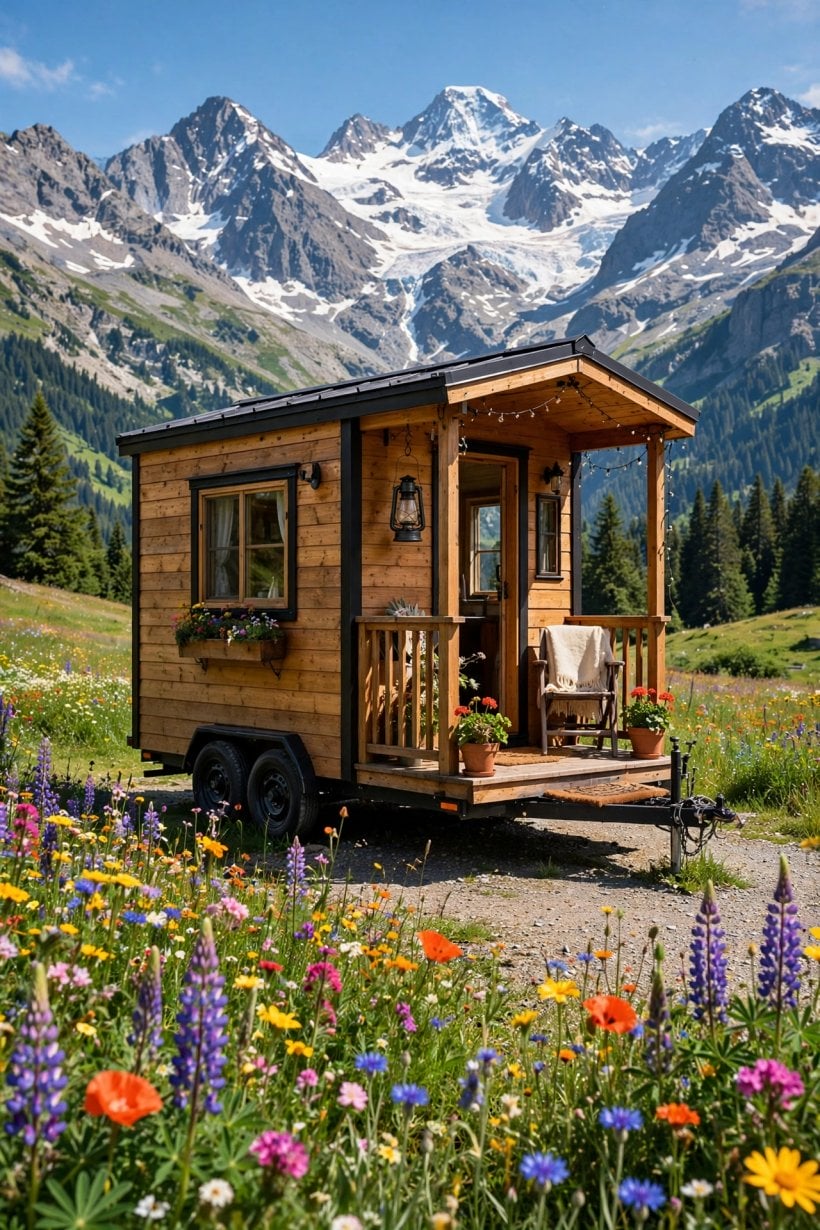
Climate shapes quality of life more quietly and more completely than any other factor. The weather question offers four honest answers. The sun chaser hates snow and wants beaches or deserts. The snow lover wants seasons, mountains, and cozy fires. The mild and temperate answer is the Goldilocks zone — not too hot, not too cold. And the dry and arid answer puts low humidity first and rain last. Layer the terrain question over it — mountains, lake and ocean, forests, or desert — and a shortlist of regions starts to draw itself.
Climate is also a safety question. When Hurricane Milton made landfall in Florida, the storm left 3 million people without power — a reminder that severe weather is a location factor, not a footnote. Research the historical frequency and severity of storms in any area you shortlist, weigh how well local infrastructure holds up, and favor long-term stability over a tempting shoreline. If weather is your deciding factor above all others, go deeper with the weather-first climate quiz, which scores regions on climate alone.
4. Community and Social Life: Building Connections
Surrounding yourself with like-minded people changes everything about how a place feels by the second month. The vibe question sketches three ways to live among others. Off-grid means deep nature and privacy. Village means shared amenities and a social life built in. Urban ADU means a backyard near jobs — tiny living woven into the fabric of a city. Each suits a different temperament, and none of them is a compromise version of the others.
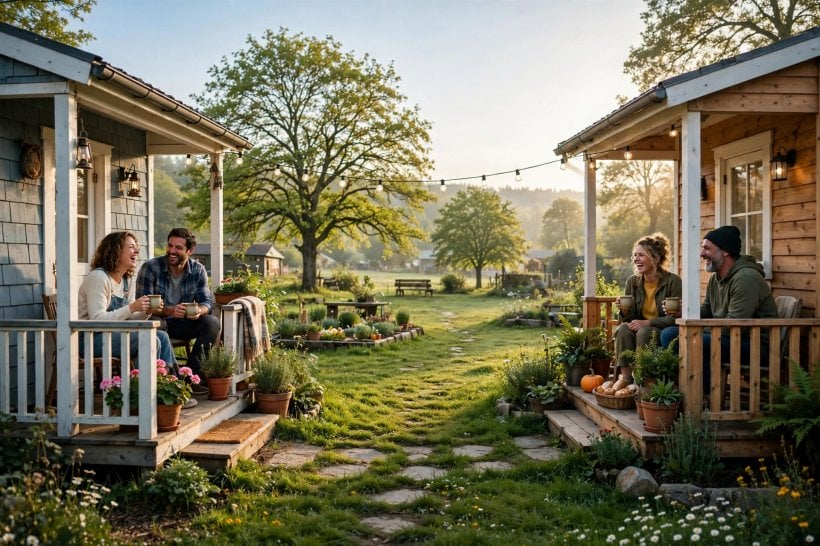
The social atmosphere question refines it further: progressive places with green energy and active social programs; traditional places with traditional values and less regulation; or independent country — live and let live, privacy first. Whether you want a vibrant social scene, a tight-knit community, or a peaceful atmosphere, the values of the neighbors become the texture of your days. See how that looks in practice in our guide to tiny house communities in Alabama, where the village model is already a lived reality.
5. Access to Health Care: Prioritizing Well-Being
Access to quality health care is easy to overlook at thirty and impossible to overlook later — plan for the life you will actually live in the place, not just the move itself. Consider the availability of medical facilities, specialized care, and everyday health services wherever you land. A region can be beautiful, affordable, and perfectly zoned, and still be the wrong choice if the nearest hospital is a hard drive away when it matters.
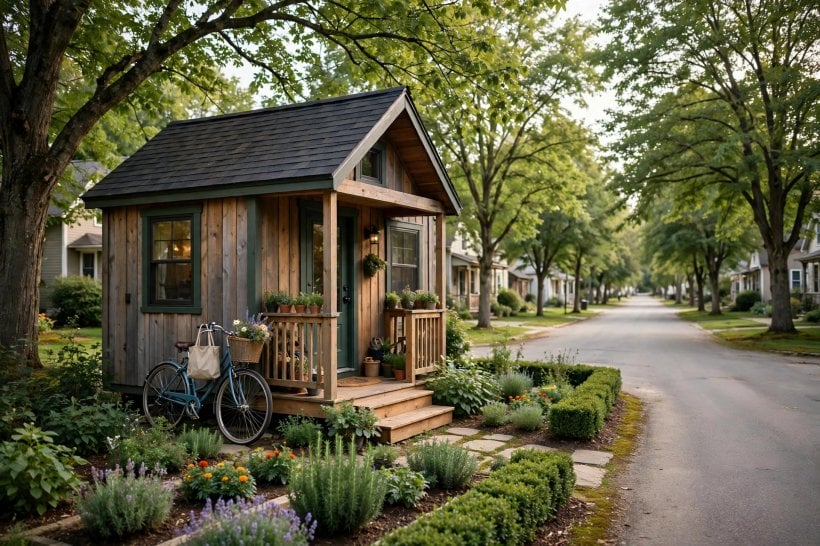
This factor trades directly against the privacy answers elsewhere in the quiz. Deep nature and under-the-radar living usually mean longer distances to clinics and specialists; village and urban placements keep care close. There is no universally right balance — only the balance that fits your health, your family, and your stage of life. Locations that prioritize health and wellness tend to show it in the small infrastructure too: pharmacies, dentists, urgent care, and the everyday services that turn an emergency from a crisis into an errand. Mark it honestly, and let the match respect it.
6. Education Systems: Schools and Learning Opportunities
If you are planning a family, or continuing your own education, the quality of local schools and institutions belongs on the checklist beside land prices. From public schools to private institutions, regions differ enormously in what they offer a child — and in what they offer an adult learner, from community colleges to the workshops and libraries that anchor the intellectual life of a small town.
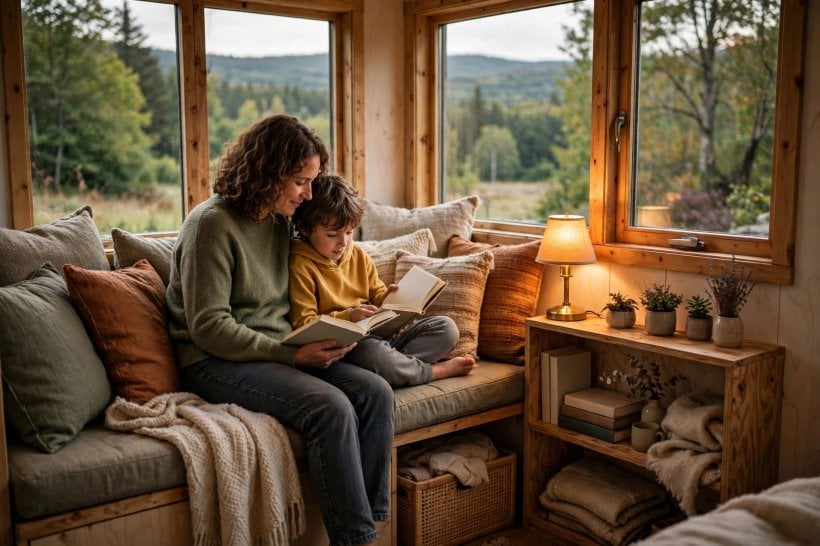
Education also compounds quietly. Strong schools hold property values, attract families, and thicken the community fabric that several other factors depend on. Even buyers without children feel the effect in resale value and in the energy of the place. And for the self-directed, a region rich in makers, courses, and libraries can be its own curriculum. The quiz cannot ask about your household’s future directly, which is exactly why this factor is yours to weight before you answer. Weigh the classrooms a place offers with the same seriousness as its climate — you will live with both for years.
7. Safety: Ensuring a Secure Environment
Feeling safe in your own home is fundamental — no view compensates for sleeping badly. Look for locations with low crime rates, effective law enforcement, and the kind of strong community where unfamiliar cars get noticed and neighbors know each other’s names. Safety is partly statistics and partly texture: lit streets, cared-for properties, and people who look out for one another.
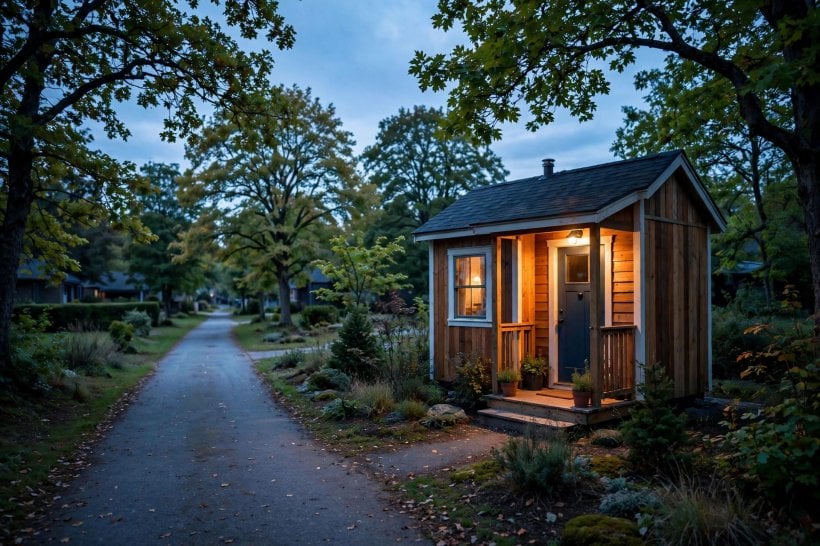
Safety also includes the preparedness woven through the climate factor: a community’s response to storms, outages, and emergencies is part of its safety profile, and regions with lower exposure to severe weather offer a quieter kind of security year after year. Read local forums and recent posts from residents, too — the gap between a region’s brochure and its reality usually shows up there first. When you compare two candidate regions, compare their worst weeks, not their best days: the place that handles trouble well is the place that lets you relax the rest of the time.
8. Cultural Offerings: Arts, Entertainment and Lifestyle
What will your weekends actually look like? The weekend question divides three ways. Adventure sports — climbing, skiing, mountain biking — belong to mountains, snow country, and wild water. Culture and chill — breweries, art galleries, live music — belong to towns with a creative pulse. Farming and DIY — gardening, building, self-sufficiency — belong to land-rich country where the project is the entertainment.
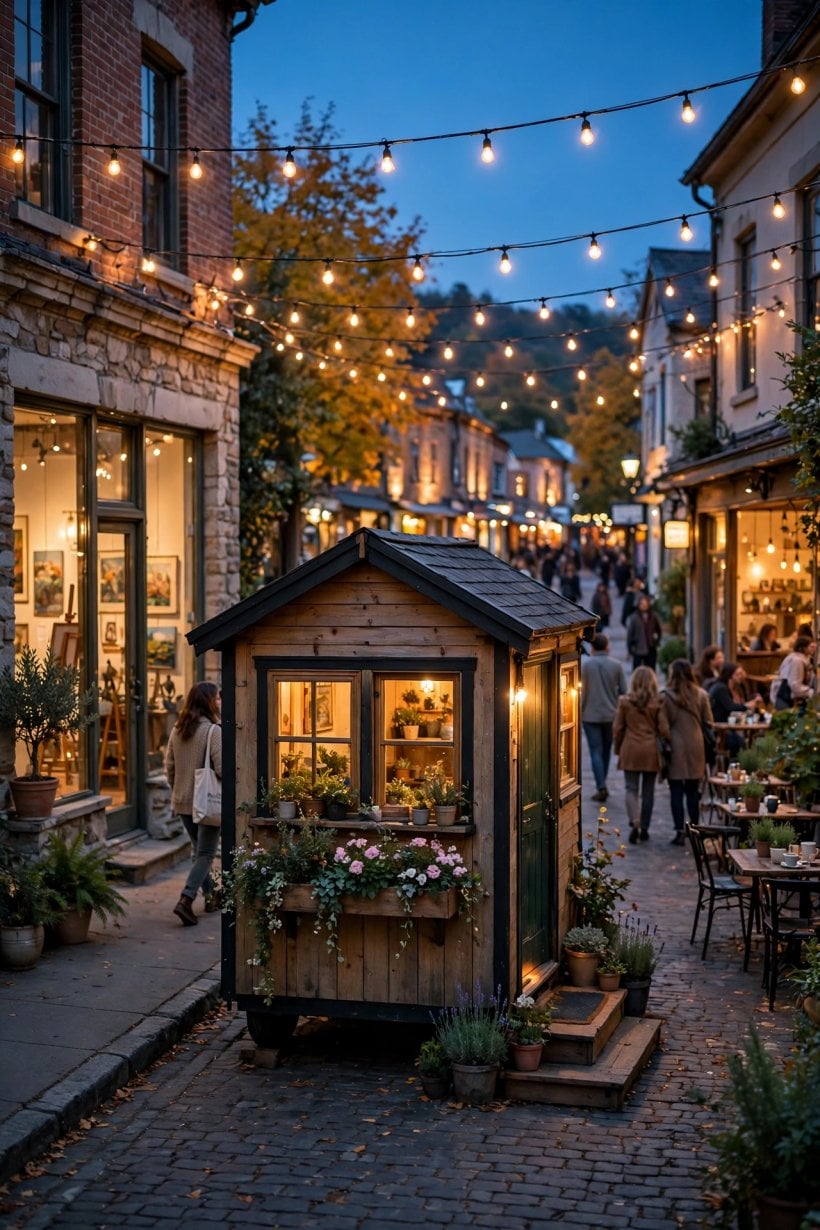
Beyond the weekends, weigh the standing cultural offer: museums, music venues, food scenes, festivals — or the deliberate absence of all of it, which for some people is the entire point. Do you crave the excitement of city life, the tranquility of nature, or something staged between the two? Culture is not a luxury factor; it is the content of your ordinary Saturdays, and it deserves a question of its own. Match it honestly and the region that wins will already feel familiar when you arrive.
9. Transportation: Getting Around with Ease
How you move through a place shapes every day in it. Whether you rely on public transportation, drive, or prefer to walk or bike, a location’s transport reality decides errands, commutes, and spontaneity alike. The travel question in the quiz draws the sharpest line: the frequent flyer who must be within 1 hour of a major airport, and the stay-put answer — rarely travels, isolation is fine. Between those poles sits everyone else, trading access against quiet.
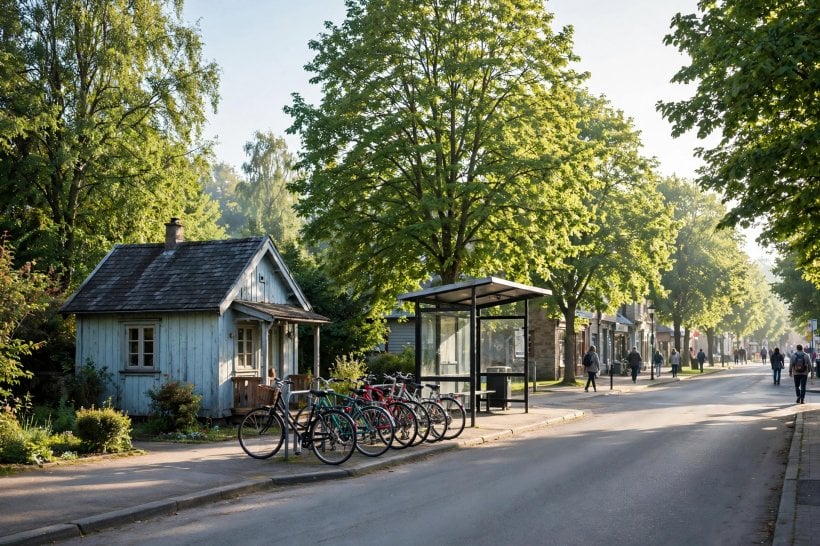
For tiny house living there is a second transport question hiding inside the first: how the house itself arrives. A region can welcome you and still be hard to deliver to — mountain roads, ferry crossings, and rural lanes all belong in the calculation. And once parked, distance becomes a lifestyle: the weekly shop, the visiting friends, the airport run at dawn. Count the miles you will actually drive, not the ones on the brochure map. The right answer is the one that makes your real week easier.
10. Real Estate: Placing Your Tiny House
The final factor is where the house itself may legally and practically sit. The real estate market decides property values and rental options, but for a tiny house two quiz answers matter even more. Zoning tolerance: the buyer who needs areas with specific tiny house ordinances and 100% legal, code-compliant placement, versus the buyer comfortable in rural areas where the rules are loosely enforced. And power preference: on-grid standard utilities and sewer, or off-grid solar power, a composting toilet, and rain water. Together they define where your home can exist at all. Budget and investment goals belong here too — the ground you buy is the one appreciating asset in the whole tiny house equation.
Start that homework with our guide to every tiny house placement option, which walks through the legal homes a tiny house can have — backyard, village, rural land, and beyond. Then treat the result of any quiz the way its own note insists: as a starting point, and always verify local zoning laws, flood zones, and HOA rules before purchasing land or parking. A match is a direction, not a deed.
The Where Should I Live Quiz: Ten Questions, One Top Match
Ready when you are: the quiz is waiting just below. Answer its ten questions on instinct sharpened by the factors above — your ideal weather, your vibe, your zoning tolerance, your budget, your connectivity, your terrain, your weekends, your social atmosphere, your travel needs, and your power preference — and it will return your top match with its climate and legality readouts. Retake it as your priorities shift; the map changes as you do. Then keep narrowing: our companion quiz asks what state should I live in when you are ready to pick a state, and the readiness check asks could you live in a tiny house? before you commit to the lifestyle at all. Your place is on the map — start with the ten questions.
“Where should I live?” is the first question to ask yourself when considering building a home. Assess your lifestyle preferences, such as desired climate, access to outdoor activities, cultural amenities, and the availability of job opportunities in areas.
Are you ready to take the leap into Living but unsure where to start? One of the most critical decisions you’ll make is where to settle down. From community to cost of living, the location of your home can make or break your Living experience.
Find Your Dream Location
Our Where Should I Live Questionaire is designed to help you discover the perfect location for your lifestyle. By answering a series of questions, you’ll get a personalized recommendation for the ideal location that fits your needs, lifestyle, and preferences.
Get Ready to
Explore the best cities and towns in the US Discover the most affordable and sustainable locations for Living Learn about the community and regulations that affect your lifestyle Find communities that align with your values and lifestyle Uncover the hidden gems and secret spots for those who value Living
Take the First Step
Where Should You Live?
Find your perfect Tiny House habitat in 10 questions.
Discover Your Dream Location
Answer 10 questions about your lifestyle, budget, politics, and terrain preferences. We’ll match you with the best Tiny House friendly regions in the USA.
1. What is your ideal weather?
2. What’s your vibe?
3. Zoning Tolerance
4. Budget Preference
5. Connectivity Needs
6. Preferred Terrain
7. Weekend Activity
8. Social Atmosphere
9. Travel Needs
10. Power Preference
—
—
This quiz is a starting point. Always verify local zoning laws, flood zones, and HOA rules before purchasing land or parking.
Factors to Consider When Choosing Your Ideal Location

Let’s talk about choosing your perfect habitat. From the cost of living to community culture, each element shapes your daily life. Consider these ten factors to find a place that fits like a glove.
Cost of Living: Balancing Your Budget
When considering where to live, the cost of living is a crucial factor to weigh. From housing costs to food prices, transportation, and utilities, the expenses can add up quickly. Will you prioritize affordability or be willing to pay a premium for a desirable location? Our quiz will help you determine the best balance for your budget and lifestyle.
Take: Quiz: Could you live in a tiny house?
Job Opportunities: Working Where You Live
A fulfilling career is a key aspect of living a happy and fulfilling life. When choosing a location, you’ll want to consider the job market, industry trends, and opportunities for growth. Whether you’re a remote worker, freelancer, or entrepreneur, our quiz will help you find a location that aligns with your professional goals.
Climate: Finding Your Ideal Weather
The climate of a location can greatly impact your quality of life. Do you prefer the warmth of sunny weather or the coziness of a snowy winter? Perhaps you’re sensitive to humidity or extreme temperatures. Our questionaire will help you identify the perfect climate for your comfort and lifestyle.
Community and Social Life: Building Connections
Surrounding yourself with like-minded individuals and a supportive community can make all the difference in your living experience. Whether you’re looking for a vibrant social scene, a tight-knit community, or a peaceful atmosphere, our quiz will help you find a location that fits your social needs.
Access to Health Care: Prioritizing Well-being
Access to quality healthcare is essential for your well-being. When choosing a location, you’ll want to consider the availability of medical facilities, specialized care, and health services. Our quiz will help you identify locations that prioritize health and wellness.
Education Systems: Schools and Learning Opportunities
If you’re planning to start a family or continue your education, the quality of local schools and educational institutions is crucial. From public schools to private institutions, our quiz will help you find a location that offers the best educational opportunities for your needs.
Safety: Ensuring a Secure Environment
Feeling safe and secure in your community is a fundamental aspect of living a happy and fulfilling life. Our quiz will help you identify locations with low crime rates, effective law enforcement, and a strong sense of community.
Read: Portable Capsule Homes Break Living Space Norms
Cultural Offerings: Arts, Entertainment, and Lifestyle
Do you crave the excitement of city life, the tranquility of nature, or the richness of cultural attractions? Our quiz will help you find a location that satisfies your cultural and entertainment needs, from museums to music venues, and beyond.
Transportation: Getting Around with Ease
Getting around your new location can be a significant factor in your daily life. Whether you rely on public transportation, drive, or prefer to walk or bike, our quiz will help you identify locations with convenient and accessible transportation options.
Read: Snooze in Snow: Your Ultimate Ice Hotel Guide
Real Estate Market: Investing in Your Home
When choosing a location, the real estate market can be a significant consideration. From property values to rental options, our quiz will help you find a location that aligns with your budget and investment goals.

Finding Your Ideal Location: A Journey to Happiness
Choosing the right location for your living experience is a crucial decision that can impact your happiness, well-being, and overall quality of life. By considering the factors that matter most to you, from cost of living to cultural offerings, you’ll be better equipped to find a place that aligns with your values, lifestyle, and goals.
With our “Where Should I Live Quiz,” you’ll be guided through a journey of self-discovery, exploring your priorities and preferences to uncover the perfect location for you. Whether you’re a city dweller, a nature lover, or something in between, we’ll help you find a place that feels like home.
Take the first step towards creating the life you’ve always wanted. Take the “Where Should I Live Quiz” today and start living your best life!
Choosing the Perfect Place to Live: A Comprehensive Guide
Deciding where to live is a significant life choice that involves evaluating various factors to find your ideal location. Utilizing a “Where Should I Live? Quiz” can help align your preferences with the best American cities or even New Zealand destinations.
Key Considerations:
Lifestyle & Culture: Cities like San Diego and San Francisco offer vibrant cultures, diverse cuisines, and numerous museums. If you prefer a small town or metro area, options like New Haven or parts of North Carolina provide a mix of different cultures and a wide range of activities.
Climate & Geography: For those who enjoy mild winters and beaches, San Diego is ideal. North Carolina offers a mix of green spaces and outdoor activities, while New Zealand boasts stunning nature and varied climates.
Job Opportunities & Economy: Assessing job opportunities and median household income is crucial. Metropolitan areas like San Francisco generally offer more job prospects but may come with higher rent and affordable housing challenges. Smaller towns might provide a more affordable living with a lower cost of living.
Housing & Cost of Living: Consider affordable housing options based on the Census Bureau data. Smaller towns often have lower rent prices, whereas metropolitan areas might require a higher budget but offer more amenities.
Community & Residents: Understanding the residents and the different cultures within a city can enhance your living experience. Engaging in community activities and exploring recent posts on local forums can provide insights.
Protecting Personal Information:
When using online tools like quizzes, be cautious about sharing your personal information or personally identifiable information. Ensure that any platform you engage with respects your privacy and uses your data responsibly.
Making an Informed Decision:
Gather information from reliable sources, including Census Bureau data and frequently asked questions about potential cities. Look for relevant adverts and recent posts that offer current insights into living conditions, median household income, and affordable housing options.
Finding the perfect destination or perfect spot to live involves balancing job opportunities, lifestyle preferences, climate, and cost of living. Whether you prefer the bustling metropolitan areas of San Francisco or the serene small towns in North Carolina, using tools like a fun quiz and researching different cities will help you make an informed decision.
Hurricane Milton makes Florida landfall!
When determining where to live, it’s crucial to avoid areas where storms are common. Recent events, such as a hurricane that left 3 million people without power, underscore the importance of assessing a region’s vulnerability to severe weather.
Although the final hurricane warning was dropped, the widespread power outages highlight the potential disruptions and risks associated with living in storm-prone areas. Prioritizing locations with milder climates and lower exposure to extreme weather can help ensure a safer and more stable living environment.
Key Takeaways:
- Assess Weather Risks: Research the historical frequency and severity of storms in potential areas.
- Infrastructure Reliability: Consider the robustness of local infrastructure in handling extreme weather events.
- Emergency Preparedness: Evaluate the community’s preparedness and response strategies for natural disasters.
- Long-Term Stability: Choose locations with lower risks of severe weather to minimize potential disruptions to daily life.
By factoring in these elements, you can make a more informed decision and select a perfect place to build your home that aligns with both your personal preferences and safety considerations.



1 Comment