

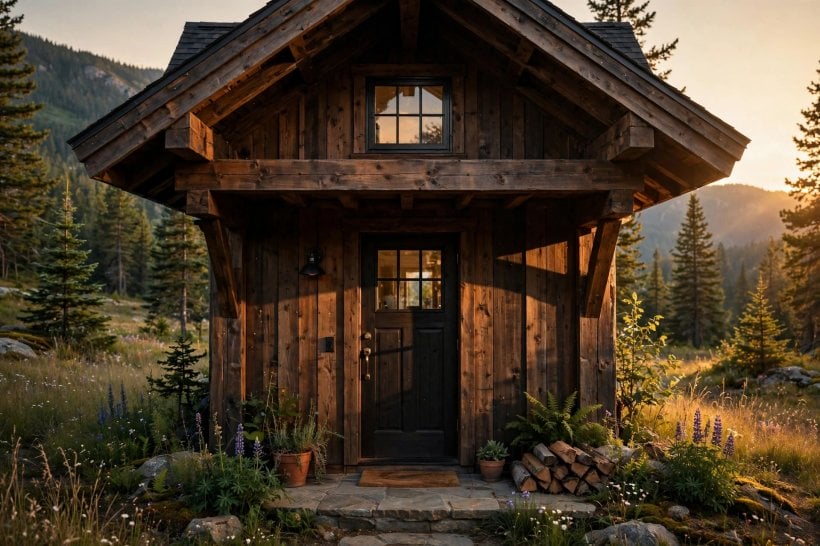
The most common rookie mistake in tiny house design is not the floor plan — it is the roofline. Deep eaves shade your windows, throw rain clear of your siding and make a small house read as a home, yet on a house that travels, every inch of overhang is audited against the legal width of the road. This guide shows how to keep the protection and lose the permit.
1. The Folding Roofline at a Glance
Well-designed eaves and overhangs do three jobs at once: they move water away from the wall, they cut the summer sun before it reaches the glass, and they give a plain box the depth and shadow lines of a real house. The obstacle is movement. A tiny house on wheels lives under a hard legal ceiling — 8 feet 6 inches of total width in most places — so the overhang that protects you while parked can make you illegal the moment you hitch up. The answer developed in this guide is the overhang that changes state: hinged eaves that fold flat, bracket eaves that detach completely, and gable-end overhangs that run as deep as they like because length is rarely the limiting factor. The table gathers the numbers that govern every design; the sections after it take each system and each critical detail in turn.
| Attribute | The Figure or Detail |
|---|---|
| Legal road width | 8 feet 6 inches (102 inches), including siding, trim, fenders and door knobs |
| The standard build | An 8-foot wide house — only 6 inches of total slack |
| The rookie mistake | 12-inch eaves on both sides of an 8-foot house = 10 feet wide |
| The cost of going wide | “Wide Load” permits, pilot cars and restricted travel times on every move |
| The three systems | Hinged drop-down eaves; fully detachable brackets; deep gable-end extensions |
| Gable-end depth | 12–24 inches at front and back — length up to 40 feet is standard |
| Detachable setup time | 30–60 minutes |
| Seam waterproofing | A continuous EPDM rubber flap or a metal flashing cap over the hinge line |
| Lightweight build | 2×4, cedar or aluminium framing; metal or polycarbonate roofing — never heavy shingles |
| Locking hardware | Hurricane ties and heavy-duty barrel bolts — gravity is not enough |
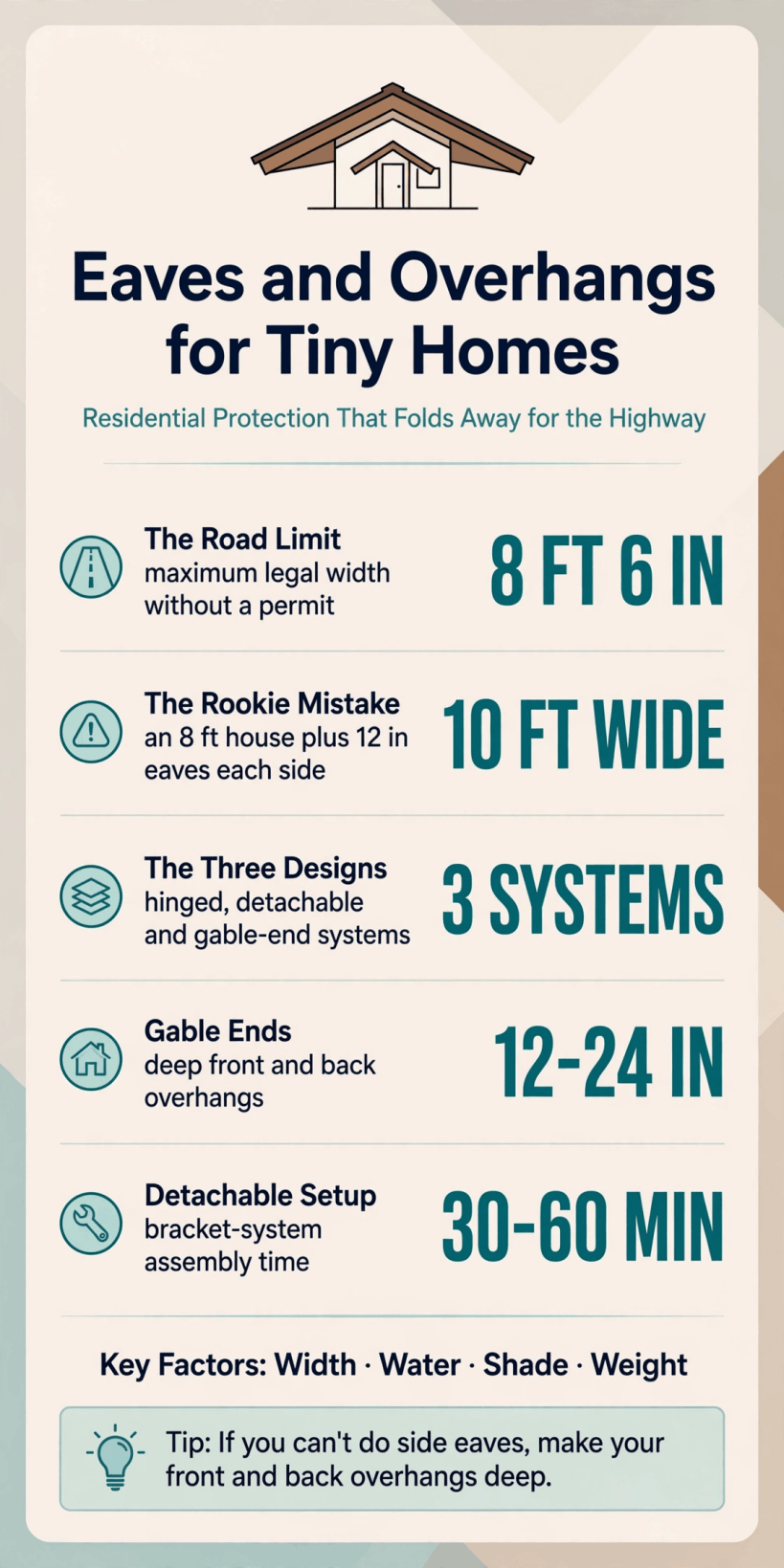
8 feet 6 inches of legal road, a 10-foot trap for the unwary, and three systems that fold, detach or run deep — the whole overhang decision on one card.
2. Why Eaves Earn Their Place
Before the engineering, the case for bothering at all. “Box-style” tiny homes with zero overhang are popular for their simplicity, and they pay for that simplicity in three currencies. The first is water. Without an overhang, rain runs directly down the siding, and every window and door opening becomes a leak waiting for its season; the wall’s whole defence falls on sealant and detailing, which is why builders who skip eaves lean so hard on systems like rain screen installation to give the cladding a drained second chance. The second currency is heat. In summer, the high sun beats directly into unshaded windows and turns a small, tight interior into an oven — the same solar load that disciplined tiny home summer prep works to defeat from the inside, an eave defeats from the outside, for free, every afternoon. The third is appearance, and it is not vanity: an overhang casts the shadow line that separates a house from a container, and on a home you may one day sell, that depth is part of the value. Shade, shelter and a roofline with intent — that is what the rest of this guide fights to keep inside 102 inches.

3. The Width Problem: 8 Feet 6 Inches and the 10-Foot Trap
Here is the hard reality the whole design bends around: the legal road limit in most places is 8 feet 6 inches — 102 inches — and that measurement is total. It includes the siding, the trim, the fenders and even the door knobs; nothing rides for free. Build the standard 8-foot wide tiny house and you hold exactly 6 inches of slack across the entire build. Now add the eaves of a normal house — 12 inches on both sides — and the arithmetic turns hostile: 8 feet plus 2 feet of roof is a 10-foot wide load. That width requires expensive “Wide Load” permits, pilot cars and restricted travel times every single time you move, which converts a house designed for freedom into a logistics exercise. This is why the side eave is the contested territory and the gable end is not: width is the scarce dimension, audited to the inch, while length is comparatively generous. Every system that follows accepts the audit as its first design input. It is the same discipline, incidentally, that governs removable gutter systems — anything that lives on the outside of the wall must earn its inches or learn to come off.
4. Design 1: The Hinged “Drop-Down” Eave
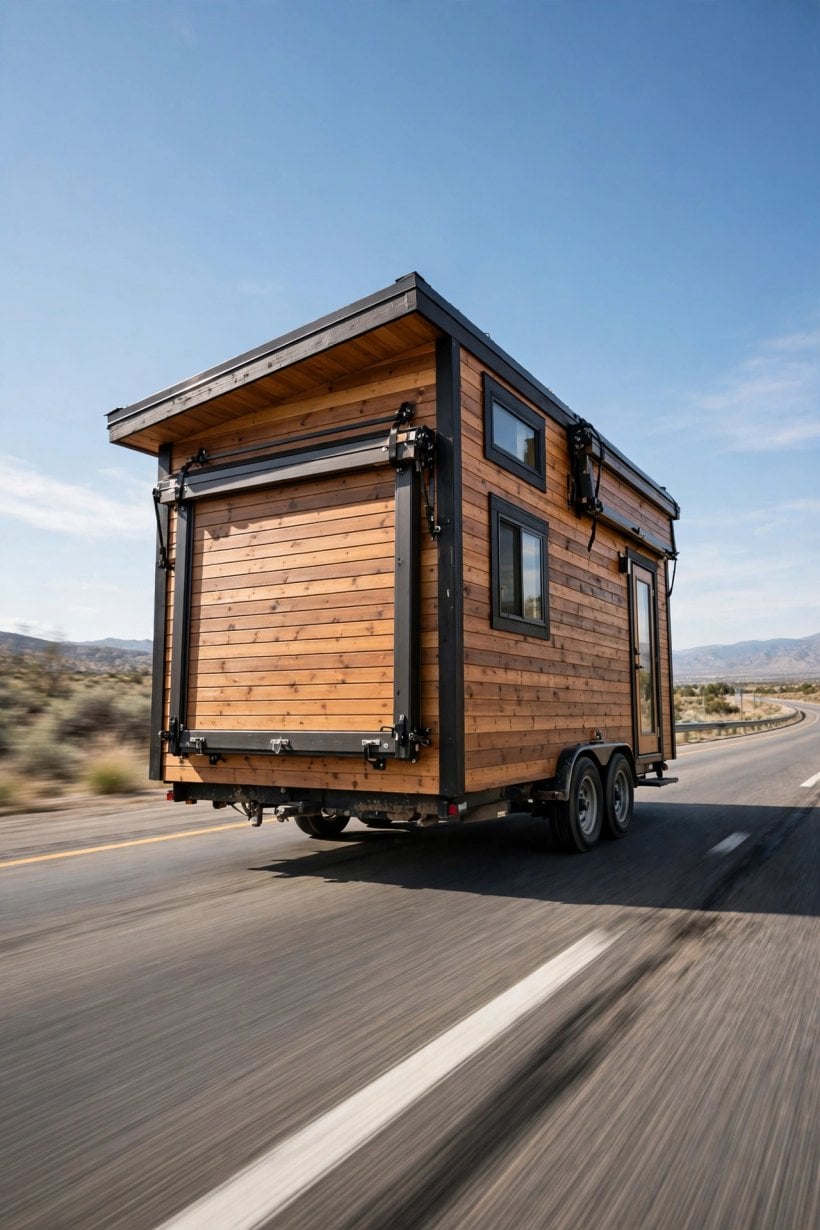
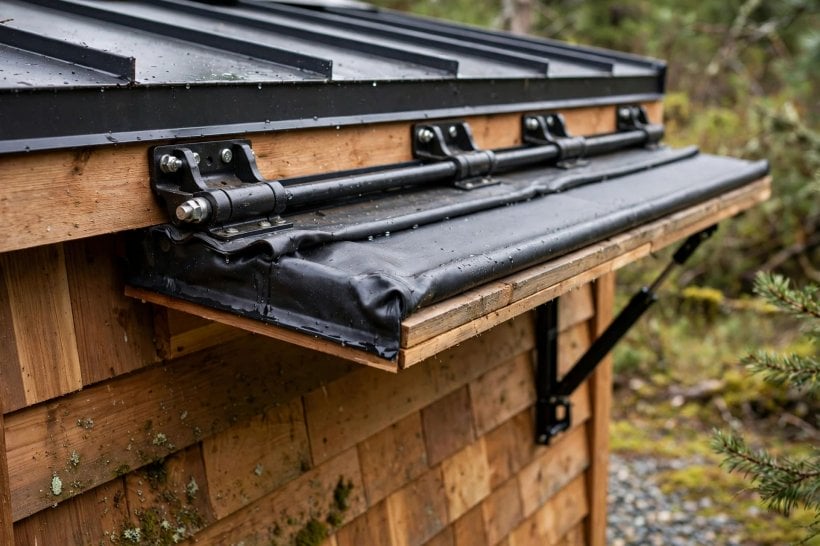
The most popular solution for tiny houses on wheels keeps the eave attached and teaches it to fold. The eave section joins the main roof on heavy-duty hinges. Parked, it is propped up and locked into place, extending the roofline to its full protective depth; for travel, you remove the supports and the eave folds flat against the side of the house, surrendering its inches back to the legal envelope. The system’s elegance is that nothing needs storage — the eave is always with the house, up or down. Its difficulty is concentrated in a single line: the seam. A hinge is a gap by design, and a gap at the roofline is an invitation. The established fix is the flashing flap — a continuous strip of rubber roofing (EPDM) or a metal flashing cap that covers the hinge gap, so that with the eave up, the flap sheds water over the joint exactly as a shingle course would. The second discipline is the lock. A folded eave that is merely resting against the wall will flap in the wind at 60 MPH, fatiguing its hinges and its fasteners mile after mile, so the folded position needs its own secure bolting, planned as carefully as the parked position’s props. Build both positions deliberately — propped, locked and flashed up; folded, bolted and silent down — and the hinge stops being the compromise and becomes the feature.
5. Design 2: The Fully Detachable Bracket System
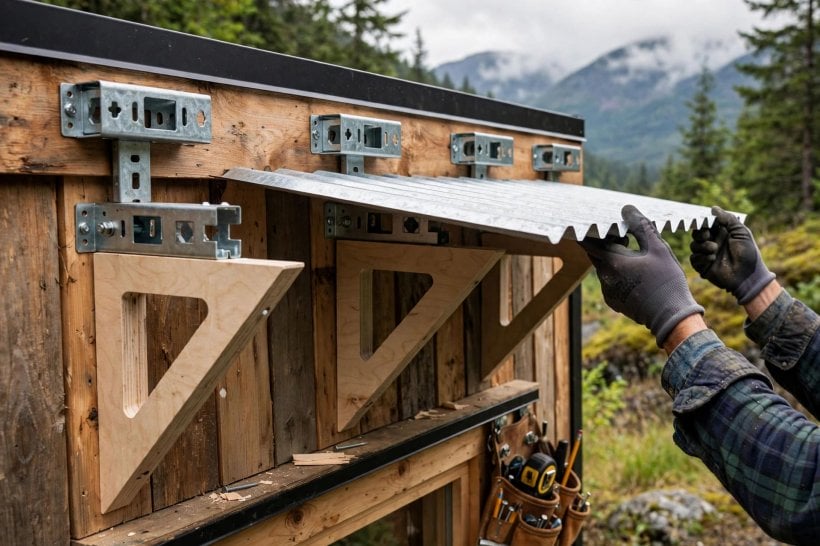
If moving parts offend you, the second system removes them: eaves that come completely off. You install permanent receiver sockets or strong-tie brackets on the top plate of the wall, and the eave “rafters” are separate triangular brackets that slide into those sockets when you park. Across the brackets you lay lightweight roofing panels — corrugated metal or polycarbonate — and the overhang exists. Unpark, and it disassembles into a stack of triangles and flat sheets. The pros are structural honesty: simpler to build, and no hinge, flap or pivot to break, wear or leak. The cons are logistical. The brackets and panels need storage space inside the house or the truck during transport, and storage is the one resource a tiny house never has spare. Setup also takes longer — 30 to 60 minutes of assembly between arriving and being sheltered, in whatever weather you arrived in. The choice between this and the hinge is therefore a choice about where you pay: the hinged system pays in seam detailing once, at the bench; the detachable system pays in minutes and cubic feet on every single move. For a house that relocates twice a year, the bracket system’s simplicity usually wins. For a house that tours, the tax compounds.
6. Design 3: The Gable End Extension
The third design is the one builders forget, because it asks for no engineering heroics at all. Side eaves are restricted by width — but gable end overhangs, front and back, are usually fine, because length is rarely the limiting factor: up to 40 feet is standard. So where the sides must fold or detach, the ends can simply be deep. Make the front and back overhangs 12 to 24 inches and they protect the two most vulnerable features on those walls — the entry door, which takes weather every time it opens, and the loft windows at the gable peak — without any “removable” engineering whatsoever. Fixed, flashed and forgotten. The tip generalises into a design rule for the whole roofline: spend your depth where the law is generous and your cleverness where it is not. A house with deep gable ends and modest folding sides is better protected, in total, than a house that fights for uniform depth everywhere and ends up compromised at the seam, the lock and the permit office alike. Depth at the ends also frames the house visually, giving the short elevations the same finished roofline the long sides get from their folding eaves — the roof reads as one deliberate design rather than two systems arguing.
7. Weight Management: Build Light or Do Not Build
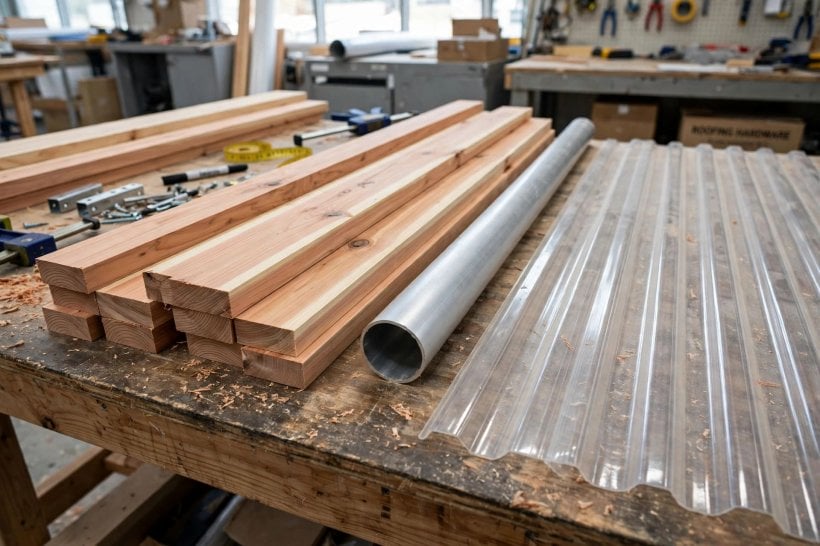
Every removable system shares one unforgiving constraint: a person has to lift it. That single fact dictates the materials list. Do not build detachable eaves out of 2×6s and heavy asphalt shingles — they will be too heavy to lift, and an eave that needs two people and a ladder ballet will eventually be left behind, uninstalled, exactly when the weather it was built for arrives. The palette that works is the light one: 2×4 framing, cedar framing, or aluminium tubing for the structure, and metal roofing or polycarbonate sheets on top, both much lighter than shingles. The same discipline scales to the hinged design, where the fold is a lift performed at arm’s length above your head, and to the brackets, where every panel is carried twice per move. It is also the discipline that governs the wall below — the weight and thickness arguments in the Hardie vs. LP SmartSide siding showdown are the cladding version of the same calculation. Weight is also a road figure, not just an ergonomic one: hardware at the roofline rides high, and keeping the assembly light keeps the lift easy, the hinges honest and the load where the trailer wants it.
8. Uplift Protection: Locking the Eave Against the Wind
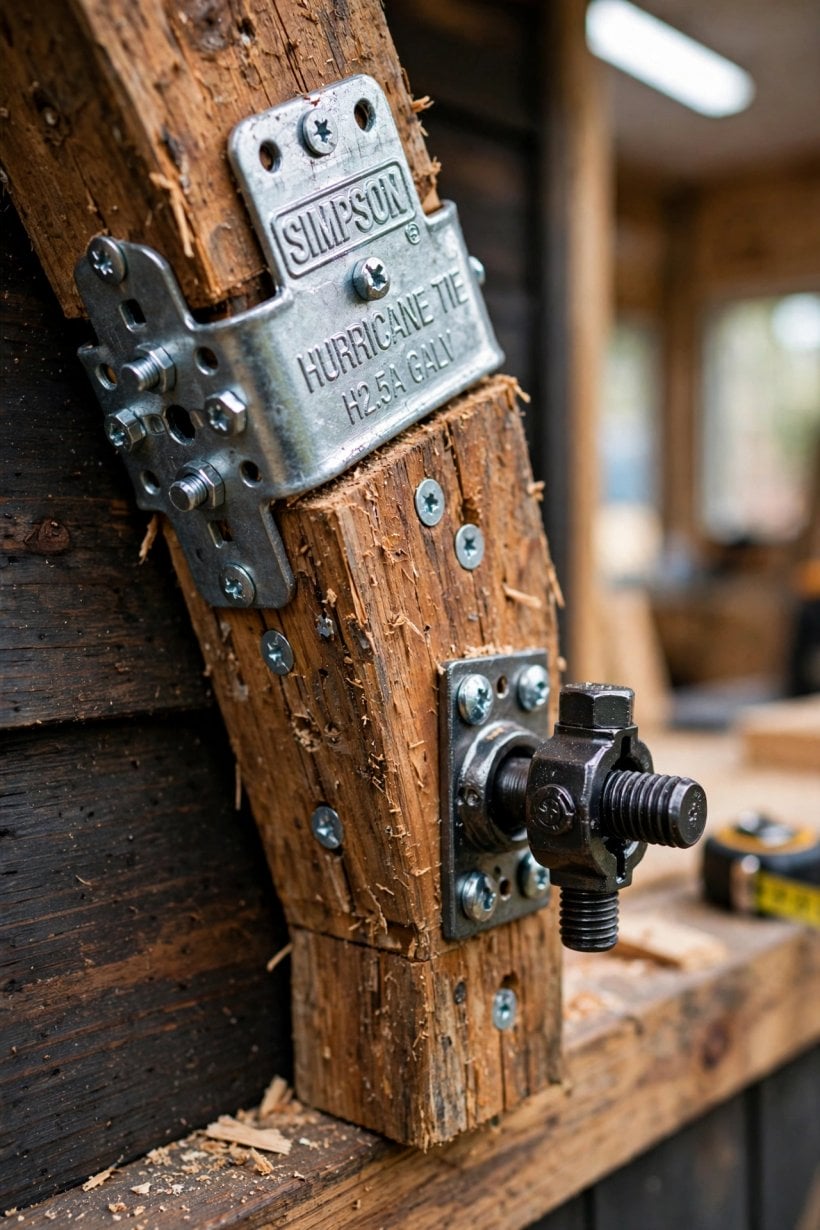
An eave is a wing bolted to your house, and it should be engineered with the respect that implies. Eaves act like airplane wings: a strong gust gets under that broad, flat surface and lifts, and a detachable eave that is not properly secured can be ripped right off — in a storm while parked, which is the precise moment the overhang is earning its keep. The defence is hardware, specified without sentiment: hurricane ties or heavy-duty barrel bolts to lock the eave in the “up” position. Gravity is not enough — gravity is merely the load the wind is negotiating with, and in a real gust it loses. This applies in both directions of the system’s life. Parked, the lock resists uplift trying to tear the eave upward off its brackets or hinges. Travelling, the companion lock holds the folded eave flat against the wall so highway wind cannot get behind it and work it loose at speed. Think of every removable overhang as having two rated positions, each with its own positive locking, and test both before the first storm and the first highway run rather than during them. The fastener schedule is not the place for the leftover screws in the coffee tin.
9. Thermal Bridging: Keep the Envelope Sealed
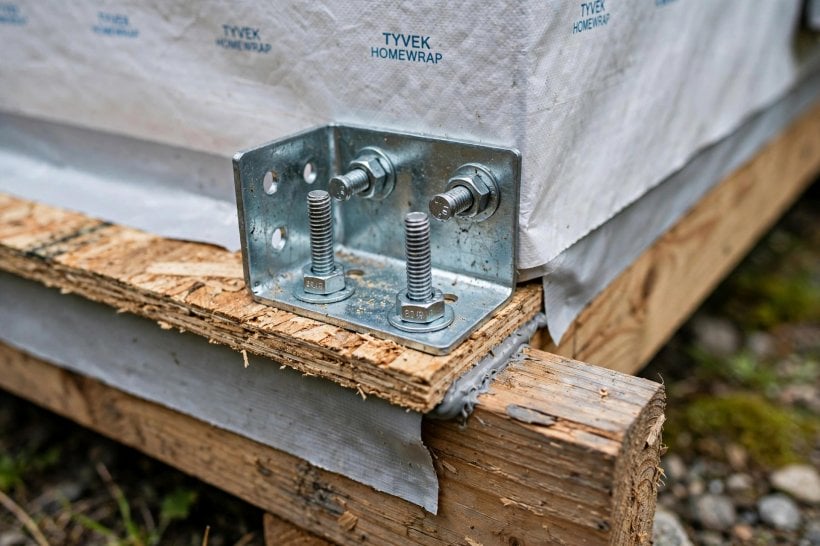
The quietest failure mode of a detachable system is thermal. If the eave rafters penetrate through the wall insulation to the interior, they become a row of cold conductors — thermal bridges that carry cold air in along the timber, stripe the ceiling edge with condensation risk, and tax the heating on every cold night, all from a row of neat, well-built brackets. The fix is in the attachment geometry. Ideally, bolt the detachable system to the exterior sheathing or the rim joist, keeping the thermal envelope of the house sealed: the structure gets its fixing, the insulation keeps its continuity, and the two never have to share a hole. This is the same envelope-first logic that decides the Tyvek vs. ZIP System air barrier battle — the wrap and the sheathing systems are judged by how few penetrations they ask you to make. Plan the bracket line on the drawing, not on the ladder: mark where the rim joist runs, fix there, and let every rafter land on structure that is already outside the warm layer. The eave then does its one job — holding water and sun off the wall — without quietly undoing the wall’s other job underneath it.
10. The Alternatives, the Permit Route and the Questions Everyone Asks
Two honest alternatives frame the decision. The first is to build wide and permit the moves: yes, you can — but it complicates travel permanently. Wide Load permits cost money per state, often require specific travel routes, and may restrict you to daylight hours only, so every relocation becomes a planned operation rather than a decision. The second alternative swaps structure for fabric: retractable RV awnings and simple canvas shade sails are excellent lightweight alternatives to structural wood eaves. They provide shade, and they ask nothing of the width audit — but they are not as good at diverting heavy rain and snow loads, which is the eave’s primary winter job. Builders who love fold-away thinking often pair the approaches, much as folding deck designs give a parked house a room the highway never sees. And the three questions every builder asks, answered from the record: What is the maximum legal width without a permit? In the USA, generally 8 feet 6 inches (102 inches) — including siding, trim, fenders and door knobs. Can you just build wide and get a permit? Yes, at the per-state, routed, daylight-limited cost above. Are retractable awnings a good alternative? Yes for shade — with the rain and snow caveat stated plainly. Choose with the whole picture in view, and the roofline stops being the rookie mistake.
Final Considerations
You do not have to choose between a dry house and a road-legal house. Design the overhang around the audit — fold the sides on hinges with a flashed seam, detach them on brackets if you move rarely, and run the gable ends deep because length lets you — then build it light, lock it against uplift in both positions, and bolt it to the sheathing so the envelope stays sealed. Do those things, and the eaves protect the investment from the elements and keep the house cool, all while avoiding the headache of wide-load permits.


4 Comments