

Less space, less stress — that is the tiny house promise, and it survives contact with the loan paperwork, but only just. A house on wheels does not borrow like a house on land: there is no 30-year mortgage waiting at the bank, and the monthly figure that matters includes rent for the ground beneath you. A mortgage calculator for tiny house buyers has to price all of that at once.
1. Tiny House Financing at a Glance
This page pairs a short financing guide with a working mortgage calculator for tiny house numbers, because the numbers are where the dream either holds or folds. Six inputs — total cost, down payment, interest rate, loan term, lot rent, and insurance and utilities — produce one total monthly figure, split three ways: building equity, burning interest, or paying land rent. The sections below walk through each input and each reality behind it; the calculator itself sits at the end of the guide. The table gathers the whole picture in one place.
| Attribute | Detail |
|---|---|
| The Problem | Tiny houses rarely qualify for a traditional mortgage — they are not “Real Estate” |
| The Classification | A house on wheels is “Personal Property” (Chattel), like a car or an RV |
| Reality One | RV loans — terms of 10–15 years, at a higher interest rate |
| Reality Two | Personal loans — short term, very high interest |
| Reality Three | Lot rent — a monthly parking cost that can run higher than the loan itself |
| The Starting Example | A total cost of $85,000 with $15,000 down, pre-filled in the calculator |
| The RV Preset | 7.5% interest over a 15-year term |
| The Personal Preset | 11.0% interest over a 7-year term |
| The Monthly Overhead | Lot rent of $500 plus $100 of insurance and utilities in the starting figures |
| The Output | One total monthly figure, split into Equity, Interest and Rent/Fees — plus the total interest paid over the life of the loan |
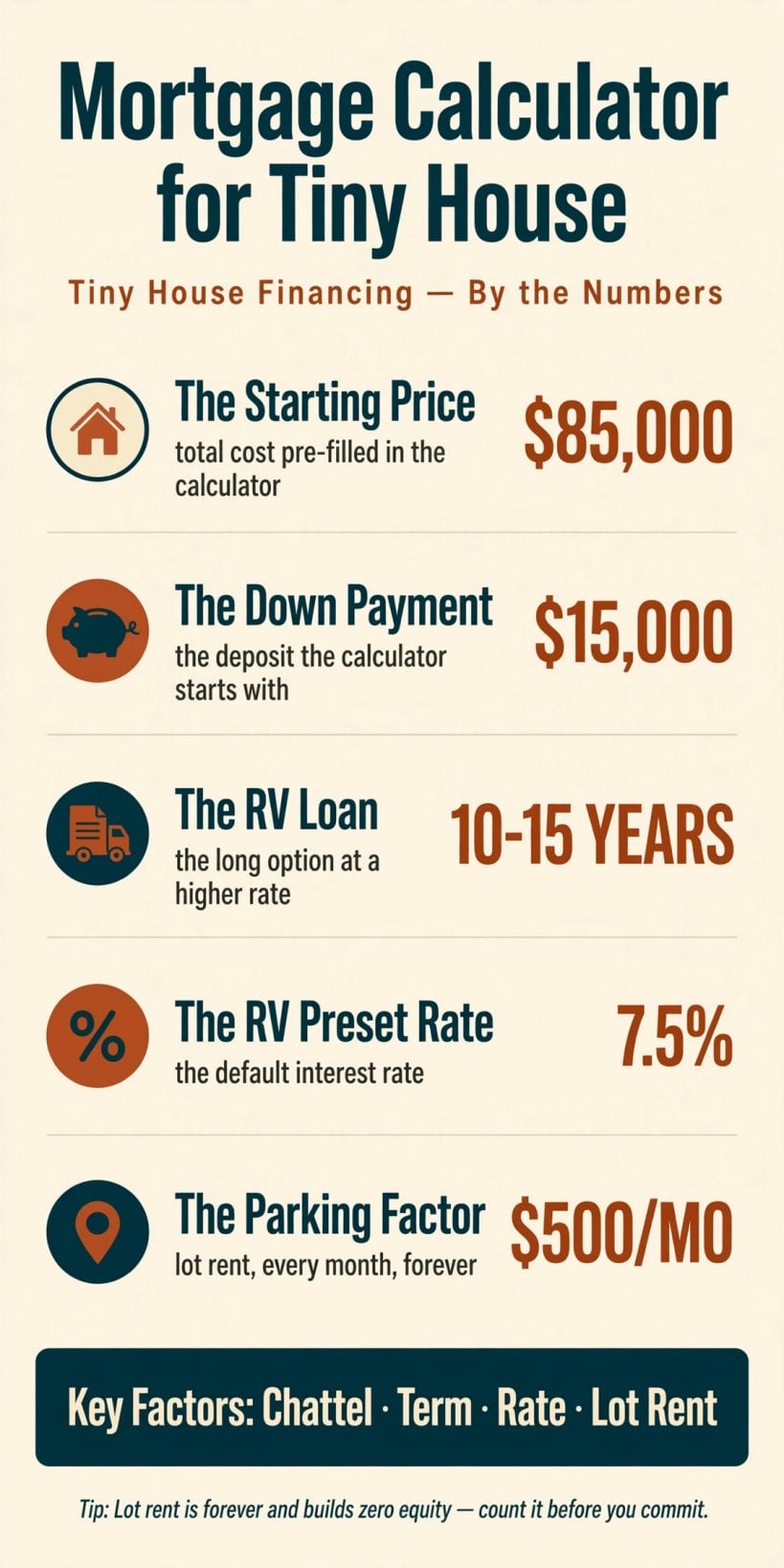
An $85,000 starting price, a $15,000 deposit and a $500 parking bill that never ends — the financing decision on one card.
2. The Total Cost: The Number Everything Hangs On
Every calculation on this page begins with one figure: what the house costs, all in. The calculator’s first field is the total cost, and its starting example puts that figure at $85,000. Everything downstream is arithmetic performed on this number: the down payment is subtracted from it, the interest rate is charged on what remains, and the term decides how thinly the remainder is spread. Get this first figure wrong and every answer that follows is wrong with it.

“Total” is the operative word. The figure to enter is the complete cost of the house you will actually live in, not the headline price of the shell. Buyers working out what a finished house really costs will find the groundwork in our guide to how much a tiny house costs. Only once that full figure is settled does the financing conversation mean anything, because a loan arranged against an understated price is a shortfall discovered after you have committed.
3. Why the Bank Says No to a 30-Year Mortgage
The first reality is a refusal, and it helps to understand exactly why it happens. This is not your standard 30-year mortgage situation. Standard mortgages require the home to be “Real Estate” — attached to a permanent foundation on land you own. A tiny house on wheels fails that test on both counts: it sits on a trailer rather than a foundation, and the land beneath it is usually somebody else’s. In the eyes of a lender, the house is “Personal Property” — chattel, in the legal term — classed like a car or an RV rather than like a house.

That single classification rewrites the loan. Chattel means higher risk for banks, and higher risk is priced the way banks always price it: higher interest rates and shorter terms — a maximum of 10–15 years where a conventional mortgage might run three decades. None of this makes the purchase unwise; it makes it different in kind, and it is why a calculator built for conventional houses gives misleading answers here. The three realities that follow are the three shapes tiny house borrowing actually takes.
4. Reality One: The RV Loan
The first and longest route is the RV loan, and its logic follows directly from §3: if the law and the lender treat the house as a recreational vehicle, then the loan that fits it is the recreational vehicle loan. The calculator’s first preset is exactly this — one tap loads the RV profile, an interest rate of 7.5% and a term of 15 years. The original frames the category plainly: RV loans run 10–15 years, at a higher interest rate than a conventional mortgage. Higher, note, not ruinous: of the three realities, this is the one that spreads the cost over the longest available span, and the 15-year term at the top of the band is the gentlest monthly shape tiny house financing offers.
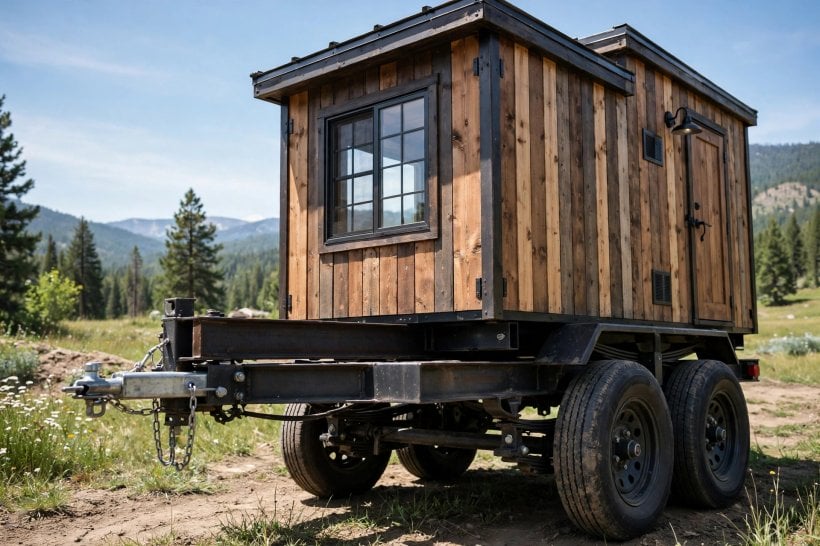
The trade is written into the term itself. Fifteen years is half the runway of a 30-year mortgage, so each monthly payment must retire principal at twice the pace — before interest is even considered. That is why the down payment of §7 matters so much: every dollar paid up front is a dollar that never has to survive this compressed schedule. The RV preset is the calculator’s default view for a reason: it is the scenario most buyers on wheels will actually sign.
5. Reality Three, Paid Monthly: The Parking Rent Factor
The third reality is the one conventional calculators omit entirely, and for many owners it is the largest line in the budget: lot rent. A house on wheels has to stand somewhere, and unless you own the ground, the standing is rented — monthly, indefinitely. The original states the uncomfortable part without flinching: the parking rent is often higher than the loan itself. The calculator builds the factor in as its own input, pre-filled at $500 a month, alongside a second overhead field for insurance and utilities, starting at $100. Together they form the monthly overhead that rides on top of the loan payment in every result the tool produces.
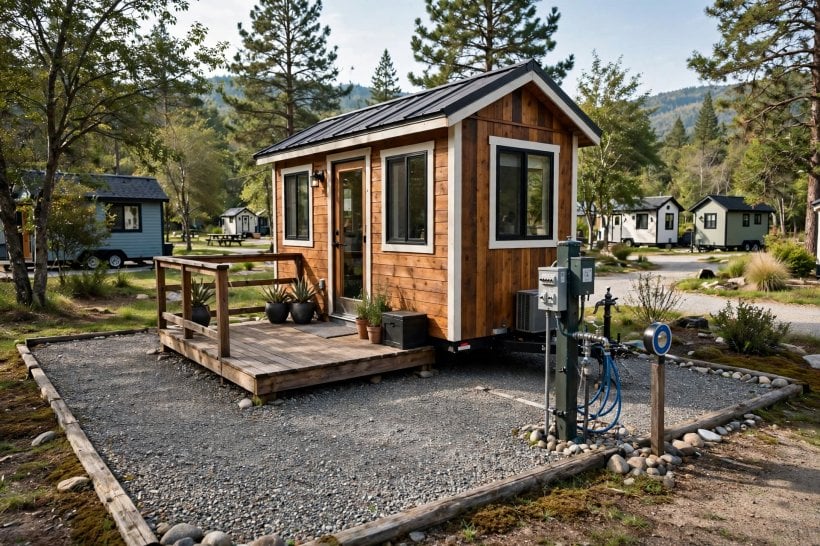
Two properties make lot rent unlike every other figure in this guide. The first is that it never ends: unlike a traditional home, where the mortgage eventually finishes, lot rent is forever. The second is that it builds zero equity: not one dollar of it buys a square inch of the ground. That is why the calculator shows it as its own slice of the monthly total, labelled Rent/Fees, where it can be watched. What the rent covers varies by site, and the wider picture of paying for power, water and parking is set out in the tiny house utilities guide.
6. Reality Two: The Personal Loan
The second route is the personal loan, and the original’s description is the shortest in the guide because the product is the bluntest: short term, very high interest. The calculator’s second preset loads its profile — an interest rate of 11.0% and a term of 7 years. Set beside the RV preset, the shape of the trade is unmistakable: the same house, financed over less than half the span, at a rate half again as high. The monthly figure that comes out of that combination is the steepest of the three realities, and it arrives that way honestly — a short term concentrates the principal, and a high rate taxes every month of it.

Why would anyone choose it? Because the three realities are not a league table; they are the options that actually exist for a house classed as personal property, and for some buyers the personal loan is the door that opens. Its virtue is the mirror of its cost: seven years and the debt is done, with the total interest over the life of the loan — a figure the calculator prints on every result — bounded by the short span. The discipline it demands is monthly: the payment has to fit the budget every month, alongside the lot rent of §5, which does not shrink to make room for it.
7. The Down Payment: The One Lever You Control
Of the six inputs, five are set by other people — the seller sets the price, the lender sets the rate and the term, the park sets the rent. The down payment is the one figure the buyer brings, and it is the most powerful lever in the whole calculation. The starting example pairs the $85,000 cost with $15,000 down, and the arithmetic that follows is performed only on the difference: the loan exists to cover what the deposit does not. Every additional dollar paid at the start is a dollar removed from the principal before the first month’s interest is calculated on it, and it stays removed for the entire term.
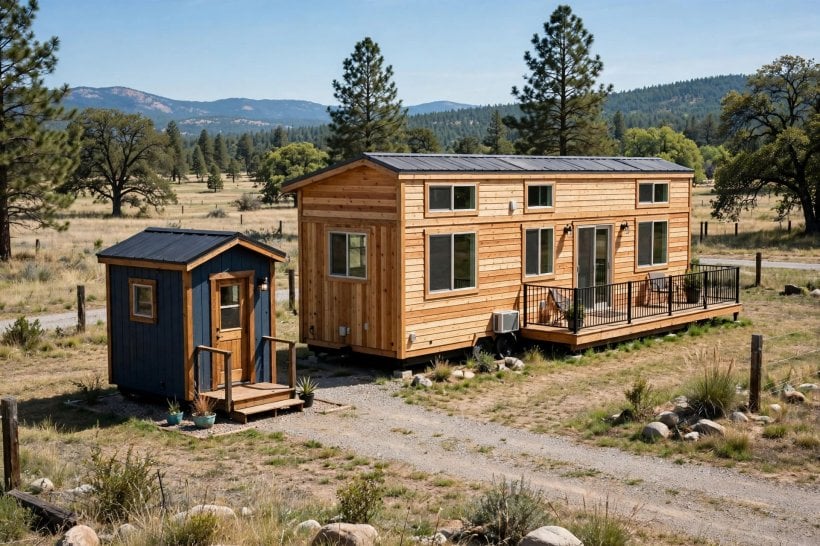
The lever has a limit case, and the calculator states it cheerfully: if the down payment covers the cost, there is nothing left to finance — the tool’s own response is “Down payment covers the cost!” Working back from that end of the scale is the practical exercise this page exists for: increase the deposit in the form and watch the monthly total and the lifetime interest fall together. The price of the house is the other half of the same decision, which is why the sizing conversation in the tiny house floor plans calculator belongs in the same afternoon as this one.
8. Reading the Result: The Cost Stack
Press the button and the calculator answers with a single headline — the Total Monthly Out-of-Pocket — and then, more valuably, with the composition of that total. The tool calls it the Cost Stack Visualizer: a ring that breaks down exactly where your monthly money goes, in three labelled slices. Equity is the principal portion, the part of the payment that buys the house. Interest is the lender’s portion, the part that buys nothing but time. Rent/Fees is the overhead portion — lot rent plus insurance and utilities — the part that buys the standing place and the services, and buys them only for that month.

Two further figures complete the reading. The breakdown beneath the ring prices each slice for the first month, so the proportions are dollars, not just colours. And at the foot of the panel sits the number that reframes every scenario: the total interest paid over the life of the loan. Compare the presets by that figure and the real cost of each reality stands clear of the monthly payment’s camouflage. Togaze’s other planning tools work the same way — one honest total, visibly composed — from the tiny house tongue weight calculator that prices a tow, to the insulation strategy analyzer and the dehumidifier sizing calculator that price the build and the running of it.
9. The Land Exit: When the Rent Line Ends
There is one way the Rent/Fees slice leaves the stack, and the original names it as the direction many owners eventually travel: this is why many tiny housers eventually strive to buy their own land. The logic is the whole of §5 read backwards. Lot rent is the only major cost in tiny house life that is both permanent and equity-free; remove it by owning the ground, and the monthly total loses its least productive line forever, while the payment that remains is the loan’s — the one with a finish date.

The calculator makes the exit testable before it is buyable. Set the lot rent field to zero and the stack redraws itself: the same house, the same loan, a monthly total with the rent slice gone. What remains is the true carrying cost of the house on its own ground — the figure to set against the price of land when that decision comes. Not every owner will make the move, and the rented pad has its own freedoms, mobility first among them. But the comparison belongs in the plan from the beginning, because a financing decision taken without it assumes the rent line is permanent — and for a growing number of owners, it is simply the first phase.
10. Custom Numbers: Making the Tool Yours
The third preset is labelled Custom, and it is where the calculator stops illustrating and starts advising. The two named presets load the standard profiles — the RV loan at 7.5% over 15 years, the personal loan at 11.0% over 7 — but no buyer’s figures arrive in round numbers. Custom is the invitation to type the real ones: the rate you have actually been quoted, the term actually on the table, the rent of the actual site you intend to park on, the deposit you have actually saved.
Work the levers in the order this guide took them. Settle the total cost first, at its full, finished figure. Then the deposit, as high as the savings honestly allow. Then run each preset before your custom figures, so the quoted offer has something to be judged against — a rate means little until it has been compared with the two standard shapes of tiny house borrowing. And keep the overhead fields filled with real rents and real utility costs, the way the electrical load planner insists on real loads: a monthly total is only as honest as its least honest input. The answer the calculator gives is not a promise or an approval. It is the shape of the commitment, drawn to scale, before you sign anything.
Run Your Numbers: The Tiny House Mortgage Calculator
Everything above converges on the tool below. You now know why the term stops at 15 years, why the rate sits where it does, why the rent is counted beside the loan instead of beneath it, and which of the six numbers is yours to move. Enter your total cost and your down payment, choose the loan shape that matches your reality — RV, personal, or the custom figures you have been quoted — add the lot rent and the monthly overhead, and press Calculate Payments. The stack will draw itself: equity, interest and rent, priced to the dollar, with the lifetime interest printed underneath.
Thinking about a tiny house? Smart move. Less space. Less stress. But what about the loan? That’s where a tiny house mortgage calculator helps. It shows your monthly payment in seconds. Price, rate, term—plug them in and get clear numbers. No guesswork. No math headaches. Just real answers, fast. If you like control and clear plans, you’re in the right place.
This isn’t your standard 30-year mortgage calculator. Tiny houses rarely qualify for traditional mortgages because they aren’t “Real Estate” (attached to land).
This tool calculates payments based on the Three Realities of Tiny Financing:
- RV Loans (10-15 years, higher interest).
- Personal Loans (Short term, very high interest).
- The “Parking Rent” Factor (Calculating the monthly lot rent, which is often higher than the loan itself).
It features a “Cost Stack Visualizer” that breaks down exactly where your monthly money goes: Building Equity vs. Burning Interest vs. Paying Land Rent.
Tiny House Financing Calculator
RV Loans, Personal Loans & Lot Rent.
2. Monthly Overhead
Financing Reality Check
Standard mortgages require the home to be “Real Estate”—attached to a permanent foundation on land you own. A Tiny House on Wheels is considered “Personal Property” (Chattel), like a car or RV. This means higher risk for banks, leading to higher interest rates and shorter terms (max 10-15 years).
Unlike a traditional home where your mortgage eventually ends, Lot Rent is forever. Notice in the chart above how much of your monthly budget goes to “Rent/Fees.” This money builds zero equity. This is why many tiny housers eventually strive to buy their own land.



0 Comments