

New Jersey runs on home rule. More than 560 municipalities each write their own zoning ordinance, run their own planning and zoning boards, and answer the same tiny-house question 560 different ways — so a project that is unremarkable in one town can be impossible two miles away, across an invisible municipal line. Layer onto that the highest property taxes and some of the highest land prices in the country, and the real New Jersey problem comes into focus: it is not finding a small house you are allowed to build, it is finding a town — and then a lot inside that town — where a small house makes legal and financial sense at the same time. Tiny House Laws in New Jersey reward buyers who pick the municipality before they pick the floor plan, and who treat the zoning ordinance, not the brochure, as the first design document.
This guide works through the state in the order a project actually meets it: the legal status of wheeled and foundation tiny houses, the statewide construction code that governs how any dwelling gets built, minimum sizes in code and in local ordinances, zoning and placement, accessory dwelling rules, the places you can legally live full-time, permits and inspections, and regional examples from the Pinelands to the New York suburbs. The honest summary up front: nothing in state law bans a small house outright, and the statewide building code is uniform — but zoning, minimum-size clauses, land cost and, in the south, the Pinelands protection regime decide almost everything, town by town.
1. Tiny House Laws in New Jersey at a Glance
The table below answers the questions New Jersey readers ask first. Because authority here is split between a statewide construction code, hundreds of municipal zoning ordinances and one powerful regional overlay in the Pinelands, each answer names the level of government that will actually decide it for your parcel.
| Question | New Jersey in brief |
|---|---|
| Are tiny houses legal in New Jersey? | Yes, as dwellings — a small house on a foundation, built to the state construction code on a lot where the town’s zoning allows a dwelling of that size and type. There is no statewide tiny-house law and no statewide ban; the municipal ordinance is where projects live or die. |
| Is a tiny house on wheels a house or an RV? | An RV. Wheeled units are treated as vehicles or recreational vehicles, not dwellings, in nearly every municipality, and most towns prohibit living in an RV on a residential lot outside a licensed campground or RV park. |
| Which building code applies? | The New Jersey Uniform Construction Code, adopted statewide and enforced by local construction offices. It sets structure, fire safety, energy, plumbing and electrical standards for every dwelling, large or small — but it is not a zoning code, and passing it does not grant placement rights. |
| How small can a house be? | The construction code governs rooms, ceilings and egress rather than total house size, but many municipal ordinances add their own minimum dwelling sizes, minimum lot sizes and lot-coverage caps — and those local numbers are usually the binding constraint. Read both layers. |
| Are backyard cottages and ADUs allowed? | It depends entirely on the town. A growing number of New Jersey municipalities have written accessory dwelling units into their ordinances, often with owner-occupancy and size conditions, while others still prohibit a second dwelling on a single-family lot. The town’s current ordinance text is the only reliable answer. |
| Where can I live in one full-time? | In a permitted foundation tiny house on a conforming lot, in a legal ADU where the town allows one, in a manufactured home in a licensed community, or seasonally in campgrounds and RV parks — subject to each park’s and town’s occupancy limits. |
| What is the Pine Barrens factor? | Roughly the southern third of the state’s land sits inside the Pinelands National Reserve, where a regional commission’s development rules overlay local zoning. Lots there can be cheaper and larger, but development credits, septic density rules and permitted-use lists add a second approval layer. |
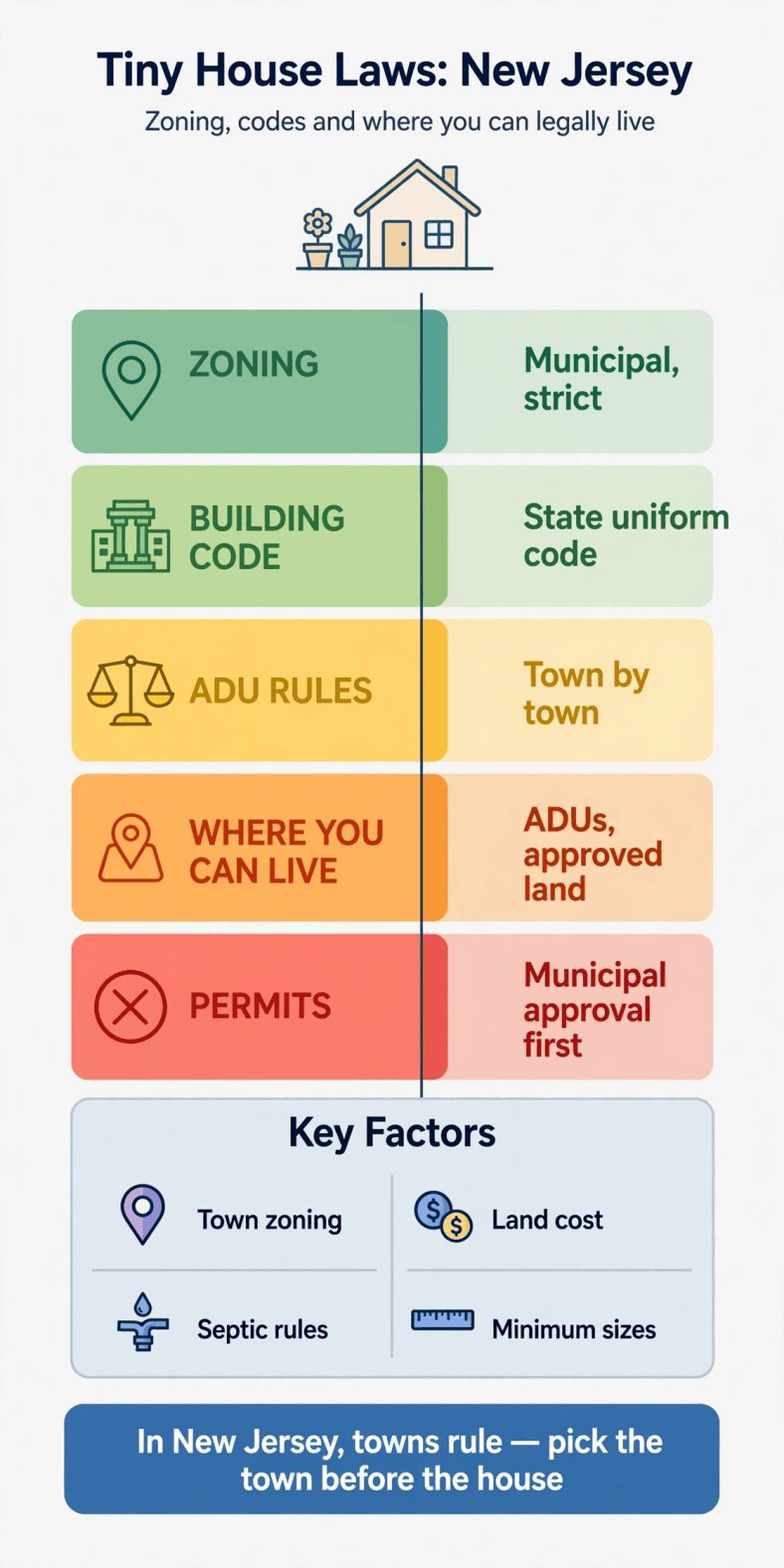
Tiny house laws in New Jersey — the whole picture on one chart: municipal zoning first, the state construction code second, and the Pinelands overlay in the south.
Two habits separate New Jersey projects that finish from projects that stall. First, get the town’s answer in writing before money moves: a zoning officer’s letter about a specific lot is worth more than any real-estate listing description. Second, run the land maths honestly — in much of the state the lot, the taxes and the utility connections cost more than the small house itself, and a project that only works on paper at the cheapest lot in the county usually stops working at the permit counter.
2. Legal Status: Tiny Houses on Wheels vs on Foundations in New Jersey
New Jersey law sorts small homes by how they touch the ground. A tiny house on a permanent foundation is a dwelling: it enters the construction code, the property tax rolls and the zoning ordinance’s definition of a single-family home. A tiny house on wheels is, in the eyes of nearly every municipality, a recreational vehicle — a titled, registered vehicle built for temporary living. That single classification decides where the unit may be parked, how long anyone may sleep in it, and whether a town can order it removed from a driveway or a back lot.
The wheeled route still has legitimate uses. Owners register and title their units as vehicles, keep them road-legal, and place them in campgrounds, RV parks and the occasional private arrangement where a town tolerates them — but the arrangement lasts at the town’s discretion, and a single complaint can end it. Anyone considering the wheels route should understand registration, insurance and park rules before buying, starting with how to register a tiny house as an RV and what RVIA certification means for a tiny house, since parks and insurers both ask about certification.
The foundation route is slower, more expensive and far more durable. A foundation tiny house gets a certificate of occupancy, a mortgage-able asset, utility accounts in the owner’s name and the full protection of being a legal dwelling. In a state where land is the scarce resource, that durability matters: a legal small house on a conforming lot holds value, while a wheeled unit on tolerated land holds only risk. Most New Jersey readers who plan to stay should design for the foundation route from day one — and use this chapter’s distinction in every conversation with a zoning office, because officials hear “tiny house” and picture wheels unless you tell them otherwise.
3. Building Codes for Tiny Houses in New Jersey
Construction in New Jersey is governed by the Uniform Construction Code, a statewide code adopted at state level and administered by municipal construction offices. Its subcodes cover building, plumbing, electrical, fire protection, energy and mechanical systems, drawing heavily on the international model codes with New Jersey amendments. For a tiny-house builder the practical meaning is consistency: the structural and safety bar for a dwelling is broadly the same in Cape May as in Sussex County, and the local construction official — not the zoning board — is the person who judges the building itself.
Small houses stress the same details as in every code state. Habitable rooms need compliant ceiling heights and natural light and ventilation fractions; sleeping rooms need emergency egress openings sized for rescue; lofts need code-compliant access, guard heights and headroom that many catalogue designs quietly fail; and the energy subcode pushes small envelopes toward good insulation and tight air sealing, which a small house can achieve more cheaply per square foot than a large one. None of these rules bans small — they ban careless, and they are enforced at inspection, not at the brochure stage.
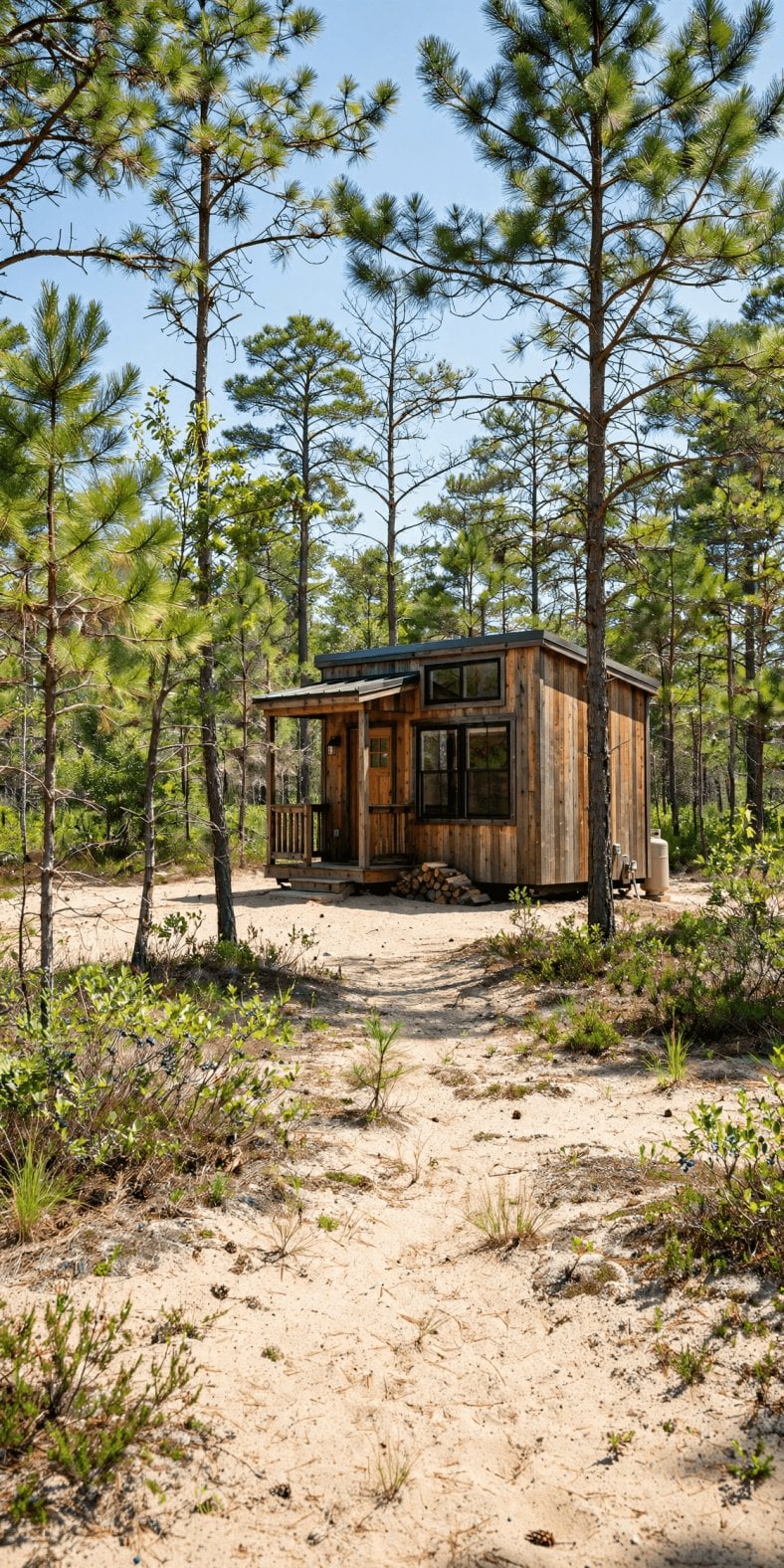
Tiny house laws in New Jersey — pin this overview for the build: one statewide construction code, hundreds of local zoning answers.
One code question readers always ask is whether the small-house relaxations in IRC Appendix Q for tiny homes — the model-code appendix that eases loft, stair and ceiling rules for houses under 400 square feet — apply in New Jersey. The honest answer is to verify it for your project: the state adopts model codes with its own amendments on its own cycle, and whether a given relaxation is in force, and how the local construction office reads it, is a question for that office at plan review. Design the house so it passes without relying on any relaxation you have not confirmed in writing; treat anything gentler as a bonus, not a foundation.
Factory-built units sit inside the same logic. A manufactured home built to the federal HUD code is a different product from a site-built or modular tiny house, and towns treat the categories differently in zoning even where the construction code is satisfied. Before buying any factory unit, confirm with both the construction office and the zoning officer which category it lands in locally — the certificate and labels on the unit, not the seller’s description, decide that answer.
4. Minimum Size Rules in New Jersey
New Jersey has no single statewide minimum house size, and the construction code does not set one either: it regulates the rooms inside the house. Habitable rooms carry minimum floor areas and dimensions, ceilings carry minimum heights with limited sloped-ceiling allowances, and every sleeping room needs its egress window. A well-designed house in the 300-to-500-square-foot band can satisfy those room rules; a badly designed 700-square-foot house can fail them. When a construction office pushes back on a tiny design, it is usually arguing about a room, a stair or a loft — items you can redesign — rather than about the total footprint.
The harder minimums live in zoning ordinances. Many New Jersey towns, especially in the northern and central suburbs, wrote minimum dwelling floor areas, minimum lot areas, minimum lot widths and maximum lot-coverage percentages into their ordinances decades ago, aimed at excluding exactly the kind of small, cheap house a tiny-house buyer wants to build. These clauses vary enormously — one town’s residential zone might set no floor-area minimum at all while the next town over requires a ground-floor area a tiny house cannot meet. There is no shortcut around reading the actual ordinance for the actual zone your lot sits in.
Where a minimum blocks an otherwise sound project, the formal escape valve is a variance from the municipal zoning board of adjustment — a public, discretionary process that costs time, professional fees and uncertainty, with no guarantee of success. Price that reality into town selection: a slightly more expensive lot in a town whose ordinance already fits beats a cheap lot that needs a variance, almost every time. Minimum sizes in New Jersey are therefore best understood as a town-shopping filter, applied before purchase, not as a construction problem solved afterward.
5. Zoning and Placement Rules
Every New Jersey municipality administers its zoning ordinance under the state’s Municipal Land Use Law framework: a zoning map divides the town into districts, and the ordinance text lists permitted uses, setbacks, height limits, lot coverage and parking for each. A foundation tiny house is placed exactly like any house — it must be a permitted use on that lot, meet the bulk standards for the district, and connect to approved water and sewer or septic. Nothing about being small exempts it, and nothing about being small automatically disqualifies it where the numbers fit.
The placement details that surprise buyers are the secondary rules: accessory-structure clauses that cap detached buildings, driveway and parking minimums written for full-size households, and property-maintenance rules that prohibit living in vehicles, tents or structures without a certificate of occupancy. In the Pinelands area, a second map overlays the first — the regional management-area boundaries can change what a lot allows even when the township’s own zoning looks permissive. Read the whole ordinance section for your district, not the summary table, and read any overlay that touches the parcel.
Because the answers are hyper-local, the highest-value hour in a New Jersey project is the meeting with the municipal zoning officer before you buy. Bring the lot’s block and lot numbers, a sketch of the house footprint and the specific questions this guide raises; most officers will tell you plainly whether the concept fits, needs a variance, or is prohibited. The approach in how to talk to zoning officials about tiny houses — specific parcel, specific questions, everything in writing — works especially well in New Jersey, where the person across the counter usually knows their ordinance’s small-house traps by heart.
6. ADU Rules in New Jersey
The accessory dwelling unit — a backyard cottage, a garage conversion, a basement apartment with its own entrance — is the fastest-moving part of New Jersey’s small-housing landscape. There is no single statewide ADU entitlement that overrides local ordinances; instead, individual municipalities have been adopting ADU provisions one by one, typically with conditions: the property owner lives on the lot, the unit stays below a size cap, parking is provided, and the unit cannot be sold separately from the main house. Where those ordinances exist, an ADU is often the cheapest legal tiny house in the state, because the land, driveway and utility connections already exist.
Garage and basement conversions follow the construction code like any dwelling work: legal ceiling heights, egress from sleeping areas, fire separation from the main house and from the garage itself, and proper plumbing and electrical permits. The conversion that fails is usually the informal one — a finished room with a hot plate and no permits — which surfaces at resale, at insurance claims and at the first neighbour complaint. A legal ADU, by contrast, adds assessed value and can be rented openly where the ordinance allows rentals, which in New Jersey’s high-rent suburbs can carry a mortgage.
Practical advice for ADU shoppers: shortlist towns by their ordinance text, not by rumour. Look for an adopted ADU section with a by-right approval path, a size allowance that fits a real cottage (many caps land in the 700-to-1,000-square-foot range, generous by tiny standards), and occupancy rules you can live with. Where a town requires a hearing or a use variance for every ADU, treat it as a soft no — the process cost in New Jersey is real money. And confirm whether the town counts the ADU against lot coverage and how it treats short-term rental, because both answers shape the project’s economics before a single stud is cut.
7. Where You Can Legally Live Full-Time
Stripped of exceptions, the full-time options in New Jersey are these: a permitted foundation tiny house on a lot where zoning allows it; a legal accessory dwelling unit in a town that permits ADUs; a manufactured home on a leased or owned lot in a licensed manufactured-home community; and, at the margins, long stays in campgrounds and RV parks whose licences and town rules allow extended occupancy — usually seasonal in practice. Each route trades cost against security differently, and in New Jersey the security end of the scale is unusually valuable because enforcement, once triggered, is rarely casual.
Compare the community options honestly before committing. Manufactured-home communities offer the lowest entry price and immediate legality, but lot rents in New Jersey climb steadily and the house’s resale value is chained to the park. RV parks offer flexibility for wheeled owners but commonly cap stays or close for winter, and a wheeled unit there remains a vehicle, never a dwelling. The contrast drawn in tiny house communities versus RV parks applies with extra force in a high-cost state: the cheaper the monthly figure looks, the more carefully you should check what happens at month seven, at resale, and when the land under you is sold.
8. Permits, Inspections and Costs
Building legally in New Jersey runs through the municipal construction office. Expect a construction permit application with sealed plans where the code requires them, zoning approval as a prior step in most towns, and — outside sewer districts — county health department approval of the septic design before the building permit issues. Inspections follow the build in stages: footing and foundation, framing, rough plumbing and electrical, insulation and energy, and finals before the certificate of occupancy. A tiny house compresses the schedule but skips none of the stages, and each failed inspection is a return trip on a small project’s tight calendar.
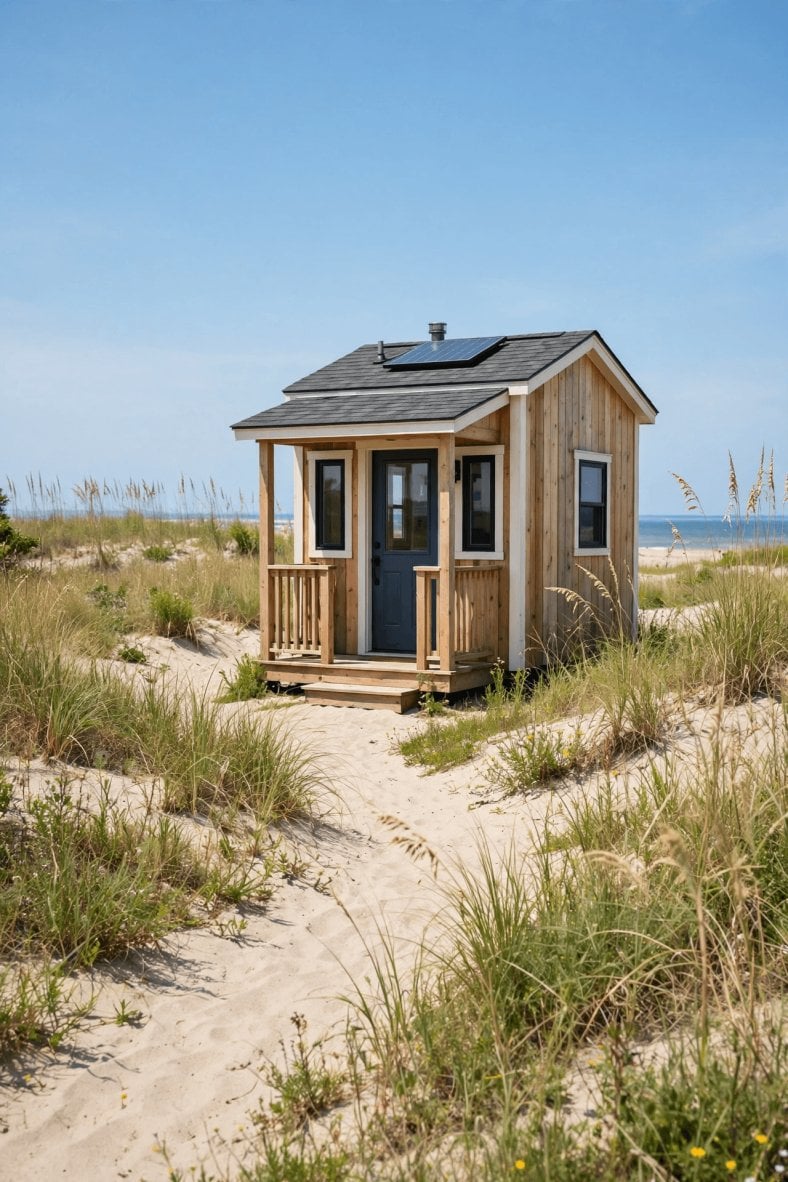
Tiny house laws in New Jersey — the permit trail at a glance: zoning sign-off first, septic where there is no sewer, then staged inspections to the certificate of occupancy.
Budget with New Jersey numbers, not national averages. Land dominates: a buildable, sewer-served lot in the northern half of the state can cost more than the entire tiny-house build, while southern and northwestern counties offer cheaper land in exchange for septic systems, well work and longer commutes. Add permit and inspection fees, utility tap fees where public water and sewer exist (frequently the single largest line after land), property taxes that are the nation’s heaviest and recur forever, and survey and engineering costs where the town requires them. The tiny house shrinks the construction budget; it does not shrink the cost of being allowed to build.
Documentation is the thread that holds the project’s value. Keep the permit set, every inspection sign-off, the septic or sewer approvals, the certificate of occupancy and — for ADUs — the ordinance compliance paperwork in one file. That file is what a future buyer’s attorney, an insurer and an appraiser will ask for, and in a state with New Jersey’s transaction formality, a small house with a complete paper trail sells like a house, while one without it sells like a problem.
9. Notable City and County Examples
The Pinelands townships of Burlington, Ocean and Atlantic counties offer the state’s most distinctive trade: large, wooded, comparatively cheap lots inside a federally designated reserve, governed by a regional development code on top of township zoning. Septic density rules there are written to protect the aquifer, minimum lot sizes in the preservation and forest areas can be very large, and some parcels carry development credits that must be bought or retired as part of building. Buyers who learn the overlay first find genuine room to build small; buyers who learn it second find they own a campsite.
At the other extreme, the older streetcar suburbs of Essex, Hudson and Bergen counties — and boroughs near rail lines across the north — are where ADU ordinances and small-lot housing traditions survive best. Lots are small, houses are close, councils face real affordability pressure, and a backyard cottage fits the existing pattern of carriage houses and converted garages. Prices, however, erase much of the tiny-house saving, and parking and coverage rules are enforced by neighbours who notice everything. In the northwest, Sussex and Warren counties offer the state’s most rural zoning and its cheapest land, at the cost of septic, well and winter — and shore towns add flood-zone construction standards and seasonal-rental economics on top of everything else. The pattern across all four regions is the same: the town, not the state, is the unit of decision.
10. Practical Steps to Go Legal in New Jersey
Step 1 — Choose towns before lots. Shortlist municipalities by reading their ordinances: no minimum dwelling size you cannot meet, an ADU section if that is your route, and rural or small-lot residential districts whose bulk numbers fit a small footprint. Two or three genuinely workable towns beat a statewide scatter of maybes.
Step 2 — Interrogate the specific lot. For each candidate parcel, confirm zoning district, lot size and width against the district minimums, sewer or septic status, flood zone, and any Pinelands or other overlay. A lot that fails one line of that check is not a bargain; it is a variance application waiting to bill you.
Step 3 — Get the zoning answer in writing. Meet the zoning officer with the parcel details and your footprint sketch, ask the questions from Chapters 4 to 6 directly, and leave with a letter or an email you can file. Verbal encouragement at a counter is not an approval.
Step 4 — Design to the construction code, on paper. Have plans drawn that satisfy the Uniform Construction Code’s room, egress, stair and energy rules without relying on unconfirmed relaxations, and put the foundation, utility connections and septic or sewer design on the same drawing set.
Step 5 — Prepare the land properly. Survey, clear, grade and set the foundation and utility runs in the order the site demands; the sequence in How to prepare land for a tiny house translates well to New Jersey lots, where tight side yards and mature trees make access planning half the job.
Step 6 — Engineer the utilities before you build. Decide water (public main or well), wastewater (sewer tap or permitted septic) and power with the town and county health department, not after framing; tiny house utilities: power, water and sewage explained covers the choices, and in New Jersey the sewer-versus-septic fork alone can swing the budget five figures.
Step 7 — Permit, build, inspect, occupy — in that order. Pull the construction permit, build to the approved plans, call every staged inspection, and move in only after the certificate of occupancy issues. Skipping the last step converts a legal house into an enforcement file, and New Jersey towns do enforce.
Final Considerations
New Jersey will not hand anyone a simple tiny-house yes, because no single authority in the state holds the whole answer — the construction code is statewide, but zoning, ADUs, minimum sizes and the Pinelands overlay are decided in town halls and a regional commission’s offices. That fragmentation is the state’s difficulty and also its opportunity: among 560-plus municipalities, some towns genuinely fit a small house today, with ordinances that allow it by right. The work is finding them before you spend, which is a research project of weeks that saves a legal fight of years.
Go in clear-eyed about the trade-off the state offers. What New Jersey charges — in land price, taxes, professional fees and patience — it partly repays in location: jobs, transit, shore and city access that few states match, wrapped around houses that cost less to heat, cool and maintain than anything else on their street. Pick the town first, get its answer in writing, build to the code, and keep every paper. Do those four things and a tiny house in New Jersey stops being a loophole hunt and becomes what it should be: a small, legal home in a very full state.