

New Mexico inverts the usual tiny-house script. In most states, a buyer fights zoning first and worries about utilities later; here, huge stretches of rural county land carry little or no zoning at all, land is cheap by national standards, and yet projects still fail — on water. This is a prior-appropriation desert state where every drop is spoken for on paper, where a parcel can be legally buildable and practically dry, and where the distance between a cheap lot and a usable homesite is measured in well depth, water rights and haul routes. Tiny House Laws in New Mexico reward the buyer who interrogates the water before the view: the well log, the State Engineer’s records, the neighbour’s experience, in that order.
This guide follows the order a New Mexico project actually flows: the legal status of wheeled versus foundation houses, the state construction codes and who enforces them, minimum sizes, the zoning patchwork from city codes to unzoned counties, water and septic in engineering detail, accessory dwellings, the places you can legally live full-time, permits and inspections, and regional examples from Taos earthship country to Albuquerque and the southern border counties. The headline to hold onto: permission is rarely the hard part in New Mexico — water, septic and distance are, and all three are knowable before you buy if you ask the right offices.
1. Tiny House Laws in New Mexico at a Glance
The table below answers the questions New Mexico readers ask first. Authority here is unusually dispersed — the state’s construction division, 33 counties, cities with their own codes, the State Engineer on water and the Environment Department on septic — so each answer names the body that will decide it for your parcel.
| Question | New Mexico in brief |
|---|---|
| Are tiny houses legal in New Mexico? | Yes. A small house on a foundation, permitted under the state construction codes, is a legal dwelling statewide. No state law sets a minimum house size or bans small homes; the practical gates are water, septic and — inside cities — local zoning. |
| What is the real gate for rural land? | Water. New Mexico allocates water under prior appropriation, domestic wells need a permit from the Office of the State Engineer, some basins are closed or restricted, and a dry or unpermittable parcel is a campsite no matter how cheap it was. |
| Is a tiny house on wheels a house or an RV? | An RV. Wheeled units register as vehicles and live legally in RV parks and campgrounds, or on private land only where local rules tolerate them — many unzoned rural areas are lenient in practice, but leniency is not a permit. |
| Which building code applies? | Statewide construction codes adopted by the Construction Industries Division, based on the international model codes with New Mexico amendments. Some cities and counties run their own permitting and inspection programmes under that umbrella; others route through the state. |
| How small can a house be? | No statewide minimum floor area applies. The code regulates rooms, ceiling heights and egress; a few cities add local minimums or design rules, and subdivision covenants in newer developments can be more restrictive than any code. |
| Are ADUs allowed? | Increasingly yes in the cities. Albuquerque has modernised its rules to allow accessory dwellings in most residential areas, and other cities are following their own versions — always with size, parking and occupancy conditions set locally. |
| Where can I live in one full-time? | In a permitted foundation tiny house, in a legal ADU, in a manufactured home (a mainstream housing form here), or long-term in RV parks that accept extended stays — the desert climate makes wheels a workable, if legally distinct, path. |
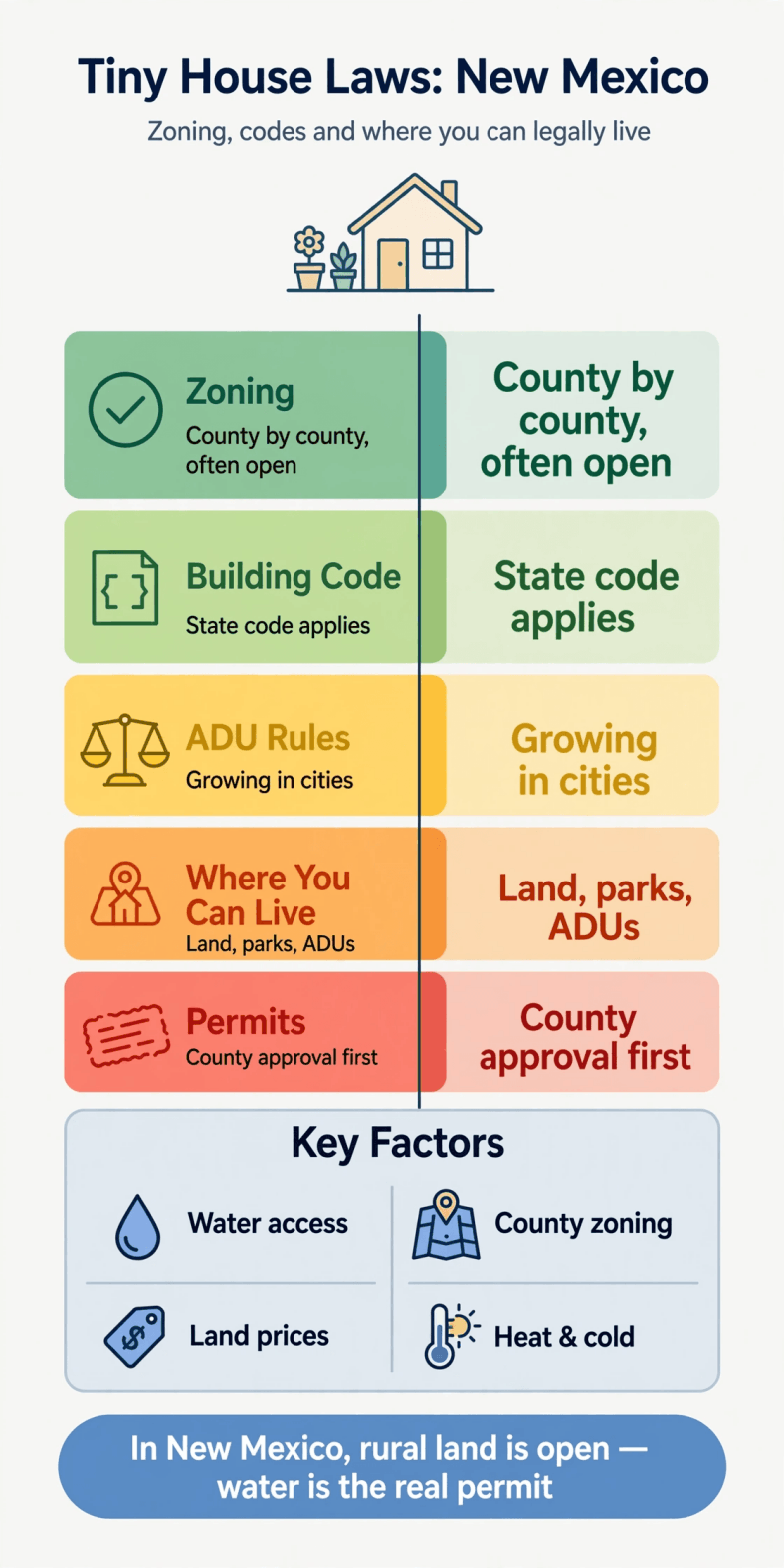
Tiny house laws in New Mexico — the whole picture on one chart: open counties, state codes, and water underneath everything.
Two New Mexico habits matter more than any single rule. First, verify water in writing — a well permit possibility, an existing well’s log and yield, or a community water system’s willingness to serve — before the land contract hardens, because land without water does not discount gracefully afterward. Second, pace your expectations for process: county permitting in rural New Mexico can be refreshingly light, but state-level pieces — well permits, septic approvals, electrical inspections — run on their own clocks, and a project planned around them finishes months ahead of one that discovers them in sequence.
2. Legal Status: Tiny Houses on Wheels vs on Foundations in New Mexico
A tiny house on a permanent foundation is a dwelling in New Mexico: permitted under the state construction codes, inspected, taxed as real property and protected by the same legal standing as any house. A tiny house on wheels is a recreational vehicle — titled through the motor vehicle system, built to vehicle or RV standards rather than the building code, and placed under the rules that govern vehicles and parks rather than houses. The distinction decides everything downstream: which permit office cares about you, whether a county can treat your home as a structure or as a parked vehicle, and what a lender or insurer will touch.
The wheels route is genuinely popular here, and the desert explains why: mild southern winters, deep RV infrastructure along the interstates and in snowbird country, and rural counties where enforcement attention is scarce. It still carries the standard wheeled risks — a park’s stay limits, a county’s complaint-driven enforcement, and no path to a certificate of occupancy. Buyers going this route should understand titling and certification before purchase, starting with how to register a tiny house as an RV and what RVIA certification means for a tiny house, since parks, insurers and border-state travel all ask about both.
Foundation builders get the opposite bargain: a slower, paper-heavier start and a far more durable finish. New Mexico’s manufactured-housing tradition matters here too — factory-built HUD-code homes are a normal, accepted housing form across the state, administered through the state’s manufactured housing regulators, and a small modular or manufactured unit can be a fully legal tiny dwelling where a site-built one is impractical. Whichever product you choose, confirm its category with the permitting office before money moves: site-built, modular and manufactured units travel through different paperwork even when they end up looking identical on the lot.
3. Building Codes for Tiny Houses in New Mexico
Construction law in New Mexico is state-led. The Construction Industries Division adopts statewide building, residential, plumbing, mechanical and electrical codes built on the international model codes with state amendments, and licensed contractors and inspectors work to that single standard from the Colorado line to the Mexican border. For tiny houses, that uniformity is a gift: a design that satisfies the state residential code in one county satisfies it in every county, and plan review is an argument about the code text, not about local taste.
Enforcement is the variable part. Larger cities and some counties operate their own building departments under the state framework and issue permits locally; in much of rural New Mexico, permits and inspections run through the state’s own offices and inspectors, sometimes with real travel distances and scheduling lead times. Ask on day one which desk your parcel answers to — city hall, the county, or the state — because submitting to the wrong desk is the most common unforced error in rural projects here.
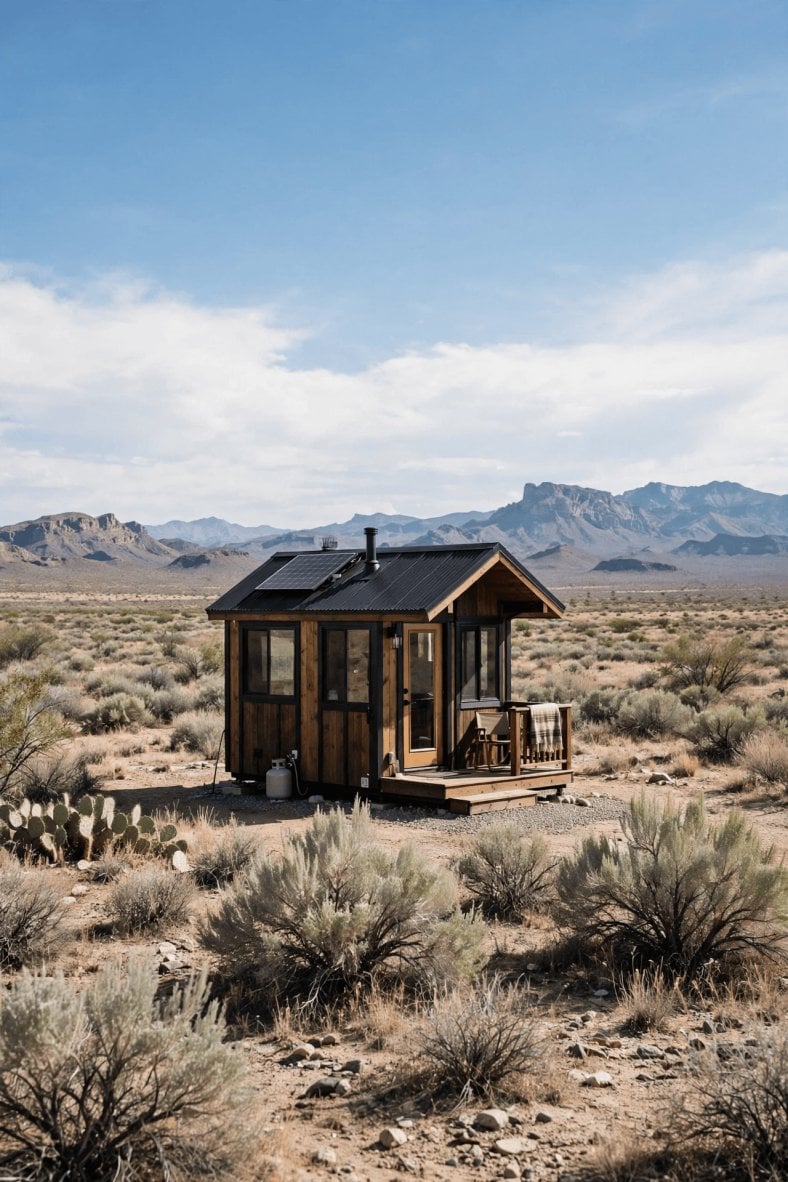
Tiny house laws in New Mexico — pin this overview for the build: state codes on top, county permitting underneath, water below it all.
The design details the code will test in a small high-desert house are predictable. Altitude and climate drive the engineering: at 5,000 to 7,000 feet, winter design temperatures bite, passive-solar gain is a genuine heating strategy (this is the state that normalised it), and roof and floor insulation values plus air sealing decide January comfort more than furnace size. Sleeping lofts still need code-compliant egress, guards and access; wood stoves — common here — need listed clearances and proper flues; and off-grid electrical systems still fall under the electrical code and inspection, however independent they feel. The small-house relaxations described in IRC Appendix Q for tiny homes are worth raising with your permit desk, but verify whether the current state adoption includes them and design so the house passes either way.
Septic deserves its own sentence in any code discussion, because in rural New Mexico it is half the permit. On-site liquid waste systems are regulated through the New Mexico Environment Department’s programme: soil and site evaluation, system design sized to bedrooms, setbacks from wells and waterways, and a permitted installer. A parcel whose soils or groundwater fail evaluation is unbuildable at any house size — which is why the water-and-septic pair, not the code book, opens and closes most rural projects in the state.
4. Minimum Size Rules in New Mexico
New Mexico sets no statewide minimum dwelling size, and neither does its state residential code in the way buyers fear: the code regulates habitable-room floor areas and dimensions, ceiling heights, light and ventilation, and emergency egress from sleeping rooms. A compact house in the 300-to-600-square-foot range can satisfy every one of those room rules with ordinary design care. When a permit desk questions a small plan here, it is nearly always about a loft’s headroom, a stair’s geometry or an egress window — specific, fixable items — not about the house being small.
Local layers can still add size back in. A few cities carry minimum floor-area or width rules in particular districts, historic and design-review districts (Santa Fe’s are the famous example) regulate form and materials in ways that constrain tiny designs, and private subdivision covenants — common in the ranchettes carved up around Albuquerque, Las Cruces and Santa Fe in recent decades — frequently impose minimum house sizes larger than anything the code requires. Covenants are private law: the county will not warn you about them, and they survive every permit you pull.
The practical sizing strategy in New Mexico is therefore a document strategy: read the recorded covenants and any city rules for the specific parcel, size the house to clear the largest of them, and keep the floor plan efficient rather than minimal. A 480-square-foot house with a real bedroom, a legal loft and a full bathroom passes more desks, more covenants and more future buyers than a 240-square-foot statement piece — and in a state with this much open land, the savings from shaving the last hundred square feet are rarely worth the friction.
5. Zoning and Placement Rules
Zoning in New Mexico is a tale of two legal worlds. Inside the cities and the urbanised counties, conventional zoning applies: Albuquerque’s integrated development ordinance, Santa Fe’s code, Las Cruces and the county ordinances around them assign districts, uses, setbacks and lot standards much like anywhere in America. Outside them, many rural counties have no zoning ordinance at all, or only fragments covering specific areas — land use is then governed by the building code, septic and well rules, subdivision law, floodplain rules and covenants, full stop. For a tiny-house buyer, that means entire counties where the placement question reduces to: can it be permitted, can it get water, can it pass septic.
Unzoned does not mean unregulated, and the remaining layers have teeth. Subdivision law governs how land was split and whether your parcel was legally created; floodplain rules control arroyo crossings and low ground — in a monsoon state, the dry wash behind a cheap lot is a design input, not scenery; manufactured-housing and RV placement rules apply in some counties even without general zoning; and the state’s cultural landscape adds acequias — community irrigation ditches with legal easements and governance centuries old — crossing land that listing photos show as empty. Walk the parcel, pull the records, and treat every ditch, wash and easement as a placement rule already written.
In zoned territory, the workflow is the familiar one: confirm the district, check that a single-family dwelling (or an ADU, or a manufactured home) is a permitted use, verify setbacks and lot coverage against your footprint, and get the answer tied to the parcel in writing. The method in how to talk to zoning officials about tiny houses — parcel first, questions in order, confirmation in writing — is doubly valuable in New Mexico, where the official you need might be a city planner, a county staffer or a state inspector depending on the parcel, and finding the right desk is half the conversation.
6. ADU Rules in New Mexico
Accessory dwelling units are the urban growth story in New Mexico’s small-housing world. Albuquerque — where most of the state’s urban population lives — has rewritten its rules in recent years to allow accessory dwellings across most residential zones, treating casitas as a normal part of the housing stock; Santa Fe and other cities operate their own ADU provisions with local conditions. The pattern of conditions is the standard one — size caps relative to the main house, on-site parking in some districts, owner-occupancy or registration requirements in some versions — but the direction of travel is clearly permissive, and in a city with Albuquerque’s lot sizes, a backyard casita is often the cheapest legal small home in the state.
Conversions follow the same code as anywhere: a garage or barn conversion needs legal ceiling heights, egress from the sleeping area, fire separation, and permitted plumbing and electrical work, with septic capacity re-checked where the property is unsewered — adding a bedroom to a septic permit is a real step in New Mexico, not a formality. Casitas have deep cultural roots here (the attached or courtyard guest unit is a traditional form), which softens design-review conversations that would stall the same proposal in a stricter state.
Rural ADUs are a different animal: where no zoning exists, a second small dwelling on a large parcel is often simply a second permitted house, and the binding questions revert to water and septic — a second well or a shared one, a second or enlarged septic system, and a second electrical service or a sub-panel arrangement. Even so, record the arrangement properly: two dwellings sharing one septic beyond its permitted bedroom count is exactly the kind of quiet violation that surfaces at resale and refinancing, anywhere in the state.
7. Where You Can Legally Live Full-Time
The full-time menu in New Mexico is broad: a permitted foundation tiny house anywhere the parcel passes water, septic and any zoning; a legal ADU in the cities that allow them; a manufactured home on owned land or in a community — a mainstream, financeable choice here rather than an edge case; and long-term RV living, which the state’s snowbird economy supports with parks built for multi-month stays, especially in the southern half where winters are gentle. Each route is genuinely viable, which is more than most states offer; the work is matching the route to the specific parcel and paperwork rather than to the dream.
Earthship country deserves an honest paragraph, because Taos draws more tiny-house dreamers than any place in the state. The earthship communities northwest of Taos — tire-and-earth homes built around passive solar, water catchment and internal food production — exist under special experimental and subdivision arrangements negotiated over decades; they are a specific place with specific rules, covenants and resale channels, not a statewide permit category. Admire them, visit them, learn the thermal lessons from them — but do not assume any county will permit a copy on raw land. The legal route to an earth-sheltered or high-mass tiny house runs through the same state code and permit desks as any other house, with engineering to match.
Choosing between community forms, use the lens of tiny house communities versus RV parks: in New Mexico the manufactured-home community on owned-versus-leased land question matters most, because land-lease parks here range from well-run cooperatives to lots whose rent grows faster than the homes’ value. On your own permitted land, none of that applies — which is why, in a state with cheap rural acres, the foundation route on owned land is the benchmark every other option should be priced against.
8. Permits, Inspections and Costs
The permit sequence for a foundation tiny house runs: confirm the permitting desk (city, county or state Construction Industries Division); submit plans under the state codes; obtain septic approval from the Environment Department’s liquid waste programme where unsewered, and any well permit from the Office of the State Engineer, in parallel; then build through staged inspections — foundation, framing, rough-in trades, insulation, and finals — to a certificate of occupancy. Trade permits for electrical and plumbing may be pulled separately by licensed contractors; in much of rural New Mexico, expect inspector travel and schedule lead time to shape your calendar more than the work itself.
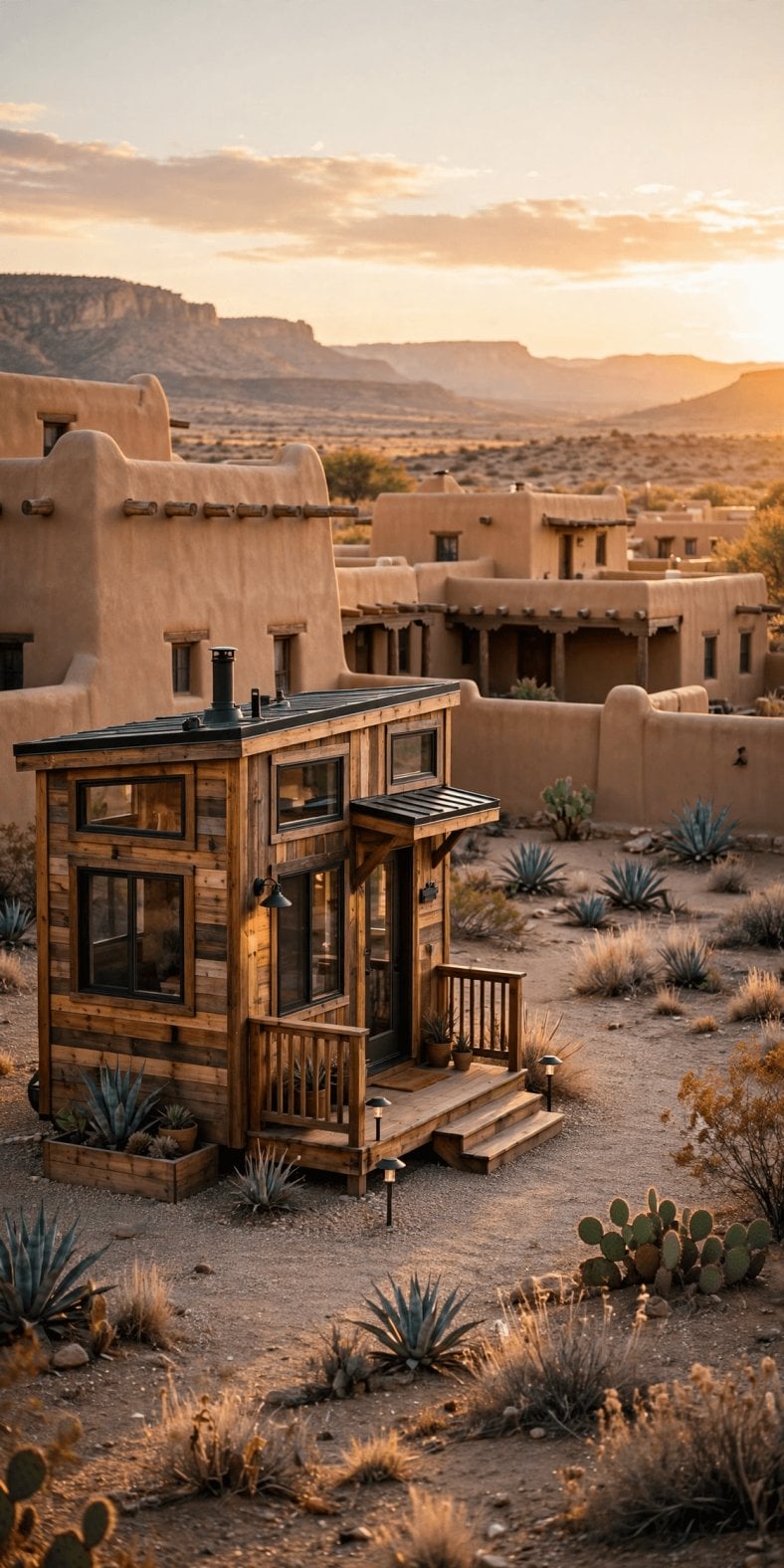
Tiny house laws in New Mexico — the permit trail at a glance: find your desk, line up water and septic, then build through the staged inspections.
Costs in New Mexico reward the small builder — with asterisks. Land is cheap across the rural counties and merely moderate outside Santa Fe, whose market is the state’s great exception and should be budgeted as a different planet. The asterisk line items: wells, whose drilling cost scales brutally with depth and whose dry holes are billed the same as wet ones; septic systems sized and sited by the Environment Department’s rules; electrical service extensions across open land, priced by the metre; and propane, water-hauling or solar infrastructure where services end. A realistic rural budget often spends as much preparing the land as building the house — normal here, and the reason the land maths must include utility distances from the first viewing.
Keep the paper: permit, stamped plans, inspection record, septic permit and as-built, well permit and driller’s log, and the certificate of occupancy. New Mexico’s rural property market runs on cash and informality more than most, and a small house with a complete file appraises, insures and resells at a different level than the identical house without one — especially when a buyer’s lender, often from out of state, asks the questions the seller never did.
9. Notable City and County Examples
Taos County pairs the state’s most famous alternative-building culture with real county permitting and genuine winters — the earthship mesas sit a short drive from conventional subdivisions, ski-valley prices bend the land market upward, and high-altitude design (snow loads, freeze protection, passive gain) is non-negotiable engineering. Los Alamos aside, the northern tier generally trades higher land costs and colder design conditions for water that is comparatively findable. Albuquerque and Bernalillo County offer the urban version of the tiny life: ADU-friendly city rules, full services, older small-lot neighbourhoods where a compact house fits the street pattern — and city process to match. Santa Fe is the premium exception to every New Mexico rule of thumb: deep demand, design and historic review, and prices that erase the tiny discount unless an ADU on family land is the play.
The south writes its own chapter. Las Cruces and Doña Ana County combine a real city code with desert land at working prices and the mildest winters in the state; the border and bootheel counties beyond — Luna, Grant, Hidalgo — offer the cheapest land and the thinnest services, where Deming and Silver City anchor islands of infrastructure in very open country. The eastern plains counties, built on ranching and oil, have land, wind and distance in equal measure. Across all of them, the verification sequence is identical: which permit desk, what water, what septic, what covenants — four questions that sort the entire state faster than any price filter.
10. Practical Steps to Go Legal in New Mexico
Step 1 — Pick your region by water, not by photos. Shortlist areas by basin: check with the Office of the State Engineer whether domestic well permits are available and typical well depths locally, and treat closed or restricted basins as ADU-and-city-water territory instead.
Step 2 — Find your permit desk. Determine whether the parcel permits through a city, a county department or the state Construction Industries Division, and get that office’s residential checklist before designing a single wall.
Step 3 — Interrogate the specific parcel. Pull covenants, confirm legal lot creation, walk the arroyos and easements, and order a septic site evaluation early — soils answer questions that listings never raise.
Step 4 — Secure the water in writing. An existing well’s log and a pump test, a new well permit’s realistic prospects, or a community system’s service letter — one of the three, documented, before the purchase closes.
Step 5 — Prepare the land properly. Access, grading that respects desert drainage, pad and foundation placement above the wash lines: the sequence in How to prepare land for a tiny house adapts directly, with monsoon drainage doing the work that frost does elsewhere.
Step 6 — Engineer the utilities as a system. Well or haul tank, septic sizing, solar-plus-propane or grid power — decide them together with the permit desks, guided by tiny house utilities: power, water and sewage explained, because in this state the utility plan is the building plan.
Step 7 — Permit, build, inspect, occupy — in that order. Build to the state code through the staged inspections and take the certificate of occupancy before moving in; a legal tiny house in New Mexico is an asset anywhere, and an unpermitted one is a story you will tell a buyer’s lawyer later.
Final Considerations
New Mexico is, on paper and often in practice, one of the most permissive states in this series for going small: state codes that do not fear compact houses, counties that ask few land-use questions, a manufactured-housing culture that never needed convincing, and cities actively legalising casitas. Its discipline is physical instead of legal — water that must be permitted and found, soil that must accept a septic system, distances that turn every service into a line item. Buyers who respect the physical gates find the legal ones mostly open.
Go in with the trade priced honestly. What New Mexico gives — space, sun, silence, and land a working person can still buy — it balances with self-reliance: your water system, your wastewater, your power resilience are yours to engineer and maintain. For the right owner that is not a drawback but the entire point, and a small, well-built house is the most maintainable version of that life. Find the water first, permit the house properly, and keep every document: do that, and a tiny house in New Mexico stands on the firmest ground the desert offers — paper that matches the land.