

Standing at the DMV counter with paperwork for your house feels absurd the first time — but a tiny house on wheels is a vehicle until the state says otherwise, and an unregistered one cannot be legally towed, properly insured, or financed. This walkthrough covers the whole registration path: the VIN, the title, certification, weight ratings and the DMV visit itself, in the order the state will ask for them.
How to Register a Tiny House as an RV: At a Glance
Registration is the bureaucratic foundation everything else stands on. Until your tiny house on wheels carries a title, a VIN record and a current registration in your state of residence, it sits in a legal grey zone: towing it on public roads is technically unlawful, insurers will not write it as an RV, and lenders will not touch it with an RV loan. Learning how to register a tiny house as an RV is therefore not the last step of a build or a purchase — it is the step that makes every other step possible. The good news is that the process is genuinely manageable once you understand its one central idea: you are registering the trailer, not the house.
The walkthrough below follows the same sequence the state does. First comes the identity of the trailer — what it is in law, and the 17-digit VIN that names it. Then ownership, through titling, and the RVIA certification that the world around the DMV will ask about. Then the numbers — weight ratings — and the visit itself, the licence questions that follow, and the habits that keep the registration alive afterwards: renewals, interstate moves and domicile. The table summarises all ten steps before we walk them one by one, and the closing section condenses them into the checklist you can run before the first tow.
| Step | What It Covers | Key Figure | Why It Matters |
|---|---|---|---|
| 1. What You Are Registering | The trailer is titled; the house rides as cargo or conversion | Terminology varies by state | Every DMV form asks about the trailer |
| 2. The VIN | The 17-digit identity fixed to the trailer frame | 2–8 weeks for a state-assigned VIN | No VIN, no registration |
| 3. Titling the Trailer | MCO, sign-over or state titling proves ownership | Check for liens first | The title is your legal proof of ownership |
| 4. RVIA Certification | Build standard inspected during construction | NFPA 1192 | Unlocks loans, insurance and park admission |
| 5. Weight Ratings | GVWR set against the house’s actual weighed weight | CAT scale weigh-in: $15 | Overweight means illegal to tow and uninsurable |
| 6. The DMV Visit | The document packet and the fee | Fees $50–300 | A complete packet makes it a 20-minute errand |
| 7. Licence & Towing Law | Thresholds, width, length and towing speeds | Max width 8.5 ft; towing caps 55–65 mph | The wrong licence class is its own violation |
| 8. Renewal & Plates | Annual or biennial renewal | $50–200 | Expired plates are a guaranteed traffic stop |
| 9. Moving Between States | Domicile decides where you register | TX, FL and SD are the popular choices | Registration follows residence, not location |
| 10. The Registration Checklist | The pre-tow verification pass | 8 checks | Catches gaps while they are still cheap to fix |
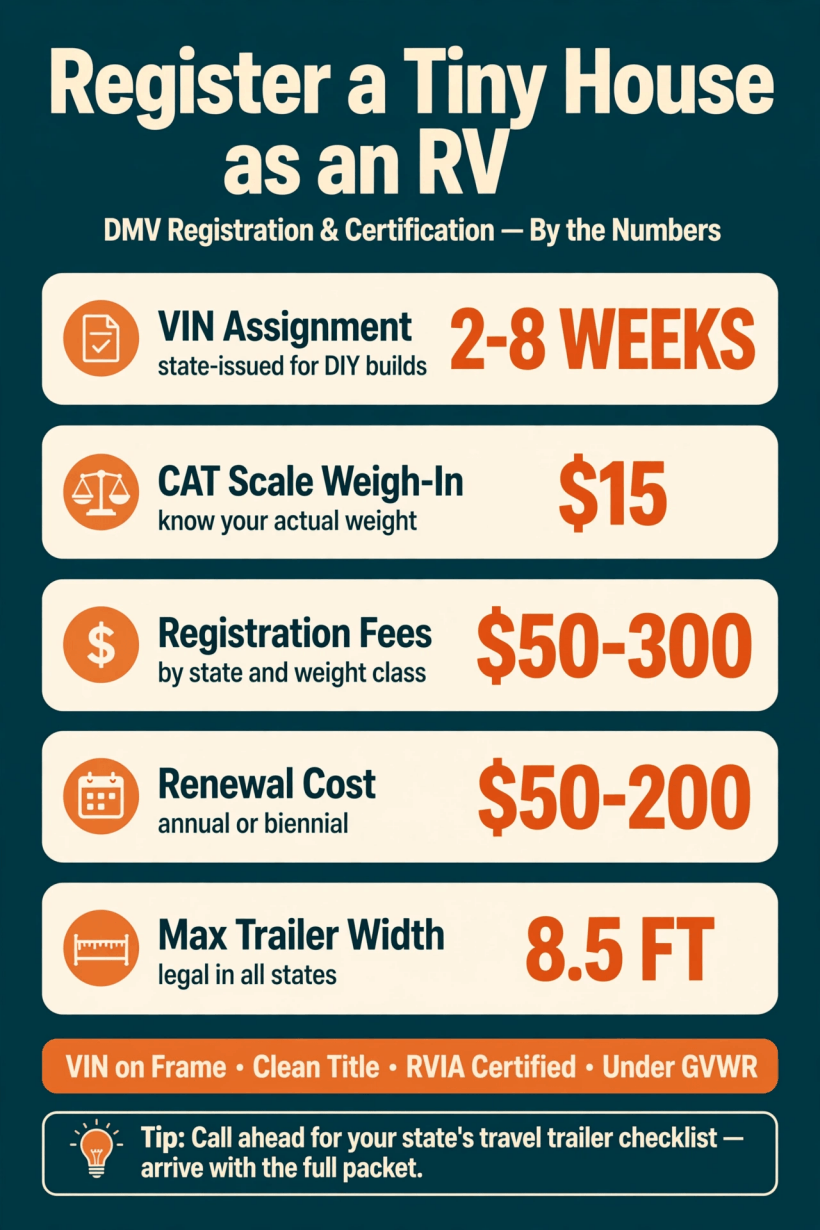
Registration by the numbers: a state-assigned VIN takes 2–8 weeks, a CAT scale weigh-in costs $15, first registration runs $50–300 depending on state and weight class, renewals run $50–200, and the trailer is capped at 8.5 feet wide in every state.
1. Understand What You Are Registering: The Trailer, Not the House
Every registration conversation goes better once this is clear: in nearly every state, you register the trailer, not the house built on it. The tiny house on wheels is titled and registered as a travel trailer, a park trailer or a recreational vehicle — the terminology varies by state — and the house itself is treated in law as the trailer’s cargo or conversion. The registration attaches to the VIN on the trailer frame, and the house rides on that registration wherever it goes.
This distinction shapes every form you will touch. DMV paperwork asks about the trailer — its axles, its weight, its length — and never about the floor plan, the loft or the kitchen. It also explains why the steps in this guide run in the order they do: identity first, through the VIN; ownership second, through the title; and only then the house-side questions of certification and weight. Owners who arrive at the DMV thinking like homeowners leave confused; owners who arrive thinking like trailer owners leave with plates. If you are still at the shopping stage, our tiny house trailer buying guide explains why the trailer decision is the foundation — literally — of everything that gets registered later.
2. The VIN: Your House’s 17-Digit Identity
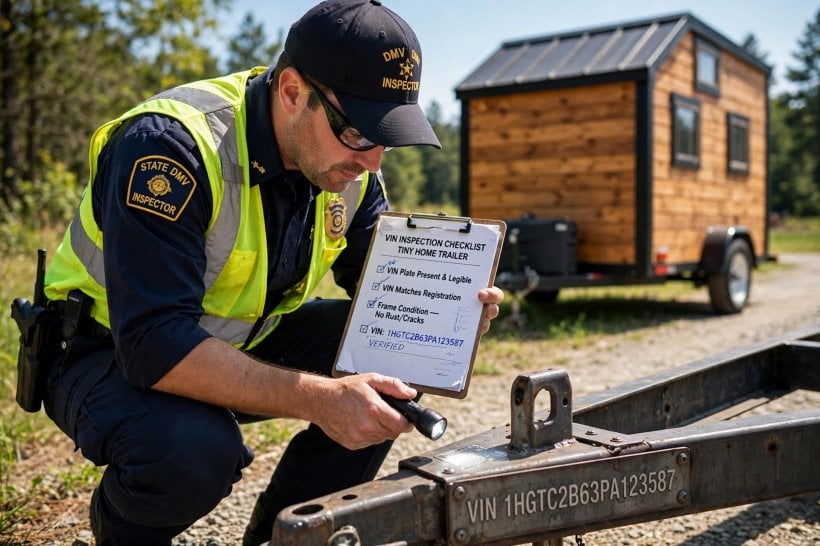
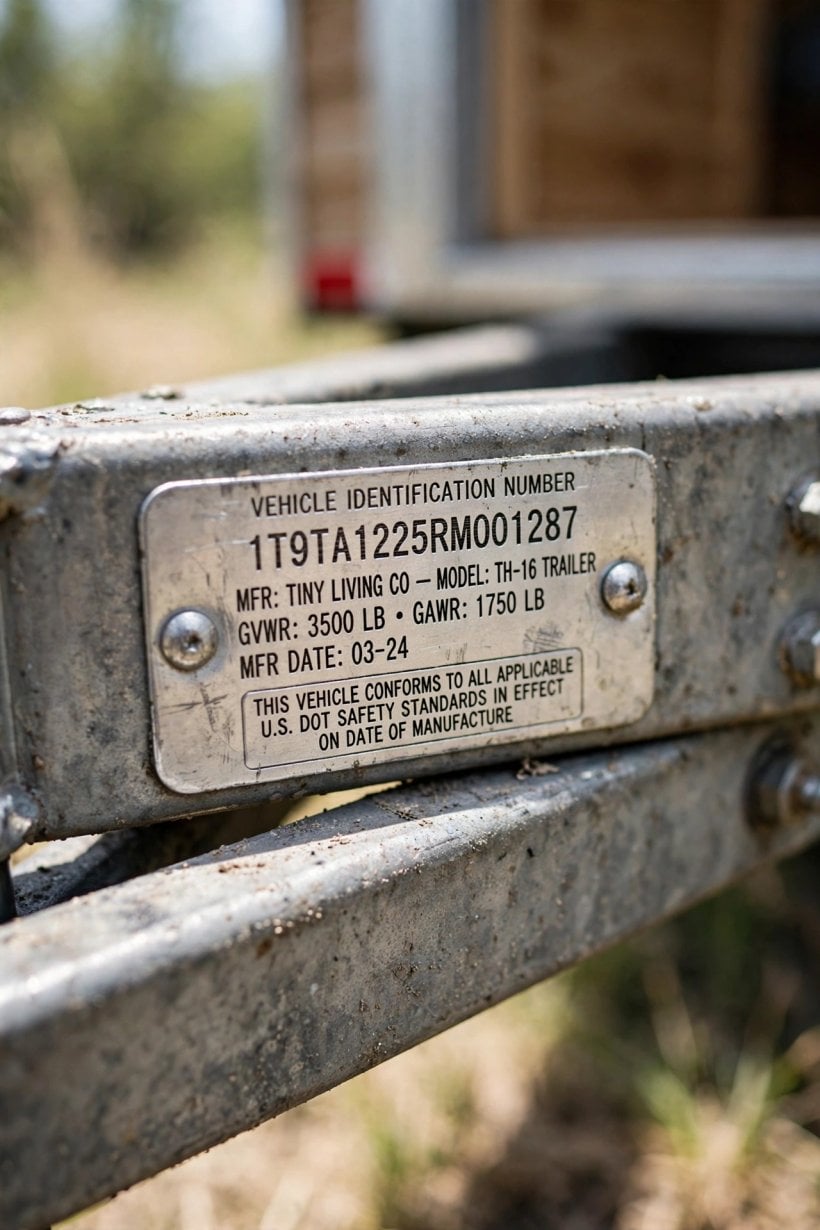
Every registrable trailer needs a Vehicle Identification Number — 17 digits that function as the house’s social security number in every state system it will ever meet. Factory-built tiny houses arrive with a VIN already on the trailer frame, and your first job on delivery day is unglamorous but essential: find it, read it, and verify it matches the paperwork character for character before accepting delivery. A single transposed digit will follow you through titling, insurance and every renewal that follows.
DIY builds take the longer road. A house built on a trailer without a usable VIN needs a state-assigned VIN, and while the process varies by state it generally involves a VIN inspection by law enforcement or the DMV, submission of your build receipts and photos, and issuance of a state VIN plate. Start early: the process takes 2–8 weeks in most states, and nothing downstream — no title, no registration, no insurance binder — can finish until it completes. When the plate arrives it must be permanently affixed to the trailer frame, riveted or welded rather than screwed, in a visible location, typically on the tongue. Photograph it once it is mounted; you will need that photo for insurance and financing.
3. Titling the Trailer: Proving the House Is Yours
If the VIN is identity, the title is ownership — the state’s official answer to the question of whose house this is. The route to a title depends on how the house reached you. Buy new from a builder and the builder provides a Manufacturer’s Certificate of Origin (MCO) for the trailer; you take the MCO to the DMV and receive a title in your name. Buy used and the seller signs the existing title over to you — but verify there are no liens on it first, because a lienholder’s claim survives the sale and can end with your house repossessed over someone else’s debt.
DIY builds split by trailer. Build on a new trailer and the trailer manufacturer’s MCO titles the trailer; the house you construct on top of it needs no separate titling of its own. Build on a homemade trailer and the state-assigned VIN process usually includes titling as part of the same proceeding — one of the few efficiencies in the whole system. Whichever route you take, guard the title like the deed it functionally is: every later transaction, from registration renewal to resale, reaches back to it, and a clean, unbroken title chain is what makes the house sellable, insurable and financeable years from now.
4. RVIA Certification: Optional at the DMV, Essential Everywhere Else
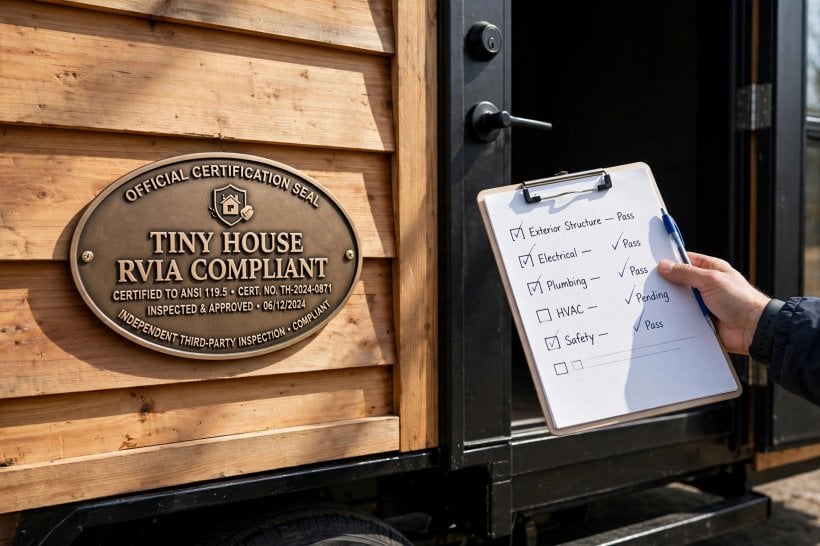
Here is the quirk at the centre of tiny house registration: RVIA certification is not legally required for DMV registration in most states — and is practically required for everything around registration. The Recreational Vehicle Industry Association certifies that a house was built to NFPA 1192, the RV standard, and inspected during construction rather than after the walls closed. The DMV may never ask about it. Everyone else will.
Lenders require it before they will write an RV loan, which is why the certification question belongs in the same conversation as how to finance a tiny house. Insurers require it before they will cover the house as an RV — the full picture is in our tiny house insurance guide for wheels vs foundation. And RV parks routinely require it for admission, turning an uncertified house away at the gate regardless of how clean its registration is. The practical translation: if you are buying, treat RVIA certification as mandatory even where the law does not. If you are building DIY, walk in with open eyes — the uncertified path closes most financing and insurance doors, and no amount of careful paperwork reopens them later.
5. Weight Ratings: The Numbers the DMV Actually Cares About
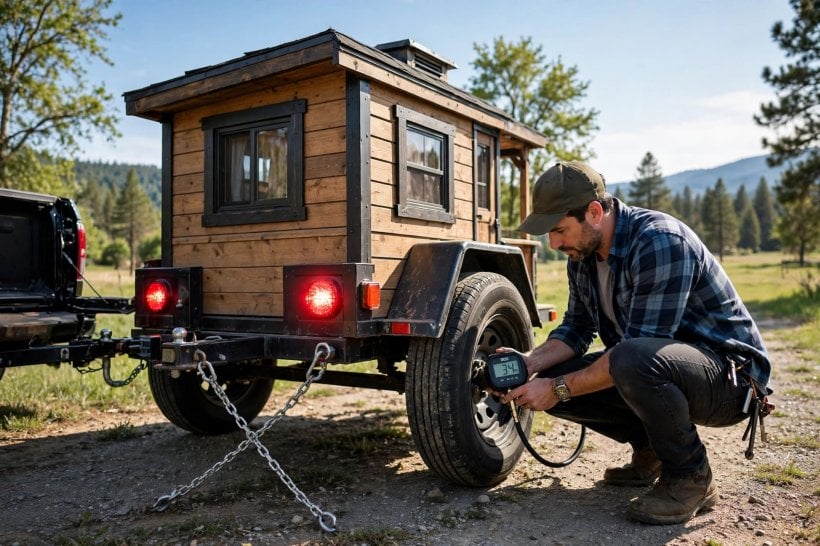
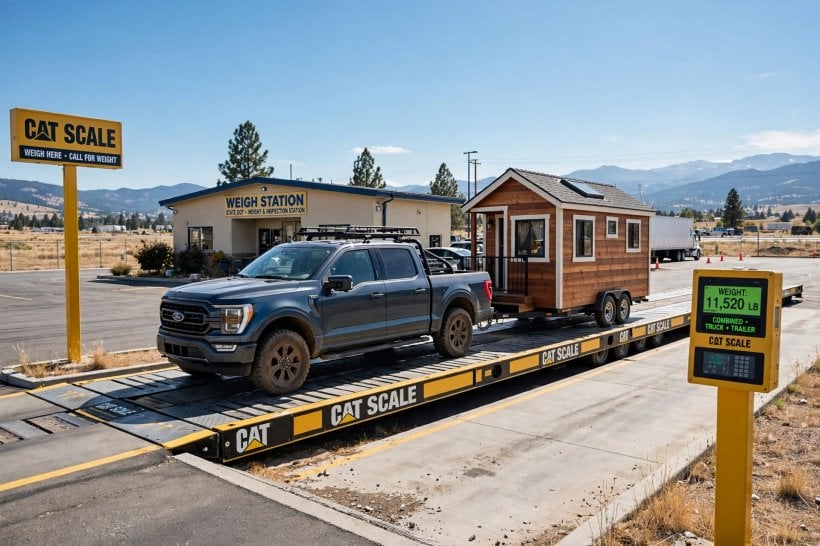
The DMV cares about weight more than any other number on the form, and you need three of them cold. First, the trailer’s GVWR — Gross Vehicle Weight Rating — the maximum the trailer can legally weigh, set by its manufacturer. Second, the house’s actual weight, which you do not estimate: you weigh it on a CAT scale — $15; do this — at a truck stop. Third, your tow vehicle’s own ratings, its GCWR and tongue weight capacity, because the combination has to be legal as a unit, not just piece by piece.
The relationship between the first two numbers is unforgiving. If the house exceeds the trailer’s GVWR, it is overweight — illegal to tow and uninsurable, full stop. Many DIY tiny houses are overweight; the scale does not negotiate. The weighing method matters too: weigh the tow vehicle alone, then the combination, and the difference is the trailer’s actual weight — and do it before the first tow, not after the first ticket. Our walkthrough of how to calculate your tiny house’s weight covers the estimation side before the scale, and the weight limits, GVWR and axle ratings guide covers what the ratings mean for your tow vehicle pairing.
6. The DMV Visit: Bring the Packet, Leave with Plates
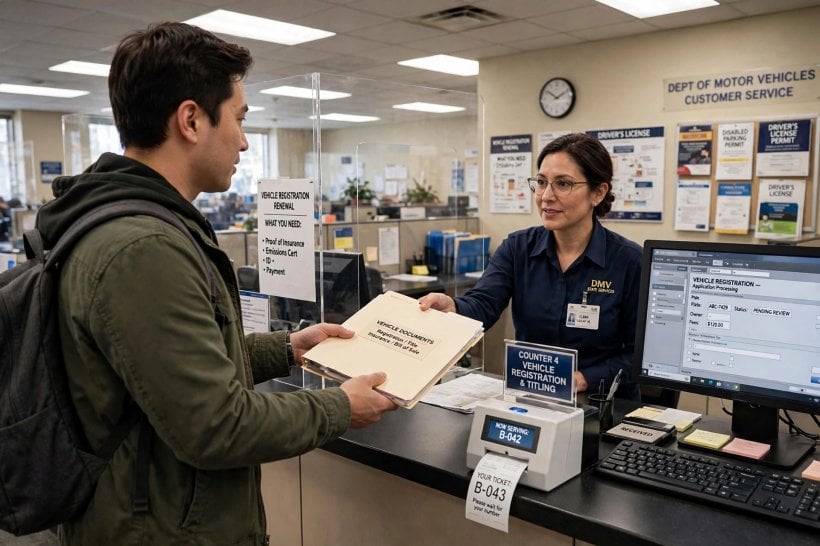
The visit itself is won or lost before you leave home. The standard packet is: title or MCO, VIN documentation, bill of sale, proof of insurance — many states require insurance bound before registration, not after — your ID, and payment, with registration fees running $50–300 depending on state and weight class. Some states also require a safety inspection of brakes, lights and tires before they will issue plates, which is one more appointment to have behind you rather than ahead of you when you reach the counter.
The highest-yield preparation costs nothing: call your DMV ahead and ask for the “travel trailer registration requirements” checklist. Every state publishes one, and it converts guesswork into a shopping list. Arriving with the complete packet turns a bureaucratic ordeal into a 20-minute errand; arriving without one document turns it into two trips and a story you will tell other tiny house owners as a warning. Treat the checklist call as part of the process itself, not a shortcut around it — the states that publish the clearest checklists are, not coincidentally, the ones where the visit goes fastest.
7. Licence, Endorsements and Towing Law
Registration makes the house legal; your licence makes you legal to move it. A standard driver’s licence covers most tiny house towing, but the ceiling is set by state law — trailers under 10,000–26,000 lbs depending on the state — so check your state’s threshold against your weighed number from the CAT scale, not the brochure number. Above the threshold you may need a non-commercial Class A or B licence: a written and skills test, not a CDL. Discovering that requirement at a traffic stop is the expensive way to learn it.
Three more legal dimensions ride along with every tow. Maximum trailer width is 8.5 feet in all states; anything wider needs oversize permits per trip. Maximum length is state-dependent, typically 40–45 feet for the trailer. And towing speed limits are their own rules in many states, capping towing at 55–65 mph regardless of the posted limit for cars. None of these numbers is difficult to learn or hard to obey; all of them are the kind of detail that separates a boring, uneventful tow from an educational one.
8. Renewal, Plates and Keeping It Current
Registration is not a one-time achievement; it is a subscription. RV and trailer registration renews annually or biennially at $50–200, and keeping it current is the cheapest legal protection in this entire guide. Expired plates during a tow are a guaranteed traffic stop, and a traffic stop on an 8.5-foot-wide house is a bad day that tends to get worse as the officer walks around the trailer checking the rest of the paperwork.
Even a house that sits stationary for years should stay registered. Some states allow non-operational status — cheaper, and legitimate while the house is parked — but the house cannot be legally towed again until it is re-registered, which is a poor surprise to discover on moving day. The standing advice is simple: maintain the registration even when parked. The cost is trivial against the risk, and a current registration also keeps the paper trail warm for insurance, park admission and any future sale, when the next owner will run exactly the lien and title checks this guide taught you to run.
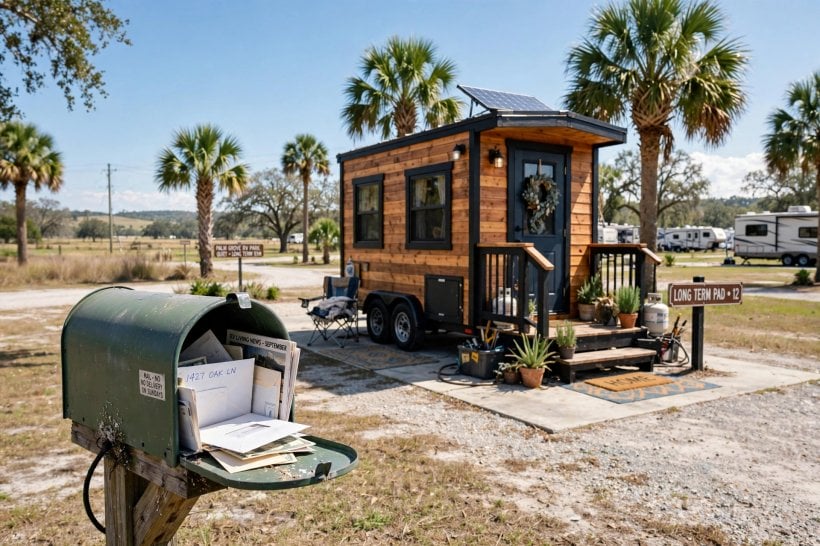
9. Moving Between States: Domicile Decides
Registration follows your state of residence — your domicile — not the house’s location. A tiny house parked in one state on plates from your domicile state is perfectly ordinary; the improvised reverse is where trouble starts. Full-time travellers therefore choose their domicile deliberately. Texas, Florida and South Dakota are the popular choices, combining no income tax with mail-forwarding infrastructure and straightforward vehicle registration — a combination built for people whose address is a house on wheels.
Changing domicile is a legal process, not a mood: declare intent, get your driver’s licence there, register your vehicles there, and vote there. Do it properly once rather than improvising across state lines, because insurers, lenders and officers all read the same paper trail, and inconsistencies in it invite questions you do not want. Where the house physically rests between moves is a separate question — our guide to where to park a tiny house covers the placement side, and the tiny home communities locator covers the communities full-timers rotate through. Domicile is the legal home; parking is just geography.
10. The Registration Checklist: Run It Before the First Tow
Everything above condenses into eight verifications. Run them in order; each one is cheap to fix at a desk and expensive to discover on a road.
- VIN verified — on the frame, riveted or welded, and matching all paperwork character for character.
- Title clean — no liens; MCO from the builder for new units, a properly signed-over title for used ones.
- RVIA certification documented — in hand for financing, insurance and park admission.
- Weight verified — on a CAT scale, and under the trailer’s GVWR.
- Insurance bound — before the DMV visit, where your state requires it.
- DMV packet complete — title, VIN documents, bill of sale, ID and payment.
- Licence adequate — for the weighed weight, checked against your state’s threshold.
- Renewal calendared — annual or biennial; never tow on expired plates.
A house that passes all eight is not merely registered; it is boring in the best way — legally towable, insurable, financeable and admissible to parks, with nothing left to improvise at a counter, a gate or a roadside.
Final Considerations
Registering a tiny house as an RV is unglamorous paperwork that unlocks everything else: legal towing, insurance, financing and park admission. Do it first, do it correctly, and keep it current. The sequence matters as much as the steps — identity before ownership, weight before the visit, insurance bound before the counter asks for it — because each stage quietly depends on the one before, and the cheapest time to discover a gap is always at home, with the packet spread on the table.
None of it requires a lawyer, a broker or luck; it requires learning how to register a tiny house as an RV once, properly, and then treating the registration as part of the house itself. The registered tiny house on wheels is a vehicle with rights. The unregistered one is a very large liability with a nice kitchen. Bring the packet, leave with plates, and let every trip after that be about the road instead of the paperwork.




29 Comments