

New York is two housing countries sharing one flag. Downstate — the city, Long Island and the lower Hudson Valley — land is priced like a luxury good, zoning is dense and defensive, and a spare bedroom can out-earn a salary. Upstate, whole counties of farmland, mill towns and mountain villages offer acres for the price of a downstate parking space, under town boards that may meet once a month in a hall with a wood stove. A single statewide building code sits over both countries, and it is friendlier to small houses than most: New York’s residential code carries the tiny-house provisions of the model code’s Appendix Q inside its framework. Tiny House Laws in New York reward buyers who decide which New York they are actually buying in — because the rules, the prices and the pitfalls differ more across the Hudson than across most state lines.
This guide works through the state in project order: wheeled versus foundation legal status, the state building code and its tiny-house appendix, minimum sizes in code and in town law, zoning and placement at town and village level, the fast-growing accessory dwelling rules, where you can legally live full-time, permits and inspections, and regional examples from the Adirondacks to New York City’s backyard-cottage frontier. The honest headline: construction permission in New York is unusually standardised, so projects here are won and lost on zoning, land cost and septic — and those three are decided locally, town by town, lot by lot.
1. Tiny House Laws in New York at a Glance
The table below answers the questions New York readers ask first. Authority in this state splits cleanly — a state building code nobody local can rewrite, zoning written by cities, towns and villages, an Adirondack overlay in the north and a separate code universe inside New York City — so each answer names the level that decides it.
| Question | New York in brief |
|---|---|
| Are tiny houses legal in New York? | Yes. A small house on a foundation, built to the state residential code where local zoning allows a dwelling, is legal statewide. The state code even contemplates tiny houses directly through its small-house appendix provisions; zoning and land cost do the real gating. |
| Is a tiny house on wheels a house or an RV? | An RV. Wheeled units are vehicles under state and local law, livable long-term mainly in RV parks and campgrounds, and barred as dwellings on ordinary residential lots in most towns and all downstate suburbs. |
| Which building code applies? | The state Uniform Code — a residential code built on the international model code, administered by the Department of State and enforced by local code officials. Towns may not weaken or rewrite it. New York City runs its own construction codes and is a separate universe. |
| What does Appendix Q do here? | The state residential code’s framework includes the model code’s tiny-house appendix approach — relaxed loft, stair, ceiling and egress rules for dwellings of 400 square feet and under — applied through local code enforcement. Confirm the current edition’s text with your code official at design time. |
| How small can a house be? | The code regulates rooms, ceilings and egress, and the tiny-house provisions are written for houses at or below 400 square feet. Some towns add minimum dwelling sizes in zoning — the local number, where it exists, is the one to beat. |
| Are ADUs allowed? | Growing fast. State policy and funding have pushed towns to legalise accessory dwellings, many Hudson Valley and suburban towns now allow them, and New York City’s recent citywide rezoning opened backyard cottages and conversions in low-density districts for the first time. |
| Where can I live in one full-time? | In a permitted foundation tiny house, in a legal ADU, in a manufactured home on owned land or in a park, or — upstate especially — through the small-house tradition of seasonal camps converted to year-round homes where towns allow it. |
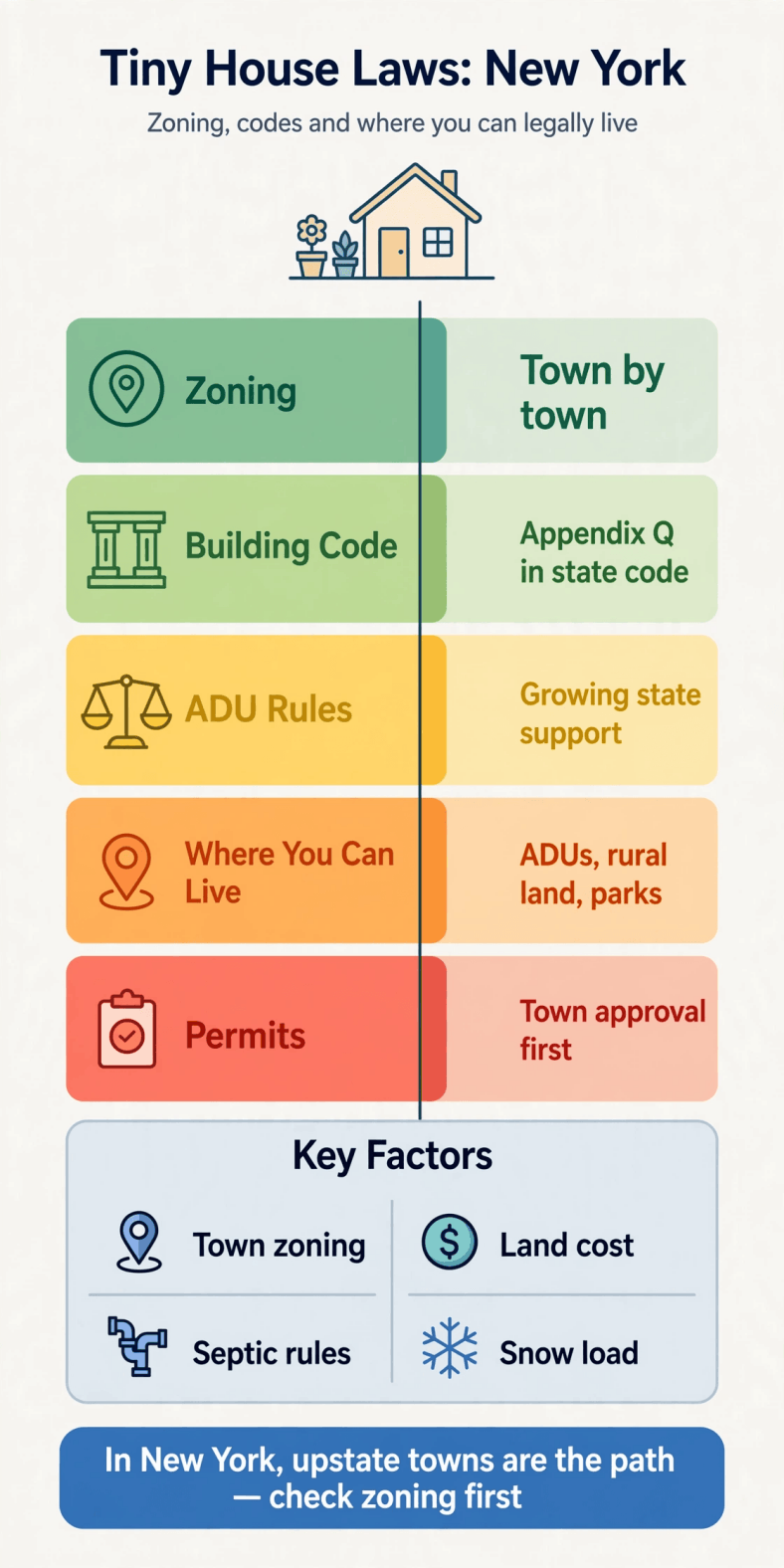
Tiny house laws in New York — the whole picture on one chart: one state code, a thousand town zoning maps, and two very different land markets.
Two New York habits separate finished projects from stalled ones. First, split the questions correctly from day one: ask the code official about the building and the town clerk or zoning officer about the land — each can only answer their half, and confusing the two produces confident, wrong answers. Second, price the region honestly: the legal work is broadly similar statewide, but an upstate project and a downstate project differ by an order of magnitude in land cost, and the cheapest legal tiny house in this state is almost always an upstate one.
2. Legal Status: Tiny Houses on Wheels vs on Foundations in New York
New York classifies by foundation. A tiny house on a permanent foundation is a one-family dwelling under the state Uniform Code: permitted, inspected, assessed and mortgageable like any house. A tiny house on wheels is a recreational vehicle or a trailer in the eyes of vehicle law and local ordinances — registered, titled and parked under vehicle rules, not housed under building rules. That classification controls where the unit may sit, how long it may be occupied, and whether a town code-enforcement officer treats its presence as a parking matter or a zoning violation.
Wheeled owners in New York live mainly in the state’s extensive RV-park and campground network, with the usual constraints: parks set their own stay rules, many northern parks are seasonal because water systems freeze, and towns commonly prohibit RV occupancy on residential lots outside licensed parks. Anyone choosing wheels should master the paperwork early — how to register a tiny house as an RV and what RVIA certification means for a tiny house — because New York’s enforcement, especially downstate, is complaint-driven and unforgiving once a file opens.
The foundation route in New York carries an extra dividend: legitimacy compounds. A permitted small house can be insured as a dwelling, financed, connected to municipal services where they exist, and sold into the hottest small-home market in the country — the downstate commuter belt’s hunger for modest houses is real. Even upstate, where enforcement pressure is lower, the paper trail is what separates an asset from an encumbrance at resale. Build the file from the first sketch: approvals, permits, inspection sign-offs and the certificate of occupancy are the house’s second foundation.
3. Building Codes for Tiny Houses in New York
New York’s Uniform Fire Prevention and Building Code is adopted at state level and built on the international model codes, with the Residential Code of New York State governing one- and two-family homes. Local governments enforce it through their own code officials, but they enforce the state’s text — a town cannot invent its own structural rules or waive the state’s, which makes design predictable from Buffalo to Montauk. New York City is the standing exception, operating under its own construction codes, its own department and its own famously thorough process.
The headline for tiny builders is the state’s treatment of small houses: the residential code’s framework incorporates the approach of IRC Appendix Q for tiny homes, the model-code appendix written for dwellings of 400 square feet and below, which adjusts the rules that otherwise crush small plans — loft access and headroom, compact stairs and ladders, ceiling heights and emergency egress sizing. In practice this means a well-designed sub-400-square-foot house has a code path that a decade ago required variances and pleading. Confirm the current code edition and exactly how your code official applies the appendix provisions at plan review, and design the egress and loft geometry carefully — those remain the sections where small plans most often fail.
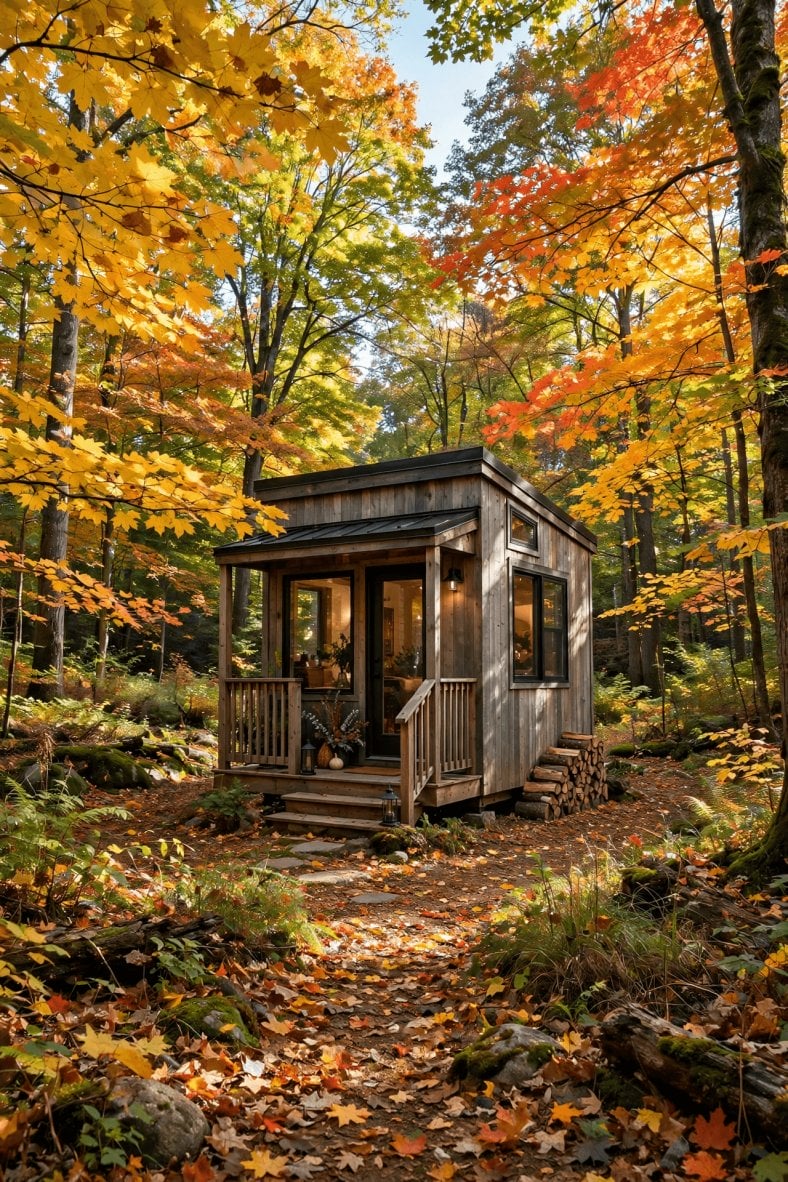
Tiny house laws in New York — pin this overview for the build: state code for the house, town hall for the land, septic science for everything rural.
Beyond the appendix, expect upstate engineering to dominate the code conversation. Snow loads in the lake-effect belts and the Adirondacks and Catskills are structural facts, not footnotes; frost depth drives foundation design across the whole state; the energy code pushes small envelopes toward excellent insulation, where tiny houses can outperform big ones cheaply; and wood heat — beloved upstate — brings chimney, clearance and carbon-monoxide rules that inspectors enforce strictly. None of this blocks small houses. All of it rewards designing for the actual county’s winter rather than for a catalogue photograph taken in Oregon.
Septic and water sit beside the code rather than inside it, administered by county health departments under state health law. In the New York City watershed west of the Hudson, an additional city environmental regime guards the reservoirs, and septic siting and repair there follow stricter rules than anywhere else in the state — a fact that shapes land value across the Catskills. Wherever the parcel, treat the health department’s answer on septic as a code question: without it, the building permit is a dead letter.
4. Minimum Size Rules in New York
New York’s building code does not impose a minimum total house size; it regulates rooms and safety, and its tiny-house provisions are written precisely for dwellings at or under 400 square feet. Habitable rooms still carry minimum areas and dimensions, ceilings minimum heights (with the appendix’s allowances for small houses and lofts), and sleeping rooms their egress requirements. A compact plan that respects those numbers is code-legal at sizes that would be unbuildable in stricter states — which is why New York punches above its weight in this series despite its reputation for regulation.
Zoning is where minimums re-enter. Some towns and villages — most often in the downstate suburbs — maintain minimum dwelling floor-area requirements, minimum lot widths and generous setbacks whose combined effect is to exclude small houses without ever naming them. Other towns, especially rural upstate ones, impose no size minimum at all, and a scattering of upstate towns have no zoning in the first place. The spread is the story: read the specific town’s ordinance for the specific district, and never import an assumption from the next town over, whose code was written by different people in a different decade.
Where a local minimum blocks an otherwise compliant small house, the tools are the zoning board of appeals — area or use variances, argued at public hearings — or a different town. In New York’s thousand-plus municipalities, town-shopping is a legitimate primary strategy rather than a last resort: the identical house, budget and builder can be prohibited in one town and welcomed in the next, twenty minutes apart. Price the variance path (months, professionals, uncertainty) against the slightly-dearer-lot-in-the-right-town path before falling in love with any parcel.
5. Zoning and Placement Rules
Land-use authority in New York lives at the bottom of the government stack: cities, incorporated villages and towns each zone their own territory, counties mostly advise, and the state mostly stays out — with two giant exceptions. The Adirondack Park, six million acres in the north, is governed by a state agency whose land-use plan classifies private land and controls development intensity, shoreline and subdivision across the whole park; the Catskill Park carries a lighter version of the same idea. A parcel inside the blue line plays by two rulebooks, and the agency’s classification of your lot matters as much as the town’s zoning.
Everywhere else, placement follows the familiar grammar: district maps, permitted-use tables, setbacks, height and lot-coverage limits, and site-plan or special-permit review for anything unusual. For tiny houses the recurring friction points are minimum lot sizes that assume big houses, prohibitions on dwellings behind dwellings (the ADU question), and seasonal-dwelling rules upstate, where many lakeside and mountain camps were built as summer-only and towns regulate their conversion to year-round use through septic and road standards. Manufactured homes get their own placement sections in most ordinances — check whether a small factory-built unit is steered to parks or permitted on individual lots.
Process advice mirrors the state’s structure: the town or village clerk’s office is the front door, the zoning text is online for most municipalities, and a short pre-application conversation with the code or zoning officer — parcel, footprint, specific questions — pays for itself immediately. The approach in how to talk to zoning officials about tiny houses works particularly well in small-town New York, where the officer across the counter may also be the building inspector, the assessor’s cousin and the person who will sign your permit — bring clarity and leave with names, dates and the answer in writing.
6. ADU Rules in New York
Accessory dwellings are where New York housing policy is moving fastest. At state level, recent housing programmes have funded and encouraged municipalities to legalise ADUs — grants for homeowners building them, model local laws, and sustained political pressure on towns to open single-family zoning to a second small unit. Town by town, the map is filling in: Hudson Valley communities, Long Island villages and suburbs across the state now run ADU permit paths, typically with size caps tied to the main house, owner-occupancy conditions, parking provisions and design rules meant to keep cottages subordinate to the main dwelling.
New York City’s chapter is the most dramatic. The city’s recent citywide housing rezoning legalised accessory units — basement and garage conversions and small backyard cottages — across low-density districts that had banned them for generations, subject to the city’s own building and fire codes. It is not a tiny-house free-for-all: the units live under NYC’s separate, demanding code universe, flood-zone rules carve out whole neighbourhoods, and costs per square foot are the nation’s highest. But as a policy signal it matters statewide: the largest city in America decided that small second homes belong in ordinary residential blocks.
For buyers, the ADU calculus in New York is unusually strong where it is legal, because the alternative — a vacant buildable lot downstate — is so expensive. A cottage behind an existing house inherits land, driveway, water, sewer and an address; what it must earn is the town’s ADU permit and code compliance on egress, ceiling height, fire separation and, outside sewer districts, septic capacity for the added bedroom. Verify the town’s current ADU section rather than its reputation, confirm whether the unit may be rented and to whom, and check the tax assessor’s treatment before assuming the numbers in any pro-forma.
7. Where You Can Legally Live Full-Time
New York’s full-time options, stated plainly: a permitted foundation tiny house on a conforming lot anywhere in the state; a legal ADU in the growing list of towns and in the city’s newly opened districts; a manufactured home on an owned lot or in one of the state’s many manufactured-home communities, a well-worn and fully legal housing form upstate; and year-round living in former seasonal colonies and camps where the town permits conversion and the septic supports it. RV parks cover the wheeled route, with the seasonal rhythm of a northern state.
Weigh the community options with clear eyes. Manufactured-home parks offer the lowest entry cost in expensive regions but pair it with lot-rent exposure that state tenant-protection laws moderate without eliminating; resident-owned and cooperative parks, a real movement in New York, change that maths fundamentally where available. The contrasts in tiny house communities versus RV parks apply cleanly here, with one New York addition: always ask a park about winter — water lines, ploughing, and whether year-round occupancy is even offered — before valuing a cheap monthly rate.
8. Permits, Inspections and Costs
The permit path for a foundation tiny house runs through the town, village or city code-enforcement office: zoning compliance first (or an ADU permit where relevant), building permit application with plans demonstrating Uniform Code compliance, county health department septic approval where unsewered, then staged inspections — footing, foundation, framing, rough trades, insulation and energy, finals — to the certificate of occupancy. Inside the Adirondack Park, add the agency’s jurisdictional check for the parcel’s classification; inside New York City, substitute the city’s own filing system entirely.
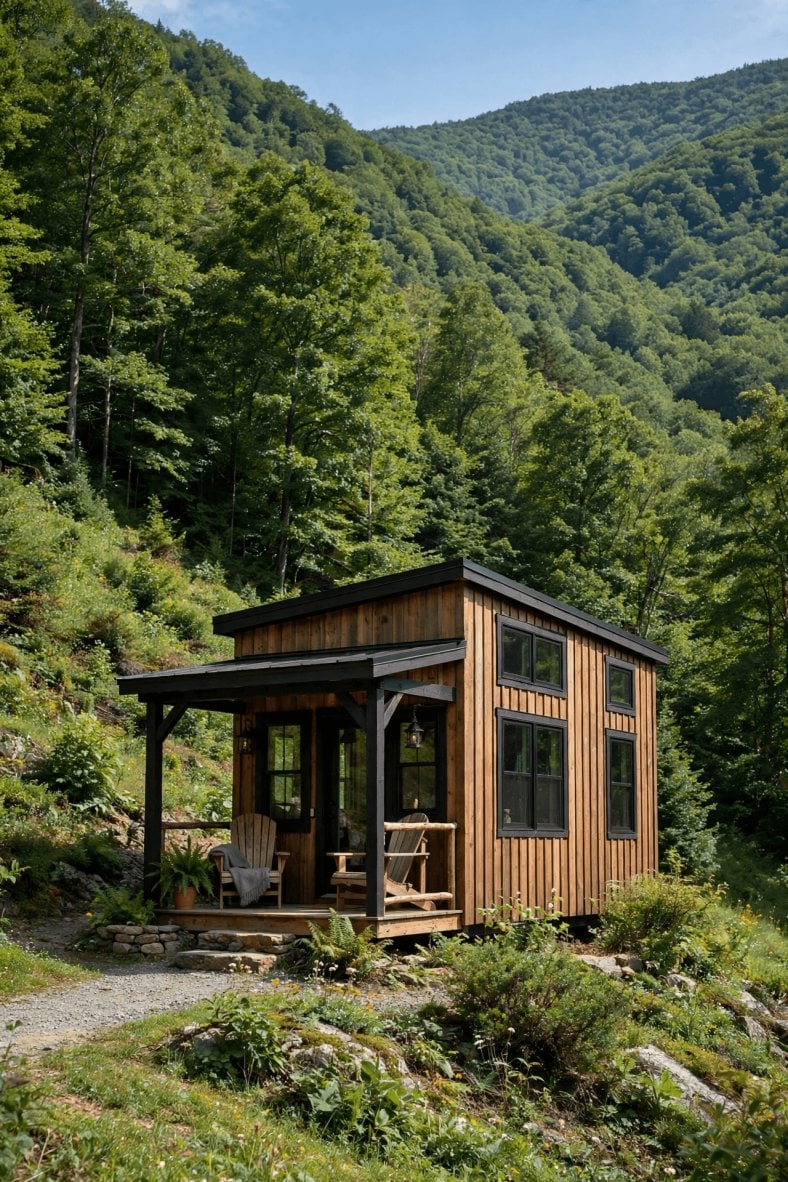
Tiny house laws in New York — the permit trail at a glance: zoning letter, health-department septic, code inspections, certificate of occupancy.
Costs split by the state’s two countries. Upstate, land can be startlingly cheap — and then the project buys a septic system, a drilled well, a long driveway, a ploughed road’s worth of winter access and utility runs across real distance; the house may be the minority of the budget. Downstate, land dominates so completely that the tiny house’s construction savings are nearly symbolic, and property taxes — among the nation’s highest in the suburban counties — become the recurring cost that decides feasibility. Between them, the Hudson Valley and Capital District offer the state’s middle path: real towns, real services, land priced between the extremes, and ADU rules increasingly written for exactly this housing type.
Paperwork discipline pays New York-sized dividends. Keep the zoning determination, building permit and stamped plans, septic permit and as-built, well documentation, every inspection record and the certificate of occupancy together. New York real-estate transactions run on attorney review and title scrutiny; a small house with a complete municipal file closes like a house, and one without it closes like a rumour — at a rumour’s price.
9. Notable City and County Examples
The Adirondack Park is the state’s grand overlay: towns like those around Lake Placid and Saranac Lake combine resort prices, park-agency land classifications, heavy snow engineering and fierce protection of shoreline and forest — buildable for tiny houses, but only after the agency and the town both agree, and with design budgets that respect the winters. The Catskills pull the opposite trick — close to the city, priced accordingly in the fashionable towns, and threaded by the city watershed’s septic regime west of the Hudson, which quietly determines which parcels can host a dwelling at all. The Finger Lakes and the Southern Tier offer the classic upstate bargain: agricultural towns, modest zoning friction, cheap land, deep winters and septic-and-well living, with college towns like Ithaca adding ADU-friendly politics and above-average prices as the local exception.
Downstate, read the map in rings. Long Island’s villages layer their own codes over town law, price land like bullion and enforce everything; the lower Hudson Valley’s river towns have become the ADU frontier, where cottages behind Victorian houses are suddenly the region’s most rational housing; and the outer suburban counties mix minimum-size zoning with genuine small-lot history in the older boroughs and villages. New York City itself, post-rezoning, is now an ADU market operating under its own codes — expensive, intricate and suddenly legal in form. The unifying lesson matches the state’s structure: the building code will not stop you anywhere in New York; the town, the overlay and the land price will decide instead.
10. Practical Steps to Go Legal in New York
Step 1 — Choose your New York. Decide downstate, mid-state or upstate first, using land price, tax load and ADU legality as the filters; the project’s entire cost structure follows from that single choice.
Step 2 — Split the authorities. List, for your target town, who enforces the state building code, who administers zoning, which county health department handles septic, and whether any overlay — Adirondack Park, watershed, historic district — touches the parcel.
Step 3 — Interrogate the specific lot. Confirm district, permitted use, minimum lot and dwelling sizes, setbacks and coverage against your footprint, and get septic feasibility assessed before the contract hardens; in watershed and park territory, confirm the overlay’s answer too.
Step 4 — Design to the state code’s small-house path. Use the tiny-house provisions deliberately — loft geometry, compact stairs, egress sizing — and have the code official confirm the approach at a pre-application meeting, in writing.
Step 5 — Prepare the land for a northern winter. Access, drainage, frost-depth foundations and snow-shedding site layout come first; the sequence in How to prepare land for a tiny house translates directly, with lake-effect snow doing the stress-testing.
Step 6 — Engineer utilities with the health department. Well, septic and power are a single system here; tiny house utilities: power, water and sewage explained covers the menu, and the county’s septic answer prices the rural project before the house design does.
Step 7 — Permit, build, inspect, occupy — in that order. Pull the permit, build to the stamped plans, pass every staged inspection and move in under the certificate of occupancy; in New York, the paper finish is what turns a small build into a bankable home.
Final Considerations
New York offers tiny-house buyers a genuinely rare combination: a state building code that contemplates small houses by name, an ADU movement with real momentum from the city to the river towns, and an upstate land market where a working budget still buys acres. Its frictions are equally real — town zoning written a thousand ways, minimum sizes hiding in suburban codes, park and watershed overlays, downstate land and tax costs that can swallow a small house whole. None of those frictions is a state saying no; all of them are specific places asking specific questions, which research can answer before money moves.
Choose the town as carefully as the house, split the code question from the zoning question, and let septic and winter engineering set the site plan. Do that, and New York stops being two intimidating countries and becomes what it is on the map: the largest menu of legal small-house routes in the Northeast — priced from Adirondack acres to a Brooklyn backyard, with a code book, unusually, already on your side.