
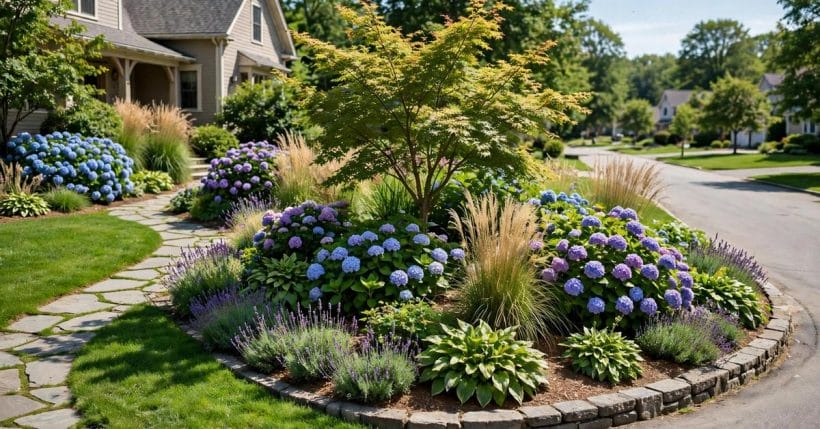
A corner lot is the only garden most streets ever really see twice. It faces two streets instead of one, so its planting, its paths and its edges are on show from two directions at once, and a design that looks finished from the front can fall apart when it is viewed from the side. That double exposure is also the opportunity: a corner plot has more light, more air and more room to compose a garden that greets the street from either way round. This guide is about corner landscaping in its narrow sense, the art of shaping that two-frontage plot so it reads as one garden, not as a front garden with a side strip attached.
The sections below follow the decisions in the order they matter. First comes reading the plot, then the open corner and the sight lines that keep it safe and welcoming, then the anchor planting, the paths, the layered beds, the edges, the lighting and the boundaries, and finally the seasonal care that keeps the whole composition looking intentional. Nothing here needs a large plot or a large intervention; a small corner, treated as one design, can hold its own against a much bigger garden that was never properly thought through.
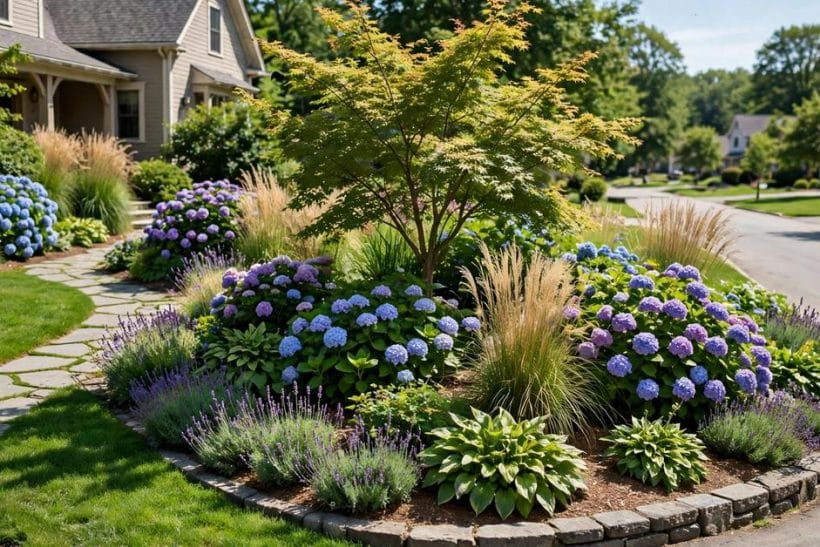
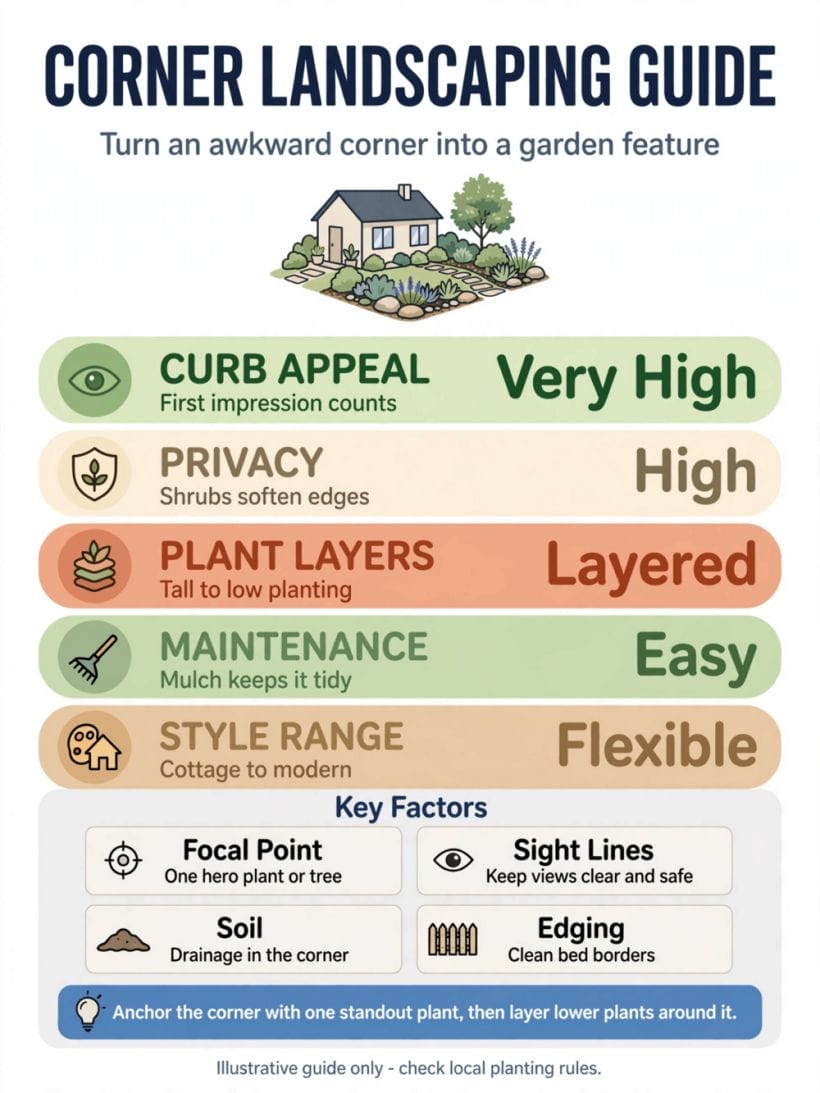
1. Reading the Corner First: Two Frontages, One Garden
Begin by walking the corner rather than looking at it from the front door. Stand on each pavement in turn and notice what each side shows: one frontage may carry the front door and the formal approach, while the other carries a side gate, a driveway or a long stretch of fence. The two faces rarely behave alike, and a design that treats them as identical will feel forced on at least one of them. Walk the plot at different times of day too, because a corner catches sun and shade from more directions than a mid-terrace garden, and the sunny side in the morning may be the shaded side by evening.
| Corner element | What to look for | Design response |
|---|---|---|
| Street corner | Views in from two directions | Open, low planting at the very corner |
| Anchor point | Where the eye naturally rests | One strong plant or small tree, well placed |
| Paths | How people actually cross the plot | A route that turns the corner gracefully |
| Boundaries | Fences, hedges and neighbouring plots | Layers that soften without shutting out light |
| Front door side | The formal welcome | Clear, generous approach planting |
| Side frontage | The long, often neglected face | Rhythm and repetition along its length |
The table above is a way of seeing the plot whole before any planting is chosen. Its point is simple: a corner garden is a single composition with two audiences, and every choice should be judged from both streets. A plant that screens the side fence beautifully may block the very view that makes the corner welcoming, and a path that serves the front door may leave the side gate stranded. Sketch the two frontages side by side, even roughly, and the conflicts show themselves before they are planted in.
It also helps to notice what already works. A mature tree, a well-placed hedge or a stretch of lawn that already holds the corner together is a gift, and a new design should build around it rather than clearing it away. Large trees in particular deserve a professional eye before any work is planned near them, since their roots and canopy shape everything planted beneath. Keep what earns its place, remove what confuses the composition, and let the new planting answer the plot as it actually is, not as a catalogue picture imagines it.
2. Sight Lines and Open Corners
The very corner of the plot, where the two streets meet, should stay open. This is partly a matter of courtesy and safety: drivers, cyclists and pedestrians all need to see round a corner, and a tall hedge or a dense shrub planted hard against the junction shuts that view down. It is also a matter of design, because an open corner reads as generous and welcoming, while a blocked corner reads as defensive. Low planting, ground cover and open mulch at the junction keep the corner legible from every approach, and the garden behind it can then rise in layers without anyone feeling fenced out.
Open does not mean empty. A low drift of ground cover, a few rounded shrubs kept well below eye level, or a sweep of ornamental grasses that move in the wind can make the corner itself beautiful without ever closing it. The test is simple: crouch to the height of a child or a seated driver and check what can still be seen through the planting. If the view across the junction is clear, the corner is doing its job; if it is not, the planting is too tall, too dense or too close to the junction, and it should be moved back or kept lower. The broader backyard landscaping ideas collection shows how the same open-corner thinking works behind the house as well.
Local rules often govern what may stand near a junction, and they vary from place to place, so check the local position before planting anything structural at the corner itself. Fences, walls and tall hedges near a junction are the items most often restricted, and a quick check saves the cost and annoyance of moving a finished feature. Where a rule does apply, treat it as a design prompt rather than a frustration: an open corner planted low is often the prettiest corner on the street, and it gives the rest of the garden a bright, airy frame to grow behind.
3. An Anchor That Holds the Corner
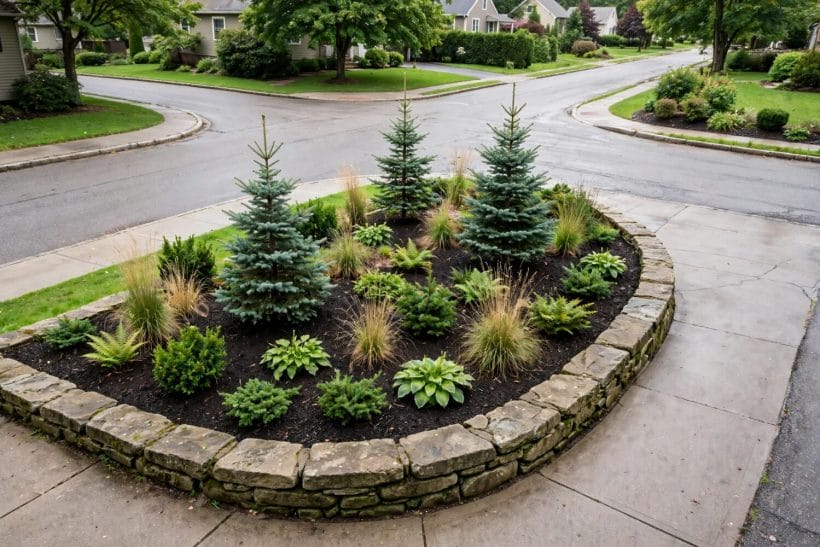
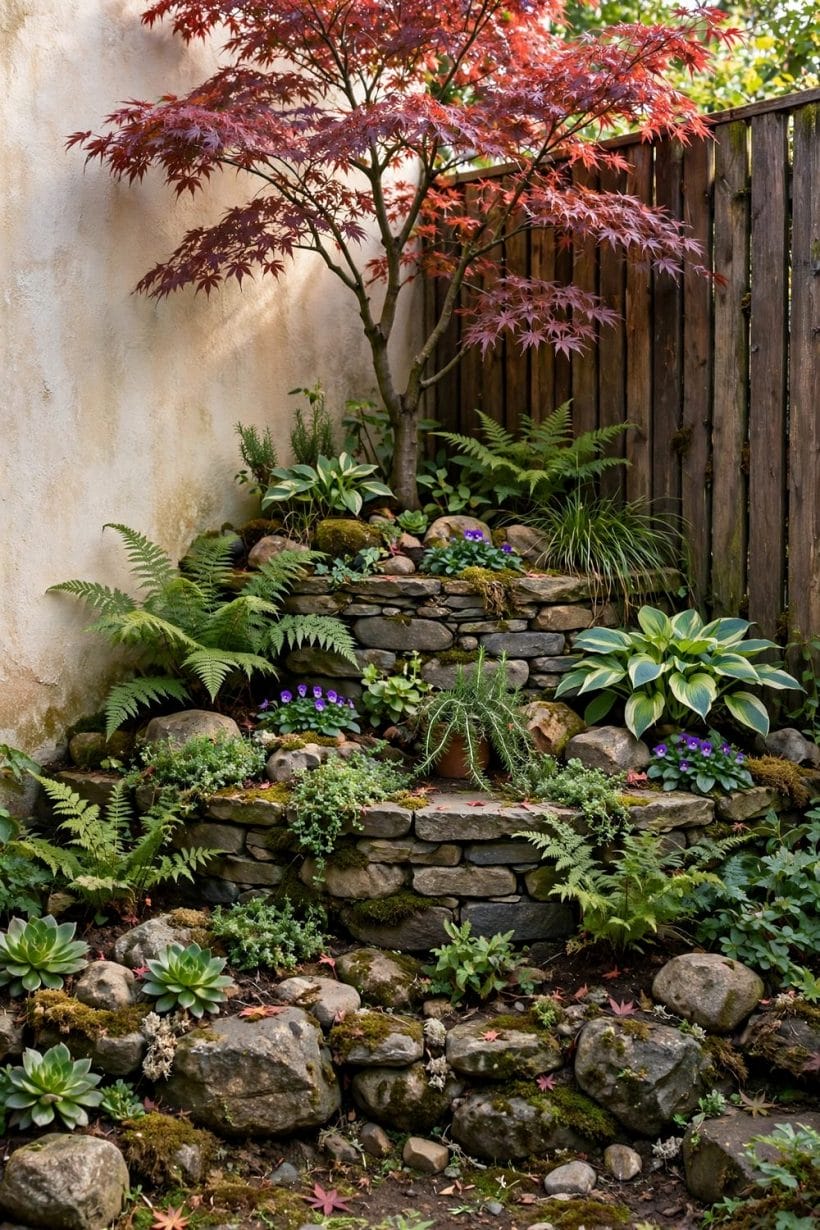
Behind the open corner, the garden needs an anchor, one strong presence that gathers the two frontages together and gives the eye a place to rest. Often this is a single well-formed tree, set back from the junction far enough to grow without crowding either street, with planting beneath it that ties the two sides together. It can also be a large shrub, a sculptural plant or a small group of plants grown as one mass. The anchor is not a collection; it is one decision, made boldly, that the rest of the garden can lean on.
Choosing the anchor means thinking about its mature character rather than its nursery size. A plant that looks modest in a pot may grow broad and tall, shading beds that were meant for sun, dropping litter on paths, or pressing against a fence within a few seasons. Ask how it behaves through the year, what it looks like bare in winter, how much leaf and flower it drops, and whether its roots are likely to trouble nearby paths or drains. Gardening advice can only point to tendencies, never promise outcomes, since soil, exposure and care vary so much from plot to plot; choose for the conditions you actually have, and prefer plants already doing well on neighbouring corners.
Place the anchor where both frontages can enjoy it, typically on the diagonal line that runs from the street corner into the garden, but set well back from the junction itself. From the front door side it should frame the house rather than hide it, and from the side street it should give the long frontage a centre of gravity. Underplant it lightly at first, with ground cover and a few companions that will not compete hard for water and light, and let the composition fill in over seasons rather than forcing it full in the first year.
4. Paths That Turn the Corner Gracefully
Corner plots are crossed more than most gardens, because people cut from one street to the other, visitors arrive from either direction, and the household itself moves between front door, side gate and garden. Watch where feet actually go before laying any path: the worn line across a lawn is a more honest plan than any drawing. A path that follows the natural desire line, then curves gently round the corner instead of meeting it at a sharp angle, feels inevitable rather than imposed, and it protects the lawn and beds from being trampled into shortcuts.
The main approach to the front door deserves the clearest, most generous treatment, since it is the garden’s formal welcome. The secondary route, along the side frontage to a gate or a garden room, can be narrower and quieter, but it should still be a real path, not a strip of bare earth. Where the two routes meet, give them a small moment, a widening, a change of surface, or a pair of flanking plants, so the junction of the paths echoes the junction of the streets without copying it. The tiny house porch ideas collection shows how arrival routes are given the same generous treatment at the door itself.
Surfaces should be chosen for the corner’s double life: they must look good from both streets, drain sensibly, and stay safe underfoot in wet weather. A single surface run through the whole corner unifies the two frontages, while a change of surface can mark the shift from public approach to private garden. Either approach works, but mixing too many surfaces across a small corner quickly looks restless. Keep the palette tight, keep the edges clean, and let the planting, not the paving, carry the variety.

5. Layered Planting for a Two-Sided View
Because a corner garden is viewed from two sides, its planting must work in the round rather than as a flat backdrop. The familiar border, tall at the back and low at the front, assumes a single viewpoint, and a corner breaks that assumption on every side. Instead, think in layers that read from any angle: a low front edge along both streets, a middle layer of rounded shrubs and perennials that gives the garden its bulk, and taller accents placed where they frame rather than block the house. A plant that is a backdrop from the front street becomes a foreground plant from the side street, and the design should welcome that shift.
Repetition is what stops a two-sided garden looking like two different gardens. Carry the same few plants along both frontages, in drifts rather than in single specimens, so the eye recognises the family as it travels round the corner. A shrub that appears on the front face and again on the side face stitches the two together, and a ground cover run along both edges gives the whole corner a shared hem. Variety still matters, but it should come from seasonal change, flower, foliage colour and texture, rather than from a long list of unrelated plants that never settle into a composition.
Seasonal rhythm matters more on a corner than anywhere else, because the garden is on show all year and from every side. Plan for something of interest in each season: spring flower, summer fullness, autumn colour and a winter structure of evergreen, bark or seed head that holds the corner when the rest has died back. No planting scheme can guarantee a display in any given year, since weather and care intervene, but a garden planned across the seasons is far more likely to look intentional in February than one planned for a single summer photograph. Stone is one of the most forgiving layering materials, and rock landscaping ideas shows how it anchors beds through every season.
6. The Corner Bed: Shape, Edge and Mulch
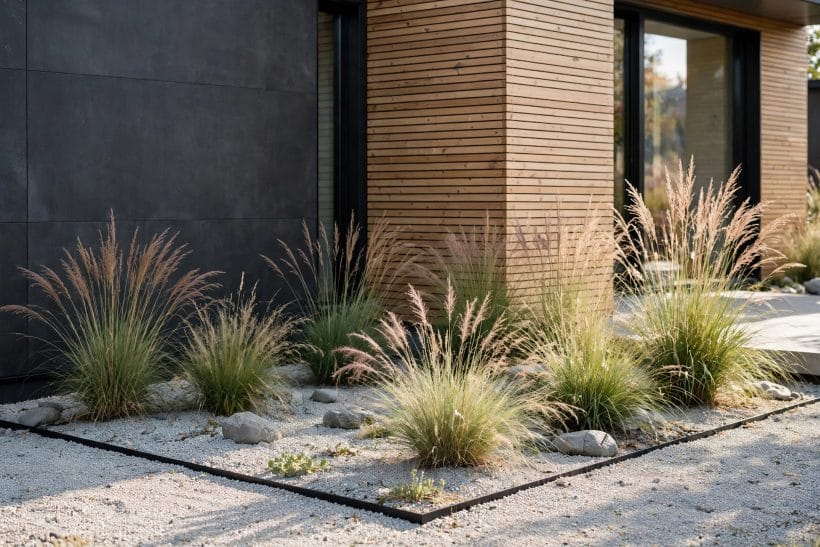
The beds themselves do much of the corner’s work, and their shape matters as much as their contents. A bed that follows the corner in a generous curve reads as one garden, while a bed chopped into rectangles by each frontage reads as two leftovers. Let the main bed sweep round the corner in a single flowing line, widening where the anchor sits and narrowing where a path passes, so the planting has room to breathe at the centre and the edges stay crisp. Curves are forgiving: they hide the exact boundary of the plot and make a small corner feel larger than a straight-edged bed of the same area.
Edges are what make a corner bed look cared for rather than merely planted. A clean spade edge, a low stone or timber edge, or a mowing strip along the lawn all do the same job, drawing a line the eye can follow round the corner. The edge should be consistent along both frontages; a stone edge on the front and a ragged edge on the side tells the street that only one face was ever finished. Keep the edging low at the junction itself, in line with the open-corner principle, and let it rise only as the bed moves away from the streets.
Mulch is the quiet worker of the corner bed. A generous layer suppresses weeds, holds moisture in dry spells and gives newly planted beds a finished look while the plants are still small. It also unifies the two frontages, since a single mulch across the whole corner reads as one cared-for surface where bare soil would read as neglect. Top it up as it settles, keep it clear of stems and trunks, and avoid piling it against the house wall or fence, where trapped moisture can cause trouble over time. For beds on a smaller scale, tiny house garden ideas shows the same edging and mulch discipline applied to compact plots.

7. Lighting the Corner After Dark
A corner garden is also a corner at night, and lighting is what keeps it welcoming rather than forbidding after dark. The aim is gentle guidance, not floodlighting: low lights along the paths, a soft wash on the anchor tree or a feature plant, and a warm glow near the front door that tells visitors they have arrived. Lit this way, the corner reads as a cared-for place from both streets, and the house behind it feels inhabited rather than shut away. Over-lighting has the opposite effect, flattening the planting and spilling glare onto the pavements, so restraint is the rule.
Place lights where they serve a real purpose first, then let the decorative effect follow. Path lights belong where a route turns or meets a step, not in a decorative row along every edge. A single uplight on the anchor gives the whole corner a night-time centre, and a light near the side gate makes the second frontage feel as considered as the first. Solar lights can suit a corner well, since they avoid cabling across two frontages, but their output varies with the season and the shade of the very trees they are meant to show, so judge them on a winter evening rather than a summer one. The wider backyard landscaping collection covers how outdoor rooms are enjoyed once daylight fades.
Electrical work outdoors belongs to qualified hands, and any wired lighting, especially near water features or buried cables, should be planned and installed professionally. For the household, the ongoing job is simpler: keep lenses clear, replace failed lamps promptly so the composition does not develop dark gaps, and walk the corner at night once a season to check that the lights still describe the garden rather than merely dotting it. A corner that is lit with intent is a small nightly advertisement for the care taken in daylight.
8. Fences, Hedges and Neighbour Boundaries
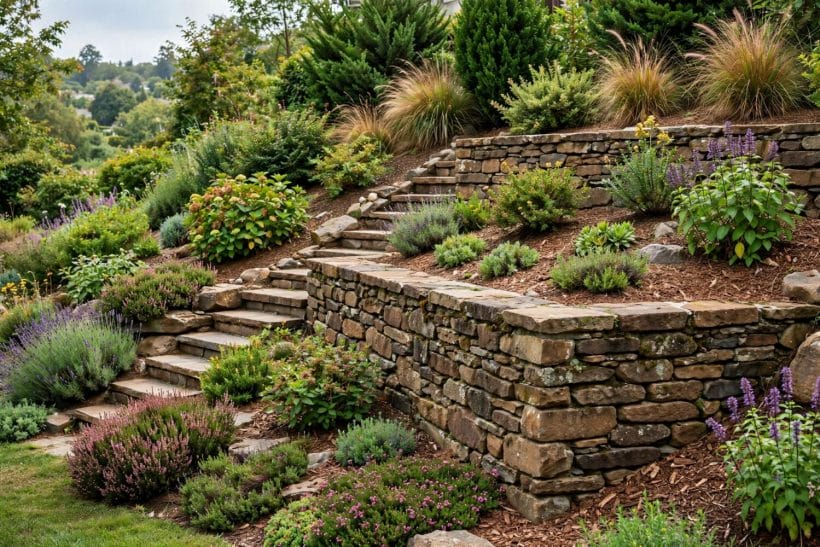
Boundaries are where a corner garden meets its neighbours, and they deserve as much thought as the planting itself. A corner plot often has more boundary than a mid-terrace plot, running along a side street as well as beside neighbours, and each stretch plays a different role. The street-facing boundary should stay welcoming and relatively open, while the neighbour boundary can be more private, but a hard switch between the two, a low open fence that suddenly becomes a tall close-boarded wall, reads as an afterthought. Grade the change instead, letting height and density rise gradually as the boundary turns away from the street.
Hedges soften a boundary in a way fences cannot, but they ask for patience and regular care, and a hedge planted for privacy will take seasons to earn its keep. Fences give immediate definition but can look harsh along a long side frontage unless planting breaks them up. The most successful corner boundaries usually combine the two: a fence or wall for structure, with shrubs and climbers in front of it that give it a green face from the street. Whichever combination is chosen, keep it in repair along the side frontage as carefully as along the front, since the side is the face most neighbours and passers-by actually see.
Boundary work also has a neighbourly dimension that no design guide can settle. Fences and hedges on a shared line, overhanging growth, and anything that shades a neighbour’s garden are all worth a conversation before work starts, and local rules may govern heights and positions, particularly near junctions. A short, friendly discussion at the outset prevents most disputes, and a boundary that both sides feel they own is far more likely to be kept well.

9. Seasonal Care Through the Year
A corner garden’s care routine is the same as any garden’s, but its exposure makes the routine more visible. Spring is the season for cutting back winter damage, refreshing mulch and checking edges after frost, while summer asks mainly for watering in dry spells, deadheading where it helps, and keeping paths clear of encroaching growth. Autumn is the moment to plant, since soil is still warm and roots can establish before winter, and it is also the season to enjoy the corner’s autumn colour from both streets before the leaves fall. Winter is for structure: pruning at the right time for each plant, checking fences and lights, and letting evergreens and bark carry the composition.
Two habits matter more on a corner than elsewhere. The first is keeping the junction open, checking through the growing season that nothing at the very corner has grown tall or dense enough to block the view across the streets, and cutting it back promptly when it has. The second is keeping both frontages to the same standard, since a front garden kept immaculate while the side frontage grows wild tells the street that only half the garden is loved. A short weekly walk round the whole corner, secateurs in hand, catches most problems while they are still small.
Care should also be honest about its limits. No routine can promise a particular plant will flourish in a particular spot, and a plant that struggles despite good care is telling you something about the soil, the light or the exposure of that corner. Moving a struggling plant to a kinder position, or replacing it with something already thriving nearby, is better gardening than persisting with a favourite that the plot does not suit. Over seasons, that kind of attention is what turns a planted corner into a garden that looks as though it has always belonged there.

10. Small Corners, Big Effect: Working with a Tight Plot
A small corner lot is not a failed large one; it is a different design problem, and it often produces the sharper result. With less ground to fill, every plant must earn its place, and the composition gains a clarity that a sprawling corner can lack. The principles stay the same, an open junction, one anchor, a graceful path, layered planting, but they are applied at a smaller scale: a compact tree or large shrub instead of a spreading one, drifts of a few plants instead of many, and a single surface for paths rather than a mixture. Restraint is not a compromise here; it is the design.
Small corners benefit most from vertical thinking. A wall or fence clothed with climbers, a narrow upright shrub that gives height without bulk, or a small tree with a clear stem that lets planting flow beneath it can all add presence without consuming ground. Containers can help too, flanking a door or a gate where the ground itself is paved, but they need regular watering and feeding, and a row of neglected pots quickly undoes the corner’s good impression. Use containers as accents, not as a substitute for planting, and keep their number small enough to care for properly. The same small-space discipline runs through tiny living room ideas, where every piece must earn its floor.
Above all, a small corner should not be overfilled. A garden that is planted to capacity on day one has nowhere to grow, and within a season or two it will look crowded rather than lush. Plant with the mature size in mind, leave room for each plant to reach its shape, and enjoy the openness while the garden fills in. A small corner treated this way often becomes the best-looking plot on the street, proof that a corner garden is judged by its composition, not its acreage.
Final Considerations
A corner lot asks for one thing above all: to be designed as a single garden with two faces, not as a front garden with a side attached. Keep the junction open, anchor the composition with one strong presence, let the paths turn the corner gracefully, and carry the same planting family along both frontages so the eye recognises one garden from either street. Layer the planting for a two-sided view, edge the beds cleanly, light the corner gently at night, and grade the boundaries from open at the street to private beside neighbours.
None of this requires grand gestures. A low drift at the junction, a well-placed tree, a curving path, a swept bed and a lit gate will do more for a corner than any single expensive feature, and they will keep doing it season after season if the care routine walks both frontages equally. That is the real measure of corner landscaping done well: a plot that looks composed from the front street, composed from the side street, and composed again when the two views meet at the corner itself.


0 Comments