
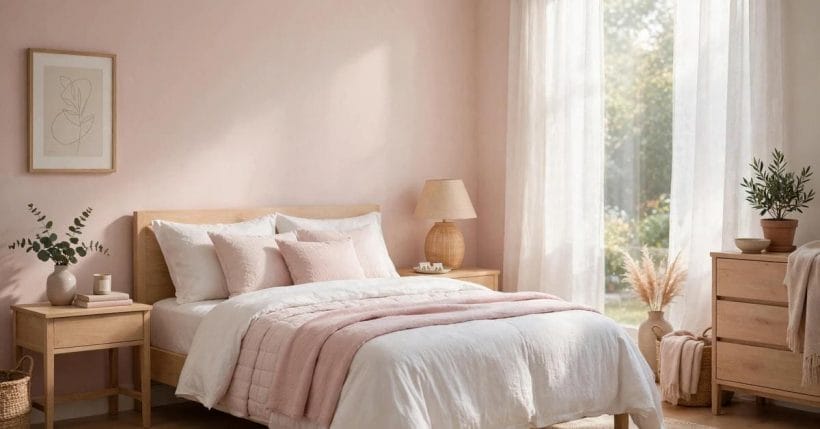
Pink walls can make a bedroom feel gentle, warm and quietly cheerful, yet the difference between restful and restless is rarely the colour itself. It is how much pink there is, which walls carry it, and what sits against it. Get those choices right and the room feels like a soft place to land at the end of the day.
This guide gathers seventy-five ideas for bedrooms with pink walls, from the palest blush to a deep rose, with layouts, storage, lighting and styling that keep the colour calm. Every idea stays inside the bedroom, and every shade is described by name, so you can picture it before you ever open a tin.
1. Choosing Your Pink
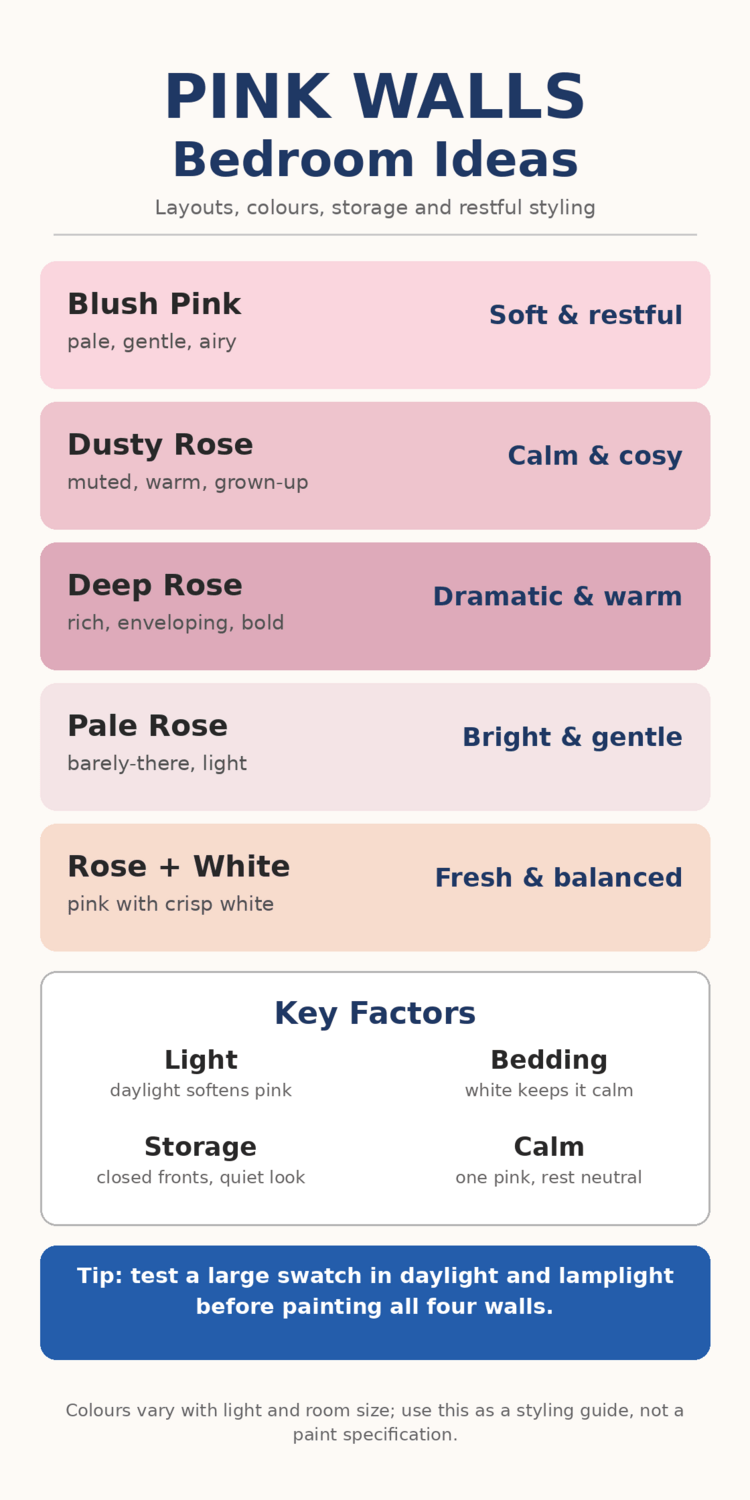
The first decision is not which pink to love in the shop, but which pink your room can live with morning and night. Light, floor tone and the size of the room all change how a pink reads, so choose slowly and test generously.
| Choice | What works |
|---|---|
| Shade | Blush for gentle rooms, dusty rose for warmth, deep rose for drama on one wall |
| Partners | White, cream, oat, soft grey and natural wood keep pink calm |
| Storage | Closed fronts and light finishes so the wall stays the star |
| Lighting | Daylight first, warm lamps at night, sheer curtains to soften glare |
1. Start with blush, the gentlest pink
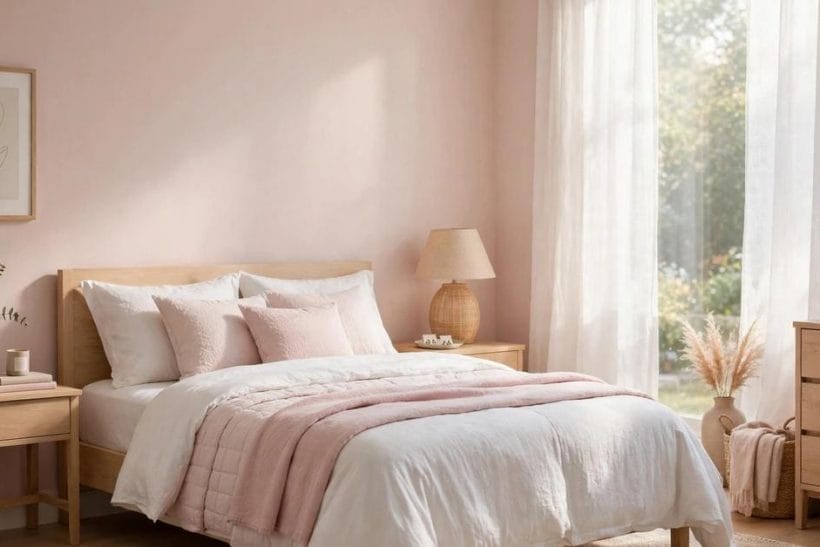
Blush is the safest way into pink walls because it behaves almost like a warm neutral. It softens a room without shouting, it flatters white bedding, and it forgives a small room or a north-facing window. If you are unsure, start here and let the rest of the room stay pale.
2. Try dusty rose for a grown-up room
Dusty rose carries a little more grey and a little more warmth than blush, which makes it feel considered rather than sweet. It suits wooden furniture, linen bedding and rooms where you want depth without darkness. Pair it with cream and it reads calm, not sugary.
3. Save deep rose for one wall
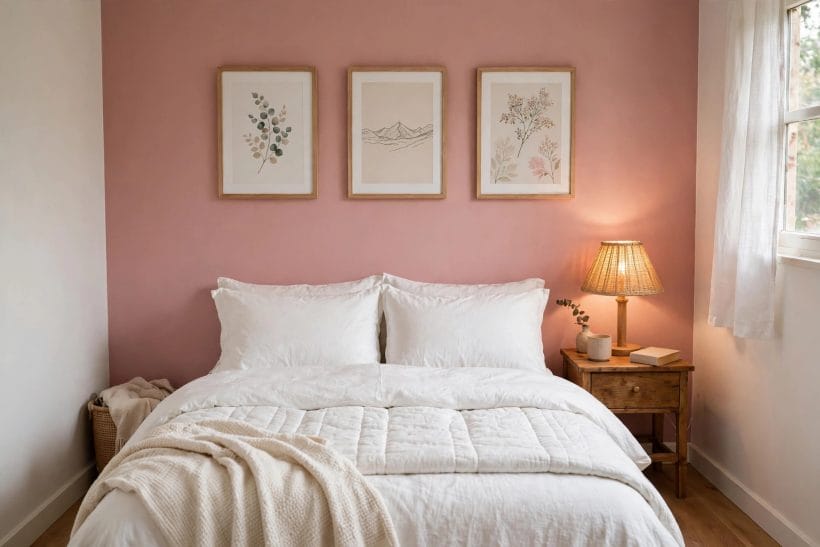
Deep rose is beautiful in a bedroom, but it is strongest as an accent. Paint the wall behind the bed and leave the other walls pale, and you get drama where you look most and calm everywhere else. Four deep walls can feel enclosing at night, while one feels intentional.
4. Let pale rose brighten a dark bedroom
A bedroom with a small window or a shaded outlook benefits from the lightest rose you can find. Pale rose bounces what light there is around the room and adds warmth that plain white sometimes lacks. Keep the ceiling white and the floor light to help it along.
5. Pair pink with crisp white from the start
White is pink’s best friend in a bedroom because it gives the eye somewhere to rest. White woodwork, white bedding and a white ceiling frame the colour and stop it from spreading visually across the whole room. Think of white as the pause between pink notes.
6. Test your pink in daylight and lamplight
Pink changes more than most colours between day and evening. A shade that looks soft at noon can turn warmer, or cooler, under lamps. Paint a large test patch, live with it for a few days, and check it in morning light, afternoon light and lamplight before committing.
7. Match the pink to your floor tone
Warm wooden floors welcome warmer pinks, while pale floors and grey-toned boards suit cooler, dustier roses. Stand back and look at wall and floor together rather than judging a swatch alone. When the two tones agree, the room feels settled from the skirting up.
8. Keep one pink, not three
It is tempting to mix blush, rose and coral across walls, bedding and art, but several pinks competing in one room usually feel busy. Choose one wall pink and let bedding, throws and art echo it in neutrals and near-neutrals. Restraint is what makes pink feel restful.
2. Layouts That Let Pink Breathe
A pink bedroom works best when the layout gives the colour room to breathe. Space around the bed, a clear path to the window and a quiet corner all help the walls feel like a backdrop rather than a crowd.
9. Put the bed on the pink wall
The simplest layout is also the most effective: the bed against the pink wall, so the colour frames the place you rest. It anchors the room, it photographs beautifully, and it means you see the pink when you enter and softer tones when you lie down.
10. Leave breathing room around the bed
Pink walls feel calmer when the bed is not squeezed against them on every side. Even a small gap on each side lets the colour read as a wall rather than a wrapping, and it makes making the bed far less of a wrestling match each morning.
11. Centre the bed on the longest pink wall
Centring the bed on the longest wall gives the room symmetry and lets the pink stretch evenly on both sides. It also leaves room for a bedside table on each side, which keeps the arrangement feeling balanced rather than improvised.
12. Float the bed in a large room, pink behind
In a generous bedroom, pulling the bed a little away from the wall and keeping pink behind it creates a sense of occasion. The colour becomes a backdrop you walk around rather than a surface you press against, and the room feels designed rather than filled.
13. Tuck a reading chair into a pink corner
A corner chair turns a pink wall into a destination rather than a decoration. Add a small table and a lamp, keep the chair in a neutral fabric, and the corner becomes the place you reach for a book before sleep. The pink makes the corner feel sheltered.
14. Give the door wall a rest from pink
Leaving the wall with the door in white or a pale neutral gives the eye a quiet entry point. You step into the room, register the pink ahead of you, and are not surrounded by it from the first step. It is a small choice that makes the colour feel deliberate.
15. Let the window wall stay pale
Windows bring light, and light deserves a pale frame. Keeping the window wall white or very pale rose lets daylight pour in without bouncing pink glare around the room, and it keeps the view, not the wall, as the focus of that side.
16. Plan the walkways before you paint
Before choosing which walls turn pink, walk the room as you use it: bed to door, door to wardrobe, wardrobe to window. The walls you pass closest deserve the calmest treatment, while the wall you face from the bed can carry the strongest pink.
3. Bed Walls and Headboards
The bed wall does the most work in a pink bedroom, so it deserves the most thought. The headboard, the art above it and the lamps beside it all mediate between you and the colour.
17. Let the headboard break the pink
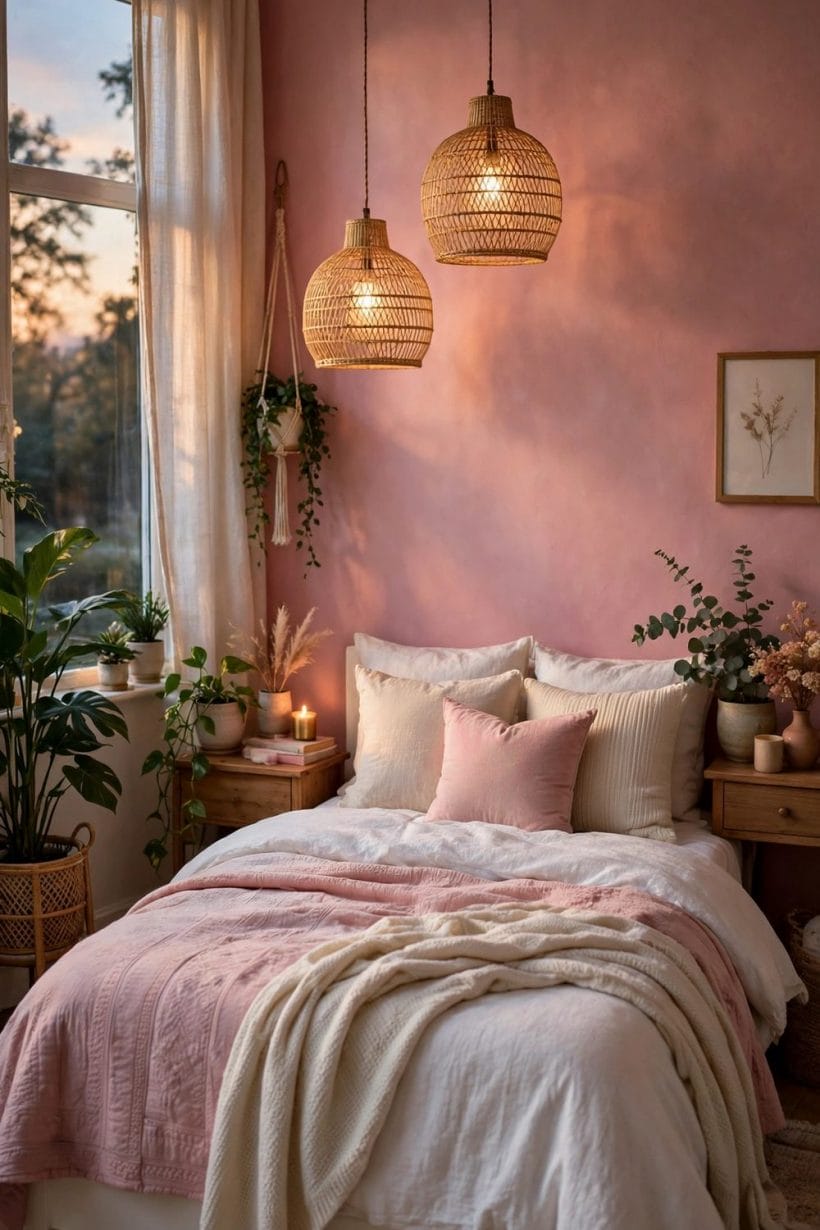
A headboard in wood, cream or soft grey interrupts the pink exactly where your eyes rest, which stops the colour from feeling flat. The break gives the bed its own shape against the wall and makes the pink behind it look chosen rather than accidental.
18. Choose a light wood headboard
Light wood warms pink without competing with it. Oak, ash and pale beech all sit happily against blush and dusty rose, and they connect the bed to bedside tables and floors. The result is a room that feels natural rather than decorated.
19. Try an upholstered headboard in cream
An upholstered headboard in cream or oat softens both the wall and the bed. It is comfortable to lean against for reading, it quiets the pink behind it, and its texture adds a layer the flat wall cannot provide on its own.
20. Hang art low over the headboard
Art hung just above the headboard, rather than floating high on the wall, ties the bed and the pink together. Keep frames light, keep the subject calm, and let the art be a pause in the colour rather than another loud voice.
21. Frame the bed with two lamps
Matching bedside lamps on both sides of the bed give a pink wall symmetry and a warm evening glow. The lamplight softens the pink at night, which is exactly when a bedroom needs to feel most restful, and the pair makes the bed feel finished.
22. Add a shelf ledge above the bed
A single slim ledge above the bed lets you change the display with the seasons: a small print, a dried stem, a tiny clock. Because the ledge is shallow, nothing crowds the wall, and the pink stays visible around whatever you place there.
23. Keep the bed wall the pinkest wall
If only one wall carries the strongest pink, make it the bed wall. It is the wall you design around, the wall guests notice first, and the wall that gives the room its character. The other walls can then stay quieter without the room feeling unfinished.
24. Soften a bold pink with a tall headboard
A tall headboard covers more of a deep pink wall and breaks its expanse, which is useful when you love a strong shade but want a calm room. The height draws the eye upward and makes the remaining pink feel like a frame rather than a flood.
4. Bedding, Colour Partners and Texture
Bedding is where pink bedrooms succeed or fail, because the bed fills so much of the room. White first, texture second, and pink in small doses is the formula that rarely disappoints. For a wider look at how colour works in compact rooms, the guide to tiny house colour palettes shows how one strong shade can sit inside a calm scheme.
25. Dress the bed in white first
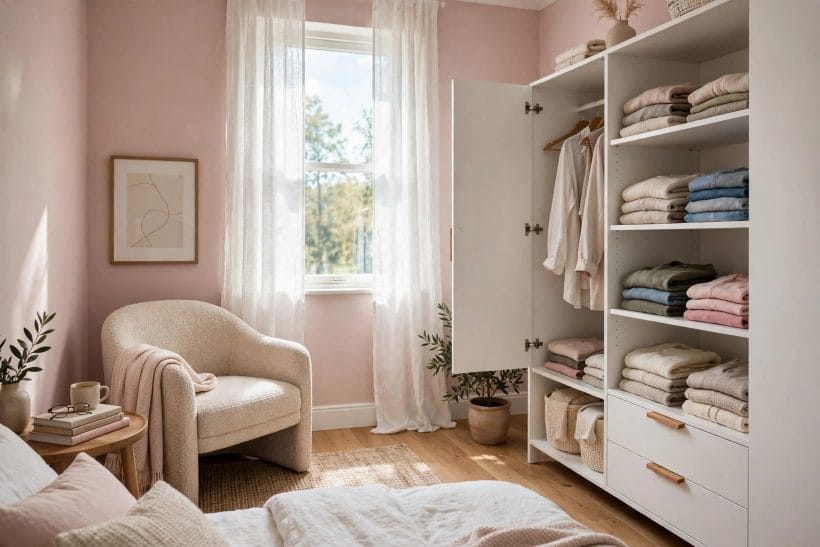
White bedding against pink walls is the classic pairing for a reason: it cools the colour, it looks fresh every morning, and it lets you change the mood with a single throw. Start white, then add warmth in layers you can remove.
26. Add one pink throw, not a pink set
One pink throw folded at the foot of the bed echoes the walls without doubling them. A full pink bedding set on pink walls, by contrast, can feel like too much of one note. The throw is the echo; the walls are the voice.
27. Bring in soft grey for balance
Soft grey cushions or a grey throw give pink a grown-up counterweight, especially in a modern bedroom. Grey cools the warmth of rose without turning the room cold, and it pairs happily with both light wood and white bedding.
28. Warm pink with natural wood
Wooden bedside tables, a wooden frame or a woven basket add an earthy note that keeps pink from feeling artificial. Natural materials ground the colour, which is why pink bedrooms with plenty of wood tend to feel restful rather than pretty alone.
29. Add green plants against pink
Green is pink’s natural complement, and a plant or two against a pink wall brings the combination to life. A trailing plant on a shelf, a small pot on the bedside table, or a tall plant in the corner all add freshness without adding another strong colour.
30. Use linen texture to quiet the colour
Texture changes how colour feels. Linen bedding, a woven throw and a nubby cushion all scatter light and soften pink, while shiny fabrics can make the same shade look louder. When in doubt, choose texture over sheen in a pink bedroom.
31. Layer cream, oat and pink together
Cream sheets, oat cushions and a pink throw build a palette that feels warm and layered without any single colour dominating. The neutrals do the quiet work, the pink provides the character, and the bed looks inviting rather than styled to within an inch of its life.
32. Keep patterns small and quiet
If you love pattern, keep it small against pink walls: a fine stripe, a tiny botanical print, a subtle check. Large, loud patterns compete with the wall for attention, while small patterns add interest at close range and disappear into calm from the doorway.
5. Storage That Keeps Pink Calm
Storage decides whether a pink bedroom feels serene or cluttered, because clutter against a coloured wall looks louder than clutter against white. Closed fronts, light finishes and a place for everything keep the pink as the room’s calm background. The storage ideas in the guide to tiny house storage ideas translate well here, especially in smaller bedrooms.
33. Choose white wardrobes against pink
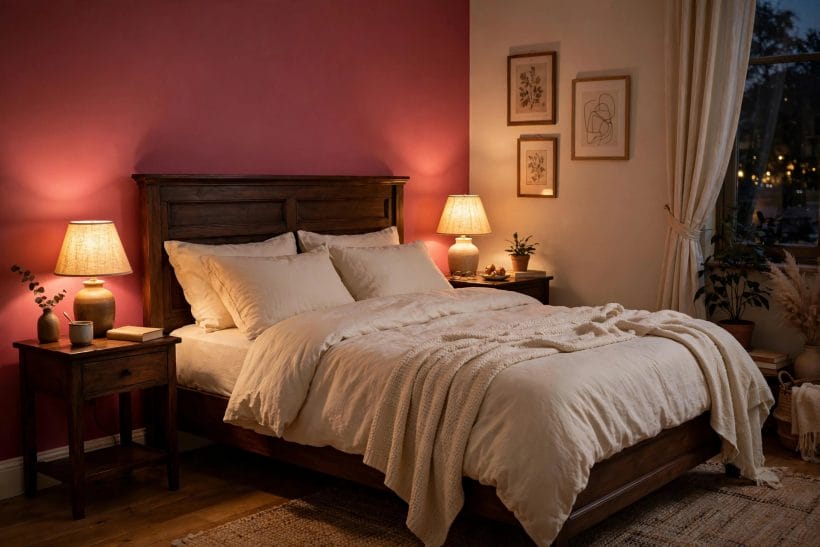
White wardrobes stand quietly against pink walls and keep the room feeling light, even when the storage itself is large. White reflects light, it does not add another colour to the palette, and it lets the wall remain the room’s main event.
34. Hide clutter behind closed doors
Open storage shows everything you own, and everything you own against pink can look busy. Closed doors, drawers and boxes hide the variety and leave the eye with just the wall, the bed and a few chosen objects. Calm storage is mostly closed storage.
35. Use under-bed drawers in small rooms
Under-bed drawers are the quiet heroes of a small pink bedroom because they add storage without adding furniture. The room keeps its floor space, the walls keep their breathing room, and bulky items disappear exactly where they are needed least.
36. Keep open shelves sparse on pink
If you love open shelves, keep them sparse against a pink wall: a few books, one vase, some folded linen. A crowded shelf fights the colour, while a sparse shelf lets the pink show through as a backdrop and makes each object look chosen.
37. Match baskets to the bedding, not the wall
Baskets and boxes in cream, oat or natural woven tones blend with the bedding and stay quiet against pink. Matching them to the wall pink instead can make the room feel themed, while matching the bedding keeps the palette grounded.
38. Let the wardrobe wall stay neutral
In a room where one wall is deep pink, keeping the wardrobe wall white or pale gives the room balance. The eye travels from colour to calm and back, and the storage wall does its practical job without demanding attention.
39. Give every item a closed home
The rule that keeps pink bedrooms restful is simple: everything has a closed home, and the home is used. When surfaces stay clear, the pink reads as a design choice rather than a backdrop to mess, and tidying becomes a quick habit instead of a weekend project.
6. Lighting for Pink Walls
Light is the partner pink cannot do without. Daylight makes pale pinks glow and deep pinks feel rich, while warm lamplight turns the same walls soft and sleepy in the evening. For lighting that flatters a coloured wall, the guide to tiny house interior lighting ideas covers the same warm, layered approach in compact rooms.
40. Use warm lamps beside the bed
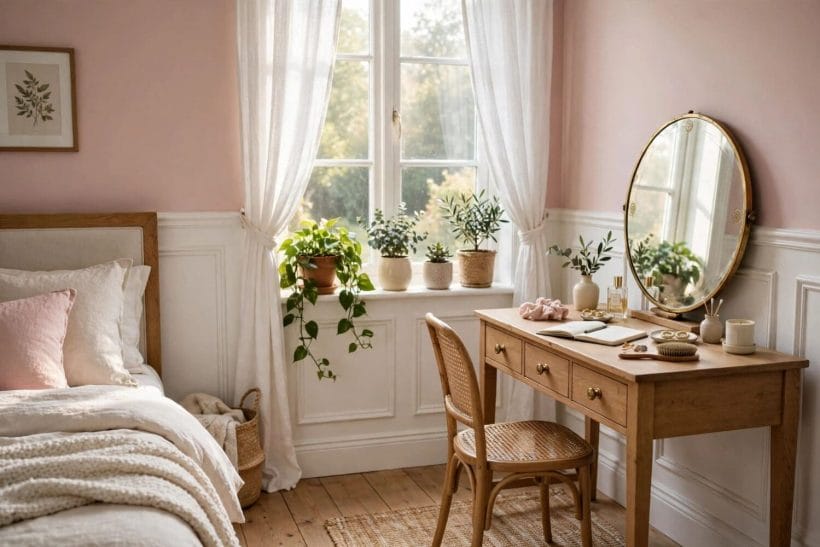
Warm-toned bedside lamps are the evening version of daylight for a pink room. They turn the walls honeyed and soft, they make the bed the warmest place in the room, and they signal to your body that the day is winding down.
41. Let daylight do the heavy lifting
During the day, keep curtains open and the window clear so daylight can show the pink at its best. Pink needs light to look fresh; a dark pink room can feel flat, while the same shade in daylight looks alive and gentle.
42. Choose a dimmable lamp for evenings
A lamp you can dim lets the pink fade gently as bedtime approaches instead of snapping from bright to dark. Lower light softens the walls, relaxes the eyes and makes the last hour before sleep feel unhurried.
43. Keep overhead light soft and low
Harsh overhead light flattens pink and makes a bedroom feel like a corridor. A soft overhead glow, used sparingly and paired with lamps, keeps the walls warm and the room feeling like a place to rest rather than a place to work.
44. Use sheer curtains to filter daylight
Sheer curtains diffuse sunlight so it falls softly on pink walls instead of glaring across them. They also give privacy without blocking light, which matters in a bedroom where the walls depend on daylight to look their best.
45. Place a lamp where you read
A reading lamp beside the chair or on your side of the bed means you never need the full room lit to read a chapter. The pool of warm light against pink is one of the cosiest sights a bedroom can offer, and it keeps the rest of the room dim and restful.
46. Check the pink at night before you commit
Before painting all four walls, look at your test patch at night under the lamps you actually use. Night is when you spend the most time in the bedroom, so the night-time pink is the one that matters most, even if the daytime pink is the one you fell for.
7. Small Bedrooms in Pink
Small bedrooms and pink walls are natural partners, because pink adds warmth without the heaviness of a dark colour. The trick is keeping everything else light, low and uncluttered so the room feels cosy rather than cramped. The layout lessons in the guide to tiny bedroom ideas apply directly, especially the habit of letting one wall do the talking.
47. Paint all walls pale rose in a tiny room
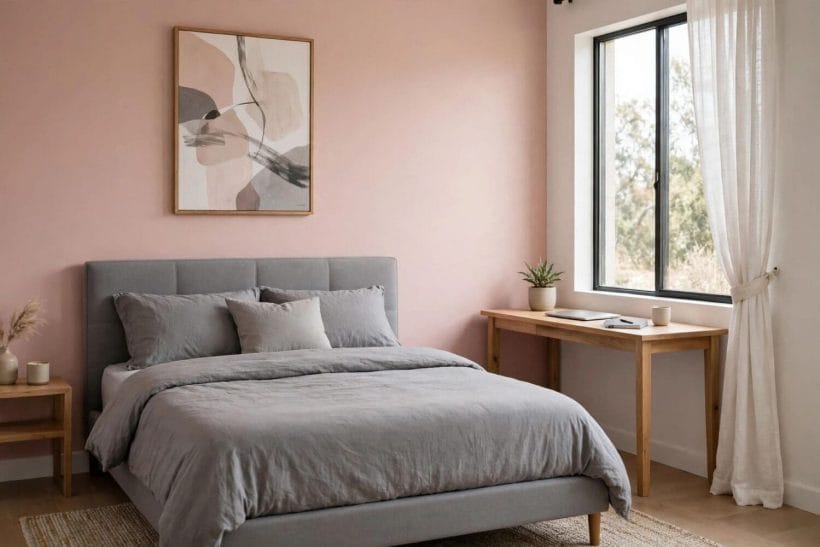
In a very small bedroom, painting every wall the palest rose can actually make the room feel larger, because there are no contrasting walls to chop it into pieces. The colour wraps the room gently and the eye travels around it without stopping.
48. Use one pink wall to add depth
In a small room with one strong pink wall, the colour pulls the eye and gives the room a sense of depth it might otherwise lack. Put the pink on the wall you face from the door and the room gains a destination, which makes it feel considered rather than small.
49. Keep furniture low in a pink box room
Low furniture leaves more pink wall visible and more air above it, which stops a small room from feeling boxed in. A low bed, low tables and a low wardrobe all help the walls breathe, and the room feels taller than it is.
50. Mirror light, not colour
A mirror in a small pink bedroom should face the window, not the pink wall, so it doubles the daylight rather than doubling the colour. The room gains brightness without gaining pinkness, and the mirror itself becomes a quiet, useful object.
51. Choose a platform bed with drawers
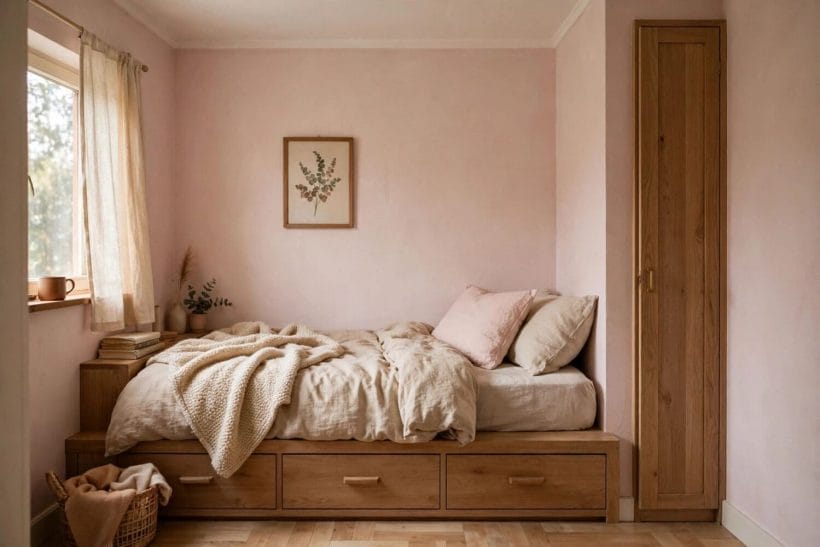
A platform bed with drawers underneath removes the need for a separate chest in a small room. The floor stays clearer, the walls stay visible, and the pink has the calm surroundings it needs to feel restful rather than crowded.
52. Hang curtains high to lift the room
Curtains hung close to the ceiling and falling to the floor draw the eye upward and make a small pink bedroom feel taller. The long vertical line also breaks the horizontal sweep of the pink, which keeps the colour from feeling like a band around the room.
53. Keep the floor light under pink
A light floor, a pale rug or light wood boards under pink walls keep a small room feeling open. Dark floors with pink walls can feel heavy in a tight space, while light floors reflect daylight upward and let the pink stay gentle.
8. Decor, Art and Finishing Layers
Once the walls, bed and storage are settled, decor is the finishing layer. Against pink, the rule is restraint: fewer objects, quieter colours, and finishes that repeat what is already in the room. Wall decor that suits a small, calm room is covered in the guide to tiny house wall decor, and the same spare approach works beautifully on pink.
54. Hang botanical prints on pink
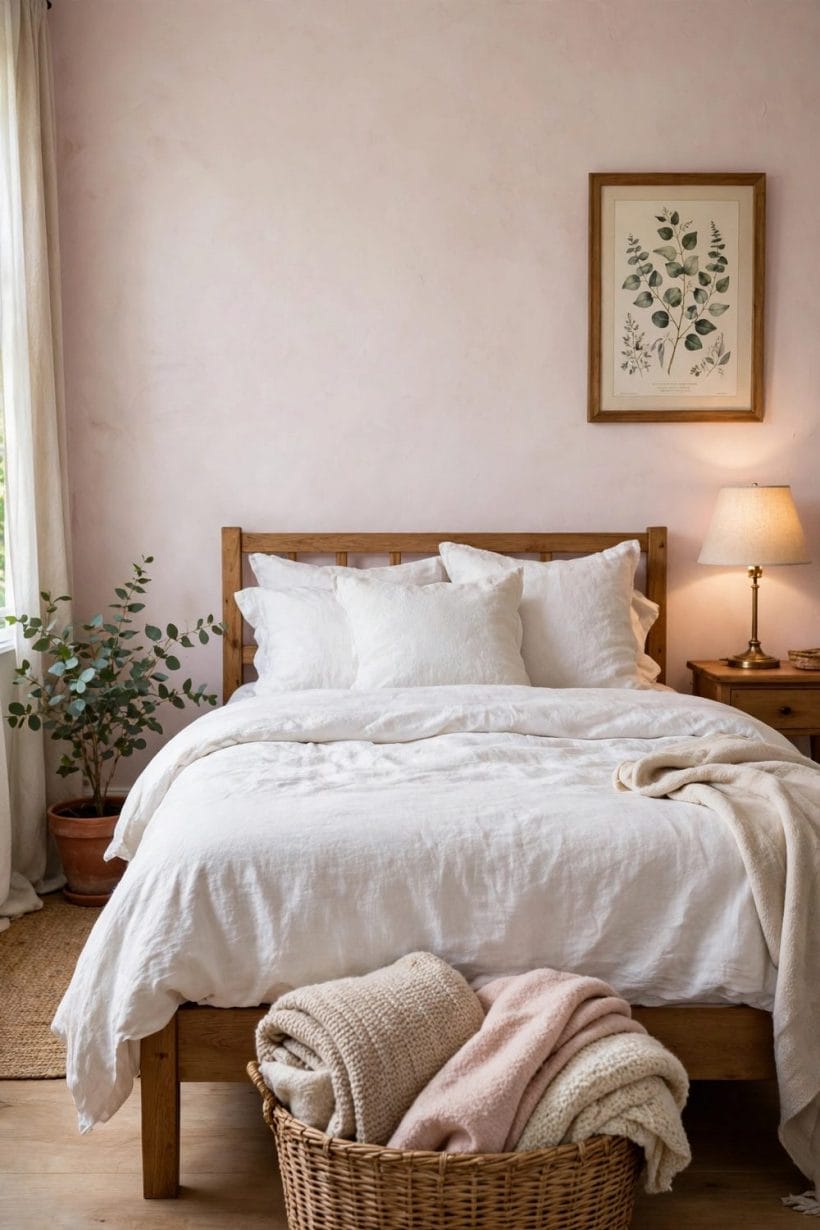
Botanical prints are the classic art for pink walls because green leaves and soft stems calm the colour naturally. Keep the prints simple, the frames light, and the arrangement uncluttered, and the wall feels like a garden rather than a gallery.
55. Use gold or wood frames, not black
Black frames can look harsh against soft pink, drawing hard lines across a gentle wall. Gold, brass-toned or light wood frames warm the art instead, echoing the wood in the room and keeping the whole wall feeling soft.
56. Add a single large print, not a busy wall
One large, calm print on a pink wall makes a stronger statement than a crowded cluster of small frames. The single piece gives the eye a resting place, the pink around it acts as a mount, and the room feels curated rather than collected.
57. Bring in dried grasses for texture
Dried grasses and stems in a vase add height and texture without adding colour competition. Their neutral tones sit quietly against pink, their shapes catch the light, and they last far longer than fresh flowers in a bedroom.
58. Keep the ceiling white
A white ceiling is the quiet lid on a pink bedroom. It reflects light downward, it stops the colour from closing in overhead, and it gives the room a clean edge that makes the pink on the walls feel intentional rather than total.
59. Add a soft rug in cream or oat
A soft rug in cream or oat warms the floor without adding another colour to argue with the walls. It also softens footsteps, defines the bed area, and gives bare feet a gentle landing on cold mornings.
60. Style the bedside table lightly
A lamp, a book and one small object are enough for a bedside table against pink walls. A crowded table competes with the wall behind it, while a lightly styled one lets the pink breathe and makes the table itself look calm and useful.
61. Leave one wall nearly bare
Leaving one wall almost empty is the bravest and often the best choice in a pink bedroom. The bare wall gives the eye a rest, it makes the decorated walls feel more special, and it proves the pink itself is decoration enough.
9. Restful Nights: Sleep-Friendly Styling
A pink bedroom should help you sleep, not just look pretty in daylight. The styling choices that support rest are quiet ones: dim light, clear surfaces, cool air and a bed that invites you in. A calm, uncluttered room is the best sleep aid a wall colour can offer, and pink, handled gently, is a fine background for it.
62. Keep the room’s evenings screen-free
Leaving phones and laptops outside the evening routine lets the pink room do its calming work. The warm lamplight, the soft bedding and the quiet walls all compete poorly with a glowing screen, so giving the room the last hour of the day pays back in rest.
63. Choose bedding you can wash easily
Bedding that washes easily stays fresh, and fresh bedding against pink walls looks and feels far better than tired fabric. White and cream bedding shows its freshness, which is part of why it pairs so well with pink: the room always looks cared for.
64. Lower the light an hour before sleep
Dimming the lamps an hour before bed lets the pink walls fade into a soft dusk. The gradual dimming tells your body the day is ending far more gently than a sudden switch-off, and the room becomes a place your mind associates with winding down.
65. Keep the room cool and aired
Fresh air and a cool room matter more to sleep than any wall colour, but pink helps: a cool, aired pink room feels like a summer evening, while a stuffy one feels heavy. Open the window during the day, let the air move, and the pink stays fresh.
66. Use blackout lining behind sheers
Sheer curtains give a pink bedroom its daytime softness, and a blackout lining behind them gives it night-time darkness. The combination means one window treatment serves both moods, and the pink walls get daylight by day and true dark by night.
67. Keep the bed made and the floor clear
A made bed and a clear floor transform a pink bedroom more than any new purchase. The colour reads as a design choice when the room is tidy, and the habit of making the bed each morning sets the room’s calm tone for the whole day.
68. End the day with one quiet ritual
One quiet ritual, a chapter of a book, a few minutes of stretching, or simply sitting in the reading chair, gives the pink room a purpose beyond sleep. The ritual ties you to the room, and over time the pink walls themselves start to feel like part of winding down.
10. Keeping Pink Fresh Over Time
Pink walls age gracefully when they are treated as a living part of the room rather than a one-time decision. Small habits, seasonal swaps and an eye on sunlight keep the colour looking as good in a few years as it did in the first week. For the wider room around the walls, the guide to tiny house interior design ideas and the rustic warmth of the rustic tiny house interior guide both show how a strong wall colour can sit inside a scheme that lasts.
69. Keep a little of the same paint for scuffs
Scuffs show on coloured walls more than on white, so keeping a small amount of the same paint for touch-ups is worth the shelf space. A quick dab on a mark keeps the wall looking even, and it avoids the slow build-up of small damage that makes a room feel tired.
70. Wash walls gently, never harshly
A soft cloth and gentle cleaning keep pink walls fresh without wearing the finish. Harsh scrubbing can lighten patches and leave the colour uneven, so treat the walls the way you treat good bedding: gently, and only as often as needed.
71. Swap throws with the seasons
Changing the throw and cushions with the seasons refreshes a pink bedroom without touching the walls. Heavier textures in cold months and lighter ones in warm months make the same pink feel new twice a year, and the room never grows stale.
72. Rotate art so pink feels new
Moving a print to a different wall, or swapping one piece for another you already own, changes how the pink reads. The colour stays the same, but the eye notices it afresh, which is the cheapest room refresh there is.
73. Check for fading on the sunniest wall
The wall that gets the most sun will fade first, whatever the colour. Checking it once in a while lets you catch fading early, rearrange furniture to even the light, or refresh that single wall before the difference becomes obvious.
74. Repaint only the tired wall
When one wall tires before the others, repainting just that wall is usually enough. The rest of the room keeps its settled, lived-in colour, and the refreshed wall lifts the whole room without the disruption of a full repaint.
75. Let pink age gracefully with neutrals
The final idea is the simplest: let pink grow older surrounded by neutrals. White, cream, oat and wood all age well, and as they soften with time, the pink softens with them. A room built on neutrals and one good pink never needs to chase a trend.
Final Considerations
A bedroom with pink walls succeeds when the colour is treated as a guest, not a host: one good shade, white and wood to balance it, closed storage to keep it calm, and warm light to make it glow at night. Choose the pink your room can live with, test it in daylight and lamplight, and let the rest of the room stay quiet enough for the colour to shine.
For readers planning the room around these walls, the gentlest version of this idea is the one worth keeping: pale rose on the walls, white on the bed, wood underfoot, and one pink throw to tie them together. And if you are still deciding on the shade itself, remember that pink bedroom walls reward patience — the colour you live with for a week of test patches is the colour you will love for years.



0 Comments