
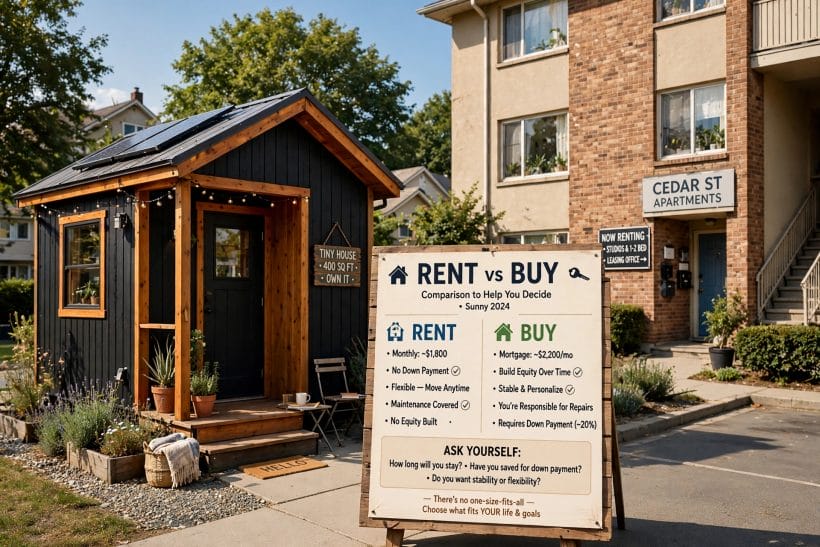
Is it better to rent a house or buy a tiny house? It’s the question behind the whole tiny house movement — and the honest answer is: it depends on your timeline, your local rent market, and what you value most. Renting buys flexibility and simplicity; a tiny house buys freedom from the rent cycle and a path to near-zero housing costs. This guide runs the real numbers — monthly costs, 5-year and 10-year math, and the hidden factors — so you can decide with math, not vibes.
For the cost side of tiny houses specifically, see our complete tiny house price breakdown.
The Short Answer
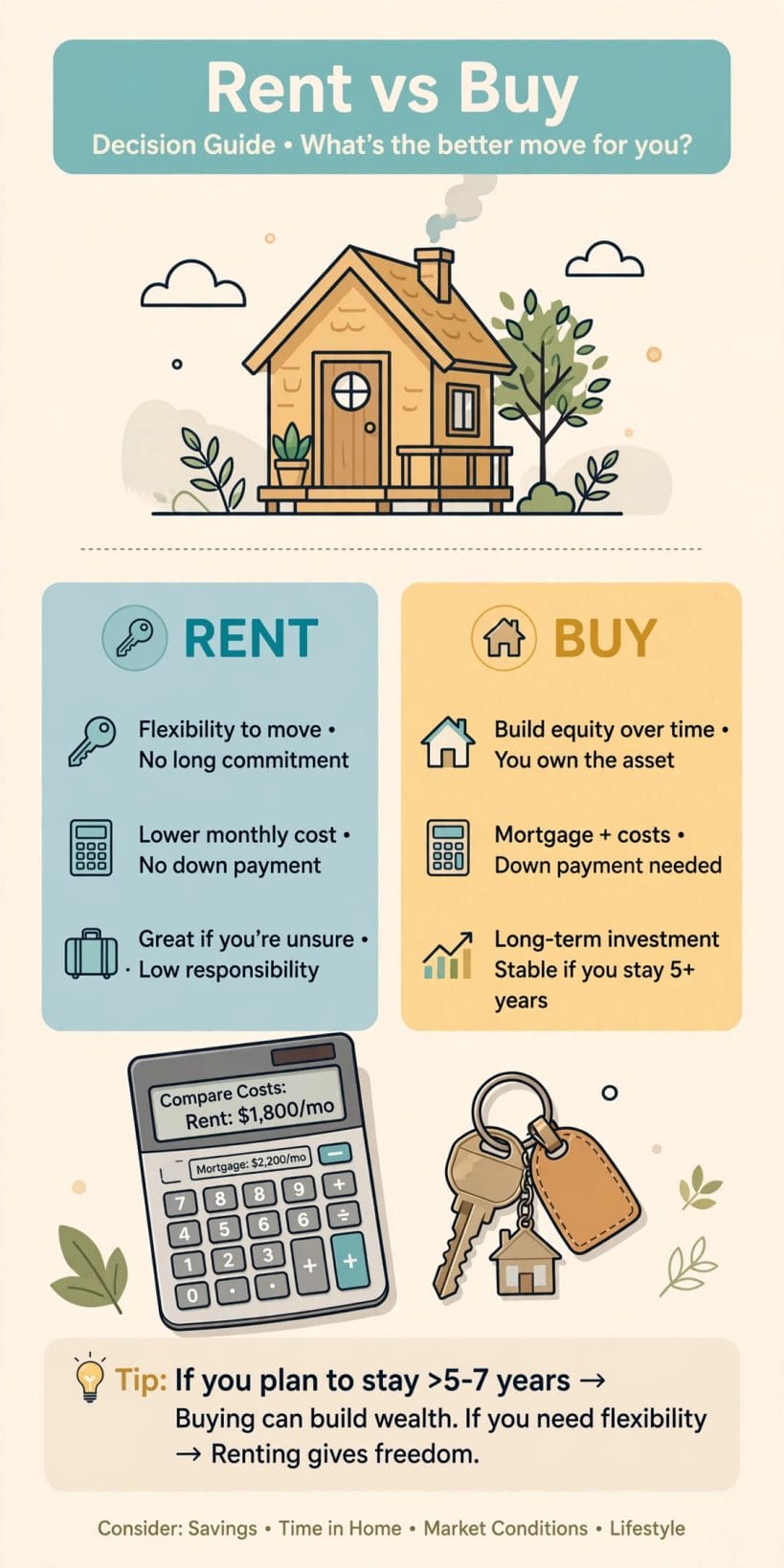
Rent if: You’ll move within 3 years, your local rents are reasonable, you value flexibility over equity, or you can’t yet afford the upfront cost of a tiny house.
Buy a tiny house if: You’ll stay put 5+ years, local rents are brutal, you want to kill your housing payment, and you can handle the upfront cost and logistics.
The crossover: In most markets, buying a tiny house beats renting somewhere between year 3 and year 7 — after that, the tiny house owner pulls ahead and keeps pulling.
Monthly Cost Comparison
Renting a house: Median US rent for a modest house runs $1,500–$2,500/month depending on market — plus renter’s insurance, and annual increases (historically 3–5%).
Tiny house (financed): A $100,000 tiny house at 8% over 15 years = ~$955/month + land/pad ($0–$800) + insurance ($50–$150) + utilities ($50–$150). Total: $1,050–$2,050/month.
Tiny house (owned outright): $200–$1,100/month — just land/pad, insurance, utilities, and maintenance. This is where the tiny house destroys renting.
The 5-Year Math
Renting at $1,800/month: 5 years = $108,000 paid, $0 equity, and rent has likely risen to ~$2,100/month.
Tiny house ($100k financed): 5 years = ~$57,000 in payments + $30,000–$48,000 in land/pad costs. You own a (depreciated but real) asset worth ~$60,000–$75,000.
The gap: After 5 years, the renter has spent more and owns nothing; the tiny house owner has spent less (or similar) and owns a home. The math favors buying — if you stay.
The 10-Year Math
Renting: 10 years at rising rents ≈ $240,000+ paid. Equity: $0. Monthly cost in year 10: ~$2,400+.
Tiny house: Loan paid off (15-year term) or nearly so. Monthly cost drops to land/pad + insurance + utilities: $300–$1,100. Total 10-year outlay often $150,000–$200,000 — with a paid-off home at the end.
The verdict at 10 years: It’s not close. The tiny house owner has housing costs approaching zero and an asset; the renter faces ever-rising rent forever.
Flexibility: Renting’s Superpower
Job mobility: Renters can relocate for a better job in 30 days. Tiny house owners face moving logistics (THOW) or selling (foundation).
Life changes: Relationships, kids, health — renters adapt by moving. Tiny house owners adapt by renovating, moving the house, or selling.
Risk: Renting caps your downside — the worst case is a lease term. Buying concentrates risk in one asset in one place.
Equity: Buying’s Superpower
Forced savings: Every mortgage payment builds equity — a savings account you live in. Renters must save voluntarily, and most don’t.
Payment stability: Fixed loan payments don’t rise with the market. Rent does. Over decades, this difference compounds enormously.
The endgame: A paid-off tiny house means housing costs near zero in retirement — the single biggest lever for financial independence.
Lifestyle: More Than Math
Renting lifestyle: Landlord handles maintenance, easy to upsize/downsize, no property logistics. But: no customization, no permanence, living by someone else’s rules.
Tiny house lifestyle: Total control, deep customization, connection to place (or freedom to move it). But: you handle everything, space constraints are real, logistics (land, parking, codes) are yours.
Who Should Keep Renting
The mobile professional: Career requires moves every 1–3 years. The transaction costs of buying/selling or moving a tiny house kill the math.
The uncertain: Not sure where you want to live, with whom, or doing what. Renting buys time to figure it out — expensive time, but valuable.
The cash-strapped: Tiny houses need upfront capital ($30,000+ minimum realistic). If you can’t swing that without dangerous debt, renting while saving is the responsible play.
Who Should Buy the Tiny House
The rooted: You know where you want to be for 5+ years. Every year past the crossover point is pure savings.
The rent-burdened: Paying 40–50%+ of income in rent with no end in sight. A tiny house converts that burden into an asset.
The freedom-seeker: You want housing costs near zero — for early retirement, creative work, or just breathing room. Nothing beats a paid-off tiny house.
Hidden Costs of Renting
Rent increases: The silent wealth transfer — 3–5% annual increases compound. Your $1,800 rent becomes $2,900 in 10 years at 5%.
Moving costs: Frequent movers pay $2,000–$5,000 per move in deposits, movers, and setup — the flexibility tax.
Opportunity cost: Money spent on rent can’t be invested. At 7% returns, $1,800/month invested for 10 years = ~$310,000. Renters pay this invisibly.
Hidden Costs of Tiny House Ownership
Depreciation: THOWs depreciate like vehicles — your “asset” loses value. Foundation tiny houses hold value better but still underperform conventional real estate.
Land risk: If you don’t own the land, pad rent can rise and you can be asked to leave. Land insecurity is the tiny house’s Achilles heel.
Maintenance surprises: Roofs, systems, and trailers need real money on real schedules. Budget 1–2% of value annually — and actually spend it.
The Hybrid Paths
Rent now, buy later: Rent cheaply while saving aggressively for a tiny house purchase. The disciplined version of “someday.”
House-hack a tiny house: Buy the tiny house, rent out rooms or the main house on your property. Let tenants fund your freedom.
Rent the land, own the house: Tiny house communities offer the ownership experience without land purchase — a middle path with its own trade-offs.
What the Numbers Don’t Capture
Peace of mind: No landlord, no lease renewal anxiety, no surprise rent hike. Owners consistently report this as the biggest quality-of-life gain — beyond the money.
Agency: Paint the walls, plant the garden, build the deck. The psychological value of control over your space is real and underrated.
Community: Owners put down roots differently than renters. Whether that’s good depends on you — but it’s different, and it matters.
Run Your Own Numbers
The inputs: Your current rent, expected annual rent increases (use 4%), tiny house all-in cost, loan terms (or cash), land/pad cost, insurance, and your realistic time horizon.
The comparison: Total renting cost over your horizon (with increases) vs. total tiny house cost (payments + land + insurance + maintenance − residual value). The lower number wins — on money.
The sensitivity test: Run it at 3, 5, and 10 years. If buying wins at 5 but loses at 3, your decision hinges on how certain the timeline is.
Tax Differences
Renters: No property tax, no mortgage interest deduction — but also no equity. Rent is not deductible (with rare exceptions).
Tiny house owners: Mortgage interest may be deductible if it’s your primary residence and you itemize. Property taxes (on foundation builds or land) may be deductible. Consult a tax pro — the rules are the same as conventional homes, just smaller numbers.
The net effect: Tax benefits slightly favor owning but rarely decide the question. Don’t buy a house for the tax deduction — buy it for the housing economics.
Insurance Compared
Renters insurance: $15–$30/month — covers your stuff and liability, not the building. Cheap and simple.
Tiny house insurance: $50–$170/month — covers the structure plus contents and liability. More expensive because there’s more to cover.
The gap: ~$50–$140/month more for owners. Real money, but small relative to the rent-vs-mortgage difference.
Maintenance: Landlord vs. You
Renting: The landlord fixes the roof, the furnace, the plumbing. Your maintenance responsibility is near zero — one of renting’s genuine pleasures.
Owning: Everything is yours — the $8,000 roof, the $3,000 HVAC, the $1,500 plumbing emergency. Budget 1–2% of the home’s value annually and you’ll rarely be surprised.
The skill factor: Handy owners cut maintenance costs dramatically; hands-off owners pay retail for every repair. Know which you are before choosing.
The Emotional Math
Renting anxiety: Lease renewals, rent hikes, landlord whims, the inability to truly settle. Low-grade chronic stress that owners forget they had.
Owning anxiety: The repair bill, the land uncertainty, the concentrated risk. Acute stress, less frequent — but sharper when it hits.
Which anxiety is yours: Honest self-knowledge matters more than spreadsheets here. Some people sleep better owning; some sleep better renting. Both are valid.
Decision Framework: Step by Step
Step 1 — Timeline: Will you stay 5+ years? If no, rent. If yes, continue.
Step 2 — Capital: Can you fund the purchase without dangerous debt? If no, rent and save. If yes, continue.
Step 3 — Land: Do you have a viable place to put it? If no, solve land first — it’s the hardest part.
Step 4 — Math: Run your numbers at 5 and 10 years. If buying wins clearly, buy. If it’s close, weigh the lifestyle factors.
Step 5 — Gut check: Which choice excites you? Which scares you, and is the fear rational? Decide.
Case Study: Two Paths, Ten Years
Alex rents: Starts at $1,800/month, 4% annual increases. Ten-year total: ~$259,000 paid. Ends with no asset and a $2,660/month rent bill.
Jordan buys tiny: $110,000 all-in ($90k house + $20k site/setup), 15-year loan at 8%, plus $400/month pad rent. Ten-year total: ~$155,000 paid. Ends with a nearly-paid-off home and $550/month ongoing costs.
The difference: Jordan spent ~$100,000 less and owns a home; Alex faces ever-rising rent. Same decade, same city — wildly different financial positions.
When the Answer Changes
Rent wins when: Timeline under 3 years, rents are low relative to incomes, you lack capital, land is unavailable, or mobility is the priority.
Buy wins when: Timeline over 5 years, rents are punishing, you have capital, land is secured, and you crave the freedom of minimal housing costs.
Revisit annually: The answer isn’t permanent. Life changes, markets change, and the right choice at 28 may be wrong at 38. Re-run the numbers when circumstances shift.
The Sunk Cost Trap
Renters: “I’ve rented here for years; moving is a hassle” — while rent quietly doubles over a decade. Familiarity is not a financial strategy.
Owners: “I’ve put so much into this house” — while the land situation deteriorates or the location stops working. Money spent is gone; only future costs and benefits matter.
The discipline: Evaluate the decision fresh each year with current numbers and current life. Past payments — rent or mortgage — don’t appear in the forward-looking math.
Frequently Asked Questions
Is it cheaper to rent or buy a tiny house?
Over 5+ years, buying a tiny house is usually cheaper — the crossover point is typically year 3–7 depending on local rents and purchase price. Under 3 years, renting usually wins due to transaction and moving costs.
How much do you save with a tiny house vs. renting?
Over 10 years, a tiny house owner often saves $50,000–$150,000+ versus renting, depending on local rents — plus ends up owning a home. The savings grow every year after the mortgage is paid.
Should I rent while saving for a tiny house?
Usually yes — rent as cheaply as you can while saving aggressively for the purchase. The exception: if rents are so high you can’t save, a low-cost interim option (family, house-sharing) accelerates the timeline.
Do tiny houses appreciate like regular houses?
No — THOWs depreciate like vehicles; foundation tiny houses hold value better but still underperform conventional real estate. Buy a tiny house for the lifestyle and the eliminated rent, not as an investment vehicle.
What if I buy a tiny house and need to move?
THOWs can move with you (budget $2,000–$8,000 for professional moving). Foundation tiny houses must be sold or rented out. This is renting’s core advantage — if mobility matters, weigh it heavily.
Final Considerations
Renting vs. buying a tiny house isn’t really about houses — it’s about time horizon and values. Short timeline, high mobility needs, uncertain future: rent, and rent smart. Long timeline, stable location, hunger for freedom from the rent cycle: buy the tiny house, and buy it with eyes open about depreciation and land. Run your own numbers with your local rents and realistic tiny house costs — the math is personal, but the principle is universal: every year you pay rent is a year you could have been building equity in your own small freedom.

0 Comments