

Ask a bank for a tiny house loan and you will usually be offered one of three products — or shown the door and told to come back with one of them in mind. The three are the chattel loan, the RV loan, and the personal loan, and they are not three prices for the same thing: they are three different legal relationships between you, your home, and the lender, with different collateral, different regulators, different rate structures, and very different consequences if life goes wrong. Choosing between them is the most consequential financial decision in most tiny house purchases after the price of the house itself.
This comparison works through the tiny house chattel loan vs RV loan vs personal loan decision the way a lender structures it: what secures each loan, who qualifies, typical rates and terms, what each costs on the same $60,000 of borrowing, and which buyer each product genuinely suits. All rates are typical advertised ranges at the time of writing and move with markets and credit profiles — use them to shortlist, then collect real quotes. If you want the wider financing landscape first (land loans, builder finance, mortgages for foundation homes), our pillar guide to how to finance a tiny house covers the whole map; this page is the deep dive on the big three.
1. The Three Loans at a Glance
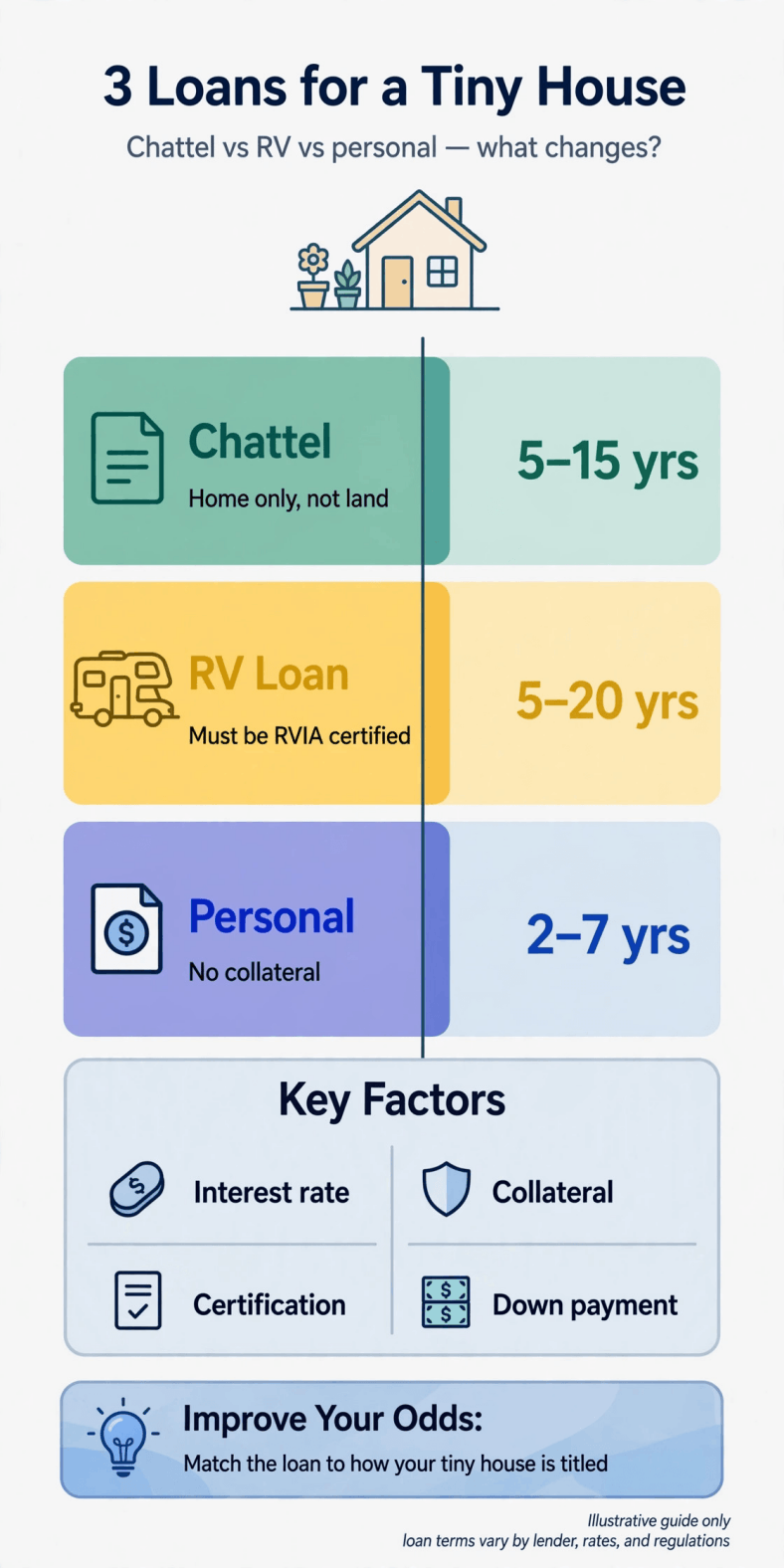
The one-sentence version: a chattel loan is secured by the home alone, an RV loan is secured by the home treated as a recreational vehicle, and a personal loan is secured by nothing but your signature and credit history. Everything in the table below flows from that difference. The tiny house chattel loan vs RV loan contest is mostly about what your home legally is; the personal loan sits outside that contest entirely, trading a higher rate for total indifference to what you bought.
| Attribute | Chattel Loan | RV Loan | Personal Loan |
|---|---|---|---|
| Collateral | The home only (title lien / UCC filing) | The home, titled and registered as an RV | None — unsecured |
| Typical rates | About 8-13 percent | About 7-11 percent | About 9-16 percent (best credit from ~7-8) |
| Typical terms | 10-23 years | 10-15 years, some to 20 | 3-7 years |
| Typical amounts | $25,000-$300,000+ | $20,000-$250,000 | $1,000-$100,000 |
| Home requirements | Title/MSO, insurance; certification helps | RVIA/NOAH certification and RV registration effectively required | None |
| Credit sweet spot | 660+ | 680-720+ | 700+ for the best rates |
| Land needed? | No | No | No |
| Speed to fund | 2-6 weeks | 1-4 weeks | 1-7 days |
| If you default | Repossession of the home | Repossession of the home | Collections, credit damage, lawsuit — home not directly at risk |
2. Chattel Loans: The Manufactured-Housing Channel
A chattel loan treats your home as movable personal property — chattel — rather than real estate. The lender’s security is a lien on the home’s title (or a UCC-1 filing where the home has a manufacturer’s statement of origin instead of a title), and the land underneath is irrelevant to the loan, which is exactly why chattel is the default channel for tiny houses parked on rented land, in parks, or on family property. The product comes from the manufactured-housing industry, and its lenders — specialist finance companies and a growing number of credit unions — understand homes without land better than any mainstream bank. Rates typically run about 8 to 13 percent, terms stretch from 10 to as long as 23 years (longer than RV money, because manufactured-housing lending is built around affordability), and loan sizes comfortably cover the whole tiny house market, from $25,000 to well past $300,000.
Chattel — the strengths. No certification gate: a well-documented DIY build with an MSO can be financed where an RV lender would refuse it outright. No land requirement and no RV registration dance. Long terms keep payments low on larger budgets. The home can sit in a park or on a lease, which matches how a large share of tiny houses actually live — and if you are still choosing where the home will sit, our guide to where to buy tiny house lots shows how the parking decision and the loan decision interact. Chattel — the weaknesses. Rates sit above RV money for the same borrower. Some contracts carry prepayment penalties or dealer markups (the rate the dealer quotes is not always the rate the lender set). And because the home depreciates while a 20-year term ambles on, chattel borrowers must watch the loan-to-value line: owe more than the home is worth and you cannot sell your way out of the loan.
3. RV Loans: The Cheapest Money — With a Gate
An RV loan is a vehicle loan written by banks and credit unions for recreational vehicles, and a tiny house qualifies only when it legally is one: built or inspected to the RV standard, carrying RVIA certification (or an accepted equivalent such as NOAH), titled, and registered as an RV with the state. Clear that gate and the pricing is the best in this comparison — typically about 7 to 11 percent, with terms of 10 to 15 years and some lenders stretching to 20 on larger amounts — because the lender is pricing a standardised, inspected, resale-liquid asset, not a one-off tiny house. If your home is already certified and registered, this is usually the first application to make; if it is not, the pathway in our guide to how to register a tiny house as an RV is the homework that unlocks it, and what RVIA certification is and why your tiny house needs it explains the inspection standard lenders are really buying.
RV loans — the strengths. Lowest typical rates of the three; mainstream lenders and credit unions (easier rate shopping, better servicing); terms long enough to keep payments sane without chattel’s ultra-long tail; prepayment penalties are uncommon. RV loans — the weaknesses. The gate is real: uncertified DIY builds, homes titled as something else, and some park-model configurations are simply declined. Some lenders restrict how the RV may be used — full-time living clauses exist in parts of the RV finance market, so read the use terms before signing if the tiny house is your primary residence. Insurance to the lender’s standard is mandatory (see Section 7). And RV values depreciate on a vehicle curve, so like chattel, long terms plus quick depreciation can strand a borrower who needs to sell in years two to four.
4. Personal Loans: No Collateral, No Questions, No Mercy on Term
The personal loan is the outsider: unsecured, underwritten purely on your credit and income, and indifferent to whether the money buys a tiny house, a boat, or a wedding. That indifference is its superpower. A DIY build with no title, no certification, and no intention of getting either can still be financed — the lender simply never asks. Funding takes days, sometimes hours; amounts run to $100,000 at the big online lenders; and because there is no lien, you hold a clean title from day one and can sell the home whenever you like without a payoff dance. For excellent credit (740+), headline personal rates can start around 7 to 8 percent and undercut a chattel quote — the catch is the term. Personal loans run 3 to 7 years, so the monthly payment on a full-size tiny house budget is punishing: $60,000 at 12 percent over 5 years is about $1,335 a month (Section 5’s example), which fails most households’ cash flow even when the total interest is the lowest of the three.
Personal loans — the strengths. Any home qualifies, including self-builds mid-construction (money can fund in stages of your choosing); no appraisal, no inspection, no insurance mandate; the home is never repossessable for this debt; prepayment is almost always free, so aggressive payoff strategies work beautifully. Personal loans — the weaknesses. Short terms make large amounts unaffordable month-to-month; rates for merely-good credit (660-700) sit in the mid-teens, the worst pricing in this comparison; origination fees of 1 to 8 percent hide inside some headline offers (compare APR, never the note rate); and a large unsecured balance dents your debt-to-income ratio for every future borrowing decision, including a mortgage on land.
5. The Worked Example: $60,000 Three Ways
Same borrower, same home, same $60,000 — three structures (illustrative rates from the middle of each range; your quotes will differ). Chattel at 10.5 percent over 15 years: about $663 a month, and about $59,300 of total interest — you repay very nearly double the price of the house across the term. RV loan at 8 percent over 12 years: about $650 a month, about $33,600 of interest. Personal loan at 12 percent over 5 years: about $1,335 a month, about $20,100 of interest. Read the table twice and the real lessons surface. First, the RV loan and the chattel loan cost almost the same per month, but the chattel loan quietly costs $25,700 more in total — the three extra years, not the 2.5 points of rate, do most of that damage. Second, the personal loan is simultaneously the most expensive per month and the cheapest overall, which is why cash-flow-rich buyers sometimes choose it deliberately and pay it off in three.
Before you fall in love with any row of this example, replicate it with your own amount and quotes in our mortgage calculator for tiny houses, and then stress-test it once more against the complete ownership picture — payments are only one line of the budget in our breakdown of the true cost of tiny houses. A loan that wins the spreadsheet but leaves nothing for insurance, lot rent, and repairs loses the year.
6. Eligibility Showdown: Credit, Income, and the Home Itself
Credit score. Personal loans price hardest on score alone: 740+ unlocks the advertised rates, 660-700 pays mid-teens, below 640 is mostly declines. RV loans want 680 to 720 for their best tiers but weigh the collateral too. Chattel lenders are the most forgiving of the three — approvals in the mid-600s are realistic — because the product was designed for buyers outside the mortgage mainstream; the forgiveness is priced into the rate. Income and DTI. All three check income; RV and chattel lenders typically cap debt-to-income around 43 to 45 percent including the new payment, and personal lenders are stricter on large amounts. The home. Here the products diverge completely: the personal loan asks for nothing, the chattel loan asks for title/MSO, photos, and insurance, and the RV loan asks for certification, registration, an insurable replacement value, and often an age limit (many RV lenders balk at units over 10 to 15 years old by the end of the term). Down payment. Expect 10 to 20 percent down on chattel and RV loans for the best pricing; personal loans are typically zero down, another reason their payments tower.
One requirement all secured lenders share: insurance from day one, with the lender as loss payee. Budget for a proper policy as part of the loan decision, not as an afterthought — our tiny house insurance guide for wheels versus foundation explains the coverage types lenders accept and the ones they reject. If a quote seems suspiciously cheap, check whether it quietly assumes you already hold a policy you do not have.
7. Verdict: Which Loan for Which Buyer
Your home is RVIA/NOAH certified and registered as an RV: take the RV loan. It is the cheapest total cost for most borrowers, from mainstream lenders, with clean terms — this is the rematch the certification was bought for. Your home is a DIY or uncertified build, or lives on rented land or in a park: the chattel loan is your channel — it was designed for exactly your paperwork, its lenders understand the asset, and its long terms fit real budgets; just cap the term at 15 years if you can afford the payment, and negotiate any prepayment penalty out before signing. The balance is modest (under about $25,000) or you need speed: the personal loan wins on friction — no appraisal, no lien, funded this week — and on small balances the short term is a feature, clearing the debt before the home needs its first big repair. Your credit is rebuilding: chattel now, refinance later into RV money if and when the home’s certification and your score allow. You own land and the home will be foundation-set and deeded: none of the three — price a real mortgage or home-equity product first, because real-property money is cheaper than all of them.

Final Considerations
Do not let a dealer, a marketplace listing, or a deadline choose your loan type by default — that is how buyers end up with 20-year chattel terms on homes that qualified for RV money, or five-year personal loans whose payments force a sale in year two. Decide from your paperwork outward: what is the home legally, where will it sit, how long will you keep it, and what does each structure cost in total on your actual numbers? Get at least one quote from each category your home qualifies for, compare APR and total interest rather than the monthly payment, and read the prepayment and full-time-use clauses before you sign anything. The right loan feels boring — affordable in a bad month, clearable ahead of schedule, and matched to the home’s real legal identity. Boring, in borrowing, is the sound of money kept.