

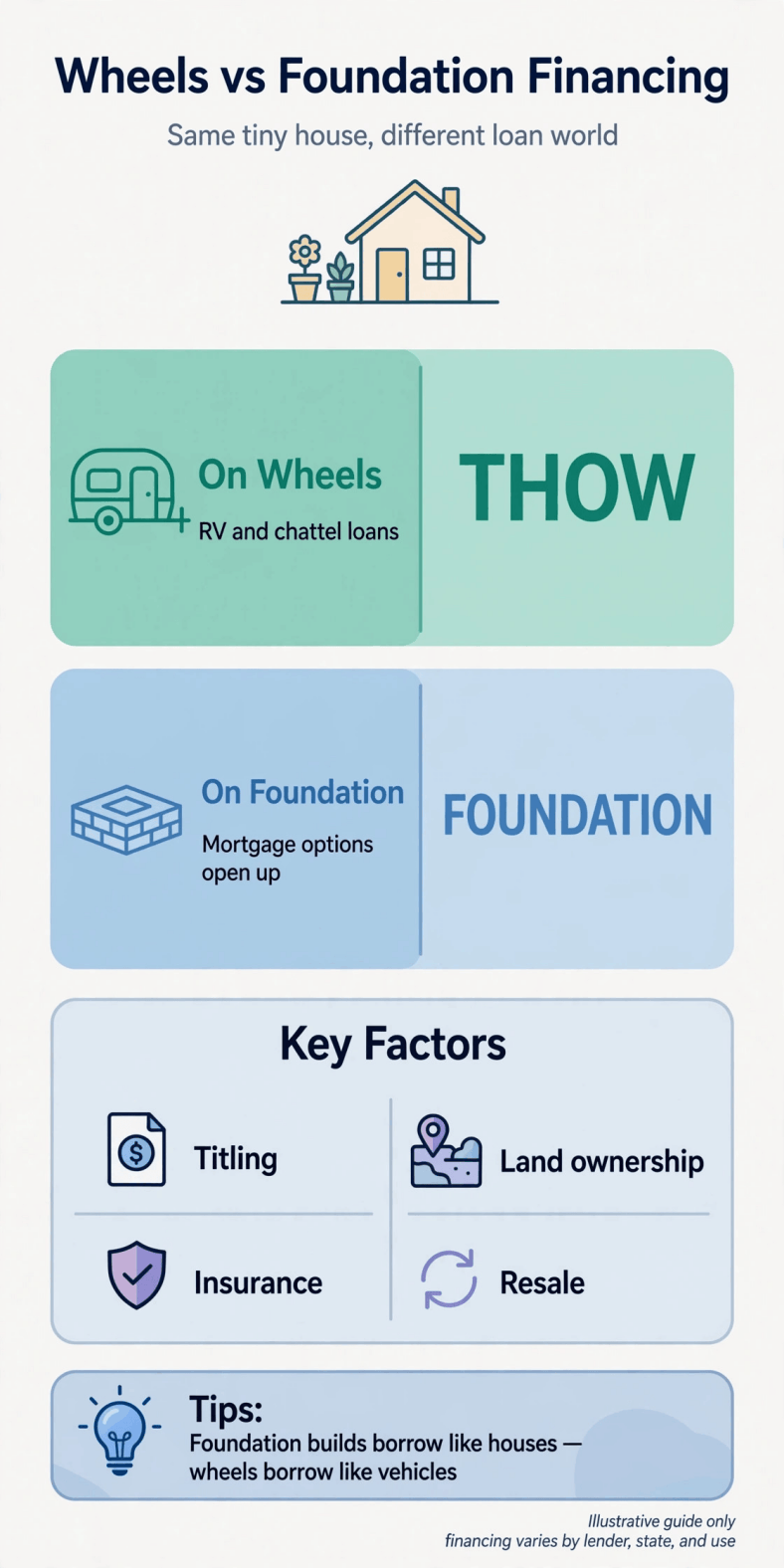
Two buyers can purchase the identical 28-foot tiny house, from the same builder, for the same $95,000 — and be offered completely different loans, at different rates, on different terms, with different rights if they stop paying. The only difference between them is what sits under the house. One chose wheels; the other chose a foundation. Financing a tiny house on wheels vs foundation is not a comparison of two loan menus. It is a comparison of two legal identities — personal property versus real estate — and every rate, term, insurance rule, and resale outcome in this guide flows from that single distinction.
We will compare the two paths attribute by attribute: the loan products each identity unlocks, how collateral and titling work, the real cost of borrowing $90,000 each way (with the arithmetic shown), how insurance differs, how land and zoning interact with the loan, and what happens to value over time. We finish with a verdict by buyer situation, because the right answer genuinely depends on whether you own land, whether you will move, and how long the money needs to last. Rates throughout are typical ranges at the time of writing — shortlist with them, then collect real quotes for your state and credit profile.
1. Two Houses, Two Legal Identities
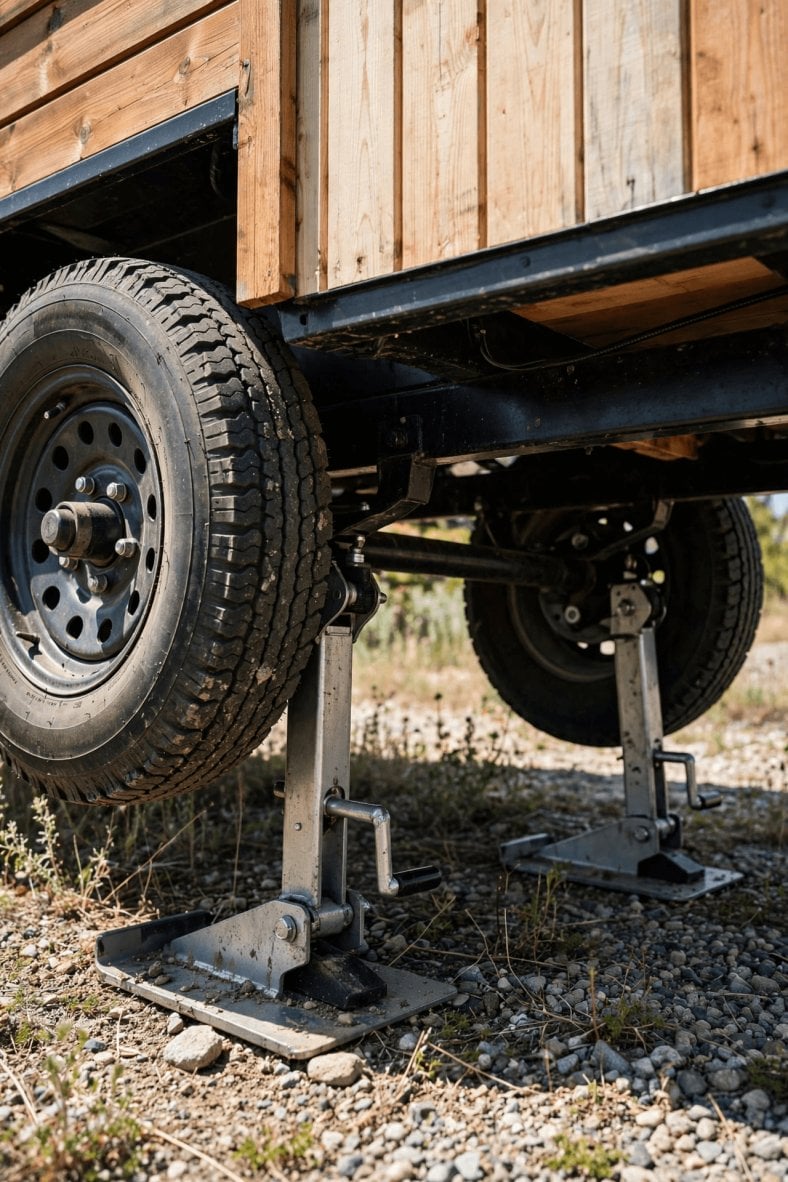
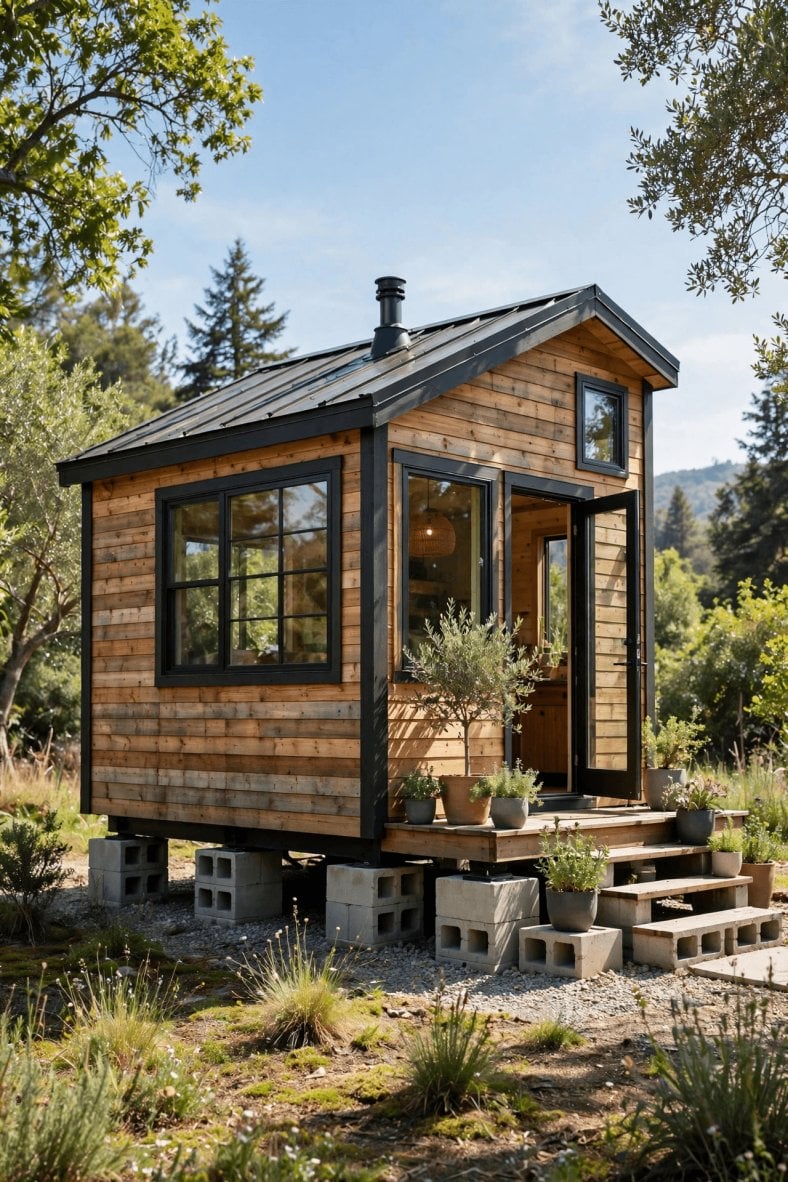
A tiny house on wheels (THOW) is, in the eyes of lenders and the state, a vehicle-like object: it carries a title or a manufacturer’s statement of origin, it is registered (often as an RV or travel trailer), and it is taxed and insured as personal property. It does not legally include the land it parks on, which may be rented, borrowed, or owned separately. A tiny house on a foundation — permanently affixed, connected to utilities, and (in most states) formally converted through a process sometimes called title elimination or affixation — becomes real property: the house and its lot are one legal asset, recorded at the county, taxed as real estate, and mortgageable. That conversion is the whole game. The foundation house borrows against real estate with two centuries of lending infrastructure behind it; the wheels house borrows against a depreciating titled asset, and its finance market is younger, smaller, and more improvised.
This is why financing a tiny house on wheels vs foundation produces such different paperwork from the very first phone call. The wheels buyer is asked: is it certified, is it titled, where will it be parked? The foundation buyer is asked: do you own the lot, what is the zoning, what will it appraise for? Our pillar guide to how to finance a tiny house maps every product mentioned here in one place; the sections below compare the two identities head to head.
| Attribute | On Wheels | On Foundation |
|---|---|---|
| Legal identity | Personal property (titled) | Real property (deeded with land) |
| Main loan products | Chattel, RV, personal loans | Mortgage, construction, home equity |
| Typical rates | About 7-16 percent by product | About 6.5-9 percent mortgage range |
| Typical max term | 15-23 years | 30 years |
| Collateral paperwork | Title lien / UCC filing | Mortgage / deed of trust on house + land |
| Default process | Repossession (fast, vehicle-like) | Foreclosure (slow, court-supervised in many states) |
| Insurance style | RV / specialty tiny house policy | Homeowners-style dwelling policy |
| Value behaviour | Depreciates like a vehicle | Can appreciate with the land |
2. Loan Products: What Each Identity Unlocks
On wheels, the menu is the trio from the manufactured-housing and vehicle worlds. Chattel loans (about 8 to 13 percent, terms to 20+ years) are secured by the home alone and are the default for parked THOWs. RV loans (about 7 to 11 percent, 10 to 15 years) are cheaper but gated: the home generally must be RVIA/NOAH certified and registered as an RV — a pathway detailed in our guide to how to register a tiny house as an RV. Personal loans (about 9 to 16 percent, 3 to 7 years) ask nothing about the home and price accordingly. Builder financing and dealer-arranged loans exist at the margins, usually as a bridge into one of the three. What you will not find on wheels is a 30-year mortgage at mainstream rates — the product literally does not exist for titled personal property.
On foundation, the mainstream mortgage market opens — with conditions. A foundation tiny home that meets local building code, sits on land you own, and appraises against comparable sales can qualify for conventional mortgages and, depending on the program and the property, government-backed channels that many buyers ask about (these programs have their own property standards, and very small or unusual homes can struggle with appraisal and minimum-property rules — verify early with a lender who has closed tiny homes before). Construction-to-permanent loans finance the build itself and convert to a mortgage at completion. Home equity loans and HELOCs become available once the property exists and has equity. The rate environment is the conventional one — roughly 6.5 to 9 percent across recent cycles for well-qualified borrowers — and terms run to 30 years. The catch is everything around the loan: permits, inspections, code compliance, and an appraisal that a 320-square-foot house does not always survive gracefully.
3. Collateral, Titling, and What Default Means
On wheels, the lender’s security is a lien on the title. You keep the home; the state record shows the lender’s interest; and if you default, the remedy is repossession under personal-property law — in many states a matter of weeks, with the home towed away and sold, and you potentially liable for any deficiency balance. There is no foreclosure process because there is no real estate. On foundation, the lender takes a mortgage or deed of trust against the house and land together. Default leads to foreclosure — a slower, more procedural path (judicial in many states) measured in months, with statutory opportunities to cure. Neither is a reason to borrow carelessly, but the foundation borrower’s downside is buffered by process and by an asset that may hold value; the wheels borrower’s downside is fast and total. Read the security instrument before you sign either, and note the practical corollary: a wheels loan follows the title, so selling the home means satisfying the lien at sale; a foundation sale is a standard real-estate closing.
4. The Real Cost: Borrowing $90,000 Each Way
Illustrative examples, computed from the middle of each typical range — your quotes will differ. Wheels, chattel loan at 10.5 percent over 15 years: about $995 a month, and about $89,100 of total interest across the term — close to paying for the house twice. Wheels, RV loan at 8 percent over 12 years (available only to the certified and registered): about $974 a month, about $50,300 of interest. Foundation, 30-year mortgage at 7 percent: about $599 a month — dramatically cheaper monthly — but about $125,600 of interest if held the full 30 years. Foundation, 15-year mortgage at 6.5 percent: about $784 a month, about $51,200 of interest. Two lessons hide in that table. First, the monthly-payment gap is mostly term, not rate: stretching any loan to 30 years halves the payment and doubles-plus the interest. Second, compared like-for-like at 15 years, the foundation mortgage’s interest bill ($51,200) still undercuts the chattel loan’s ($89,100) by roughly $38,000 — that gap is the true price of the wheels identity over a full loan life, before counting the land the foundation buyer also had to buy.
Run your own versions of these numbers with our mortgage calculator for tiny houses, and sanity-check the total against the full ownership picture in our breakdown of the true cost of tiny houses — the foundation path’s land purchase, permits, foundation work (commonly $8,000 to $25,000+ for piers, slab, or basement work plus utility connections), and closing costs belong in the same spreadsheet as the rate advantage.
5. Insurance: Two Different Policies for Two Identities
The wheels home is insured like a vehicle-adjacent asset: RV-style or specialty tiny house policies, priced roughly $400 to $1,800 a year depending on use and value, with the lender named as loss payee and transit risk as a live underwriting question. The foundation home is insured like what it legally is — a house: homeowners-style dwelling policies, commonly $600 to $1,500 a year at tiny-home values, with territory, construction, and replacement cost driving the premium, and the mortgage lender’s escrow machinery often collecting it monthly. Both lenders — chattel and mortgage — will force-place expensive cover if yours lapses, so the comparison that matters is not which policy is cheaper in the abstract but which one your situation can actually sustain. The full pricing picture, with example premiums, is in our tiny house insurance guide for wheels versus foundation.
6. Land and Zoning: The Loan’s Silent Partner
Every wheels loan carries an unasked question — where will it be parked? — because the collateral’s legality affects its value. A THOW financed into a jurisdiction that prohibits full-time RV living, or a park that can be sold and closed, is riskier collateral, and while most chattel lenders do not audit your parking, the risk lands on you: move costs, lost lot arrangements, and a home whose local resale market just shrank. Buyers who do own land for a wheels home should read our guide to where to buy tiny house lots before assuming the wheels discount makes land cheap — a THOW lot still needs legal occupancy, utilities, and access. The foundation path inverts the problem: land, zoning, permits, and site work come first and the loan follows them. Budget the unglamorous sequence — survey, septic or sewer, water, power, driveway, foundation — using our walkthrough of how to prepare your land for a tiny house, because a construction lender will ask for exactly that list, priced, before money moves.
7. Appraisal, Value, and the Exit
Wheels homes depreciate on a vehicle-like curve — steepest in the first three years — which is why their lenders watch loan-to-value so carefully and why long chattel terms can leave owners owing more than the home would sell for. Foundation homes behave like real estate: the structure may age, but the land component can appreciate, and owners can plausibly exit with equity. Certification narrows the wheels penalty more than any other single factor, because it widens the buyer and lender pool at resale; our explainer on what RVIA certification is and why your tiny house needs it is required reading before you choose an uncertified build at either identity. And note the conversion asymmetry: a wheels home can sometimes be placed on a foundation and converted to real property later (with permits, inspections, and a title-elimination process that varies by state), but a foundation home never goes back to wheels. The foundation decision is the one-way door; price it accordingly.
8. Verdict: Which Identity Suits Which Buyer
You rent your land or may move within five years: wheels, financed with the shortest chattel or RV term you can afford — mobility is the asset you are buying, and a foundation strands it. You own land and plan to stay a decade or more: foundation, almost regardless of the build hassle — mortgage pricing, foreclosure protections, appreciation potential, and standard insurance all compound in your favour, and the loan will likely be the cheapest money you ever borrow. Your budget is the binding constraint today: wheels is cheaper to enter (no land purchase, no foundation works, faster funding), but be honest that you are renting the difference back through higher rates and depreciation; set the loan term short enough that you are never upside-down. You are buying the home as an investment or future rental: foundation on your own lot, because real property is financeable, insurable, and sellable through mainstream channels at every step. You genuinely cannot decide: buy the wheels home, park it legally on land you could later build on, and keep the conversion path open — it is the only sequence that preserves both options.
Final Considerations
The wheels-versus-foundation choice is usually made with the heart (freedom! roots!) and paid for with the wallet, so run the wallet’s numbers before the heart signs anything: total interest at matched terms, insurance at real quotes, land and site costs included on the foundation side, depreciation included on the wheels side. Then check the two gates that quietly decide feasibility — for wheels, certification and a legal place to park; for foundation, zoning that allows the home and an appraisal that supports the loan. Buyers who clear their gates on paper first rarely regret either identity. Buyers who discover them after the deposit do not get to choose at all — the paperwork chooses for them.