

Insurance is the line item tiny house buyers forget to budget until a lender, a park, or a dose of common sense demands it — and then the first quote arrives and nobody knows whether it is fair. So here is the number range up front: tiny house insurance cost typically runs about $400 to $1,800 per year for most owners, with full-time homes on wheels in the $700 to $1,800 band, foundation-set tiny homes often at $600 to $1,500, and hard-to-place homes (uncertified, high-value, rented out, or parked in severe-weather country) climbing past $2,000. Where you land inside that range is not random. It is priced, factor by factor, from the insured value, the home’s certification, how and where it lives, and the deductible you choose.
This guide unpacks those factors with worked premium examples — five realistic owner profiles with the figures an insurer might quote them, clearly labelled as illustrative examples built from typical market ranges, because no two tiny houses rate identically. We then decode the coverage types inside the premium, quantify the certification effect (NOAH and RVIA), do the deductible maths, and list the levers that genuinely lower a premium. If you need the full insurance landscape — policy types, wheels versus foundation rules, and how to buy — start with our tiny house insurance guide for homes on wheels versus foundation; this page is its pricing companion.
1. The Short Answer: Premium Ranges by Situation
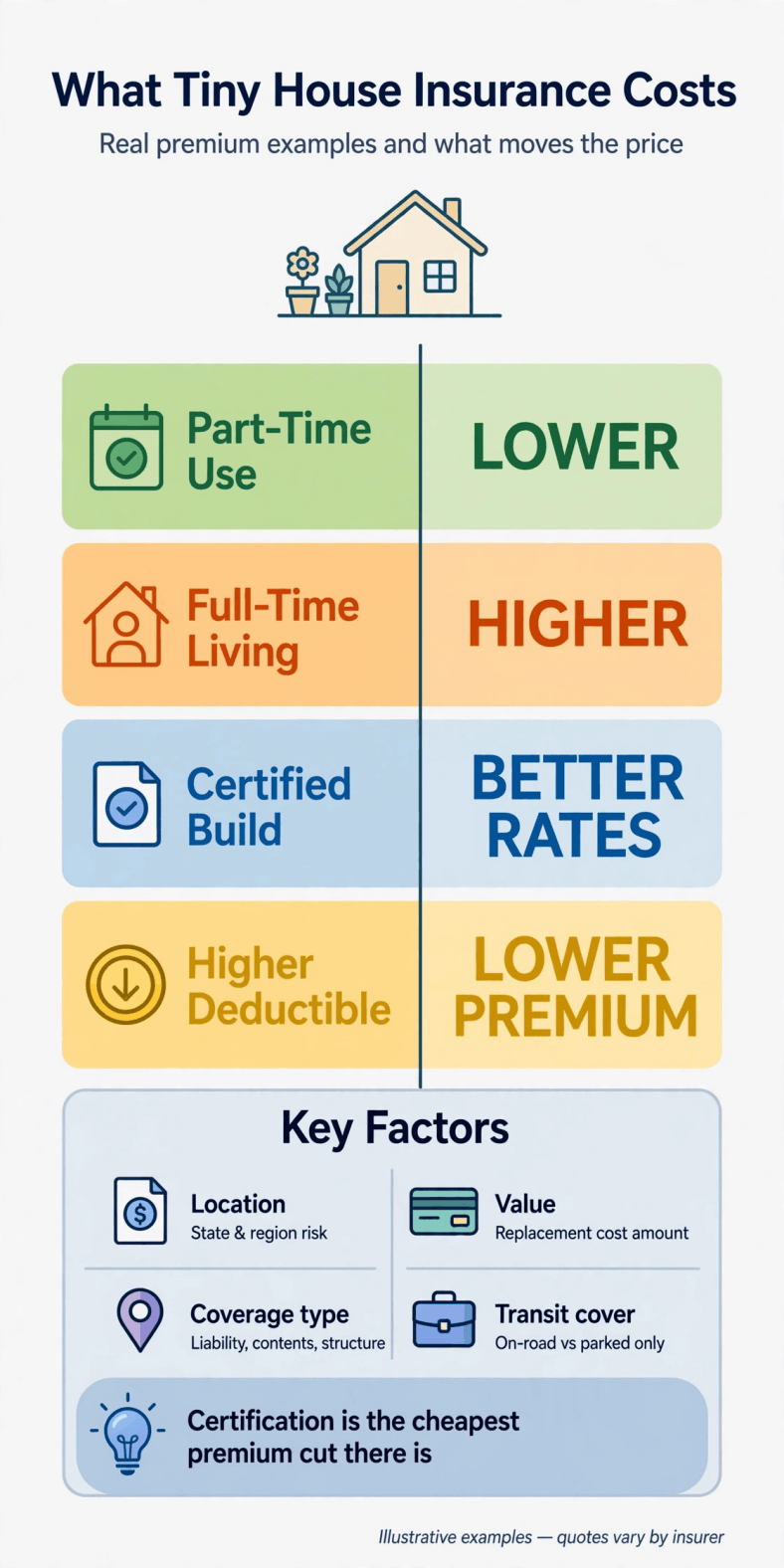
Insurers do not have one tiny house product; they have several, and the product decides the price band before your details are even entered. A tiny house on wheels used part-time is often written like a travel trailer or RV policy — the cheapest band, roughly $400 to $900 a year. The same house lived in full-time needs a policy that contemplates a primary residence (specialist tiny house programs or manufactured-home style policies): roughly $700 to $1,800 a year. A tiny house set on a permanent foundation and treated as a dwelling is commonly written on homeowners-style forms: roughly $600 to $1,500 a year, influenced by the same territory and construction factors as any small house. Layer on the complications — uncertified construction, high insured value ($120,000+), short-term rental use, coastal wind or wildfire territory — and premiums of $1,800 to $2,800+ appear, or the standard market declines and a specialty broker places the risk at specialty prices. Keep those bands in mind; the examples next show how individual owners land inside them.
2. Real Premium Examples: Five Owner Profiles
Each profile below is an illustrative example assembled from typical market ranges for homes of that type and value; treat them as calibrated estimates for budgeting, not as quotes — your state, insurer, and claims history will move the real number. Example A — the certified full-timer: $1,145 a year. A 28-foot RVIA-certified tiny house on wheels, insured value $85,000, lived in full-time and parked long-term in a North Carolina tiny house community, replacement-cost cover, $100,000 liability, $500 deductible: about $95 a month. Certification, a managed park setting, and a moderate value keep her near the middle of the full-time band. Example B — the DIY build: $1,580 a year, if placed at all. A 24-foot self-built home, value $45,000, no certification, parked on rural family land in Oregon. Two standard carriers decline; a specialty program writes it at $1,580 with a $1,000 deductible and actual-cash-value settlement — a lower-value home paying more, purely on documentation risk. Example C — the foundation cottage: $890 a year. A 400-square-foot tiny home on a permanent foundation in Ohio, insured as a dwelling for $120,000 replacement cost, $300,000 liability, $1,000 deductible: $890 — the cheapest per dollar of cover in this set, because the underwriting is conventional. Example D — the weekend traveller: $760 a year. A 20-foot certified THOW worth $65,000, used recreationally, stored on the owner’s property in Colorado, RV-style policy with transit cover and a $500 deductible: $760. Example E — the rental host: $2,340 a year. A certified 26-foot THOW worth $95,000 in a Florida park, rented on short-term platforms when the owner travels, requiring a landlord/commercial-use policy with higher liability: $2,340 — rental use and Florida wind exposure stack two surcharges on one small house.
3. What Drives the Price: The Rating Factors
Insured value is the base rate’s multiplier: expect premiums in the region of 1 to 2 percent of insured value per year for homes on wheels, less for foundation homes written on standard dwelling forms. Every $10,000 of added insured value adds roughly $70 to $180 a year depending on the program. Use is the second big lever: full-time primary-residence use costs more than recreational use (you are home to cook, heat, and flood it every day), and rental use costs most of all. Location prices the weather and the law: hurricane-exposed coastal counties, wildfire-interface zones, and hail belts carry territory loadings that can double a premium, while the park-versus-private-land setting changes theft and liability exposure. If you are still siting the home, our guide to where to buy tiny house lots is worth reading alongside quotes — two otherwise identical lots can rate very differently. Your record matters too: prior water or fire claims, and in many states a credit-based insurance score, move the number by 10 to 30 percent. Construction and protection — metal versus shingle roof, anchoring and tie-downs, skirting, smoke and CO alarms, a monitored extinguisher — each shave small percentages that compound.
4. Coverage Types: What the Premium Actually Buys
A premium is a bundle, and comparing bundles by price alone is how owners end up underinsured. The components: dwelling/structure cover for the home itself, ideally at replacement cost (what it costs to rebuild or replace today) rather than actual cash value (replacement minus depreciation — on a five-year-old home, ACV settlement can return 60 to 75 cents on the replacement dollar, a gap that shocks owners at claim time). Personal property for contents, often 40 to 70 percent of the dwelling limit on bundled forms, sometimes a separate scheduled amount on RV-style policies. Liability — $100,000 is a common floor demanded by parks and lenders; $300,000 costs surprisingly little more (often $30 to $80 a year) and is the upgrade we would buy first. Additional living expense / loss of use, paying for a motel while the home is repaired — verify it exists on wheels policies, where it is sometimes thin. Transit and trip cover for the specific catastrophe of a home that moves: collision and overturn while towing, which a parked-home policy may exclude entirely; if the house travels, our guide to towing a tiny house: trucks, hitch, and weights covers the mechanical side of the same risk. Read the declarations page for these five lines before you celebrate any premium.
5. The Certification Effect: NOAH and RVIA
Certification is the closest thing tiny house insurance has to a master key. An RVIA-inspected (or NOAH-certified) home arrives with third-party verification that its electrical, plumbing, HVAC, and structure meet a published standard — which answers the underwriter’s first and hardest question about a small, non-standard dwelling. The practical effects, in order of value: access (standard and specialist carriers will quote at all, where uncertified builds collect declines, as Example B showed); price (certified homes routinely rate 15 to 35 percent below comparable uncertified placements in the specialty market, and unlock the mainstream programs entirely); and settlement quality (replacement-cost forms are far easier to obtain than ACV-only offerings). If your build is uncertified and your quotes look like Example B’s, the certification pathway in what RVIA certification is and why your tiny house needs it may pay for itself inside two renewal cycles — an unusual sentence in insurance, but the arithmetic of a $400-to-$700 annual saving against a one-time inspection cost makes it plausible for many owners.
6. Deductibles: The Maths of the Cheapest Lever
The deductible is the part of every claim you pay yourself, and it is the fastest honest way to move a premium. Typical tiny house deductibles run $250, $500, $1,000, and $2,500 (foundation homes may also offer percentage deductibles for wind). As a rule of thumb from the examples above: moving from $500 to $1,000 trims roughly 8 to 15 percent off the annual premium; $1,000 to $2,500 trims a further 5 to 10 percent. On Example A’s $1,145 premium, the $1,000 deductible saves perhaps $115 to $170 a year — worth taking if you hold a $1,000 emergency fund, because you would need a claim every six to nine years just to break even on the saving, and most owners claim far less often. On a $2,340 premium like Example E, the same steps are worth real money. Two cautions: lenders and parks sometimes cap the deductible they accept (a $2,500 deductible may breach a loan covenant), and a deductible you cannot actually pay in a bad week is not a saving — it is a second disaster scheduled inside the first.
7. How to Lower Your Premium: Ten Levers That Work
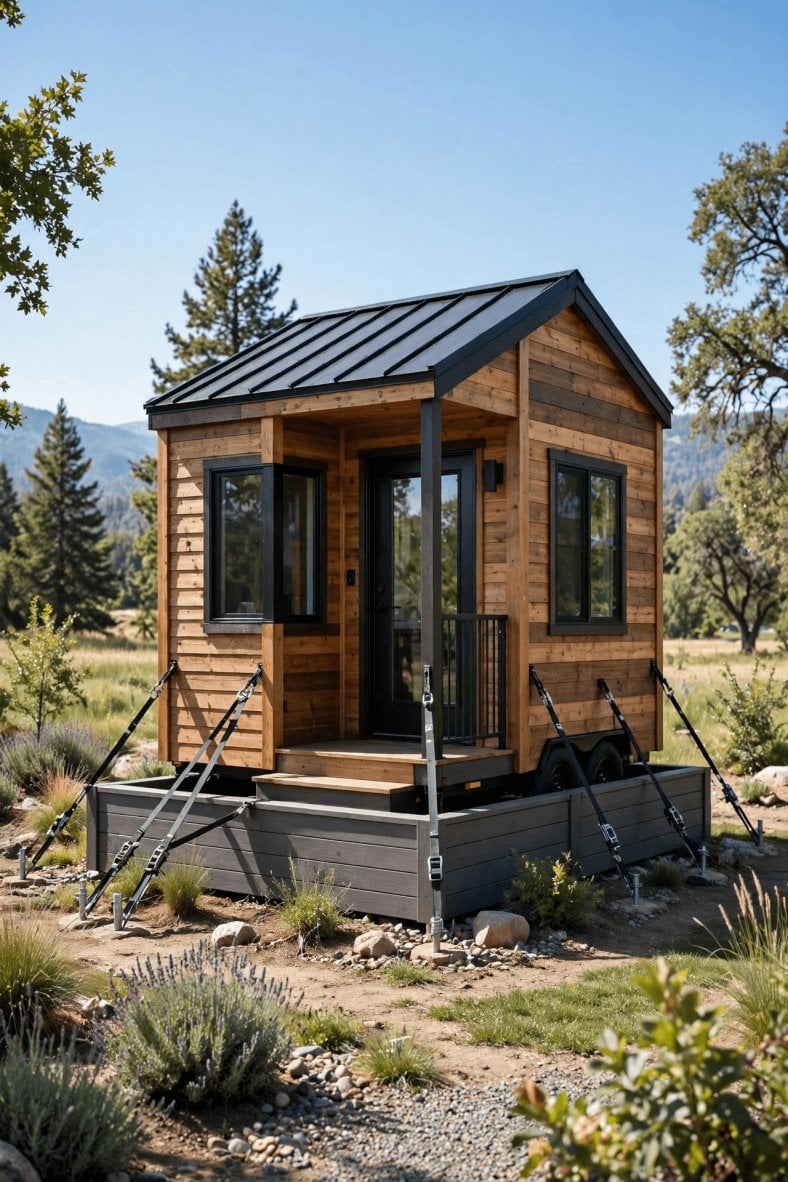
One: certify the home (Section 5 — the biggest lever). Two: anchor and skirt it; engineered tie-downs and proper skirting cut wind and freeze risk, and underwriters price both — the safety upgrades in how to keep your tiny house safe double as a premium-reduction checklist. Three: fit alarms and an extinguisher — smoke, CO, and a kitchen-rated extinguisher cost under $150 and satisfy protection credits. Four: choose the deductible deliberately (Section 6). Five: pay annually; monthly instalments commonly add 5 to 10 percent in fees. Six: bundle with your auto policy where the same group writes both. Seven: insure the honest value — replacement cost on the structure you actually own, not the Zillow daydream; over-insuring buys premium, not payout. Eight: park smart — managed communities with hydrants, setbacks, and lighting rate better than isolated exposed sites. Nine: protect the plumbing (heat tape, insulated skirting, leak sensor) because water damage is the tiny house claim that actually happens. Ten: shop at renewal through a tiny-house-literate broker; the specialist market moves, and loyalty is rarely rewarded in it.
8. When Someone Else Sets Your Premium: Lenders and Parks
Many owners do not choose their cover freely. If the home secures a loan, the lender requires continuous insurance at specified limits with itself named as loss payee, and a lapse triggers force-placed insurance — coverage that protects only the lender, at two to three times a normal premium, billed to you. The financing side of that relationship is mapped in our guide to how to finance a tiny house; the insurance consequence is simple: never let a policy lapse mid-loan, and bind any replacement before cancelling the old one. Parks and tiny house communities set their own floors — $100,000 to $300,000 of liability is typical, with the park named as additional insured — and landlords of private lots increasingly ask for the same. When you compare quotes, compare them at the limits your obligations actually demand; the cheapest quote that breaches your park agreement or loan covenant is not a quote, it is a future argument.
9. The Three Expensive Mistakes
Mistake one: undisclosed full-time use. A recreational or part-time policy on a home you live in year-round invites claim denial at the worst possible moment; insurers investigate occupancy after fires and major losses, and the premium saving (a few hundred dollars) is not worth the exposure. Mistake two: insuring actual cash value without knowing it. Owners who chose by price discover at claim time that their $85,000 home settles like a $55,000 one; if budget forces ACV, bank the difference consciously as self-insurance. Mistake three: the transit gap. Moving day is the highest-risk day of a tiny house’s year — and the day some parked policies exclude. Confirm transit/collision cover before every tow, or buy the trip endorsement; our tiny house moving guide and transport cost breakdown shows what professional transport and its insurance arrangements look like when owners decide the risk is better outsourced. Two of the three mistakes are free to avoid; the third costs a phone call. There is no excuse section in a claim denial.

Final Considerations
Budget the insurance before you buy the house, not after: for most owners it lands between $60 and $150 a month, a real but manageable line beside lot rent and loan payments — and if a full ownership budget is what you are building, set this page beside our analysis of the true cost of tiny houses so the premium sits in its proper company. When quotes arrive, judge them in this order: does the policy actually cover full-time wheels living (or your real use), is the dwelling on replacement cost, is liability at least $100,000 and preferably $300,000, and only then — what is the premium? A tiny house is a small asset with a concentrated risk: everything you own is inside one insulated box, on wheels, in the weather. Insurance priced honestly for that reality is not a tax on the tiny life. It is what makes the tiny life survivable on its worst day.