

Ask five websites what a tiny house costs and you will get five shrugs wearing numbers. The famous $30,000 to $60,000 range is technically true and practically useless — which is exactly how budgets die: on the costs nobody mentioned, like the trailer, the windows and the delivery truck. This guide replaces the shrug with line items.
1. The True Cost of Tiny Houses at a Glance
There is no single price for a tiny house, because the name covers three different purchases: a house you build yourself, a professional shell you finish yourself, and a certified house a builder hands you with the keys. Each path prices differently, hides different costs, and fails differently when the budget runs out. The honest comparison is never the sticker — it is the all-in number: the house, plus the land, plus the site work, plus the delivery, plus the contingency for everything that goes wrong. The table below gathers the three paths and the costs that ambush each of them in one place; the sections after it take every row apart, line item by line item.
| Attribute | Detail |
|---|---|
| The Internet’s Answer | $30,000–$60,000 — technically true, practically useless |
| DIY From Scratch | $25,000–$50,000 all-in, plus 800–1,500 hours of your own labor |
| Prefab Shell + DIY Finish | $40,000–$80,000 — a professional weathertight shell, your interior finish |
| Turnkey Professional | $70,000–$150,000+ — RVIA-certified and move-in ready |
| The Biggest Quality Lever | Windows and doors at $2,500–$5,000 — cheap windows leak |
| The Hidden Half | Land at $10,000–$100,000+, or $300–$600/month in community lot rent |
| Delivery | $1,500–$5,000 for professional transport, permits and escorts |
| The Contingency | 15–20% on top of every budget — every build exceeds its budget |
| Cost Per Square Foot | $300–$600, against $150–$250 for conventional construction |
| The Financing Split | Cash for DIY; RV loans at 7–12% APR for certified turnkey houses |
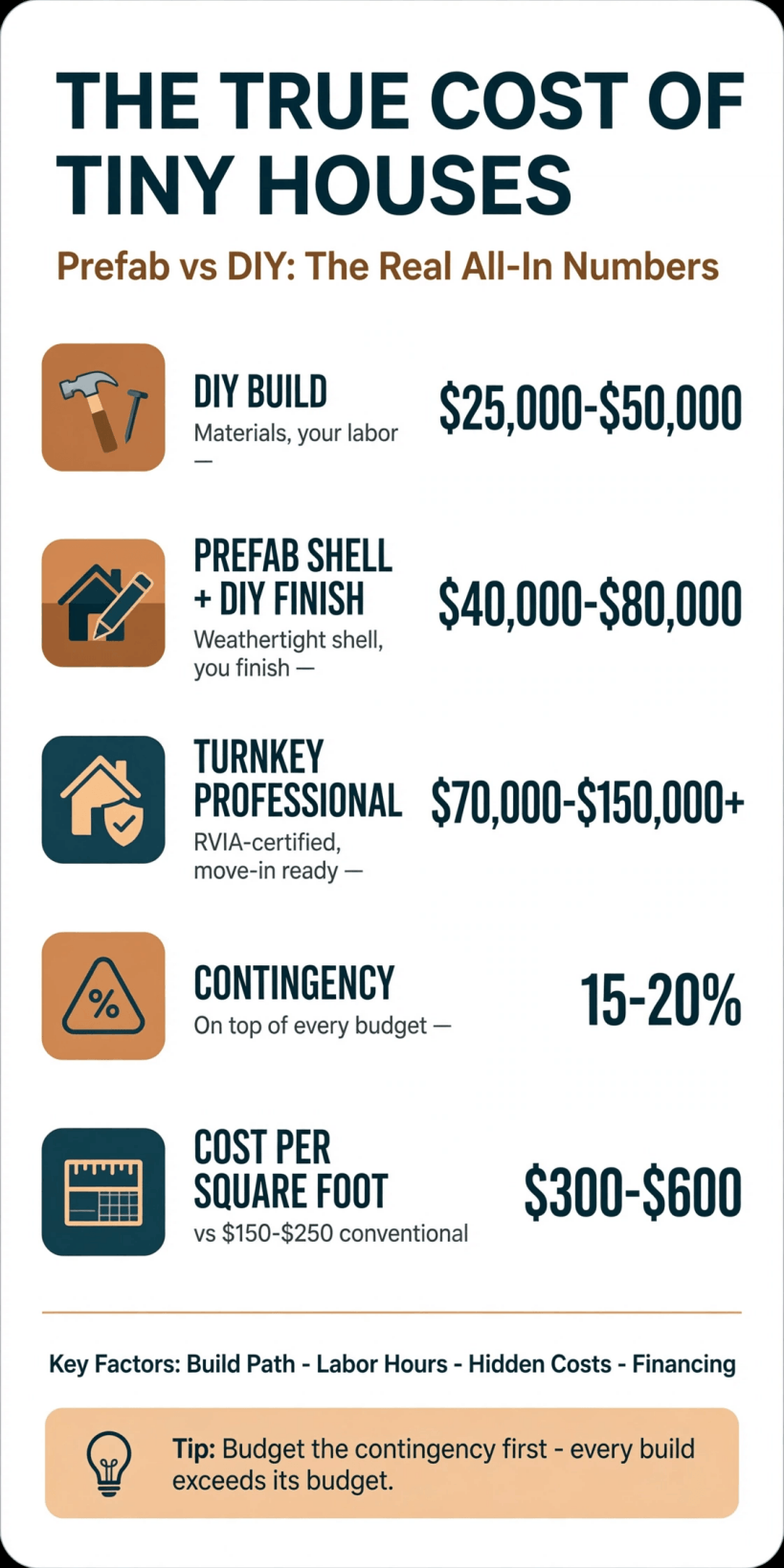
Three build paths, three honest all-in ranges — and the contingency that sits on top of all of them.
2. Why the Headline Range Misleads
Type the true cost of tiny houses into a search engine and the same $30,000 to $60,000 range comes back, repeated so often it has hardened into fact. It is true in the same way that “cars cost $20,000 to $80,000” is true: technically accurate, and useless for planning anything. The range survives because it averages together builds that share nothing — a self-built house on a salvaged budget and a certified turnkey build differ in labor, in materials, in inspection and in warranty, and quoting their midpoint prices neither of them.

Worse, the headline number quietly excludes the costs that arrive after the house exists. It says nothing about the land the house will sit on, the gravel pad and utility hookups that make the land usable, or the truck that delivers the house to both. Budgets rarely die on the big visible items — the trailer, the shell, the builder’s invoice are all priced before anyone commits. They die on the unmentioned ones, discovered one invoice at a time after the money is already spoken for. The cure is to stop asking what a tiny house costs and start asking which tiny house, built which way, standing where — because each of those choices moves the total more than any negotiation over finishes ever will.
3. Three Build Paths, Three Different Houses
The first path is DIY from scratch: $25,000–$50,000 all-in, with you supplying 800–1,500 hours of labor. It is the cheapest door into a tiny house and the slowest, and its real price is measured in weekends as much as dollars. The second path is the prefab shell with a DIY finish: $40,000–$80,000, in which a professional builds the weathertight structure and you finish the interior. The third is turnkey professional: $70,000–$150,000 and up, move-in ready from a builder and RVIA-certified. Same footprint on paper; three different houses in structure, in risk and in how the money leaves your account.
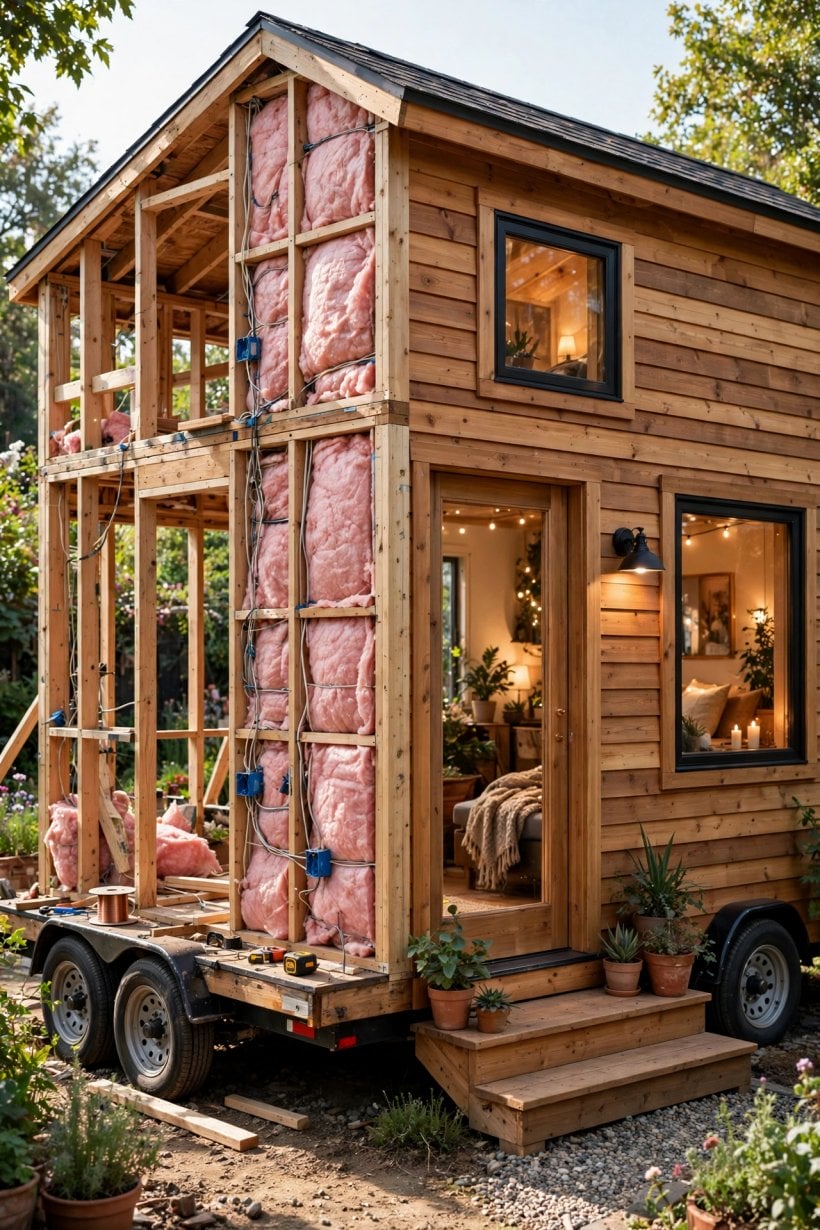
The choice between them is not really about budget — it is about which resource you have more of. Choose DIY if you have more time than money, want the skills, can keep the design simple, and can tolerate a 12–24 month build. Choose prefab or turnkey if you need housing on a timeline, value warranty and certification, or are planning a complex design. The shell hybrid sits between them, buying professional structural quality — the part that can kill you if it is wrong — while letting you save on finish work, the part that is forgiving. It is the most popular choice for good reason. Whichever path you lean toward, fix the footprint first: the tiny house floor plans calculator matches a layout to your household before a single line item is priced against it.
4. The DIY Build, Line Item by Line Item
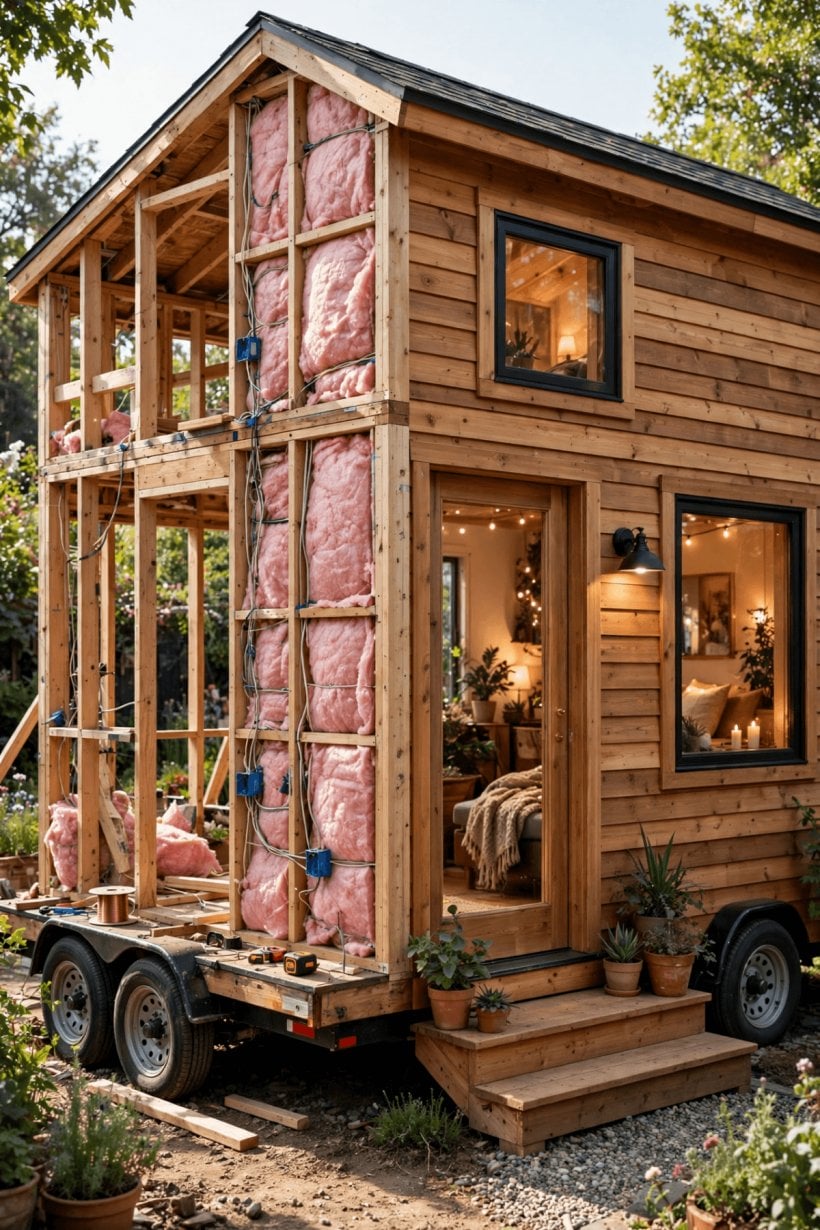
Here is what the materials for a DIY 8×24 tiny house on wheels, built to a decent rather than luxury standard, actually cost. It starts underneath: the trailer runs $5,000–$8,000 new — an engineered tiny house trailer, never a used flatbed built on without an engineer’s review. Framing lumber and sheathing add $4,000–$6,000; metal roofing $1,500–$2,500; siding and trim $2,000–$4,000. Windows and doors are the single biggest quality lever in the whole build at $2,500–$5,000, because cheap windows leak, and in a house this small a leak is never far from where you sleep.
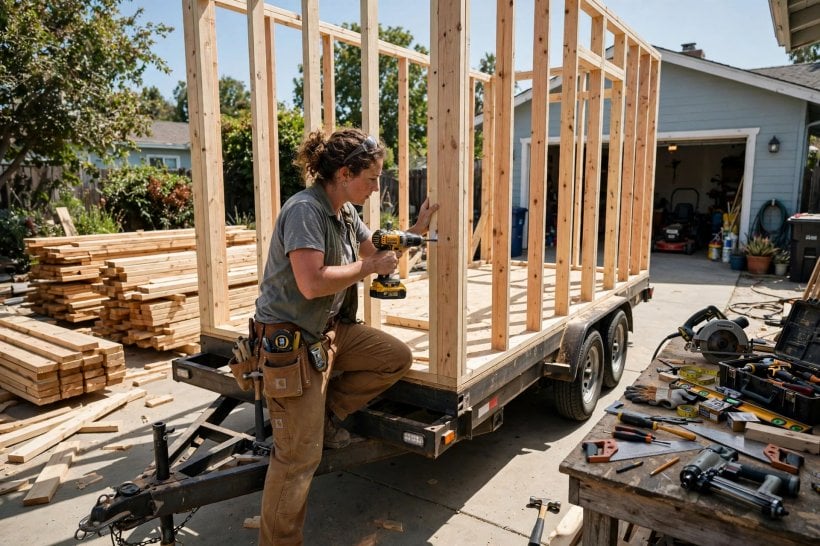
The systems come next: insulation at $1,500–$3,000 (spray foam costs more, mineral wool less); electrical at $1,500–$3,000 for panel, wire and fixtures, with a licensed electrician for the panel recommended; plumbing at $1,500–$3,000 for PEX, fixtures and a water heater; and HVAC at $1,500–$4,000 for a mini-split and ventilation. Then the finish: interior finish work — flooring, drywall or paneling, kitchen, bath and trim — runs $4,000–$8,000, and appliances $2,000–$4,000. The materials total lands at $27,000–$50,000, before tools, permits or a single hour of your time is counted. Builders stretching the DIY path to its cheapest honest form will find the same line-item discipline applied in the cheap tiny house build guide.
5. The DIY Trap: Your Labor Is Not Free
Every DIY budget contains the same quiet fiction: labor priced at zero. The original breakdown names it directly — value your time at even $25 an hour and 1,000 hours of building becomes $25,000 of opportunity cost, a sum that rivals the entire materials bill. Set against the 800–1,500 hours a from-scratch build actually demands, the “cheap” path is cheap only under one of two conditions: your time is genuinely free, or the learning itself is the point of the project. If neither is true, the spreadsheet that made DIY look half the price of turnkey was never comparing the same thing.
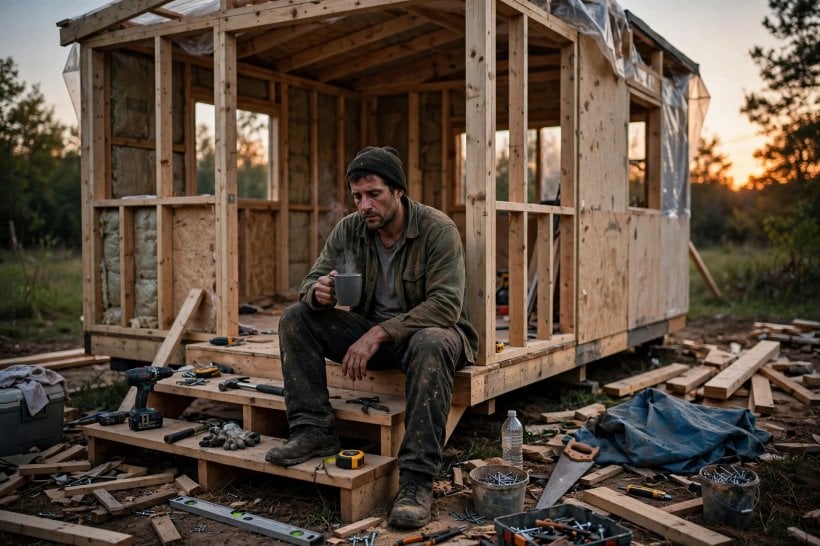
The hours hide a second cost: calendar time. A DIY build that stretches across 12–24 months is a year or two of rent paid elsewhere, of a house that exists but cannot yet be lived in, and of motivation that has to survive winter, mistakes and the long middle where the house looks worse every week instead of better. None of that argues against building your own — thousands do, and finish proud. It argues for pricing the labor honestly before the build, so the decision is made with the real number on the table. A path chosen because its true cost was understood will survive its own build; a path chosen because its labor was invisible often stalls at the point the hours run out.
6. The Prefab Shell: Professional Bones, Your Finish
The shell path splits the build at its natural seam. A professionally built weathertight shell — framed, roofed, sided, windows and doors in, rough electrical and plumbing run — typically costs $35,000–$55,000 for an 8×24. You then finish the interior for $10,000–$25,000 in materials, bringing the all-in total to $45,000–$80,000 with 300–600 hours of your labor. What the premium over DIY buys is certainty in exactly the places a first-time builder is most likely to get it wrong: the structure, the roof and the weather envelope that everything else depends on.
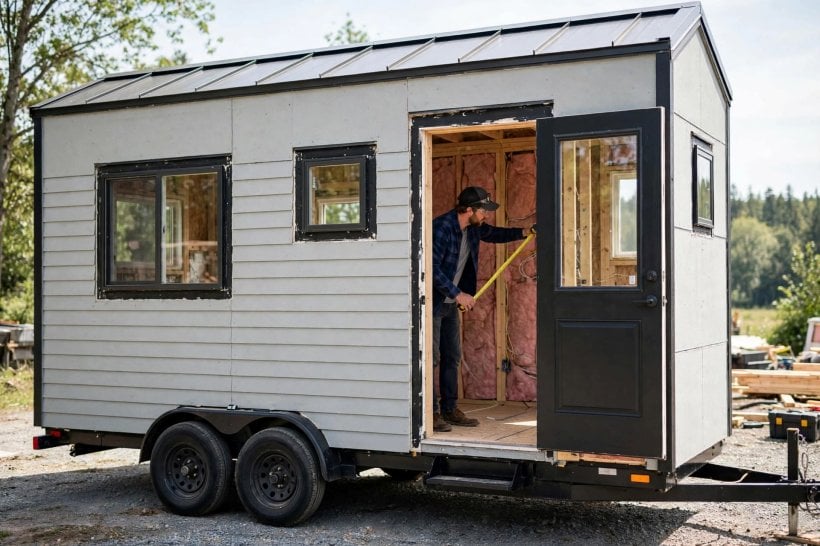
Accept the shell like a surveyor, not a fan. Before signing off, hire an independent inspector for $400–$600 and check the things that decide whether the shell is sound: squareness, with diagonal measurements within 1/4 inch; roof flashing; window installation, with sill pan flashing rather than caulk alone; and the trailer welds underneath. It is the cheapest insurance in the entire project, because every flaw found at handover is the builder’s problem, and every flaw found a year later is yours. At the top of this market the same shell logic scales upward into the high-end builds collected in the luxury prefab homes guide, where professional structure and finish meet.
7. Turnkey Professional: Reading the Price Tag
Turnkey tiny houses from reputable builders run $70,000–$150,000 and beyond, and the spread is not markup — it is itemised in the spec. RVIA certification adds $3,000–$5,000 in compliance cost, worth every penny for the financing and insurability it unlocks. Custom plans add 20–30% over standard ones. Finish level swings the total by $10,000 or more on cabinetry alone — the difference between flat-pack and custom work. And off-grid systems, solar plus batteries plus a composting toilet, add $8,000–$15,000. Two houses with identical footprints can honestly differ by the price of a car, and the difference is written in the specification, not the salesmanship.
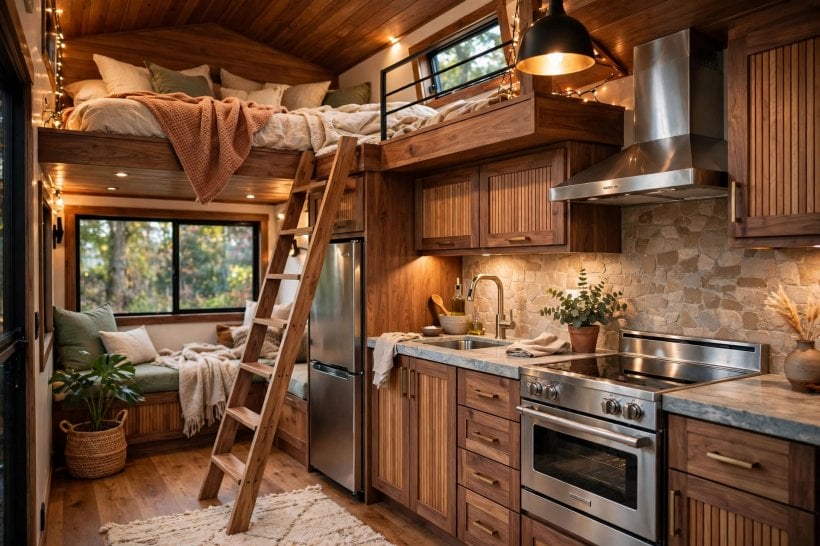
The original breakdown performs the anatomy on a single number: a $90,000 turnkey house is not “expensive for its size.” It is 1,000 or more professional hours, plus $45,000 in materials, plus certification, warranty and overhead. Read a turnkey quote that way and the questions change. Instead of asking why the house costs so much per foot, ask what the certification covers, what the warranty promises, how much of the price is finish you can see versus structure you cannot, and whether the off-grid package is sized for your land or padded for the brochure. A builder who can walk you through the anatomy of their own price is usually the one whose price is honest.
8. The Hidden Costs Nobody Budgets
Then come the costs that attach to the house rather than the build, and they can rival the house itself. Land runs $10,000–$100,000 or more — or $300–$600 a month in community lot rent for those who skip buying. Buyers weighing the two will find the packaged options priced out in the tiny house for sale with land guide, and the placement rules that govern both in where you can build a tiny house. Site work — grading, a gravel pad, a driveway, clearing — adds $2,000–$15,000. Utilities add $5,000–$25,000 for well, septic and power hookup, each capable of exceeding its estimate on a difficult site; the tiny house utilities guide breaks those systems down one by one.
The rest of the ambush list is smaller but just as certain. Delivery costs $1,500–$5,000 for professional tiny house transport, with permits, escort vehicles and insurance folded in. Permits and fees run $500–$3,000. The DIY builder starting from scratch needs $800–$2,000 of tools before the first cut. And over everything sits the contingency: budget 15–20%, because every build exceeds its budget, and the contingency decides whether that fact is an inconvenience or a crisis. None of these figures is exotic. All of them are routinely missing from the spreadsheet drawn up on the first excited evening — which is precisely why they are called hidden.
9. Financing: The Path Chooses the Loan
Money has a vote in the build-path decision, and it often casts the deciding one. DIY builds are almost always cash-funded, for a simple reason: lenders do not finance piles of lumber. A half-built house on a trailer is collateral no bank can value, so the DIY builder’s budget is bounded by savings, not by borrowing power. The financing available often decides the build path before the budget does — a sentence worth reading twice before falling in love with a path your money cannot take you down.

The certified paths borrow differently. Turnkey RVIA-certified houses qualify for RV loans at 7–12% APR for terms up to 15 years — the certification that added $3,000–$5,000 to the price is exactly what makes the house lendable. Foundation tiny houses step into the conventional system entirely, qualifying for construction-to-permanent mortgages. Before committing, run the borrowing both ways: the mortgage calculator for a tiny house shows what a given loan amount and rate do to the monthly payment, which is the number a household budget actually feels. A cheaper house paid in cash and a dearer house financed over 15 years can swap places once interest joins the ledger, so the comparison belongs in the all-in column with everything else.
10. Cost Per Square Foot: The Misleading Metric
Sooner or later someone divides the price by the footprint and gasps: tiny houses cost $300–$600 per square foot, against $150–$250 for conventional construction. The arithmetic is right and the conclusion is wrong. This is not inefficiency; it is concentration. A tiny house packs a kitchen, a bathroom and full mechanical systems — the expensive parts of any house — into around 200 square feet, with none of the cheap bedroom square footage that dilutes a conventional home’s average. Kitchens and bathrooms cost what they cost at almost any house size; shrink the house and the expensive rooms simply take up a larger share of every foot.
The metric misleads in the other direction too. Per-square-foot pricing makes the turnkey path look extravagant and the DIY path look miraculous, when the totals tell the truer story: the most expensive tiny house in this guide costs less than the deposit-plus-fees on many conventional purchases, and the cheapest is a year of weekends. Compare totals, not cost per foot — and compare finished totals at that, house plus land plus site work plus contingency, each path priced the same honest way. The buyer who does that is no longer shopping a range from a search result. They are holding a budget that can survive contact with the build.
Final Considerations
The true cost of a tiny house is the house plus the land plus the site work plus the contingency — and the cheapest build path is the one you can actually finish. The original guide closes on the sharpest version of that truth: a $40,000 DIY shell that never gets finished costs more than a $90,000 turnkey house you actually live in. Price the paths honestly, labor included; budget the hidden half before it introduces itself; let the financing you can actually get narrow the choice; and add the 15–20% contingency without being talked out of it. Do that, and whichever path you pick — your own hands, a professional shell, or a builder’s keys — the number you planned for is the number you will pay.

6 Comments