

Conventional houses worry about break-ins. A tiny house on wheels worries about the whole house disappearing — hitched up and driven off in minutes. Add rural isolation, expensive solar gear and long absences, and security stops being an afterthought. This guide builds the full protection stack, layer by layer, so yours becomes the property thieves walk past.
How to Keep Your Tiny House Safe: At a Glance
A tiny house asks a security question no conventional home ever faces: how to keep your tiny house safe when the house itself can be stolen. The answer is never a single product. It is a stack of layers, each covering the weakness of the one before it — locks control who gets in, trackers recover what gets taken, anchors stop the house itself from moving, cameras watch when nobody is home, deterrence persuades thieves to try somewhere else, and insurance absorbs whatever risk remains. The ten sections below build that stack in working order: the core vulnerability first, then the realistic threat model, then each physical and financial layer in the sequence an owner actually installs them. Every figure comes from the working kit of tiny house owners — the deadbolt, the tracker subscription, the auger anchor — because security that cannot be priced cannot be planned. Read it as a build order: no layer is sufficient alone, and together they make your tiny house the hardest target on the road.
| Topic | What It Covers | Key Fact or Figure |
|---|---|---|
| 1. Your House Can Be Towed Away | The core vulnerability no conventional house has | An unsecured THOW can be hitched in minutes |
| 2. The Threat Model | What you are actually protecting against, in order | Opportunistic burglary is the #1 tiny house crime |
| 3. Smart Locks and Access Control | Keypad deadbolts, temporary codes, entry logs | Smart deadbolts $150–300 |
| 4. GPS Trackers | Finding the stolen house — one wired, one hidden | Hardwired trackers $100–200 + $10–20/month |
| 5. Anchor Systems | Making the house un-towable | Hitch locks $30–80; auger anchors $30–60 each |
| 6. Cameras and Monitoring | Cellular eyes on the hitch and the entry | Trail cameras $150–300 |
| 7. The Off-Grid Equipment | Protecting panels, batteries and the generator | Security fasteners $20 a set |
| 8. Deterrence | Making yours the hard target on the road | Motion floodlights $30–60 each |
| 9. Insurance | The financial backstop for what remains | Tracker + documentation file = a paid claim |
| 10. The Absence Protocol | The pre-trip hardening routine | 30 minutes before every long trip |
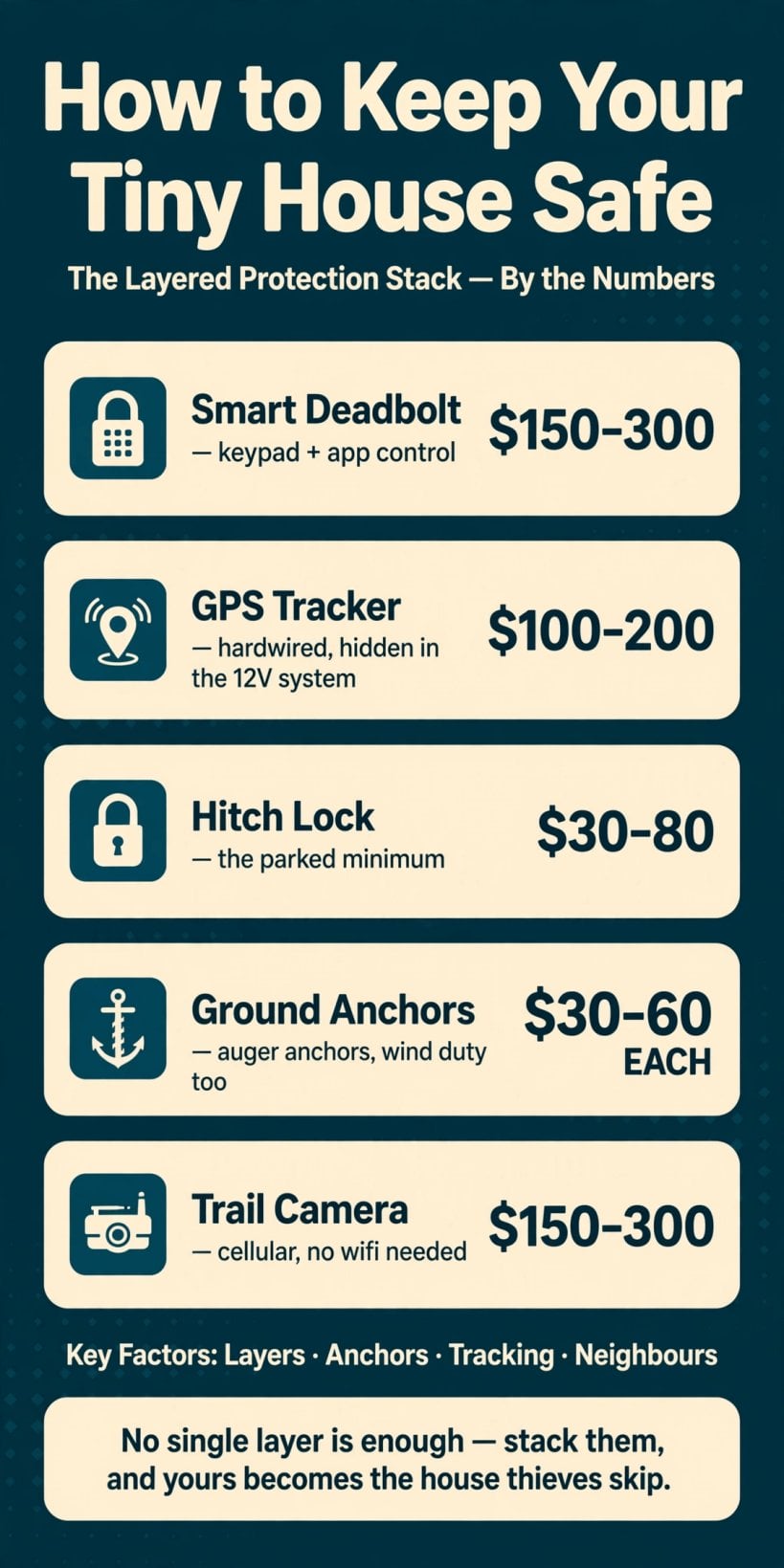
The protection stack by the numbers: a $150–300 smart deadbolt, a $100–200 hardwired GPS tracker, a $30–80 hitch lock, $30–60 auger anchors and a $150–300 cellular trail camera — layered, never single.
1. Your House Can Be Towed Away
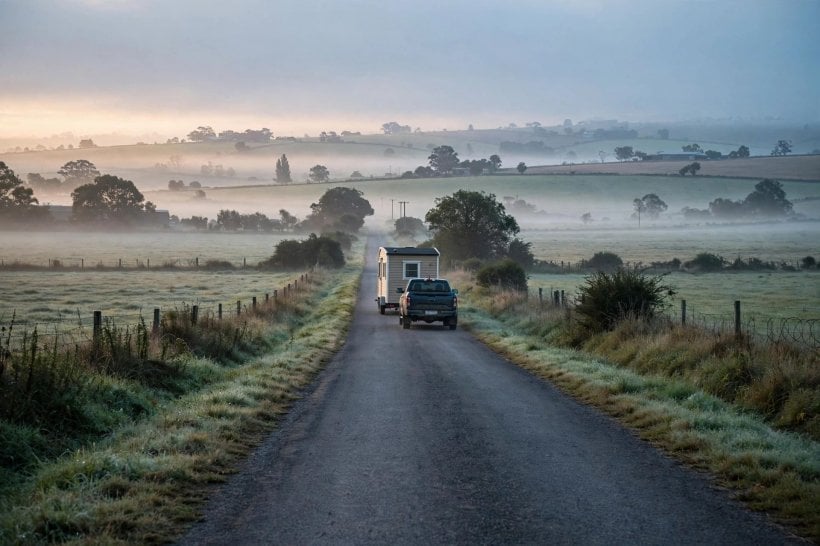
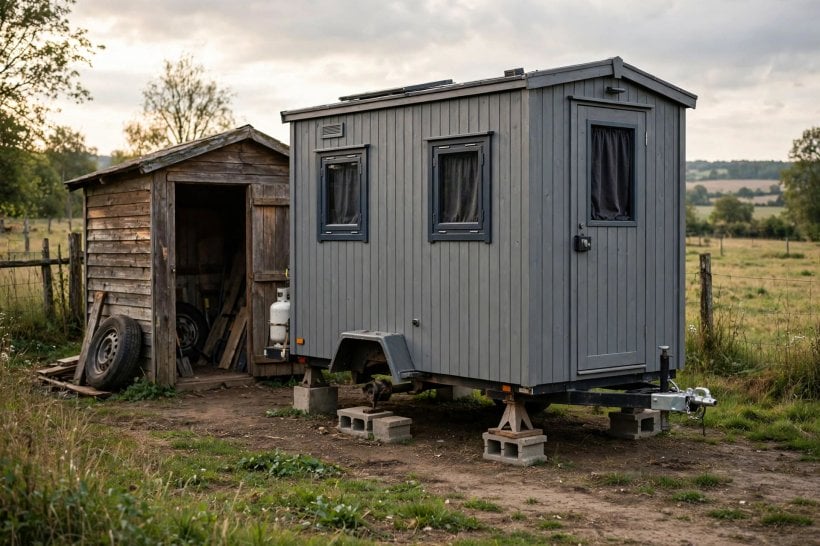
Start with the fact that shapes everything else in this guide: unlike a conventional house, a tiny house on wheels can be stolen whole. No broken window, no forced door — a thief with a suitable tow vehicle backs up to the tongue, hitches up, and drives your home away in minutes. It is the nightmare scenario of tiny living, and it is the reason tiny house security cannot simply copy the advice written for houses with foundations.
Three amplifiers make the vulnerability worse. Rural isolation means no passing traffic and no near neighbours to notice a strange truck at your tongue. High-value off-grid equipment — solar panels, battery banks, tools — rides with the house or sits beside it, raising the prize. And long absences, the travelling life the wheels were bought for, leave the house unwatched for exactly the stretches a thief needs. Where the house sits shapes all three, which is why placement and security are the same conversation — the exposure questions run through our guide to where to park a tiny house. Design against the whole stack of risks, and the sections below do it in order.
2. The Threat Model: What You Are Protecting Against
Security spending goes wrong when it is aimed at the wrong crime, so rank the threats by likelihood before buying anything. First and most likely is opportunistic burglary — tools, electronics and solar components taken from rural properties. This is the number-one tiny house crime, and it is a crime of convenience: the unlocked shed, the visible generator, the house that looks empty. Design against it first, because it is the loss you are statistically most likely to meet.
Second is whole-house theft: rare, but real — the unsecured THOW hitched in minutes. Third comes vandalism and squatting, which vacant rural properties attract precisely because nobody is watching. Fourth is not theft at all: storm and wind damage, which belongs in the model because the anchor systems in section 5 serve double duty against it. The discipline of the threat model is a single sentence — design against the likely while insuring against the catastrophic. Burglary gets the locks, lights and cameras; the tow-away gets the anchors, trackers and the policy. Spending the whole budget on either one alone leaves the other wide open.
3. Smart Locks and Access Control
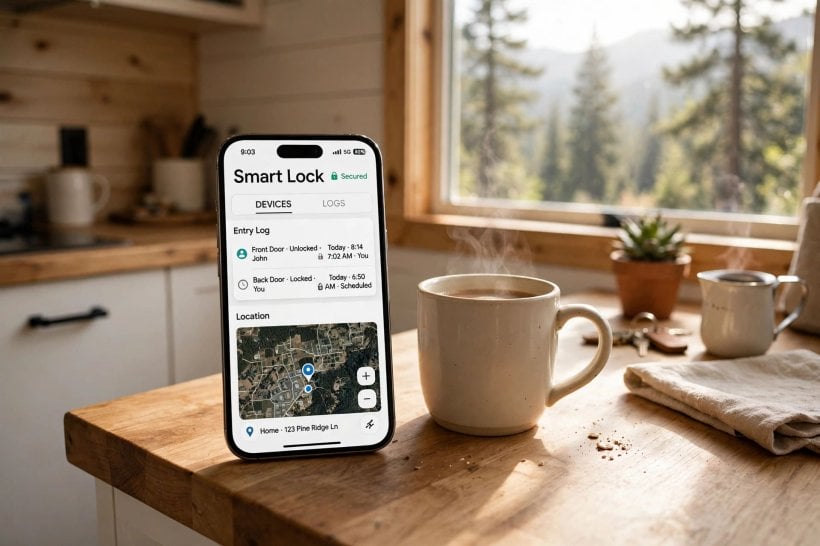
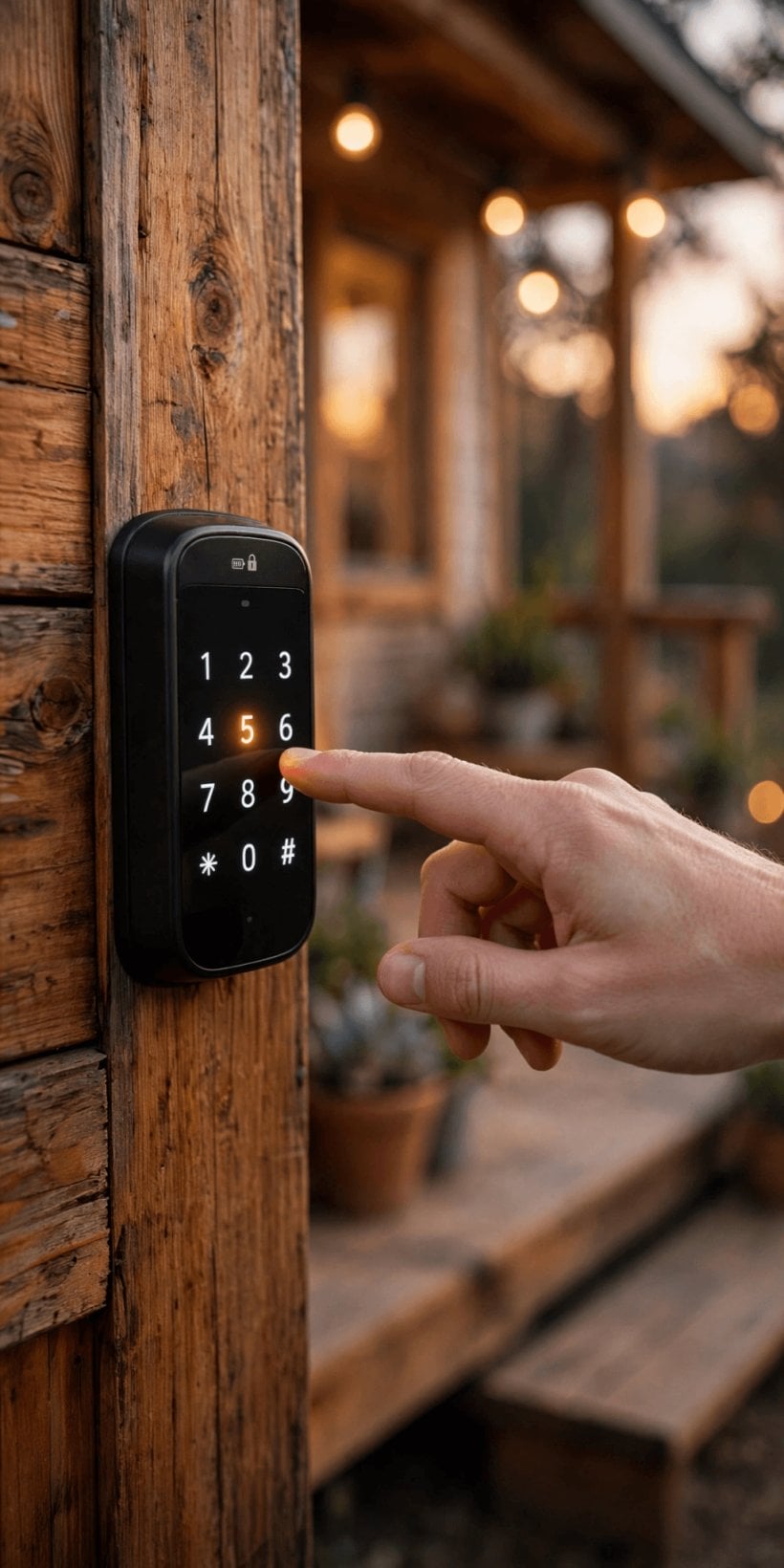
The entry layer starts with a smart deadbolt ($150–300): keypad plus app control, temporary codes granted to cleaners, guests and workers without ever handing over a physical key, and a log of every entry. That audit trail is the smart lock’s real value — not keylessness itself, but knowing exactly which code opened the door and when, and being able to retire a worker’s code the hour the job ends instead of rekeying a cylinder.
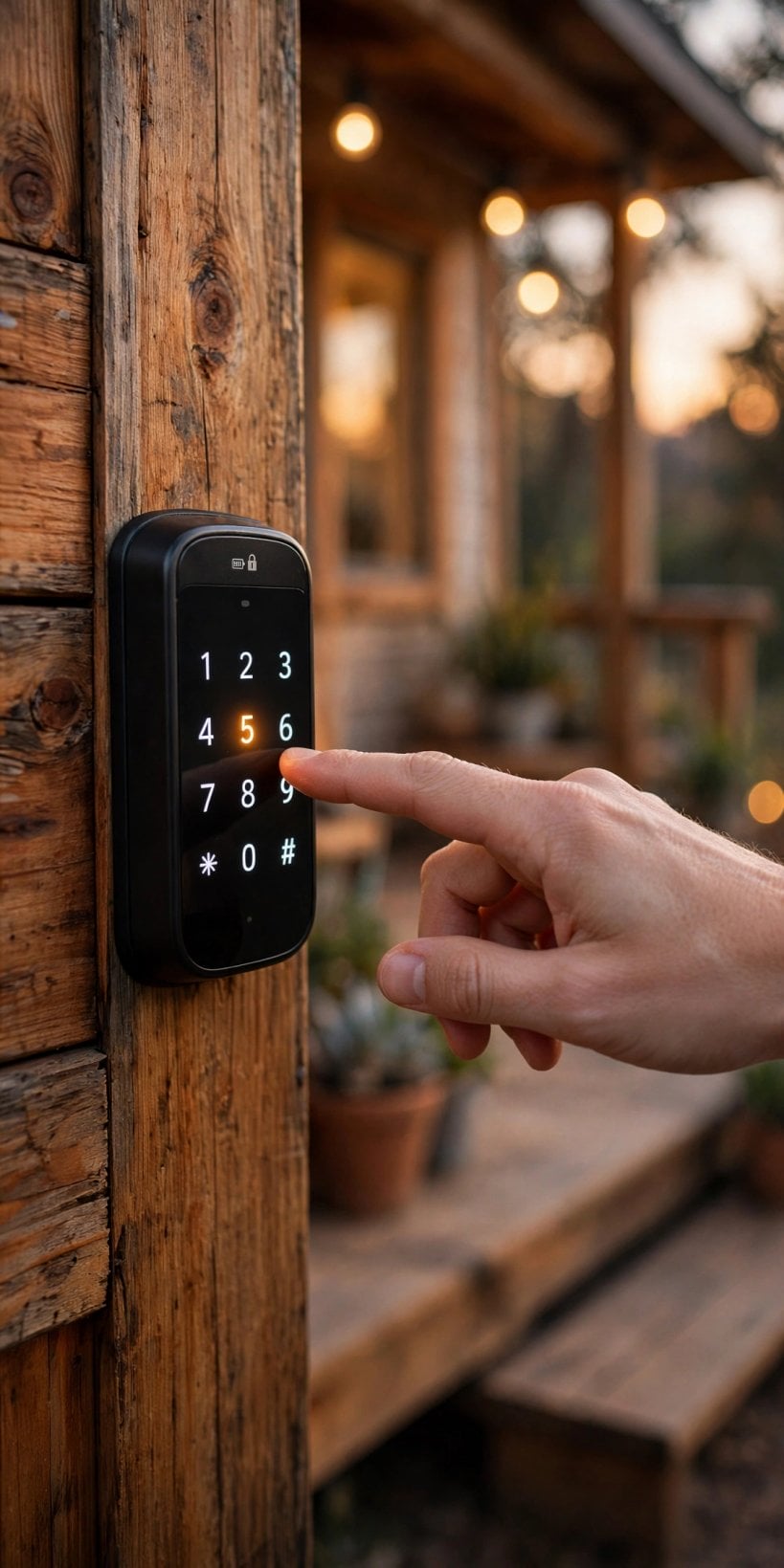
Around the lock, harden the door itself. A reinforced strike plate with 3-inch screws driven into the framing — not just the jamb — is the $20 upgrade that defeats most kick-ins, and it is the cheapest meaningful security money in this entire guide. Windows get locks and security film ($5–10/sq ft installed), which holds shattered glass in place and turns a quiet smash-and-grab into slow, loud work. And keep the key discipline absolute: no hidden keys, ever — the fake rock and the mat are the first two places any burglar looks — and rekey or rotate codes whenever workers finish. Access control is a habit, not a purchase.
4. GPS Trackers: Finding the Stolen House
If the worst happens anyway, the recovery layer decides whether the story ends with a police report or a recovered house. The primary tracker is hardwired ($100–200 for the device, plus $10–20/month): wired into the house’s 12V system, hidden, and reporting location continuously. The second tracker is battery-powered and covert ($50–150 plus subscription), with a 1–3 year battery life, hidden in the frame or the walls. A thief cannot disable what they cannot find — and the deeply hidden unit is the recovery.
Placement is the craft. Put trackers inside the trailer frame rails, behind interior panelling, or in the underfloor insulation zone — places that require tools and time to reach — and never in the obvious utility compartment, which is the first place a knowledgeable thief checks. AirTag-style Bluetooth trackers make a cheap third backup: limited range, but the crowd-sourced network finds things in surprising places. Register both real trackers with your insurer — some insurers discount for GPS-tracked THOWs — and keep the house’s own paperwork in the same order, because the documented, registered house described in our guide to registering a tiny house as an RV is the one that can be identified, claimed and recovered.
5. Anchor Systems: Making It Un-Towable
The physical layer attacks the tow-away directly: make the house unmovable without major effort. Wheel locks and boots ($80–200 each) are a visible deterrent and a real obstacle — lock all the wheels, not just the convenient one. A hitch lock ($30–80) means a locked coupler simply cannot be hitched, and it is the minimum for any parked THOW: the cheapest item in this section and the first one to buy.
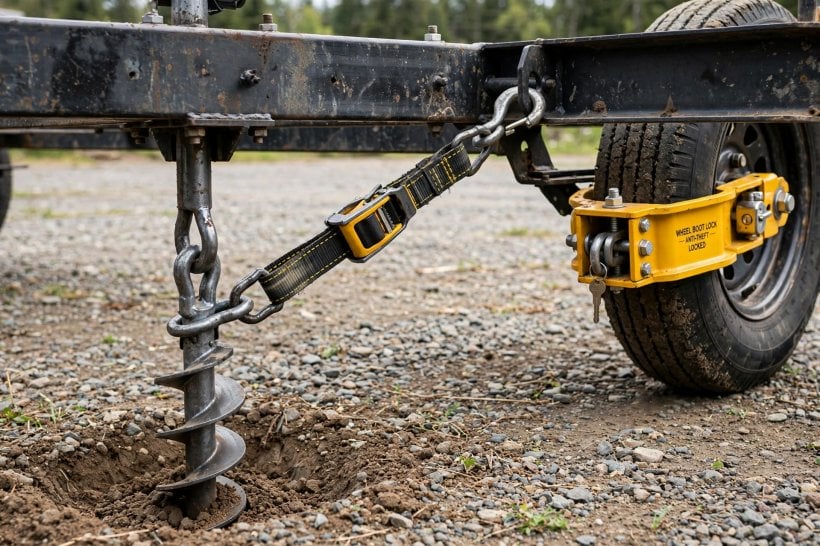
Ground anchors go deeper — literally. Mobile-home auger anchors ($30–60 each) screw 4+ feet into the ground and strap to the frame, holding the house against both thieves and wind. For long absences there is the free nuclear option: remove a wheel. A house on blocks with a wheel in the shed is not going anywhere quickly. And settled houses can go permanent with concrete deadmen or helical piers, at which point the house is effectively founded. Layer them in order of effort: the casual thief is defeated by the hitch lock; the determined one by the anchors. The contrast is worth savouring — the same hitch and frame that make a legitimate move straightforward, as our guide to towing a tiny house explains, are exactly what the anchor stack is designed to neutralise.
6. Cameras and Monitoring
Cameras are the eyes of the stack, and the rural standard is the cellular trail camera ($150–300 plus a data plan): no wifi needed, motion-triggered photos sent straight to your phone. Where internet exists, wifi cameras add continuous recording and two-way talk; a doorbell camera keeps the entry record; and a simple alarm — a loud siren plus cellular notification — earns its place because the siren is the deterrent. Rural thieves hate noise.
Position matters more than resolution. Cover the hitch and tongue — the theft vector, where a tow-away begins — and the entry, where a burglary begins. Solar-powered cameras ($100–200) solve the power question off-grid, sipping from the same sun as the house. A tiny house needs a simpler system than a conventional property: fewer approaches, fewer blind spots, two or three well-placed cameras rather than a wall of feeds nobody watches. The point of monitoring is not footage for its own sake; it is the phone buzzing while something can still be done about it — a neighbour called, a siren triggered, a theft interrupted instead of reviewed.
7. The Off-Grid Equipment: Protecting the Systems
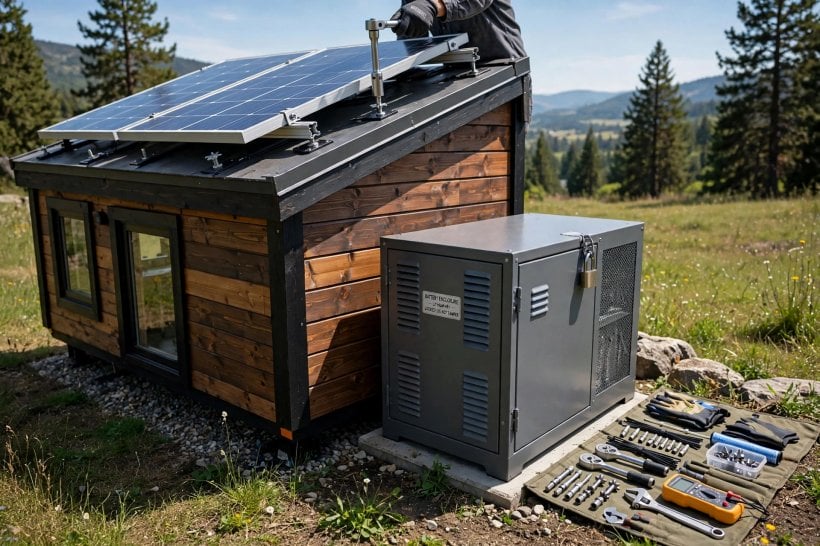
The house is not the only prize. Solar panels, batteries and generators are high-value, portable and easy to resell — which makes the off-grid system a theft target in its own right. Start at the roof: panel mounting with security fasteners — tamper-resistant bolts, $20 for the set — turns a 5-minute theft into a 30-minute job, and time is the currency every layer in this guide trades in.
The battery bank belongs in a locked, ventilated enclosure, preferably inside the house or a locked shed rather than visible outside. The generator — the most stolen item on rural properties — should be chained and covered, or kept in a locked enclosure. Mark everything: engrave or UV-mark equipment with your details, because recovered property returns to marked owners. And insure the system properly, with riders that schedule the off-grid equipment specifically at replacement value; standard policies underinsure it. The systems themselves — what a complete power, water and sewage setup consists of — are detailed in our guide to tiny house utilities for power, water and off-grid sewage: you cannot protect an inventory you have never listed, so list it, mark it, and lock it down.
8. Deterrence: Making Yours the Hard Target
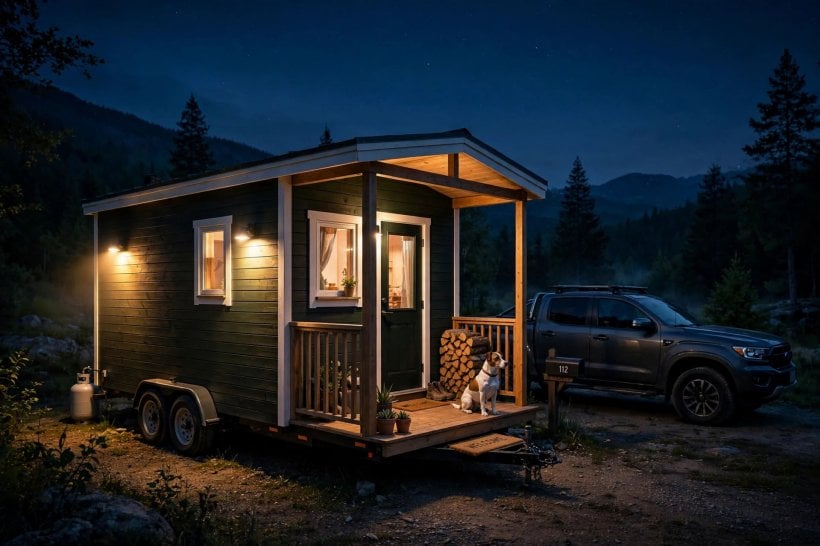
Security is relative. You do not need to be impregnable — you need to be visibly harder than the next property, because opportunistic thieves choose the easy target and move on. Visibility leads: motion-activated floodlights ($30–60 each, solar-powered where needed) strip away the darkness rural theft depends on. Thieves avoid lit properties.
Occupancy signals do the quieter work: timed interior lights, a parked vehicle, maintained grounds — the lived-in look that makes a watching thief unsure whether anyone is home. Signage is cheap psychological deterrence: security-system signs and “GPS tracked” decals cost almost nothing and plant doubt at the decision point. A dog remains the oldest alarm system there is — even a small, loud dog changes the calculus. And above all of it sit the neighbours: the rural watch network of people who know your truck and would notice a strange one. Introduce yourself, exchange numbers, watch each other’s places. It is the highest-ROI security measure in this guide, and it costs nothing but the introduction.
9. Insurance: The Financial Backstop
Security reduces risk; insurance transfers what remains. Verify three things in the policy. First, that it covers theft of the entire unit — not just the contents — confirming the structure itself is covered for theft and not only for fire and wind. Second, that the off-grid equipment is scheduled separately at replacement value. Third, whether recovery costs are covered, since some policies pay toward recovering a stolen unit. The wheels-versus-foundation distinctions that decide which policy family applies are worked through in our tiny house insurance guide for wheels vs foundation, and the practical steps sit alongside it in our guide to how to insure a tiny house.
Then build the claims file before there is a claim: photographs of the house inside and out, serial numbers of every piece of equipment, receipts. Documentation prepared in calm weather is what a claim runs on in the worst week of the year. The combination is what gets paid: the GPS tracker plus the documentation file is the difference between a paid claim and a disputed one — one proves where the house went, the other proves what it was and what it held. Insurance is the backstop, never the plan; but a backstop built properly is what lets every other layer be a deterrent instead of a last hope.
10. When You Are Away: The Absence Protocol
Extended absence is when the stack is tested, so run the protocol before every long trip. Hitch lock on, wheel boots on. Valuables removed or hidden — laptops and documents travel with you. Curtains closed, so there is no window shopping. Mail held or forwarded, because an overflowing box is an announcement. A neighbour notified, with your contact details and your expected return. Cameras armed and tested, not assumed. Generator fuel stabilised or removed. Water shut off and pipes drained in winter. And the lived-in timers set, so the house keeps its evening rhythm without you.
The whole routine takes 30 minutes, and it prevents the losses that ruin the return. Notice how it leans on every earlier layer: the anchors from section 5, the cameras from section 6, the neighbours from section 8, the documentation behind section 9. That is the design — absence is not a separate security problem, just the stack running unattended. And when the trip ends with a move rather than a return, the legitimate version of the journey your anchors were built to prevent is planned step by step in our tiny house moving guide and transport cost breakdown.
Final Considerations
Tiny house security is a layered system, not a single product — that is the whole answer to how to keep your tiny house safe. Smart locks control access, GPS trackers enable recovery, anchors prevent the tow-away, cameras watch, deterrence deflects, neighbours notice, and insurance covers the remainder. No layer is sufficient alone; together they make your tiny house the property thieves skip.
Build the layers once and maintain them lightly: codes rotated, trackers registered, anchors checked when the seasons turn, the claims file updated when equipment changes. The owners who live this way — many of them following the same off-grid logic laid out in our guide to how to live off grid in a tiny house — are not more anxious than other tiny house owners. They are less, because the worrying was done once, properly, in advance. Sleep well — at home, or away.


0 Comments