

Call an insurance agent about a tiny house and listen for the hesitation. There is no tiny house box in their software, so your home is filed as either an RV or a dwelling — and guessing wrong leaves you uninsured at claim time or overpaying for cover that does not fit. This guide walks both paths: wheels and foundation, costs, traps and claims.
Tiny House Insurance: At a Glance
Insurers, like lenders, do not have a “tiny house” category. A tiny home on wheels is usually insured as an RV; a tiny house on a permanent foundation is usually insured as a dwelling. That single classification decision drives everything else in this guide: the policy type, the premium, the exclusions and what happens when you claim. Get it wrong and the consequences run in both directions — the policy may exclude your house type entirely, leaving you effectively uninsured, or you may pay for cover built on recreational-use assumptions that do not match how you actually live.
The ten sections below walk the decision in the order an owner faces it: the two policy paths, the valuation trap that quietly underpays claims, the liability half most owners underbuy, the highest-risk hour of a tiny house’s life, and the special cases — off-grid systems, rentals and DIY builds — that standard policies handle badly. One theme runs through all of it: tiny house insurance rewards owners who classify correctly, disclose honestly and document everything. Start with the table, then read the path that matches your house.
| # | Topic | What It Covers | Key Figure |
|---|---|---|---|
| 1 | THOW Insurance: The RV Policy Path | Structure, contents and liability under an RV or trailer policy | $800–1,500/year |
| 2 | Foundation Tiny House: The Dwelling Policy Path | Full homeowner’s cover for a permitted foundation build | $600–1,200/year |
| 3 | Replacement Cost vs Actual Cash Value | How the payout is calculated after a total loss | Update agreed value every 2–3 years |
| 4 | Liability: The Overlooked Half | Injuries and damage your house causes to others | $300,000 sensible minimum |
| 5 | In-Transit Coverage | The move itself: towing, transporters and cargo gaps | The highest-risk hour of its life |
| 6 | Off-Grid Systems Coverage | Solar, batteries, wells and septic scheduled separately | $15,000–25,000 for a 5 kW system |
| 7 | Renters, Airbnb and Business Use | Landlord, short-term rental and home-business cover | $1,500–3,000/year for STR policies |
| 8 | DIY Builds: The Hard Case | Cover without a manufacturer or RVIA certification | Documentation decides |
| 9 | Shopping for a Policy: The Process | Specialty insurers, three quotes, exclusions first | Re-shop every 2–3 years |
| 10 | Claims: What Actually Happens | Water, wind, theft and transport damage in practice | Document maintenance, report promptly |
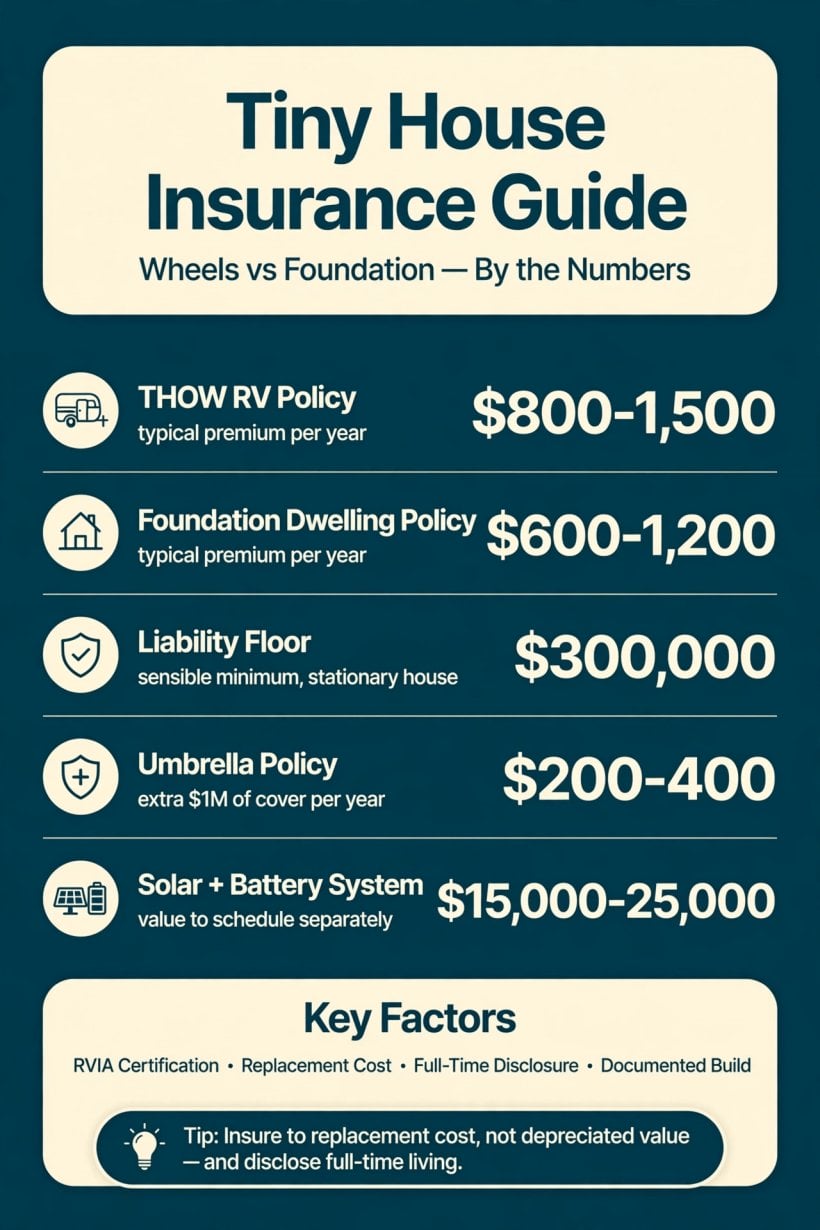
The guide by the numbers: the two premium ranges, the liability floor worth starting from, the umbrella bargain, and the off-grid system value most owners forget to schedule.
1. THOW Insurance: The RV Policy Path
Most tiny houses on wheels are insured under RV policies — Class A, B or C motorhome policies adapted for the purpose, or more commonly travel trailer and fifth-wheel policies. The structure is covered much like a vehicle, with comprehensive and collision cover; personal property inside is typically included at $5,000–10,000, with the option to schedule more; and liability cover responds if someone is hurt in or by your house. Typical cost runs $800–1,500 per year for a THOW worth $80,000–120,000. Where your house will sit matters to the conversation, and many owners start by looking at tiny house friendly RV parks whose rules already expect full-time rigs.
Two conditions shape this path. First, almost every RV insurer requires RVIA certification — the uncertified THOW is largely uninsurable in the standard market. Second, standard RV policies assume recreational use. If you live in the THOW full-time, disclose it: some insurers exclude full-time residency outright, while others require a full-timer endorsement. An undisclosed full-time claim can be denied, which makes honesty at application the cheapest protection on this entire page.
2. Foundation Tiny House: The Dwelling Policy Path
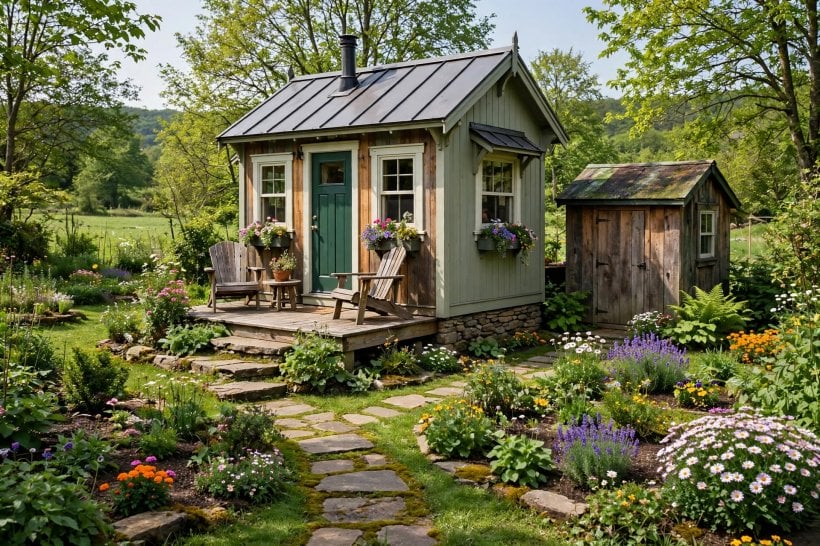
A tiny house on a permanent foundation, built to code and permitted, insures as a standard dwelling under a homeowner’s (HO-3) policy — the simplest insurance story in tiny housing. The package is familiar: dwelling coverage for the replacement cost of the structure, other structures cover for a deck or shed, personal property at 50–70% of the dwelling coverage, loss of use so you have temporary housing if the house becomes uninhabitable, and liability at $100,000–300,000 as standard.
Cost typically runs $600–1,200 per year for a $100,000–200,000 tiny dwelling, varying widely by state and hazard — Florida wind and California fire price very differently. Because the house is permitted, inspected and fixed in place, underwriters can treat it like any other small home, and that normality is worth money every renewal. If you are still choosing between wheels and a foundation, understand that this path is the one where insurance stops being a research project and becomes a routine line item.
Two parts of the dwelling package earn their keep quietly. Loss of use matters more in a tiny house than in a conventional one, because there is no spare room to retreat to while repairs happen — the whole home is the damaged room. And the other structures line, easy to overlook on a small plot, is what responds when the deck, the shed or the utility hookups are damaged alongside the house. Owners on foundations should read both figures rather than assuming the small footprint makes them irrelevant.
3. What “Replacement Cost” Means for a Tiny House
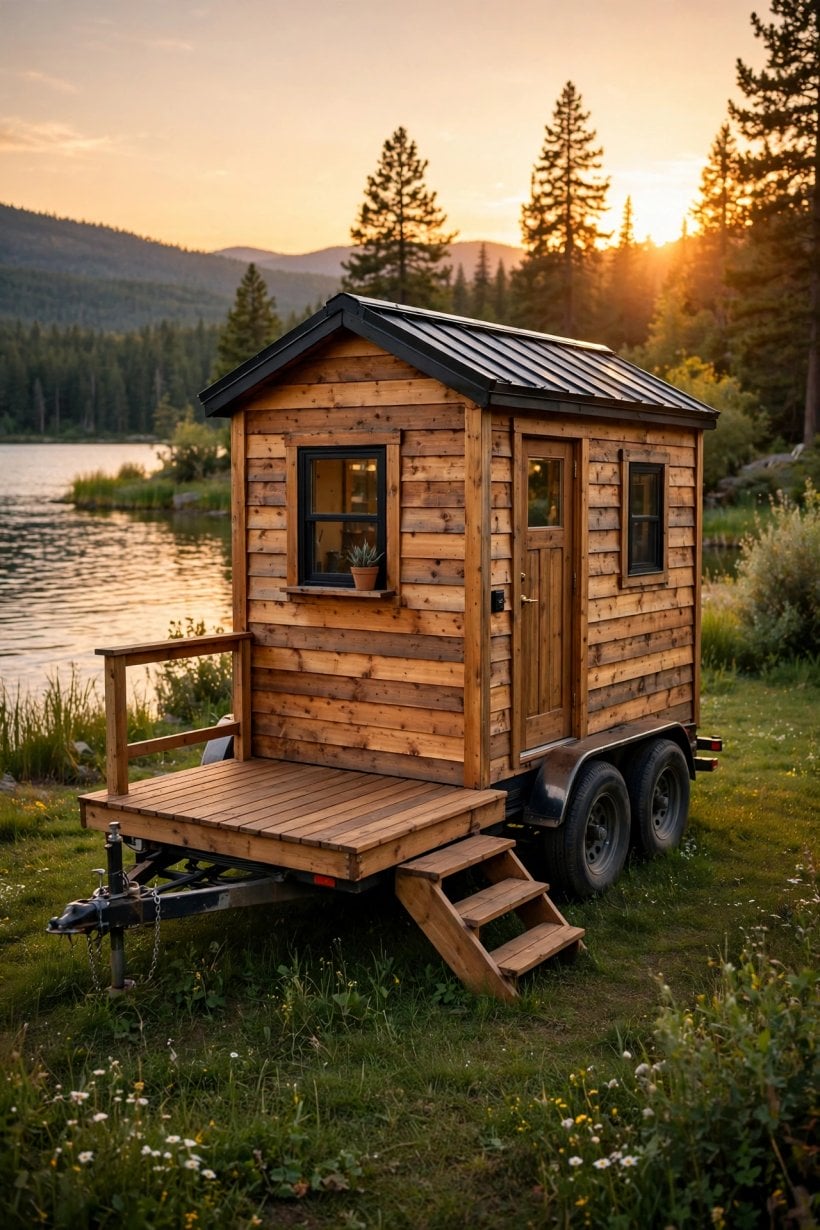
Insist on replacement cost coverage, which pays to rebuild at today’s prices, rather than actual cash value, which pays the depreciated value — a devastating basis for settling a five-year-old THOW that would cost far more to recreate than its book value suggests. For custom and DIY builds there is a further trap: standard replacement-cost estimators undervalue the work, because they price generic construction rather than your hours, your materials and your one-off details.
The fix is an agreed-value endorsement, where you and the insurer agree on the insured value upfront, documented with build receipts and photos. Owners working out what their build is genuinely worth will find the breakdown in our guide to the true cost of tiny houses, prefab vs DIY, directly transferable to the insurance conversation. Whatever value you agree, revisit it: update the agreed value every 2–3 years, because construction inflation runs 4–7% annually and a value set at build time quietly falls behind the real cost of rebuilding.
4. Liability: The Overlooked Half

Liability coverage protects you when someone is hurt on your property or by your property — a guest trips on the loft stairs, or your THOW’s awning detaches in wind and hits a car. Owners tend to shop for structure cover and treat liability as an afterthought, yet liability claims, not structure fires, are the most common insurance events tiny house owners face. People get hurt around small houses with steep stairs, lofts and tight decks, and those claims arrive with legal costs attached.
The sensible floor is $300,000 of liability for a stationary tiny house, rising to $500,000 if you host guests, run a business, or Airbnb the unit. Above that, umbrella policies are cheap catastrophe protection: $1M of cover for $200–400 per year. Set against the cost of a single serious injury claim, the umbrella is the best-value line in this entire guide, and the one owners most often skip because nothing about it feels tangible until the day it is needed.
5. In-Transit Coverage
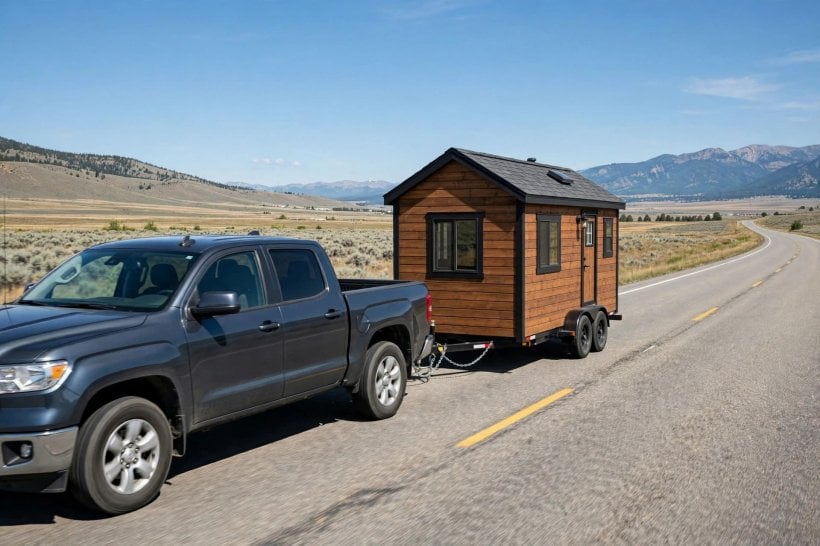
Moving a THOW is the highest-risk hour of its life, and the cover around that hour has two classic gaps. First, does your RV policy cover the house while it is towed by a third-party transport company? Many exclude commercial towing. Second, does the transport company’s own cargo insurance cover your house’s full value? Ask for their certificate and verify the limit rather than accepting an assurance. Road legality sits alongside insurance here — our walkthrough of how to register a tiny house as an RV covers the paperwork side of getting a house on the road properly.
For DIY moves, your auto policy’s trailer coverage may extend — call and confirm in writing before moving day, and check your weights with the same care using the method for how to calculate your tiny house’s weight. A $100,000 house riding on a $1M liability auto policy with no cargo coverage is a total-loss risk. Run the transport checklist: the transporter’s cargo insurance certificate with a limit at or above the house value, your policy’s transit clause confirmed in writing, timestamped photos of the house pre-move, and a written condition report signed at pickup and delivery.
6. Off-Grid Systems Coverage
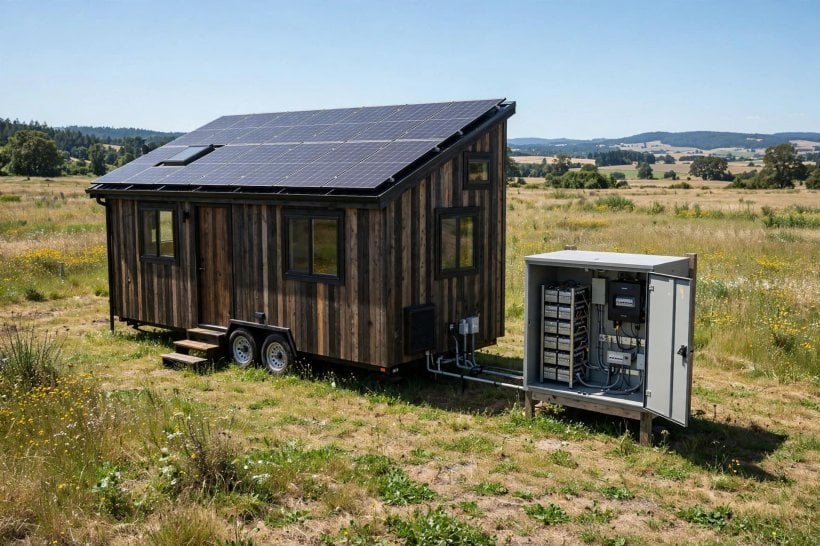
Solar arrays, battery banks, wells and septic systems need explicit scheduling. Standard policies may cap “other structures” well below the cost of replacing them: a 5 kW solar-plus-battery system runs $15,000–25,000, and if that figure exceeds the cap, the difference comes out of your pocket after a loss. List the major off-grid components separately, with values, the same way you sized them when planning the system — the sizing work in our guide to solar panel kits for tiny homes doubles as the inventory your insurer needs.
Battery storage deserves a direct conversation. Battery fires — lithium thermal runaway, rare but real — are a growing underwriting concern, and some insurers now ask about battery chemistry and installation. UL-listed batteries in proper enclosures are insurable; DIY powerwalls in the bedroom are not. If your system was self-installed, expect questions, answer them with documentation, and never let an unlisted power system sit inside a house the insurer believes is standard.
Wells and septic systems sit at the other end of the drama scale but belong on the same schedule. They are expensive, buried and easy to forget precisely because they work silently for years — until a failure turns into an excavation bill. When you list off-grid components for the insurer, work through the property the way a loss would: anything that would hurt to replace belongs on the list with a value next to it, not buried inside a generic structures cap.
7. Renters, Airbnb, and Business Use
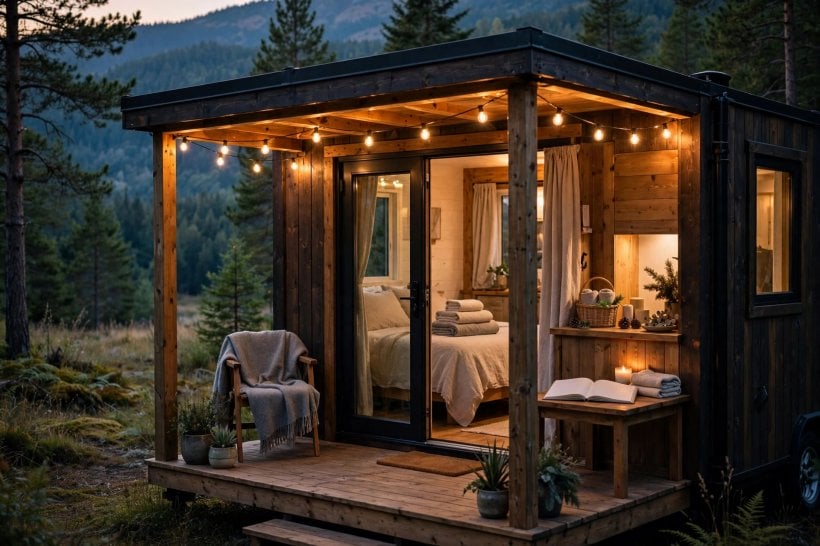
Standard homeowner’s and RV policies exclude business activity, full stop. Renting the tiny house — to a long-term tenant or through Airbnb — requires a landlord endorsement or a commercial short-term rental policy; proper STR policies run $1,500–3,000 per year. Disclosure to the insurer is not optional paperwork: an undisclosed rental voids coverage. Owners weighing the income side can work through the legal and profitability side in our guide to how to rent your tiny house on Airbnb — but the insurance line belongs in the budget before the first booking, not after.
Working from the tiny house triggers the same exclusion in miniature. A home-business endorsement, at $100–300 per year, covers business property and liability and keeps a work claim from contaminating the whole policy. The uninsured Airbnb tiny house is one guest injury away from financial ruin; the insured one treats rental income as a business and protects it like one.
8. DIY Builds: The Hard Case
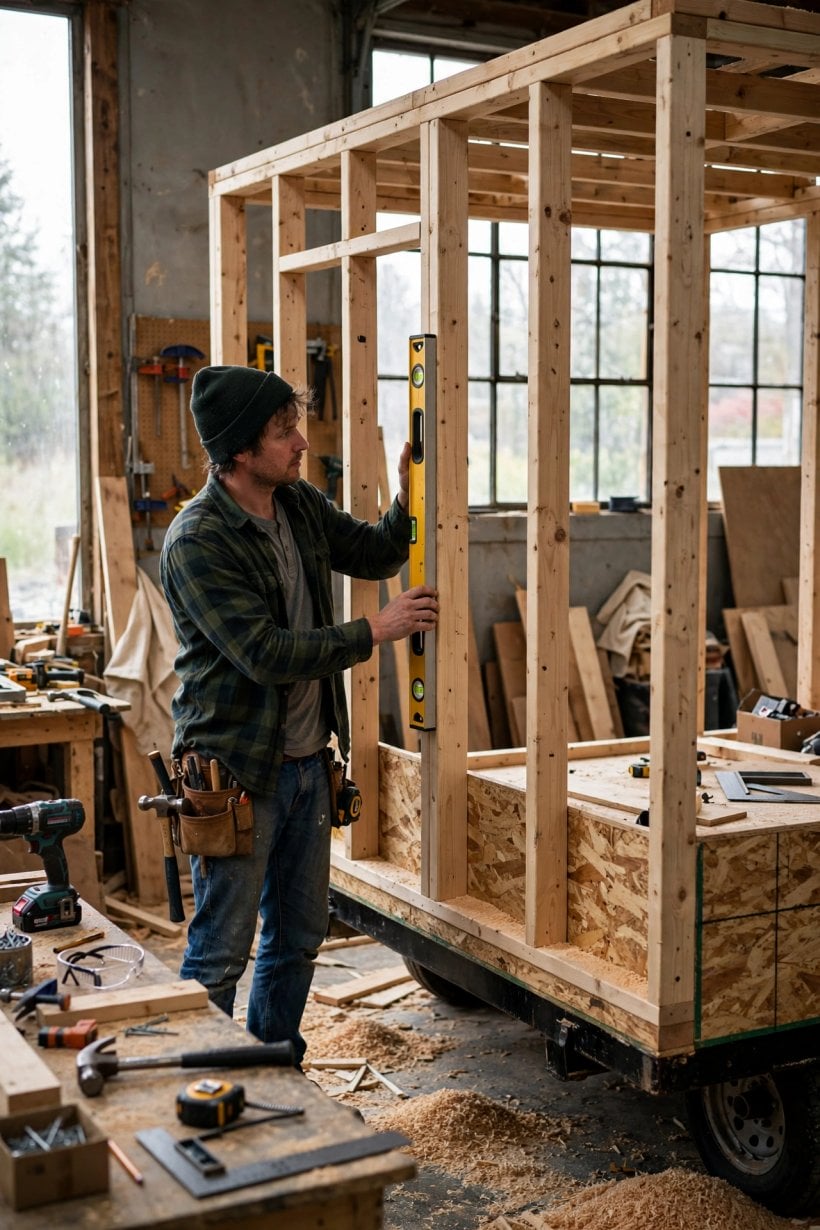
DIY tiny houses are the hardest to insure: no manufacturer, no RVIA certification, no professional documentation. Three paths work in practice. Builder’s risk during construction, converting to a dwelling policy, suits foundation builds with permits and inspections. RV policies from specialty tiny-house insurers work for THOWs — some accept well-documented DIY builds with professional electrical and plumbing sign-off. And farm or ranch policies can carry a DIY cabin as an “other structure” on an insured farm. If you are still at the deciding stage, our guide on whether you can build your own tiny house covers the wider trade-offs.
Across all three paths, one asset decides the outcome: documentation. Photograph the framing, the electrical, the plumbing; keep the receipts; file the inspection records. Documentation is what makes the unclassifiable insurable, because it lets an underwriter see a verified build instead of an unknown risk. Start the photo record on day one of the build, not the week you go shopping for quotes.
9. Shopping for Tiny House Insurance: The Process

Start with specialty insurers. Companies that explicitly advertise tiny house coverage understand the product; start there, not with your auto insurer’s call center. Then get three quotes: a specialty insurer, an independent agent who shops multiple carriers, and your current insurer. Compare on coverage, not price — replacement cost versus ACV, full-time residency, transit, off-grid systems and business use are the differentiators that decide whether a policy pays. Insurers, like the lenders in our guide to how to finance a tiny house, reward the applicant who arrives classified and documented.
Read the exclusions: the exclusions page is the policy; everything else is marketing. And re-shop every 2–3 years — the market for insuring tiny houses is evolving, and new entrants undercut incumbents regularly. A policy bought when your house was unusual may be overpriced by the time it becomes ordinary.
10. Claims: What Actually Happens
The most common tiny house claims are water damage (roof and seal failures — often contested as “maintenance,” so maintain seals and document it), wind damage to awnings and roof components, theft of tools and systems from rural sites, and transport damage. Notice the pattern: the frequent claims are unglamorous, preventable or documentable, which is why the claims process rewards the same habits as the application process.
Claims discipline is simple. Document maintenance as you go — seal inspections, dated photos. Report promptly when something happens. And never admit fault or speculate on cause to the adjuster; describe what you found, not what you think caused it. A well-documented claim on a proper policy pays. A poorly documented claim on a wrongly classified policy does not — and by claim time, it is too late to fix either problem.
The maintenance contest deserves emphasis, because it is where ordinary owners lose winnable claims. When water gets in through a failed seal, the adjuster’s first question is whether the failure was an event or a neglect story, and dated inspection photos are the evidence that answers it. Keep a simple log — dates, what you checked, what you resealed — in the same folder as your build documentation. It takes minutes a few times a year, and it converts the most common claim in this guide from an argument into a payout.
Final Considerations
Tiny house insurance is a solved problem for the owner who classifies correctly — an RV policy for a THOW, a dwelling policy on a foundation — insures to replacement cost, discloses full-time use and rentals, and documents the build. None of those steps is expensive, and together they convert an uncategorizable house into an ordinary, payable risk.
The uninsured tiny house is not saving money; it is self-insuring a six-figure asset against fire, wind and liability with no reserves. Whatever path your house takes, buy the policy before you need it — the classification conversation is easy at a desk and impossible at a claim.




9 Comments