

Hawaii is where the tiny house fantasy and Hawaii real estate collide head-on. The fantasy: a small, shaded cottage under palms, trade winds doing the work of air-conditioning, and a life simplified down to what fits in 300 square feet. The collision: Hawaii has the most expensive residential land in the United States, and nearly every land-use and building decision is made by just four counties, each with its own rulebook. Understanding tiny house laws in Hawaii means understanding that the state barely speaks on the subject at all — the counties decide what may be built, where it may sit, and whether a home on wheels counts as a home at all, while the land itself, much of it zoned agricultural, answers a large share of proposals before the building code ever gets a say.
This guide covers the full attribute set for Hawaii: the legal status of tiny houses on wheels versus foundations, how building codes work when each county adopts its own, the local status of IRC Appendix Q, minimum dwelling sizes, zoning and placement with the agricultural-land question at the centre, the ohana and ADU tradition that gives Hawaii a head start other states lack, where you can legally live, permits and inspections, and county-by-county examples, ending with practical steps and pitfalls. Two honest warnings frame everything below: land cost will dominate every budget here, and infrastructure realities — water catchment, cesspools, lava zones — matter as much as legality. Confirm specifics with the county planning and building departments for your parcel; this article is general guidance, not legal advice.
1. Tiny House Laws in Hawaii at a Glance
| Question | Hawaii in brief |
|---|---|
| Who makes the rules? | The four counties — Honolulu, Maui, Hawaii and Kauai. There is no meaningful state-level tiny house code |
| State zoning? | A statewide land-use layer (including an agricultural district covering much of the land) sits above county zoning and can override county flexibility |
| Tiny house on wheels classified as? | Generally a trailer / recreational vehicle, not a dwelling |
| IRC Appendix Q? | Adoption is county by county and version by version — ask your county building division directly |
| Statewide minimum house size? | None from the state; county codes and subdivision rules set the effective floors |
| Hawaii’s built-in advantage | The ohana/ADU tradition — secondary units are a long-standing, recognised housing form, especially on Oahu |
| The deciding factor | The parcel’s county zoning and state land-use district together — and water: county supply, catchment, or neither |
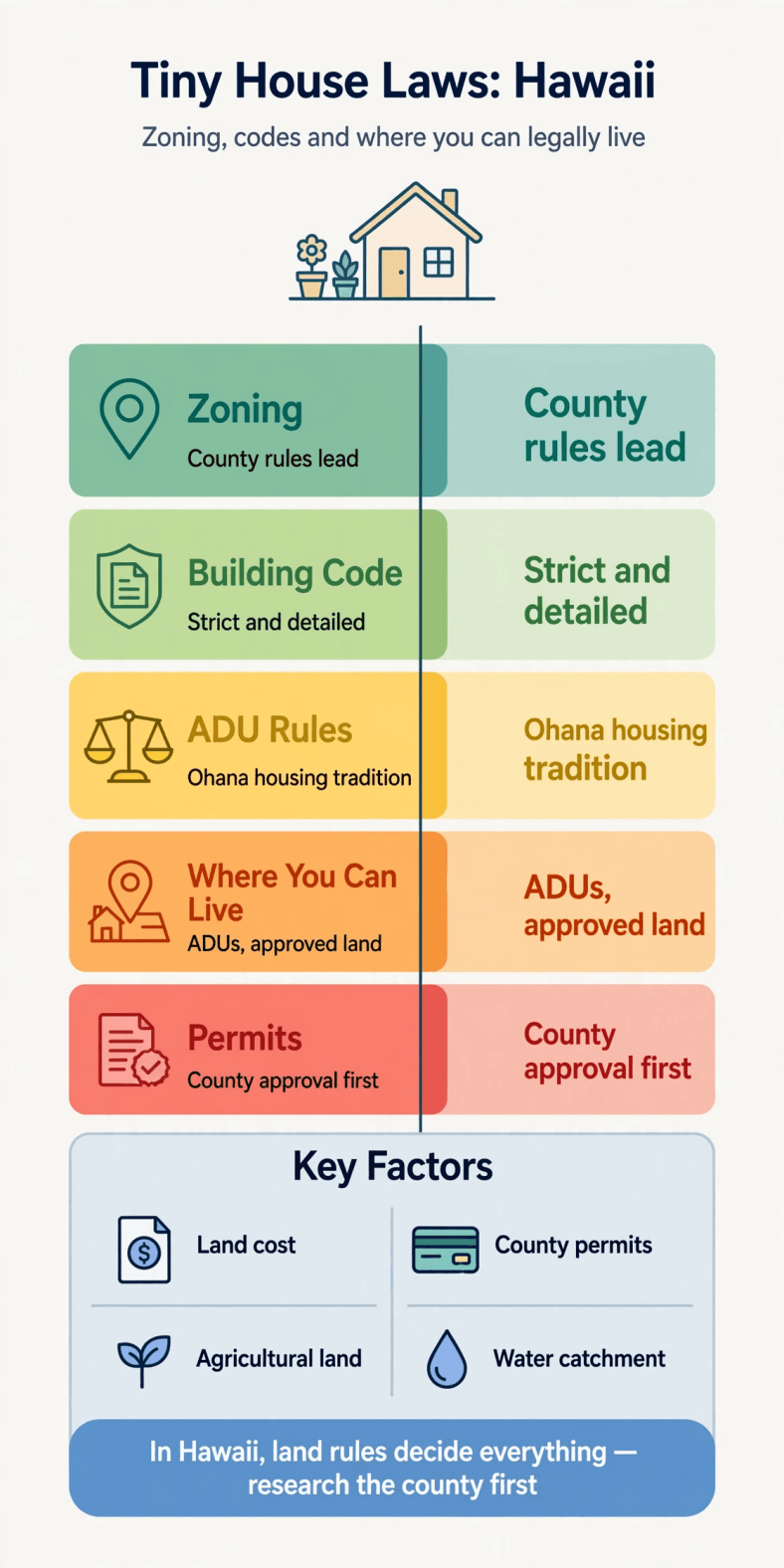
The table’s key row is the second one. In most states a willing county is the end of the zoning question; in Hawaii it can be only the middle, because a parcel the county would happily see developed may sit in the state agricultural district, where dwellings are tied to farming. Read every Hawaii answer below through that double filter — county and state layer — before money moves.
2. On Wheels vs On Foundation: Legal Status
A tiny house on wheels in Hawaii is generally classed as a trailer or recreational vehicle: registered as a vehicle, not recognised as a dwelling by county land-use codes, and not entitled to be lived in on a residential lot. County ordinances restrict camping and trailer occupancy, and unlike some mainland states, Hawaii offers very little cheap rural land where an unpermitted wheeled unit can sit unnoticed — population density, high land values and active county enforcement on most islands make the “park it and keep quiet” strategy far riskier here than the scenery suggests. If the build is genuinely mobile, the registration side still matters: see how to register a tiny house as an RV and what RVIA certification means for a tiny house, noting that certification helps with insurance and resale but does not convert a trailer into a dwelling in any Hawaii county.
A tiny house on a permanent foundation is a dwelling under county building and zoning codes: permitted, inspected, and taxed as real property. This is the only status that supports open, indefinite, full-time living on your own land in Hawaii, and it is the status every county system is built around. The engineering consequences are genuinely local: hurricane-level wind design, termite-resistant detailing, corrosion protection in salt air, and moisture management in a climate that never really dries out. A mainland-built tiny house designed for the Lower 48 will usually need design changes for Hawaii even before its floor area is discussed — budget for a Hawaii-licensed design professional on anything beyond the simplest build.
3. Building Codes in Hawaii: Four Counties, Four Rulebooks
Hawaii has no single state residential building code that a tiny house simply follows. Each county adopts and amends its own building code, working from the international model codes as a base but on its own edition schedule and with its own local amendments — so Honolulu’s code, Hawaii County’s code, Maui County’s and Kauai’s can differ in edition, detail and administrative habit at any given moment. A state building code framework exists, but county adoption is where the operative rules live. For the small-house builder this means the design review questions are county questions: ceiling heights, loft access, egress, energy provisions and the structural wind calculations are all checked against your county’s current adopted edition.
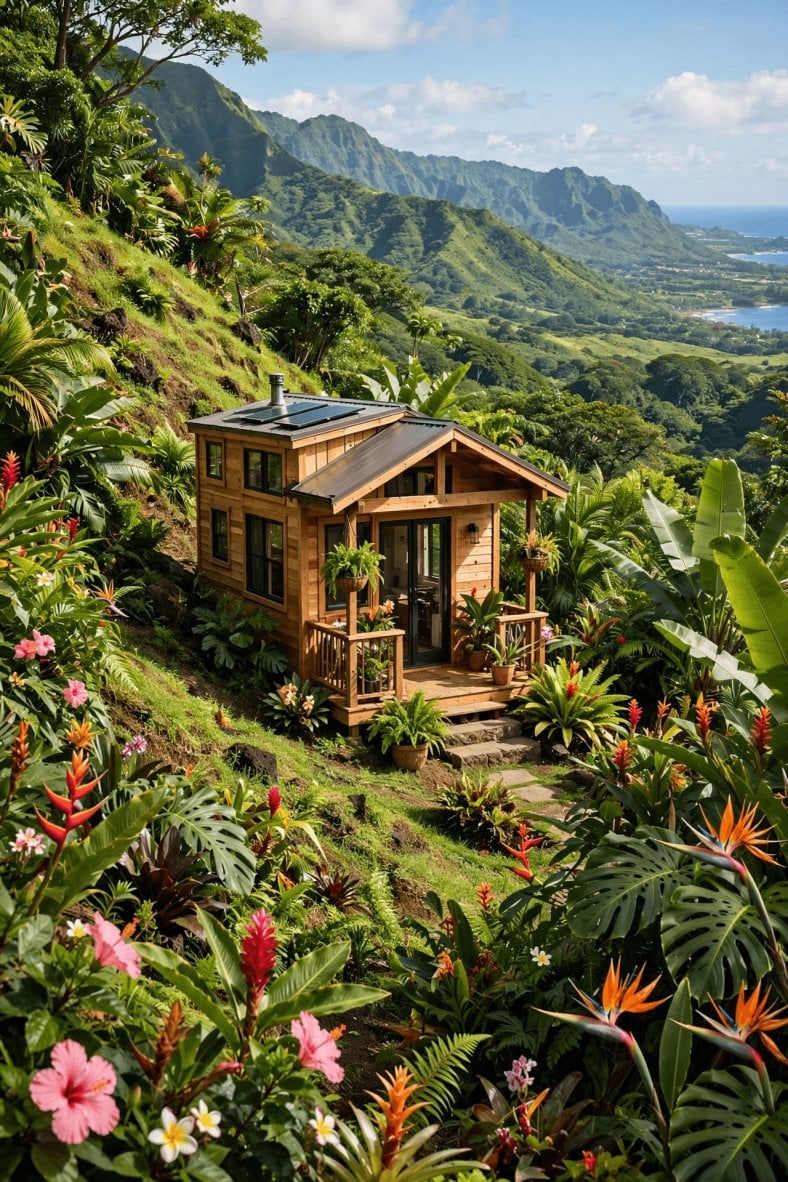
IRC Appendix Q — the model-code appendix that relaxes stair, ladder and ceiling provisions for homes of 400 square feet and under — follows the same county pattern: it applies only where and as the county has adopted it, and Hawaii counties have not moved in lockstep on it. The correct procedure is to review how IRC Appendix Q works for tiny homes, then put the direct question to your county building division for the edition in force, before the design depends on a ladder or a reduced-height loft. Hawaii’s counties do answer pre-application questions; use that channel early, because plan-review corrections on the islands are measured in months, not weeks.
4. Minimum Sizes and What Small Means in Hawaii
No Hawaii statute sets a statewide minimum house size. County building codes, following the model-code pattern, require a dwelling to contain the essentials — at least one habitable room meeting minimum area and ceiling standards, sanitation facilities, and a kitchen provision — which leaves a well-designed house under 400 square feet code-feasible in principle. Where the effective minimums bite is elsewhere: county zoning ordinances and, frequently, subdivision covenants written during Hawaii’s decades of conventional development, which can impose minimum floor areas, footprint or design standards that exclude very small homes from precisely the serviced, near-town lots a tiny house most wants.
The honest framing is that in Hawaii the minimum-size problem is usually not the binding constraint — the land price is. A legally buildable lot in a residential district commonly costs more than the entire tiny house project would in a mainland state, which is why Hawaii’s realistic tiny routes are so often about adding a small unit to land already in family hands (the ohana pattern, below) rather than buying a lot for a standalone cottage. Where a small standalone house is contemplated, verify three numbers early: any zoning minimum floor area, any covenant minimum, and the wastewater capacity of the lot — an older cesspool lot may not lawfully support the added bedroom at all.
5. Zoning and Placement: Agricultural Land Is the Trap
Hawaii runs a two-level placement system found nowhere else in quite this form. The state land-use law divides all land into districts — urban, rural, agricultural and conservation — and the agricultural district covers a very large share of the islands. Inside it, dwellings are generally expected to be farm dwellings: residences connected to a genuine agricultural use of the land. The counties then zone within that layer, adding their own agricultural, residential, resort and other districts and rules. A cheap, beautiful parcel advertised as agricultural is therefore usually cheap and beautiful for a reason: a non-farm tiny house on it is not a zoning grey area, it is simply not a permitted use, and county enforcement against unpermitted dwellings on ag land is an established, recurring thing on every major island.
Within the state urban district and county residential zoning, placement is more conventional: setbacks, height limits, lot coverage and one-dwelling-per-lot baselines, with second units only as the ohana/ADU rules allow. Conservation-district land is effectively out of reach for a new tiny dwelling. Two overlays deserve early checks on any specific parcel: flood and tsunami inundation zones, which drive foundation design and insurance, and on Hawaii Island, lava hazard zones, which do not prohibit building but reshape insurance cost and resale entirely. The working method mirrors the mainland one, with the extra state layer added: confirm the parcel’s state district and county zoning, then follow the approach in how to talk to zoning officials about a tiny house in your county planning office.
6. Ohana Units and ADUs: Hawaii’s Built-In Answer
Hawaii’s distinctive asset is cultural as much as legal: the ohana dwelling — a secondary home on a family lot for extended family — has been a recognised housing form for decades, and Honolulu’s ohana and later ADU frameworks normalised the idea of a small second unit long before the mainland ADU wave. Current county rules on Oahu allow accessory units subject to conditions on lot size, unit size, parking and owner-related requirements that change over time, and the other counties maintain their own additional-dwelling and ADU provisions with their own conditions. For a tiny-house household, this is the islands’ most realistic legal product: a compact, code-built unit of a few hundred square feet on a lot that already has a main house, services and — crucially — land tenure settled.
The limits deserve equal emphasis. An ohana or ADU is tied to its lot and main dwelling: it typically cannot be sold separately, may carry rental or occupancy conditions, and its size is capped relative to the main house or in absolute terms, depending on the county programme. Agricultural lots face the farm-connection tests for any dwelling, second units included. And every county programme has been amended repeatedly in recent years as Hawaii wrestles with its housing shortage — which is good news for small units generally, but means the only safe source is the current county text, checked this year, for the specific island. Treat any blog post older than a couple of years — including the examples in the next section — as a map of where to look, not as the rule itself.
7. Where You Can Legally Live in a Tiny House in Hawaii
The legal Hawaii options, ranked by solidity: First, a permitted tiny house on a foundation on residentially zoned land (state urban district) — fully legal and financeable, constrained mainly by finding land at a price that leaves anything for the house. Second, an ohana/ADU unit built under a county programme on an eligible lot — fully legal, and for most residents the realistic path. Third, a genuine farm dwelling on agricultural land where the farming is real — legal, but the agriculture must be more than a paperwork garnish. Fourth, long-term stays in licensed campgrounds, RV facilities or organised communities where they exist — Hawaii has fewer of these than mainland states and county rules limit stays, so weigh the differences between tiny house communities and RV parks alongside the county’s stay limits.
What does not make the list: living in a THOW on a residential or agricultural lot as a de facto home. It happens, quietly, in rural corners of the islands — and it remains the arrangement most exposed to enforcement, neighbour complaint, and the practical problem that Hawaii counties can and do order unpermitted living arrangements removed. The trade-off in Hawaii is unusually stark: the legal routes are real but land-gated; the informal routes are cheap but carry the highest removal risk of any state in this guide series. Price that risk honestly before shipping a house across an ocean — transport alone makes a Hawaii mistake five figures deep before the first county letter arrives.
8. Permits, Inspections and County Paperwork
A permitted Hawaii tiny dwelling follows the county building-permit path: plans prepared or stamped as the county requires (Hawaii is strict about licensed design professionals for much residential work), plan review against the county’s adopted code edition, staged inspections, and final approval. Timelines are the islands’ open secret — county plan review can run many months, and small projects queue behind large ones. Two infrastructure approvals gate most rural projects. Wastewater: much of Hawaii still relies on cesspools and septic systems; state health rules govern new systems and require cesspools to be upgraded or converted over time, and a new dwelling must show an approved wastewater solution before a permit completes. Water: county water service reaches only part of each island.

Where county water does not reach — famously in districts of Hawaii Island such as Puna and Kaʻū — homes rely on rainwater catchment: roof collection into tanks with filtration and disinfection, built and maintained to state health guidance, because catchment water is only as safe as its treatment. That system is a real engineering subsystem of a Hawaii tiny house, not an accessory: tank volume is drought insurance, gutters and first-flush diverters are water quality, and the whole arrangement must be planned alongside how to prepare land for a tiny house rather than improvised after the slab. Start county conversations early, expect the wastewater and water answers to shape the design, and keep every permit and approval in one file for insurers and future buyers.
9. Local Examples: Honolulu, Hawaii County, Maui and Kauai
Honolulu (Oahu) is the ohana/ADU centre of gravity: the densest island, the highest prices, the most developed secondary-unit framework, and the tightest enforcement environment for informal arrangements. Tiny living here realistically means a permitted accessory unit or a small unit in an established neighbourhood — not a standalone cottage on raw land, which barely exists at attainable prices. Hawaii County (the Big Island) is the opposite pole: the state’s cheapest land, vast agricultural districts, catchment-water subdivisions, and active county rules on farm dwellings and additional units — the island where a legal rural tiny house is most plausible and where the ag-land and lava-zone checks matter most.
Maui County combines high prices with its own ohana/additional-dwelling provisions and a housing debate sharpened by tourism pressure; expect programme conditions and verify them against current county text. Kauai similarly runs its own additional-dwelling rules with strong local sentiment about housing for residents. The pattern across all four: the county is the author of your project. There is no “Hawaii rule” to learn once — there are four, and an inter-island move restarts the learning. These examples show which questions dominate each island — ADUs and price on Oahu, agriculture and water on the Big Island, programme conditions on Maui and Kauai — and none of them replaces the parcel-level check.
10. Practical Steps to Go Legal in Hawaii
Hawaii punishes the mainland habit of buying land first and reading rules second more severely than any state in this series. The sequence below front-loads the island-specific gates: state district, county zoning, water and wastewater.
- Fix the island and tenure first. Owned land in family hands (for an ohana/ADU) and a purchased lot are entirely different projects; know which one you actually have.
- Check both layers for the parcel: state land-use district and county zoning, in writing from the county planning department.
- If the land is agricultural, test the farm-dwelling question honestly. No genuine farm use means no dwelling route — walk away rather than build and hope.
- Answer water and wastewater before design. County water or catchment design; sewer, septic or cesspool status and its conversion implications.
- Ask your county building division the Appendix Q question for its current code edition, and confirm design-professional requirements.
- Read the covenants. Subdivision rules on minimum size and second units override many otherwise-legal plans.
- Permit, build, inspect, document. Keep final approvals, wastewater sign-off and catchment details together for insurance and resale.
While the site plan is still fluid, work through the utilities side deliberately — tiny house utilities: power, water and sewage options: Hawaii’s high electricity prices reward solar and passive design, trade-wind ventilation genuinely works in a small shaded envelope, and a tiny house that is engineered for its island — wind, water, termites, salt — will outlast one that is merely legal. The honest trade-off to close on: Hawaii offers the country’s best climate for small-footprint living and its most developed second-unit tradition, in exchange for the country’s hardest land economics and a two-layer approval system that rewards only the patient.
Final Considerations
Hawaii’s rules are not hostile to small houses; they are indifferent to them, which is a different problem. The system was built around county administration, agricultural protection and family land patterns, and a tiny house succeeds here when it fits one of the shapes the system already recognises — a permitted small dwelling on residential land, an ohana or accessory unit on a family lot, a genuine farm dwelling — and fails when it asks the system to improvise a new category on agricultural or unpermitted ground.
Work with those shapes, verify both layers of any parcel in writing, and solve water and wastewater before floor plans, and a legal tiny life in Hawaii is achievable — there are permitted small homes on every major island proving it. Skip the verification, and the Pacific is an expensive moat around a mistake: removal orders, unsellable improvements and a house that cost a fortune to ship. In Hawaii more than anywhere, the paperwork is the project; the cottage is the reward at the end of it.