
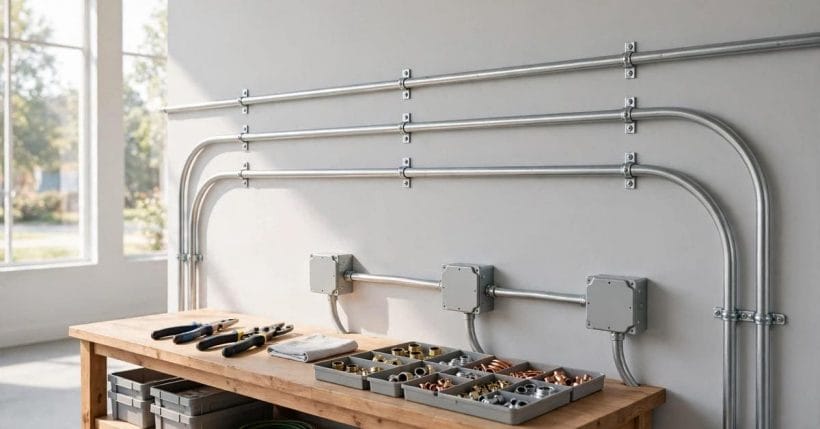
Conduit is the tube that wiring runs through: a protective pipe — metal or plastic — that carries electrical cables through walls, floors and ground, keeping them safe from damage and the world safe from them.
This explainer defines conduit in plain terms: what it is, the main types, where each is used, and how it differs from the cable inside it. It stays general throughout, on purpose: anything involving installing, altering or connecting mains wiring is work for a qualified electrician under your local code, and nothing here is a how-to.
1. Conduit at a Glance
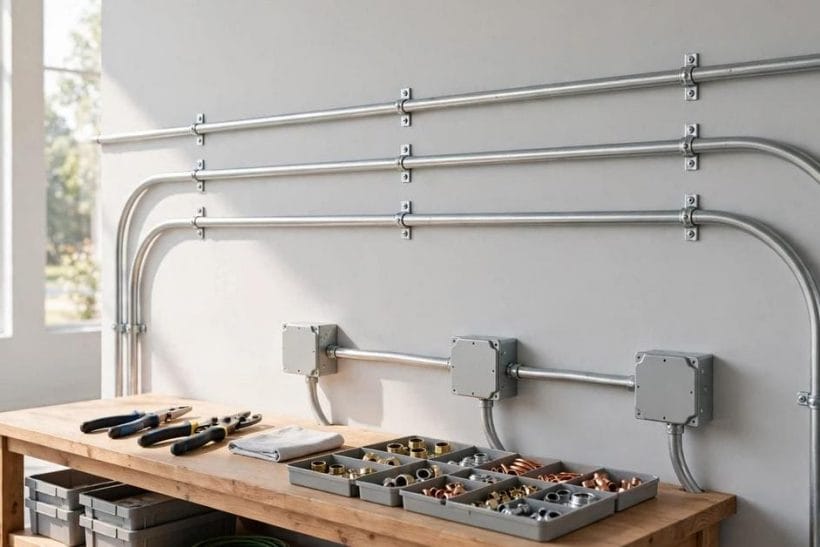
The central entity is conduit: a hollow tube or duct whose attributes are its material, its flexibility, its fittings, and the environment it is rated for — and whose job is to protect electrical conductors and make them replaceable. This post keeps one slice of the structure-and-services family: how thick the wall around it is lives in interior wall thickness; the frame that carries the building answers to post-and-lintel; and the columns doing the heavy lifting sit in load-bearing column ideas. Here the subject is the humble tube itself. The feature photograph shows the idea at its clearest: runs of conduit fixed in straight, orderly lines along a wall, each bend deliberate, each cable inside protected and invisible.
| Question | Short answer |
|---|---|
| What is conduit, in one sentence? | A protective tube — metal or plastic — through which electrical cables are pulled, so the wiring is shielded from damage and can be replaced without opening the building up |
| Is conduit the same as cable? | No — the cable carries the electricity; the conduit is the pipe it travels in. They are chosen separately and do different jobs |
| Why not just bury cable in the wall? | Sometimes cable alone is permitted, but conduit adds mechanical protection, a safer path through masonry and ground, and the ability to rewire later — which is why codes require it in many settings |
| Who installs it? | A qualified electrician, working to the local electrical code. This post explains the concept; installation is licensed work everywhere it matters |
| Where is conduit used? | Inside walls and floors, underground, outdoors, and in commercial and industrial buildings — anywhere wiring needs protection, order or a route that can be serviced |
2. What Conduit Is: The Definition
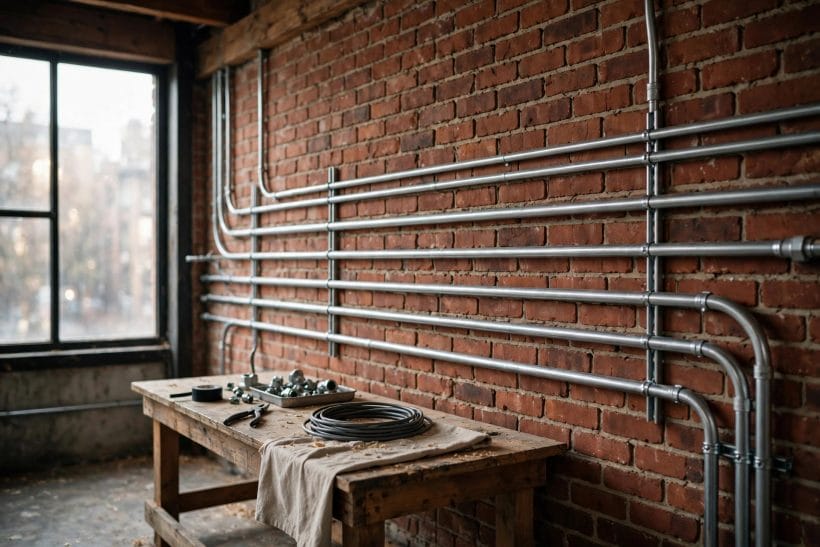
Start with the word itself. A conduit is any channel that conveys something from one place to another — water, air, or, in building work, electricity. Electrical conduit is a tube, usually round in section, made to receive cables: the cables are drawn through it after the tube itself is fixed in place, which is the detail that explains everything else about how conduit is used.
That sequence — tube first, cables second — gives conduit its two defining virtues. The first is protection: a hard shell between the cable and the world, guarding against nails and screws in walls, knocks in workshops, moisture in the ground, and the slow abrasion of a building moving through its seasons. The second is replaceability: because the cable is not embedded, it can be withdrawn and renewed at the end of its life, or upgraded when a room’s needs change, without demolishing the wall that hides it. Anyone who has planned a wall’s build-up, as the tiny house electrical wiring guide does for small homes, meets conduit as the part of the system designed to be forgiven later.
Conduit is therefore best understood as infrastructure rather than equipment. It does not switch, power or consume anything. It is a route — planned, protected and permanent — and like all good infrastructure, it is noticed only when it is missing.
3. Conduit and Cable: The Difference That Matters
Confusion between conduit and cable is the commonest misunderstanding in this corner of building work, and clearing it up makes every conversation with an electrician easier. The cable is the conductor: insulated wires, bundled in a sheath, that carry current between the consumer unit, switches, sockets and lights. The conduit is the container: an empty tube whose entire job is to give those cables a protected path.
The distinction shows up in how the two are chosen. Cables are chosen for the electrical load they must carry and the job they must do. Conduit is chosen for the place it must survive — damp or dry, buried or surface-run, straight or full of bends — and for how many cables it must comfortably hold, now and in a plausible future. An electrician thinks about both at once, but they answer different questions: the cable answers “how much power, to what?”, and the conduit answers “through what, protected from what?”
Some wiring systems blur the line — armoured cables carry their own metal protection, and flexible cable systems are rated to run without a separate tube in certain settings. Those are their own product families with their own rules, assessed by the professional doing the work. The simple mental model holds regardless: wherever you see a tube with wires emerging from its end, the tube is the conduit and the wires are the point.
4. The Main Types of Conduit
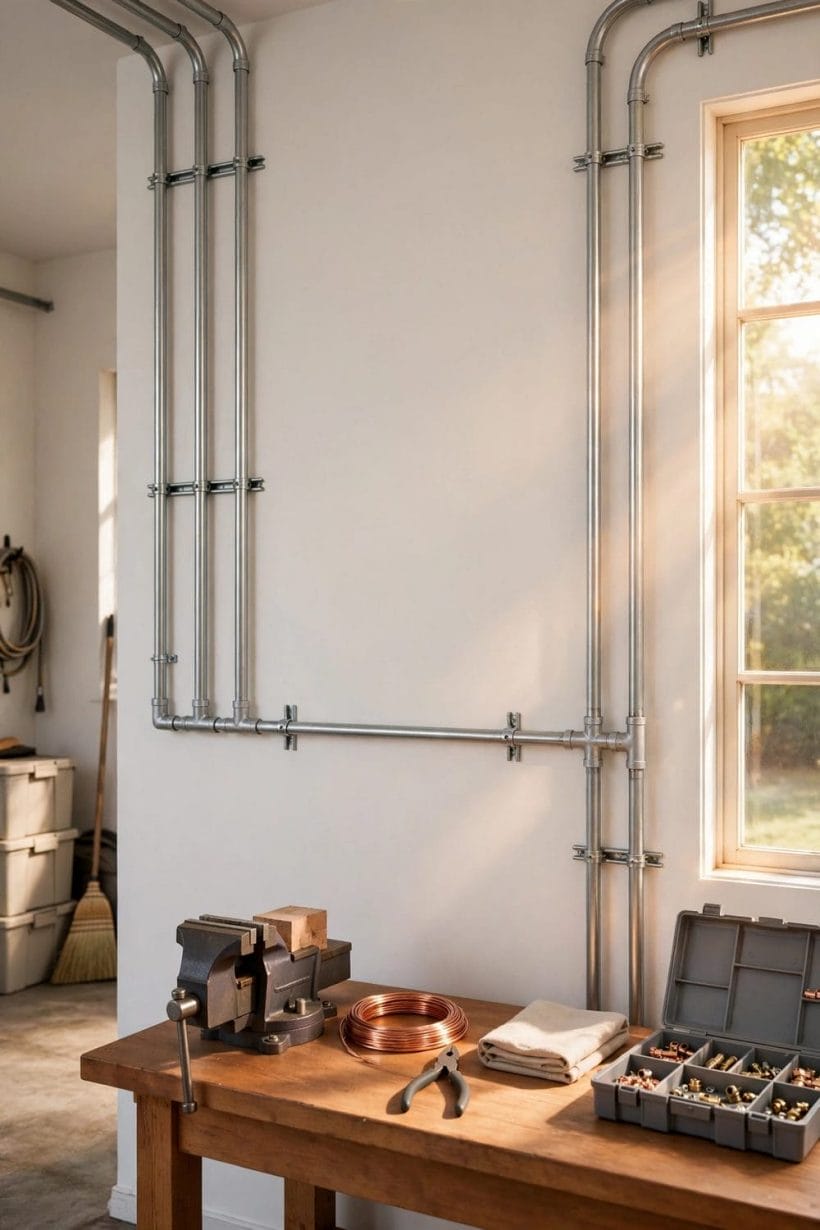
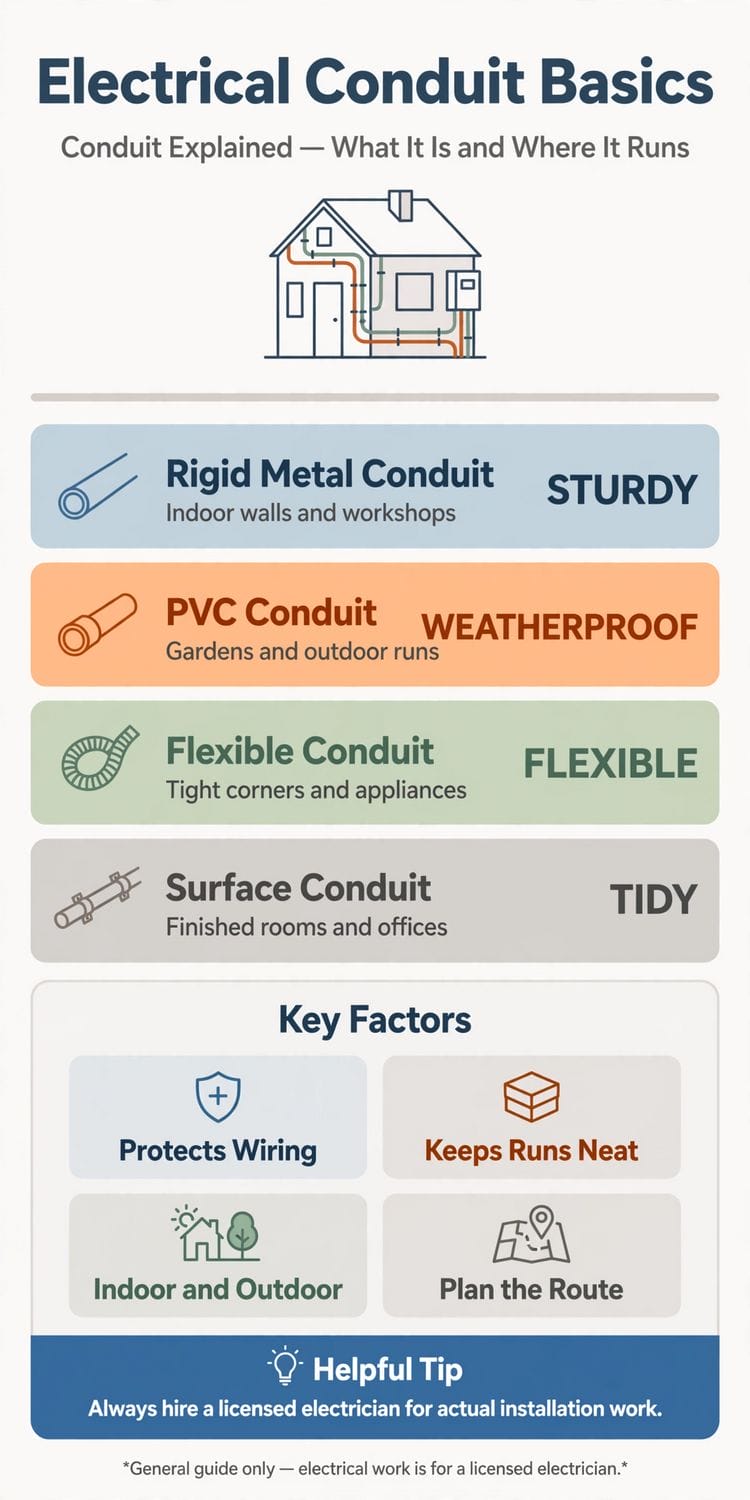
Conduit comes in a handful of families, divided by material and by whether they bend. These are the types a homeowner will meet named in quotes, specifications and older buildings — described generally, because exact products, ratings and permitted uses are set by manufacturers and local codes, and are the installing electrician’s call.
1. Rigid metal conduit
Steel tube, cut and threaded or joined with fittings, is the heavyweight of the family: immensely strong, inherently fire-resistant, and the traditional choice for commercial and industrial work and anywhere wiring faces a hard life. It is bent with specialist tools into precise, permanent routes.
2. Rigid plastic conduit
PVC and similar plastics form the domestic workhorse — light, inexpensive, immune to rust, and joined with solvent or push fittings. It is the conduit most often seen in homes: in walls, in lofts, and surface-run in garages and outbuildings where its neatness is a virtue.
3. Flexible conduit
Corrugated or spiral-wound tube that bends by hand around obstacles and through awkward voids. Flexible conduit suits short, complicated runs — the final approach to a fitting, a route through a crowded ceiling — and as a protective sleeve where a cable passes through a difficult spot.
4. Liquid-tight flexible conduit
A flexible tube with a smooth, sealed jacket, made for wet and outdoor duty — the run to an external unit, a garden building, a piece of machinery that gets washed down. Its fittings seal at each end so the protection is continuous.
5. Trunking: conduit’s rectangular cousin
Trunking is a lidded, usually rectangular channel that carries cables along a surface rather than inside a wall — in offices, workshops and retrofits where opening the wall is impractical. It shares conduit’s purpose, with a lid that opens along its whole length for access.
6. Underground ducting
Beneath gardens and driveways, cables travel in buried duct — conduit’s outdoor form — laid in a trench with warning tape above it, so future digging meets a warning before it meets a cable. Colours and specifications for buried duct are set by local practice and code.
5. Where Conduit Is Used

The map of conduit in a building follows the map of risk and inconvenience: anywhere a cable could be damaged, anywhere it would be miserable to replace, and anywhere the rules simply require a protected route.
7. Inside walls, floors and ceilings
The domestic heartland. Conduit runs through stud walls, across ceiling voids and under floors, emerging at socket, switch and light positions through small boxes set into the wall. The wall’s own construction decides the route, which is why conduit planning belongs with the wall planning — thicknesses, voids and chases all interact.
8. Surface runs in utility spaces
Garages, workshops, plant rooms and outbuildings often wear their conduit openly, clipped in straight runs along the wall. It is honest, inspectable and easy to extend — and in these rooms, surface conduit looks intentional rather than unfinished.
9. Underground and outdoors
Garden lighting, outbuilding supplies, gate and driveway runs: buried and outdoor conduit protects cables from spades, weather and sunlight, and gives the route a findable, replaceable path. Outdoor work is where codes and professional involvement matter most.
10. Commercial and industrial buildings
Offices, shops, schools and factories are conduit’s ancestral home — steel systems carrying dense networks of power and data, designed to be reconfigured as tenants and machinery change. The scale differs from a house; the principle is identical.
11. As protection at vulnerable points
Even where a wiring system does not use conduit throughout, short lengths appear as armour at the vulnerable spots: where a cable passes through masonry, emerges from the ground, or crosses a place exposed to knocks. Sleeving a risk is conduit thinking at its most economical.
12. In small and tiny homes
Compact houses concentrate services into thin walls and shared voids, so planned conduit runs earn their keep — the tiny house electrical load planner treats routes and capacity together for exactly this reason. In a small building, a replaceable cable path is the difference between an upgrade and a rebuild.
6. Fittings, Boxes and Bends: The Supporting Cast
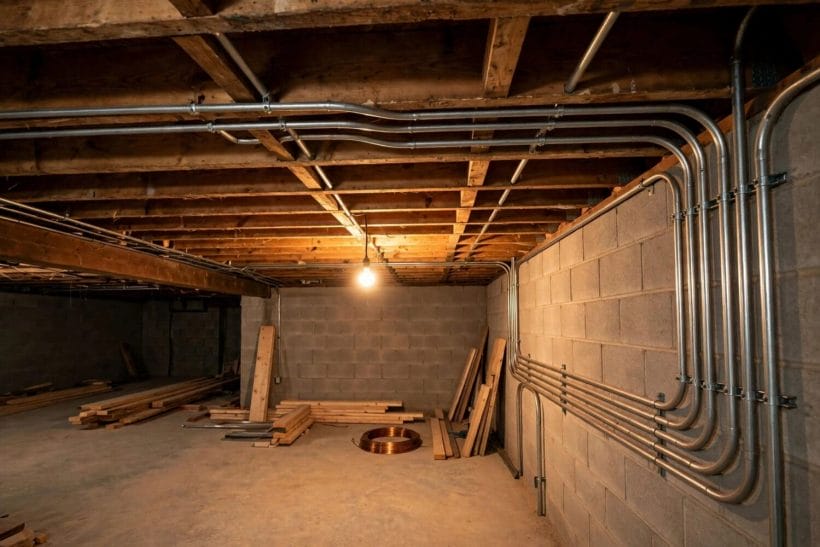
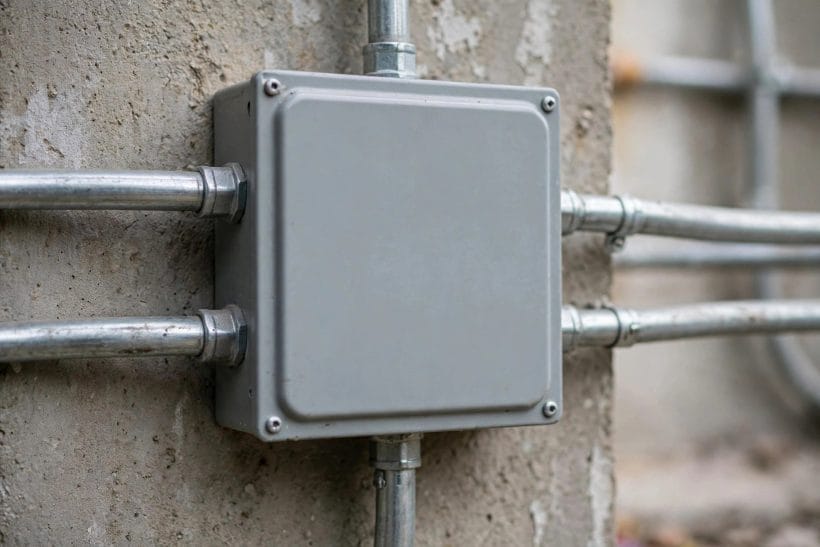
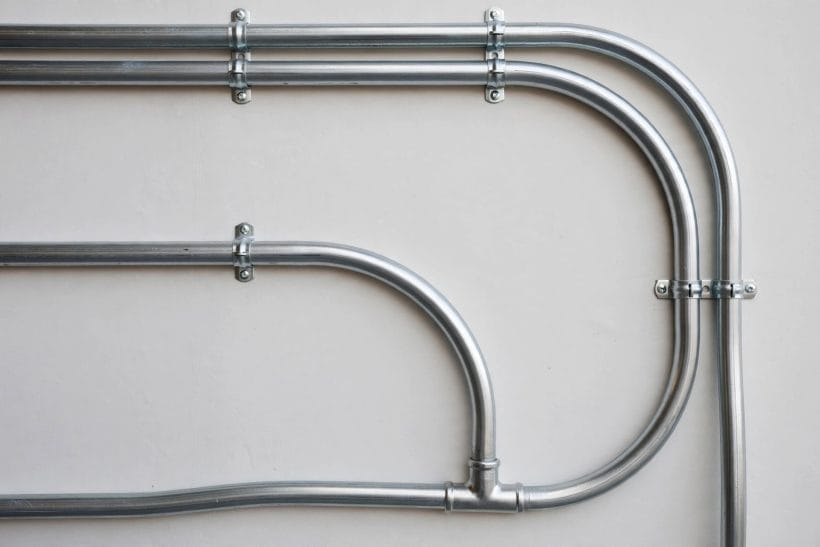
A conduit run is more than tube. Couplers join lengths end to end; bends and elbows turn corners — swept gently, because cables must be persuaded around them, never forced; and boxes punctuate the system wherever cables join, branch or meet a switch or socket. The box is the system’s access point and its face: set into the wall during the build, finished flush, and the only part of the run a room’s occupants ever see.
Two quiet principles govern the whole assembly. The first is continuity: protection only counts if it is unbroken, so every joint, bend and entry is fitted to leave no gap where damage or moisture can reach the cable. The second is drawability: a well-planned run can actually have its cables drawn through it — bends are few and gentle, distances between access points are sensible, and nothing is asked of the cable that physics will refuse. Both principles are invisible in a finished room, and both are why the design of a conduit system is professional work even though its concept fits in a sentence.
7. Choosing Conduit: The Questions That Decide
Homeowners rarely choose conduit directly — the electrician specifies it — but understanding the questions behind the choice makes specifications and quotes readable. The decision always works through the same short list.
13. Where will it run?
Environment first: dry interior walls ask little; damp, buried and outdoor runs ask everything. The route’s conditions choose the material family before any other consideration is allowed a vote.
14. How much protection does the route need?
A cable behind plasterboard in a quiet bedroom and a cable crossing a workshop wall live different lives. Exposure to knocks, tools, vehicles and vermin raises the armour required — rigid metal at one end of the scale, light plastic at the other.
15. How many cables, now and later?
Conduit is sized for the cables it must hold with room to draw them comfortably — and the wise specification leaves spare capacity, because the cheapest future-proofing in any building is an emptier tube. Filling a conduit to its limit makes the drawing-in miserable and the upgrading impossible.
16. Straight runs or a bending route?
Long straight runs suit rigid systems; routes that weave through existing construction argue for flexible sections. Most real systems mix both — rigid where life is simple, flexible where the building is awkward.
17. Will it be seen?
Surface conduit in a living space is a design decision as much as a technical one: straight, level, evenly clipped runs in a finish that suits the room look deliberate, while the same tube fitted carelessly looks like an apology. In utility spaces, neatness alone carries the day.
18. What does the local code require?
Above every preference sits the code: electrical regulations specify where conduit is mandatory, which materials are permitted where, and who may do the work. The code is not a style guide and it outranks this page — your electrician works to it, and so should any plan.
8. Conduit and the Wider Building

Conduit does not exist alone; it threads through the same walls, floors and ground as every other service and structure, and it is planned in their company. The wall it crosses has a build-up and a thickness of its own; the floor it runs beneath carries weight on the structure beneath that. Good building work coordinates the routes early — electricians, like plumbers and carpenters, do their neatest work when the drawings agree before the walls close, and their most expensive work when they do not.
The relationship that matters most to a homeowner is with the building’s future. A house wired with replaceable cable routes can absorb the next half-century’s inventions — new circuits, new controls, generation joining from the roof — the question worked through in how much are solar panels for a tiny house — technologies nobody has named yet — by drawing new cables through old tubes. A house wired without them meets every upgrade with a chisel. Conduit is, in that sense, a gift from the builder to every future owner: invisible, unglamorous, and cashed in gratefully decades later.
9. Safety and the Rules Around Conduit
Electricity is unforgiving of improvisation, so this section is deliberately plain. Conduit exists as part of a regulated system: electrical codes specify how wiring must be protected, where it may run, and what counts as safe — and in most jurisdictions, work on fixed wiring must be done or certified by a qualified electrician. Treat that as a floor, not a ceiling.
Three habits keep a homeowner on the right side of the system. First, never drill or fix into a wall blindly where cables may run — conduit and cables follow predictable routes from sockets and switches, and a cable detector plus caution is the minimum before any fixing. Second, never open, extend or alter a conduit run or its boxes yourself: the system’s protection and its certification both end where amateur work begins. Third, if a run is damaged — clipped by a drill, crushed, cracked by impact — have it inspected by an electrician before it is covered up again; damage hidden is damage kept.
Nothing in this post qualifies anyone to install anything. Its purpose is the opposite: to make the system legible enough that a homeowner can specify a renovation intelligently, read a quote critically, and recognise the boundary where reading stops and a professional begins.
10. Costs and Conversations: Talking to Your Electrician

Conduit itself is inexpensive material; the cost of a conduit system lives in the labour of planning, fixing, bending and drawing cables through it — which is why the honest conversation with an electrician is about routes and futures, not tube prices. Three questions get the most value from that conversation.
Ask where the runs will go and what they will be made of, and why — a good electrician’s reasoning will match the framework in this post: environment, protection, capacity, code. Ask what spare capacity the system leaves, because a modest allowance now is the cheapest upgrade path you will ever buy. And ask what the plan means for the room’s finishes: which walls open, which stay closed, and what making-good follows. With those answers, “conduit” stops being a line item and becomes what it really is — the building’s wiring, given a safe, serviceable and permanent home.
Final Considerations
Conduit is the least visible decision in a building and one of the longest-lived: a tube, chosen for its environment, carrying cables it protects and can one day surrender for renewal. Understand it as a route rather than a product, and every specification, quote and older building becomes easier to read.
Keep the splits clean and the definition simple: the cable carries the power, the conduit carries the cable, and the code carries them both. For anything beyond understanding — installing, altering, extending, certifying — the answer is the same one this post has given throughout: a qualified electrician, working to your local rules, every time.




0 Comments