

Solar is the upgrade that turns a tiny house into its own power station — but the quote is where most buyers stall. Panels are only part of the bill: batteries, an inverter, wiring and the install itself all take their share. This 2026 price breakdown prices every piece from the guide’s own figures, so you can size the system, choose DIY or pro, and know the payback before you spend a dollar.
How much solar panels cost for a tiny house: At a Glance
The strongest answer this guide gives is a range with a reason: a professionally installed tiny-house solar system typically lands between $5,000 and $12,000, while a self-installed system runs $3,000 to $7,000. That spread is not padding — it is the install choice, the battery bank and the measured size. Everything below follows the guide’s own order — the quick answer, the sizing, the panels, the batteries, the inverter and balance, the install, the credit, the payback — because how much solar panels cost for a tiny house is decided by those pieces, in that order, and by nothing else.
| Topic | What It Covers | Key Fact or Figure |
|---|---|---|
| 1. The Quick Answer | The two headline totals | $5,000–$12,000 installed; $3,000–$7,000 DIY |
| 2. Sizing Your System | Usage, watts, panel count | 3–6 kWh/day; 1–3 kW; 4–10 panels |
| 3. The Panels | The per-watt price | $0.70–$1.10 per watt |
| 4. The Batteries | The lithium bank | $800–$3,000; 2–3 days stored |
| 5. The Inverter & Balance | Inverter, wiring, balance | $500–$2,000; the balance is 30% |
| 6. DIY vs Professional Install | Skilled vs warranted | $3,000–$7,000 DIY; $7,000–$12,000 pro |
| 7. The 2026 Tax Credit | Federal claim, state check | 30% federal credit |
| 8. The Payback Math | Years, worth, financing | 4–8 years; 25–30 year life |
| 9. The 10 Commandments | Ten imperatives, verbatim | 10 commandments |
| 10. Mounting & the Powered Life | Mounts, weather, upkeep | 100–300 sq ft of roof |
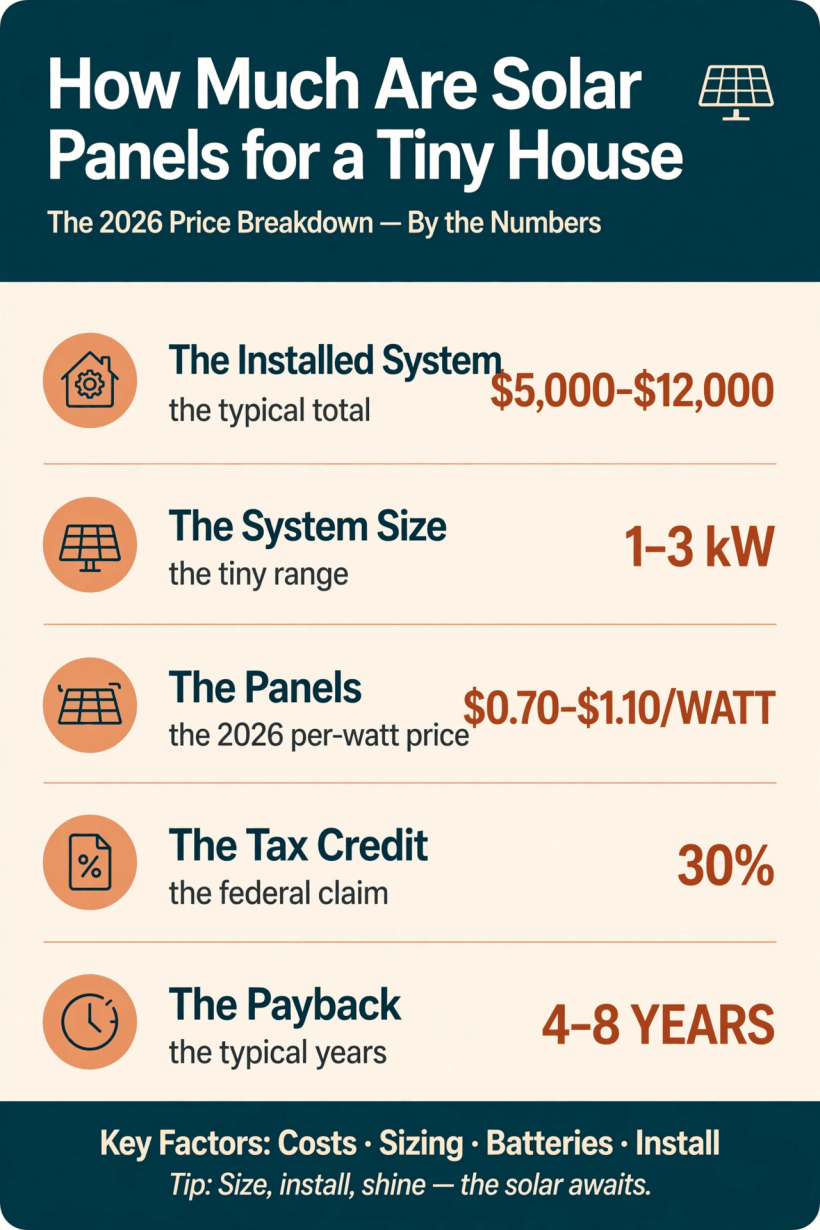
The 2026 numbers at a glance: the total, the size, the per-watt price, the credit, the payback.
1. The Quick Answer: What a Tiny Solar System Costs in 2026
The original guide opens with the number everyone comes for. The typical tiny-house solar system, fully installed, costs $5,000–$12,000. The same system installed by its owner costs $3,000–$7,000. Between those ranges sits the whole breakdown: identical equipment, and the difference is labor, warranty and confidence.

Why is a tiny system not simply a small version of a house system at a small version of the price? Because the tiny house needs less of everything. Its daily usage is measured in single digits of kilowatt-hours, its roof carries a handful of panels rather than a field, and its bank is sized in days rather than weeks. The rule the guide repeats is the one worth keeping: the tiny needs less — and that is where the savings live.
This is also where the guide’s most-asked question gets its answer. Asked what solar panels cost for a tiny house in 2026, the guide gives the same two ranges — $5,000–$12,000 installed, $3,000–$7,000 DIY — and adds the discipline that the cost is the sized: it follows the usage you measure and the system you build from it. A buyer who skips the measuring step is not buying a cheaper system; they are buying a guess. The sections that follow price the system piece by piece, so the total at the end is one you built yourself.
2. Sizing Your System: Usage First, Watts Second
Sizing is the step the whole price hangs on, and the guide sizes from usage, never from the roof. A tiny house typically uses 3–6 kWh per day — lights, refrigeration, devices, water pumping and the small loads of a small life. Matched against the sun, that usage calls for a system of 1–3 kW: the typical tiny range.
The panel count follows the watts. The guide’s answer to how many panels a tiny house needs is 4–10 panels — the 1–3 kW expressed in hardware. The needed is the measured: the kWh you actually use and the sun your site actually gets. Two identical tiny houses can land at opposite ends of that range — one in a bright field, one under trees with a home office aboard — and both can be right.
Roof space is part of the same measurement. The guide puts the space tiny-house panels need at 100–300 sq ft for those 4–10 panels, and the needed is the measured: the roof you have and the tilt you can give it. If the roof cannot offer that space facing the sun, the answer is not a smaller system — it is a different mount, covered below. Our guide to how much solar power a tiny house needs works the same measurement from the load side.
3. The Panels: Priced by the Watt
Panels are the one component priced like a commodity, and the guide prices them by the watt: $0.70–$1.10 per watt in 2026. Multiply by the system you sized — 1–3 kW — and the panel bill explains itself: the array is a four-figure line, not the five-figure one buyers fear. The count stays tiny, 4–10 panels, because the load is tiny. A per-watt price also makes quotes comparable on one line.
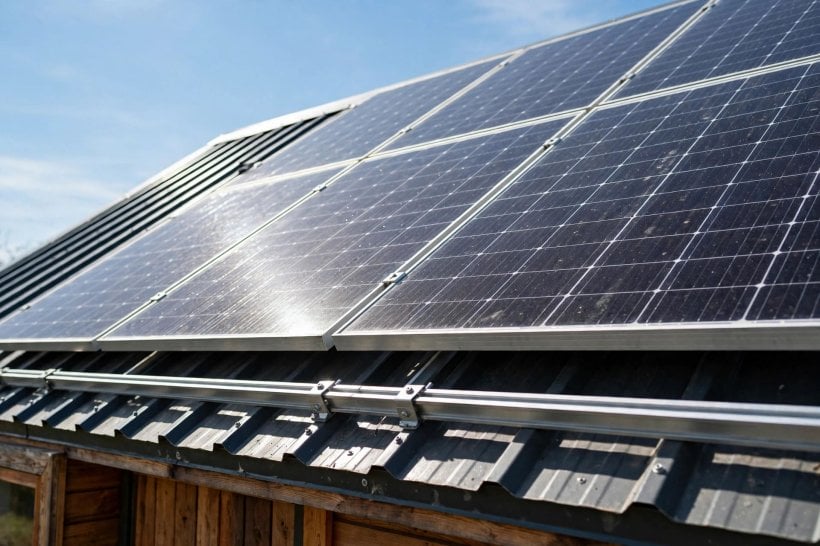
The guide’s truth for this section is the one that reorganizes the whole budget: the panels are the cheapest part — the system is the cost. Buyers who comparison-shop panels for weeks and then guess at batteries and inverters have it backwards. The panel price matters, and it is worth paying for quality that lasts — the guide’s lifespan answer, covered in the payback section, is 25–30 years, warranted — but the money decisions that decide the total live in the next three sections: the bank, the inverter and the install.
4. The Batteries: Where the Budget Really Lives
If panels are the cheapest part, batteries are the opposite. The guide prices the lithium bank at $800–$3,000 — the widest swing in the whole system, because the bank is sized in days, not watts. The guide’s figure is 2–3 days of autonomy: enough stored power to carry the tiny through the cloudy stretch without the lights becoming a negotiation.
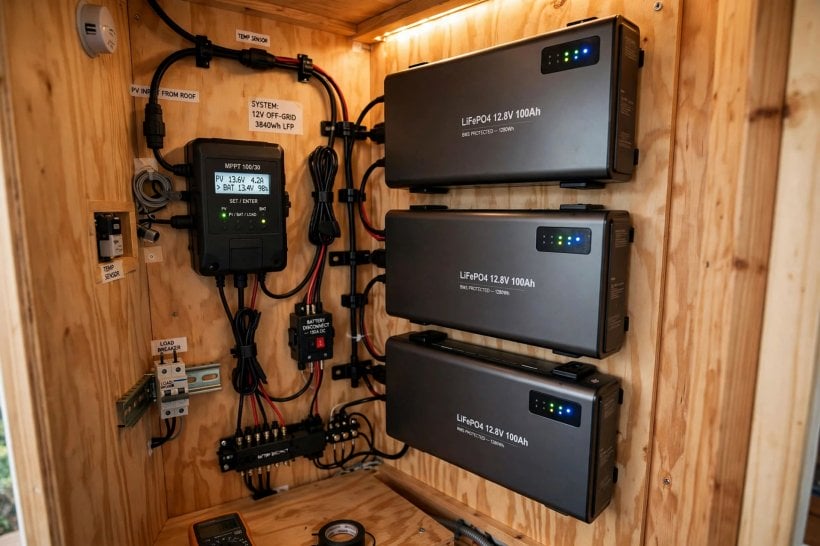
That is why the guide’s rule for this section is blunt: the batteries are the budget — the planned. An undersized bank does not announce itself on the first sunny day; it announces itself on the third gray one, which is why the bank is planned from the usage measurement and the autonomy target, not trimmed at the checkout to prettify the total. Our guide to solar panel kits and sizing an off-grid battery bank works that bank-sizing math in full.
Do you need batteries at all? The guide’s answer splits by connection. Off-grid — yes: the bank is the only thing standing between sunset and darkness. Grid-tied — optional: the grid itself plays the storage role, and the bank becomes a backup choice rather than a necessity. The needed is the sited: decided by your connection and your outages.
5. The Inverter and the Balance of System
Between the panels and the life they power sits the balance of system, priced in two halves. The inverter — the box that turns the panels’ direct current into the alternating current the house runs on — costs $500–$2,000, sized. The wiring that mounts it all together costs $300–$800. And the guide’s rule keeps the whole category honest: the balance is the 30% — the share of the system total that lives outside the panels and the bank, and the share do-it-yourself budgets most often forget.
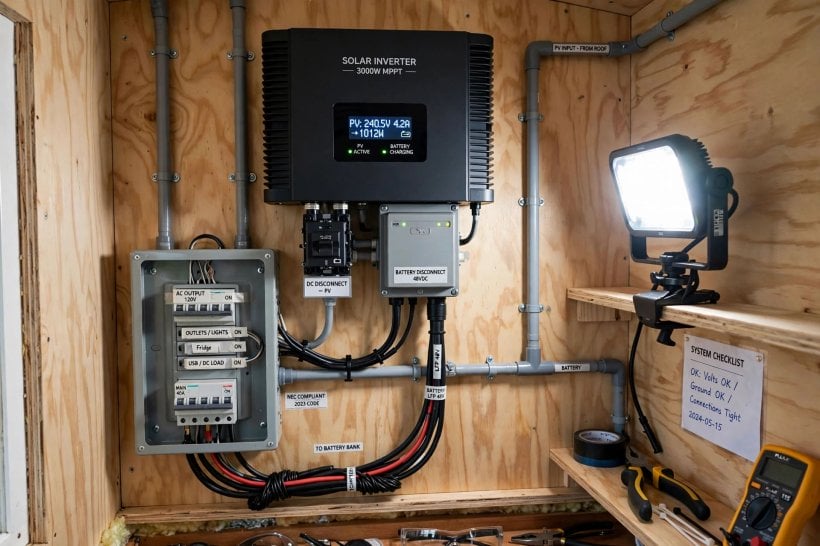
Inverter sizing has its own question and its own number: what size inverter does a tiny house need? The 2–4 kW — the loads-matched. The sized is the calculated, from the peak load and the continuous load: the biggest moment the house can draw, and the draw it sustains. An inverter under that peak trips on the kettle-and-fridge moment; one far over it spends money converting capacity the house will never call. As with the array and the bank, the right size is not a shelf category — it is the measurement, finished.
6. DIY vs Professional Install: The Choice That Moves the Total
The widest price decision in the whole breakdown is not a component — it is who installs. The guide prices the DIY route at $3,000–$7,000, the skilled path: the same class of equipment, with the labor supplied by the owner. The professional route runs $7,000–$12,000, the warranted path: the labor billed, the work guaranteed, the paperwork carried by someone who files it weekly. The guide’s truth is that the install is the choice — the budget: this single decision moves the total more than any component upgrade inside either route.
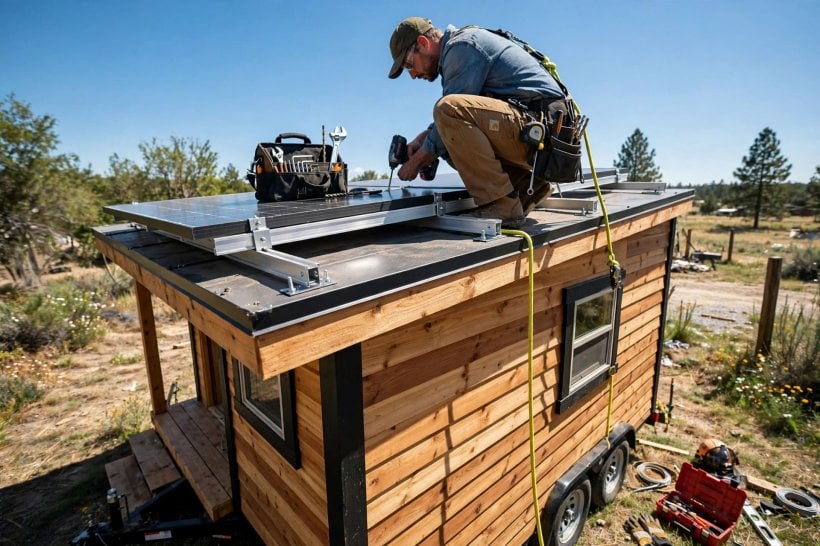
Can you install tiny-house solar yourself? The guide’s answer is yes — the skilled, the permitted, the careful. The installed is the capable: comfortable with the electrical work and the roof work, because a solar install is both at once. What DIY must never skip is the permit and the care: the guide’s yes is conditional on both, and savings are not savings if the system has to be redone.
Solar deeper, in the guide’s own words: our DIY-friendly tiny house plans and true cost: prefab vs DIY guides.
7. The 2026 Tax Credit: Claim What the System Earns
The last discount on the system is the one the government offers, and the guide treats it as part of the price. The federal credit in 2026 is 30% — the claimed share of the system’s cost, returned through the tax filing. On the guide’s own ranges, that is the difference between the sticker total and the real one, and it applies to the installed system the previous sections priced. Keep the receipts together: the claim is only as strong as the paper under it.

State incentives sit on top: the guide’s word for them is varies — the checked. There is no second national number to print here, because there isn’t one; the state layer is checked where the tiny will live, before the budget is called final. The guide’s rule for the whole section is procedural and absolute: the credit is the claimed — the filed. A credit that never reaches a tax return is no credit at all, so the filing is not paperwork after the project; it is the last step of the install.
8. The Payback Math: When the System Starts Paying You
Every figure so far is money out; payback is where the guide turns the ledger around. The years: 4–8 — the typical span in which the system’s savings retire its cost. The free: the after — the decades of power the system keeps making once the math is done. With the guide’s lifespan at 25–30 years, warranted — the lasted is the quality: the tier-1, the maintained — a system paid back in year six still has two decades of free production ahead. The guide’s truth is flat: the payback is the math — the done. It is the division of the net cost, after the credit, by the bills the system removes.
Are solar panels worth it for a tiny house? The guide’s answer is the usually — the off-grid, the high-rates. The worth is the math: the payback against the years. Where the alternative is a generator’s fuel or a utility’s highest tier, the math closes fast; where power is cheap and the site shaded, it closes slowly — the guide leaves the verdict to the division, not the dream.
Should you finance it? The same discipline answers: the math decides — the rate, the payback. The financed is the compared: the cash price against the loan’s true total, interest included. If the loan’s cost stretches past the payback the system earns, the financing, not the solar, is the bad buy.
9. The 10 Commandments of Tiny Solar
The guide distills its whole discipline into ten imperatives, reproduced here exactly as written — the checklist the priced system has to pass before it earns the roof:
- Measure the usage.
- Size the system.
- Price the panels.
- Budget the batteries.
- Choose DIY or pro.
- Claim the credit.
- Mount the south.
- Store the surplus.
- Maintain the clean.
- Live the powered.
Read in order, they are the article in miniature: measure before sizing, size before pricing, budget the bank before choosing the install, claim what the system earns, mount toward the sun, store what the day gives, keep it clean — and then live the powered life they bought together.
10. Mounting, Weather and the Powered Life
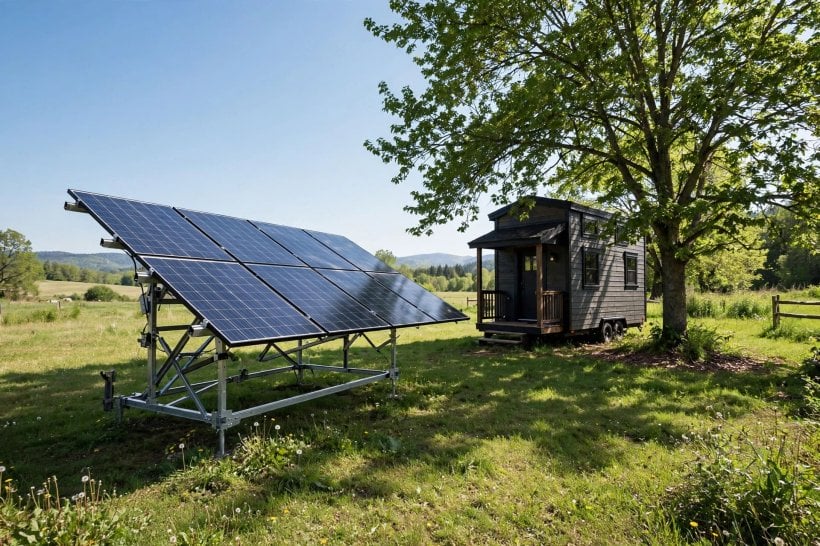
Mounting is where the measured system meets the physical tiny. The roof mount comes first: the tilted — the south-facing, the optimal. The tiny roof is the limited — the measured: it holds the 4–10 panels of a tiny system and not one more, which is why sizing counted roof space alongside watts. The truth: the roof is the first — the mounted. Our solar-ready tiny house layouts guide works those angles. When the roof fails — shaded, small or wrong-facing — the ground mount takes over: the angled — the perfect, the adjustable — sited in the sunny corner of a tiny yard. The ground is the option — the shaded-roof.
The guide’s mistakes are the three ways the measurement gets skipped. The undersized — the dark: a system guessed small. The cheap-battery — the dead: a bank bought on price. The shaded — the useless: panels mounted where the sun isn’t. The rule redeems all three: the sun forgives — the planned. Each is a planning error, priced in the sections above.
Then comes the first sunny day: the flipped — the breaker, the humming; the meter — the spinning-back, the grinned. The truth: the first day is the magic — the solar. Monitoring keeps it magic: the apped — the production, the watched; the optimized — the usage, the shifted. Maintenance is the small rent the decades charge: the cleaned — the twice-yearly, the hosed; the checked — the connections, the annual. How do you clean them? The hosed, the soft-brushed, the twice-yearly — the cleaned is the producing: the dust-free, the max. Our solar panel maintenance guide holds the routine. The maintained is the lasting — the decades.
Winter is the honest season: the shorter — the days, the less; the angled — the low-sun, the planned. The truth: the winter is the test — the sized. The cloudy week is the same test, shorter: the gray — the days, the low; the banked — the batteries, the carried. Do panels work on a cloudy day? The reduced — the 25%, the still: production falls to a quarter and keeps working, the bank covering the difference. The cloudy is the planned-for — the sized.
For tinys that keep a connection, the grid-tied option trades the bank for a meter: the net-metered — the credited, the spun-back; the cheaper — the no-battery, the simpler. The truth: the grid-tied is the easy — the connected; our tiny house utilities guide covers the connection. Behind both stands the generator backup: the small — the inverter-gen, the standby; the rare — the used, the insurance; the backup is the peace — the off-grid, with off-grid power stations at its portable end. Can a tiny house run fully on solar? Yes — the sized, the stored, the sunny. The run is the designed: the batteries for the night, the conservation for the gray week.
The payoff is the daily fact the math promised: the powered — the daily, the tiny; the saved — the monthly, the decades; the free — the after-payback, the years. The truth: the payoff is the sun — the owned. The guide closes as the powered life feels: the solar story, told in years; the last word; the sun blessing; the always solar and the solar grace; the final panel and the last ray; the powered tiny, humming at dusk; the solar eternal; the dawn charge and the dusk bank; and over it all the tiny sun — the small, the loved, the always.
Final Considerations
The guide’s own verdict is the right place to end: solar panels for a tiny house in 2026 are the power made affordable — the sized, the stored, the sunny. Price it well, install it right, live powered. Knowing how much solar panels cost for a tiny house was never about the panels; it is about the measured system — the usage counted, the bank planned, the credit claimed, the mount faced south — and a total you priced piece by piece is a total you can trust. Note, in the guide’s own caution: prices and incentives change — verify all current information directly. This is not financial advice.



2 Comments