
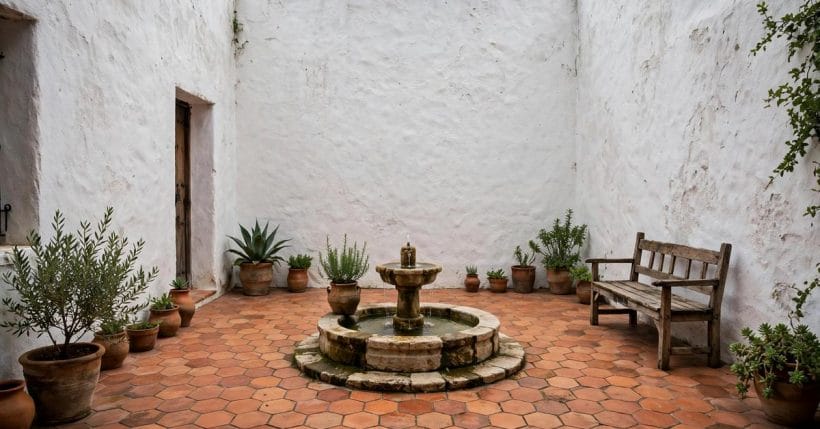
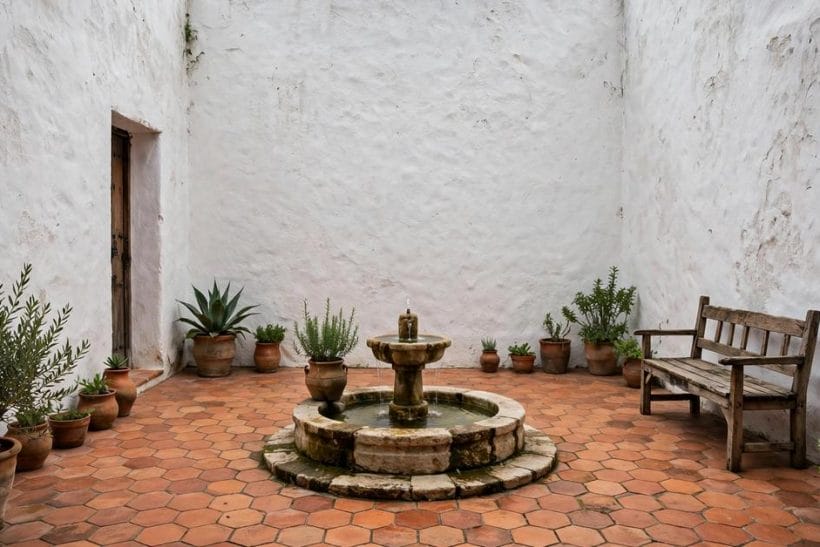
A Mexican courtyard is an outdoor room made from walls, sky and shade, and the simplest versions are often the most inviting. If you are looking for pictures of simple Mexican courtyards, the pattern is easy to recognise once you know it: pale plaster walls enclose a modest open space, warm terracotta underfoot grounds the whole scene, and one or two strong details, a fountain, a tiled border or a bright pot, carry all the colour. Nothing in the space shouts, and that restraint is what makes it feel calm. This guide stays with that simple courtyard alone, its layout, its colours and its practical details, in general terms. For courtyards in general, beyond the Mexican style, see the courtyard ideas gallery, which surveys the form more widely; here, the Mexican courtyard is the subject, and simplicity is the thread that runs through every section.
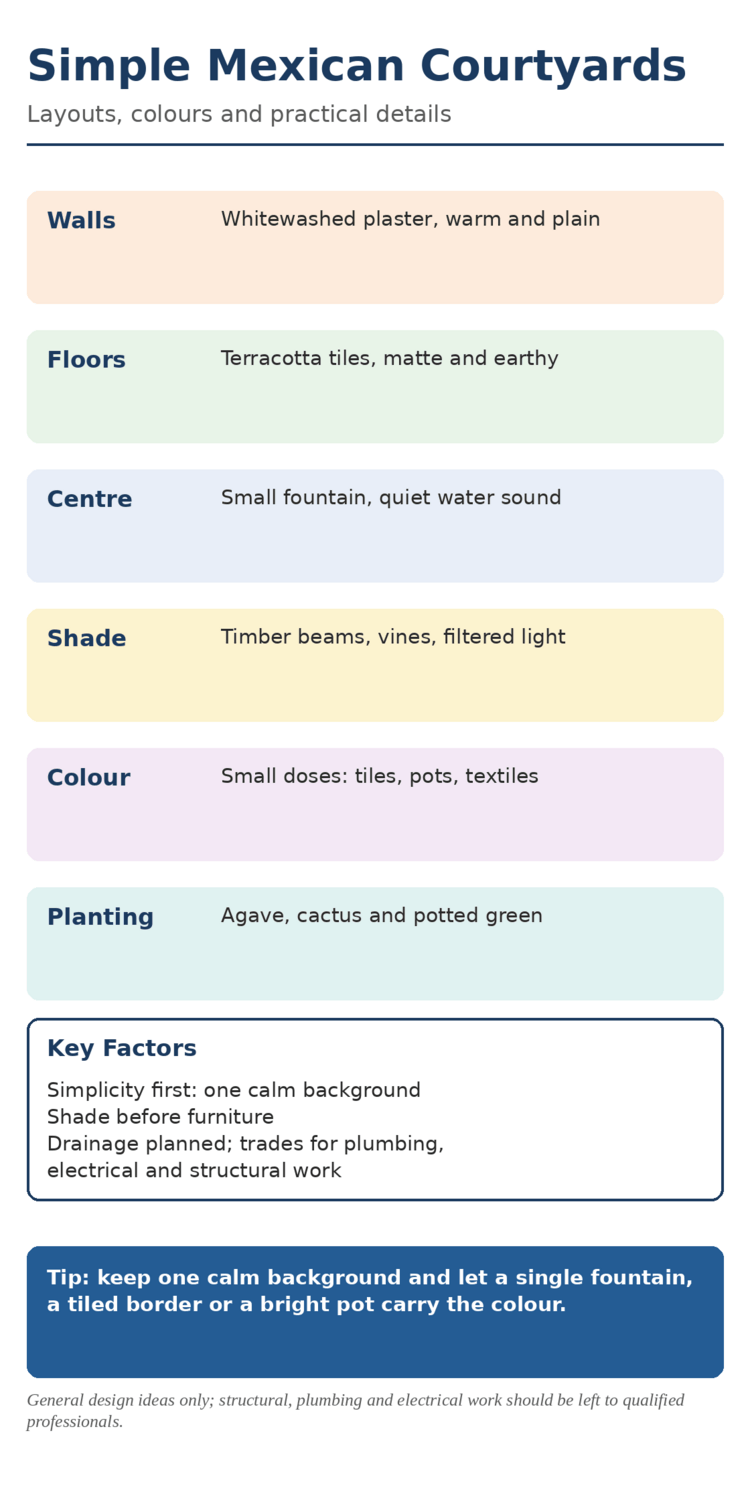
| Item | What it is |
|---|---|
| The Simple Courtyard Shape: Four Walls and Open Sky | The shape comes first, and in a simple Mexican courtyard it is almost always a plain enclosure open to the sky. |
| Whitewashed Walls and Warm Plaster Tones | Whitewashed plaster is the backdrop of the simple Mexican courtyard, and its appeal lies in what it does not do. |
| Terracotta Floors Underfoot | Terracotta is the floor of the simple Mexican courtyard in most photographs, and for good reason. |
| A Small Fountain as the Quiet Centre | A small fountain is the classic centre of a Mexican courtyard, and its job is sound as much as sight. |
| Shade from Timber Beams and Climbing Plants | Shade is what makes a Mexican courtyard livable through the heat of the day, and timber beams are its most characteristic form. |
| Colour in Small Doses: Tiles, Pots and Textiles | Colour in a simple Mexican courtyard arrives in small doses, and that restraint is the whole trick. |
| Furniture That Keeps the Courtyard Easy to Live In | Furniture in a simple Mexican courtyard should be sturdy, sparse and easy to move. |
| Plants That Suit a Dry, Sunny Courtyard | Planting in a Mexican courtyard leans towards plants that enjoy sun and tolerate dry spells, and that preference shapes the whole look. |
| Evening Light: Lanterns and Warm Glow | Evening is when a Mexican courtyard earns its keep, and lantern light is the classic way to light it. |
| Keeping a Simple Courtyard Simple | The hardest part of a simple Mexican courtyard is keeping it simple over time. |
1. The Simple Courtyard Shape: Four Walls and Open Sky
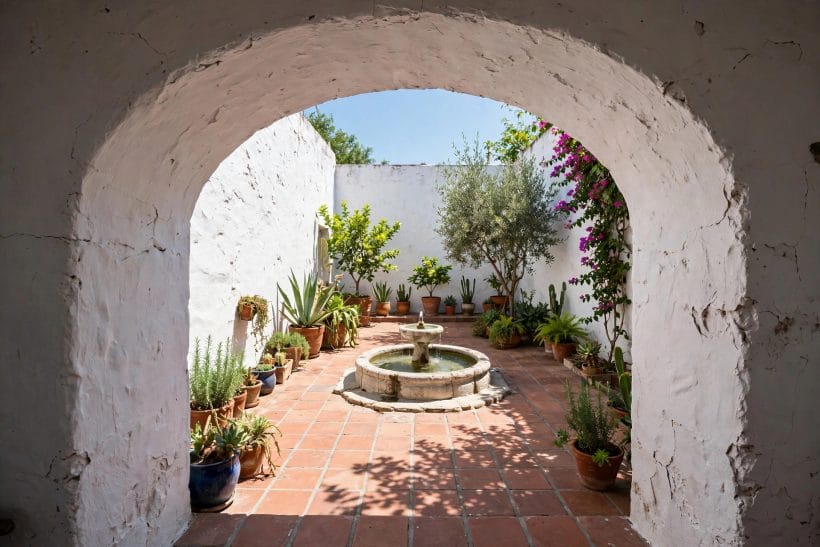
The shape comes first, and in a simple Mexican courtyard it is almost always a plain enclosure open to the sky. Walls on every side give privacy and shelter from wind, while the open centre lets daylight fall straight onto the floor and lets warm air rise away. That combination, enclosure plus sky, is what separates a courtyard from a patio: a patio sits beside a house, while a courtyard is a room of the house that happens to have no roof. Even a small enclosure works, because the walls make the space feel complete rather than leftover.
Within that shape, the layout usually follows a quiet order. A central open area holds the eye, paths or planting run along the edges, and seating gathers where shade falls for longest. Keeping the centre clear matters more than filling it: an empty stretch of terracotta floor reads as generous, while a centre crowded with furniture and ornaments quickly loses the calm the walls were built to create. Walk the space in your mind from each doorway that opens onto it, and let the views from those doorways decide where the focal point should sit.
Doorways and arches shape how the courtyard is used as much as the walls do. A wide opening from a living room turns the courtyard into an extension of that room, while a narrow arched doorway makes arrival feel more like stepping into a secret garden. Either way, the threshold deserves attention: a step, a change of floor pattern or a pair of pots can mark the passage from indoors to outdoors without any need for decoration. The tiny house exterior ideas gallery shows how openings and walls work together on a smaller scale, and the same lesson applies here.
2. Whitewashed Walls and Warm Plaster Tones
Whitewashed plaster is the backdrop of the simple Mexican courtyard, and its appeal lies in what it does not do. It does not compete with plants, tiles or sky, it bounces daylight deep into shaded corners, and it gives the whole enclosure a clean, cool feeling even in strong sun. The surface itself is rarely perfectly smooth: hand-plastered walls carry gentle undulations, soft shadows and small variations in tone that keep a plain white wall from feeling flat or clinical. Those imperfections are part of the character, not faults to be hidden.
Warm plaster tones offer a second, equally honest option. Ochre, sand and pale terracotta washes keep the same calm background but add warmth, and they pair naturally with terracotta floors and dark timber. The choice between white and warm plaster is really a choice about light: white walls suit courtyards that need every bit of brightness they can get, while warm washes suit sun-drenched spaces where a little softening of the glare is welcome. Either way, one wash across all the walls reads as calmer than a different colour on each wall.
Upkeep is part of the honest picture. Limewash and plaster weather outdoors, and a wall that looks fresh in a photograph will need attention over time, especially near the ground where splashing and damp leave their mark. A slightly darker base course or a tiled skirting can protect the lowest stretch of wall, and repairs are best left to people who understand plaster and masonry. For the wider story of Mexican style in the home, the modern Mexican homes guide looks at how these same plaster walls work across whole houses, while this guide keeps its attention on the courtyard alone.
3. Terracotta Floors Underfoot
Terracotta is the floor of the simple Mexican courtyard in most photographs, and for good reason. Its warm, earthy tone ties the walls, the pots and the planting together, and its matte surface stays comfortable underfoot in sun in a way that glossy finishes do not. The tiles themselves vary: some are large and square, some are hexagonal, some carry a hand-made unevenness that makes the whole floor feel crafted rather than manufactured. That variation is worth looking for, because a floor of identical machine-perfect tiles can feel colder than the courtyard around it.
Pattern comes from the laying, not from decoration added afterwards. A simple border of patterned tiles along an edge, a change of direction in the middle of the floor, or a medallion of tiles around a fountain can all give the floor structure without breaking its calm. The safest approach is to keep one pattern and repeat it: a border that runs the whole courtyard feels intentional, while several different patterns competing in one small space feel restless. Let the border be the jewellery and the main field stay plain.
Practical details matter underfoot. Terracotta is porous, so sealing and cleaning need thought, and the floor must drain so that rain does not sit against the walls. Falls towards a drain, a slightly raised threshold at each doorway, and a floor that can be hosed down all belong in the planning, and drainage and groundwork are jobs for qualified tradespeople. A floor that looks simple in a photograph usually hides careful groundwork beneath it, and that groundwork is what keeps the courtyard usable after heavy rain.
4. A Small Fountain as the Quiet Centre
A small fountain is the classic centre of a Mexican courtyard, and its job is sound as much as sight. The gentle movement of water softens the enclosure, masks distant noise, and gives the eye a natural resting place in the middle of the open floor. Simple fountains work best here: a stone basin, a wall spout or a single tier, rather than anything tall or elaborate. The fountain should feel like part of the courtyard’s architecture, built from the same stone or plaster family as the walls, not like an ornament dropped into the middle of it.
Placement decides whether a fountain calms the space or crowds it. A fountain against a wall leaves the centre of the floor free and turns the wall into a backdrop, which suits smaller courtyards particularly well. A freestanding fountain in the centre needs room around it on every side, so that people can walk past without squeezing, and so that the basin reads as a centrepiece rather than an obstacle. Whichever placement you choose, keep the approach clear and let the sound carry across the whole enclosure.
Water also brings practical demands that should not be glossed over. A fountain needs a supply, a drain and a pump, and all three belong to qualified plumbing and electrical tradespeople, not to improvisation. Standing water needs cleaning, and in cooler months the system needs care against frost and stagnation. A courtyard without a fountain is still a complete courtyard, and a simple basin of still water or even an empty stone well-head can give the same focal point with far less upkeep, so the fountain should be chosen, not assumed.
5. Shade from Timber Beams and Climbing Plants
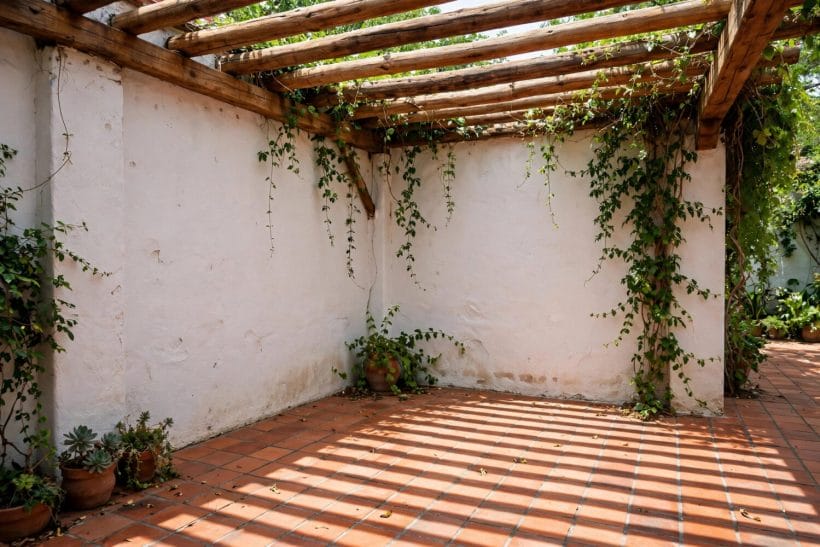
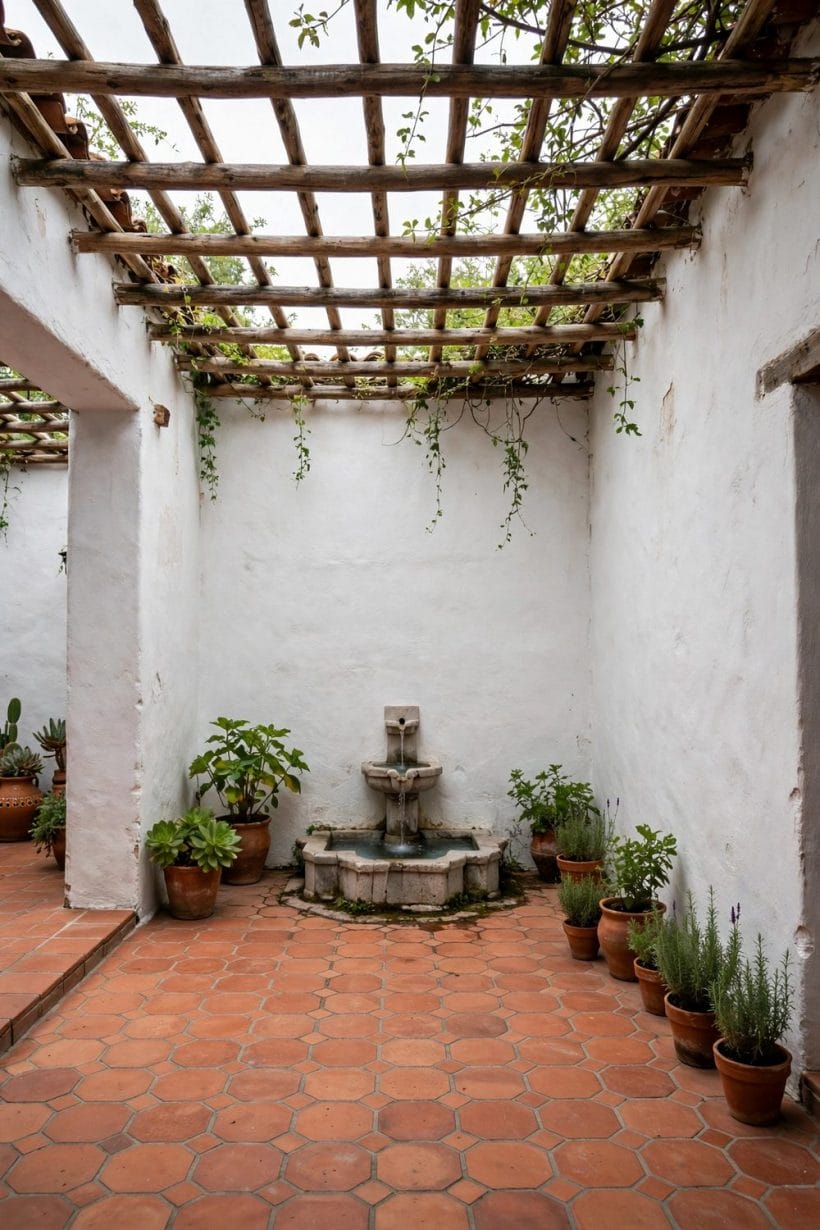
Shade is what makes a Mexican courtyard livable through the heat of the day, and timber beams are its most characteristic form. A pergola of dark timber beams across one side of the courtyard filters the sun into stripes of light and shadow, and the stripes themselves become part of the decoration, moving across the terracotta floor as the day passes. The beams also give climbing plants something to hold onto, and within a season or two the combination of timber and vine can turn a bare corner into the coolest seat in the house.
Climbing plants do work that no built structure can do alone. Vines soften hard wall edges, cool the air around them as they transpire, and bring green into the upper part of the enclosure where pots cannot reach. The choice of climber matters: a vigorous vine will need regular cutting back from gutters and roofs, while a lighter climber stays polite but takes longer to give real shade. Either way, the support must be sound, because a mature vine is heavy, and fixing beams and supports is structural work best left to professionals.
Shade should be planned where people actually sit, not spread thinly across the whole courtyard. A deep band of shade along one wall, covering the bench and the table, is worth more than a scattering of shade everywhere and nowhere. Notice how the sun moves across your own courtyard through the day, and place the shaded seat where the afternoon sun is kindest. A courtyard that is sunny in the morning and shaded in the afternoon suits most daily rhythms better than one that is shaded when nobody is there to enjoy it.
6. Colour in Small Doses: Tiles, Pots and Textiles
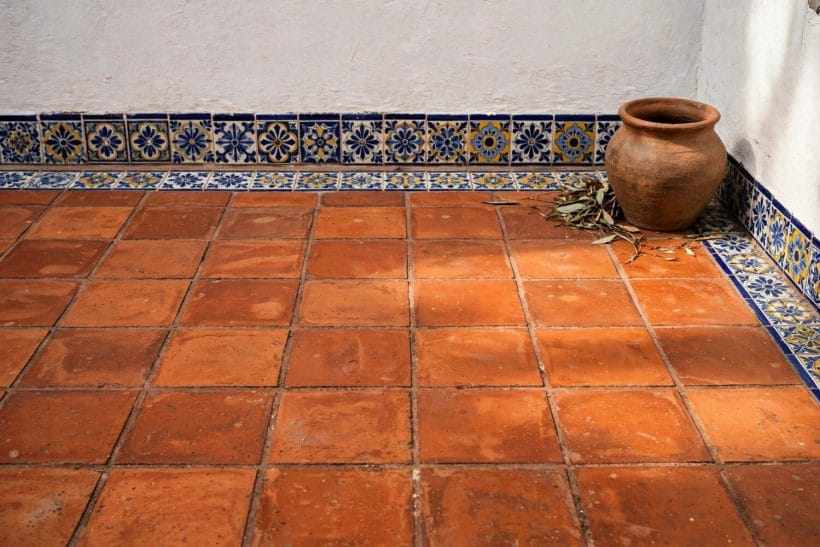
Colour in a simple Mexican courtyard arrives in small doses, and that restraint is the whole trick. A border of patterned tiles in blue and white, a row of glazed pots, or a woven textile in a strong warm tone can each carry the colour for the entire space, but only if the rest of the courtyard stays calm. The moment every surface competes, the simplicity is lost. Choose one or two colour moments, repeat them, and let the whitewashed walls and terracotta floor do the quiet work around them.
Patterned tiles are the most permanent colour decision, so they deserve the most thought. A tiled border along a step, around a fountain or at the base of a wall gives a lasting flash of pattern that can be enjoyed every day without any upkeep beyond cleaning. Because tiles are hard to change, keep the pattern to edges and accents rather than whole walls: a courtyard tiled from floor to ceiling in pattern can feel busy, while the same pattern used as a border feels considered. Photographs reward this restraint, and so does everyday living.
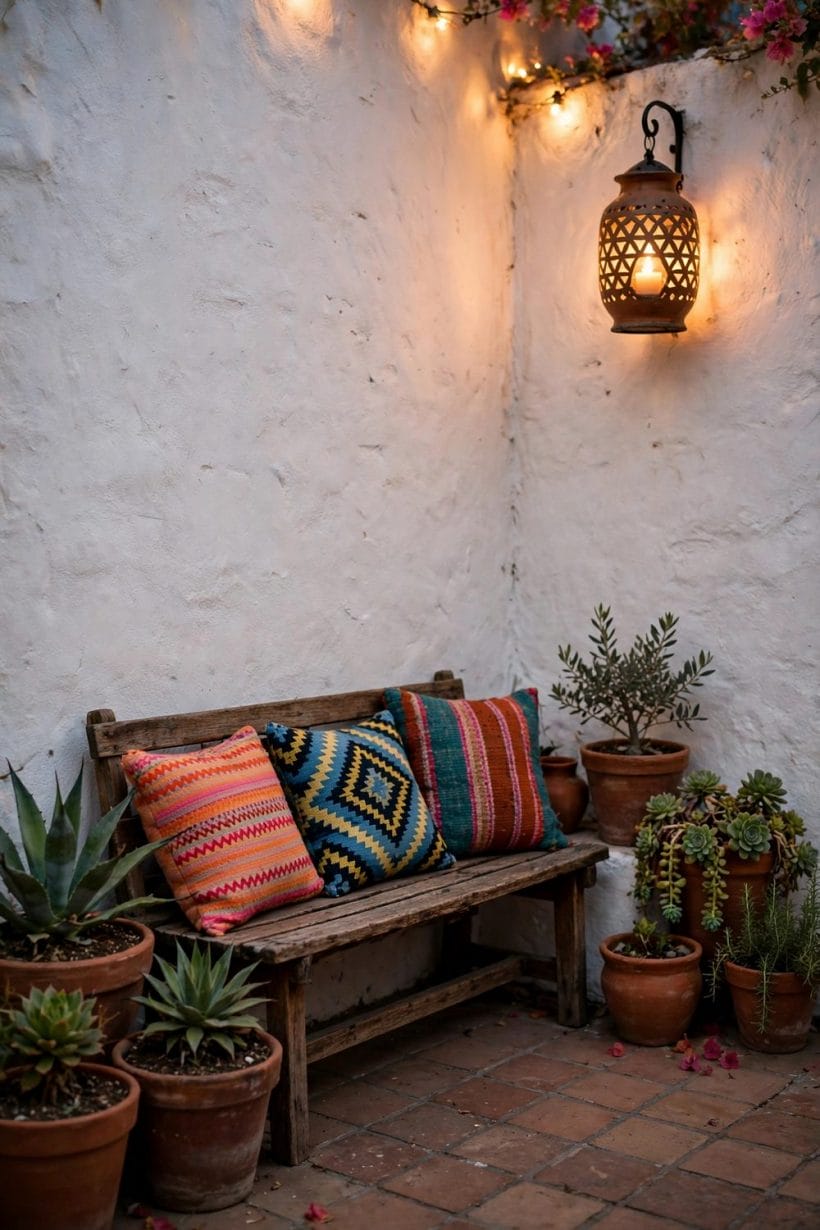
Pots and textiles are the forgiving colour decisions, because they can be moved, swapped and changed with the seasons. A bright pot can be tried beside a doorway and moved the next day if it jars, and cushions in warm woven patterns can be stored when the weather turns. That flexibility makes pots and textiles the right place to experiment: try the bold colour in a pot first, live with it for a while, and only then consider anything more permanent. The backyard landscaping ideas gallery shows the same principle at work in wider gardens, where moveable colour keeps a planting scheme adaptable.
7. Furniture That Keeps the Courtyard Easy to Live In
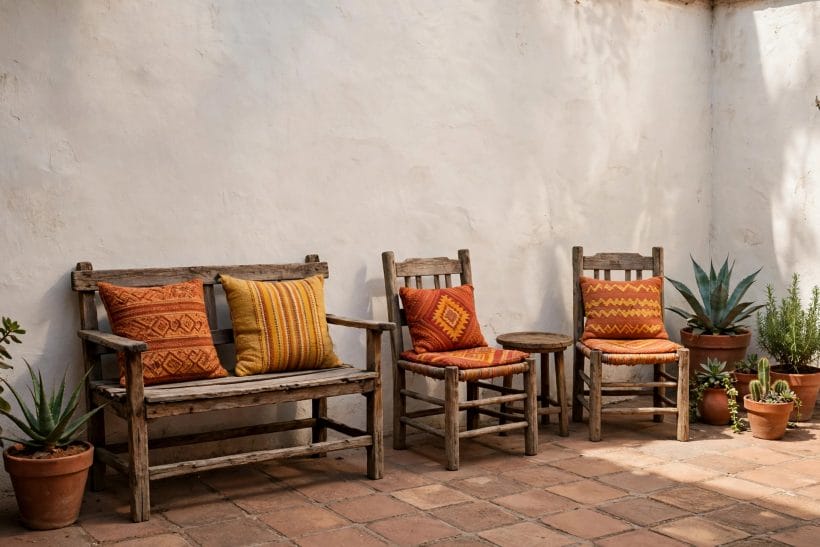
Furniture in a simple Mexican courtyard should be sturdy, sparse and easy to move. A wooden bench, a pair of chairs and a small table are often all the space needs, and timber suits the setting because it ages gracefully outdoors and echoes the beams overhead. Iron furniture has its place too, especially in a lighter, more open form, but heavy ornate pieces can fight the simplicity of the walls. Whatever the material, the furniture should be able to stay out in the weather or be moved under cover without a struggle.
Arrangement matters more than quantity. Seating gathered in the shaded band along one wall, facing the fountain or the open sky, invites lingering, while chairs scattered around the whole enclosure can make the courtyard feel like a furniture display. Leave clear paths from every doorway to the seating and around the fountain, and keep at least one stretch of floor completely empty, so the courtyard never feels like a room that has been filled up. An empty corner is not wasted space in a courtyard; it is breathing room.
Comfort comes from textiles rather than from more furniture. A woven cushion, a light throw for cool evenings and a simple rug under the seating group can make a hard bench feel welcoming, and all three can be brought indoors when rain threatens. Choose textiles in warm, earthy tones with one stronger accent, echoing the tiled border or the pots, so that the seating group reads as part of the courtyard rather than as an import from indoors. The tiny house porch ideas gallery shows how a small seating group can anchor an outdoor space without overwhelming it.
8. Plants That Suit a Dry, Sunny Courtyard
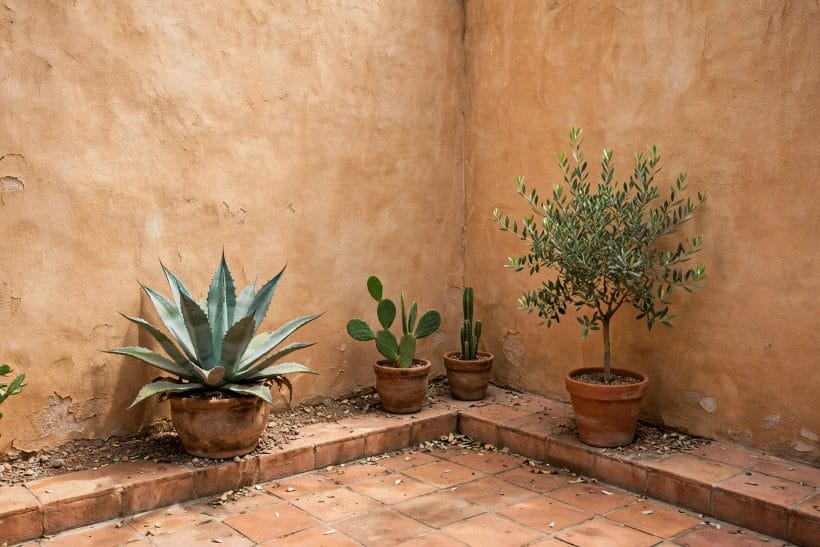
Planting in a Mexican courtyard leans towards plants that enjoy sun and tolerate dry spells, and that preference shapes the whole look. Agave, cactus and other succulents give bold sculptural shapes with very little water, and their blue-green tones sit beautifully against warm plaster and terracotta. A single large agave in a clay pot can anchor a corner on its own, while a group of smaller succulents along a wall gives texture without demanding constant attention. These plants ask for sun, drainage and restraint with the watering can, and they repay that with year-round structure.
Potted plants deserve a special mention, because pots are the main planting method in a courtyard whose floor is tiled. Pots let you control soil and drainage for each plant, move tender plants under cover, and rearrange the whole scheme without digging. Terracotta pots are the natural choice, echoing the floor, and a mix of pot sizes, a few large anchors with smaller pots grouped around them, reads as more natural than a row of identical pots. Group pots in odd clusters near walls and doorways, and leave the centre of the floor clear.
Green climbers and small trees round out the planting, but they need honest expectations. A small tree in a large pot gives height and dappled shade, yet it will need watering, feeding and eventual repotting, and a climber needs a sound support and regular cutting back. Gardening in a courtyard is a pleasure precisely because the space is small enough to tend by hand, but no plant should be promised success: sun, wind and watering all vary, and a plant that thrives in one walled courtyard may struggle in another. Start with a few proven sun-lovers, learn the courtyard’s own microclimate, and add more only as confidence grows.
9. Evening Light: Lanterns and Warm Glow
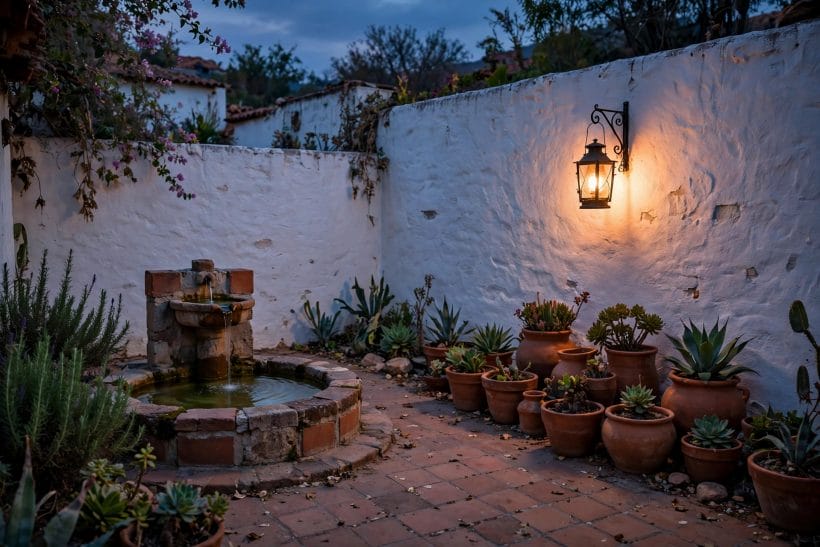
Evening is when a Mexican courtyard earns its keep, and lantern light is the classic way to light it. A lantern hung beside a doorway, set on a wall bracket or placed on the ground near seating gives a warm, flickering pool of light that flatters plaster walls and terracotta alike. Unlike bright overhead lighting, lantern light keeps the enclosure feeling intimate: it lights the people and the table, and lets the far corners fall gently into shadow. That contrast, lit centre and dim edges, is what makes a courtyard feel like an evening room rather than a yard with lights on.
Placement should follow use. Light the seating group, the path from the doorway, and the fountain if there is one, and leave the rest to darkness. A lantern at each end of a bench, one beside the door and one near the water, is usually enough for a modest courtyard, and more lights quickly spoil the mood. Candle lanterns need care and a stable, sheltered spot away from textiles and climbing plants, while wired wall lights and festoon lighting are electrical work for qualified tradespeople. Safety and simplicity point the same way here: fewer lights, well placed, beat a courtyard strung with glare.
Warmth of light matters as much as brightness. A warm glow suits plaster, timber and terracotta, while a cold white light can make the same surfaces feel stark and unwelcoming. When choosing any fixed lighting, look at it in the evening against the actual walls before committing, because a light that looks fine in a shop can feel harsh in a small whitewashed enclosure. The tiny house designs gallery shows how warm light transforms small spaces generally, and the lesson carries straight into the courtyard at dusk.
10. Keeping a Simple Courtyard Simple
The hardest part of a simple Mexican courtyard is keeping it simple over time. Courtyards invite additions: another pot, another ornament, another chair, each harmless on its own, until one day the calm that made the space special has quietly disappeared. A useful habit is the seasonal edit: once or twice a year, stand in the courtyard and ask what could be removed without loss. Anything that has not earned its place, anything duplicated, anything that no longer suits the walls, can go, and the space will usually feel larger and calmer for the removal.
Care routines are simple when the design is simple. Sweep the terracotta, wipe the fountain, cut back the climber, and check the drainage after heavy rain, and the courtyard largely looks after itself. The jobs that need professionals are the ones hidden from view: groundwork and drainage, plumbing for a fountain, electrical work for fixed lighting, and any structural change to walls or beams. Treating those jobs as professional work is not fussiness; it is what keeps a beautiful courtyard safe and standing, and it protects the plaster and tilework that give the space its character.
Simplicity also means accepting the courtyard as it is, in its own climate and season. A courtyard photographed in high summer will look different in winter, when climbers thin out and pots are moved under cover, and that change is part of the charm rather than a failure. The contemporary home design ideas gallery shows how calm, uncluttered outdoor spaces hold their appeal across seasons, and a simple Mexican courtyard does the same: whitewashed walls, terracotta floors, shade, water and green, repeated without fuss, season after season.
Final Considerations
If you came here looking for pictures of simple Mexican courtyards, the takeaway is reassuring: the style asks for less, not more. Four walls and open sky, whitewashed or warm plaster, a terracotta floor, one fountain or tiled border for colour, shade where people sit, and plants that enjoy sun and dry spells. Hold to that short list, and the courtyard will feel coherent even before any decoration is added. Additions should have to earn their place, one at a time, against the calm background the walls provide.
Before building or remodelling, spend time in the space itself. Notice where the sun falls morning and afternoon, where rain runs after a storm, which doorway you use most, and where you naturally pause. Those observations will tell you where the shade, the seating and the focal point belong far better than any photograph can. Photographs are for inspiration; the courtyard itself is the brief. And where the work touches structure, plumbing, drainage or electrics, bring in qualified tradespeople early, so that the simple surface you see rests on sound work underneath.
A simple Mexican courtyard is, in the end, a room for slow hours: morning coffee in striped pergola shade, an evening under lantern light, the sound of water in a small fountain, green leaves against whitewash. Keep the walls calm, the floor warm, the colour in small doses, and the centre clear, and the courtyard will repay that restraint every day. It does not need to impress; it needs to invite, and simplicity, honestly kept, is what does the inviting.

0 Comments