
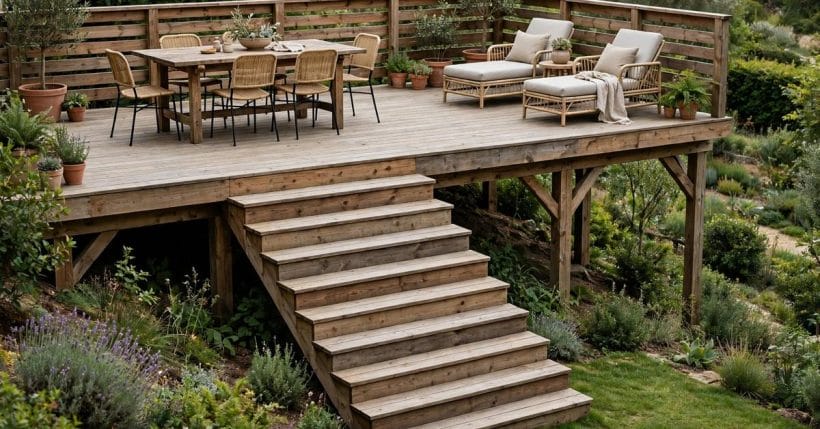
A raised deck is a deck that stands above the ground it looks over, lifted on supports so that its surface sits higher than the garden, the lawn or the slope below. That lift is the whole idea. It turns a patch of outdoor floor into a platform with a view, a place where dining, lounging and quiet sitting happen above the damp, the mud and the uneven ground, reached by steps and edged by a railing. For anyone gathering raised deck ideas, the questions are always the same ones: how the deck is laid out, what it is made of, how its edges are guarded, how it is reached, and how it is furnished so that it feels like a room rather than a bare platform.
This collection stays with the raised form alone. A deck at ground level sits on the ground itself and answers a different set of questions, while a raised deck answers questions about height, steps, railings and the space underneath. The wider deck family is covered by the deck in general, and the house it belongs to is part of the exterior as a whole, but this collection owns the raised deck itself: its layouts, its materials, its railings and its outdoor furniture. Structural work, supports, railings, drainage and weatherproofing belong throughout with qualified professionals, never as a do-it-yourself project, and every structural idea below is framed that way. Local rules should be checked before any change.
| Item | What it is |
|---|---|
| Layouts That Suit a Raised Deck | The layout of a raised deck starts with the house it leaves and the garden it overlooks. |
| Planning the Deck as One Outdoor Room | A raised deck works best when it is planned as one outdoor room, not as three separate add-ons. |
| Materials for Boards and Framing | The boards underfoot set the tone of a raised deck more than any other single choice. |
| Railings and Balustrades | The railing is the most visible part of a raised deck, and the part that most decides whether the deck feels open or enclosed. |
| Steps, Access and the Ground Below | Steps are the welcome of a raised deck, and they deserve as much design attention as the deck itself. |
| Outdoor Furniture for a Raised Deck | Furniture turns a raised deck from a platform into a place to live. |
| Planting and Privacy Around a Raised Deck | Planting is what stops a raised deck from looking like a platform on stilts. |
| Shade, Lighting and Evening Use | A raised deck in full sun can be too bright and too hot at midday, while a deck with no light at all is abandoned at dusk, so shade and lighting decide how many hours a day the deck is actually used. |
| Choosing Your Raised Deck Layout | Choosing a raised deck layout begins with three honest questions, and the answers will narrow the field far faster than browsing pictures alone. |
1. The Raised Deck at a Glance
A raised deck is recognised first by its lift. You step out of the house and onto a surface that is above the garden, with air beneath it and a view over planting, lawn or a slope that a ground-level surface could never offer. That lift gives the deck its character: it feels like a balcony and a terrace at once, open to the sky, edged by a railing, and generous enough to hold a table, chairs and a quiet corner for reading. The best raised decks use the lift rather than apologising for it, turning height into outlook and the space below into planting, shade or simply breathing room for the garden.
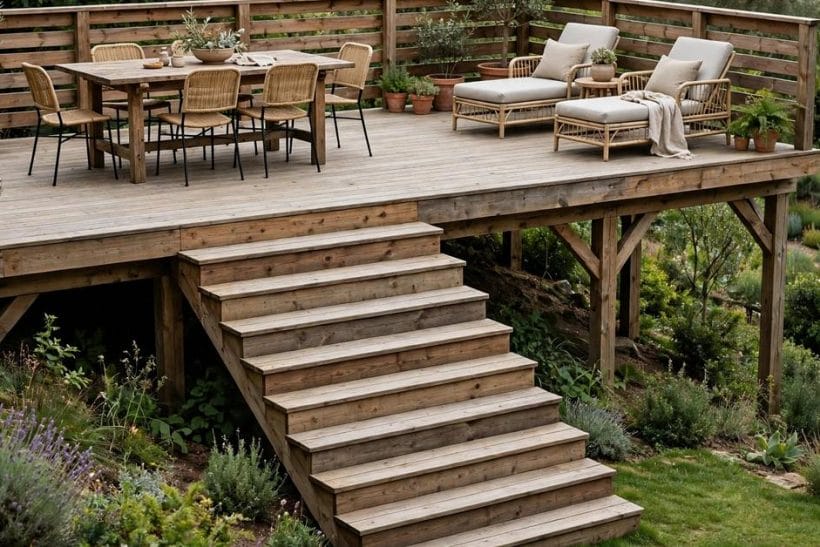
The lift also brings responsibilities that a ground-level deck does not. Supports must be sound, railings must be secure, steps must be comfortable and safe, and water must be able to drain away rather than collect against the house or the structure. All of that is professional work, planned with a qualified builder and checked against local rules, not improvised on a weekend. Once that professional frame is in place, the pleasures of the form can be enjoyed with confidence: breakfast above the garden, evening meals with a view, and a platform that makes a sloping or uneven plot feel generous rather than awkward.
Think of the raised deck as an outdoor room with one open side. It has a floor, an edge, an approach and a ceiling of sky, and it works best when those four things are planned together. A deck planned as a room, rather than as a slab of boards, will hold furniture well, feel safe at its edges and invite use in every season the weather allows.
2. Layouts That Suit a Raised Deck
The layout of a raised deck starts with the house it leaves and the garden it overlooks. A deck that runs straight out from a living room door gives a simple, generous rectangle for dining and lounging, with the table near the house and the loungers towards the view. A deck that wraps around a corner of the house gives two outlooks and two moods, a sunny side for morning coffee and a sheltered side for evening sitting, and it can make a modest house feel much larger outside than it does inside. A deck that steps in levels, with one area for dining and a lower or higher area for lounging, suits a sloping garden, because the levels can follow the fall of the ground instead of fighting it.
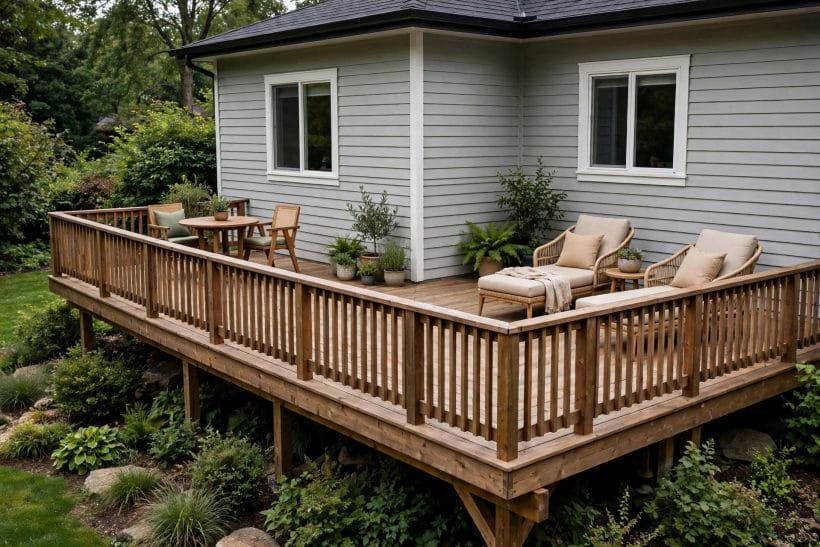
Layout is also about movement. A raised deck needs a clear path from the house door to the steps, a clear place for the table that does not block the way to the railing, and a quiet corner that is not a corridor. The neighbouring patio faces the same movement question at ground level, and the lesson carries upwards: leave the main walking line open, and the deck will feel calm even when it is full. Furniture placed against the flow of movement makes a deck feel cramped even when it is generous, while furniture placed to leave the main path open makes the same deck feel calm. Plan the walking lines first, then place the table, then the loungers, and leave the best view for sitting rather than for passing through.
The shape of the deck should also respect the garden below. A deck that is too deep can shade the planting beneath it and darken the rooms behind it, while a deck that is too narrow leaves no room for a table and chairs to sit comfortably. The balance is a matter of judgement, helped by standing on the ground where the deck will stand and looking back at the house, rather than by drawing lines on paper alone. A qualified professional can help test the shape against the house, the light and the slope before anything is built.
3. Planning the Deck as One Outdoor Room
A raised deck works best when it is planned as one outdoor room, not as three separate add-ons. The railing, the steps and the furniture all belong to the same composition, and when they are chosen together the deck reads as a single, settled place. A railing that matches the boards, steps that land where the garden path begins, and furniture that suits the scale of the platform will make a modest deck feel considered, while a deck assembled piece by piece, with each element chosen in isolation, can feel restless even when every piece is handsome on its own.
Start the planning with use, not with materials. Ask how the deck will be used on an ordinary day: meals outside, reading in the shade, children playing within sight, evenings with friends. Each use asks for something different, a table near the kitchen door, a shaded chair away from the glare, a clear stretch of floor, a corner for lamps. When the uses are clear, the layout, the railing style and the furniture follow naturally, and the deck is less likely to end up with a beautiful dining set that nobody uses because it sits in the wind, or a lounger that faces a fence instead of the garden.
Planning as one room also means planning the edges. The railing is not an afterthought but the frame of the view, the steps are not a leftover but the welcome to the garden, and the space beneath the deck is not waste ground but part of the garden, planted or left open with care. A deck whose edges are planned with the same attention as its centre will feel finished from the garden as well as from the house, and that matters, because a raised deck is seen from below as much as it is used from above.
4. Materials for Boards and Framing
The boards underfoot set the tone of a raised deck more than any other single choice. Natural timber boards bring warmth, grain and a colour that softens with the seasons, and they suit houses with timber, brick or painted details. Low-maintenance boards, made to resist weather and fading with less regular care, suit households that want the look of a deck without the rhythm of oiling and sealing, and they come in a range of tones from pale and sandy to deep and warm. The choice is less about which material is best in the abstract and more about which one suits the house, the climate, the amount of care the household is willing to give, and the look the garden already has.
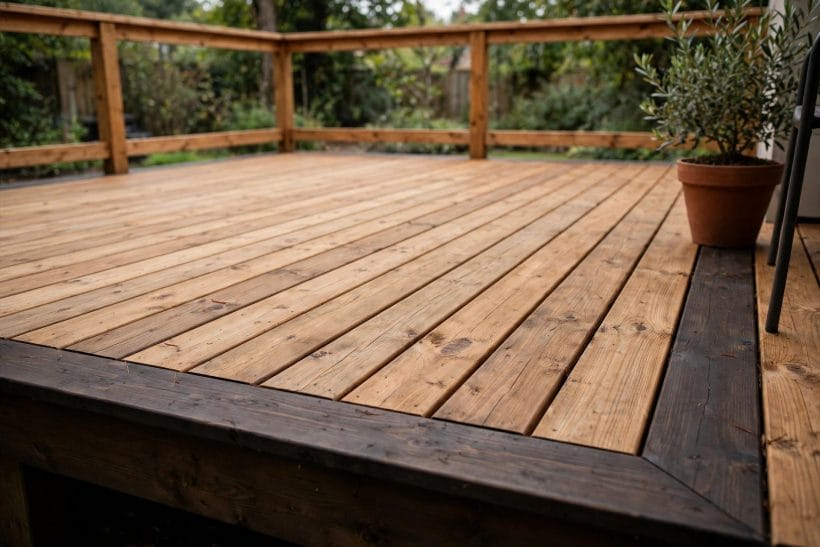
Framing and supports are the quiet part of the material story, and they belong entirely with qualified professionals. The frame carries the deck, the supports carry the frame, and the way they meet the house and the ground decides whether the deck stays level, drains well and lasts. A householder does not need to choose the engineering, but does need to insist that it is done properly, with sound materials, proper drainage and a finish that protects the structure from weather. Ask a professional how the deck will shed water, how its underside will be ventilated, and how its boards will be fixed, and treat vague answers as a reason to look elsewhere.
Colour and finish deserve the same care as the boards themselves. A pale deck can brighten a shaded garden and keep the surface cooler underfoot in strong sun, while a deep-toned deck can anchor a light-coloured house and make planting stand out against it. A border board in a contrasting tone can frame the deck like a rug frames a room, and it can also mark the edge of the steps, which helps everyone, especially in low light. Whatever the tone, it should be chosen in daylight, beside the house wall and beside the planting, because a board that looks warm in a showroom can look cold beside grey stone or warm brick.
5. Railings and Balustrades
The railing is the most visible part of a raised deck, and the part that most decides whether the deck feels open or enclosed. An open railing, with slim balusters or clear panels, keeps the view and lets the garden in, and it suits decks built for outlook, over a valley, a lawn or a distant view. A solid balustrade, with boards or panels that block the sightline, gives privacy and shelter from wind, and it suits decks overlooked by neighbours or exposed to a prevailing breeze. Between those two poles lies a whole range of choices: timber rails with metal balusters, metal frames with timber handrails, and mixed designs that are open at sitting height and solid where privacy matters most.
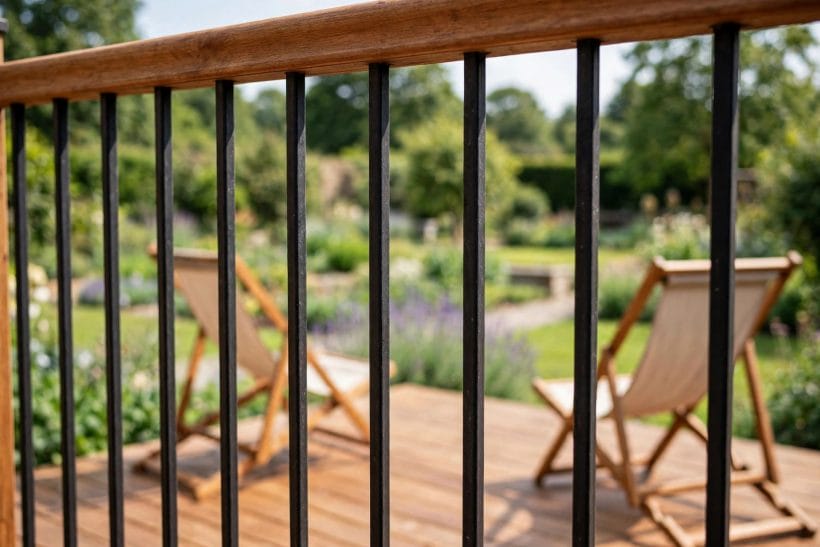
Railings are safety work as well as styling, and they must be treated that way. A railing on a raised deck guards a drop, and its strength, its fixings and its suitability for the height involved are professional decisions, checked against local rules, not matters of taste alone. Never treat a railing as decoration, never improvise a guard where children or guests will lean on it, and always have a qualified professional design and fit the railing for the deck it guards. The same professional framing applies to gates in a railing, to handrails beside steps, and to any part of the edge where someone might sit, lean or climb.
Styling follows safety, and it follows the house. A timber handrail warms a metal railing and is pleasant to hold in cold weather, while a metal handrail suits a crisp, modern house and needs little care. The handrail colour can echo the window frames, the boards or the furniture, and that small echo is often what makes a deck feel part of the house rather than bolted onto it. Keep the railing line clean and uncluttered, and avoid hanging heavy planters or lights from a railing that was not designed to carry them, since a guard loaded beyond its design can fail when it is needed most.
6. Steps, Access and the Ground Below
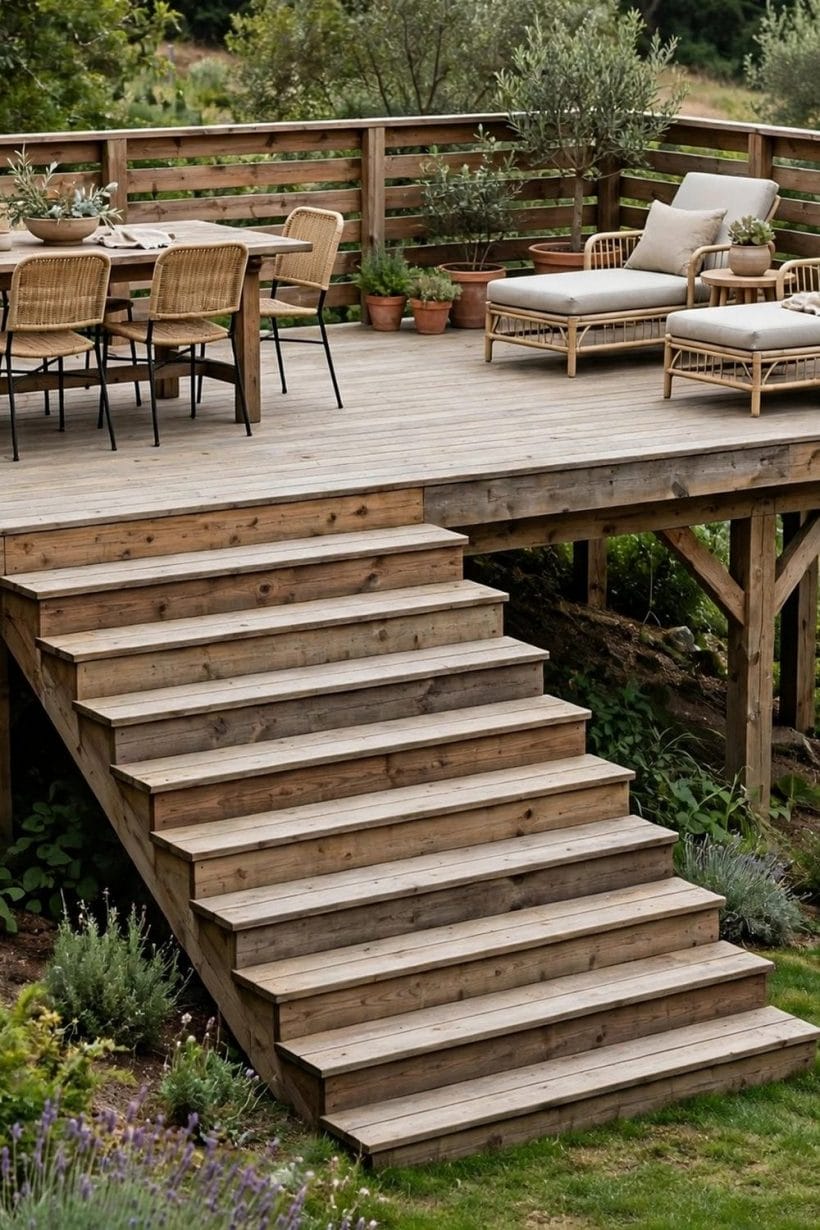
Steps are the welcome of a raised deck, and they deserve as much design attention as the deck itself. Wide steps, generous enough for two people to pass or for a chair to be carried, make the deck feel inviting and make the garden feel close, while narrow, steep steps make even a beautiful deck feel like an effort to reach. Steps that land on a path, a terrace or a level patch of lawn feel natural, while steps that land in mud or on a slope feel unfinished. Planting beside the steps softens the change of level and gives the eye something to follow on the way down, and a handrail beside the steps gives confidence to everyone, especially in wet weather or at dusk.
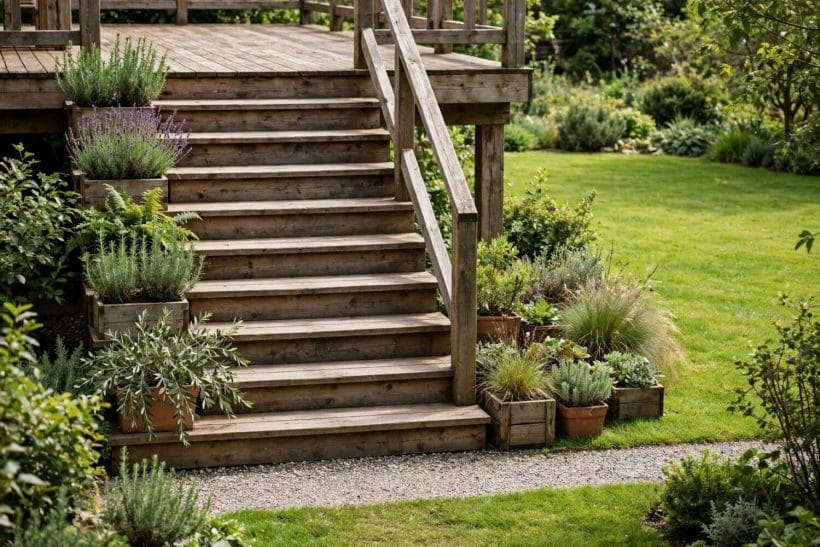
Access is also about who uses the deck. A deck reached only by steps will not suit everyone, and households planning for older relatives, for guests with limited mobility, or for their own later years should talk to a professional about gentler approaches and about how the deck connects to the house and the garden as a whole. The ground below matters too: the space beneath a raised deck can be planted with shade-tolerant shrubs, left as open, ventilated ground, or used for storage that stays dry and does not block drainage or ventilation. Whatever is chosen, it should be planned with the builder, not improvised afterwards, because blocking airflow or drainage beneath a deck can shorten its life.
The link between deck and garden is completed by the path. A path that starts where the steps land and leads to a seating area, a vegetable patch or a gate makes the deck part of a journey through the garden, while steps that land nowhere make the deck feel isolated. The porch offers a useful comparison here: like a porch, a raised deck is a threshold, a place between inside and outside, and it works best when both sides of the threshold are welcoming. Plan the landing, the path and the planting together, and the deck will feel like the start of the garden rather than its end.
7. Outdoor Furniture for a Raised Deck
Furniture turns a raised deck from a platform into a place to live. A dining set, with a table and chairs that suit the number of people who usually eat outside, anchors the deck near the house door, where carrying food is easy and where the table can be used for work, games or homework as well as meals. A lounge set, with a sofa, chairs and a low table, anchors the deck towards the view, where sitting can be lazy and long. A single quiet chair, tucked into a corner with a small table for a book and a drink, gives the deck a use on days when nobody is dining or entertaining, and that everyday use is what keeps a deck from becoming a place used only on special occasions.
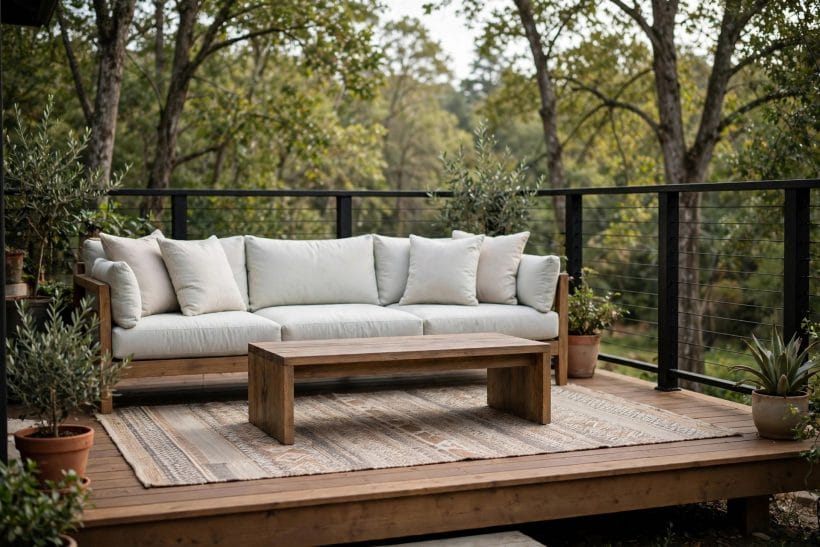
Scale matters more than style when choosing deck furniture. Oversized pieces can swallow a modest deck and leave no room to walk, while tiny pieces can look lost on a generous platform. Measure the deck, mark out the footprint of a table and chairs with tape or with pots on the boards, and walk the route from door to steps with the furniture in place before buying. Furniture for a raised deck should also be able to live outside: frames that resist weather, cushions that can be stored or covered, and fabrics that dry after rain. A rug under a lounge set can soften the boards and define the sitting area, but it should be an outdoor rug that drains and dries, not an indoor rug that will hold damp against the deck.
Storage is the quiet partner of deck furniture. Cushions, throws, lanterns and games all need a dry home, and a bench with storage, a small outdoor cupboard near the house door, or a sheltered corner inside can keep the deck tidy without a daily carry indoors. Keep the deck itself clear of clutter, because a raised deck crowded with pots, toys and stored furniture loses the openness that is its main charm. Choose fewer, better pieces, give each one a purpose, and leave empty boards where the eye can rest and where people can stand to look at the garden.
8. Planting and Privacy Around a Raised Deck
Planting is what stops a raised deck from looking like a platform on stilts. Shrubs and climbers around the base soften the supports, grasses and perennials beside the steps blur the edge between deck and garden, and pots on the deck itself bring colour and scent to within arm’s reach of a chair. Planting below a raised deck needs shade-tolerant choices, because the deck itself casts shade, and it needs plants that do not block ventilation or drainage beneath the structure. A gardener or a landscape professional can help choose plants that suit the shade, the soil and the amount of care the household can give, and gardening advice here is general: no planting scheme guarantees a particular result, and plants should be chosen for the conditions they will actually live in.
Privacy is the other half of planting. A raised deck is visible, and it also overlooks, so neighbours and passers-by matter in both directions. Tall shrubs, a trellis with climbers, or a section of solid balustrade can give a deck a sense of enclosure without turning it into a walled yard, and the choice should be made with the neighbours in mind as well as with comfort. A deck that offers privacy to its users while still allowing light and air will be used far more than a deck that feels exposed, and planting is often a kinder privacy screen than a solid wall, because it changes with the seasons and softens rather than blocks the view.
The wider garden belongs in the same plan. The backyard as a whole, and the garden in particular, set the planting palette that a raised deck should echo, with the same shrubs, the same grasses and the same colours repeated at ground level and in pots on the deck. When the deck planting and the garden planting speak the same language, the deck stops looking added on and starts looking grown from the garden, which is the highest compliment a raised structure can earn.
9. Shade, Lighting and Evening Use
A raised deck in full sun can be too bright and too hot at midday, while a deck with no light at all is abandoned at dusk, so shade and lighting decide how many hours a day the deck is actually used. Shade can come from a pergola, a sail, a retractable canopy or a tree planted where it will shade the deck without dropping debris onto the boards or threatening the structure as it grows. Each option changes the feel of the deck: a pergola gives dappled shade and a frame for climbers, a sail gives a clean, modern canopy, and a canopy that can be retracted gives sun when it is wanted and shade when it is not. Structural shade, like a pergola fixed to a raised deck, is professional work, tied into the deck and the house by a qualified builder, never an improvised addition.
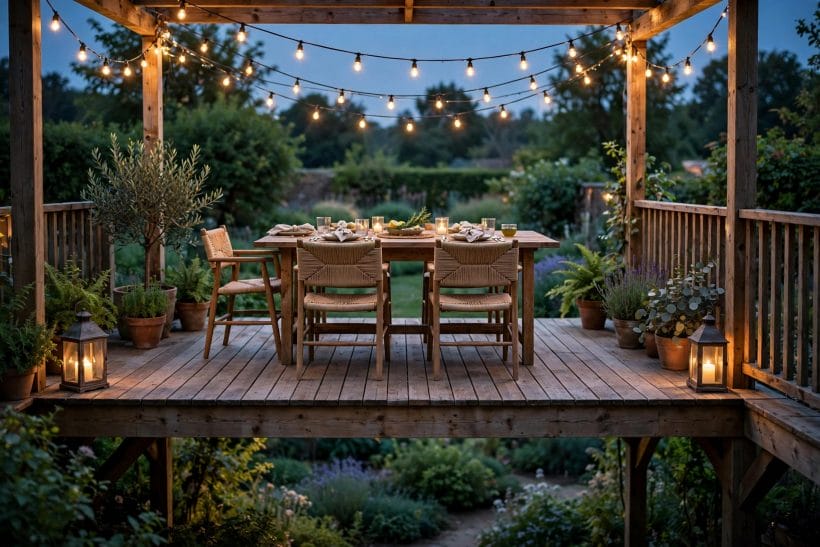
Lighting extends the deck into the evening, and it should be layered rather than single. Soft lights along the steps make the change of level safe after dark, lanterns or a low lamp on the table make dining pleasant, and a gentle wash of light on planting below makes the garden visible from the deck at night. Electrical work for fixed deck lighting belongs with a qualified electrician, with fittings chosen for outdoor use and with cables protected from weather and from feet. Battery lanterns and solar lights can add warmth without wiring, but they are a supplement to safe, professionally fitted step and path lighting, not a substitute for it.
Evening use is where a raised deck earns its keep. A deck that is lit, shaded by day and sheltered from wind becomes a second living room in the warmer months, a place for long suppers, for reading as the light fades, and for watching the garden settle at dusk. Keep the evening simple: a table that is easy to clear, chairs that are comfortable for an hour rather than for a photograph, and light that is warm and low rather than bright and harsh. A deck used in the evening, every evening the weather allows, is a deck that has been planned well.
10. Choosing Your Raised Deck Layout
Choosing a raised deck layout begins with three honest questions, and the answers will narrow the field far faster than browsing pictures alone. First, what will the deck be used for most: dining, lounging, quiet sitting, or a mix of all three. Second, what does the deck look over, and which view deserves the best seats. Third, how is the deck reached, from which door, by which steps, and onto which part of the garden. A deck chosen from those answers will fit the household, while a deck chosen from a picture alone may fit nobody, however beautiful the picture is.
From there, the choices fall into place in a sensible order. Settle the shape and the size with a professional, who can test it against the house, the slope and local rules. Choose the boards for their look and for the care they need, and choose the railing for safety first and for view second, with privacy where it is genuinely needed. Place the furniture on the plan before buying it, walk the routes, and leave room to move. Add planting last, but plan it first, so that pots, climbers and shrubs have places to live from the start rather than being squeezed in afterwards.
Finally, judge every raised deck idea by a simple test: does it make the deck easier to use, safer to stand on, and pleasanter to sit on. Ideas that pass all three tests are worth keeping, whatever their style. Ideas that pass only one, a dramatic railing that blocks the view, a vast table that leaves no room to walk, a shade structure that darkens the rooms behind it, should be set aside, however fashionable they look. A raised deck is a long-lived addition to a house, and it should be chosen for the life that will be lived on it, not for a single summer.
Final Considerations
A raised deck rewards planning and punishes haste. Its lift gives it a view and a presence that a ground-level deck cannot match, but that lift also asks for professional structure, secure railings, comfortable steps, sound drainage and weatherproofing done properly. Keep those professional matters at the centre of the project, check local rules early, and let a qualified builder, and where lighting is involved a qualified electrician, carry the parts of the work that carry people. The rest, the layout, the boards, the furniture, the planting and the evening light, is where personal taste can play freely, and where raised deck ideas become a deck that belongs to one particular house and one particular garden.
Start small in the planning and generous in the thinking: walk the garden, stand where the deck will stand, watch where the sun falls and where the wind comes from, and imagine an ordinary Tuesday on the deck, not just a party. If the deck works on that ordinary day, for a meal, for a book, for a quiet hour above the garden, then it will work on every other day too. That is the real test of a raised deck, and it is a test that careful planning, professional building and honest furniture choices will pass.


0 Comments