
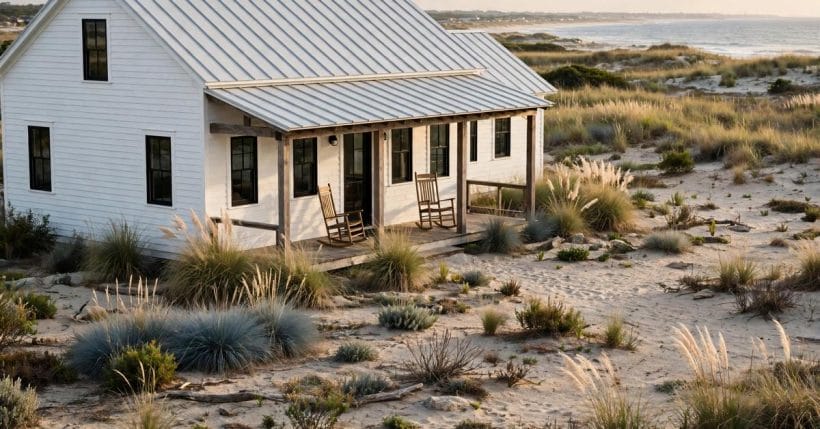
A coastal farmhouse brings two familiar ideas together and lets each one soften the other. From the farmhouse side it takes plain shapes, honest materials and rooms that are made to be used every day. From the coast it takes pale colour, daylight and a relaxed feeling that never tries too hard. The result is a house that feels calm on a grey morning and welcoming on a bright one, a place where sandy feet, wet towels and long lunches are part of the plan rather than a problem to be solved. The ideas below look at the style as a whole, from the shape of the roof to the way a bedroom is dressed, so you can see how the pieces fit together before you borrow any of them for your own home.
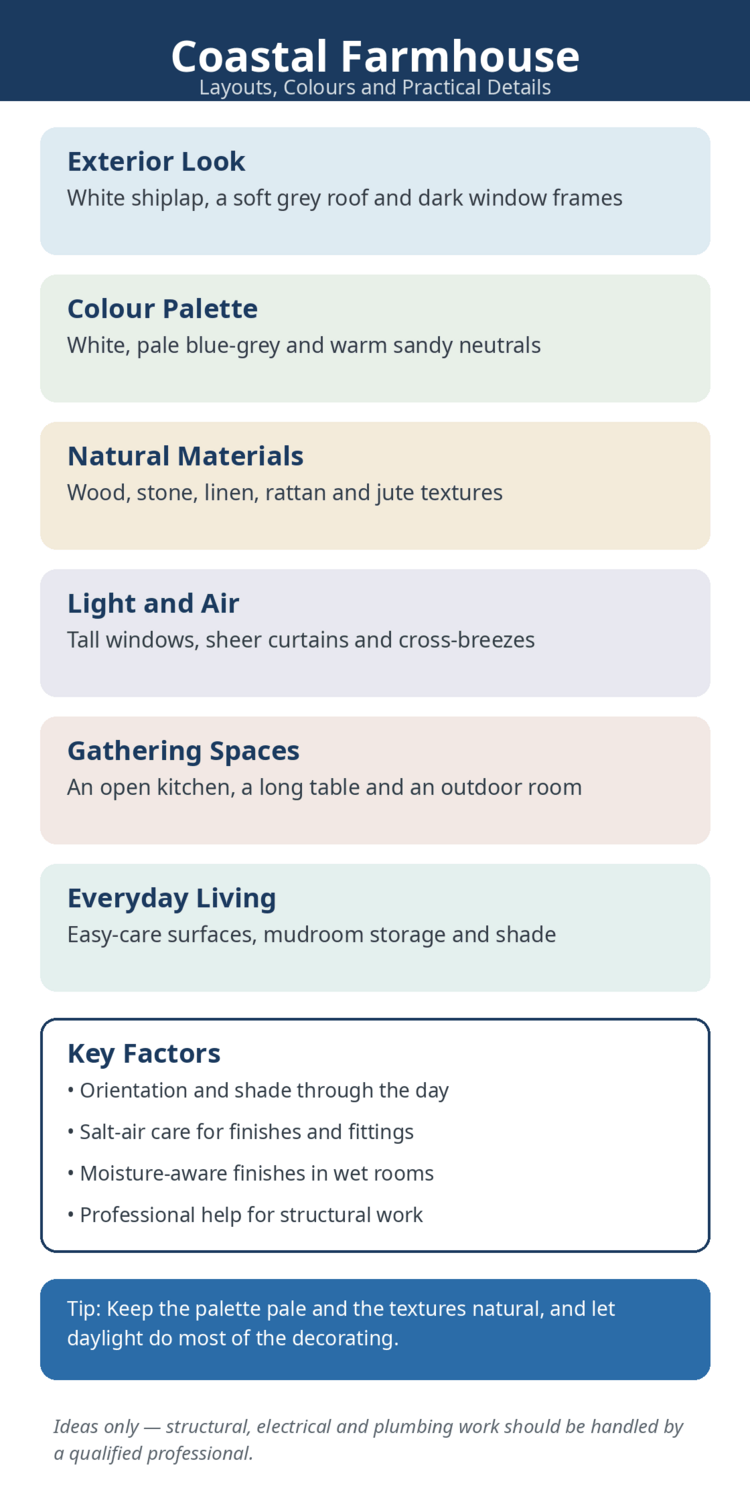
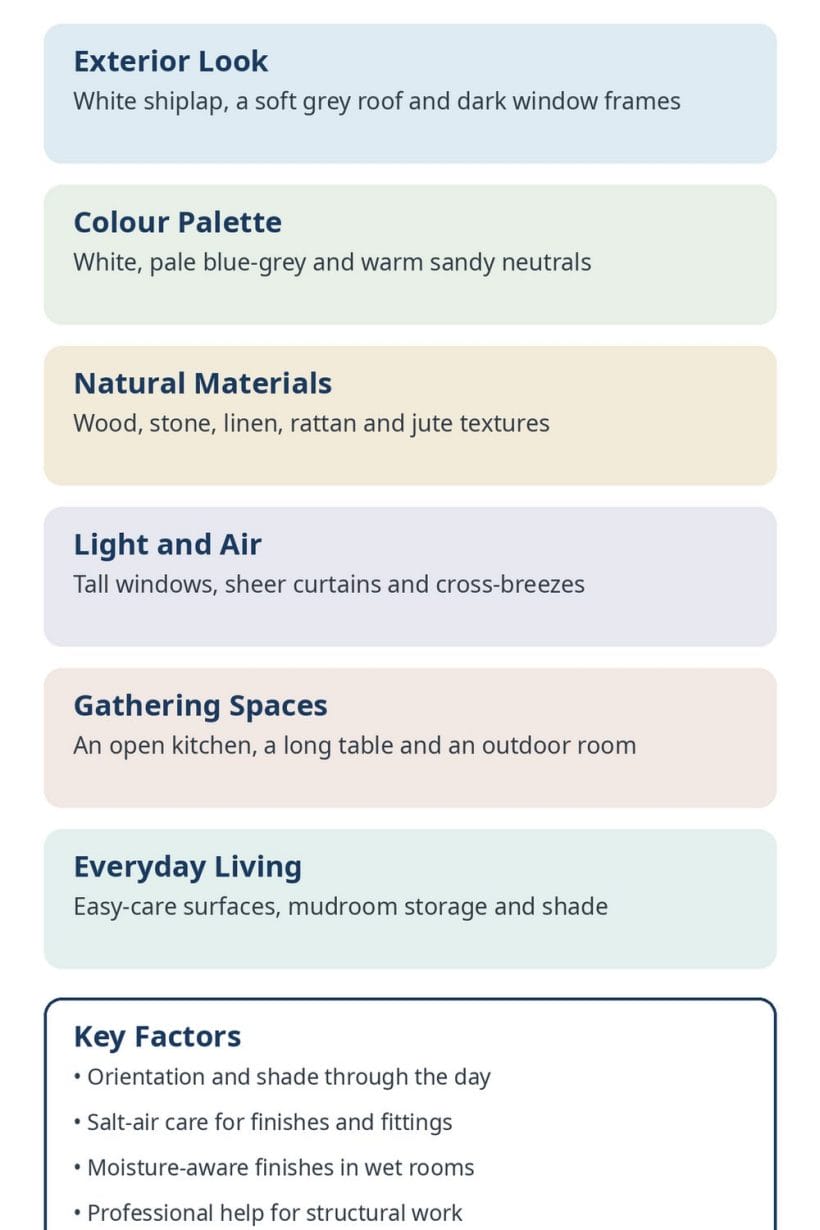
| Item | What it is |
|---|---|
| What Makes a House a Coastal Farmhouse | A coastal farmhouse is best recognised by its feeling rather than by any single feature. |
| Exterior Shapes and Rooflines That Read Coastal | The outside of a coastal farmhouse is usually a simple gable or a pair of gables, sometimes with a lower wing or a lean-to that keeps the main form from looking too tall. |
| Living Rooms That Stay Light and Easy | The living room of a coastal farmhouse is usually the brightest room in the house, and it earns that brightness honestly, with tall windows, pale walls and very little standing between the seating and the daylight. |
| Kitchens Made for Gathering | In a coastal farmhouse the kitchen is rarely a room for cooking alone. |
| Bedrooms with a Relaxed Feel | A coastal farmhouse bedroom should feel like a deep breath at the end of the day. |
| Bathrooms That Handle Damp Air | A coastal bathroom has one job that an inland bathroom does not always face so directly: it must cope with damp air day after day, from showers, from wet towels and from the humid air that comes in through an open window. |
| Porches and Outdoor Rooms | Most coastal farmhouses have some kind of covered outdoor space, whether that is a small entry porch, a side veranda or a deck shaded by the roof. |
| Colour, Texture and Natural Materials | If the coastal farmhouse had to be described in three words, they might be pale, natural and worn, in the gentle sense of materials that show honest use rather than damage. |
| Furniture and Decor Without the Cliches | The easiest way to spoil a coastal farmhouse is to decorate it with every seaside cliche at once. |
| Living with a Coastal Farmhouse Day to Day | The real test of a coastal farmhouse is not how it looks on the day it is finished but how it lives after a year of salt air, sandy feet and wet towels. |
1. What Makes a House a Coastal Farmhouse
A coastal farmhouse is best recognised by its feeling rather than by any single feature. The outline is usually simple, a plain gabled form with a calm, uncluttered front, and the decoration is kept to what the house genuinely needs, such as boards, shutters or a covered entry. Nothing is fussy for its own sake, and nothing shouts. That restraint is what separates the style from a beach house dressed up in novelty details, and from a traditional farmhouse that happens to sit near the water. The coastal part shows in the lightness of the whole composition: pale walls, generous windows and materials that look as if they belong outdoors as much as indoors.
Inside, the same restraint applies. Rooms are open where it helps daily life and closed where privacy matters, and the furniture is comfortable rather than precious. Slipcovers, washable fabrics and wooden surfaces that can take a knock all suit a house where people come in from the garden or the shore. If you are still working out how your rooms should connect, it helps to study tiny house floor plans for the way small, well-planned layouts keep every room useful, because the coastal farmhouse works on the same principle at any size: no wasted space, no room that exists only to be looked at.
It is worth remembering that this is a style, not a set of rules carved in stone. A house can be a coastal farmhouse with a grey roof or a white one, with shutters or without them, and with a porch that is large or small. What matters is the combination of farmhouse plainness and coastal lightness, held together consistently from the front door to the back bedroom. When one room breaks that combination, with heavy dark furniture in an otherwise pale house or with bright novelty decoration in an otherwise calm one, the whole house feels less settled. Keeping the palette and the materials steady is the simplest way to keep the style believable.
2. Exterior Shapes and Rooflines That Read Coastal
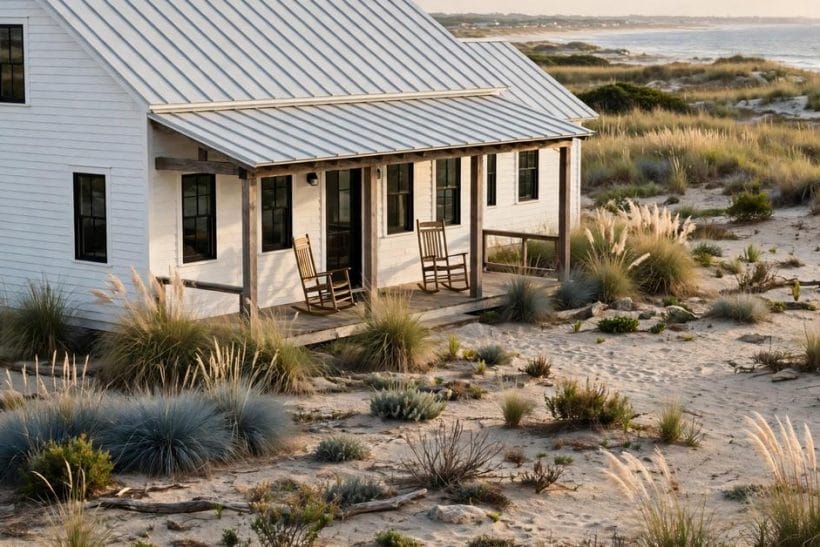
The outside of a coastal farmhouse is usually a simple gable or a pair of gables, sometimes with a lower wing or a lean-to that keeps the main form from looking too tall. A metal roof in a soft grey is a common choice, partly because it suits the plain farmhouse outline and partly because its quiet colour lets the white or pale walls do the talking. Dark window frames give the pale walls a clear edge and stop a white house from looking washed out in strong seaside light. Board siding, whether horizontal shiplap or simple weatherboard, adds the farmhouse texture, and it reads best when it is left plain rather than covered with extra trim.
Colour on the outside should stay close to the landscape. White is the classic choice, but pale grey, soft blue-grey and warm sand all work, especially when the trim is kept a shade or two lighter or darker than the walls rather than a sharp contrast. Landscaping should be just as easygoing: grasses, hardy shrubs and sandy paths suit the setting better than formal beds that need constant attention. For the broader question of how a small house sits on its plot, tiny house design offers useful lessons in keeping the outside simple and the proportions honest, which is exactly what a coastal farmhouse needs.
Any change to the shape of a house, including moving a wall, altering a roofline or adding an opening, is structural work and should be left to a qualified professional, who can confirm what the existing structure will allow. The same care applies to anything that touches the weatherproofing of the walls or the roof, since a coastal house faces wind and driven rain more often than an inland one. Getting that advice early keeps a style project from becoming a repair project, and it leaves you free to enjoy the visible choices, such as colour, boards and planting, with confidence.
3. Living Rooms That Stay Light and Easy
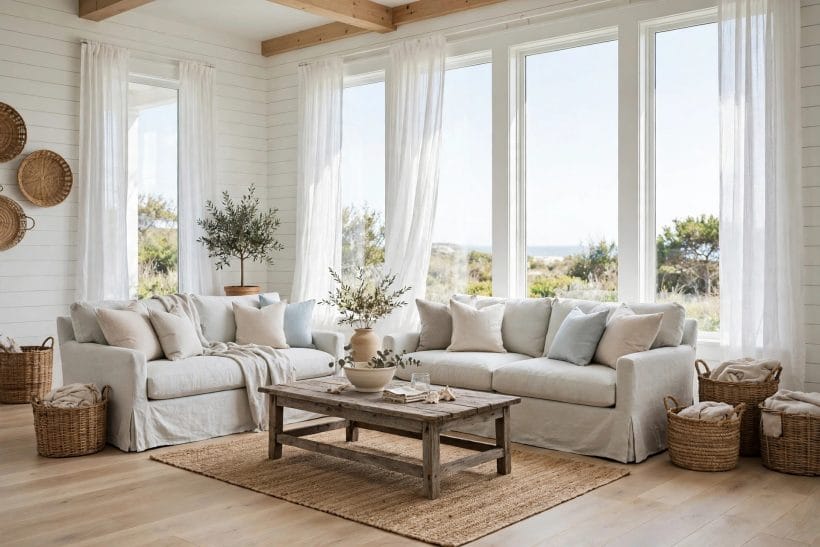
The living room of a coastal farmhouse is usually the brightest room in the house, and it earns that brightness honestly, with tall windows, pale walls and very little standing between the seating and the daylight. White shiplap or pale plaster keeps the walls quiet, while a jute or sisal rug grounds the seating area without darkening it. Sofas in pale linen, with loose covers that can be removed and washed, suit the room far better than dark leather or heavy velvet, because they keep the room looking soft even after a summer of everyday use.
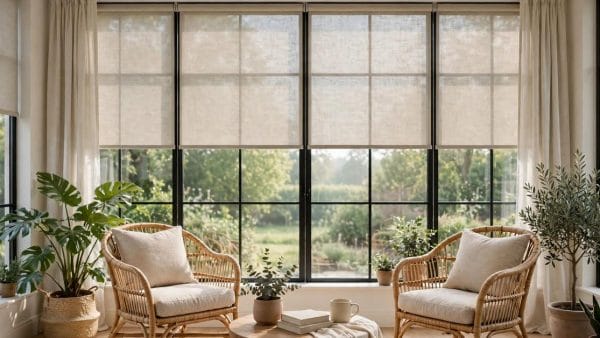
Furniture in this room should be easy to move and easy to live with. A weathered wood coffee table, a basket for throws and a chair that can be turned towards the window or towards the conversation both suit the farmhouse habit of rooms that adapt through the day. Sheer curtains are often all the window dressing this room needs: they soften glare without shutting out the view, and they move gently when a breeze comes through. If you want more ideas for keeping a bright room calm, tiny living room ideas show how pale colour and simple furniture keep even a modest room feeling open.
Decoration should be kept to things that mean something or that come from the natural world: a bowl of shells gathered on a walk, a vase of dried grasses, a woven wall hanging or a stack of books. Too many ornaments, especially brightly coloured novelty pieces, will fight the calm the room is trying to create. One larger piece, such as a weathered mirror or a simple landscape print, usually does more than a shelf of small objects. The aim is a room that feels collected over time rather than decorated in a single shopping trip.
4. Kitchens Made for Gathering
In a coastal farmhouse the kitchen is rarely a room for cooking alone. It is where people gather while a meal is being made, where children do homework at the island and where guests stand with a drink while the cook finishes. That means the layout should give people somewhere to be that is not in the cook’s way, whether that is an island with stools on one side or a table close by. White shaker cabinets keep the room pale, and a painted island in blue-grey gives the room a gentle focal point without introducing a loud colour.
Open shelving suits this kitchen when it is used for everyday dishes rather than display alone, because it keeps plates and bowls within reach and stops the room from feeling like a showroom. A farmhouse sink under a bright window is both practical and characteristic, and a butcher-block surface adds warmth beside the painted cabinets. Woven pendant lights soften the ceiling line and echo the baskets and rugs used elsewhere in the house. For more ways to plan a kitchen that works hard without feeling busy, tiny kitchen ideas are a good place to look, since they concentrate on storage and layout rather than decoration.
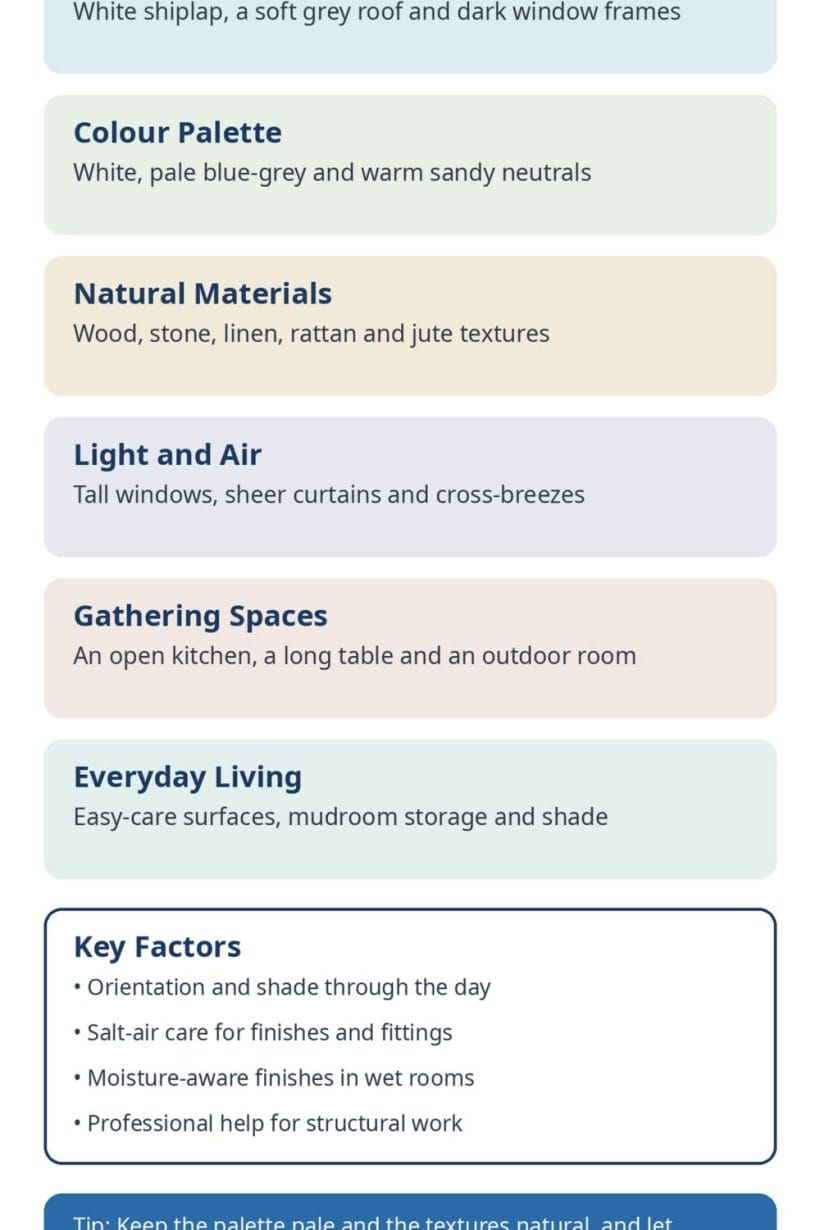
Practical details matter more here than in any other room. Surfaces should wipe clean, flooring should cope with wet feet, and there should be a place for everything that is used daily, from chopping boards to school bags, so the counters stay clear. Anything that involves plumbing, gas or electrical work, including moving a sink or adding a circuit, should be handled by a qualified professional. With those decisions settled, the visible choices become simple: keep the colours pale, the wood warm and the room open enough for people to gather.
5. Bedrooms with a Relaxed Feel
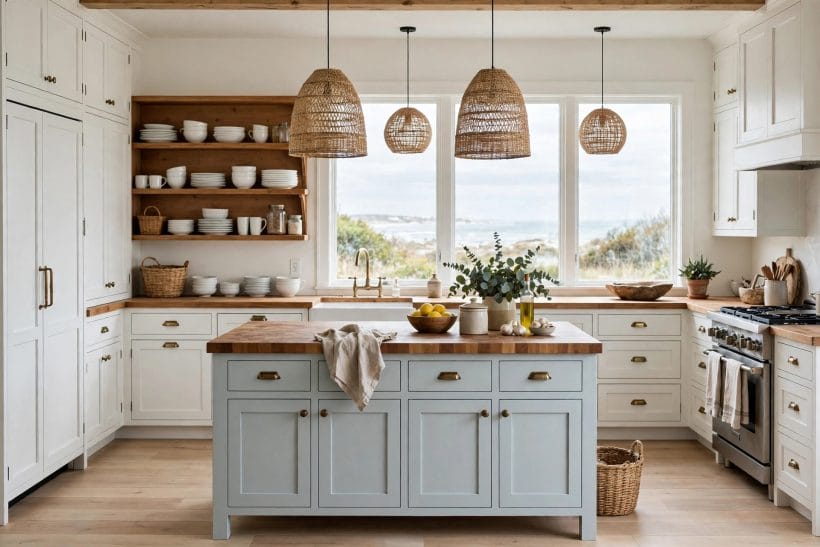
A coastal farmhouse bedroom should feel like a deep breath at the end of the day. White or very pale walls, crisp white bedding and a single soft accent, such as a pale blue throw or a pair of linen cushions, are usually enough. A rattan or whitewashed wood bed frame keeps the room light, and a wooden nightstand with a ceramic lamp adds warmth without weight. The room should not try to impress; it should invite rest, and the simplest way to do that is to leave some empty space on the walls and the floor.
Light is handled gently here. Sheer curtains soften the morning sun, while a heavier curtain or a blind behind them gives privacy at night. If the bedroom faces the sea or a garden, it is worth keeping the window dressing simple so the view stays part of the room. Storage should be quiet too: baskets under the bed or on a shelf, a simple wardrobe and a hook for a dressing gown all suit the style better than elaborate fitted furniture. For bedrooms in smaller homes, tiny bedroom ideas show how pale colour and low furniture keep a room feeling restful rather than cramped.
Texture does most of the decorating in this room. Linen bedding, a woven throw, a jute rug beside the bed and a wooden frame all add interest without adding colour, and they feel pleasant to touch, which matters in a room used in bare feet. Avoid piling on cushions or throws until the bed becomes a chore to make each morning. A bed that can be made in a minute will be made every day, and a tidy bed does more for the feeling of the room than any amount of decoration.
6. Bathrooms That Handle Damp Air
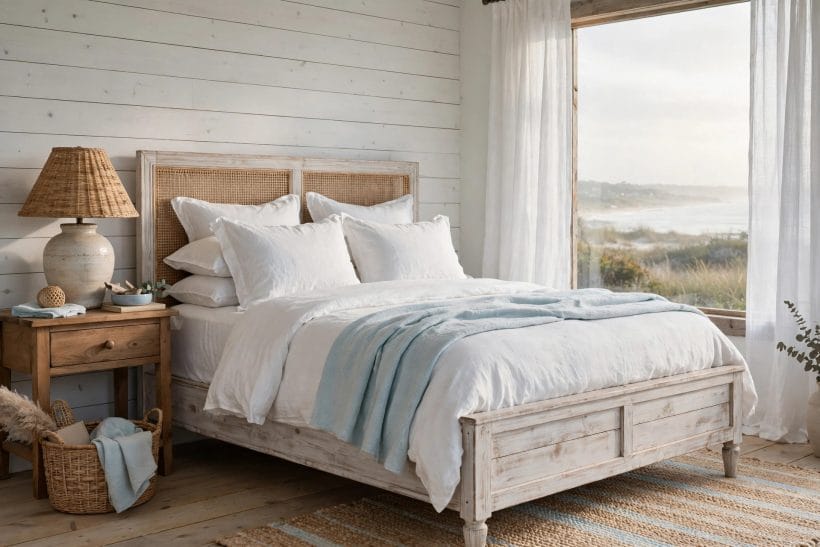
A coastal bathroom has one job that an inland bathroom does not always face so directly: it must cope with damp air day after day, from showers, from wet towels and from the humid air that comes in through an open window. That makes the choice of finishes more important than the choice of decoration. Painted beadboard, tiles that are easy to wipe and a vanity that stands clear of the floor all help the room dry out between uses, and a window that can be opened, even a little, is worth more than any amount of scented decoration.
The look should stay in keeping with the rest of the house: white beadboard walls, a pale blue-grey vanity, a wooden countertop and a round wooden-framed mirror. A freestanding bath suits the relaxed feeling of the style, but a simple shower with pale tiles suits it just as well, and either choice should be made for how it will be used rather than how it photographs. Baskets hold towels and toiletries without adding clutter, and a wooden stool or a small bench gives somewhere to put clothes while bathing.
Anything that involves plumbing, drainage or electrical work in a bathroom, including moving a bath, adding a shower or fitting lights near water, should be handled by a qualified professional, since bathrooms combine water and electricity in a way that leaves no room for guesswork. Ventilation deserves the same seriousness: a fan that actually clears steam, used every time, will protect paint, wood and grout far better than any finish applied afterwards. With those practical matters settled, the room can stay pale, simple and calm for years.
7. Porches and Outdoor Rooms
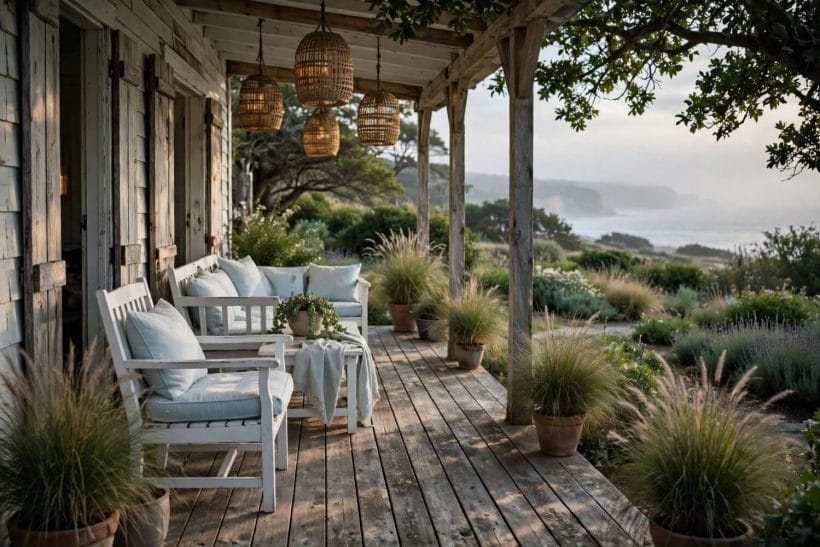
Most coastal farmhouses have some kind of covered outdoor space, whether that is a small entry porch, a side veranda or a deck shaded by the roof. The point of the space is not its size but its use: somewhere to sit outside without being fully exposed to sun or rain, to eat breakfast, to read or to watch the evening light. White-painted furniture with pale cushions, woven lanterns and potted grasses all suit this space, and the furniture should be sturdy enough to stay out through the season rather than delicate pieces that must be carried in at the first sign of rain.
This post treats the porch as one part of the coastal farmhouse style, not as a subject of its own. The porch here is kept modest and in proportion to the house, with simple posts, a plain rail and boards underfoot, rather than an elaborate wraparound structure that would become the whole story of the house. Keeping the outdoor room in scale with the rest of the home is what lets the style, rather than any single feature, carry the design. For porches as a subject in their own right, tiny house porch ideas look at porch planning in detail.
Shade and shelter deserve thought before furniture does. A roof overhang, a canvas shade or a well-placed tree will decide whether the space is used daily or only on perfect days, and a floor that dries quickly after rain will decide whether it is pleasant to use in bare feet. Anything structural, such as posts, beams or a roof extension, should be left to a qualified professional, who can confirm that the structure is sound and properly fixed to the house. With that settled, the outdoor room becomes the easiest room in the house to enjoy, because it asks so little and gives so much.
8. Colour, Texture and Natural Materials
If the coastal farmhouse had to be described in three words, they might be pale, natural and worn, in the gentle sense of materials that show honest use rather than damage. The palette starts with white and adds only soft companions: pale blue-grey, warm sand, driftwood grey and the muted green of coastal grasses. Strong colours are used sparingly, if at all, and usually through something that can be changed easily, such as a cushion or a throw, rather than through a painted wall that would be hard to undo.
Texture is what stops a pale house from feeling cold. Linen, cotton, wool, rattan, jute, weathered wood and stone each add a different surface, and together they give a room depth without needing colour. A rough jute rug against a smooth linen sofa, a woven basket beside a painted cabinet and a stone hearth in a white room all create interest that the eye can enjoy without being shouted at. The rule of thumb is simple: if a room feels flat, add texture before adding colour, and if it still feels flat, add a plant before adding anything else.
Materials should also be chosen for how they age near the coast. Salt air and damp can dull some finishes and stain others, so it is worth choosing surfaces that can be wiped, washed or sanded back rather than finishes that must stay perfect to look good. Painted wood that can be touched up, natural stone that can be cleaned and fabrics that can be laundered all suit a coastal house far better than delicate surfaces that show every mark. This is also why the style favours plain, honest materials over imitation ones: real wood, real linen and real stone age gracefully, while imitations tend to look tired sooner.
9. Furniture and Decor Without the Cliches
The easiest way to spoil a coastal farmhouse is to decorate it with every seaside cliche at once. Anchors, ropes, life rings and novelty signs may each seem charming on their own, but together they turn a house into a theme rather than a home. The style works best when the coast is suggested rather than announced: through pale colour, natural texture and daylight, rather than through objects that spell out where the house stands. One or two pieces with a genuine connection to the place, such as a print of the local shore or a bowl of shells gathered nearby, will always beat a collection bought to fit a theme.
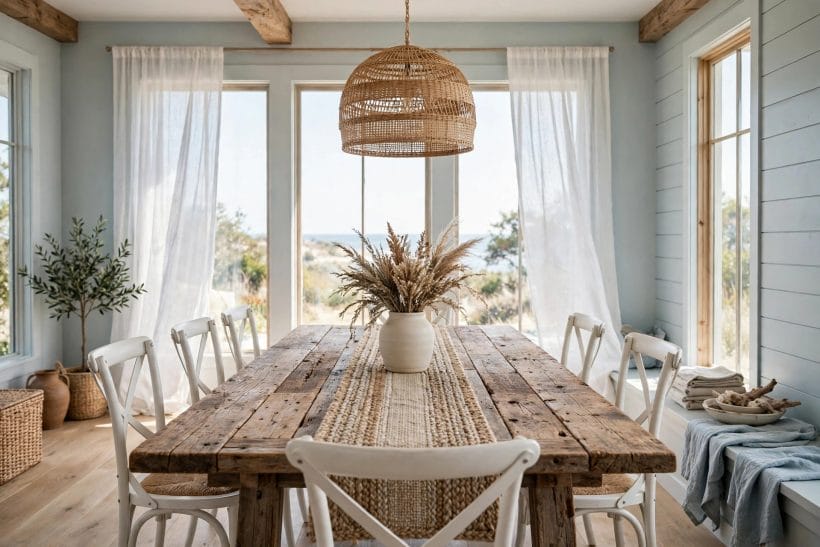
Furniture should be chosen for comfort and for the way it will be used. A long wooden dining table with simple cross-back chairs invites people to sit for a long time, and it suits the farmhouse habit of meals that stretch into conversation. A slipcovered sofa can be washed after a summer of sandy afternoons, and a wooden bench by the door gives somewhere to sit while putting on shoes. In every room, the test is the same: would this piece still belong here on a grey winter day, when the sea is out of sight and the house must stand on its own merits? If the answer is yes, it belongs in a coastal farmhouse.
It also helps to let rooms breathe. A coastal farmhouse is not a gallery, and walls do not need to be filled, nor does every surface need an object. Leaving a wall plain, a shelf half empty or a corner for a plant gives the eye somewhere to rest, and it makes the pieces that are there feel chosen rather than accumulated. For the living room in particular, small living room ideas show how restraint keeps a room calm, and that lesson applies at any size of house.
10. Living with a Coastal Farmhouse Day to Day
The real test of a coastal farmhouse is not how it looks on the day it is finished but how it lives after a year of salt air, sandy feet and wet towels. The houses that pass that test share a few habits rather than a few purchases. Shoes come off by the door, ideally into a mudroom or a basket by the entry, so sand stays out of the living rooms. Towels have somewhere to dry properly, rather than draped over furniture, and outdoor cushions are brought under cover when a storm is coming. None of this is glamorous, and all of it is what keeps a pale house looking pale.
Regular, gentle care matters more than occasional deep cleaning. Wiping salt film from windows, brushing sand from rugs, washing slipcovers when they need it and touching up paint before a small mark becomes a large one will all keep the house feeling fresh with less effort than a yearly overhaul. It is also worth watching for damp in corners, around windows and in bathrooms, and dealing with it early, since damp left alone will mark paint and wood far more stubbornly than salt air alone. Where damp points to a leak, a drainage problem or damage to the structure, a qualified professional should be asked to look at it rather than simply painting over the mark.
Shared meals are part of this daily life too, and the dining table earns its place as the centre of the house when it is used every day rather than kept for special occasions. A table that is easy to clear, easy to wipe and surrounded by chairs that people actually like sitting in will be used far more than a formal setting kept under a cloth. That everyday use is the heart of the coastal farmhouse: a house that is beautiful because it is lived in, not in spite of it.
Final Considerations
A coastal farmhouse succeeds when its two halves stay in balance. Keep the farmhouse plainness in the shapes, the boards and the honest materials, and keep the coastal lightness in the pale colours, the daylight and the easy textures, and the house will feel calm without feeling empty. Resist the temptation to add a novelty in every room, to darken a room for drama or to let one feature, however handsome, take over the whole design. The style is at its best when nothing in it is trying to be noticed, and everything in it is quietly doing its job.
Before borrowing any idea from this post, it helps to walk through your own house room by room and ask which change would make daily life easier rather than merely different. A paler wall, a washable cover, a basket by the door or a chair turned towards the light may each do more than a large project, and they can be tried without touching anything structural. Where a change does touch structure, plumbing, wiring or weatherproofing, bring in a qualified professional first and let the visible choices follow their advice. Done that way, a coastal farmhouse is not a look to be copied but a way of living to be settled into, one pale, calm room at a time.



0 Comments