
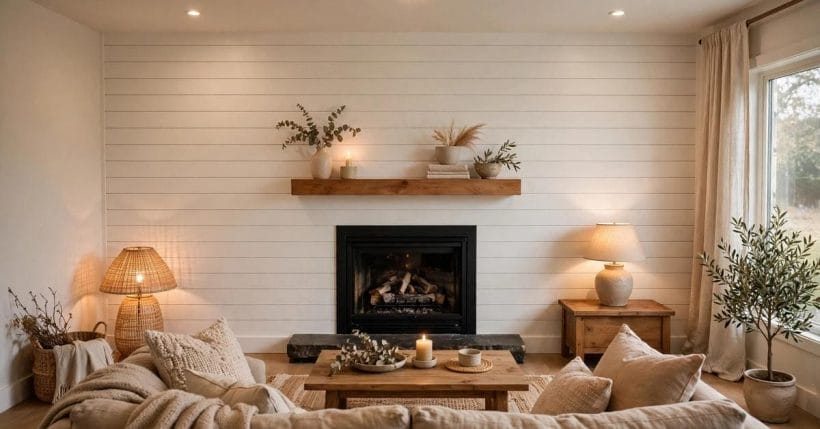
A living room changes the moment its fireplace wall stops being background and becomes the place the whole room turns toward. A shiplap fireplace does that quietly, with boards, shadow lines and a calm, even surface rather than with noise or ornament.
This guide looks at that one wall in a living room only: how to choose its finish, place the sofa, pick colours and layer the light so the room feels settled at every hour of the day.
1. Start With the Wall: What Makes the Look Work
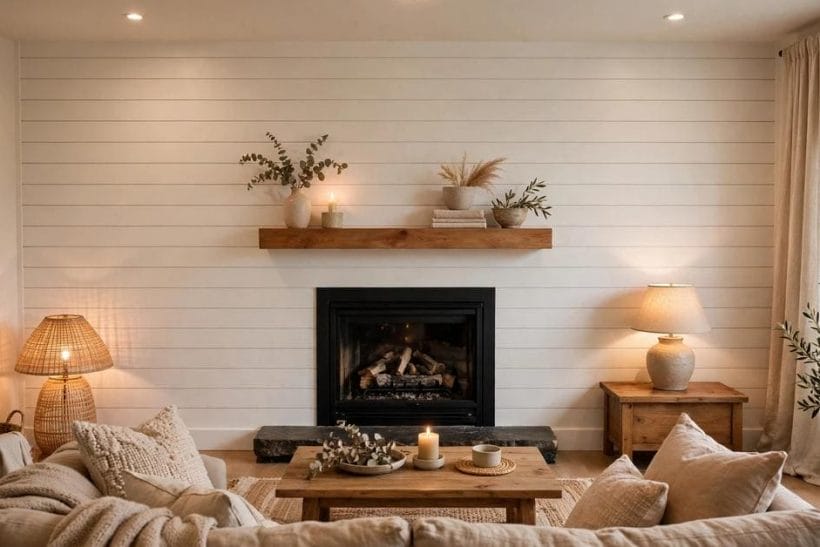
The appeal of a board wall around a fireplace is rhythm. Horizontal boards draw the eye across the room and make a wide wall feel ordered, while vertical boards lift the eye and make the same wall feel taller. Neither direction is right for every room. The choice should follow the room you already have: a long, low room often suits boards that run with its length, while a room with a high ceiling can carry boards that run upward without feeling busy.
Finish matters as much as direction. A soft white finish keeps the wall light and lets the sofa, rug and mantel objects carry the colour. A pale timber finish warms the room and pairs naturally with woven baskets, linen cushions and wooden furniture. A muted green, such as sage, gives the wall a gentle presence of its own and suits rooms that already lean toward plants and natural textures. In each case, the wall works best when it is the calmest large surface in the room, not one more pattern competing for attention.
Before settling on a finish, look at the room in daylight and again in the evening. Daylight shows the true tone of the boards and the shadows between them. Evening light shows how the wall will look when lamps are on and the fire is lit, which is when a living room is most often used. A finish that looks fresh at noon but harsh under lamplight will tire quickly, so the evening test matters.
| Part of the room | A calm choice |
|---|---|
| Shiplap Finish | Soft White |
| Mantel Style | Simple Timber |
| Sofa Placement | Facing the Fire |
| Colour Palette | Warm Neutrals |
| Lighting Layers | Soft and Layered |
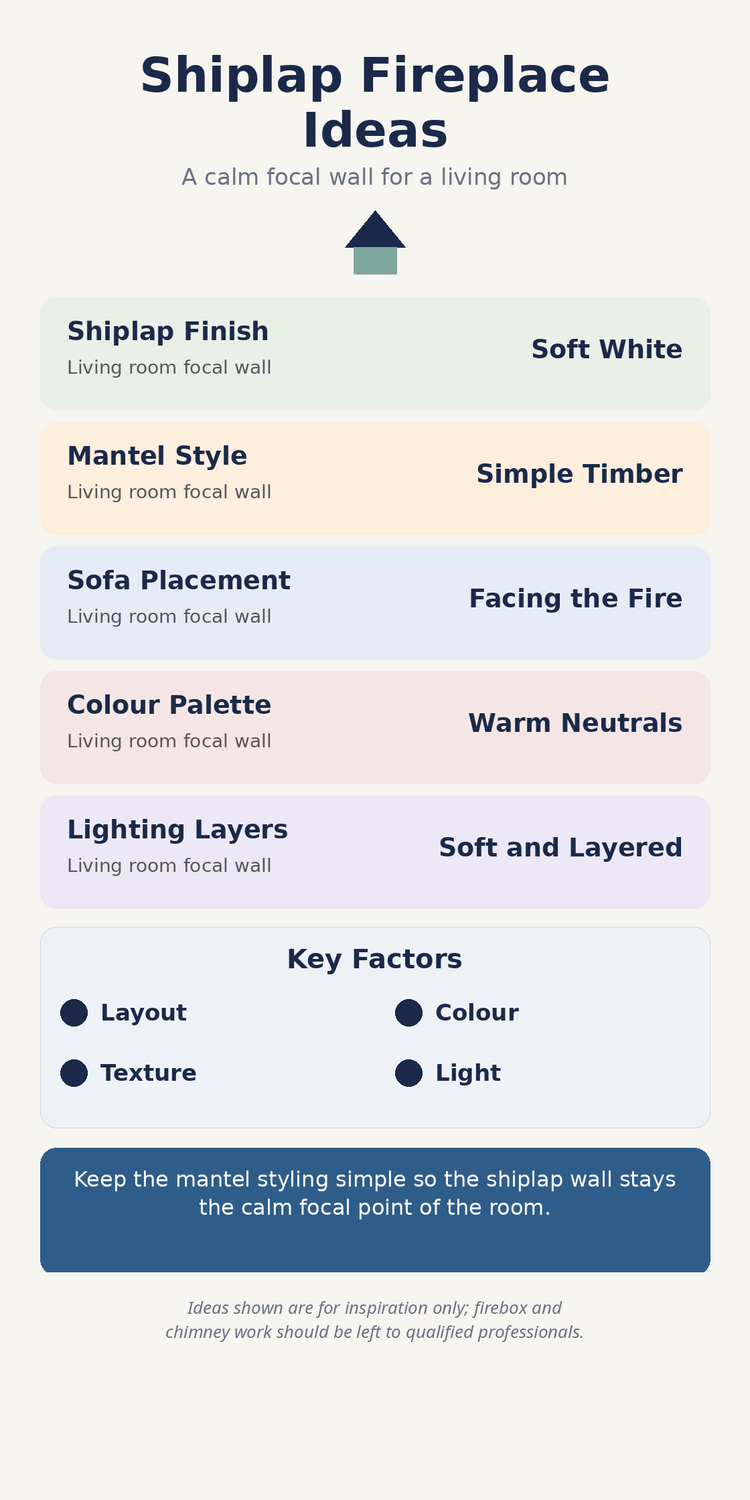
The table above is a starting point, not a rule. A room with dark floors may need a lighter wall to stay balanced, while a very bright room may welcome a deeper board colour. The through-line is restraint: one wall, one finish, and furniture and textiles that support it rather than fight it. For a broader sense of how a small sitting room can stay calm around a single focal wall, see these tiny living room ideas, which keep the same settled, uncluttered feeling at a smaller scale.
2. Choose the Board Direction and Finish
Board direction changes how the eye travels. Horizontal boards emphasise width and suit a fireplace wall that spans a good part of the room. They also echo the line of the mantel, so the mantel and the wall read as one composed piece. Vertical boards emphasise height and suit a wall that rises toward a tall ceiling or a chimney breast that already feels narrow. Where the wall is neither very wide nor very tall, the safer choice is usually the direction that matches the longest line already in the room, whether that is the sofa, the rug or the window wall.
Board width changes the feeling too. Wide boards give a quiet, modern surface with fewer shadow lines, while narrower boards give a more traditional, cottage feeling with a busier rhythm. Neither is better in itself. A room full of small objects and patterned cushions usually benefits from wider, quieter boards, while a plain room with simple furniture can carry narrower boards without feeling crowded.
Finish is where many rooms go wrong by adding too much. A painted board wall in a soft, pale tone is forgiving: it reflects daylight, it photographs well, and it lets seasonal changes in cushions and throws do the colour work. A natural timber finish needs more care, because its tone will set the warmth of the whole room. Pair pale timber with cream and oatmeal textiles, and pair deeper timber with lighter walls elsewhere so the room does not grow dark toward evening.
Whatever finish you choose, keep the area immediately around the firebox itself out of the decorating conversation. The surround that you see and the firebox and chimney behind it are different matters. Any work on the firebox, chimney, venting or gas supply belongs to qualified professionals, and the boards, mantel and decor should always follow the guidance for the fireplace that is installed. Styling stops where heat, fuel and flues begin. For ideas on dressing a board wall without overloading it, see these tiny house wall decor ideas, which favour a few well-chosen pieces over a crowded wall.
3. Place the Sofa to Face the Fire
The simplest living room arrangement is also the most satisfying: the sofa faces the fireplace, with the rug and coffee table between them. This arrangement gives everyone a view of the fire and a natural place to set down a cup, and it makes conversation easy because people sit facing one another across a shared centre rather than in a line along a wall.
Distance matters more than symmetry. Pull the sofa too close and the room feels cramped and the fire dominates. Push it too far back and the fire becomes a picture on a distant wall rather than the heart of the room. The right distance is the one where the fire is easy to watch without turning the head, where the coffee table is within comfortable reach, and where there is still a clear path around the seating for everyday movement. Walk the route you use most often, from the door to the sofa and from the sofa to the kitchen, and make sure it does not cut across the rug or force anyone to squeeze past a chair.
Where the room has a television as well, the fireplace wall often has to share attention. Placing the television above the mantel keeps the room focused on one wall, but it raises the screen high and can make viewing uncomfortable, so it suits rooms where the seating sits well back. Placing the television on a side wall keeps the fireplace wall purely for the fire and the mantel, but it splits attention between two walls. There is no universal answer. The honest test is to sit in each proposed seat and notice where the eye goes first. If the eye is pulled in two directions at once, the room will feel restless.
A rug anchors the arrangement. It should sit under the front of the sofa and the chairs, and extend far enough that the coffee table rests fully on it, so the seating reads as one group rather than separate pieces of furniture. A rug that is too small makes even a generous room feel scattered, while a rug that reaches the walls can swallow the fireplace wall altogether. In a compact room, the same facing arrangement still works, as these small living room ideas show, with a shorter sofa and lighter furniture keeping the fire in view.
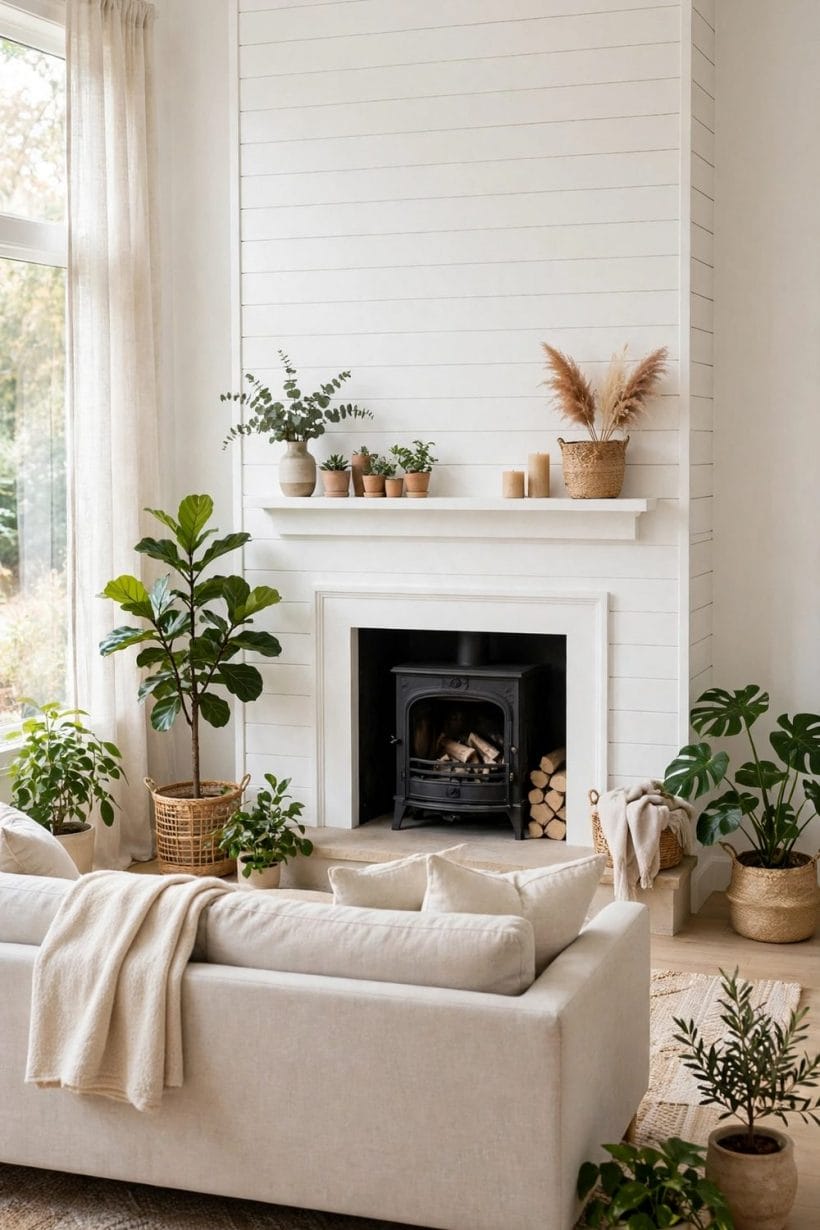
4. Build the Seating Around the Hearth
Once the sofa faces the fire, the chairs complete the circle. Two chairs angled gently toward the fireplace, rather than square to the wall, invite people to sit and talk. The angle matters: a chair turned fully toward the fire leaves its occupant with their back to the room, while a chair angled toward both the fire and the sofa keeps the occupant part of the group. A small side table beside each chair, with a lamp, gives every seat its own light and a place for a book or a cup.
Seating comfort is about depth and support rather than size. A deep sofa looks inviting in a photograph but can be hard to sit in for a long evening if the back is too far to lean against comfortably. Cushions that hold their shape, a back that supports the shoulders, and arms at a height that suits reading all matter more than a dramatic silhouette. When choosing fabric, think about the life the room actually leads: a household with pets or small children needs a fabric that cleans easily and a colour that forgives everyday marks, while a quiet adult sitting room can carry paler, softer textiles.
The coffee table is the working heart of the group. A wooden table warms a board wall and suits a timber mantel, while a lighter table keeps a pale room feeling airy. Keep its surface calm: a tray, a small stack of books and one plant or candle are enough. A table crowded with objects blocks the view of the fire from the sofa, which defeats the purpose of facing the fire in the first place.
Throws and cushions are the easiest way to change the room with the seasons. A heavier throw and deeper cushion colours suit winter evenings by the fire, while linen cushions and a lighter throw suit summer, when the fireplace is a visual anchor rather than a source of heat. Because the board wall stays the same all year, these small textile changes keep the room feeling fresh without redecorating. A farmhouse leaning room, with its simple timber mantel and natural textures, shows the same principle in these farmhouse living room ideas, where plain furniture and honest materials do the work.
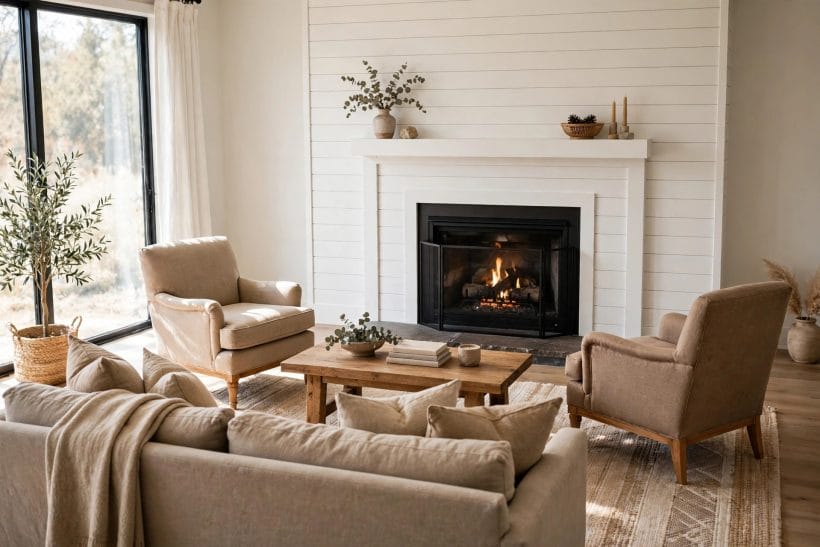
5. Shelving and Storage Beside the Surround
Shelving beside a board fireplace wall can be the most useful part of the room, provided it stays quieter than the wall itself. Built-in shelves on one or both sides of the surround give books, baskets and a few objects a home, and they frame the fireplace without competing with it. The key is to let the shelves echo the wall: the same pale finish, the same plain framing, and no fussy trim that draws the eye away from the boards.
What goes on the shelves matters more than how many shelves there are. Books, grouped by size and with some laid flat, give a lived-in feeling. Baskets on the lower shelves hide the everyday clutter that every living room accumulates, from charging cables to children’s toys, and they add a woven texture that softens the straight lines of the boards. A few plants on the upper shelves bring life to the wall, but trailing plants should be kept clear of the firebox and mantel, and anything placed near heat should follow the fireplace guidance.
Closed storage has a place too. A low cabinet or a pair of cupboard doors beneath the shelves can hold board games, blankets and media equipment, keeping the open shelves free for display. The room feels calmer when the closed storage matches the wall finish, so the whole side of the fireplace reads as one piece of joinery rather than a collection of separate units. If the shelves are added after the fireplace, they should be planned around the existing surround, not forced against it, and any fixing into the chimney breast or wall structure should be done with care for what lies behind the boards.
Storage beside the fire also needs a safety habit. Nothing flammable should be stored against the surround or on the hearth, and the hearth itself should stay clear except for the tools and accessories that belong there. A tidy hearth is not just tidier to look at; it keeps the fire, whatever its fuel, free of clutter. For more on keeping a sitting room both beautiful and practical, with storage that serves the room rather than filling it, see these tiny house storage ideas, which apply the same discipline at a smaller scale.
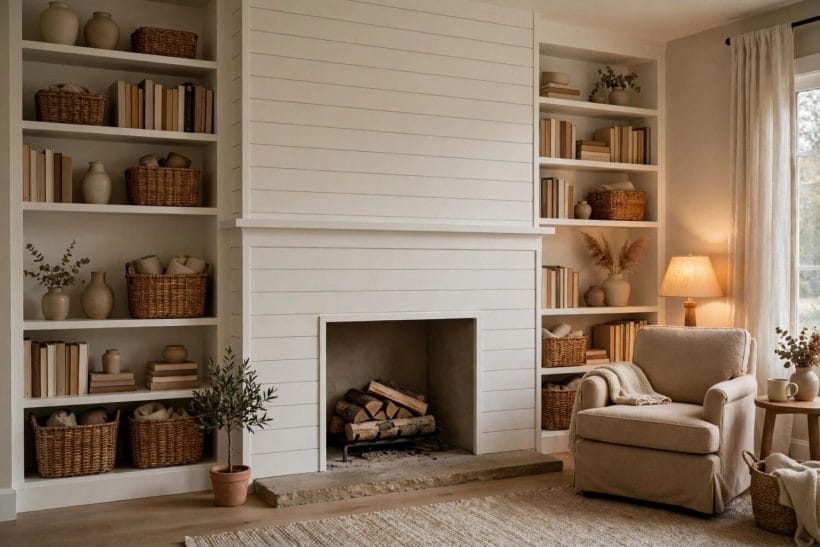
6. Colour: Warm Neutrals, Soft White and Sage
Colour around a board fireplace wall should be chosen for the room at its dimmest, not its brightest. A palette of warm neutrals, cream, oatmeal, soft grey and pale timber, keeps the room gentle in lamplight and lets the fire itself provide the warmest colour in the evening. Within that palette, the board wall can be the lightest surface, the sofa a tone deeper, and the rug and cushions the places where a little more colour appears.
Soft white boards are the most forgiving choice. They suit almost any sofa colour, they keep a north-facing room from feeling gloomy, and they make the mantel and its objects stand out cleanly. Their risk is blandness, which is solved with texture rather than colour: a woven rug, a linen sofa, a timber mantel and a wool throw give a white room depth without a single strong colour.
Sage green boards give the wall a quiet personality. Sage sits well with cream sofas, wooden furniture and plants, and it suits rooms that look onto a garden, because the green inside echoes the green outside. It needs lighter furniture around it, though, or the corner of the room can grow heavy. Pair sage boards with cream textiles and pale wood, and keep the rug light, so the wall reads as calm rather than dark.
Deeper board colours, such as a soft charcoal or a muted blue-grey, can be beautiful in a large, bright living room, but they change the room’s whole balance. A dark wall demands lighter sofas, a lighter rug and generous lamplight, or the seating area will feel like a cave. If you are unsure, test the colour on a single board or a sample area and live with it through a full day and evening before committing the whole wall. Colour names, not codes, are enough for this decision; what matters is how the tone feels in your light, with your furniture. A thoughtful palette, chosen this way, is the subject of these tiny house colour palette ideas, which show how a few related tones can carry a whole room.
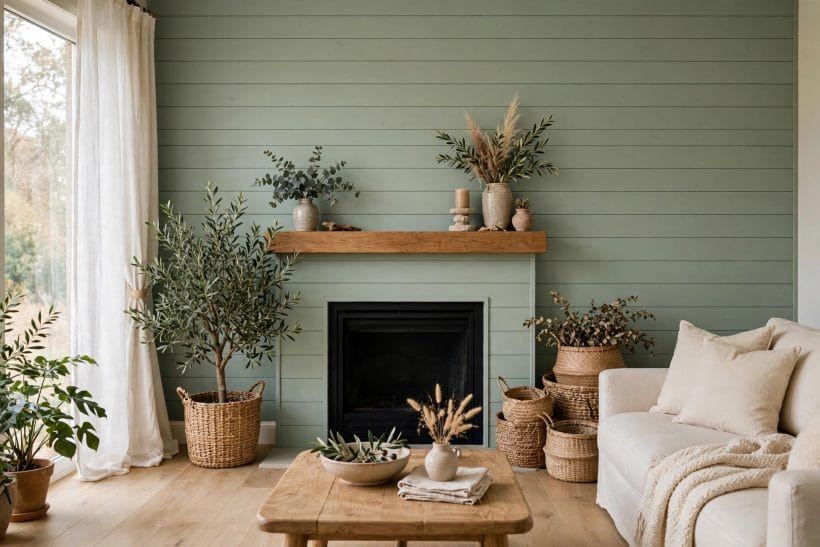
7. Layered Lighting for Day and Evening
Layered lighting means the room is lit from more than one source, so no single light has to do everything. In a living room with a board fireplace wall, the layers usually fall into three kinds: the general light from the ceiling, the task light from lamps beside the seating, and the soft glow of the fire itself. Together they let the room shift from bright daytime use to a calm evening without a harsh change.
Daylight is the first layer and the one most often overlooked. A board wall in direct sun shows every shadow line, which can be beautiful, but it can also glare. Sheer curtains soften that light without shutting it out, and they let the boards keep their texture while the room stays comfortable. In the evening, the same sheer curtains give privacy while lamps take over, so the room never feels exposed.
Lamps beside the sofa and chairs are the most important evening layer. A lamp at each end of the sofa, or a floor lamp beside a reading chair, gives pools of warm light where people actually sit, and it lets the fireplace wall sit in a softer glow rather than under a bright ceiling light. Wall lights either side of the surround can do the same work, washing the boards gently and drawing attention to the wall without glare. Dimmer controls, where they are already fitted, help the room move gradually from evening activity to late-night quiet.
The fire itself is a light source as well as a heat source, and its flicker changes the room in a way no lamp can copy. That is one reason the seating faces the fire: the moving light becomes part of the evening, not just a backdrop. When the fire is not lit, in warmer months, a few candles on the mantel or a small lamp on the hearth can give the wall a gentle evening presence, provided candles are never left unattended and are kept clear of curtains, throws and anything flammable. Keep all lighting work that involves wiring to qualified professionals; styling with lamps is decorating, rewiring is not.
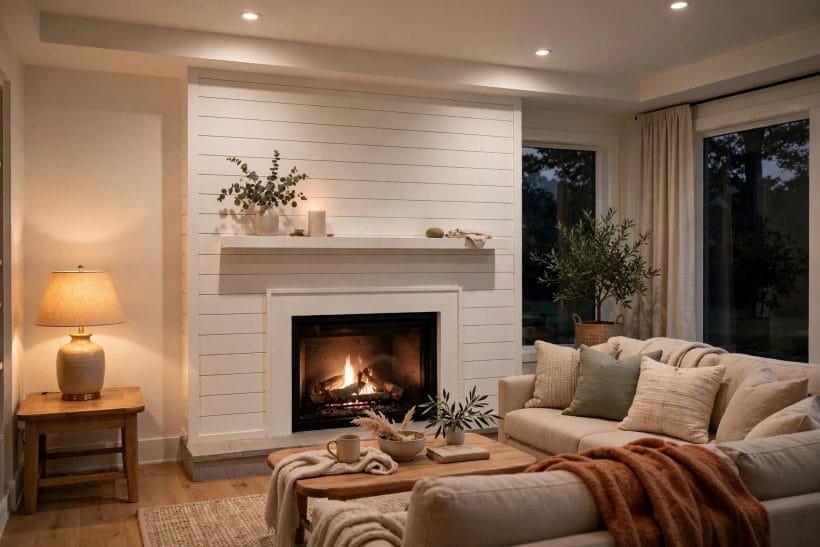
8. Style the Mantel Without Clutter
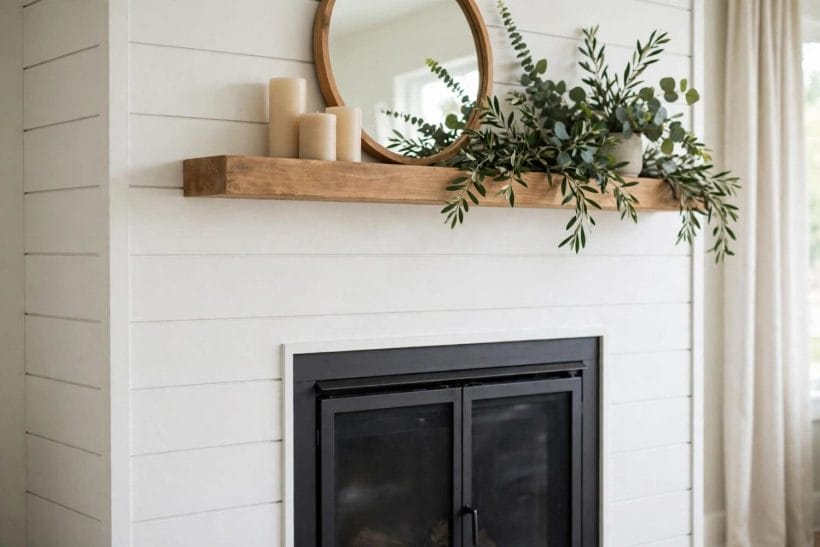
The mantel is the shelf where a living room shows its character, and it is also the easiest place to overdo. A calm mantel follows a simple pattern: one larger piece in the centre or to one side, a pair of smaller pieces to balance it, and empty space left deliberately. A round mirror, a framed print, a tall vase or a simple clock can each serve as the anchor. Around it, candles, a small plant and one or two books are enough.
Height and balance matter more than the number of objects. A tall anchor with low objects beside it gives the mantel a pleasing shape, while a row of objects all at the same height looks like a shop display. Vary the heights, but keep the materials related: timber, ceramic, glass and greenery sit happily together, while a mix of shiny metals, bright colours and busy patterns will fight the quiet boards behind them.
Seasonal changes keep the mantel fresh without redecorating the wall. In winter, greenery and candles suit the fire below. In spring, a vase of fresh stems lightens the whole wall. In summer, when the fire is unlit, a lighter arrangement, perhaps a single print and a plant, keeps the mantel from feeling heavy. Each change is small, but because the mantel is the focal point of the focal wall, even a small change refreshes the room.
Above all, the mantel should be safe as well as beautiful. Nothing should hang over the firebox opening, nothing flammable should sit close to the fire, and anything hung above the mantel must be fixed securely into the wall, not merely leaned where it could fall. Mirrors and pictures above a fireplace need fixings suited to the wall behind the boards, and if you are unsure what lies behind the boards, ask a professional before drilling. A mantel that is calm, secure and easy to dust is a mantel that will still please in a year, not just on the day it is styled.
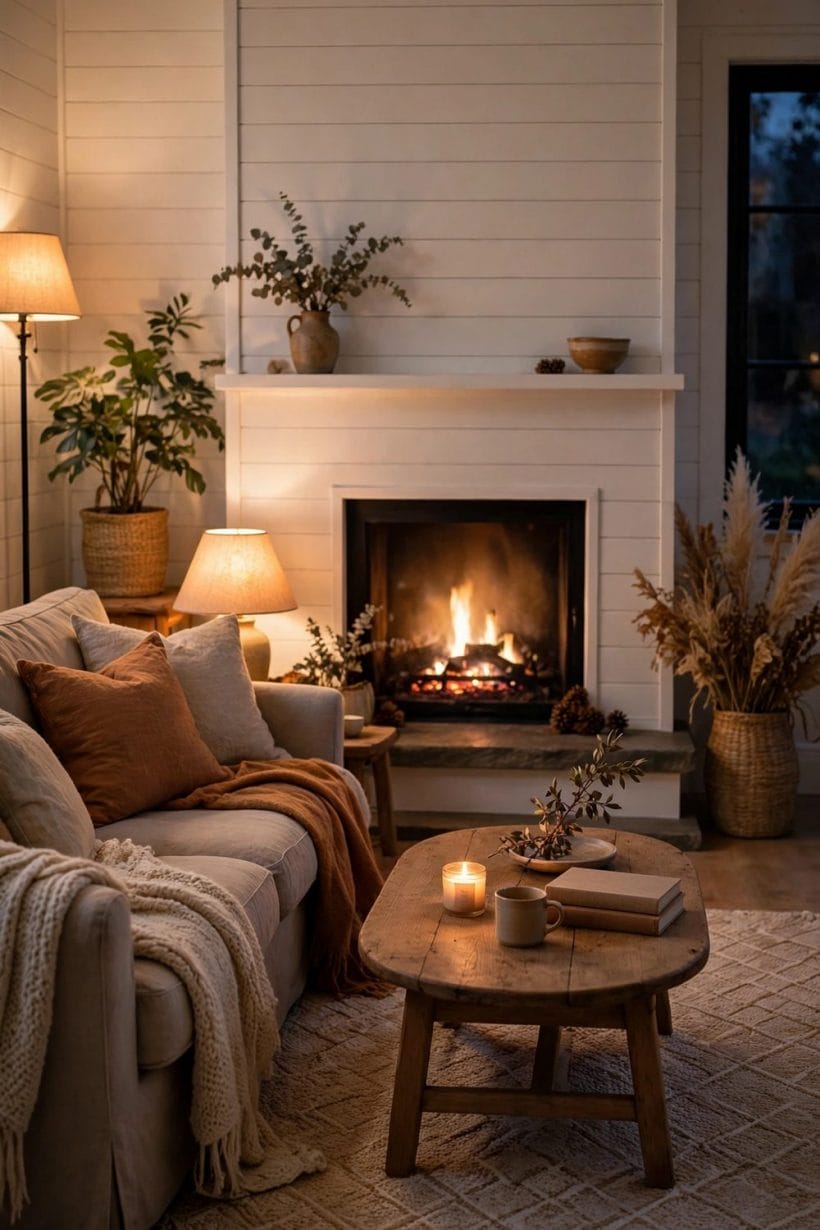
9. Small Living Rooms: Keep the Wall Calm
In a small living room, a board fireplace wall can be a gift, because it gives the room a clear centre without taking up floor space. The wall itself does the decorating, so the furniture can stay simple. A compact sofa facing the fire, a small rug and a single chair are often enough. The temptation in a small room is to fill every wall, but a board fireplace wall works best when the other walls are left comparatively plain.
Colour and finish matter even more at a small scale. Pale boards keep the room feeling open, and a pale sofa and rug continue that feeling. A dark board wall in a small room can still work, but only if the rest of the room stays light and the lighting is generous. In most small rooms, the pale option is the safer and calmer choice, and it lets the fire, rather than the wall colour, be the warmest thing in the room.
Furniture scale is the other small-room discipline. A sofa that fits the wall it faces, a coffee table that leaves a comfortable path around it, and a chair that can be moved easily all matter more than a grand suite. Multipurpose pieces help: a storage ottoman can serve as a coffee table, extra seating and blanket storage in one, and a side table with a drawer can hide the small items that otherwise clutter a small room. The goal is a room that feels generous to sit in, not a room that merely looks full.
Finally, keep the view to the fire clear. In a small room, a tall plant, a floor lamp or a pile of cushions can easily block the fireplace from the sofa, which removes the very centre the wall was built to provide. Place tall items to the sides of the seating, keep the coffee table low, and let the fire stay visible from every seat. A rustic sitting room, with its plain timber and simple furniture, shows this restraint well in these rustic tiny house interior ideas, where a small room feels calm because nothing blocks its centre.
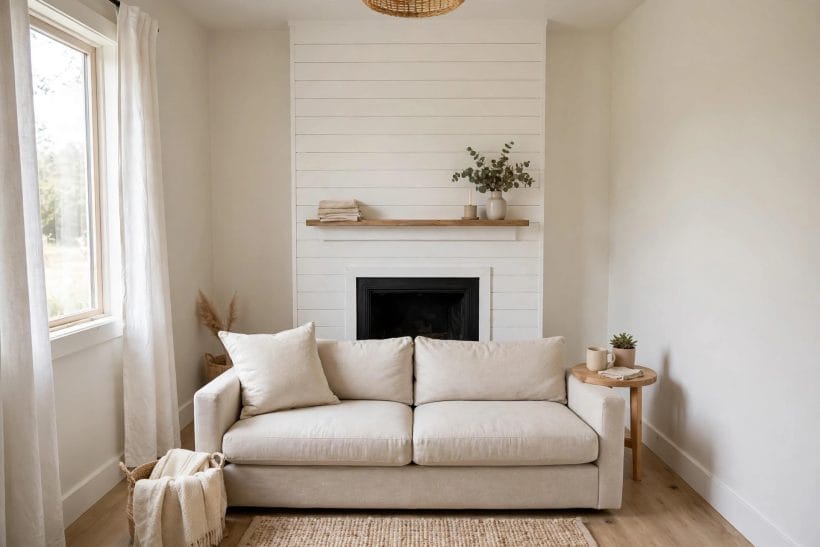
10. Care, Safety and Everyday Living
A board wall around a fireplace is easy to live with if it is cleaned as part of ordinary housekeeping. Dust the boards with a soft, dry cloth, working along the boards rather than across them, so dust does not settle in the shadow lines. Wipe the mantel in the same pass, and keep cleaning products away from the firebox and hearth. Painted boards can be wiped with a barely damp cloth where the paint finish allows, while natural timber should be kept dry and treated only with products suited to that timber.
Everyday safety habits matter more than any single product. Keep the hearth clear, keep flammable items away from the fire, and never leave a lit fire or candles unattended. Have the fireplace, flue and chimney checked and serviced on the schedule recommended for the type that is installed, by qualified professionals, and follow their advice about fuel and use. If a board near the fire ever shows heat damage, discolouration or a smell of scorching, stop using the fire and get professional advice before using it again. These are not decorating decisions; they are the conditions that let a beautiful wall stay safe to live with.
Children and pets change the habits slightly. A hearth guard, kept in place when the fire is lit, protects small hands and paws, and toys should have a basket away from the hearth so play does not drift toward the fire. Cushions and throws that migrate toward the fire during an evening should be returned to the sofa before the room is left. None of this needs to spoil the room. A basket by the sofa and a guard that matches the room keep safety looking like part of the furniture, not an afterthought.
Over time, boards may need repainting or refreshing, and the mantel may need a new finish. Treat that as a fresh decorating decision, not a repair to rush. Live with the wall through the seasons first, notice how the light changes it, and choose the next finish with the same care as the first. A board wall that is maintained gently, styled calmly and used safely will outlast any trend, because its appeal was never novelty. It was rhythm, warmth and a room that knows where to turn.
Final Considerations
A living room with a shiplap fireplace works when the wall is allowed to be calm. Choose a finish that suits your light, place the sofa so the fire is easy to watch, keep the colours warm and related, and light the room in layers so evening feels as settled as day. Style the mantel with a few pieces and empty space, keep the hearth clear, and leave every question of firebox, chimney, venting or fuel to qualified professionals.
If you remember one thing, let it be this: the boards are the backdrop, not the performance. The fire, the sofa and the people in the room are the performance. Build the wall to support them, and the room will feel right whether the fire is lit or not, in summer as well as in winter, for everyday evenings and for guests alike.


0 Comments