
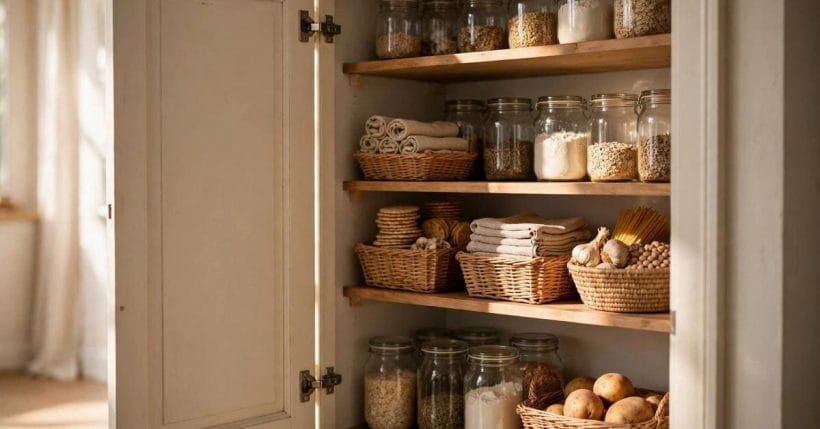
A small pantry is not a lesser pantry. It is a store that fits the kitchen you already have: a cupboard with doors that open onto neat shelves, a narrow gap beside the counter, a corner that would otherwise hold nothing, or a nook under the stairs. What matters is not how much room it takes, but how easily you can see what is there and reach what you use. When every shelf faces you and every group has a home, a small store can serve a busy kitchen without fuss.
This gallery stays with the small form throughout. You will find reach-in layouts, pull-out units, tall narrow shelves, corners, light colours and practical details, each shown the way it looks in a real kitchen. For the wider kitchen around the pantry, these small kitchen ideas set the scene, and the ideas below show how the store itself can earn its place.
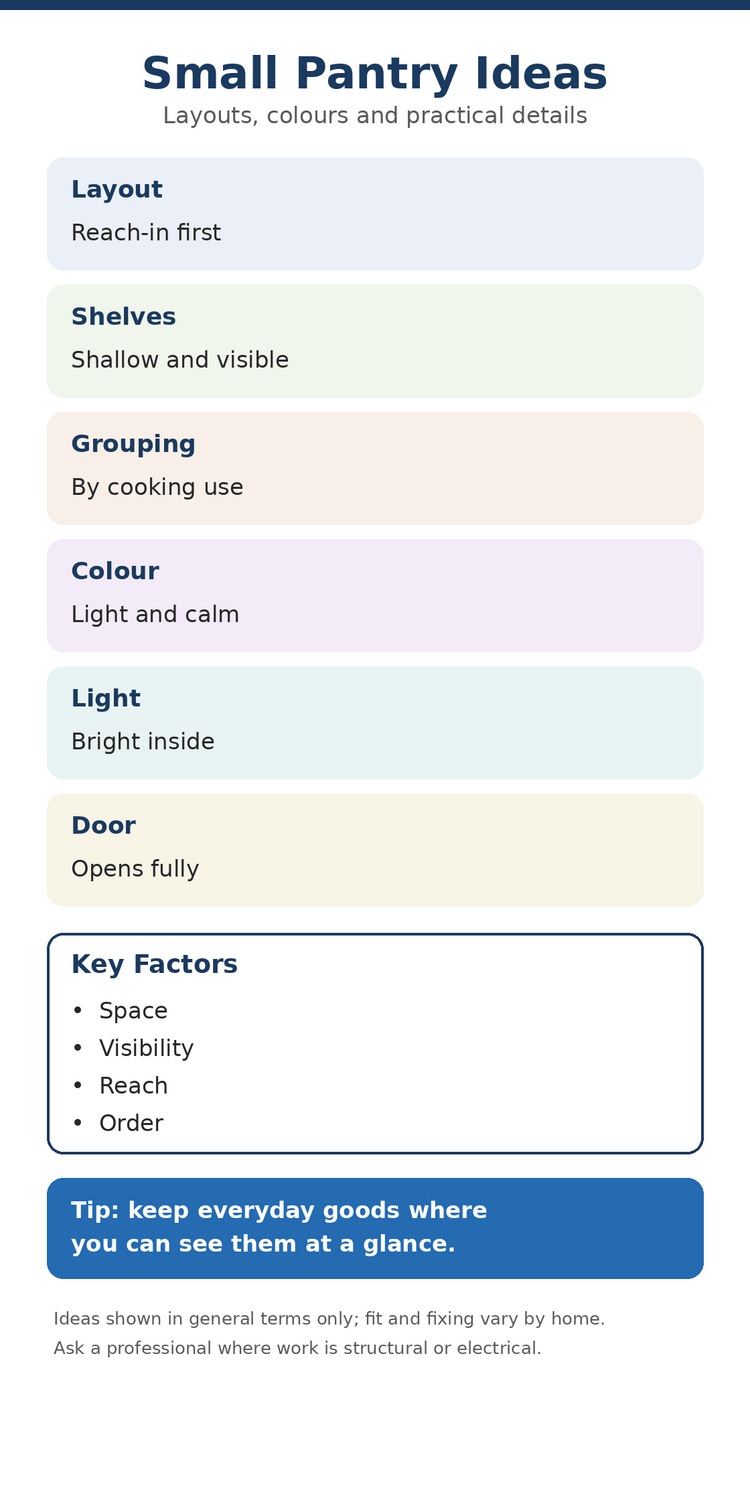
| Item | What it is |
|---|---|
| Start With the Reach-In Shape | The reach-in pantry is the shape most small kitchens already own, and it is a good place to start. |
| Let a Pull-Out Unit Carry the Narrow Gap | Many kitchens hold a narrow gap that seems too slim for anything useful: the strip beside the cooker, the space at the end of a run of units, or the gap between a tall cupboard and the wall. |
| Go Tall Where the Floor Runs Out | When the floor gives you nothing more, go up. |
| Corners That Earn Their Keep | A corner is the easiest place in a kitchen to waste, and the small pantry is one of the kindest ways to rescue it. |
| A Cabinet With Doors That Close the Day Away | Not every pantry wants to be on display. |
| The Under-Stair Nook, Put to Work | The space under the stairs is often the most overlooked corner of a home, and a small pantry fits its sloping shape beautifully. |
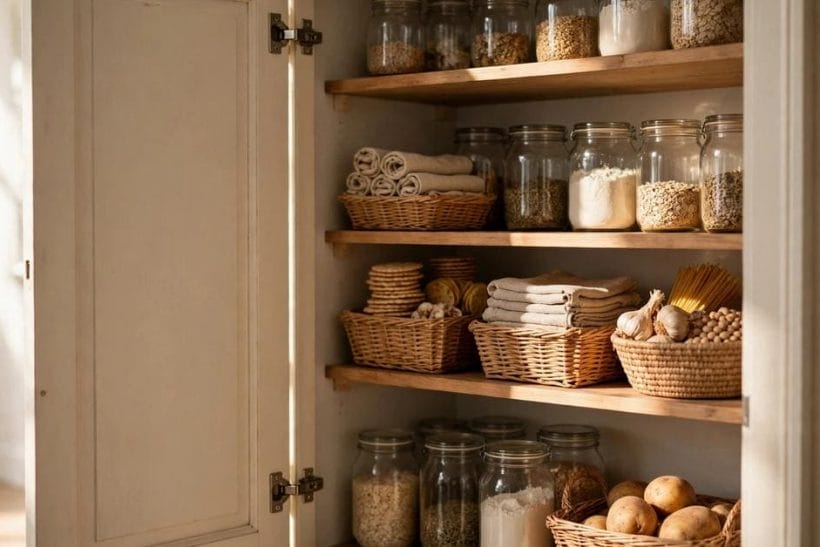
1. Start With the Reach-In Shape
The reach-in pantry is the shape most small kitchens already own, and it is a good place to start. Doors open, shelves face you, and everything sits in a single row that you can read at a glance. Nothing hides behind anything else, so you stop buying a second jar of something you already own and stop finding forgotten tins at the back. The shape works because it asks so little of the room: a cupboard front, a few shelves, and a door that opens fully.
Shallow shelves are the quiet secret of this shape. A shelf that holds one row of jars will always be easier to use than a deep shelf that swallows things in two rows. When the shelf is shallow, you see the whole store in one look, and putting the shopping away takes moments rather than a rearrangement. Baskets can sit on the lower shelves for loose things, while jars and tins stand above them in plain view.
Light helps the reach-in shape as much as any shelf. A pale interior bounces daylight around the cupboard, and a small light inside turns the back row from a shadow into a shelf like any other. Where wiring is involved, that work belongs to a professional, but the effect is worth planning: a pantry you can see into is a pantry you will actually use. The wider kitchen ideas around it matter too, because a pantry that sits near the cooking zone saves steps every single day.
2. Let a Pull-Out Unit Carry the Narrow Gap
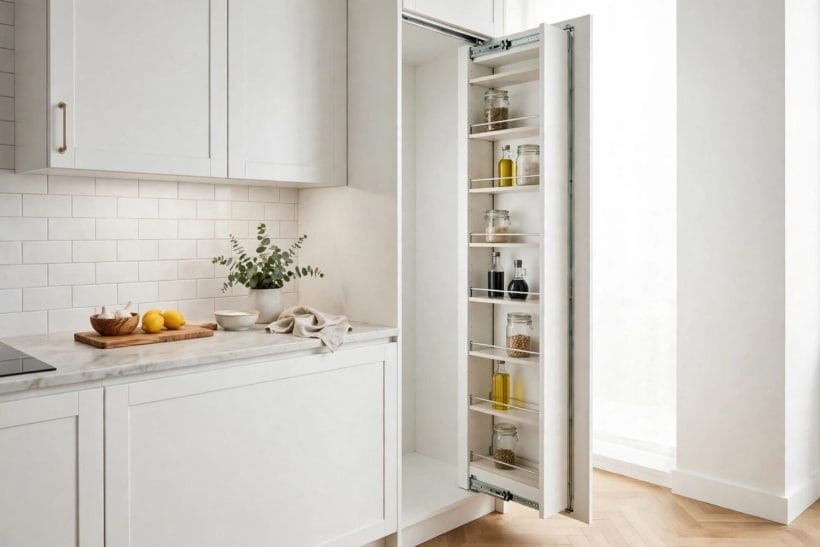
Many kitchens hold a narrow gap that seems too slim for anything useful: the strip beside the cooker, the space at the end of a run of units, or the gap between a tall cupboard and the wall. A pull-out pantry unit turns that strip into a store. Slim shelves ride out on runners in a single row, so you see everything as the unit slides towards you, and the whole thing closes away behind a door front that matches the kitchen.
The pull-out suits the small pantry because it wastes nothing. There is no dark corner and no second row to forget, only a tall, narrow column of shelves that you can scan from top to bottom. Everyday cooking goods can live at eye level, with taller bottles and spare stock lower down where their weight sits comfortably. A clear stretch of floor in front of the unit lets it slide freely, which is the one thing to plan before choosing this shape.
This is also a forgiving shape for a rented home or a kitchen that cannot be rebuilt, since the unit reads as furniture rather than a renovation. It pairs naturally with the rest of a compact kitchen, and the same thinking runs through many tiny house storage ideas, where every narrow gap is expected to work. Keep the shelves light enough to slide smoothly, group like with like, and the narrow gap becomes one of the hardest-working parts of the room.
3. Go Tall Where the Floor Runs Out
When the floor gives you nothing more, go up. A tall, narrow run of shelves from floor to ceiling can hold a surprising store in the width of a single cupboard, and it suits a small kitchen because it borrows height the room already has. The eye reads it as one calm column rather than a sprawl of cupboards, and the kitchen keeps its floor clear for moving around.
The trick with a tall pantry is giving every height a job. Everyday goods belong where your hands fall naturally, so cooking feels easy rather than a stretch or a crouch. Higher shelves can hold spare stock and things you reach for rarely, while the lowest shelves suit baskets for bulky or heavy goods that are awkward to lift from above. When each height has a purpose, the tall column stays orderly instead of drifting into a pile.
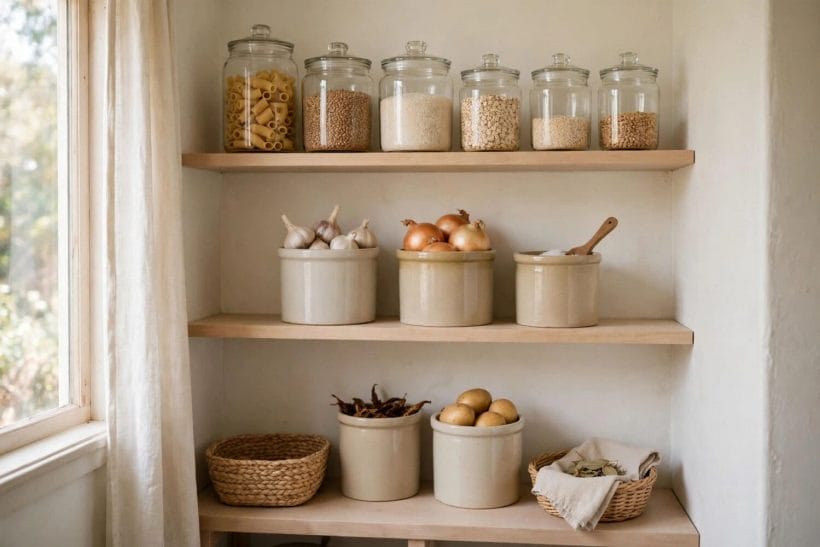
Glass jars and plain crocks help a tall pantry enormously, because you can see at a glance what each shelf holds without pulling everything out. Pale shelves and a light back keep the column bright from top to bottom, and a small step kept nearby for the highest shelf is safer than climbing on anything never meant for standing. Tall and narrow is a small-pantry shape at its best: modest on the floor, generous in what it holds.
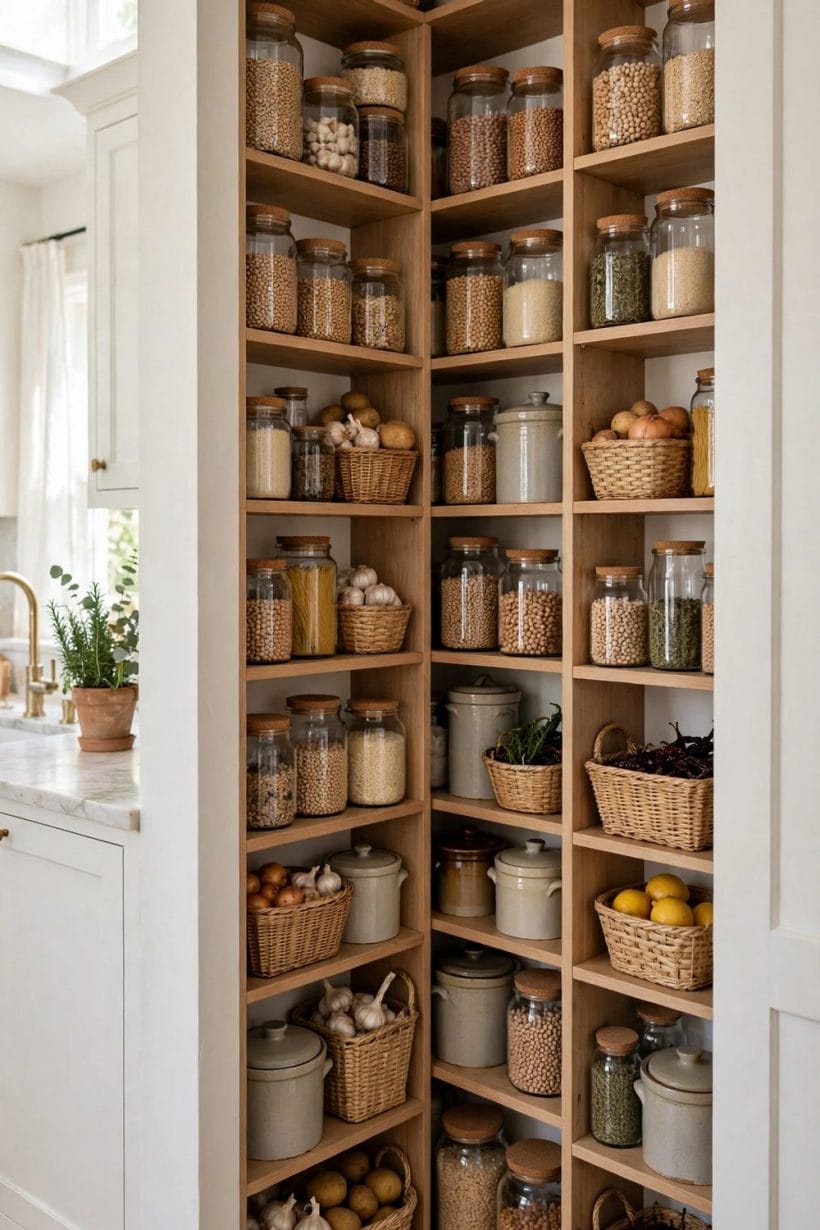
4. Light Colours That Open a Small Space
Colour does real work in a small pantry. Pale paint, light wood and white crocks bounce light around the shelves and make a tight cupboard feel open rather than cramped. A pantry painted in warm white with light timber shelves reads as part of the kitchen, not as a dark hole in it, and the food itself supplies the colour: golden grains, deep pulses, green herbs and terracotta pots against a calm background.
The calm palette also helps you find things. When the shelves and the walls stay quiet, the eye goes straight to the shapes and colours of the stores, and a jar stands out against its shelf instead of sinking into a busy pattern. That is why so many small pantries in this gallery wear the same gentle colours: the palette steps back so the store can step forward. A soft contrast, such as a pale shelf against a slightly deeper wall, can frame the pantry without shrinking it.
Light colours forgive a small space in another way too. Marks and dust show less dramatically on a matte pale surface than on a dark gloss one, and a quick wipe keeps the whole cupboard looking fresh. If you love a bold colour, save it for the inside of a door or a single accent shelf, where it gives pleasure without closing the space in. In a small pantry, colour should open the room first and decorate it second.
5. Corners That Earn Their Keep
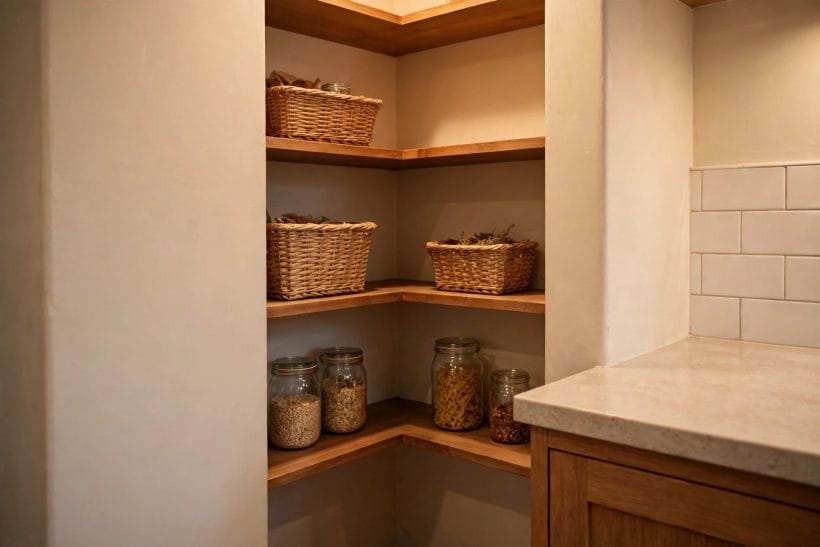
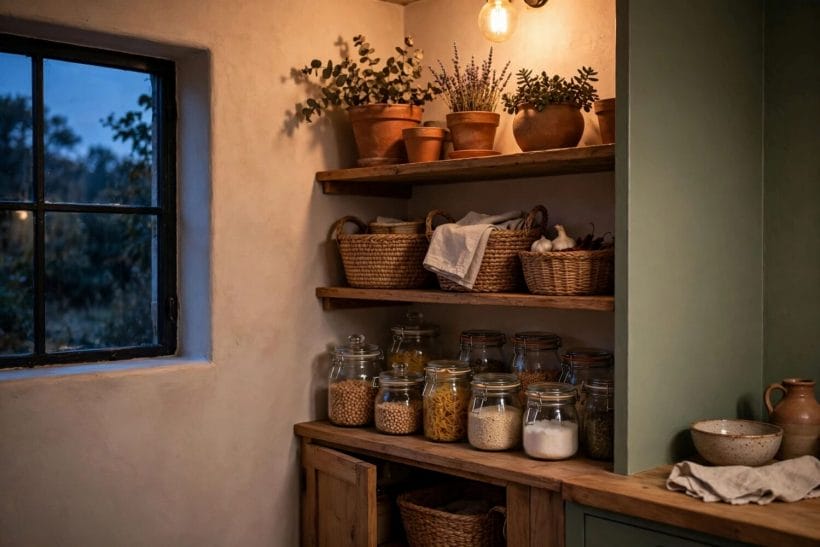
A corner is the easiest place in a kitchen to waste, and the small pantry is one of the kindest ways to rescue it. A short run of shelves wrapping a corner turns dead space into a store, and because the run is short, nothing sits so deep that it disappears. Baskets on the lower shelves hold loose goods, jars stand above them, and the whole corner reads as one tidy nook rather than a forgotten angle.
The corner pantry works best when it stays shallow. Two short arms of shelving, each holding a single row, will serve you better than a deep corner that hides half its stock. Keep the corner near the cooking zone if you can, since a store you pass while cooking gets used far more than one tucked at the far end of the room. The corner in this gallery sits right beside the counter, so putting away the shopping and reaching for a jar are part of the same easy movement.
Timber shelves warm a corner that could otherwise feel bare, and woven baskets soften the straight lines of the walls. The shape also suits homes where the kitchen itself is small, because it asks for no extra floor and no new room. For the wider question of how a compact cooking space comes together, tiny house kitchen design shows the same corner-first thinking at the scale of a whole room. A corner that earns its keep is a small pantry doing exactly what it should.
6. A Cabinet With Doors That Close the Day Away
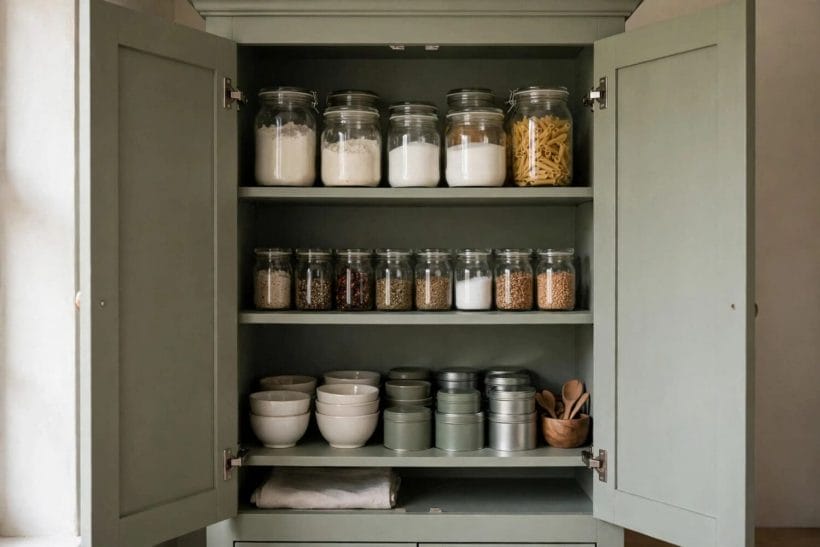
Not every pantry wants to be on display. A cabinet with doors gives you the same store with the option of closing it away, and for many kitchens that is the calmer choice. Open the doors and the shelves stand in tidy rows; close them and the kitchen returns to a plain run of cabinetry. The shape suits a small pantry because it hides the everyday variety of jars, tins and packets behind one quiet front.
Painting the cabinet a soft colour, such as a muted green, lets it sit gently among the other units while still feeling like a piece of furniture in its own right. Inside, the same rules apply as anywhere else in a small store: shallow rows, groups by cooking use, and baskets below for loose things. A painted interior in a deeper tone can make the jars glow when the doors open, turning an ordinary moment of reaching for a tin into a small pleasure.
Doors also protect the store from kitchen steam and dust, which keeps jars cleaner and labels easier to read. The one detail to honour is the swing: doors should open fully without meeting a handle, a wall or a neighbouring unit, so you can stand in front of the whole pantry at once. When the doors open wide and the shelves read clearly, a closed cabinet becomes the tidiest small pantry of all.
7. The Under-Stair Nook, Put to Work
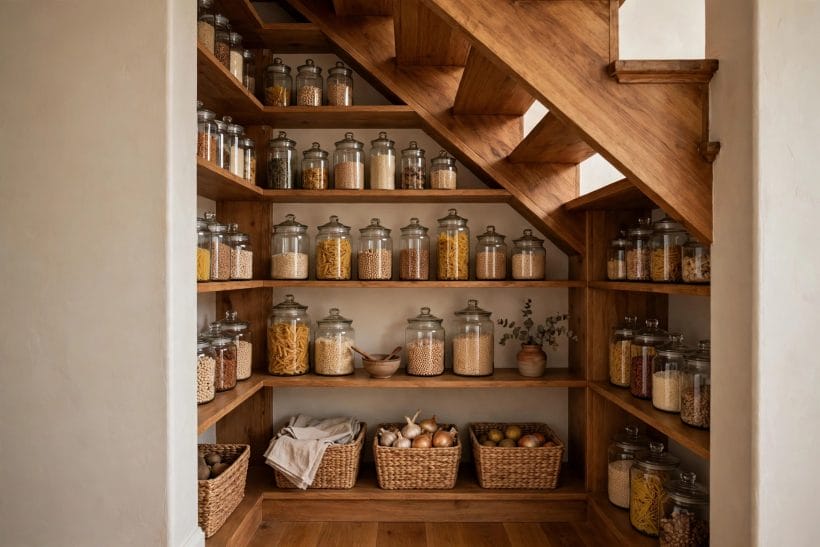
The space under the stairs is often the most overlooked corner of a home, and a small pantry fits its sloping shape beautifully. Low baskets slide into the lowest part of the slope, jars stand where the ceiling rises, and a run of shelves follows the line of the stair above. What was once a dusty triangle becomes a store that sits a few steps from the kitchen and holds the goods a busy household reaches for daily.
The slope itself tells you how to arrange the nook. Heavy and bulky things belong low, where they are easy to lift and cannot fall far, while lighter jars and tins rise with the ceiling. An open front keeps the whole nook visible and easy to use, though a simple door can close it away when you prefer a plainer wall. Either way, the nook should feel like part of the home rather than an afterthought, with shelves that fit the slope instead of fighting it.
Because the nook borrows space the house already owns, it suits homes where the kitchen cannot grow. The same spirit runs through the wider kitchen design ideas in this gallery: use the shape you have, let the shelves follow it, and keep everything visible. Where the nook needs new shelves fixed to the wall or a light wired inside, that work belongs to a professional, but the idea itself is simple, and the result is a pantry that takes no room from the house at all.
8. A Bold Interior for a Small Space
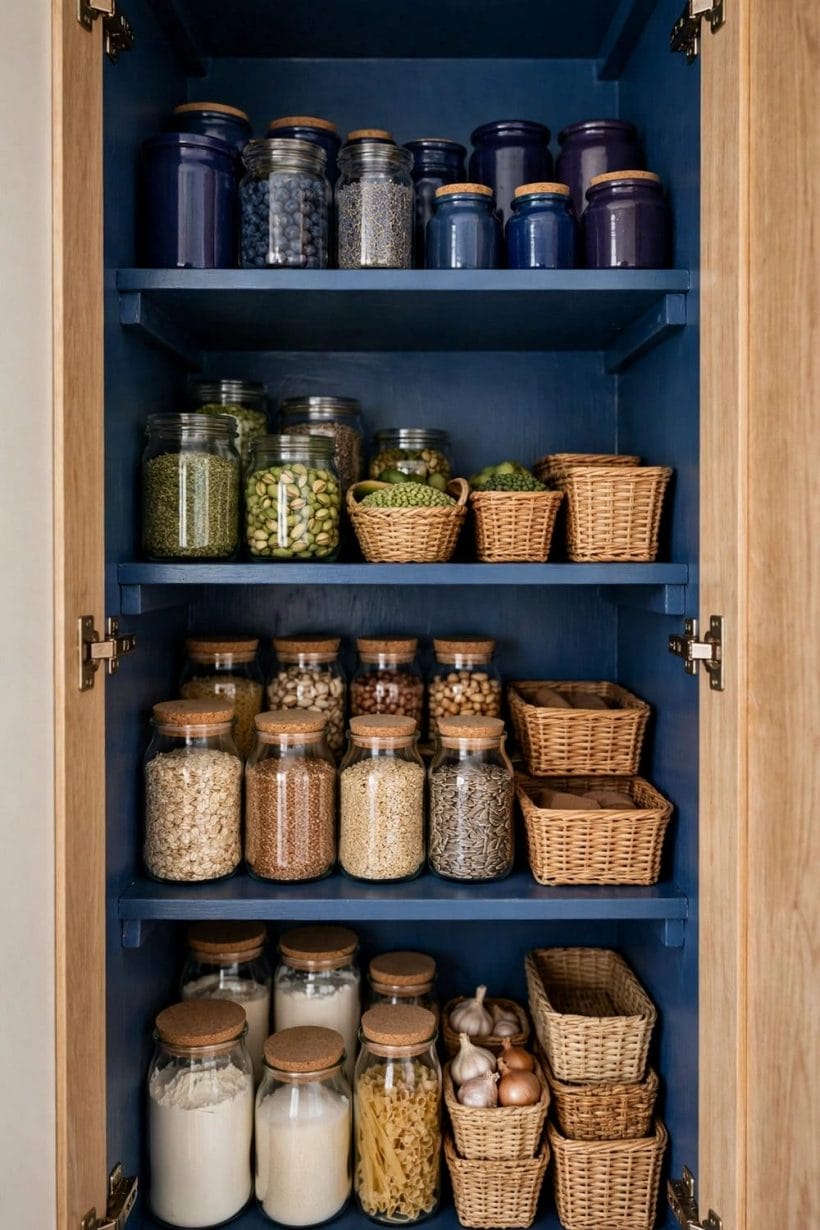
A small pantry does not have to whisper. Painting the inside of a cupboard a deep, confident colour turns the moment the doors open into a small event, while the closed doors keep the kitchen calm. Deep blue shelves behind pale doors give jars and baskets a rich backdrop, and the colour groups the store visually so each shelf reads as a band of its own. Bold inside, quiet outside is a combination that suits small rooms particularly well.
The trick is letting the bold colour work for order rather than against it. When the interior is dark, pale jars, woven baskets and light crocks stand out crisply, so finding things stays easy. Grouping by colour as well as by use can help here: grains together, pulses together, baking goods together, each group a shape you recognise before you read anything. Keep the bold paint to the interior and a single accent, and the pantry stays a pleasure rather than a shout.
A bold interior also forgives the variety of a real store. Packets, jars and tins in many colours sit more happily against one strong background than against a busy pattern, and the whole cupboard looks intentional even on a day when the shopping has just been piled in. Open, it is a display; closed, it is a quiet door. That double life is exactly what a small pantry needs.
9. Light That Reaches the Back Row
A pantry is only as good as its darkest shelf, and in a small store the back row is often the one that decides whether the pantry works. Light that reaches the back turns a guessing game into a glance: you see the jar you want, you reach for it, and nothing is bought twice or left to linger. Pale backs, glass jars and a light inside the cupboard all push brightness to the very back, and each one is a small change with a daily reward.
Evening cooking shows the value of pantry light most clearly. When the kitchen is lit for cooking, a pantry without its own light falls into shadow just when you need it, while a lit pantry stays as readable as it was at midday. If the light needs wiring, that work belongs to a professional, but many pantries gain enormously from daylight alone when their doors face a window or their shelves wear a pale finish. Position matters as much as any fitting: a pantry that catches the light of the room will always serve better than one turned away from it.
Glass is the pantry keeper’s friend here. Clear jars show their contents without opening, so the back row announces itself instead of hiding, and plain crocks with open tops do the same for garlic, onions and other kitchen staples. Keep the back row for things you recognise by shape and colour, keep the front row for the day’s cooking, and let the light do the rest. A bright pantry is a used pantry, and a used pantry is an orderly one.
10. An Order That Holds After the Shopping Comes Home
The hardest day for any pantry is the day the shopping comes home, when bags of new goods meet shelves that are already full. A small pantry survives that day through groups, not through space. When every group has a home, putting away becomes a matter of returning each thing to its place rather than finding a gap anywhere it fits. Cooking goods together, baking goods together, breakfast goods together: the groups do the remembering so you do not have to.
Baskets are the small pantry’s best friend on shopping day. A basket gathers the loose things that would otherwise drift across a shelf: small packets, spice jars, snack bars and all the odds and ends that make a shelf look untidy. One basket per group keeps the shelf readable even when the shopping is generous, and lifting a basket out to reach the shelf behind it is far easier than moving a dozen small things one by one.
Clear jars complete the order by showing what is inside, which means you reach for the right thing the first time and the shelves stay as you left them. The order that holds is never a rigid system; it is a few groups, a few baskets and a habit of returning things to their home. Kept that way, a small pantry stays the calmest corner of the kitchen, week after week, whatever the shopping brings.
Final Considerations
A small pantry rewards the same few decisions wherever it sits: a shape that faces you, shelves shallow enough to read at a glance, groups by cooking use, light colours that open the space, and light that reaches the back row. Whether your store is a reach-in cupboard, a pull-out unit, a tall narrow column, a corner nook or a space under the stairs, those decisions matter more than the size of the room around it. Start with the shape your home already offers, and let the shelves follow it.
Keep the practical details gentle as well. Doors should open fully, baskets should lift out easily, and anything that needs fixing to a wall or wiring into the home belongs to a professional. The pantry itself should ask little of you beyond returning each thing to its group, and in return it gives you a kitchen where cooking starts with a glance rather than a search. For the wider habits that keep a compact home orderly, these tiny house organization strategies carry the same ideas beyond the pantry door.
Look at the gallery once more and notice which shape matches the corner, gap or cupboard you already have. That is your small pantry: not a room to build, but a space to see clearly, group simply and use every day.

0 Comments