
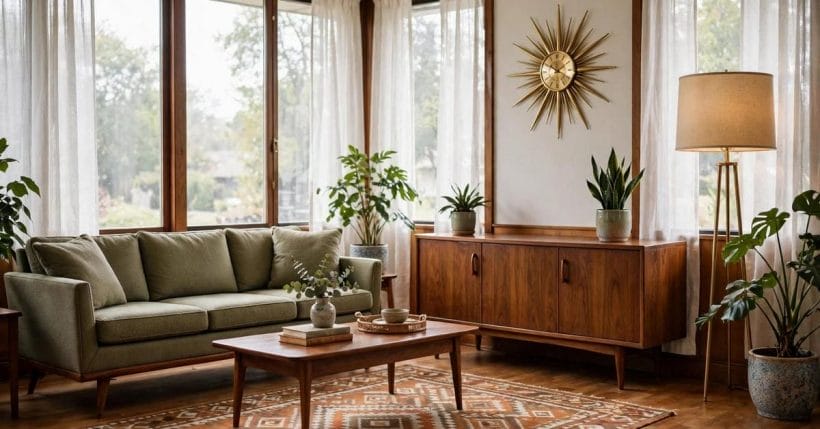
A 1950s living room has a feeling that is easy to recognise and hard to fake. It is not about filling a room with old-looking objects. It is about a particular balance: low furniture that lets the room breathe, warm wood against soft colour, daylight in the daytime and lamplight in the evening, and a layout that invites people to sit and talk rather than to admire a display. When those pieces work together, the room feels calm, welcoming and unmistakably of its decade, even in a modern home.
This guide stays inside one decade and one room. It does not re-teach the earlier decade survey, and it does not wander into bedrooms, kitchens or whole-house histories. Everything here is about the living room only: how it is laid out, what its sofa should feel like, which colours suit it, how its wood is used, and how its lighting is layered through the day. The advice is general throughout. No single product is recommended, no maker is named, and no measurement, code or price is given, because a style guide should help you recognise the character and shape your own room, not hand you a shopping list. For a sense of how living rooms sit within whole homes, see these tiny house interiors, where every room has to earn its place.

1. What Makes a Living Room Read as 1950s Midcentury
The first thing to notice is the height of the room. Midcentury living rooms sit low. Sofas are low, with slim cushions and legs you can see beneath. Coffee tables are low, sideboards are long rather than tall, and shelves stay at a height where books and objects can be reached without stretching. That low profile changes the whole feeling of the room. The walls seem taller, the windows seem larger, and the eye travels across the room instead of climbing up it. Nothing looms, and nothing shouts.
The second thing is the mix of materials. Warm wood is the thread that runs through the room, usually in a medium to dark walnut tone, joined by soft upholstery, woven rugs, ceramic lamps and a little metal or glass where a lamp base or a table edge needs it. Colour is warm but restrained: creams and soft whites on the walls, warm neutrals on the larger pieces, and muted accent tones on cushions, throws and art. The room never looks like a paint chart. It looks like a place where someone chose a few colours they liked and then lived with them for a long time.

2. Start With the Layout: Conversation First
The layout of a 1950s midcentury living room begins with a simple question: where do people sit, and can they talk to each other easily? The sofa usually anchors the arrangement, facing a coffee table with one or two chairs drawn in at an angle. The chairs do not line up stiffly against the walls. They turn slightly inward, so that everyone seated can see each other without twisting around. A fireplace, where one exists, often gives the arrangement a second focus, but it does not take over the room. The seating still faces inward, toward people, rather than lining up in a row toward a single screen or feature.
Space around the seating matters as much as the seating itself. People need room to stand, to carry a cup across the room, and to pull a chair a little closer without scraping furniture. In smaller rooms this matters even more, because a layout that looks generous on paper can feel crowded once the furniture arrives. It helps to walk the room as it will be used, imagining the paths between the door, the seats and the window, and to leave those paths clear. These small living room ideas show how much a compact room can hold when its layout is planned around use rather than around filling every wall.

3. First Impressions: The Pieces That Set the Decade
Some rooms announce their decade in the first glance, and some only reveal it slowly. A 1950s midcentury living room usually does the former, but quietly. The eye picks up the low sofa, the long sideboard, the sunburst or abstract shape on the wall, and the floor lamp standing in a corner, and the decade reads clearly without any single piece trying too hard. That is the standard to aim for. If one object has to do all the work, the room will feel like a theme rather than a home.
It helps to think of the room in three layers: the large pieces, the middle pieces and the small touches. The large pieces are the sofa, the main chairs and the sideboard. The middle pieces are the coffee table, the side tables and the lamps. The small touches are the cushions, the throws, the plants and the art. When the large pieces carry the decade honestly, the smaller pieces can be simple and the room still reads clearly. These tiny living room ideas show the same principle in compact rooms, where a few well-chosen pieces matter more than a crowded collection.

4. The Sofa: Low, Slim and Easy to Live With
The sofa is the heart of the 1950s midcentury living room, and its shape tells you most of what you need to know. It sits low, with a straight, uncluttered back and arms that are slim rather than rolled and padded. The cushions are slim too, and the whole piece rests on short, tapered wooden legs that lift it just clear of the floor. That lift matters. It keeps the sofa from looking like a heavy block, it lets the rug and the floor show beneath it, and it makes the room feel lighter and easier to clean around.
Comfort in this style is quiet rather than enveloping. The seat is firm enough to sit upright for conversation, yet soft enough to linger in through an evening. Deep, sinking seats and high, sheltering backs belong to other styles, and they change the posture of the whole room. Fabric suits the decade better than shine: warm wool, soft linen and other matte weaves in plain or gently textured finishes. A sofa chosen for its shape and its fabric, rather than for a pattern or a novelty, will sit happily in the room for years and will let the cushions and throws carry the colour.

5. Colour: Warm Neutrals With Muted Accents
Colour in a 1950s midcentury living room works by restraint. The walls are usually warm and pale: soft cream, gentle off-white, or a pale warm tone that lets daylight do its work. The larger furniture pieces stay in warm neutrals or in the natural tone of their wood. Colour then arrives in smaller amounts, through cushions, a rug, a throw, or a piece of art, in muted tones such as mustard, teal, olive, rust or soft orange. Because the accents are muted rather than bright, they warm the room without competing with each other.
The safest way to build the palette is to start pale and add colour slowly. Choose the wall tone first, then the sofa fabric, then one accent colour for cushions and a second, quieter accent for the rug or the art. If the two accents argue with each other, the room will feel restless no matter how good the furniture is. Where the living room opens toward a dining space or a kitchen, carrying one of the accent tones gently through the joining rooms helps the whole home feel connected. For a sense of how colour travels through open rooms, see these kitchen ideas, where the same warm, restrained palette keeps a busy room calm.

6. Layered Lighting: Daylight, Lamps and a Soft Evening Glow
Lighting is where a 1950s midcentury living room most shows its character, and it is layered rather than switched on all at once. In the daytime, the room relies on daylight through large windows, softened by sheer curtains that glow without blocking the light. The windows themselves are part of the style: generous, often stretching across a good share of the wall, and dressed simply. Heavy, ornate curtains would fight the room. Light, plain curtains, or bare windows where privacy allows, suit it far better.
In the evening, the room shifts to lamps. A floor lamp beside a reading chair, a table lamp on a sideboard or side table, and a soft overhead light used sparingly together create pools of warm light rather than one flat brightness. The shades are usually simple: drum or cone shapes in fabric that warm the light as it passes through. Ceramic, wood and metal lamp bases all suit the decade, and the lamp itself can be one of the prettiest objects in the room. Any wiring, fitting or electrical change belongs to a qualified professional throughout, and nothing here is a guide to electrical work. The goal is simply the feeling: a room that glows gently in the evening, with light where people sit and softer light everywhere else.

7. Corners, Shelves and the Things You Collect
A midcentury living room is rarely a bare room. Its corners hold the things that make it personal: a bookshelf with books and a few objects, a low cabinet with records or a player, a reading chair with a lamp beside it, and plants in ceramic pots softening the edges of the wood. The trick is to let these corners breathe. A bookshelf looks better with some empty space on its shelves than with every shelf packed tight, and a single plant in a good pot does more for a corner than a crowd of small ones.
Storage deserves the same care as display. A long sideboard can hide a great deal while looking calm from the outside, and closed storage keeps the room from drifting into clutter. Open shelves suit books and a few chosen objects, while everything else is better behind a door. That balance between showing and hiding is what keeps a collected room feeling relaxed rather than busy. These tiny house storage ideas show the same balance in small homes, where every shelf and cupboard has to work hard without making the room feel full.

8. Textiles and Warmth: Rugs, Throws and Cushions
Textiles are what stop a midcentury living room from feeling hard. Wood, metal and glass dominate the furniture, so the room needs wool, linen and woven cotton to soften it. A rug anchors the seating area and warms the floor underfoot, and its pattern can carry one of the room’s accent colours without shouting. The pattern is usually geometric or simply textured rather than fussy: a repeating motif, a border, or a plain weave with a visible texture that catches the light.
Cushions and throws do the smaller, warmer work. A few cushions in the room’s accent tones, a throw folded over an arm or draped across a chair, and a soft blanket within reach on a cold evening all make the room feel lived in. The colours should stay within the palette already chosen, so that the textiles deepen the room rather than starting a new one. Natural fibres suit the decade and feel better against the skin than shiny synthetics, and their slightly imperfect texture suits a room built from warm wood and soft light.

9. Small Rooms: The Style in a Compact Home
The midcentury living room translates well to a small home, because its furniture is already low, slim and light on its feet. A compact room does not need a smaller version of every piece. It needs fewer pieces, chosen well: a sofa that fits the wall without crowding it, one good chair rather than two cramped ones, a slim sideboard instead of a tall cabinet, and nesting or slim side tables that can move where they are needed. Each piece should do more than one job where possible, and nothing should block the window or the path through the room.
Light and colour matter even more when space is tight. Pale walls, a rug that defines the seating area without covering the whole floor, and lamps rather than a single overhead light all help a small room feel open. Mirrors and glass can help too, but only where they sit naturally; a mirror placed simply to enlarge a room often looks like exactly that. The honest approach works better: accept the size of the room, choose low and slim pieces, and let daylight and lamplight do the enlarging. For a sense of how compact plans hold these rooms, see these tiny house floor plans, where the living room must share its space gracefully with everything else.

10. Keeping the Look Honest: What Not to Force
The easiest way to spoil a 1950s midcentury living room is to force it. A room stuffed with decade objects, all shouting at once, feels like a set rather than a home. A single strong piece, such as a good sofa or a handsome sideboard, surrounded by simpler things, reads far more honestly than a room where every object is trying to prove the decade. The same applies to colour: one or two muted accents, repeated calmly, beat a rainbow of bright tones that fight the wood.
It also helps to respect the home the room sits in. A midcentury living room inside a modern house does not need period walls or a period fireplace to work. The furniture, the palette and the lighting carry the character, and the room can sit happily beside modern kitchens, modern bathrooms and modern windows. Where a fireplace exists, it can be enjoyed as it stands, with any firebox or chimney work left to a qualified professional. For a calm check of the whole home around the room, see this building a tiny house checklist, which reminds you to settle structure, services and safety with professionals before decorating anything.
Final Considerations
A good 1950s living room is ultimately a room for people. Its low sofa invites sitting, its chairs turn toward conversation, its lamps glow where people gather, and its warm wood and muted colour make the room feel settled rather than staged. If you remember nothing else, remember the balance: low furniture, warm wood, restrained colour, and light in layers. Get those four things right, and the smaller choices will mostly take care of themselves.
Start with the sofa and the lighting, add colour slowly, and give every piece room to breathe. Leave structural, electrical and fireplace work to qualified professionals, and let the room grow gradually rather than arriving all at once. A living room that grows this way, piece by piece and season by season, ends up feeling like it has always belonged to the people who live in it, which is the truest test of any style from any decade.


0 Comments