
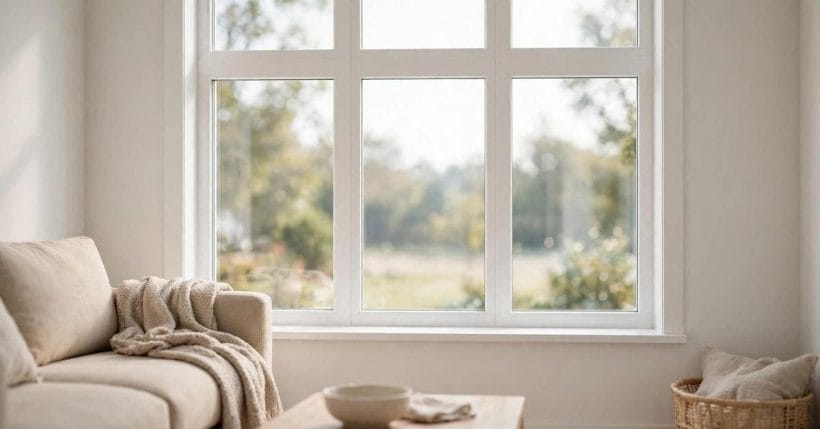
Window trim is the frame that decides how a window sits in a room. In a modern interior, that frame is quiet. It does not compete with the view, the furniture, or the wall around it. Instead, it gives the window a clean edge, carries the eye calmly from wall to glass, and lets daylight do the work. When you look at window molding images of modern rooms, the trim often seems almost invisible at first glance, and that is the point. The simplicity is deliberate, and it is what makes the whole room feel calm, ordered, and current.
This guide looks at modern window trim style only: the profiles, materials, rooms, and pairings that give windows a contemporary finish. It is a style guide for choosing and briefing a look, not a fitting guide. Trim installation, and any work that touches the window, the wall structure, or the surrounding finishes, belongs with a qualified professional. The ideas here help you describe what you want and recognise it when you see it, so the finished result matches the room you have in mind. For the wider room around the window, interior design ideas can help you see how trim sits with furniture, light and colour.
Start with the room, not the catalogue. Notice how much daylight the window receives, how the wall colour behaves through the day, and whether the room already has strong lines from shelving, doors, or furniture. Modern trim works best when it agrees with those existing lines rather than introducing a new pattern. A single, consistent trim language carried through the rooms you see together will always feel more modern than a different flourish at every window.
| Item | What it is |
|---|---|
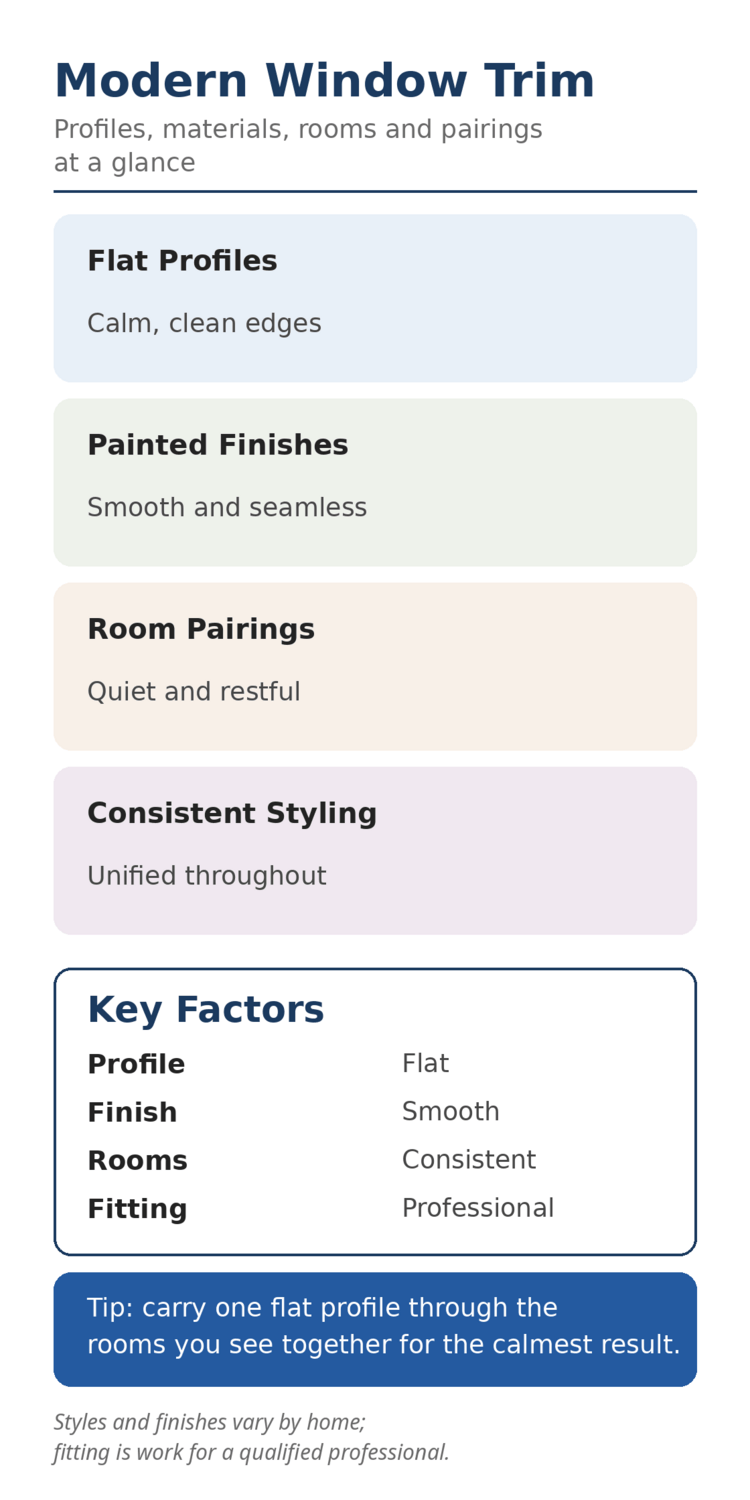
| What Makes Trim Look Modern | Modern trim is defined less by ornament than by restraint. |
| Flat Profiles and Clean Shadow Lines | The most recognisable modern profile is the flat board: a plain, smooth face with a square edge, running evenly around the window. |
| Materials That Suit a Modern Finish | Painted timber is the classic choice for modern trim, because it takes a smooth finish and can be matched to the wall or to the room's other painted woodwork. |
| Modern Trim in Living Rooms | Living rooms are where modern trim earns its keep, because they usually hold the largest windows and the most daylight. |
| Modern Trim in Bedrooms | Bedrooms ask trim to be even quieter. |
| Modern Trim in Kitchens and Bathrooms | Kitchens and bathrooms test trim in a different way, because these rooms deal with steam, splashes, and frequent cleaning. |
| Pairing Trim With Wall Colour and Flooring | The most reliable modern pairing is trim that relates to the wall rather than shouting against it. |
| Pairing Trim With Window Styles and Light | Modern trim suits most contemporary window styles, because its simplicity does not argue with the window itself. |
| Keeping the Look Consistent From Room to Room | Consistency is the quiet discipline behind every successful modern trim scheme. |
| Briefing a Professional for a Clean Finish | A modern trim look depends on execution, so the briefing matters as much as the choice of profile. |
1. What Makes Trim Look Modern
Modern trim is defined less by ornament than by restraint. Traditional trim often layers curves, beads, and stepped mouldings into a profile that draws attention to itself. Modern trim pares that back to flat planes and crisp edges, so the window opening reads as a simple, confident shape in the wall. The eye notices the proportion of the opening and the quality of the finish, rather than the decoration around it.
That restraint also changes how a room feels. A heavily moulded frame can make a wall feel busy, especially where several windows sit close together. A flat, quiet frame lets the wall breathe and gives furniture, art, and textiles room to speak. In smaller rooms this calm matters even more, because every visual interruption is felt more strongly when the walls are close.
Modern does not mean cold. A quiet profile can still feel warm when it is paired with natural timber tones, soft wall colours, and daylight. The warmth comes from the room as a whole, not from applied decoration on the trim itself. When the trim steps back, the materials and light of the room step forward, and that balance is the heart of the modern look.
2. Flat Profiles and Clean Shadow Lines
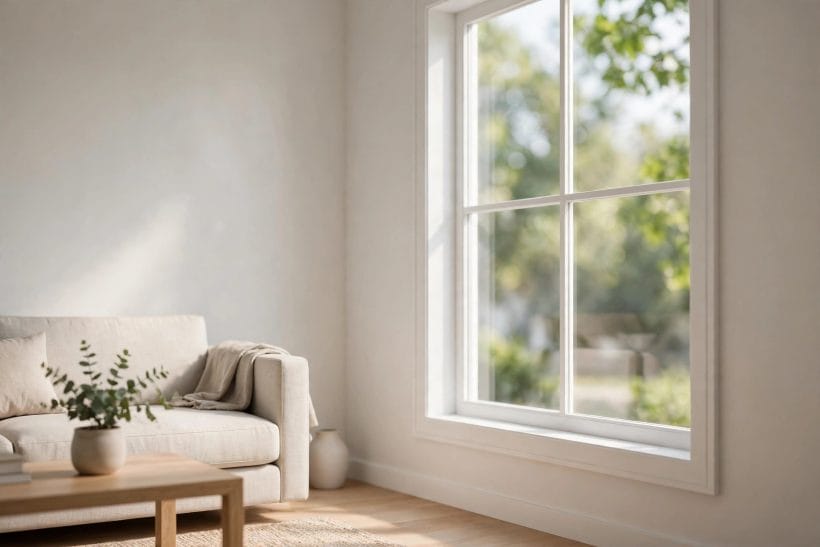
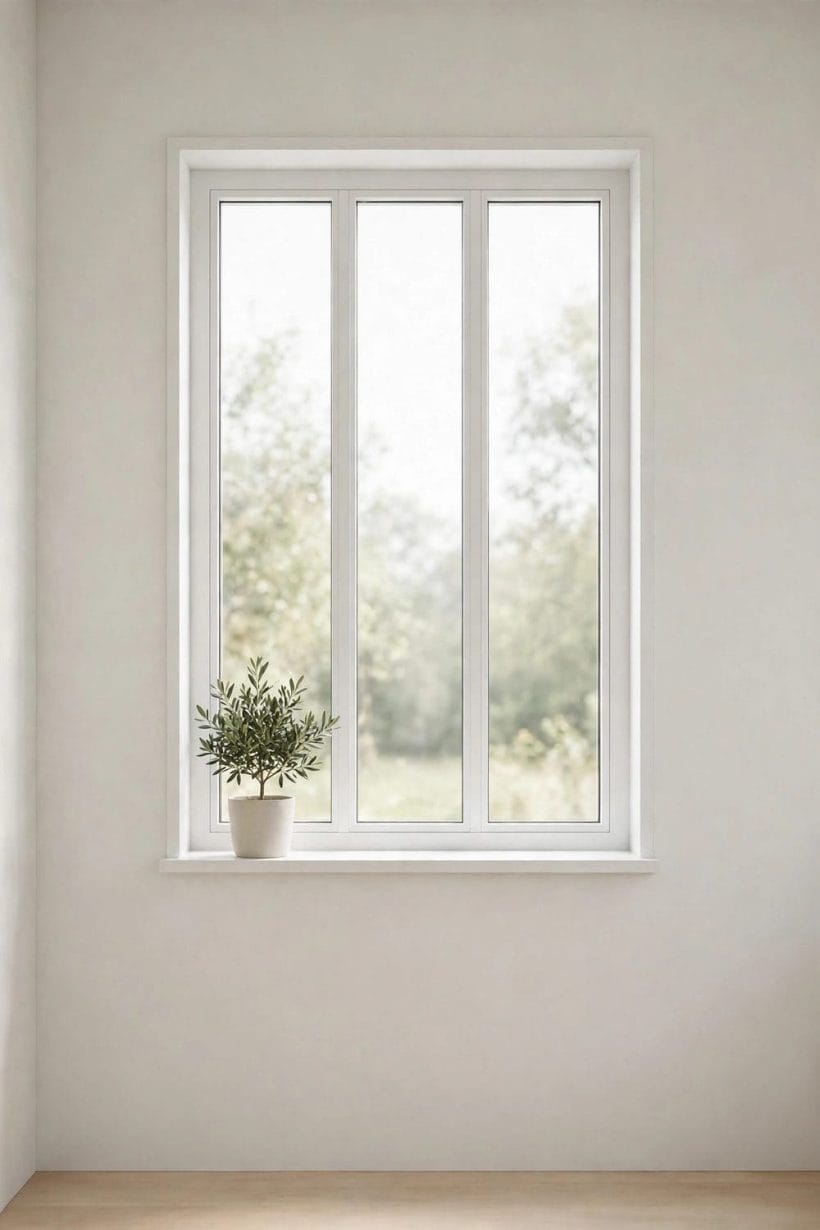
The most recognisable modern profile is the flat board: a plain, smooth face with a square edge, running evenly around the window. It has no curves to catch dust or shadow, and it meets the wall in a single clean line. Used consistently, it gives a house a calm architectural rhythm, window after window, without any single window demanding attention.
A close relative is the barely-there edge, where the trim is reduced to a slim, flat frame that reads almost like a border drawn around the glass. This approach suits rooms where the view is the feature, because the frame stays out of the way. It also suits rooms with strong horizontal lines, such as long shelving or a low sideboard, because the slim frame does not fight those lines.
Shadow lines deserve attention even though they are subtle. Where trim meets wall, a crisp, even joint reads as careful work, while a wavy or uneven joint reads as unfinished, however good the profile. When briefing a professional, ask to see how the joints at the corners are finished and how the trim meets the sill and the wall, because those small junctions are where the modern look is won or lost.
3. Materials That Suit a Modern Finish
Painted timber is the classic choice for modern trim, because it takes a smooth finish and can be matched to the wall or to the room’s other painted woodwork. A well-prepared painted surface looks seamless, which is exactly what the modern style asks for. It also allows the trim to change with the room: when the wall colour changes, the trim can change with it, keeping the whole scheme coherent.
Painted composite boards offer a similar smooth face and are often chosen for their stability and even finish. They suit rooms where a flawless painted surface matters more than a visible wood grain. Natural timber, left with a clear finish, is the warmer alternative. It brings grain and tone into the room and pairs beautifully with wooden floors and furniture, though it asks the room to accept timber as a visible material rather than a painted background.
Whatever the material, the finish is what the eye actually reads. A smooth, even coat with no drips, brush marks, or rough patches will look modern; a rough or patchy coat will not, whatever profile sits beneath it. If existing trim is being refreshed rather than replaced, preparation matters more than the final coat, and that preparation, along with any removal or refitting, is work for a professional.
4. Modern Trim in Living Rooms
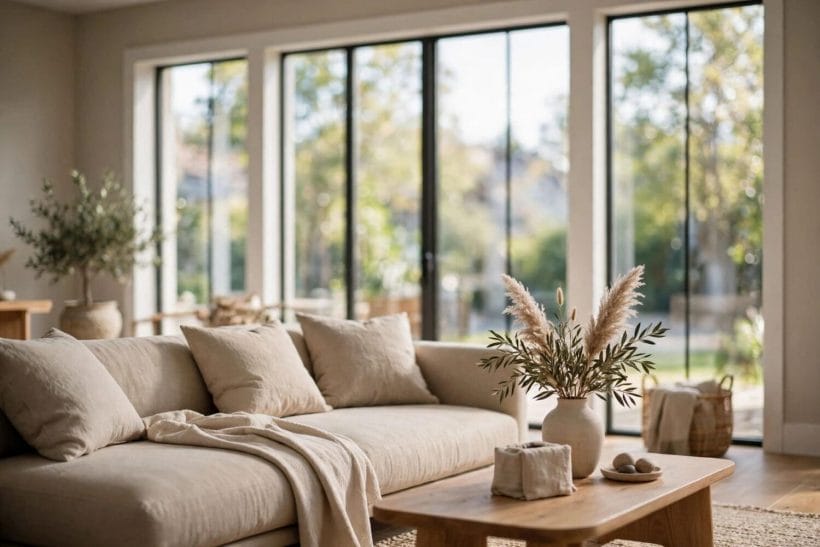
Living rooms are where modern trim earns its keep, because they usually hold the largest windows and the most daylight. A flat, pale frame around a generous window keeps the focus on the light and the view, while giving the wall a finished edge. Where a living room has several windows, carrying the same profile across all of them ties the wall together and stops any one window from looking like an afterthought.
Colour pairing in a living room is usually quiet. Trim that matches the wall colour lets the window dissolve into the wall, which suits a calm, gallery-like room. Trim in a contrasting pale tone against a deeper wall colour frames the window more boldly and can give a plain wall a sense of architecture. Both approaches are modern; the choice depends on whether you want the window to disappear or to be quietly announced.
Consider the furniture the window faces. A sofa, a reading chair, or a low media unit all sit in conversation with the window wall, and trim that is too fussy will compete with them. Flat trim leaves the conversation to the furniture and the light, which is why it photographs so well in modern living rooms and why it continues to feel fresh as furniture changes over the years. In tighter rooms, small living room ideas show the same flat, calm approach working at a smaller scale.
5. Modern Trim in Bedrooms
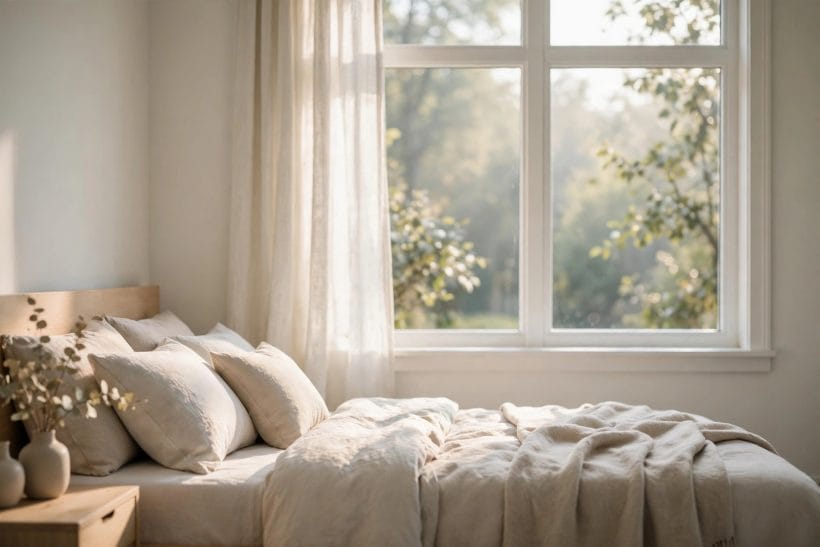
Bedrooms ask trim to be even quieter. This is a room for rest, and a busy frame around the window works against that mood, especially first thing in the morning when daylight is the first thing you see. Flat trim in a soft, restful tone keeps the window calm and lets bedding, curtains, and natural light set the mood instead.
Bedroom windows often sit beside wardrobes, headboards, or dressing tables, so the trim needs to agree with those neighbours. A slim, flat profile is forgiving here: it does not clash with the straight lines of fitted furniture, and it does not demand attention beside a patterned headboard or a textured wall. Where a bedroom has more than one window, consistency matters most of all, because mismatched frames are noticed from the bed every single day. The same quiet approach carries through the whole house, as tiny house interiors show in rooms where every line has to earn its place.
Light control is part of the bedroom picture too. The trim frames whatever dressing the window carries, whether that is a simple blind, a sheer layer, or full curtains, and a clean frame makes any of those look intentional. Keep the trim, the dressing, and the wall in the same quiet register, and the room will feel restful without feeling bare.
6. Modern Trim in Kitchens and Bathrooms
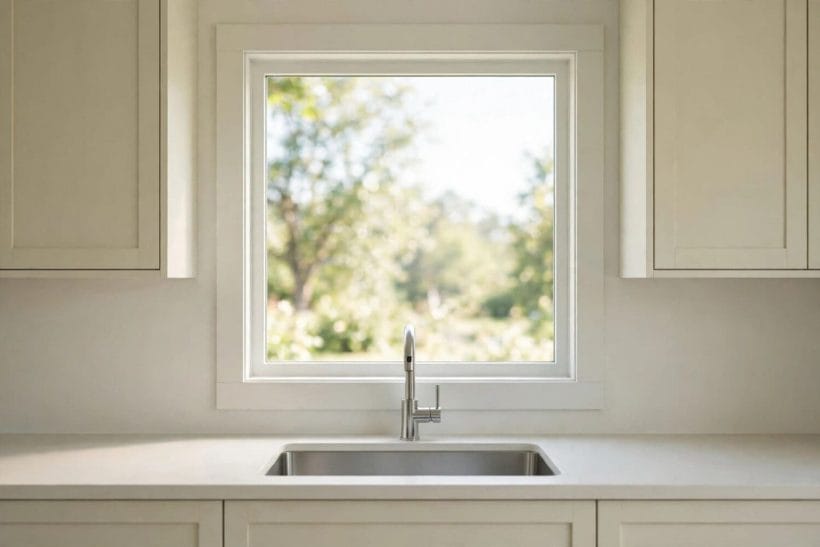
Kitchens and bathrooms test trim in a different way, because these rooms deal with steam, splashes, and frequent cleaning. A flat profile has a practical advantage here: with no curves or grooves to trap moisture or grime, it is simpler to wipe down and keep looking fresh. That practicality is part of why flat trim feels so at home in contemporary kitchens and bathrooms. A flat profile is also simpler to keep clean beside cooking and storage, a point tiny house storage ideas make wherever space is tight.
In a kitchen, the window often sits above a sink or beside a run of units, so the trim needs to sit comfortably with cabinetry lines and worktop edges. For the wider kitchen around the window, kitchen ideas can help you see how the window wall sits beside units, worktops and storage. A flat frame that echoes the clean lines of modern units will feel like part of the kitchen’s design rather than an interruption. In a bathroom, the same logic applies: flat, well-sealed trim around a window reads as calm and hygienic, and it does not fight the tiles, the mirror, or the other straight lines of the room.
Any work in these rooms that touches plumbing, tiling, or the window seal belongs with a qualified professional, and the trim should be specified with the room’s moisture in mind. A professional can advise on finishes and sealing that suit a steamy room, so the trim keeps its clean look rather than showing wear early. The style choice and the practical specification go together here.
7. Pairing Trim With Wall Colour and Flooring
The most reliable modern pairing is trim that relates to the wall rather than shouting against it. Trim painted the same colour as the wall creates a seamless surface where the window becomes a clean opening in an unbroken plane. This is a favourite in contemporary rooms because it makes walls feel taller and calmer, and it lets art and furniture carry the colour instead.
A pale trim against a deeper wall is the bolder modern pairing. It outlines the window crisply and gives a plain wall a sense of structure without any applied decoration. This works particularly well where the wall colour is a soft grey, a warm neutral, or a muted green, because the pale frame lifts the window without turning it into a feature that dominates the room.
Flooring completes the pairing. Timber floors with a natural tone sit happily beside both painted and timber trim, because the eye reads all three surfaces as part of one material story. Pale floors ask for trim that is equally light and quiet, while darker floors can carry a slightly stronger trim tone. The rule is agreement: when wall, trim, and floor speak in the same register, the room feels designed rather than assembled, a principle home design ideas return to again and again.
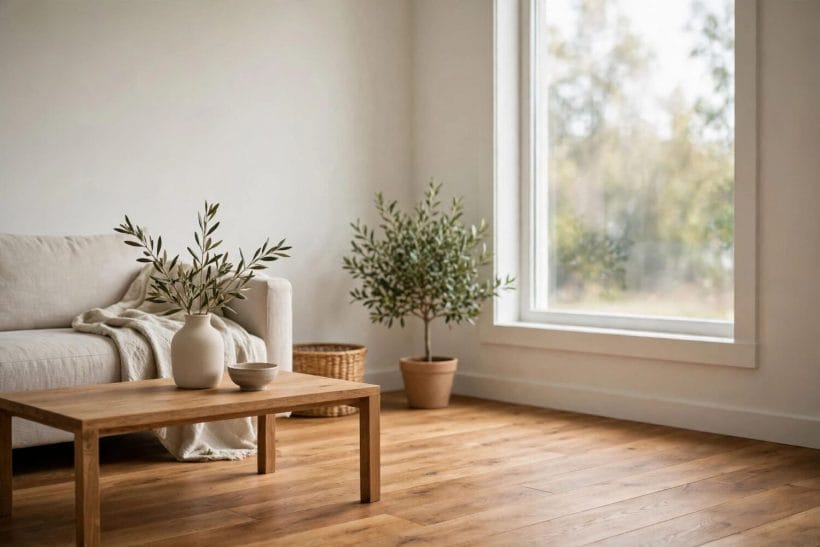
8. Pairing Trim With Window Styles and Light
Modern trim suits most contemporary window styles, because its simplicity does not argue with the window itself. Large panes, slim frames, and generous glazing all benefit from a quiet surround, since the trim frames the glass without adding visual weight. Where a window is divided into panes, flat trim keeps the grid calm and architectural rather than fussy.
Daylight changes how trim reads through the day. A pale frame glows softly in morning light and stays gentle in the evening, while a darker frame gives a stronger outline that can anchor a bright room. Before settling on a tone, look at the window wall at different times of day and notice how the light moves across it. A trim colour that looks perfect at noon can feel heavier in low evening light, and the reverse is also true.
Dark-framed windows are a related modern look worth understanding on their own terms. A dark window frame with quiet trim around it can give a room a crisp, contemporary edge, but it is a stronger statement than pale trim and it asks more of the wall around it. Keep the surrounding trim flat and simple either way, so the window, not the moulding, carries the drama.
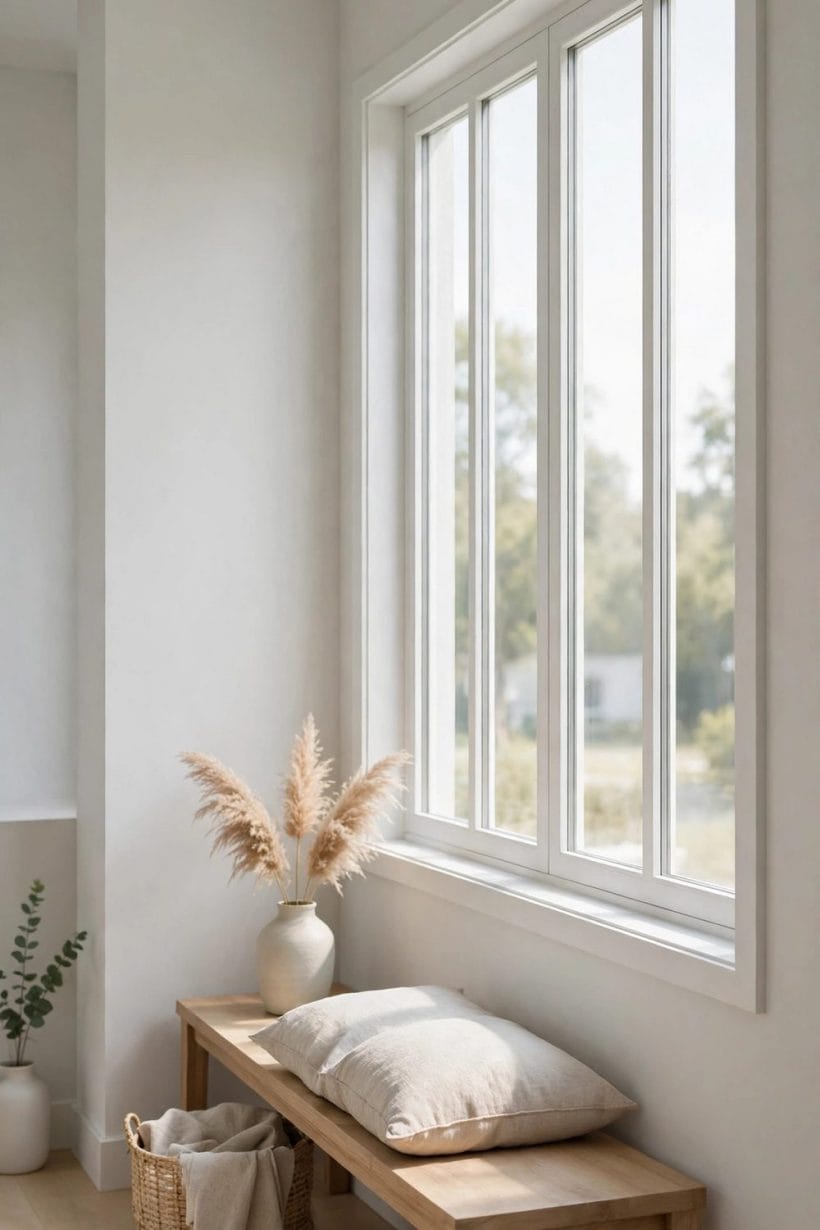
9. Keeping the Look Consistent From Room to Room
Consistency is the quiet discipline behind every successful modern trim scheme. When the same profile and finish appear at every window, the house feels considered, even if the rooms themselves differ in colour and purpose. Tiny house designs are a good test of this discipline, because a single profile carried through a small home is visible everywhere at once. When each room invents its own trim, the house feels patched together, however attractive each room is on its own.
That does not mean every room must be identical. A bedroom can carry a softer tone than a living room, and a bathroom can carry a more practical finish, while still sharing the same flat profile. The profile is the common thread; the tone and finish can flex to suit each room. This balance, one profile, sympathetic variations, is what keeps a modern scheme coherent without becoming monotonous.
Transitions deserve a thought too. Hallways, landings, and the rooms that connect to each other are where mismatched trim is most visible, because you see two rooms’ windows in a single glance. If you are updating trim in stages, start with the rooms and passages you see together, and carry the chosen profile through them first, so the house never feels half-finished from any one viewpoint.
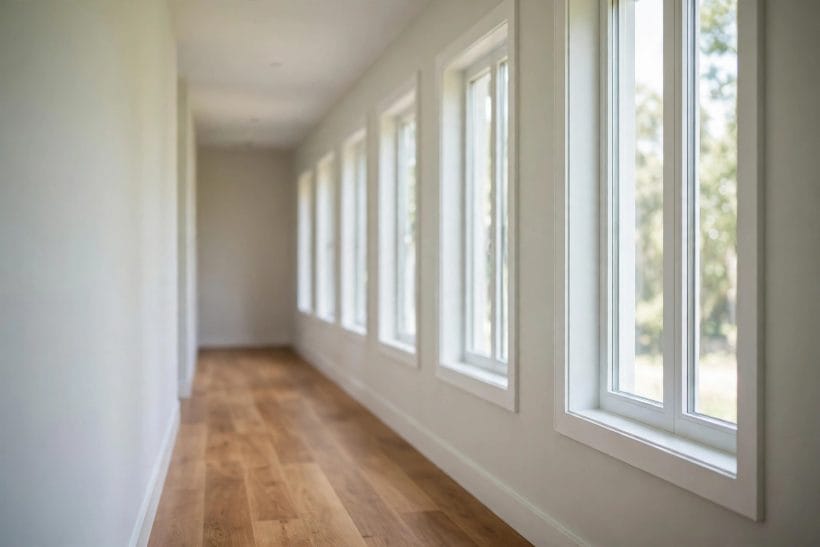
10. Briefing a Professional for a Clean Finish
A modern trim look depends on execution, so the briefing matters as much as the choice of profile. Show your professional the rooms, the light, and the examples that capture what you want, and talk through the profile, the finish, and how the trim should meet the wall, the sill, and any neighbouring woodwork. A clear brief at the start prevents the small mismatches that are hardest to live with afterwards.
Ask how corners will be joined, how the trim will be sealed and finished, and what preparation the walls and existing woodwork will need. These are the details that separate a crisp modern result from one that looks almost right. A good professional will also flag anything the brief has missed, such as a window that needs attention before new trim goes on, or a wall finish that will affect the final line.
Finally, agree what success looks like before work begins: straight, even lines, clean joints, a smooth finish, and a consistent profile from room to room. Walk the finished rooms in daylight and look at each window from the doorway, from the seat you use most, and up close. Modern trim rewards that close look, because its whole appeal is in the quality of its quiet lines.
Final Considerations
Modern window trim succeeds by doing less, and doing it beautifully. Flat profiles, smooth finishes, and a consistent language from room to room give windows a contemporary calm that suits changing furniture, changing colours, and changing seasons. When you browse window molding images for inspiration, look past the first impression and notice the profile, the finish, and the way the trim agrees with the wall, the floor, and the light. Those quiet agreements are the real style.
Choose the profile that suits your rooms, pair it thoughtfully with wall colour and flooring, keep it consistent where rooms are seen together, and leave the fitting and finishing to a qualified professional. Done that way, modern trim will not date quickly, will not fight the rest of the house, and will keep giving every window a clean, calm frame for years to come.



0 Comments