

Most tiny houses are not bought with mortgages. They are bought with whatever loan would say yes at the time — a dealer-arranged chattel loan at 11 or 12 percent, a personal loan taken in a hurry, an RV loan with a shorter term than the buyer wanted. Then life settles down: the credit score climbs 60 points, the income stabilises, rates move — and the owner starts wondering whether that first, expensive loan has to be the loan they keep. That question is a tiny house refinance: replacing your existing tiny house loan with a new one, ideally at a lower rate, a better term, or both, using the same home as collateral.
This guide covers the refinance decision the way a lender will see it. We explain what can and cannot be refinanced, work a full break-even example with real arithmetic, list the loan types you can refinance into with their typical rate and term ranges, set out the eligibility rules (credit score, debt-to-income, documentation, and why certification matters), walk the process step by step, itemise the closing costs, and finish with the risks and the alternatives — because sometimes the honest answer is that refinancing your tiny house is the wrong move. Rates below are typical advertised ranges at the time of writing and vary by lender and borrower; treat every figure as a starting point for quotes, not a promise.
1. What a Tiny House Refinance Actually Is
A refinance is a new loan that pays off the old one. Nothing about the house changes — same trailer, same title, same parking spot — but everything about the debt can: the lender, the interest rate, the remaining term, the monthly payment, and sometimes the loan category itself. That last point is what makes a tiny house refinance different from a conventional mortgage refinance. Because tiny houses are financed through several different legal channels (the full landscape is mapped in our guide to how to finance a tiny house with loans, personal financing, and RV loans), a refinance often means moving the debt from one channel to a better one: a personal loan replaced by an RV loan once the house is registered as an RV, a dealer chattel loan replaced by a credit union loan, or a short builder loan replaced by a long-term loan once the house is finished and certified.
Two structures cover almost every case. A rate-and-term refinance changes the rate and/or the remaining term without changing the balance (beyond rolled-in closing costs). A cash-out refinance borrows more than the payoff balance and pockets the difference — possible only where the home’s appraised value comfortably exceeds the debt, which in the tiny house world usually means foundation-set homes or owners with several years of payments behind them. There is also a quieter third motive: refinancing to remove a co-signer, to take an ex-partner off the title and loan, or to consolidate the house loan and the land loan into one payment. The paperwork does not care which motive you have; the math in the next section decides whether any of them is worth it.
2. When Refinancing Makes Sense: The Break-Even Test
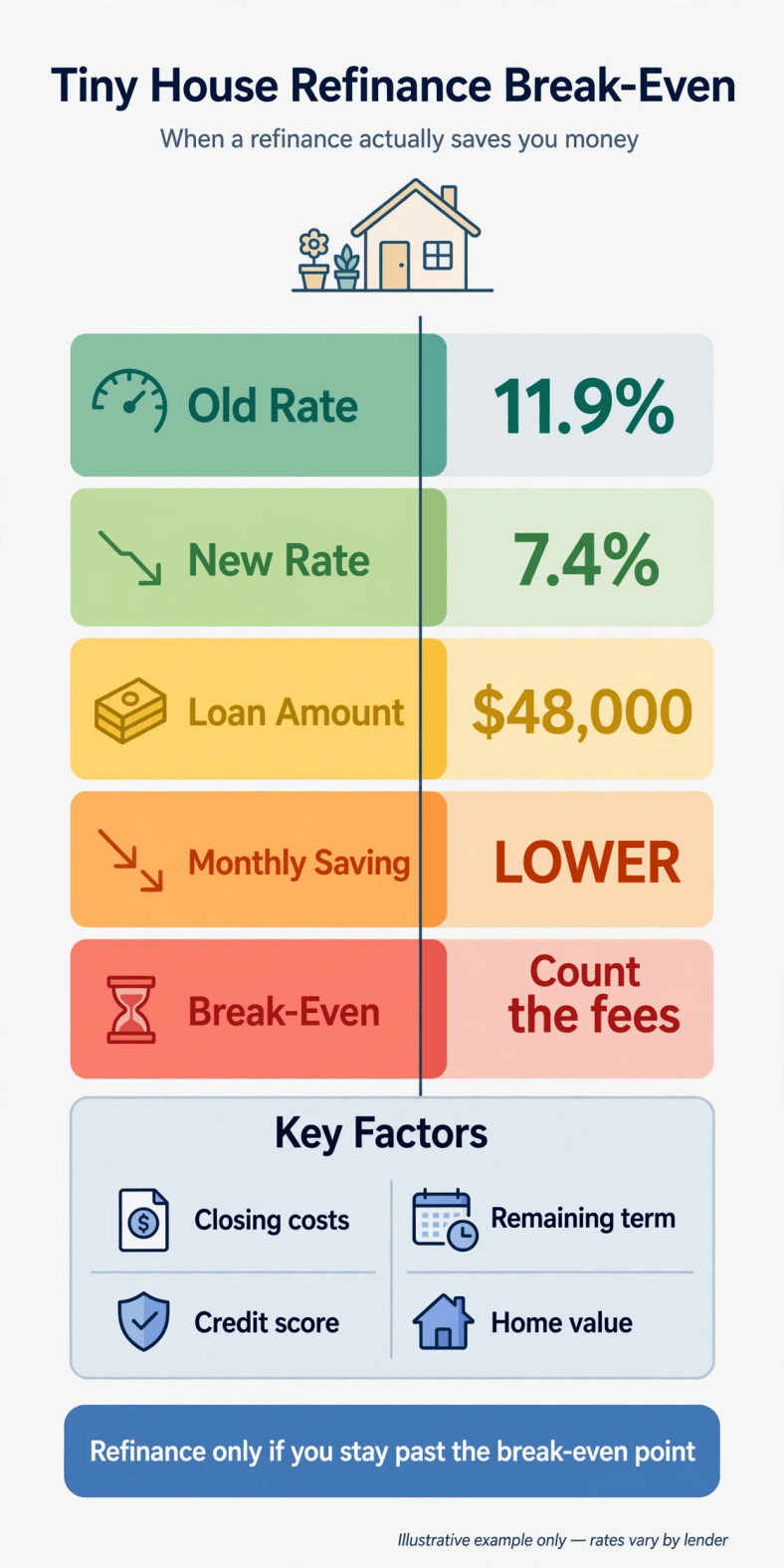
Forget rate differences in the abstract — the only question that matters is whether the monthly savings repay the closing costs before you sell, move, or pay off the home. Work this example (illustrative figures, rounded). You owe $48,000 on a chattel loan at 11.9 percent with 10 years left: your payment is about $689 a month, and you would pay roughly $34,700 of interest if you kept it to term. A credit union offers a refinance at 7.4 percent over the same 10 years: the payment drops to about $569 a month, total interest falls to roughly $20,300, and the monthly saving is $120. Closing costs on a loan this size typically run $900 to $2,500; at $1,800, your break-even is $1,800 divided by $120 = 15 months. Keep the home at least 15 months after refinancing and you profit; keep it to term and you save roughly $14,400 of interest minus costs.
Run your own numbers before you talk to a single lender — our mortgage calculator for tiny houses handles balances, rates, and terms in this exact shape. The situations that pass the break-even test most easily: your credit score has crossed a tier boundary since purchase (680 to 740 is worth 1.5 to 3 points of rate on many tiny house loan products); your original loan was a stopgap (personal loan, dealer financing, a builder’s short note); rates have fallen a full point or more since you bought; or you can move the debt into a fundamentally cheaper category — the classic being an uncertified home financed as personal property that becomes RV-loan eligible once it is certified and registered, a pathway explained in our guide to how to register a tiny house as an RV. The common thread: something material changed. If nothing changed, the new quote will look like the old loan wearing a fee.
3. When Refinancing Does Not Make Sense
The refinance industry advertises the monthly payment and whispers the term reset. If you are six years into a 10-year loan, your payment is now mostly principal; refinancing into a fresh 10-year term cuts the payment dramatically while quietly re-adding years of interest-heavy payments — you can end up paying more in total for the privilege of paying less per month. The same trap catches owners who refinance repeatedly, paying $1,500 to $2,500 of fresh closing costs every two years for progressively smaller rate wins. Other clear no cases: your remaining balance is small (on $12,000, even a 4-point rate cut saves about $25 a month — decades to break even against real fees); you plan to sell or move the home within the break-even window; your credit has worsened since purchase, so the new quote is worse than the old loan; or your current loan carries a prepayment penalty (some chattel and dealer loans do — read the note, or call the servicer and ask for the payoff figure and any penalty in writing). A useful rule: if the refinance only works by stretching the term, it does not work.
4. Loan Types You Can Refinance Into
RV loans (typical range about 7 to 11 percent, terms to 10-15 years, occasionally 20). The cheapest money most tiny houses on wheels will ever see, offered by banks and especially credit unions — but only for homes that qualify as RVs: built by a certified manufacturer or inspected and badged, titled and registered as an RV. If your house already lives in this category, this is your first call. Chattel loans (about 8 to 13 percent, terms 10-23 years). The manufactured-housing channel: the loan is secured by the home alone, not land, which is exactly a tiny house’s situation on rented land or in a park. Specialist lenders and some credit unions write them; they are the natural refinance target for dealer paper. Personal loans (about 9 to 16 percent, terms 3-7 years). Unsecured, fast, and expensive — rarely a good destination, but occasionally right for a small remaining balance where avoiding collateral paperwork and closing costs beats the rate. Home equity and HELOCs (about 7 to 10 percent). Only where you own land and a conventional house, or where the tiny house itself is foundation-set, deeded, and treated as real property by the county — then equity products and even cash-out mortgage refinances open up. Builder or manufacturer refinance programs. Some tiny house builders partner with lenders to convert construction-period financing into permanent loans at completion; if your original loan was always meant to be temporary, this conversion is less a refinance than the plan finishing itself.
One classification warning that decides more applications than credit scores do: lenders refinance the thing the paperwork says your home is. A house titled as an RV gets RV products; a house with a manufacturer’s statement of origin and no title gets chattel or personal products; a house converted to real property gets mortgage products. If your classification is about to improve — certification pending, registration in progress — finish that paperwork first and refinance second, into the better category, instead of refinancing now inside the worse one.

5. Eligibility: What Lenders Actually Check
Credit score. The tiers are unforgiving. Below about 640, most tiny house refinance products are closed to you. From 660 to 700 you will be approved but priced in the upper half of the range. Above 720 to 740, you are shopping in the best tier and lenders compete. If you are within 20 points of a tier boundary, waiting two or three months while you pay down a credit card can be worth more than any negotiation. Debt-to-income ratio. Most lenders cap total DTI (all monthly debt payments, including the new loan, divided by gross monthly income) at about 43 percent, with the cleanest pricing under 36 percent. Payment history. Twelve months of on-time payments on the existing loan is the single best document you own; a single 30-day late in the last year can sink an otherwise strong file. The home itself. Lenders verify value (photos, build specs, comparable sales, sometimes a formal appraisal), age, and condition — and they ask about certification.
Certification deserves its own paragraph, because it quietly controls both eligibility and price. An RVIA-inspected home (or NOAH-certified build) tells the lender the electrical, plumbing, and structure were built to a published standard, which de-risks the collateral; uncertified DIY builds are routinely declined by RV and chattel lenders or pushed into personal-loan pricing. If your home lacks certification, read what RVIA certification is and why your tiny house needs it before you apply anywhere — retrofitting certification is sometimes possible through inspection programs, and it can move your refinance quote by several points. Lenders will also require the home to be insured as a condition of the new loan, with the lender named as loss payee; if your current policy is thin, expect the refinance to force that conversation (the next sections and our insurance guide below cover what adequate cover looks like).
6. The Refinance Process, Step by Step
Step 1 — Pull your payoff and your paper (day 1). Request the exact payoff figure from your current servicer (valid 10 to 30 days) and dig out the title or MSO, registration, insurance declarations page, and build documentation. Step 2 — Run your break-even (day 1-2) using Section 2’s method; if it fails on your own numbers, stop here with confidence. Step 3 — Get three quotes (week 1). One credit union, one specialist tiny house or manufactured-home lender, one of the RV-loan banks. Apply inside a single 14-day window where possible so multiple inquiries group together for scoring purposes. Step 4 — Choose on APR and costs, not rate alone. A 7.2 percent loan with $3,000 of fees can lose to a 7.6 percent loan with $600 of fees at balances this size; the break-even formula from Section 2 is the judge. Step 5 — Appraisal and inspection (weeks 2-3). Expect a photo inspection or a formal valuation ($150 to $500) and an insurance binder update naming the new lender. Step 6 — Closing (weeks 3-6). Most tiny house refinances close in 2 to 6 weeks — far faster than mortgage refinances — signing a new note, a security agreement against the title, and authorisations for the new lender to pay off the old loan. Step 7 — Verify the payoff (week 6). Confirm the old loan shows a zero balance and closed status, file the new title lien paperwork, and set up autopay — several lenders discount 0.25 percent for it.
7. Costs and Fees: The Full Itemised Picture
Budget for these line items (typical ranges at this loan size): application or origination fee $0 to $895 (1 to 2 percent of the loan at some chattel lenders); appraisal or valuation $150 to $500; title and lien recording $50 to $250 depending on state; document and processing fees $100 to $400; prepaid insurance or escrow top-ups, variable; and any prepayment penalty on the old loan, which you must confirm in writing before signing anything. Total realistic closing costs: $900 to $2,500 — small beside a mortgage refinance, but decisive at tiny house balances, which is why the break-even test runs this whole guide. Remember the closing costs sit inside a bigger ownership picture — taxes, insurance, lot rent, maintenance — and if you have never seen your home’s full annual number assembled, our breakdown of the true cost of tiny houses for sale, prefab versus DIY is the place to benchmark it before you optimise one line of it.
8. Risks and Honest Warnings
Your home is the collateral. That sentence deserves a pause: a personal loan default wrecks a credit score, but a secured refinance default can take the house itself, and repossession of a tiny house is fast and legal in most states because it is titled property, not real estate with foreclosure protections. Do not refinance into a payment you can only afford in a good month. Second risk: term stretching, covered in Section 3 — compare total interest, never just the payment. Third: cash-out temptation. Pulling $10,000 of equity for a renovation at 8 percent can be smart; pulling it for a holiday converts your cheapest asset into your most expensive debt. Fourth: insurance continuity. The new lender will require a policy meeting its standards from day one; a lapse during the switch can trigger force-placed insurance at two to three times normal cost. Read our tiny house insurance guide for homes on wheels versus foundation and bind the new policy before the old lender releases its lien, not after.

9. Alternatives to Refinancing
Before you refinance, price the boring options. Ask your current lender for a rate modification. It rarely works, but credit unions occasionally reprice a loan for a member in good standing for a $50 to $150 fee — one phone call, no closing. Attack the principal instead. Paying an extra $100 a month on an 11.9 percent loan is a guaranteed 11.9 percent return, beats most refinances on small balances, and keeps your options open. Refinance only the land or only the house. Owners who bought both sometimes find the land loan is the expensive half. Sell and buy. If your needs changed — a partner, a child, a work-from-home room — trading the home can beat re-papering the debt on the wrong house. Rent it out and let a tenant pay the old loan down. Where local rules allow, a year or two of rental income transforms your equity position and your next refinance quote; our guide to how to rent your tiny house on Airbnb covers what that takes in practice. Each alternative has the same judge as the refinance itself: total cost over the years you will actually keep the home, compared honestly.
Final Considerations
Refinancing a tiny house is neither magic nor a scam; it is arithmetic with paperwork. It rewards owners whose situation has genuinely improved — better credit, a certified and correctly titled home, a stopgap first loan — and it quietly taxes owners who chase a lower payment across a longer term. Do the break-even sum on your own balance before you speak to a lender, get the payoff and any prepayment penalty in writing, collect three quotes inside a fortnight, and choose on APR plus fees with your real keeping-period in mind. If the numbers say go, the process takes a month and the savings last for years. If they say wait — build the credit, finish the certification, pay the principal — you now know exactly which levers to pull, and the refinance you do next year will be the one worth doing.