
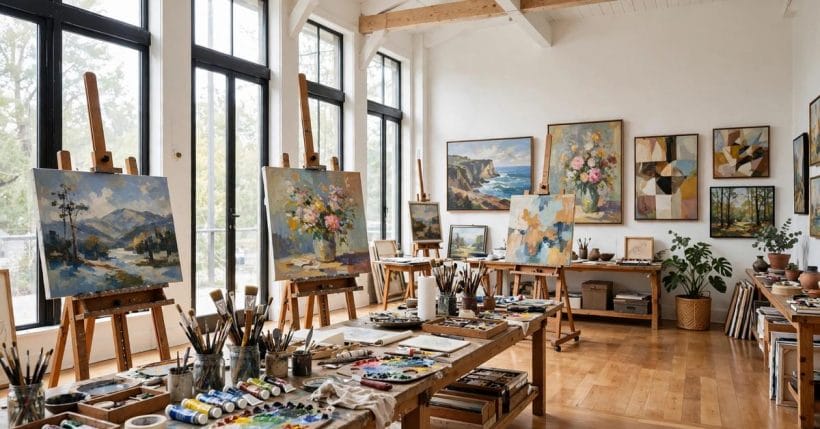
Every artist knows the feeling: the work is ready in your head, but the room fights you — the light is wrong, the paints are buried, the canvas has nowhere to dry.
These art studio ideas fix the room instead: honest light, a layout with room to step back, storage that keeps materials alive, and space to look at what you have made.
1. The Artist’s Studio at a Glance
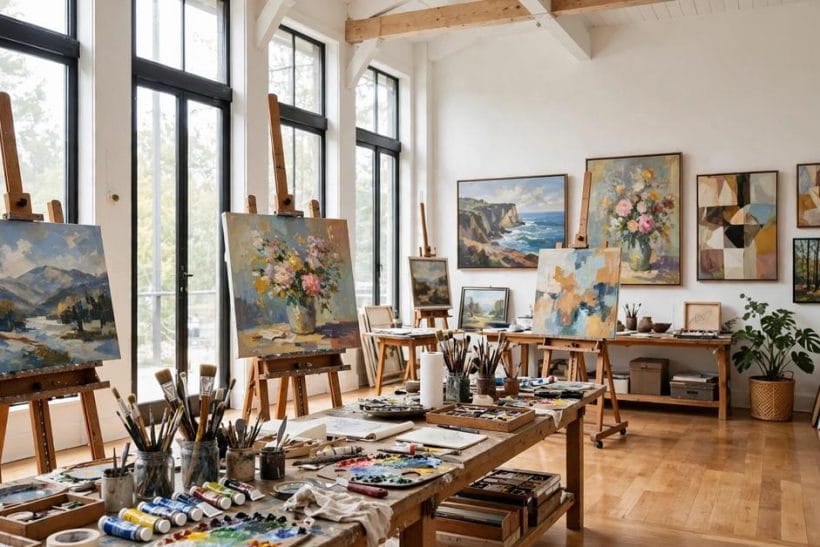
An artist’s studio is a workspace before it is a picture. Its real subject is a daily practice: making work, looking at it clearly, storing materials and finished pieces safely, and cleaning up without dread. The magazine phrase that named this row promised a model-of-perfection studio; this guide translates that promise into the unglamorous systems that make any studio — a spare room, a garage corner, a cabin, a rented loft — feel close to perfect for the person working in it. No named artist’s studio is described or imitated here; the ideas are the shared craft of working artists everywhere, stated generally so they can be fitted to any medium and any room. The studio is also a small-space problem of the kind this site loves, and the compact planning in tiny home office layouts is its closest cousin.
| Question | Short answer |
|---|---|
| What matters most in a studio? | Honest, steady light on the work — everything else in the room is arranged around protecting and using it |
| How much space does a studio need? | Enough for the work itself, room to step back and look at it, and storage that keeps the floor clear — a corner can qualify if all three hold |
| What is the classic layout? | An easel or main work zone near the best light, a work table beside it, storage at the edges, and one clear wall for looking |
| What do beginners under-buy? | Storage for finished and drying work — canvases, boards and sheets multiply faster than any other studio problem |
| What keeps a studio healthy? | Ventilation, materials stored and disposed of exactly as their labels direct, and a cleanup routine short enough to actually happen |
2. Light First: The Studio’s Whole Foundation
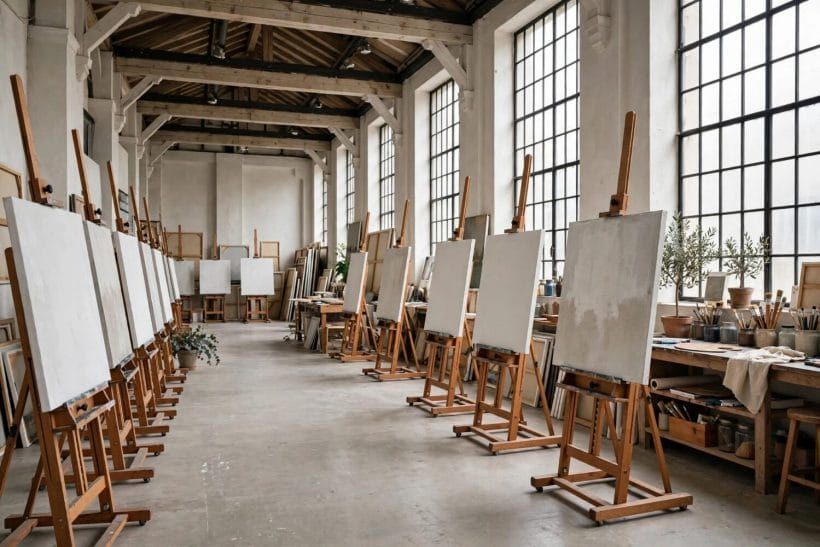
Painters have organised their rooms around light for centuries, because colour judged in bad light is colour judged wrong. The studio’s windows, lamps and wall colours all serve one purpose: seeing the work truthfully.
Steady daylight, and why artists prize it
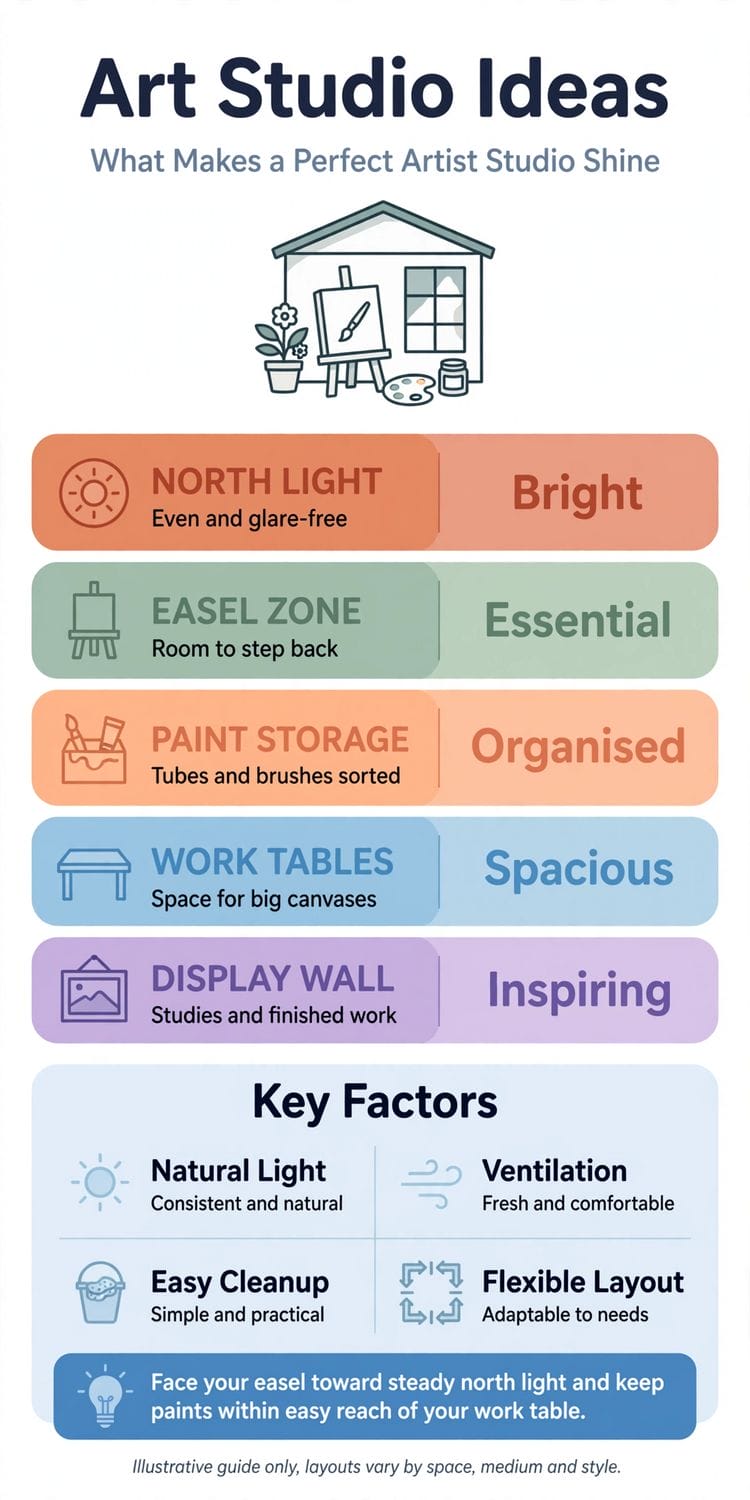
Daylight that stays even through the day — traditionally the light from windows facing away from the sun’s direct path — lets an artist judge colour without the judgement shifting by the hour. Direct sunbeams crossing the canvas create false highlights and heat; sheer curtains, blinds or a repositioned easel tame them while keeping the daylight’s honesty.
Artificial light that does not lie
For evening work and dull days, choose lamps sold for colour-critical work and check their stated colour-rendering quality with the supplier — the bulb’s job is to show pigments as daylight would. Position lights so they fall on the work without shining into the artist’s eyes or bouncing glare off wet paint, and keep one consistent lamp setup so colour decisions stay comparable between sessions.
Walls and floors that stay out of the argument
Neutral walls — soft white, pale grey, a quiet warm neutral — return honest light to the work and never tint it. Strongly coloured walls reflect their colour onto everything, which is why working studios so often look plain in photographs: the room is deliberately quiet so the artwork can be loud. Floors take the opposite brief — they will be splashed, so they should be washable and forgiving rather than precious.
3. The Layout: Easel Zone, Table Zone, Looking Wall
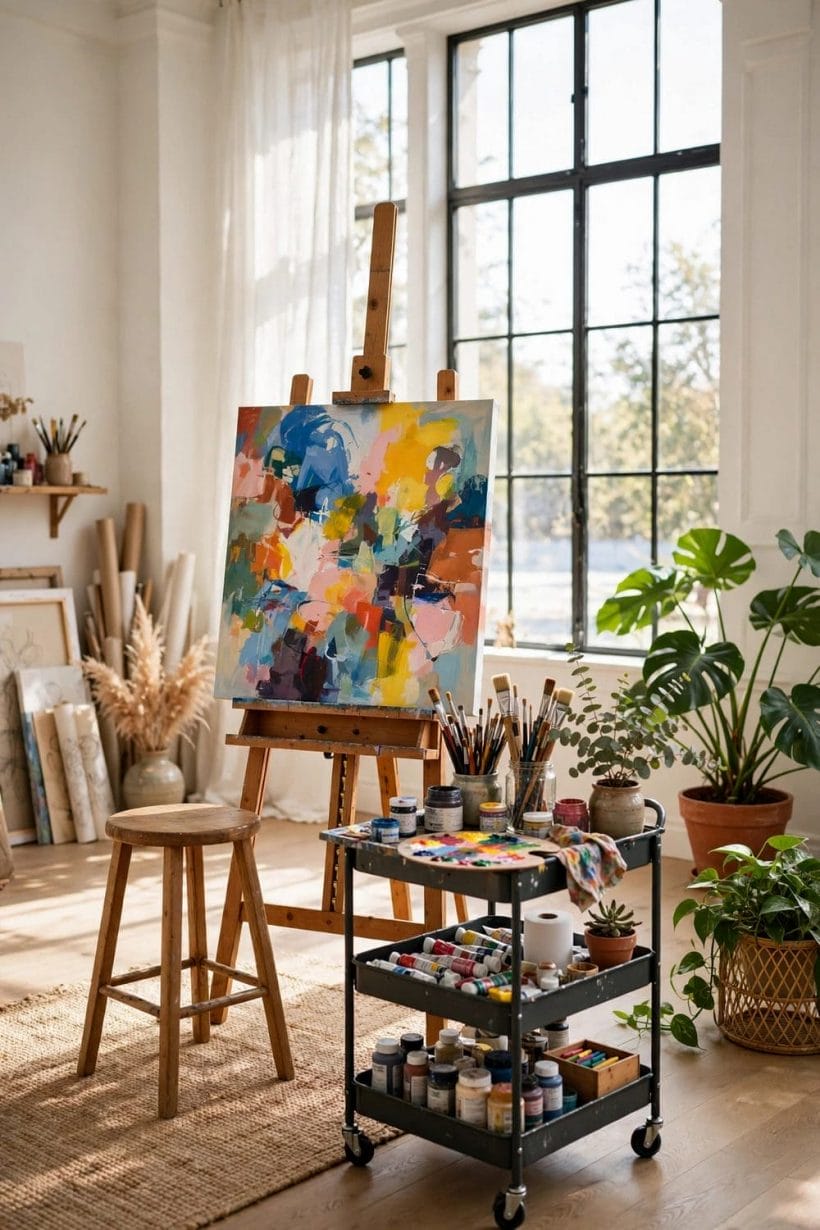
A studio works when its three zones are settled: where the work is made, where flat and messy tasks happen, and where finished work is stood back from and judged. The zones can share a small room, but each needs protecting from the others.
The easel zone and the step back
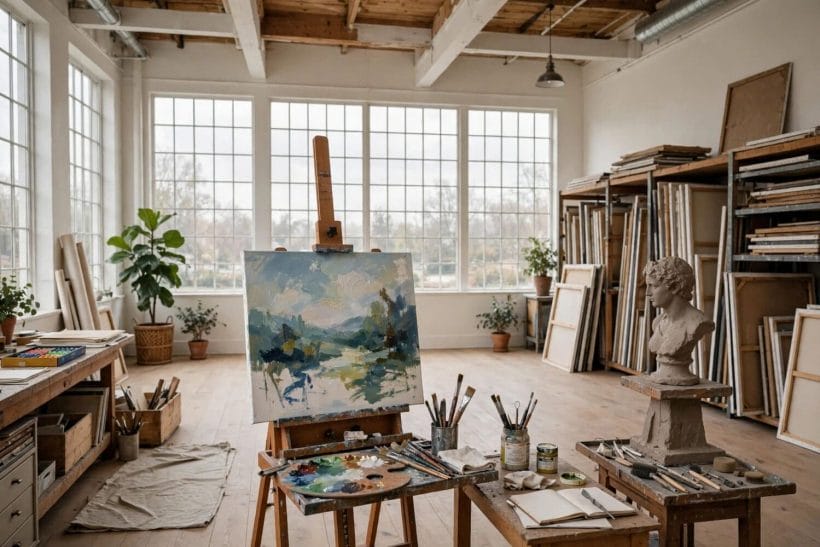
The easel — or the main bench, wheel or drawing board — belongs in the best light with clear floor behind it. The distance to step back and see the whole piece is not a luxury; it is how errors announce themselves. In a small studio, the step back is planned first and the furniture fitted around it, not the other way round.
The work table: the studio’s second engine
A sturdy table at a comfortable working height carries mixing, cutting, mounting, sketching and the laptop-and-notebook side of practice. Keep it beside the easel zone so a working session flows between the two without crossing the room, and give it a surface that can be scraped, wiped and sacrificed — a sheet of replaceable board over a good table is the classic compromise.
The looking wall and the drying rack
One clear wall, lit decently, where work can be pinned, leaned or hung and lived with for a few days, catches more mistakes than any other studio habit. Near it, flat drying space — racks, shelves or a slotted stand — keeps wet work safe and off the floor. Studios fail by accumulation; the looking wall and the drying rack are where accumulation is managed honestly. The work-from-home versions of the same planning appear in tiny house floor plans with home office spaces, and the spare-room conversions surveyed in home office and guest room ideas for tiny houses solve the same three-zone problem at domestic scale.
4. Storage That Keeps Materials Alive
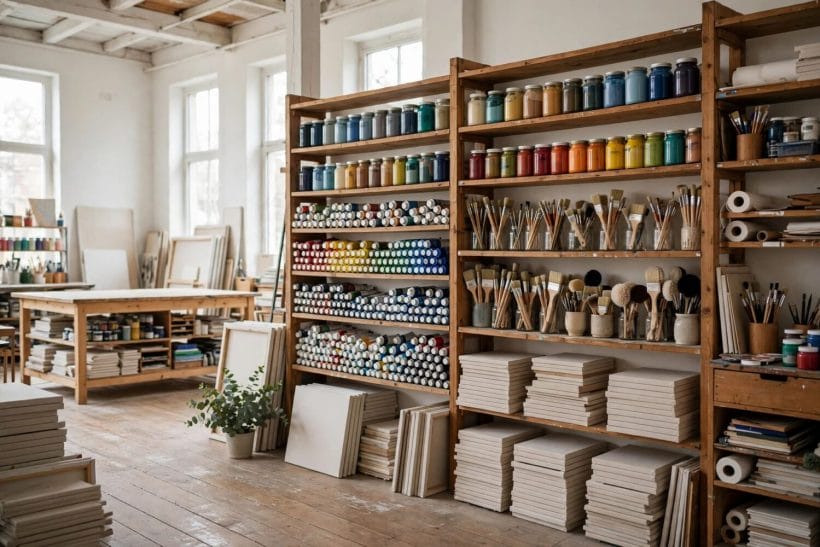
Studio storage is not tidiness for its own sake. Paints dry out, papers cockle, brushes die bent in jars — good storage is materials conservation, and it pays for itself in supplies that survive.
Paints, inks and mediums, stored by their labels
Tubes, jars and bottles live best together, visible and reachable, in shallow trays, drawers or wall racks near the work table — deep cupboards are where colours go to be forgotten and duplicated. Lids on, labels out, and every product stored at the temperatures and conditions its own label directs; solvents and sprays in particular are stored, ventilated and disposed of exactly as their labels say, never by habit or guesswork.
Brushes and tools within arm’s reach
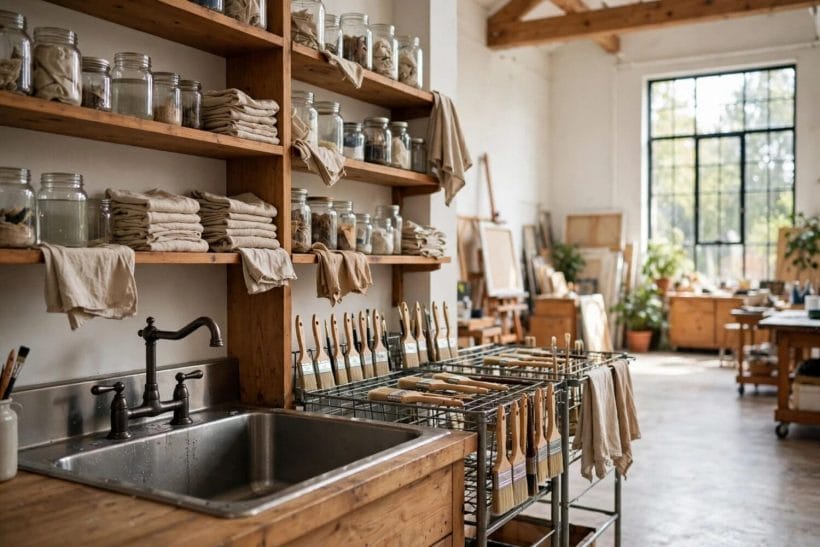
Working tools earn their place by the easel: brushes upright or flat as their care requires, knives and pencils in jars and trays that keep edges safe and points unbroken. A rolling cart beside the easel is the small studio’s beloved solution — the whole palette of tools travels the few steps between table and canvas and parks out of the step-back zone when parked is needed.
Paper, canvas and finished work
Flat storage protects what shelves bend: plan chests, portfolio cases or simple slotted racks keep paper and boards flat, dry and uncreased, while finished canvases store upright, separated so faces never press together. Label the spines and edges — the studio’s future self, hunting one piece for a photograph or a frame, is a person worth being kind to. The shed-scale version of this thinking is collected in office shed plans, where the studio leaves the house entirely.
5. Choosing the Space: Rooms, Corners, Cabins and Sheds
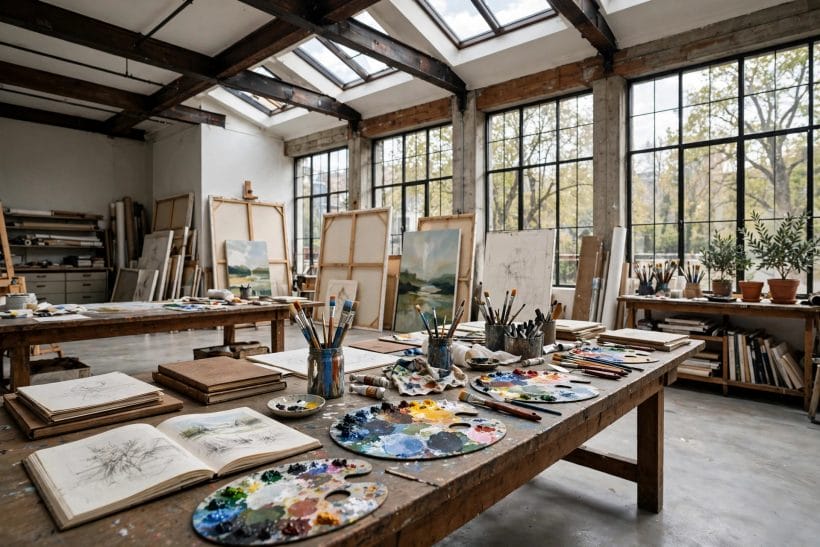
Almost any space can hold a studio if the light, the floor and the door behave. This section reads the common candidates honestly, so the choice is made on the room’s merits rather than its romance.
The spare room and the garage corner
A spare room offers walls, warmth and a door that closes on the mess — the easiest studio most households can make. A garage or outbuilding corner offers the messier freedoms: bigger work, bolder materials, no fear for floors — at the price of heating, insulation and the walk through winter rain. Both work; the deciding factors are light and how the household actually lives.
The shared corner and the fold-away studio
Where no room can be spared, a defined corner — easel, cart, wall — with everything on wheels or folding stands can open for a session and close back to a tidy edge of the living space. The discipline is the close-down: if packing away takes longer than the patience most evenings hold, work stops happening, so the fold-away studio must be designed for speed. The desk-scale versions of these choices are compared in tiny home office setups.
Windows, doors and the practical checks
Whatever the space, check the unglamorous list before the easel moves in: can the largest canvas or board actually get through the door and up the stairs, does the floor carry the work and its maker without spring, is there power where the lamps need it, and can the room be ventilated when materials ask for fresh air? Studios are remembered for their light and abandoned for their logistics.
6. Studios by Medium: Painting, Drawing, Print and Mixed Media
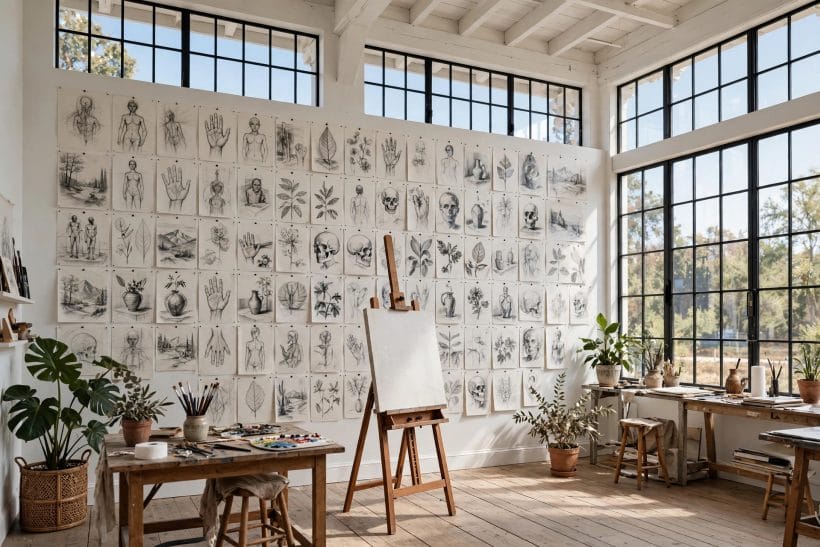
The bones of the studio stay constant, but each medium weights them differently. Reading your own medium’s version honestly prevents building a beautiful room for someone else’s practice.
Painting: wet work and its patience
Painting asks for the easel zone, the palette’s home beside it, and drying space above all — wet canvases are the studio’s most fragile citizens. Water-based painters need a sink or a planned water routine nearby; oil painters need ventilation they actually use and rag disposal exactly as product guidance directs. Both need the looking wall, because paintings are finished by looking, not by brushing.
Drawing, illustration and paper work
Paper practices live at the table: a drawing board or sloped surface, flat storage within reach, and light that does not pool or glare on pale paper. The paper artist’s studio is the tidiest version — its enemies are damp, dust and creasing rather than splashes — and it folds into the smallest spaces of all, including the reading-and-drawing corners in home library and office design ideas.
Print, craft and mixed media
Printmaking and craft practices are the studio’s industrial wing: presses, cutting stations and material stock need bench strength, task light and storage for bulky, oddly shaped supplies. The mixed-media studio succeeds by zoning honestly — wet from dry, dusty from clean — even when the zones are two ends of one table. Trying to keep one surface doing everything is the beginner’s arrangement and the experienced artist’s warning.
7. Comfort, Posture and the Working Body
Studios are workplaces, and artists work long hours in them. Comfort is not indulgence — it is what keeps hands accurate in the fourth hour and backs willing in the fourth decade.
Seating, standing and working heights
A stool or chair that supports a long session, an easel adjusted so the work’s centre sits at a natural eye line, and a table at a height that lets forearms rest without shoulders rising — these small fittings decide how a session feels. Many painters alternate sitting and standing; a floor mat at the easel softens the standing hours kindly.
Warmth, air and honest ventilation
A studio too cold to sit still in will not be sat in. Heat the space to honest working comfort, and keep the air moving gently — ventilation is comfort as well as care whenever paints, sprays or solvents are in use, and an openable window is the studio fitting no fan fully replaces. Breaks belong in the design too: a chair that is not the work chair, and somewhere to make tea, are studio furniture in the truest sense.
The display corner and the morale wall
Studios benefit from one corner that is purely encouraging — finished pieces, a postcard wall, the sketchbook shelf. Morale is a production input in a solitary practice, and the studio that celebrates its own history sends its artist back to the easel readier than the studio that only stores its problems.
8. Walls, Floors and Surfaces That Forgive
A studio’s surfaces are chosen for a life of being splashed, scraped, pinned and leaned on. The right choices look better with use rather than worse, which is the only sensible standard for a working room.
Walls that can be pinned, washed and repainted
The studio wall’s jobs are to hold work up for looking, return neutral light, and be repainted cheaply when it has absorbed a season of splashes and pin holes. Plain painted walls do all three; elaborate wall finishes in a wet-work studio are a promise nobody can keep. One wall painted slightly deeper than the others can give dark-toned work a fairer viewing ground where the practice needs it.
Floors for splashes and rolling stools
Washable, hard-wearing floors — sealed boards, vinyl, painted concrete, inexpensive rugs that are honestly sacrificial — free the artist to work without flinching. Whatever the floor, the easel zone wants it level and firm, and the rolling cart and stool want it smooth. Protect a good floor with boards or canvas drops rather than working timidly on top of it.
Tables, palettes and the sacrificial layer
Working surfaces earn a sacrificial layer: disposable palette paper, replaceable cutting mats, boards under clay and print work. The habit keeps the furniture good and the session brave — artists make their boldest passages when the room cannot be ruined by them.
9. Order, Cleanup and the End-of-Session Reset
The studio’s tidiness system succeeds or fails in the last ten minutes of a session. Designed well, the reset is short enough to survive tiredness — and tomorrow’s start is instant because of it.
A home for everything, at the point of use
Storage works where it stands beside the task: brushes by the sink or their cleaning station, colours by the table, framing tools by the looking wall. Every item that must be fetched from another room is a small tax on starting, and starting is the fragile moment the whole studio exists to protect.
Cleaning routines that follow the labels
Brushes washed as their makers direct, palettes scraped while paint is workable, water jars emptied rather than left to ripen, rags and waste handled and disposed of exactly as the products involved require — studio safety lives in these unglamorous sentences, and no shortcut with solvents, sprays or waste is ever part of good practice. Ventilate while you clean, and let the room air before it closes for the night.
The weekly reckoning
Once a week, or once a project, the studio takes its longer reset: drying racks emptied to storage, the looking wall cleared, supplies listed before they run out, floors swept of the dust that finds its way into wet paint. The reckoning is also creative stock-taking — the moment half-finished pieces argue for their futures — and the studio is the better workplace for holding it regularly.
10. Costs as Drivers, and Building the Studio in Stages
A studio is built in stages by almost everyone who has one, and the order of the stages matters more than any total. This section keeps money honest: drivers only, no invented figures, and the sequence that gets an artist working soonest.
What actually drives the cost
The drivers are the room itself where building or conversion is involved, heating and insulation for outbuildings, window and lighting work, the easel and main furniture, storage furniture, and the steady consumable cost of materials. Quotes for any building, electrical or heating work belong to local professionals with the room in front of them — no guide can price another person’s garage honestly.
The sensible order of stages
First the light and the easel zone, so work can start; then storage for the materials already owned; then the looking wall and drying space as finished work accumulates; then comfort and display as the practice settles. Studios built in this order are used at every stage, and each stage is paid for by an artist who is actually working rather than waiting.
Second-hand, borrowed and built furniture
Studio furniture has a proud second-hand tradition: plan chests, tables and easels circulate between artists for decades, and a sturdy old table outperforms a flimsy new one at the work that matters. Build what cannot be found — slotted drying racks and simple shelving are classic home carpentry — and spend the saved money where only new will do, which is usually the light.
Final Considerations
The perfect artist’s studio is not a photograph — it is a room where the light tells the truth, the tools are where the hands expect them, and starting work takes less effort than avoiding it.
Build that room in stages, around your own medium and your own space, and the model of perfection the magazine promised turns out to be something better: a studio that fits its artist exactly.


0 Comments