
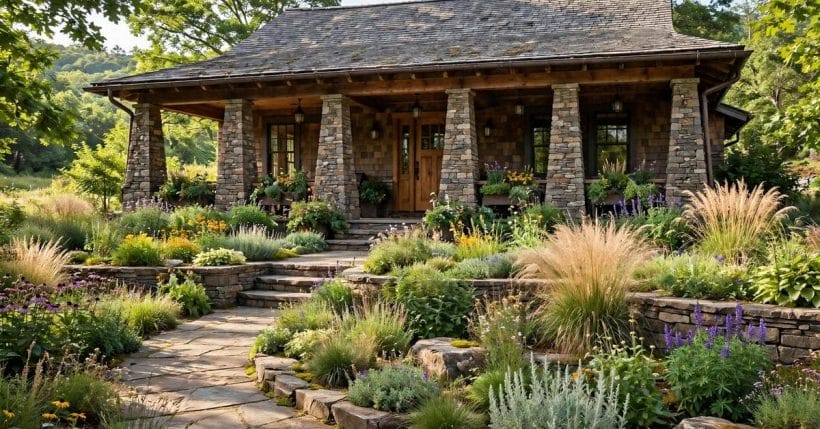
A craftsman house already knows how it wants to be gardened: stone underfoot, timber overhead, and planting that looks grown rather than arranged.
These seventy-five craftsman landscaping ideas cover the porch frame, stone work, layered and native planting, seasonal colour, walks and welcomes — beautiful craftsman house landscaping built the way the house itself was built: honestly, and to last.
1. Craftsman Landscaping Ideas at a Glance
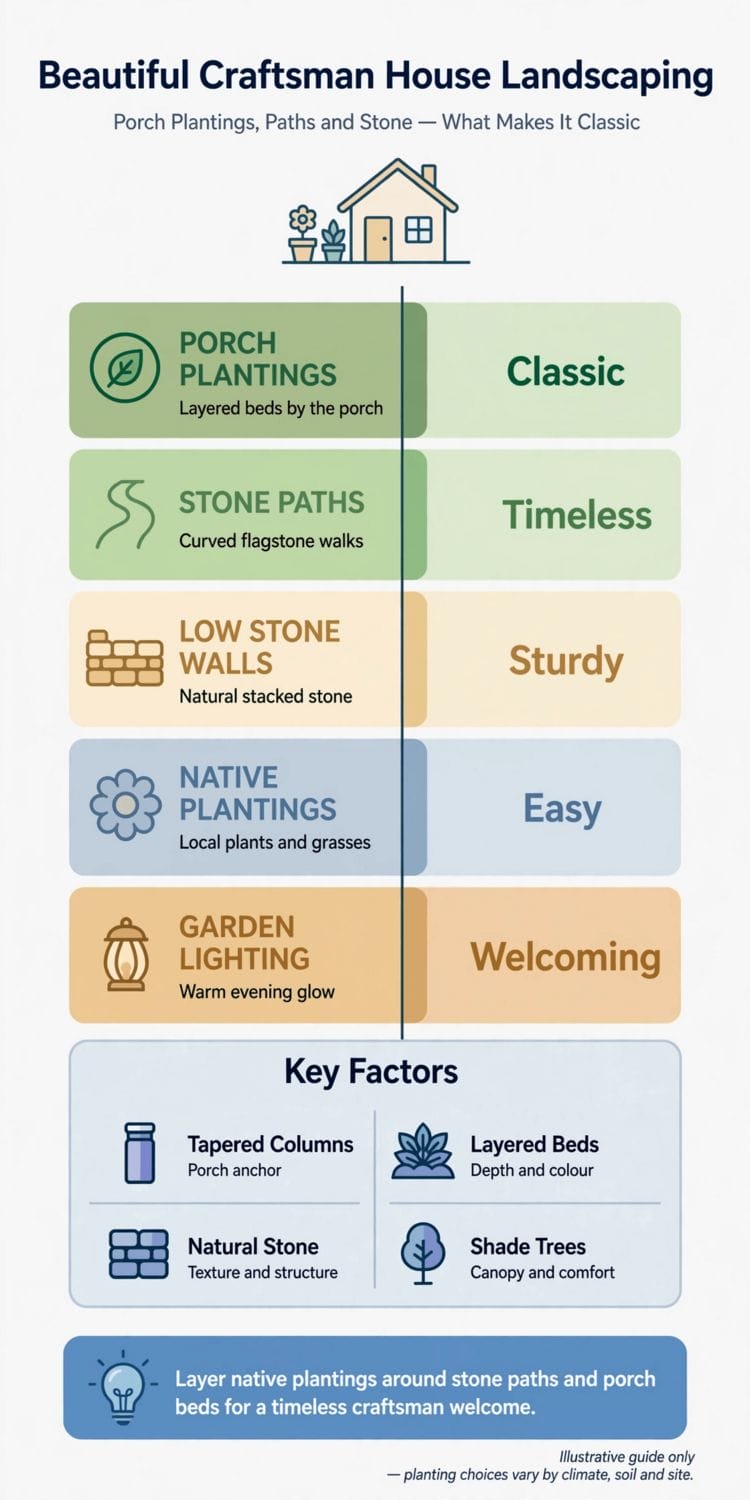
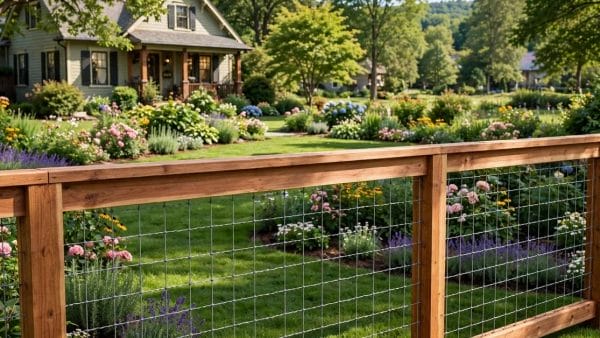
Craftsman landscaping is the garden expression of the house it surrounds: natural materials, hand-built detail, deep porches framed by planting, and beds that layer shrubs, perennials and grasses the way the house layers stone, shingle and timber. It favours the local and the lasting over the exotic and the instant, which is why a good craftsman garden improves for a decade instead of peaking on planting day. This post is the garden member of the craftsman family — the porch architecture itself belongs to craftsman porch ideas, and the two read together as one approach to the house. Planting advice here is general and climate-honest: species are named as types and examples only, and local nurseries and conditions always have the final say.
| Question | Short answer |
|---|---|
| What defines craftsman landscaping? | Natural stone and timber, layered informal planting, a welcoming walk to a deep porch, and materials that belong to the place |
| Which plants suit it? | Layered shrubs, woodland and native perennials, ornamental grasses and shade trees — chosen for your climate, not from a photograph |
| What hard landscaping matters most? | The front walk, low stone walls and bed edges, and the steps — the stone skeleton the planting grows around |
| How formal should it be? | Structured bones, soft planting: straight walks and walls, with beds allowed to billow inside them |
| What is the biggest mistake? | Planting a thin line of shrubs against the house and calling it done — craftsman beds are deep, layered and connected to the garden |
2. The Craftsman Frame: Porch, Columns and the Approach
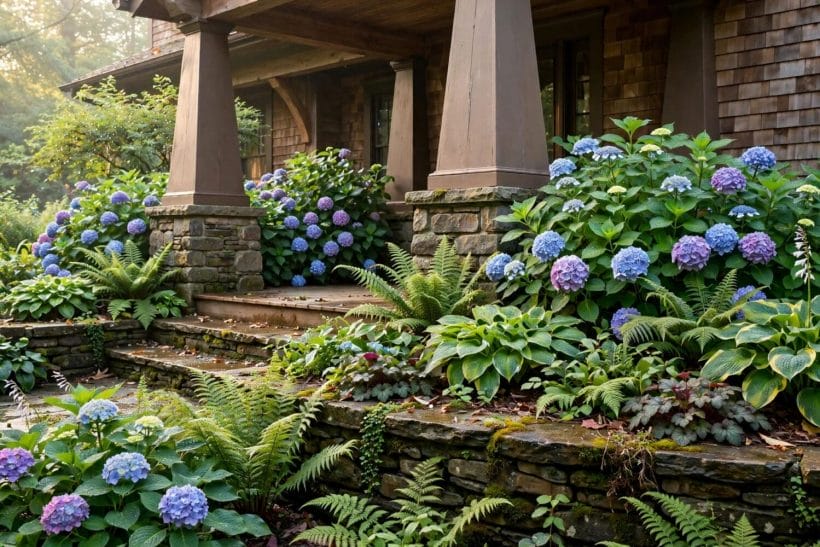
Before a single plant is chosen, the approach is settled: how the garden receives the house’s porch, its tapered columns and its wide eaves. This section frames that welcome.
1. Planting that bows to the tapered columns
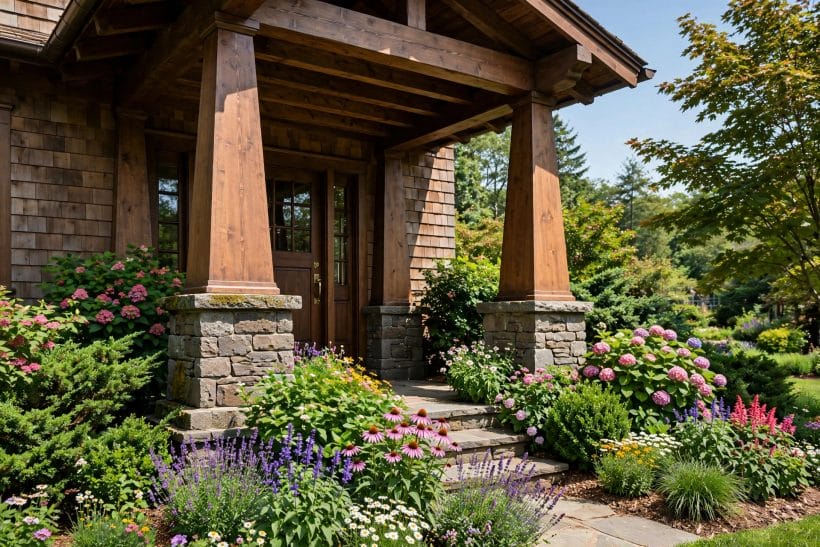
Keep the porch’s stone or timber columns visually clear at their bases, with low planting at their feet rather than shrubs swallowing them. The columns are the house’s handshake; the garden frames them, never hides them.
2. Deep beds instead of a foundation line
Pull the beds well out from the walls so planting can layer in depth — tall behind, low in front — instead of pressing a single row against the foundation.
3. A garden that starts at the street
Begin the composition at the front boundary with a low wall, a hedge or a planted verge, so the house is approached through garden rather than across lawn. The walk then becomes a journey the planting accompanies.
4. Symmetry softened, never rigid
Craftsman planting often balances the porch — a shrub echoing a shrub, planters in pairs — then loosens deliberately with perennials and grasses. The bones are ordered; the planting breathes. Rigid mirror symmetry belongs to other house styles.
5. Eaves, shade and the drip line respected
Plant with the wide eaves in mind: beds under them sit in rain shadow and shade together. Choose plants honestly suited to those conditions, or extend beds beyond the drip line where sun and rain actually reach.
6. A bench or seat in the approach garden
One seat — a stone bench, a timber settle — turns the front garden from scenery into a place. Craftsman gardens were made to be sat in, and a seat gives the layering a reason and the gardener a viewpoint.
7. Porch planters in stone, timber or clay
Containers on the porch should speak the house’s material language: stone, weathered timber, plain clay. Fill them generously and seasonally, and let them carry the colour when the beds rest.
8. Climbing plants on honest supports
A climber on a sturdy timber or metal support beside the porch — never left to tear at shingles or mortar — adds the vertical softness craftsman gardens love.
9. The side garden treated as a room, not a gap
The strip beside the house becomes a shaded side garden with a stepping-stone path and woodland planting, linking front and back. Craftsman plots waste nothing; the side passage is a grove in miniature.
3. Stone Work: Walls, Edges and Steps
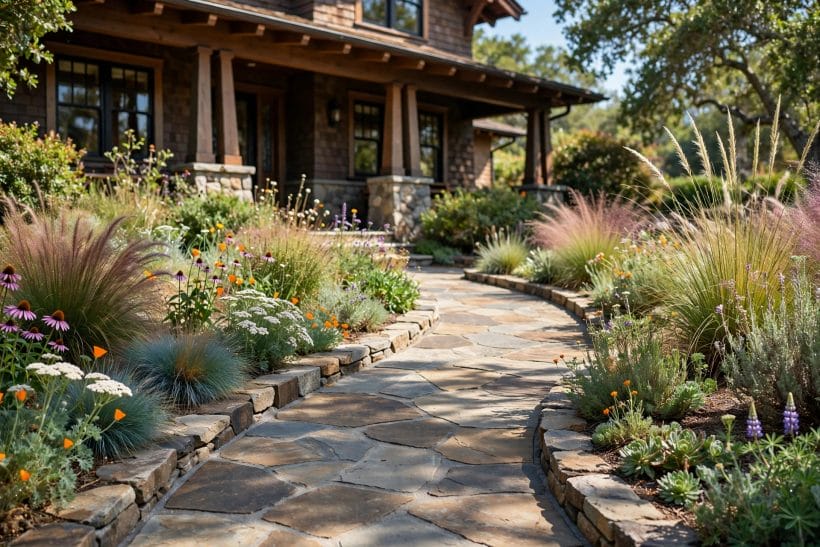
Stone is the craftsman garden’s skeleton. This section covers the walls, edges and steps that give the planting its structure — built work, stated generally, with local craft and conditions governing the real thing.
10. Low dry-stacked stone walls along the walk
A low wall of local stone edging the front walk or terracing a gentle slope is the signature craftsman garden structure. Built or commissioned properly, it outlives every plant in the garden and gives beds their raised, layered stage.
11. Flagstone walks with planted joints
Wide flagstones, laid generously and spaced for low creeping plants in the joints, make the walk feel grown into the garden. The stones should be large and honestly thick; thin, busy paving fights the house’s calm proportions.
12. Stone steps that take their time
Broad, shallow steps in stone — with landings where the slope asks for them — suit craftsman approaches better than steep flights. Plant their edges softly so the stair reads as part of the garden’s terracing.
13. Boulder accents placed like geology
A few substantial boulders, settled into beds as if the hill left them there, anchor planting compositions. Half-bury them; a boulder perched on the surface looks delivered, while one sunk into the ground looks discovered.
14. Stone edging that ends the lawn cleanly
A simple stone or brick soldier edge between lawn and bed keeps the soft planting’s billow deliberate rather than messy. The edge is the garden’s grammar: invisible when it works, sorely missed when it does not.
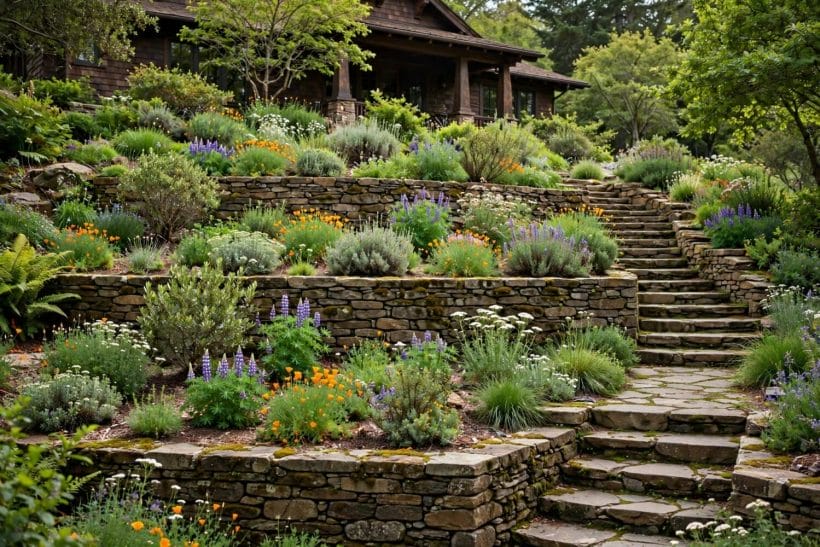
15. Retaining the slope with planted terraces
On sloping plots, terrace with stone walls and plant each level as its own bed, rather than mowing a bank. Terraces create the flat planting shelves craftsman layering needs and turn a problem slope into the garden’s best feature.
16. A stone plinth for the mailbox or lamp
Small stone structures — a mailbox plinth, a lamp base, a low pier at the walk’s start — repeat the porch’s material at garden scale and stitch the composition together. Repetition of one honest material beats a catalogue of novelties.
17. Gravel and stone mulch in the dry places
Where beds bake or planting thins, a stone or gravel mulch in tones taken from the house’s stone keeps the ground finished and echoes the walls. Keep it to the dry, sunny zones; living mulch plants serve better elsewhere.
18. Timber that matches the house
Raised edges, a simple pergola or a gate in the same timber language as the porch beams keeps woodwork in one family. Weathered naturally or stained to match, the timber should look built by the same hand as the house.
4. Foundation Planting and Layered Beds
The beds against the house carry the composition all year. Layering — structure shrubs, mid perennials, low edges, seasonal accents — is the technique this section unpacks against the walls.
19. Evergreen structure shrubs as the winter bones
A framework of evergreen shrubs sized for their mature spread gives the beds their winter shape and the house its green footing. Choose types proven in your district and plant for the plant they will become, not the pot they arrived in.
20. A mid-layer of flowering shrubs
Flowering shrubs in the middle layer carry the great seasonal moments — spring blossom, summer flowers, autumn colour — above the perennials. Stagger their seasons so the bed’s middle height is never all performing, or all resting, at once.
21. Perennials in drifts, not dots
Plant perennials in generous drifts of one kind rather than single specimens of many. Drifts read as the lush, naturalistic abundance craftsman beds are known for, and they are kinder to maintain than a collector’s scatter.
22. Ornamental grasses for movement
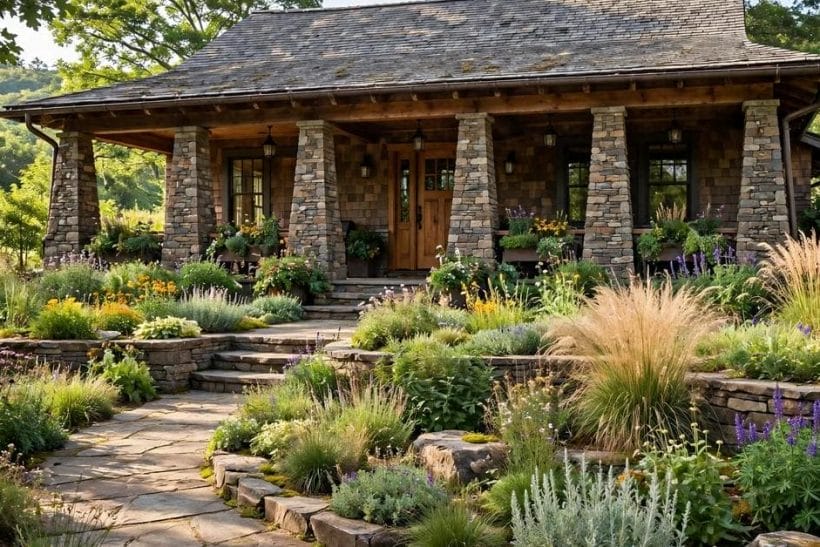
Grasses bring what shrubs cannot: movement, translucency and fine texture against stone. Their late-season plumes and winter silhouettes extend the bed’s performance long after the flowers finish — one reason the feature garden in this post’s photographs leans on them so heavily.
23. Ground-cover carpets under everything
A living carpet of low ground-cover plants knits the bed’s floor, suppresses weeds and keeps soil splash off the walls. It is the layer beginners omit and experienced craftsman gardeners plant first.
24. Hostas and ferns in the porch shade
The shaded beds under wide eaves suit bold foliage: hostas, ferns and their woodland companions, chosen for your climate’s moisture. In shade, foliage is the flower show, and texture contrasts do the work colour does in sun.
25. Layering heights in honest steps
Arrange each bed in clear height steps — ground cover, perennial, shrub, small tree — with no layer hiding the one behind from the main viewpoint.
26. Repeating one plant through the whole garden
Repetition is the craftsman garden’s calm: one grass, one perennial, one shrub reappearing in bed after bed ties the plot into a single composition and makes even a new garden feel settled and intentional.
27. Beds that curve around the corners
Wrap the beds around the house’s corners in generous curves instead of ending them at the downpipes. A corner bed carries the garden from front to side in one gesture and gives corner windows a planted outlook.
5. Native and Woodland Planting
Craftsman design grew from a love of the local landscape, and its gardens honour that origin with native and woodland planting — chosen with local guidance, since what is native is a question only your region can answer.
28. Native shrubs for the local birds and seasons
Shrubs native to your region feed and shelter local wildlife in ways exotic plantings rarely match, and they arrive pre-adapted to your soil and rainfall.
29. A woodland edge under the shade trees
Where mature trees shade the garden, plant beneath them as woodland: ferns, shade perennials and spring bulbs in the leaf-mould soil trees create.
30. Spring bulbs naturalised in the beds
Bulbs planted in generous drifts through the beds and under deciduous shrubs give the garden its early spring floor show before the perennials rise. Let their foliage die back naturally inside the planting, where rising perennials hide it kindly.
31. Ferns along the north and shaded walls
Shaded walls that defeat flowering plants carry ferns beautifully, their texture flattering stone and timber alike. Given moisture at establishment and shelter from drying winds, a fern bank becomes the garden’s coolest, calmest corner.
32. A small native tree as the garden’s ceiling
One well-chosen small tree — flowering, berried or fine-barked — planted where its canopy roofs part of the garden gives the plot its architecture. Underplant it lightly and let its seasons headline that corner of the composition.
33. Meadows touches in a sunny corner
A patch of informal, flower-rich planting in the sunniest corner nods to the prairie planting the craftsman era admired. Kept to a defined area with mown edges, it reads as a deliberate garden room rather than neglect.
34. Berry and seed-head planting for winter life
Plants that hold berries or handsome seed heads into winter feed birds and the gardener’s eye together. Leave the seed heads standing until late winter’s tidy — the garden’s winter structure and the wildlife both profit from the patience.
35. Rain garden planting in the wet hollow
Where the plot collects water, plant the hollow as a rain garden with moisture-loving types suited to your region, rather than fighting the site with drainage alone.
36. Leaf mould, mulch and the woodland floor
Feed woodland and shrub beds with leaf mould and organic mulches, renewed as they thin, copying the forest floor the planting imitates. The soil improves yearly under the habit, and the beds’ moisture steadies through dry spells.
6. Colour Through the Seasons
Craftsman colour is seasonal and earthy — the garden performs in movements rather than all at once. This section sequences the year so something always carries the composition.
37. Spring: bulbs, blossom and fresh green
The year opens with bulbs under the shrubs, early blossom on the flowering layer and the perennials’ fresh green mounds. Keep spring’s palette soft and clear; the garden wakes gently, in keeping with the house’s calm.
38. Early summer: the perennial drifts take over
As the shrubs’ blossom fades, the perennial drifts headline — planted in the warm, earthy tones that flatter stone and timber. Succession is planned, not hoped for: each drift’s neighbours are chosen to rise as it rests.
39. High summer: grasses and long performers
In high summer the grasses flower, the longest-performing perennials hold the beds, and the garden’s texture peaks even where individual blooms pause. Water deeply and rarely in dry spells, at the roots, as local guidance for your climate advises.
40. Autumn: the craftsman garden’s finest hour
Autumn colour — shrub foliage, grass plumes gone tawny, late flowers against stone — is where this garden style surpasses most others. Choose some shrubs for their autumn performance alone; the season is long and the house deserves the show.
41. Winter: structure, bark and evergreen
Winter reveals the bones the style is built on: stone walls, evergreen layering, handsome bark, seed heads and the porch’s timber. A craftsman garden in winter should look composed, not empty — walk it in January and plant what the walk finds missing.
42. Colour echoes between garden and house
Repeat one house colour in the planting — the door’s deep green in evergreen shrubs, the trim’s cream in a pale perennial drift — and the garden and architecture lock together.
43. Warm tones against stone, cool in shade
Warm flower colours glow against sunlit stone and timber; in the shaded beds, pale and cool tones — white, cream, soft blue — carry light into the gloom.
44. One hot accent, used once
A single vivid accent — a blazing autumn shrub, one drift of saturated summer colour — earns its drama against the garden’s earthy calm precisely by being alone. Two competing accents halve each other; the craftsman palette is edited, not accumulated.
45. Night colour: pale blooms and lit stone
Evening gardens reward pale flowers and light foliage that hold the dusk, especially near the porch where the household actually spends evenings. Plan one bed for the hour the family comes home, not only for the midday photograph.
7. The Front Walk and the Welcome
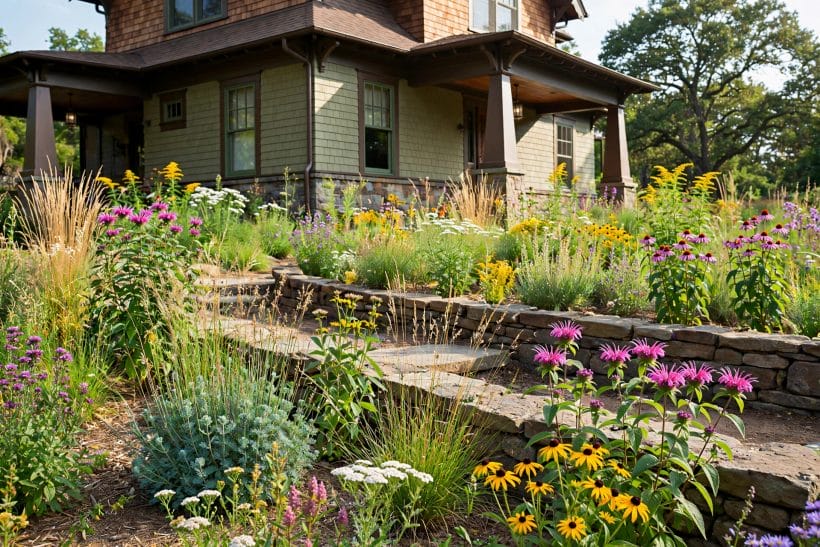
The walk from street to porch is the garden’s narrative. These ideas compose the welcome the craftsman house promises — with the rock-led edging in front yard rock landscaping for curb appeal as a close material cousin — the same approach the wider front yard landscaping ideas survey treats at whole-plot scale.
46. A walk wide enough for two
Generous width lets a couple walk side by side to the door — the social dimension of a welcome. Narrow, mean paths belong to houses that expect deliveries, not guests, and widening an existing walk transforms the approach more than any planting.
47. A gentle curve or a confident straight
Choose the walk’s line honestly: straight and axial for a formal plot, gently curved where the garden’s beds deserve the journey. Avoid the apologetic wiggle — a curve should reveal something at its turning, ideally the porch itself.
48. Planting that leans in, softly
Let the bed edges billow a little over the walk — grasses brushing ankles, low perennials spilling at the margins — while keeping the walking surface itself clear and safe.
49. A gate or low opening in the front wall
Where the front boundary has a wall or hedge, a simple timber gate in the house’s style marks the threshold between street and garden. Thresholds matter in this style; even a gap flanked by two stone piers composes the arrival.
50. House numbers and a lamp with presence
Legible house numbers and one well-made porch lamp, in finishes that suit the house, complete the welcome after dark and in winter. They are small structures, and the craftsman garden treats small structures with the same material honesty as large ones.
51. Scent planted at the door
Fragrant planting near the porch and along the walk’s last stretch greets arrivals before the door opens. Place scented shrubs and perennials where people pause — by the steps, beside a bench — following local advice on what scents sweetly in your climate.
52. Porch-edge beds at sitting height
Beds planted right against the porch, at a height the seated eye enjoys, turn the porch into a garden room with the planting as its wallpaper.
53. Steps dressed with pots and low planting
Broad porch steps take a pot at their base and low planting at their sides, softening the masonry without ever narrowing the tread. Keep every step’s surface clear and its edge readable — welcome and safety are the same design decision here.
54. The view back: garden composed from the porch
Compose one bed specifically for the view from the porch chairs looking out — the household’s own daily picture. Many gardens are planted for the street’s admiration and never for their owners; the craftsman garden reverses the priority politely.
8. Back Gardens, Shade and Outdoor Rooms
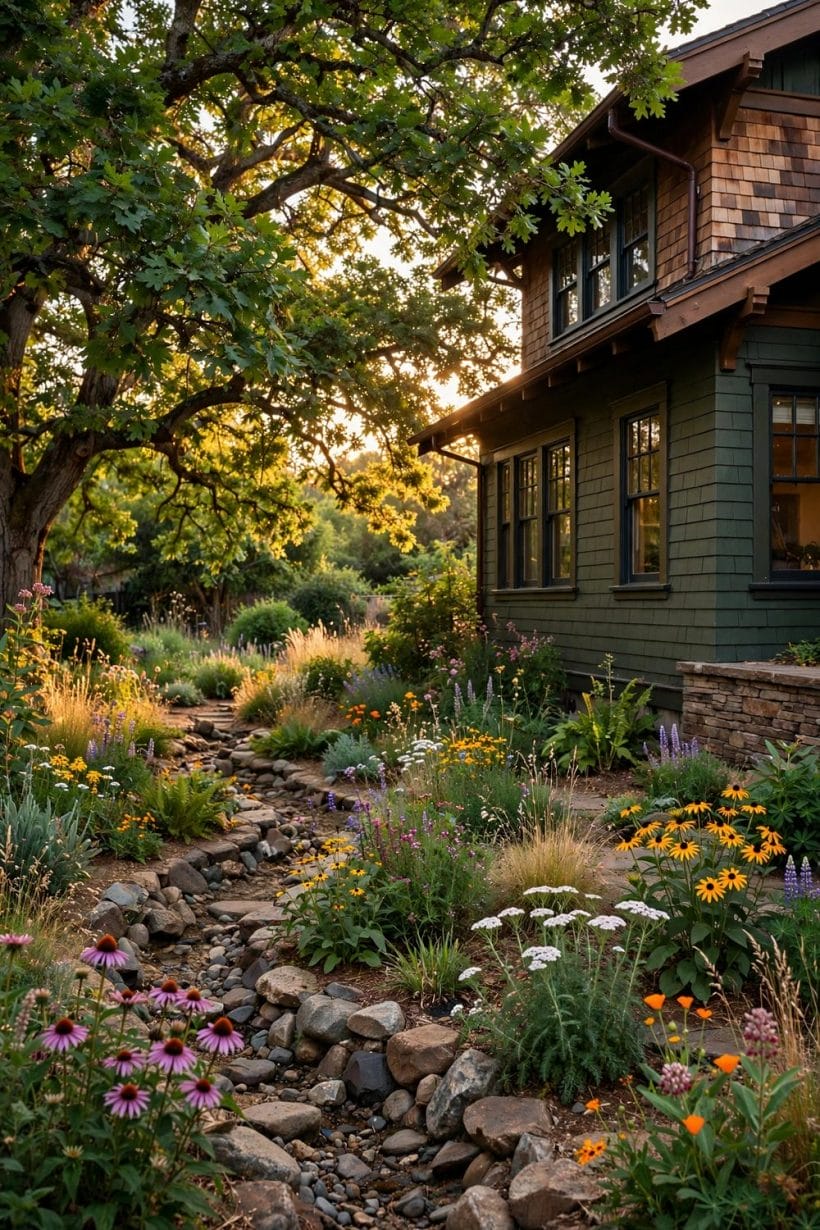
Behind the house the craftsman garden relaxes into rooms for living. This section extends the same materials and layering into the private garden, where the broader backyard landscaping ideas survey works at whole-garden scale.
55. A back terrace in the house’s stone
A terrace of the same stone or brick as the front walls carries the house’s material into the garden’s main outdoor room. Size it for the furniture and the gathering honestly — terraces fail by being almost big enough.
56. A pergola in honest timber
A chunky timber pergola over part of the terrace, planted with a climber chosen locally, gives the shade and enclosure outdoor meals want.
57. A fireplace or fire feature as the room’s hearth
An outdoor hearth gives the back garden its evening centre, built and used with the local rules and plain fire sense the subject always requires. Even unlit, the structure composes the room the way a chimney breast composes a parlour.
58. Shade garden rooms under the trees
The back garden’s shaded quarters become fern-and-foliage rooms with a stepping path and a seat — the cool retreats summer afternoons are spent in. The woodland planting of the earlier section finds its fullest expression here.
59. A kitchen or herb corner near the door
Herbs in raised timber beds or generous pots near the kitchen door join the working garden to the house’s daily life. Craftsman plots always grew food somewhere; the herb corner is its most charming modern form.
60. Lawns kept, but given a shape
Keep lawn where it earns its place — play, sitting out, the green foreground — but give it a composed shape edged in stone rather than letting it be the leftover.
61. A wildlife corner left a little wild
One corner allowed its seed heads, log pile and untrimmed tangle shelters the creatures the tidy garden excludes. Bounded by the garden’s order elsewhere, the wild corner reads as generosity rather than neglect.
62. Children’s play inside the composition
Swings from a strong tree, a mown play lawn, a den in the shrubs — play belongs in the craftsman garden’s plan from the start, screened by planting rather than exiled to a leftover strip.
63. Evening rooms: the garden after dark
Plan the back garden’s evening life deliberately — the terrace lit warmly, pale planting near the seats, the path home readable. The garden’s second showing, after sunset, is the one working households actually attend.
9. Lighting, Water and the Working Details
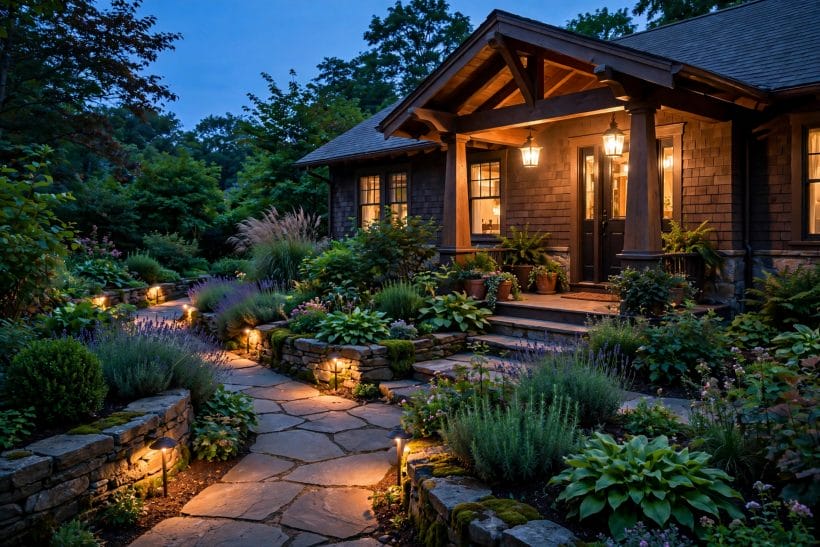
The craftsman garden’s details are working details: light for the path, water for the beds, and the small structures that make gardening itself easier.
64. Path lighting low, warm and sparing
Lights at path edges should be low, shielded and warm in tone, marking the way without flooding the garden. A few well-placed fittings beat a runway; darkness between them is what makes a garden feel like night.
65. The porch lamp as the garden’s lighthouse
One generous porch light does more for the garden’s welcome than any other fitting — it draws the eye, lights the steps and signals the occupied, cared-for house. Keep its glare shielded from the street and its style in the house’s family.
66. Uplighting one tree, not every shrub
A single specimen tree lit from below becomes the garden’s night sculpture. Resist lighting everything; the craft is in choosing the one subject and letting the rest rest in shadow.
67. Water: a small basin, a bird bath in stone
A simple stone basin or bird bath gives the garden water’s movement and the birds a reason to visit — wildlife planting’s natural partner, in the spirit of the wildlife-friendly garden. Keep it shallow, clean and simply made; complicated water features fight the style’s honesty.
68. Irrigation planned with the beds
Where summers are dry, simple drip or soaker irrigation laid when beds are built waters roots without wetting foliage and disappears under mulch.
69. Compost and the gardener’s corner
A screened corner for compost bins, pots and tools — timber-screened, in the garden’s material language — keeps the working machinery invisible from the rooms it serves. Every beautiful garden has this corner; the skill is hiding it in plain style.
70. Paths that drain and stay sound
Garden paths should shed water to their edges and sit on honest foundations, so they stay level and safe through wet winters. Any path that ponds or rocks underfoot wants rebuilding properly rather than patching — builders and local guidance govern the construction.
71. Mulch everywhere the soil shows
Bare soil in a craftsman bed is unfinished soil: mulch with organic material suited to the planting, renewed as it thins. Mulch is the style’s quiet signature — the dark, rich ground against which every stone and leaf reads more beautifully.
10. Planting Plans, Care and Costs as Drivers
The last ideas are the planning ones: how the garden is composed on paper, cared for through the year, and what its costs honestly consist of.
72. A plan drawn before a plant is bought
Sketch the beds, walls and walks to scale — or plan them in a floor-and-garden planner of the kind this site builds for tiny spaces — and place mature plant sizes on the drawing.
73. The gardener’s year of care
The care rhythm is seasonal and light: spring’s tidy and mulch, summer’s watering and deadheading, autumn’s planting and leaf gathering, winter’s structure walk and tool care. An hour’s rhythm kept beats a heroic weekend twice a year, in gardens as in houses.
74. Costs as drivers, honestly listed
The garden’s costs are driven by the stone work and any building, the size and maturity of plants bought, the trees, the lighting and irrigation, and the gardener’s own hours against hired help.
75. A garden that improves for a decade
End where the style begins: plant for the garden’s tenth year, not its first photograph.
A closing note on sources of plants and advice: the planting in these seventy-five ideas is deliberately described by type, habit and season rather than by cultivar lists, because the right plant is a local answer. Nurseries that know your soil, native-plant and garden societies, and neighbours whose craftsman gardens thrive are the authorities this post happily defers to — the same neighbourly knowledge the garden in tiny house garden ideas is built from, at plot scale.
Final Considerations
Beautiful craftsman house landscaping is a partnership between stone and leaf: build the bones in honest materials, layer the planting deeply and locally, and compose the walk to the porch as the welcome it is.
Do that, and the garden stops being the house’s setting and becomes its equal — which is exactly what the builders of these houses intended.


0 Comments