
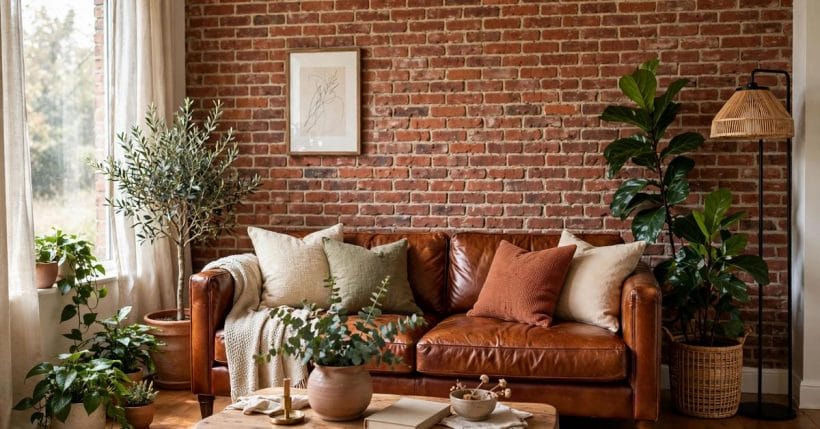
One brick wall can do the work of a whole redecoration — texture, warmth and history in a single surface, before a single cushion is moved.
These seventy-five brick wall living room ideas cover layouts, sofas, colours, finishes and layered lighting, plus the care checks that keep real and faux brick looking their best.
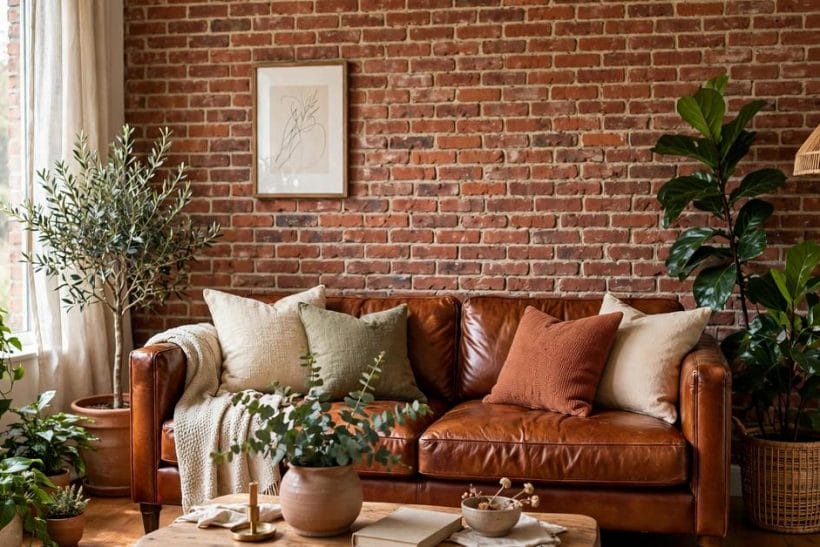
1. Brick Wall Living Room Ideas at a Glance
A brick wall in a living room is a material statement first and a backdrop second. Whether it is original masonry uncovered under plaster, a newly built brick feature, or a lightweight brick-effect finish, the wall brings pattern at two scales — the large rhythm of the courses and the small variation inside every brick —. This post belongs to the wider living room ideas family, but it stays with the brick wall itself: how the room is laid out against it, what sits in front of it, and how light makes it glow or glare.
| Question | Short answer |
|---|---|
| Which wall should be brick? | The one the seating faces or gathers around — usually the fireplace wall or the longest unbroken wall |
| Real brick or brick-effect? | Real brick where the structure already offers it; quality slips or panels where weight, cost or renting rules it out |
| What colours suit brick? | Warm whites, deep greens, inky blues, charcoal and the mortar’s own greys — tested against your brick’s undertone |
| How is brick lit well? | In layers: daylight controlled, wall-washing kept soft, and warm lamps at seating height |
| What is the main care point? | Dust held in the texture, and moisture — seal and clean gently, and investigate damp rather than covering it |
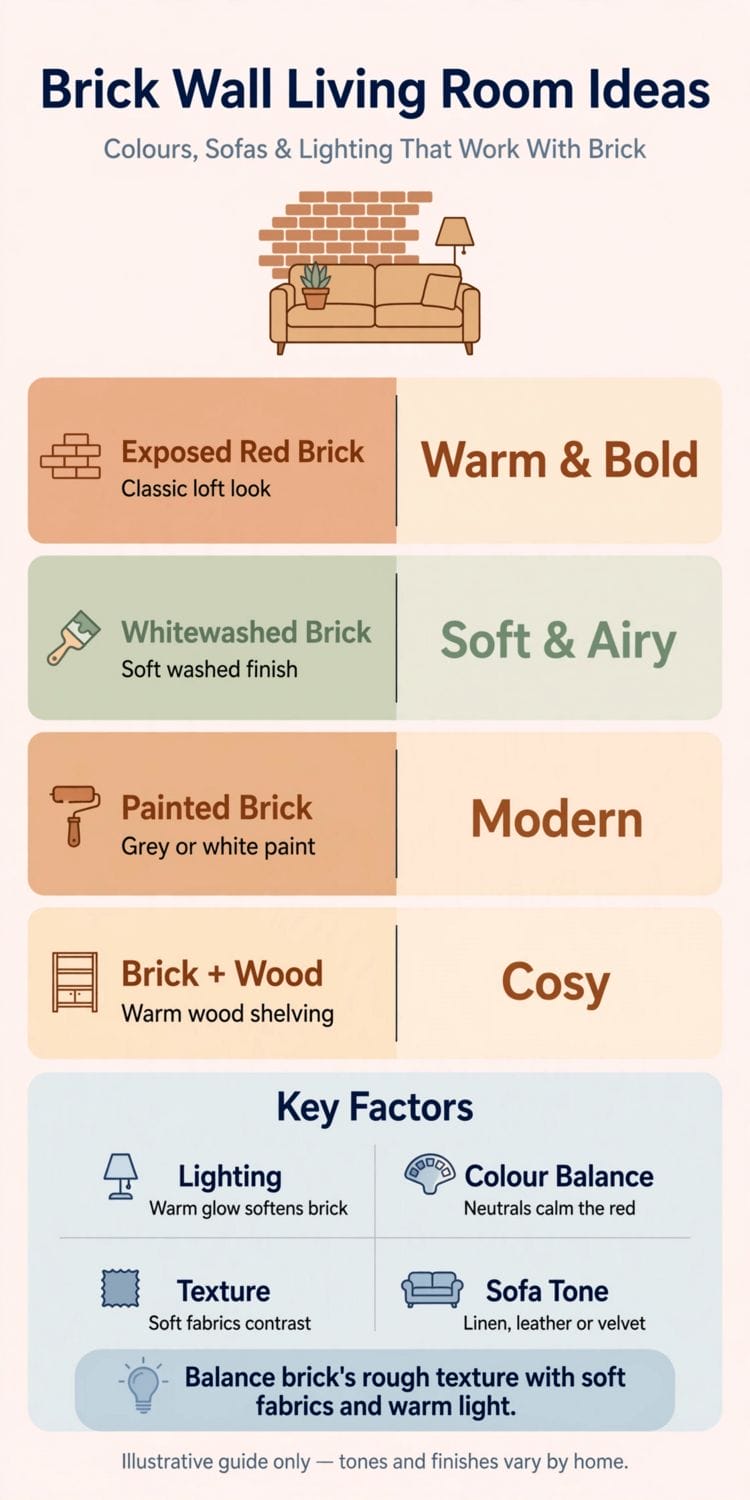
2. Layouts Around a Brick Wall
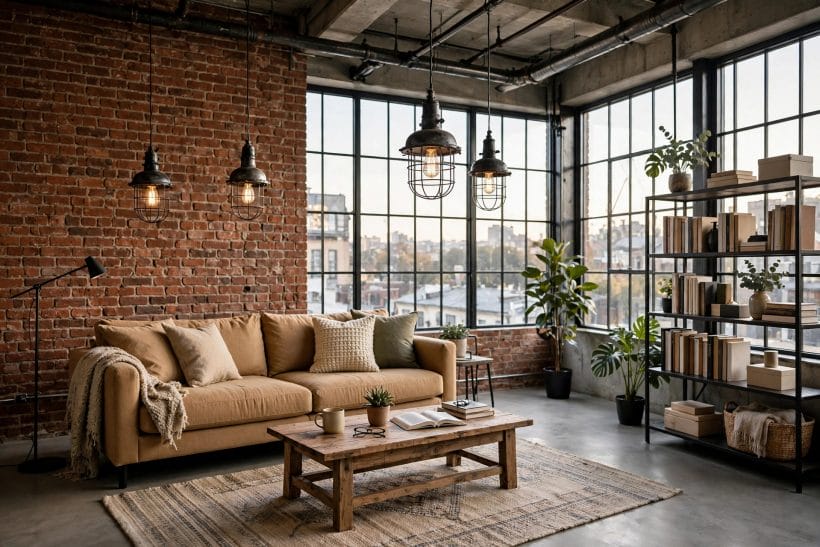
Layout comes before styling: the brick wall is the room’s anchor, and the furniture plan should treat it as the front of the room even when the television lives elsewhere.
1. A sofa facing the brick wall as the room’s focal point
Arrange the main sofa square to the wall so the brick becomes the picture the room sits and looks at. A low-backed sofa keeps the masonry visible above it, and a rug centred on the wall’s midpoint ties the arrangement to the architecture.
2. Twin armchairs flanking a brick fireplace wall
Where the brick wall carries a fireplace, a chair each side of the hearth balances the composition and leaves the fire itself as the centre. Keep the chairs angled slightly inward so conversation and warmth are shared.
3. An L-shaped sectional hugging the corner beside the brick
In a corner room, run the sectional along the wall next to the brick and let the brick end wall close the arrangement. The sectional’s back stays clear of the masonry, so the texture is seen over and beyond the seating.
4. A floating sofa with a console behind, brick beyond
Pulling the sofa off the wall and adding a slim console behind it creates depth in a long room, with the brick as the far layer. Lamps on the console put a warm middle layer between seating and masonry.
5. A reading corner against the quietest stretch of brick
The end of a brick wall, away from doors and screens, makes a natural reading nook: one deep chair, a floor lamp and a small table. The brick’s texture does the decorating, so the corner needs very little else.
6. A media wall set beside, not on, the brick
Mount the television on the adjacent plain wall and let the brick stay a pure material surface. The room gains two calm zones — viewing and sitting — and no cables or brackets interrupt the brickwork.
7. A low media bench running under a full brick wall
If the screen must live on the brick, a low bench beneath it grounds the arrangement and hides equipment, while the brick above stays the dominant sight. Fix into mortar joints where a professional advises, never through brick faces.
8. Symmetrical shelving either side of a central brick chimney breast
A projecting brick breast with matching shelves in the alcoves is the classic arrangement for a reason: storage fills the dead corners and the brick keeps the centre. Style the shelves lightly so the masonry still leads.
9. A window-seat layout that lets daylight rake the brick
Where a window sits in or beside the brick wall, low seating under it catches the same side light that models the brick’s texture. Keep tall furniture off that wall so nothing shadows the surface.
10. An open-plan zone defined by the brick wall alone
In a combined living and dining space, let the brick wall mark the sitting zone: sofa and rug on its side, table on the other. One material change does the zoning that screens and partitions would otherwise be bought to do.
3. Sofas, Seating and Soft Edges
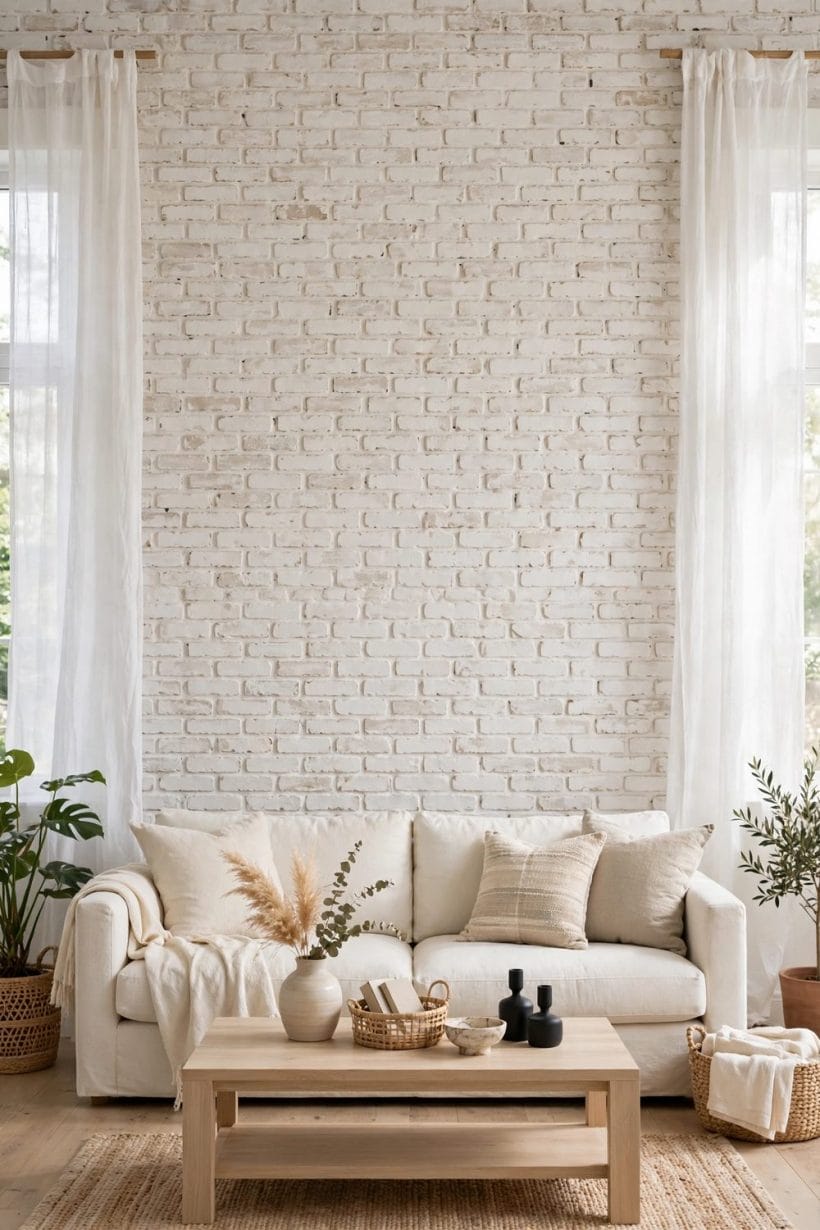
Brick is hard, rough and visually busy; seating is where the room softens it. Fabric, depth and colour at sofa level decide whether the wall feels warm or austere.
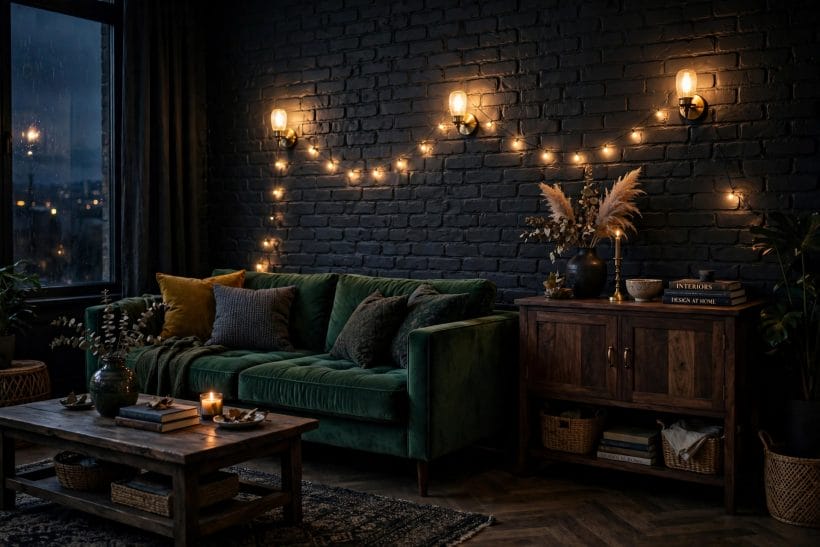
11. A pale linen sofa cooling warm red brick
Natural linen against red brick is the reliable classic: the pale fabric calms the brick’s heat and the brick stops the pale scheme feeling washed out. Add cushions in the mortar’s grey to stitch the two together.
12. A deep green velvet sofa against orange-toned brick
Green is brick’s complementary opposite, so a green velvet sofa makes both colours richer. Keep the rest of the palette quiet — wood, cream, one metal — so the pairing stays the room’s single strong statement.
13. A cognac leather sofa echoing brick’s earth tones
Leather in a warm tan sits inside brick’s own colour family and ages as gracefully as the wall behind it. It suits rooms that lean rustic or industrial, and a wool throw breaks the leather’s sheen.
14. A charcoal sofa grounding pale, whitewashed brick
Against light brick, a dark sofa gives the room its anchor and stops the scheme floating. The contrast is graphic and modern, and it tolerates the soot-dark cushions and throws of a working fireplace room.
15. A low, armless sofa that leaves the brick courses visible
Sofa height is a sightline decision: a low back shows more wall and suits brick worth displaying. Armless ends keep the profile light in a small room where the wall already supplies plenty of visual weight.
16. Curved seating softening a hard brick grid
A curved sofa or a pair of tub chairs answers brick’s straight courses with arcs. The contrast of geometries is subtle but it is what makes a brick room feel designed rather than merely exposed.
17. A window-daybed along a brick wall in a narrow room
Where a full sofa would crowd the room, a daybed-depth seat along the brick gives lounging without bulk. Bolsters in a plain weave keep the masonry as the pattern of the wall.
18. Two small sofas facing each other across a brick hearth
The conversational layout — sofas opposite, fire between at the end — suits long brick-walled rooms and households that talk more than they watch. A shared ottoman keeps the middle flexible.
19. A chaise angled to catch light across the brick
One angled piece breaks the grid politely: a chaise turned toward the window lets its sitter watch light move across the brick through the day. Keep its fabric plain and let the wall perform.
20. Built-in bench seating with storage under a brick wall
A fitted bench along the brick gives seating, storage and a clean line in one build, and its cushions can carry the room’s one pattern. The bench top should stop short of the wall so the brick reads as a backdrop, not a seat back.
4. Colour Pairings That Flatter Brick
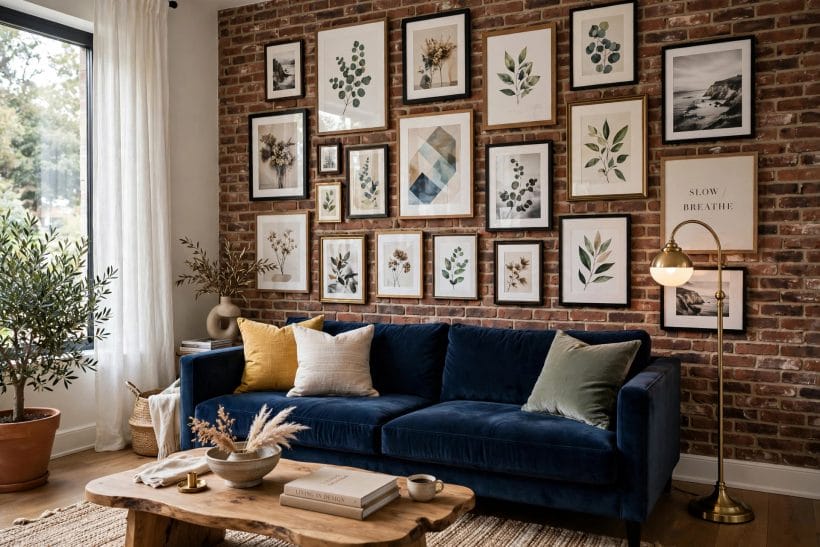
Every brick has an undertone — red, orange, brown, buff or grey — and the room’s colours succeed when they are chosen against that undertone, in daylight, before anything is bought.
21. Warm white walls letting red brick lead
Painting the remaining walls a warm white hands the room to the brick without a fight. The white must carry the same warmth as the mortar, or the plain walls will look blue and cold beside the masonry.
22. Deep forest green as brick’s rich partner
Green on the adjoining walls or the ceiling beam deepens a brick room into something library-like and calm. It is the pairing to choose when the brick is handsome and the mood wanted is evening-warm.
23. Inky blue with buff and yellow bricks
Pale yellow-brown brick glows against dark blue, each making the other clearer. Use the blue on cabinetry, a bookcase wall or the sofa, and repeat it once more in a small object across the room.
24. Charcoal and black accents sharpening pale brick
On whitewashed or naturally pale brick, black picture frames, lamp bases and a dark floor line give the softness a skeleton. Without those dark notes, pale brick schemes can drift into vagueness.
25. Terracotta and clay tones doubling down on warmth
Colours drawn from the brick itself — clay, rust, sand — make a enveloping, tonal room. Vary the textures rather than the hues: wool, pottery, rattan and raw wood keep tonal from becoming flat.
26. Sage and grey-green cooling an orange brick
Where brick runs too orange for comfort, grey-greens on the other walls pull it back toward neutral. Test large swatches through a full day; orange brick changes character between morning and lamplight.
27. Mustard and ochre bridging brick and wood
A mustard cushion, chair or curtain is the bridge colour between red brick and mid-tone wood floors. Used in two or three places it reads as intention; used once it reads as accident.
28. Blush and dusty pink softening industrial brick
Pale pink is brick’s own faded cousin, and a blush sofa or rug takes the warehouse edge off an industrial wall. It pairs especially well with grey mortar and black steel details.
29. Cream and stone neutrals with grey-brown brick
Weathered grey-brown brick wants stone, cream and flax around it — a quiet, country palette. Shiny or bright colours fight this brick; matte and woven finishes join it.
30. A single bold colour used once, against brick
One confident hit — a cobalt chair, a scarlet cushion pair — electrifies a brick room precisely because everything else is restrained. The rule is singularity: the eye should find the bold note, then return to the brick.
5. Brick Finishes and Treatments
The wall itself can be tuned. From leaving sound original brick bare to painting it outright, each treatment trades character against calm — and the fireplace version of the same choice is covered in the brick fireplace living room ideas post.
31. Original brick cleaned and left honestly bare
Where the brick is sound and handsome, the best finish is none: a gentle clean, a check of the mortar, and the wall left to be itself. Aggressive cleaning damages old brick faces, so soft methods and patience win.
32. Limewash softening colour while keeping texture
Limewash veils brick in a cloudy, breathable coat that mutes strong colour but keeps every bump of texture. It can be diluted for a whisper of change or built up for near-opacity, and it suits old masonry.
33. Whitewash for a brighter, country feel
A thinned white paint wash brightens a dark brick room while letting the brick’s tones ghost through. It reads fresher and less formal than limewash, and it is the classic cottage treatment.
34. Fully painted brick in a soft warm white
Painting brick outright gives a textured but colour-quiet wall — the pattern of the courses without the red. It is a one-way door on old brick, so it suits brick whose colour genuinely fights the room.
35. Fully painted brick in charcoal or black
Dark painted brick is dramatic and forgiving of soot near a fireplace, and it turns the wall into a gallery backdrop. The room needs strong lighting layers to keep the drama from becoming gloom.
36. German schmear for a soft, aged plaster look
Mortar smeared over brick and partially wiped back gives the aged, cottage-European finish that flatters buff and red brick alike. It is a skilled, permanent treatment — a test patch in an unseen corner is essential.
37. Brick slips where real brick is too heavy
Thin brick slips applied to a boarded wall give genuine brick surface without structural weight, and they are the usual route in upper rooms and flats. Corners need proper corner slips or the illusion fails at the edges.
38. Brick-effect panels for renters and fast makeovers
Modern embossed panels and quality wallpapers fake brick convincingly at arm’s length and remove easily — the honest rental option, labelled as effect, not masonry.
39. Sealed brick with a matte, invisible finish
A matte sealer stops brick dust shedding onto sofas and sleeves and makes the wall wipeable, without the shine that cheap sealers add. Breathable products matter on old, solid walls — advice from a masonry supplier is worth taking.
40. Repointed mortar refreshing tired brickwork
Sometimes the brick is fine and the mortar is the problem: grey, crumbling joints grey the whole wall. Repointing in a tone close to the original mortar lifts the wall more honestly than any paint.
6. Furniture and Materials Beside Brick
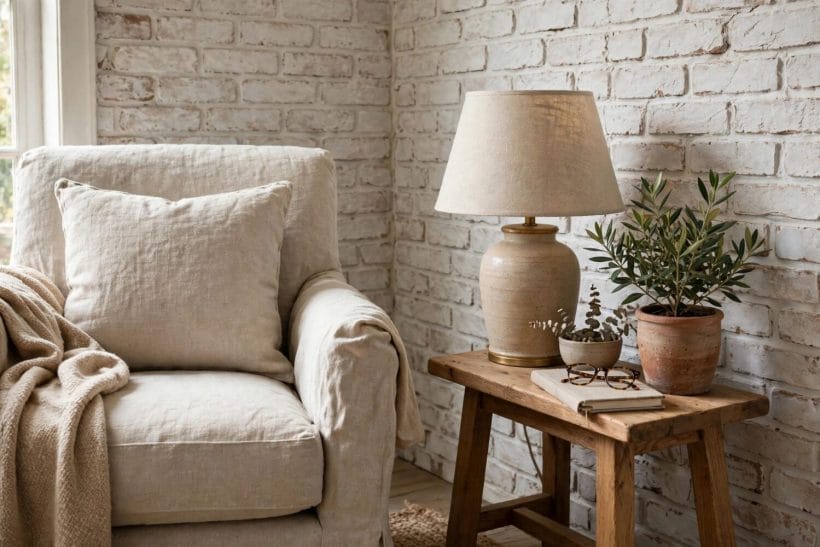
Brick sits happily beside most honest materials; the failures are all about shine and scale. Pieces should be chunky enough to hold their own against the wall’s pattern.
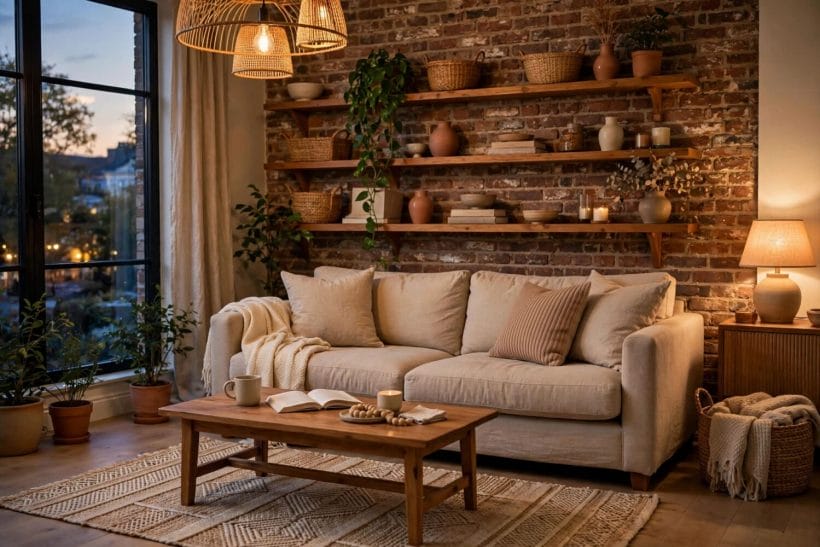
41. Raw timber shelving warming a brick wall
Thick wood shelves on brick combine the room’s two most natural materials, and the shelves’ contents give the wall rhythm. Keep fixings into the mortar joints and the loads modest, as the fireplace living room arrangements also show.
42. Black steel and glass for an industrial note
A blackened-steel bookcase or coffee table sharpens brick into loft territory. Glass tops keep the sightline to the wall open and stop the metal scheme becoming heavy.
43. A large pale rug calming a busy brick wall
The floor is the brick room’s pressure valve: a big, pale, plainly woven rug gives the eye a rest and pulls the seating into a group. Pattern belongs on the wall here, not underfoot as well.
44. Leather and hide accents echoing brick’s tactility
A hide rug, a leather ottoman or cushions repeat brick’s natural, uneven character in soft form. These materials forgive the dust that brick texture holds and sheds.
45. A stone or concrete hearth slab grounding the wall
Where the brick wall meets the floor, a stone slab or a simple raised hearth gives the masonry a plinth and protects the floor edge. The junction reads finished rather than stopped.
46. Woven baskets and rattan lightening dark brick
In a room whose brick runs dark, pale woven storage adds light-catching texture without adding colour. Baskets also tame the firewood, throws and magazines that collect near a hearth.
47. A wooden mantel shelf crossing a brick chimney breast
One horizontal timber across vertical brick is a composition in itself, and it gives the room its styling shelf. Keep the display sparse — three objects, varied heights — and let the brick breathe.
48. Upholstered ottomans instead of a hard coffee table
Soft centrepieces suit brick rooms, where hard surfaces already abound. An ottoman in a plain weave with a tray on top handles drinks and feet with equal grace.
49. Antique and reclaimed pieces matching brick’s age
Old brick deserves some old company: a worn chest, a reclaimed-wood sideboard or a vintage chair stops the room feeling newly decorated around an ancient wall. One or two pieces are enough.
50. Plants trailing and standing against brick
Green is brick’s oldest partner — think of every ivy wall. A tall plant in the corner, a trailing pot on the mantel and herbs on a sunny sill soften the masonry and prove the room is alive.
7. Layered Lighting for Brick
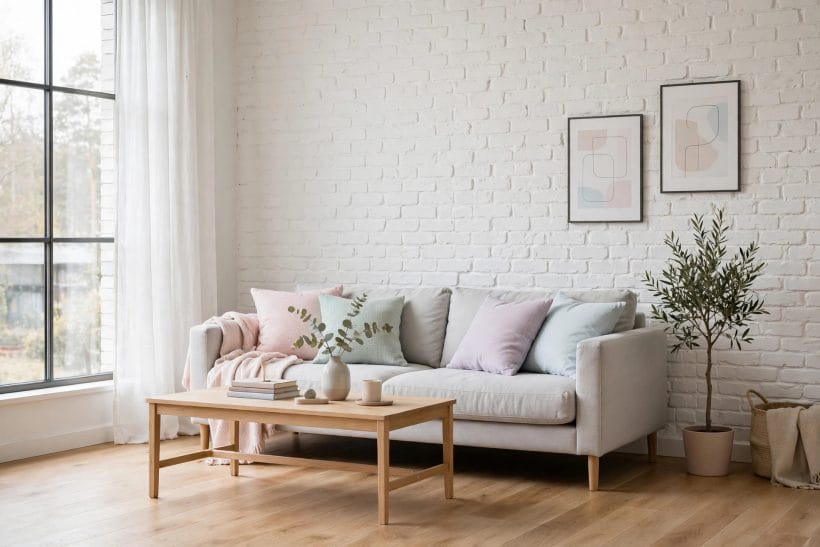
Brick eats light and rewards it: grazed by a soft wash, its texture deepens; hit by a single harsh downlight, it glares and flattens. Layers, as in every good scheme, do the work.
51. Wall-washing light softening the brick’s face
A soft, even wash from ceiling track or a picture light broadens the wall and smooths its contrasts for the evening. Position matters more than power: the aim is glow, not spotlight.
52. Grazing light for maximum texture on a feature stretch
Where the brick is beautiful, a light set close and angled across it rakes every course into relief. Reserve grazing for the one stretch that deserves it; a whole grazed wall can feel restless.
53. Warm lamps at seating height balancing the wall
Table and floor lamps at the sofa put warm pools where people sit, so the brick becomes backdrop rather than the only lit surface. Matching warm bulb tones throughout keeps brick’s colour true.
54. Picture lights over art hung on brick
Art on brick needs its own light or it sinks into the pattern. A slim picture light lifts the canvas forward and gives the wall a gallery rhythm of lit rectangles.
55. Sconces flanking a brick fireplace
A sconce each side of the hearth frames the fire wall and lights faces kindly for conversation. On brick, choose fittings whose plates sit flat, and let an electrician route cables with the mortar joints in mind.
56. Daylight control with sheers on the brick wall’s window
Strong sun across brick bleaches cushions and throws harsh shadows by evening. Sheer curtains keep the modelling light but take its edge off, and they protect upholstery from fading.
57. A pendant cluster lowering light in a tall brick room
High brick walls swallow ceiling light; pendants dropped to just above head height bring the light down to the people. A cluster of simple shades suits the wall’s industrial honesty.
58. Candlelight and firelight as the final layer
Real flame is brick’s native light — the two were paired for centuries. Even without a working fire, grouped candles on the hearth or mantel give the wall its oldest and kindest illumination.
59. Dimming everything for evening calm
Put the brick room’s circuits on dimmers and the wall can move from bright family use to a low, ember-like glow. Dimming is the cheapest layer of all and the one that changes mood most.
8. Styling, Art and Textiles
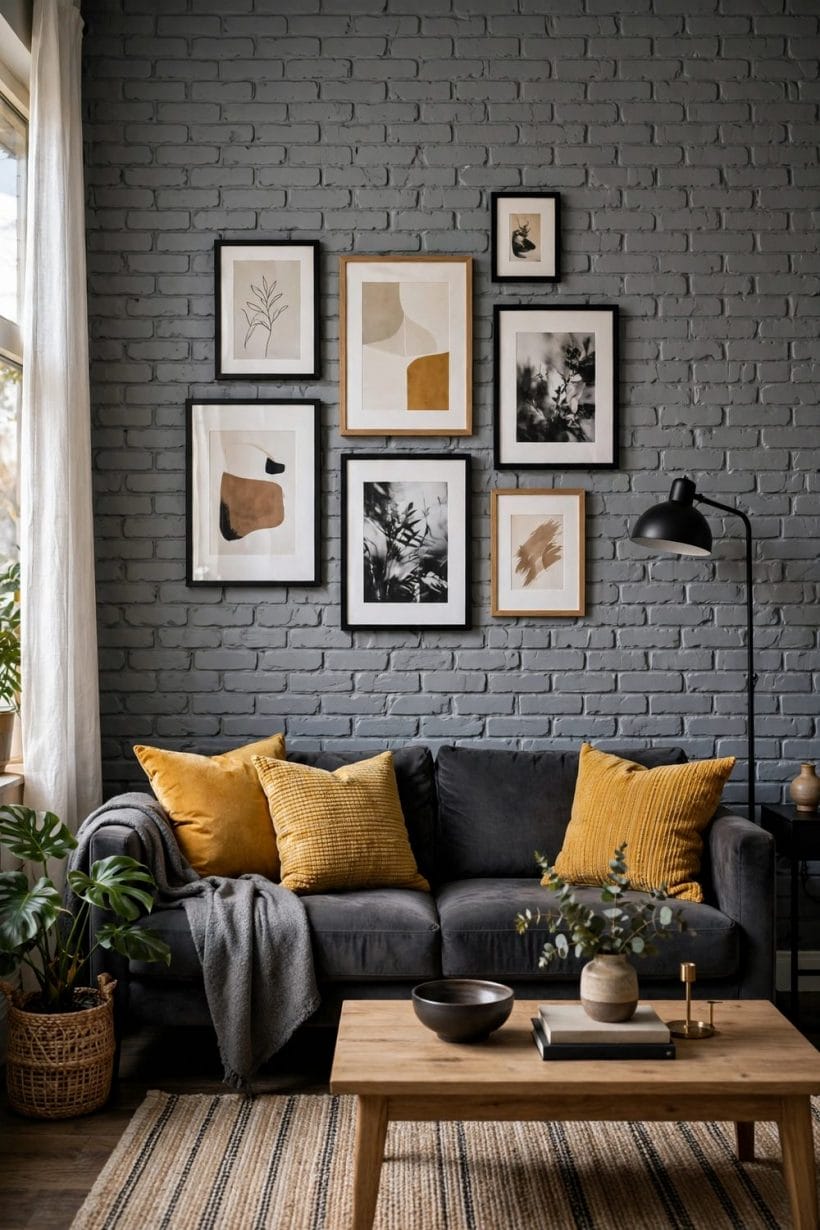
Styling a brick wall is an exercise in restraint: the wall is already patterned, coloured and textured, so everything added should be larger, plainer and quieter than feels natural.
60. One oversized artwork calming a whole brick wall
A single large, pale, abstract canvas gives a busy wall a resting place and instantly modernises old brick — a trick the farmhouse living room ideas schemes use in country form. Hang it on proper fixings rated for masonry.
61. A grid of small frames reading as one picture
Where one big piece is out of reach, a tight grid of matching frames with generous pale mounts reads as a single calm rectangle. The mounts, not the images, do the calming.
62. A big round mirror breaking the brick’s straight lines
A circular mirror over a mantel or sofa answers all those straight courses with one curve, and it bounces window light back into the room. Keep the frame simple — thin metal or plain wood.
63. Textiles in plain weaves, pattern kept off the wall
Cushions and throws in linen, wool and cotton weaves add softness without competing pattern. If pattern is wanted, one cushion in a large-scale check is the limit beside busy brick.
64. A mantel styled in threes, changed with the seasons
Three groups — something tall, something green, something horizontal like stacked books — keep a brick mantel composed. Seasonal swaps refresh the room without touching the wall.
65. Open shelving styled with air between objects
On shelves against brick, leave gaps: the brick showing between objects is part of the display. Crowded shelves on patterned brick exhaust the eye; edited shelves let both breathe.
66. A clock or metal sign as the single industrial accent
One piece of honest hardware — a station clock, an enamel sign — nods to brick’s working past; a collection of retro objects turns the room into a theme.
67. Books stacked horizontally as quiet colour blocks
Low stacks of books on a bench or hearth bring muted colour that never fights brick, and signal a room that is read in, not just looked at.
9. Small Rooms, Rentals and Tiny Homes
Brick’s reputation for shrinking rooms is undeserved — handled lightly, one brick wall adds depth to a small space, and in tiny homes a brick-effect finish gives masonry character without masonry weight, as the compact schemes in tiny house living room ideas and small living room ideas show.
68. One brick wall only, the rest kept pale and plain
In a small room, brick on a single wall — ideally the one faced on entering — reads as depth, not enclosure. The other walls in a soft pale tone keep the room’s light circulating.
69. Brick slips on a chimney breast only
Limiting brick to the breast gives the material’s character at a fraction of the visual weight, with calm alcoves either side. It is also the honest treatment where only the breast was ever brick-faced.
70. A half-height brick wall with a shelf cap
Brick to picture-rail height, capped with a timber shelf, with plain wall above, suits low rooms: the texture sits where hands and eyes linger, and the upper wall stays light.
71. Pale-painted brick in a dark small room
Where a small room’s brick is dark and the room faces away from the sun, painting the brick a warm pale tone keeps the texture and rescues the light. It is the pragmatic choice, and it looks intentional.
72. Rental-safe brick-effect panels over one wall
Good panels or a brick-print hanging give renters the look with fixings a landlord can accept. Choose the wall behind the sofa, where the effect is seen across the room rather than inspected up close.
73. A brick-look backdrop behind open shelving in a tiny lounge
In the smallest rooms, a slip or panel backdrop inside a shelving unit delivers brick character in a few square feet. The shelves’ contents frame it, and no wall is committed.
74. Keeping furniture low and legs visible under seating
Low, leggy furniture lets a small brick room breathe: floor shows, light travels, and the wall’s base course stays visible. Heavy skirted pieces make brick feel closer than it is — a point the layouts in how to decorate a tiny living room return to often.
75. A brick wall as the tiny home’s one big gesture
A tiny living space can afford exactly one grand material, and brick — real slips on a single end wall — is a fine choice: warmth, pattern and a sense of permanence in a home that must earn every surface.
10. Care, Moisture and Safety Checks
Brick is durable, not invincible, and most brick-wall problems are water problems wearing a disguise. Dust is the daily issue: the texture holds it, so a soft brush attachment on the vacuum and an occasional wipe of sealed brick keep the wall fresh; unsealed old brick should never be soaked, because the water carries salts and stains to the face.
Efflorescence — white salty bloom — means moisture is moving through the wall, and the answer is to find and stop the water, not to scrub and seal over it. Damp patches, crumbling mortar and spalling brick faces all deserve a mason’s or surveyor’s eye before decoration, and any fireplace in the wall must have its flue and hearth checked by a qualified sweep or installer before use. Painted and limewashed brick needs only gentle cleaning and the occasional touch-up; sealed brick needs its sealer renewed when water stops beading and starts darkening the surface. Treat the wall as the building’s fabric, not wallpaper, and it will outlast every scheme built against it.
Final Considerations
Start with the wall as it is: clean it, live with its colour for a week of different lights, and let the room’s first moves be the sofa’s position and one pale rug. Brick rewards patience: treatments are hard to undo, layouts are not. Choose the layout that faces the brick, the colours that flatter its undertone, and light it in warm layers, and the oldest material in the house will feel like the newest idea in it.



0 Comments