
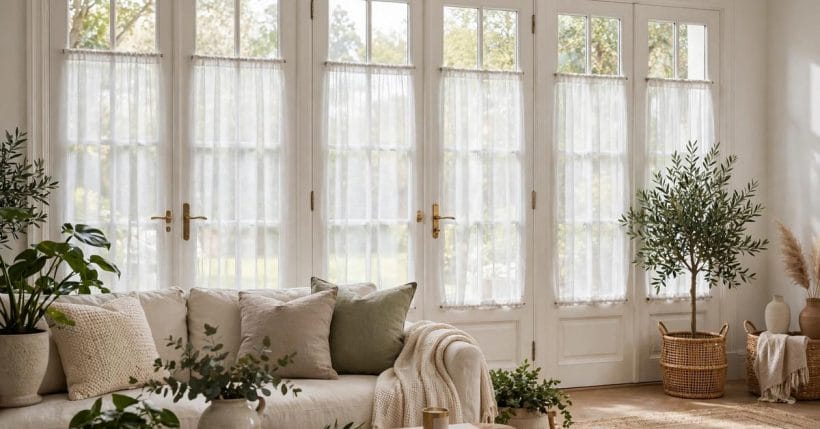
A glass door is a generous thing until the evening you want the room to yourself — the street lit, the hallway bright, and your living room on show like a shop window. Covering glass doors is not about hiding; it is about choosing, hour by hour, how much of the view runs each way.
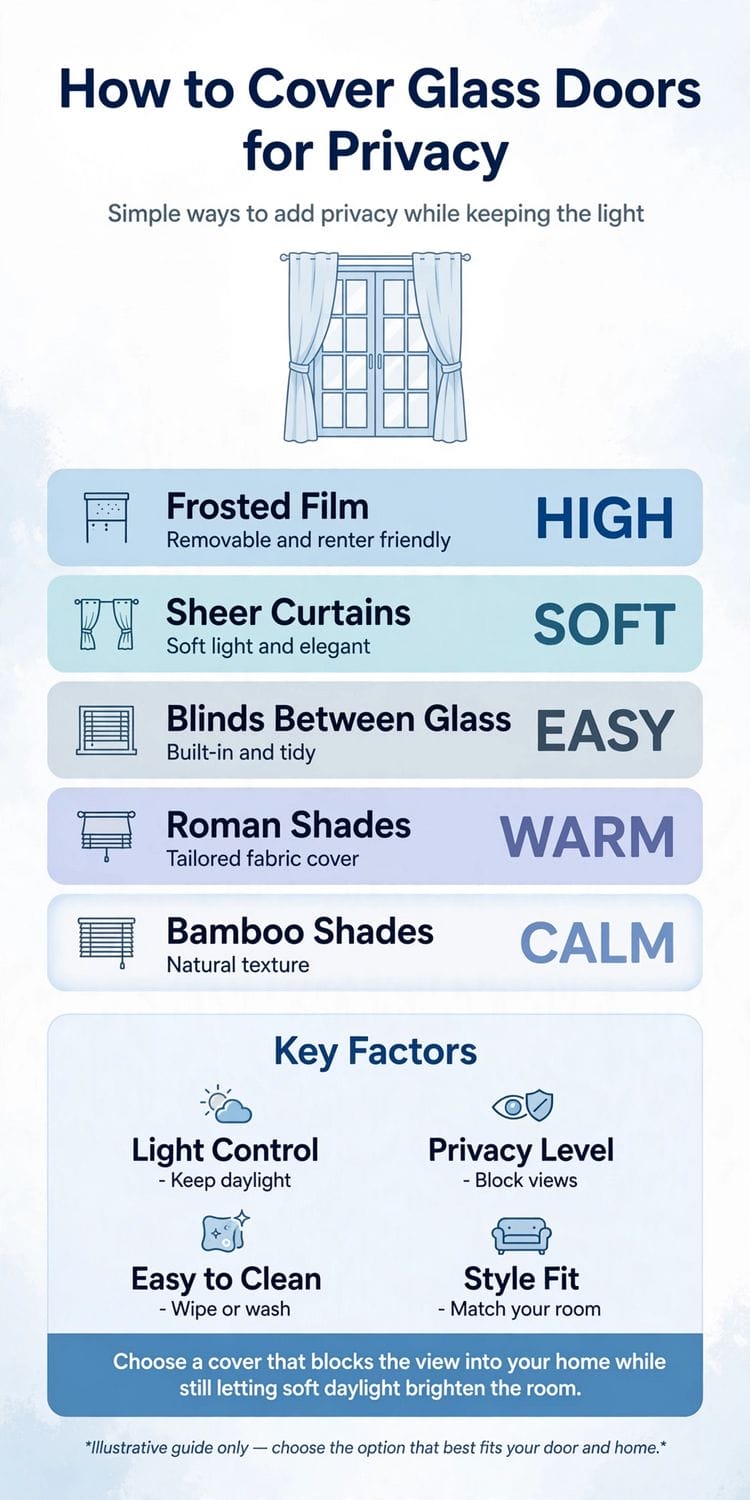
These twelve ways to cover glass doors for privacy cover films, blinds, curtains, screens and solid panels, with honest notes on light, fitting and reversibility, plus the checks for French doors, sidelights and rented homes.
1. Covering Glass Doors at a Glance
Every method below trades three things against each other: privacy, light and permanence. Films give privacy and light but no darkness; blinds and curtains give all three at the price of hardware; panels and screens suit doors that must keep working hard. The door itself decides much of it — a hinged French door, a sliding patio door and a glazed front door each favour different answers, and the wider family of glazed openings, from the clerestory windows post onward, shares the same logic: glass you can govern is glass you can enjoy.
| Question | Short answer |
|---|---|
| What gives privacy but keeps the light? | Frosted or privacy film, sheer curtains, and top-down blinds |
| What gives darkness as well? | Lined curtains, solid blinds and fitted panels |
| What suits a rented home? | Static-cling film, tension-rod curtains and no-drill blind mounts |
| What should be avoided? | Anything that blocks the door’s swing, its handle, or your escape route in an emergency |
| What is the fitting rule? | Measure the glass, not the door — and leave clearance for handles and locks on every method |
2. Choosing by Door Type and Light
Start with the door’s job. A front door’s glass is about callers seeing in and you seeing out; a bathroom or bedroom door’s glass is about silhouettes; a patio door’s glass is a whole wall of exposure after dark. Then decide the light: rooms that rely on the door for daylight need translucent answers, while rooms with other windows can take solid ones. Finally, the mechanics: coverings on a hinged door travel with it and must clear the frame; coverings on a sliding door must stack clear of the moving panel; coverings on any door must leave the handle, lock and any letterbox fully usable.
Hold samples against the glass at night as well as by day, with the room lit and someone standing outside if you can arrange it. Privacy is a night-time property — many coverings that look opaque at noon turn into shadow theatre after dark, and it is better to learn that with a sample than with the finished job.
Decide, too, who the covering is for at each hour. A street-facing front door mostly needs to stop the casual glance, and a distortion film does that all day without making the hall gloomy. A bedroom or bathroom door needs silhouette-proofing, which is a stricter test. A living-room patio door needs both, but at different times — translucent by day, solid by night — which is why that door so often ends up with two of the twelve ways in partnership. Naming the actual need before shopping is what keeps a household from buying the strictest answer to a question it never had.
Safety outranks privacy in one respect: no covering may slow an exit. Doors on an escape route must open fully with the covering in place, blinds and panels must not jam a leaf, and anything fitted to a door should be operable by a half-awake person in the dark. It is a short check to make at sample stage and an unforgiving one to skip.
3. Films and Frosted Finishes
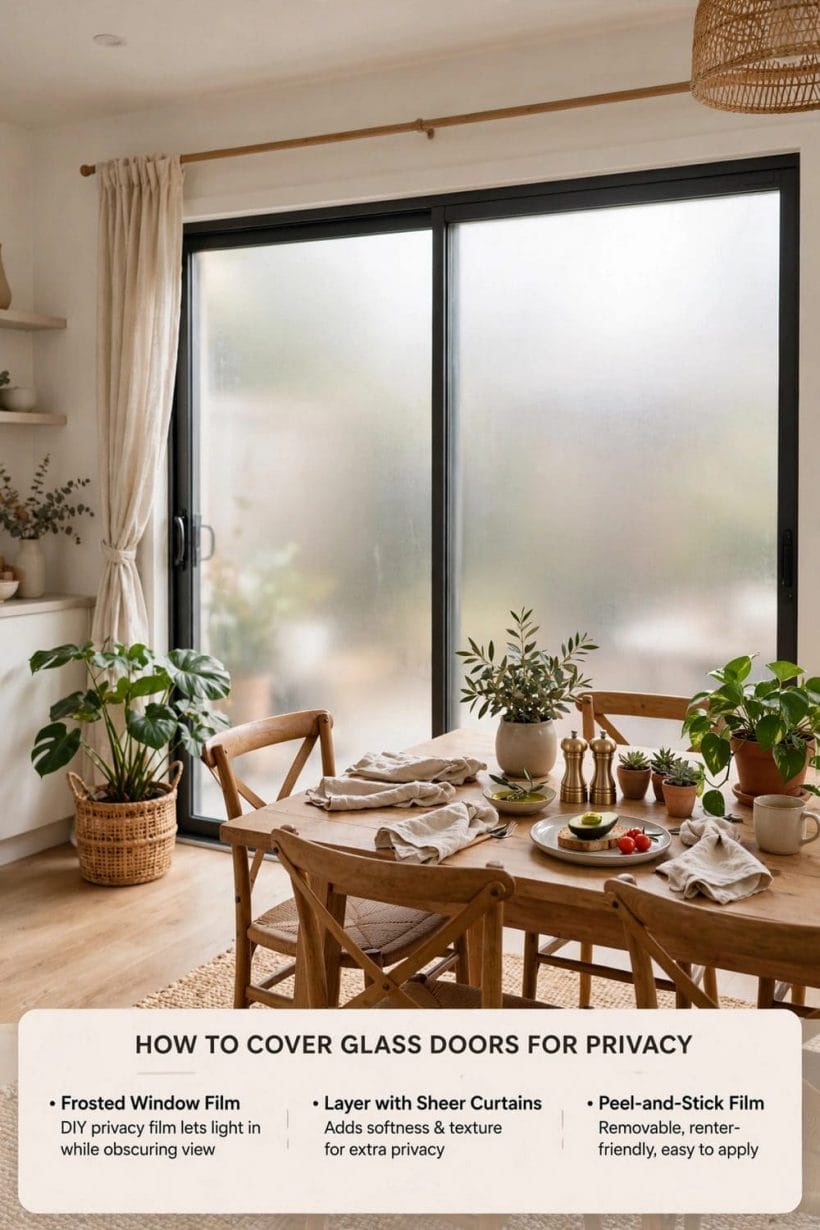
Film is the lightest-touch family: nothing moves, nothing hangs, and the door keeps its clean lines while the glass turns to a soft blur.
1. Full frosted privacy film
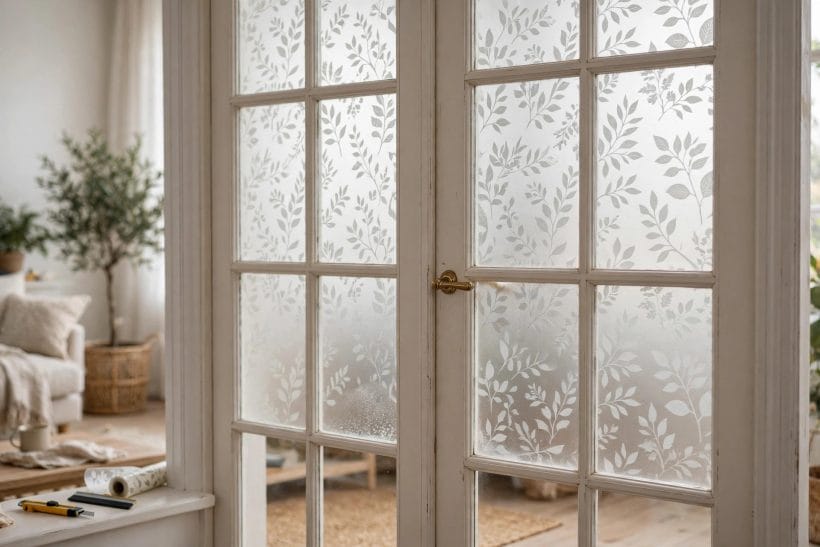
A matte film over the whole pane gives complete visual privacy with most of the daylight — the standard answer for bathroom doors, front doors and office doors. Static-cling versions peel off cleanly; adhesive versions sit flatter and last longer. Neither gives darkness, only privacy.
2. Partial film: frosted bands and borders
Frosting the middle band of a tall pane, or leaving a clear border around a frosted centre, keeps privacy where bodies are and light and outlook where eyes are not. It is the patterned-glass look without replacing the glass, and it suits front doors where a full frost can feel blank.
3. Decorative and reeded-look films
Films that imitate reeded, ribbed or patterned glass distort the view into texture rather than blur, which many rooms wear better. They behave like other films for light and privacy, and they are the friendliest option for period doors whose style a blind would fight.
4. Blinds and Shades Made for Doors
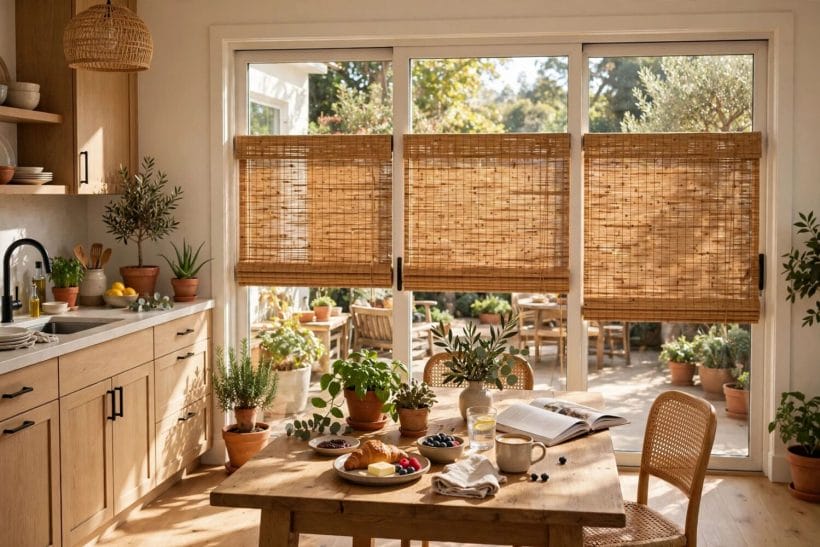
Blinds answer the door that needs privacy on demand — open by day, closed at night — and the door-specific versions are built slim so the door can still move.
4. Slim venetian blinds fitted to the door
Narrow-slat blinds mounted close to the glass, with hold-down brackets at the base so they do not swing and clatter when the door moves. Tilt gives every grade between view and privacy, and the light control is the finest of any method here.
5. Roller and Roman shades on the door
A shade gives a softer finish than slats and can be had in light-filtering or blackout fabrics. On a door it needs a tidy mount and a cord arrangement that stays clear of the handle — cordless or loop-secured designs are the sensible pick, especially with children in the house.
6. Blinds sealed between the panes
Where a glazed door unit is being replaced anyway, blinds built inside the sealed unit need no cleaning, never swing, and are worked by a slider on the frame. It is the most permanent answer in this article, a decision that belongs with the door itself — the sort of whole-door thinking in the door installation cost guide — but for a hard-used patio door it is close to perfect.
5. Curtains and Fabric Panels
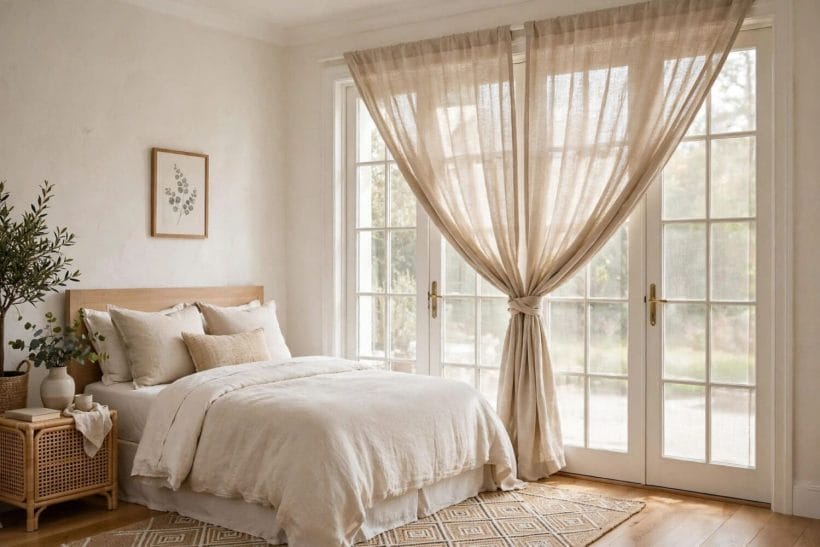
Fabric is the warmest answer: it softens the door, adds insulation at the glass, and can be changed with the room’s mood for very little.
7. A curtain on a rod above the door
The classic portière: a rod over the door, a curtain that draws to one side. It gives full privacy and real darkness if lined, insulates a draughty door noticeably, and must be arranged so the door’s swing and the curtain never fight — the rod sits on the opening side, with clearance checked before drilling.
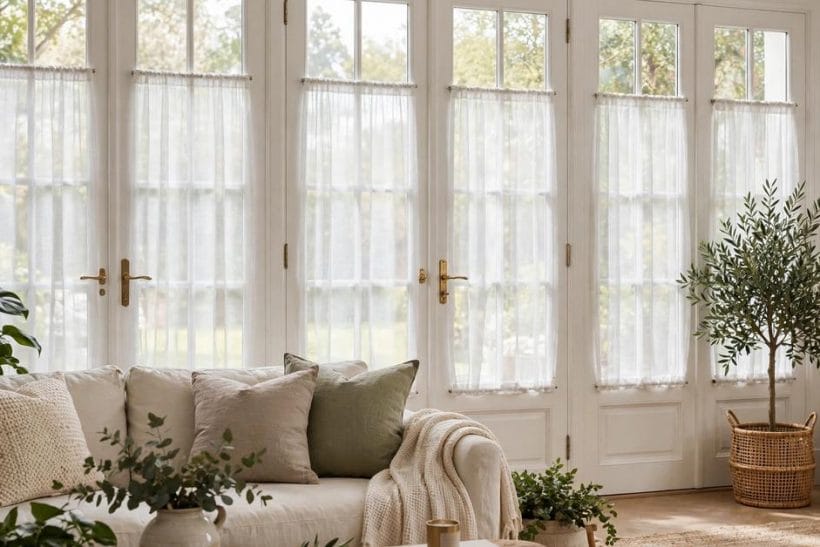
8. Sheer and voile panels for daytime privacy
A sheer hung close to the glass blurs the view in from outside while the room stays bright — daytime privacy without darkness, and none at night once the lights are on. Sheers pair well with a solid curtain over the top for the evening, each doing the half it is good at; the tiny house curtain ideas post works the same pairing at window scale.
9. Door-hung panels on slim rods top and bottom
The traditional French-door treatment: a panel gathered onto a slim rod at the top and another at the bottom of the glass, so the fabric travels with the door and never swings free. In a sheer it is the café look; in a lined fabric it is full privacy with a tailored finish, and it is the neatest answer for doors that open a hundred times a day.
6. Screens, Shutters and Solid Covers
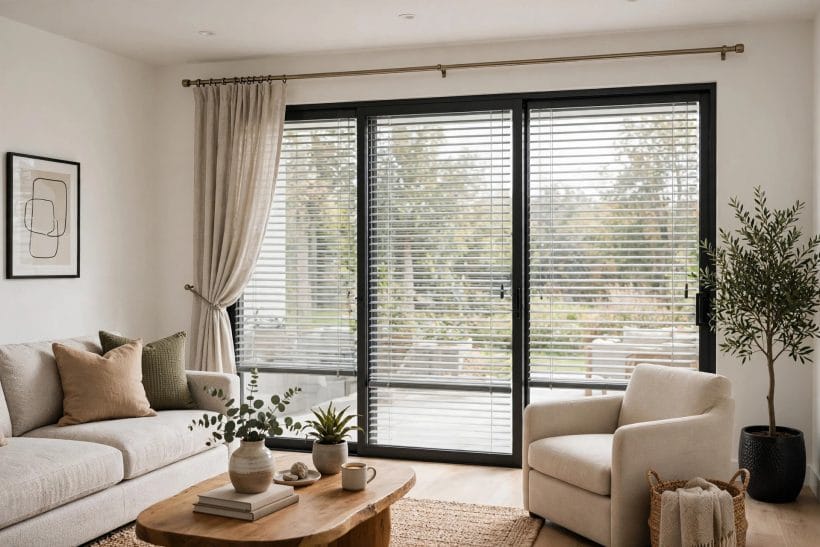
The substantial family: coverings with structure, for doors whose glass needs governing in all weathers and lights.
These three share a virtue the lighter methods cannot match: they work from both sides of the door. A shutter or a panel looks as deliberate from the street or the landing as from inside the room, which matters on front doors and on the doors of flats, where the outside face is seen by everyone who passes. They also add a layer of insulation and a sense of security that film alone cannot give — the door feels finished rather than treated. Against that stands cost and commitment: these are joinery decisions, to be measured and made properly, and they reward the households that expect to stay.
10. Interior shutters over the glass
Shutters with tilting louvres give privacy, light control, security theatre and a genuinely architectural finish. Fitted in the reveal or on the door itself, they are the most expensive way here and the one that most changes the room — usually for the better, and most at home on wide French and patio doors.
11. A folding or sliding screen across the doorway
A screen does not touch the door at all: it stands in the room, folds or slides aside, and can serve a rented home or a listed interior where nothing may be fixed. It gives privacy at seated height rather than at the glass, which is exactly what a living room often needs and a bathroom never does.
12. A fitted solid panel for full blackout
A lightweight panel — board, or fabric over a frame — cut to the glass and held by turn-buttons or magnetic catches gives complete privacy and darkness: the shift-worker’s bedroom door, the media room, the nursery. It stores flat behind furniture when not wanted, and it is the only method that makes glass behave entirely like wall.
7. French Doors and Sidelights
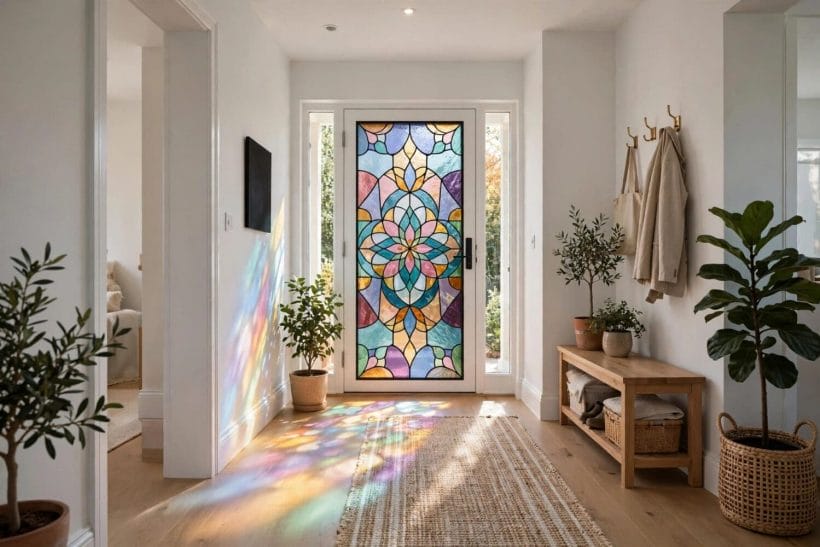
Paired doors and their flanking sidelights should be covered as one composition: the same film on every pane, matching panels on both leaves, or blinds of one family throughout — mixed methods across a single doorway always look accidental. Treat the sidelights with the door’s own logic, since a covered door beside naked sidelights is privacy in name only.
Mind the meeting of the two leaves: panels and blinds on each leaf must clear each other and the central hardware through the full swing, and a single wide curtain over a pair needs room to stack without trapping the opening leaf. Doors with divided panes suit film and door-hung panels best; large single panes take blinds and shutters well.
Hardware placement is the detail that catches people out. Handles on French doors often sit at the meeting stile exactly where a blind’s bottom bar or a panel’s lower rod wants to be, and locks and bolts add their own projections. Work leaf by leaf with the door open and closed, in both directions, before fixing anything — a covering that clears by a comfortable margin in every position is the only kind that survives daily use. Where a projection truly cannot be cleared, move the covering to the room side of the frame rather than forcing it onto the leaf; the doorway reads as one composition either way.
8. Renters and Reversible Options
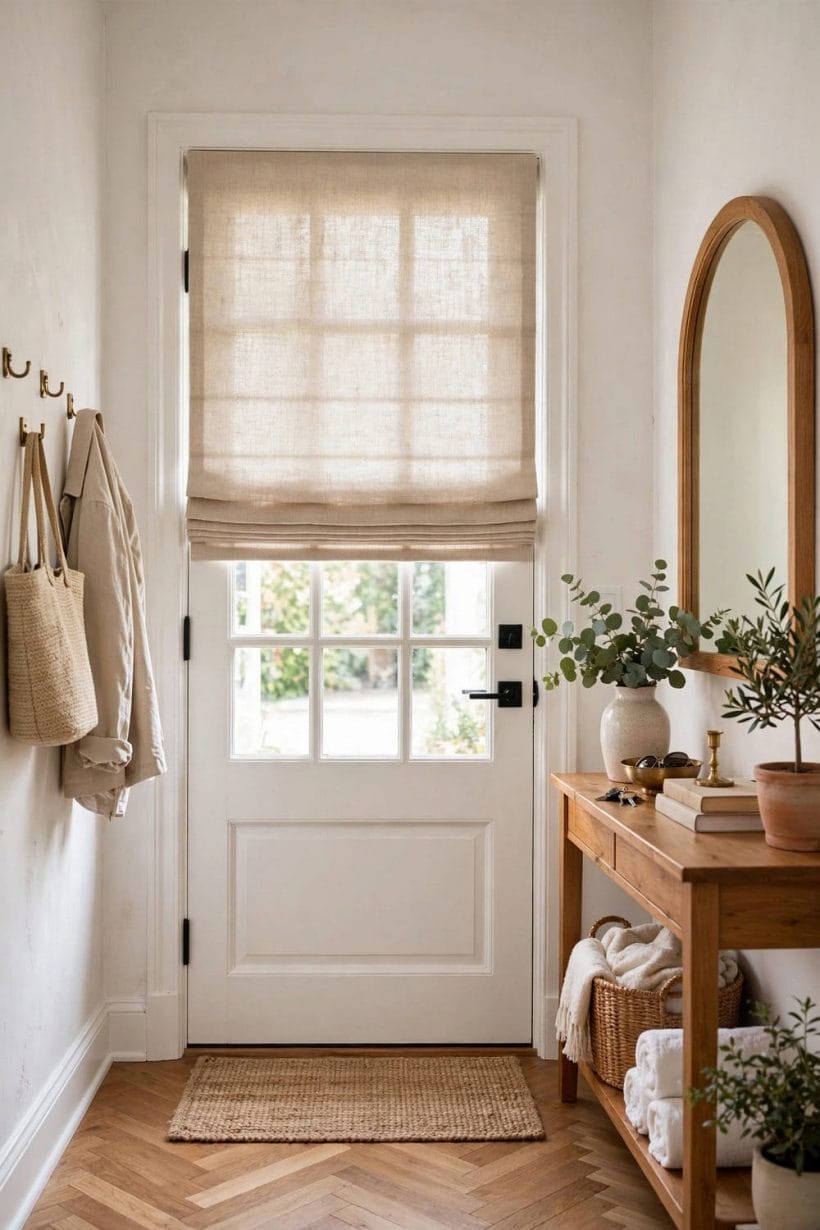
Almost every family above has a reversible member. Static-cling film leaves nothing behind but clean glass. Tension rods inside the reveal hold sheers and light curtains with no holes at all, and slim rods can be had with adhesive or clamp mounts for door-hung panels. No-drill blind brackets grip the door’s frame edge on many designs, and a standing screen fixes nothing anywhere.
The renter’s discipline is to test removability early: put one sample up, live with it a week, take it down and check the glass and paint before committing to the whole door. Photograph the door’s condition before you start, keep every original fitting you remove, and the deposit conversation at the end becomes a short one — the same leave-no-trace thinking that governs the travel-ready doors in the sliding glass doors post.
9. Light, Heat and Condensation Checks
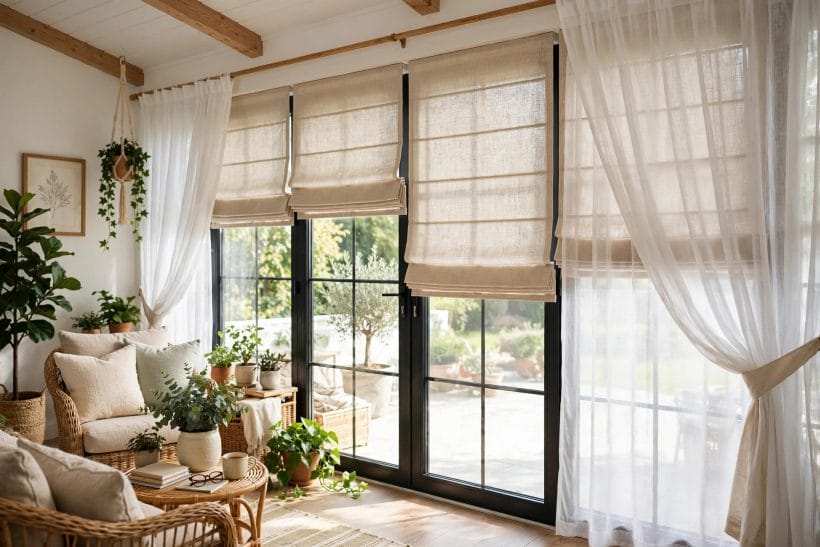
Coverings change the glass’s climate as well as its view. A close-fitting solid covering on a cold night traps a still layer of air against the pane where moisture can condense; a small gap at the edges, or a covering that breathes like fabric, keeps that in check, and any covering should come away easily for the occasional wipe of the glass behind it.
Sun is the other check. South- and west-facing glass heats a blind or curtain trapped against it; light-coloured, heat-tolerant fabrics fare best, and some films carry a reflective quality that cuts glare as well as sightlines. Judge a covering by the worst hour of its day, not the best — a lesson shared with fixed glass of every kind, as the debate in the awning vs sliding windows post shows for windows proper.
One film-specific caution belongs here: not every film suits every type of glass. Some glazing — certain double-glazed, wired or tinted units — can be stressed by the heat a dark or reflective film absorbs, so the film maker’s own suitability guidance for your glass type is part of the purchase, not fine print to skip. A reputable supplier will tell you plainly which of their films your door can take; treat any who will not as an answer in themselves, and choose a fabric or blind method instead.
10. Fitting and Care Checks
Measure the visible glass and add only the overlap the method wants: film is cut a hair under the pane’s edge, blinds sit within or over the bead as their brackets dictate, and fabric panels gain their gathering in the cutting, not on the door. Work through the door’s furniture — handle, lock, hinges, letterbox — and mark where each covering must stop or notch around it, because nearly every disappointing door covering is a good product measured against the wrong rectangle.
Care is light: films want only a soft cloth and no abrasives, blinds a periodic dust, fabrics a wash or vacuum as the room gets. Check fixings after the first weeks — doors vibrate, and screws and adhesive pads settle — and keep one spare sample of film or fabric against the day a pane is replaced, so the covering can be matched without starting again. Traditional door styles repay the same care in kind; the charm of the Dutch doors post, for instance, survives because its doors are looked after as furniture, not fittings.
Final Considerations
Choose the covering by the door’s worst hour: film for bright privacy, fabric for warmth, blinds for control, a panel for darkness, and nothing at all that traps the handle or blocks the way out. Covered well, a glass door keeps everything it was loved for — the light, the view, the borrowed space — and simply stops performing for the street after dark.


0 Comments