

Every membership buying club makes the same promise in different words: pay to join, and the paying-back begins. The promise is sometimes kept handsomely — and the only way to know is arithmetic nobody performs for you.
This guide is that arithmetic, plus the paperwork: a neutral, brand-free value-check for any membership buying club — the fees, the contract, the exit, and the basket test a reader can run themselves — with no company named, no verdict offered on anyone, and no claim made that the reader cannot verify from documents in their own hands.

1. Membership Buying Clubs at a Glance
A membership buying club is a seller whose prices are open only to members: the member pays a fee — joining, annual, or both — for access to member pricing on goods, classically the big home categories of furniture, appliances, flooring and fittings, through the club’s own showrooms, catalogues or ordering channels. Its attributes are exactly the checkable ones: the total fee, the membership term and renewal, the cancellation and refund terms, the real member prices on a real basket, and the service that stands behind delivery and faults. This guide is a method for judging any such club, written generally and naming none: the buying discipline it teaches is the sibling of the furniture buying guide for furniture and of the site’s cost guides for project goods, and the wider map gathers under home design ideas. Nothing in it asserts anything about any particular company’s conduct, status or reputation — favourable or faulting — because a reader’s own verified documents are a better foundation than any guide’s opinion.
| Question | Short answer |
|---|---|
| How do I judge whether a buying club is worth it? | By one comparison done in writing: your real year’s basket, priced at the club’s member prices plus all its fees, against the same basket priced through ordinary channels in the same week. The route with the lower honest total wins; everything else is presentation. |
| What should I read before joining? | The fees in total, the term, the renewal mechanism, the cancellation route and the returns terms for faulty and unwanted goods — in the contract’s own words, taken home. A club’s willingness to hand over that paperwork is itself the first finding. |
| When does the model work best? | In a heavy buying year: a renovation, a furnishing-from-scratch, a list long enough for verified savings to clear the fee. In a light year the same club can be perfectly respectable and still not worth this household’s fee — fit, not virtue, is the question. |
| What is the single biggest warning sign? | Pressure against verification: a decision demanded today, savings claimed without a comparison you may take away, or paperwork offered for signature before reading. Each is a sales-process fact you can observe yourself, and each answers the membership question more reliably than any review. |
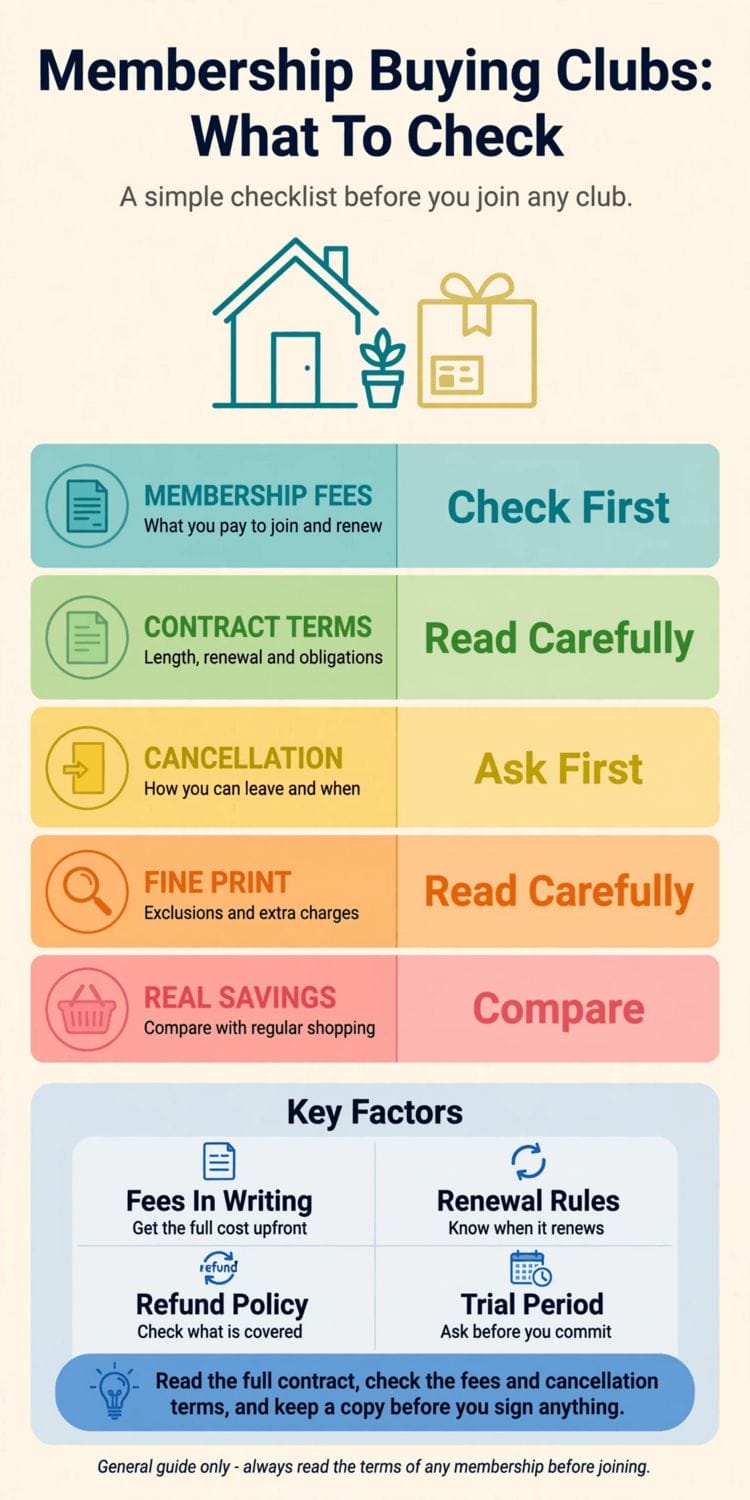
2. What a Membership Buying Club Actually Is

Strip away every brochure and a buying club is a simple machine: members pay to join, and in return they buy through the club’s channels — its showrooms, catalogues or member pricing — at prices the club presents as lower than ordinary retail. The model’s honesty is not in question here, because it is not a model’s job to be honest or otherwise; it is a structure, and structures are judged by their arithmetic and their paperwork. This guide gives the reader both tests, in the order a careful buyer runs them.
The membership is the product being sold first
Before any member saves anything, the club has sold a membership — and that sale is the moment this guide exists for. Everything after it (the pricing, the range, the service) is only knowable later; the fee, the term and the exit are knowable now, in writing, and a careful buyer judges the club first on how willingly it puts those three in front of them.
Member pricing is a claim, not a fact
A member price is one seller’s price wearing a label. It becomes evidence only when compared, item by item, with the same item’s price elsewhere on the same week — the basket test in this guide’s middle sections. Until then it is marketing, whoever prints it, and the guide treats every club, shop and sale by that one rule.
Why the model suits home goods in particular
Furniture, appliances, flooring and fittings are the classic club categories because they are expensive, infrequent and heavily discounted in ordinary retail too — which is exactly why they reward comparison. A household furnishing a room or renovating a kitchen is the club model’s natural customer and its natural sceptic in one, and the renovation purchases it faces are the same ones costed, generally, in the flooring installation cost overview.
3. The Fee Question: Reading the Membership Itself

The membership’s own paperwork is the club’s first examination, and it is a pass-or-fail one. A club that will not state its fees, its term and its renewal plainly — before payment, in writing, to take away and read — has answered the buyer’s main question already, whatever its prices later prove to be.
Every fee, named and totalled
Joining fee, annual fee, any tier upgrades, delivery and handling charges, and the fees that arrive later in the small print: total them for the first year and for a typical year after. The honest total is the number the club’s savings must beat before they save anything at all, and this guide’s arithmetic starts there.
Tiers and what they actually unlock
Where a club sells grades of membership, ask what each grade unlocks in practice — range, pricing, services — and price the difference against the household’s real plans. A higher tier bought for a renovation that happens once is a fee paid annually for a single year’s errand.
Renewal: automatic, and how to stop it
Note whether membership renews itself, when, at what price, and by what exact act it is stopped. Renewal terms are the paragraph members most often meet too late; read them at joining, when they are still a choice, and diary the date the way any careful household diaries a contract’s anniversary.
Trial periods and cooling-off, checked locally
Some memberships and some jurisdictions provide a trial or a cooling-off window; some do not. The buyer checks what their own consumer law and the club’s own terms provide — in the documents, not in the salesperson’s summary of them — and keeps the evidence of dates and receipts that any later claim would need.
4. The Contract: Cancellation, Refunds and the Exit Read First

Every membership is easiest to leave on the day before it is joined, and the exit clauses are therefore read first, not last. This section is the guide’s driest and most valuable: it converts a sales conversation into a set of documents the reader can verify themselves, at home, without anyone’s permission.
Cancellation in writing, with its conditions
How is membership cancelled — by what notice, in what form, with what refund of fees paid, and what happens to orders in progress? Each answer should exist in the contract’s own words. A cancellation route that can only be described verbally has not, for a careful buyer’s purposes, been described at all.
Refunds on goods: the returns reality
Member pricing means little beside a returns policy that strands a household with a faulty sofa or a mis-measured floor. Read how faulty, damaged and simply unwanted goods are handled, who pays carriage, and what time limits run — and compare that, too, with the ordinary retailer’s terms the club asks to be judged against, as the furniture buying guide does for furniture itself.
Deposits, orders and the club’s promises about time
Where a club takes deposits on ordered goods, the contract should say what the deposit secures, when delivery is promised, and what happens if the promise slips. Vague delivery language is not a fault in any one club; it is a risk in every contract, priced by the reader accordingly.
What survives the membership’s end
Warranties, guarantees and service promises should state whether they outlive the membership that bought them. A household planning to stay one year and renovate once needs that answer before joining, not in the renewal letter’s third year.
5. The Total-Cost Test: The Basket, Priced Honestly

Here is the guide’s centre: a buying club is worth its fee only if the household’s real shopping, priced honestly, beats the alternatives by more than the fee. Everything in this section is a check the reader can perform themselves with a list, a notebook and an evening — which is precisely why it is the section no brochure performs for them.
Build the basket from your own list
Write the actual basket: the sofa, the flooring, the appliances, the fittings the household genuinely plans to buy in the membership year, specified closely enough that prices are comparable. Savings on things the household was never buying are not savings; they are spending with better public relations.
Price the same basket everywhere
Take the basket to the club’s member pricing and to the ordinary channels — retailers, their sales, online sellers — in the same week, like for like in specification and delivery. The laminate flooring cost guide’s discipline applies to every line: material, fitting, delivery and finishing are one price or they are not a price at all.
Add the whole cost of each route
To the club’s route add its fees for the year; to every route add delivery, fitting, disposal and the cost of mistakes the returns policy leaves with the buyer. Then compare totals, not headlines. A club that wins the honest total has earned its fee; a club that wins only the brochure comparison has earned a polite goodbye.
The break-even line, written down
The arithmetic ends in one sentence the household writes for itself: we must buy at least this much, at these verified savings, for the membership to pay. If the year’s real plans do not reach the line, the club may be excellent and still not be for this household, this year — the calmest conclusion in consumer life, and the one this guide exists to make reachable.
6. What Suits the Model — and What Does Not

A buying club is a tool with a shape: it fits some households and some years beautifully and others barely at all. This section reads the fit honestly in both directions, because a guide that only warns is as useless as a brochure that only promises.
The renovating year
A household mid-renovation concentrates a year’s big purchases into a few months — the basket is large, current and comparable, which is the club model’s best case. The same household in a quiet year, buying a kettle and a cushion, has no basket for the fee to beat.
The furnishing-from-scratch household
New homes, first homes and emptied rooms give a club its second-best case: many rooms, one season, a list long enough for the basket test to mean something. The furnishing plan itself — rooms in order, pieces that earn their place — follows the household logic of the living room ideas and dining room ideas lanes, whichever channel supplies them.
Storage, patience and the bulk habit
Clubs that sell in quantity reward households with storage and without urgency. A small flat, a just-in-time temperament or a taste that changes monthly all tax the model; none of them is a failing in the household — they are simply the fit, read honestly.
The single-item buyer
For one purchase — one appliance, one sofa — the fee must be beaten by that item alone, verified against its ordinary sale price in the same week. Sometimes it is, gloriously; the guide’s discipline is only that the verification happens before the joining, in writing, at home.
7. The Questions to Ask — and the Answers to Get in Writing

This section is the guide in pocket form: the questions a buyer takes to any club, in any order, with a notebook. None of them is hostile; a well-run club answers all of them daily. What matters is not the asking but the form of the answers.
The fee questions
What is the total first-year cost of membership, every charge included? What does renewal cost, and how exactly is it stopped? What, precisely, does each tier add? A club’s fees are its own facts, and facts can always be written down.
The price questions
May I price my basket before joining? May I take member prices away and compare them? How are member prices set against ordinary prices — and who checks? A club confident in its arithmetic welcomes the comparison that this guide insists on; the comparison is, after all, its own best advertisement when the numbers are real.
The contract questions
Show me the cancellation clause. Show me the returns terms for faulty and for unwanted goods. What happens to my deposit if delivery slips by months? Each question points at a page; the page is the answer, and the buyer reads the page, not the gesture towards it.
The service questions
Who delivers, who fits, who do I call when something arrives wrong, and what do members around here actually say — in reviews the buyer finds independently, not in the folder provided? Service is a local fact, gathered locally, and it varies by branch and by year in every organisation on earth.
8. Pressure Patterns and Vague Claims: The General Warning Signs

This section names no one, because it does not need to: the warning signs of a bad membership sale are the warning signs of every pressured purchase, in every industry, and a reader who can spot them in general is armed in particular. They are checks on a sales process, not verdicts on any company — the distinction this whole guide is built to keep.
The decision that must be made today
A membership whose value is real on Tuesday is real on Friday. Urgency that expires at the showroom door is a technique, not an argument, and the buyer’s correct response is the guide’s whole method in one act: take the paperwork home and do the arithmetic where nobody is waiting.
Savings stated without a comparison
Claims of the form ‘members save’ followed by a large, round, unsourced figure are a genre, not a measurement. The reader’s reply is the basket: my list, your prices, their prices, this week, in writing. Any seller — club, shop or website — whose savings survive that test deserves the custom; any whose do not has been measured, not insulted.
The contract that shrinks at reading time
Paperwork offered for signature before it has been offered for reading — summaries substituted for clauses, the full terms available ‘later’ or ‘online somewhere’ — is a process failure the buyer can simply decline. Later is when the paperwork matters, so later is too late to first see it.
Fees that surface in stages
A joining price that grows by instalments of discovery — the tier the household ‘really needs’, the delivery tier, the warranty tier — is best met by the total-cost discipline: the whole route, priced whole, compared whole. Staged revelation is a sales shape, and a written total is its solvent.
9. Alternatives, Timing and the Calm Decision

The last section widens the lens: a buying club is one route among several to the same basket, and the calm decision compares routes, not brochures. It ends where the guide began — with the household’s own list, which outranks every channel’s opinion of it.
The ordinary routes, honestly priced
Retailers’ sale seasons, online sellers, warehouse-style stores, cooperatives and group-buying arrangements, ex-display and end-of-line sales: each has a season and a strength, and the basket test prices them all by the same rule. The club’s case is strongest exactly when it beats this whole field — not a straw price, but the field — on the household’s real list.
Timing the joining to the buying
If the arithmetic works, it usually works best when membership starts at the basket, not before it: join when the renovation or the furnishing season begins, so the fee’s year and the spending’s year coincide. A membership bought in a hopeful January for a project that slips to the next year is a fee spent on a calendar’s optimism.
The one-page decision
Fees totalled, exit read, basket priced on every route, break-even written down: the whole guide fits on one page, and the decision made from that page — join, or not, or not yet — is the calm kind that survives buyer’s remorse in either direction. Households that buy this way rarely feel deceived, because deception needs the fog this page dispels.
Keeping the membership honest, year by year
Members who stay should rerun the basket annually — a light version, an evening’s work — because prices, ranges and the household’s own needs all drift. A club that keeps winning the honest comparison keeps the member; the annual check is not disloyalty but the membership’s own terms, honoured by the member’s side too.
10. Costs and Pulling It Together
Costs, in this guide, are the subject rather than a section’s filler: the club route’s true cost is its total fees plus its member prices plus its delivery and returns realities, and the ordinary route’s true cost is its prices plus the same realities, and the comparison of those two honest totals — on the household’s own basket, in the same week — is the entire economics of the decision. No figures are invented here because none are needed: the reader’s basket supplies real ones, locally, which no published number could do for them.
Pull the guide together as one page: total the fees, read the exit first, price the basket on every route, write the break-even line, and decide at home in calm. A club that passes those checks has earned its membership honestly, and a household that runs them will never need anyone’s verdict — on any club, in either direction — again.
Final Considerations
Membership is a promise sold in advance of its evidence, which is not a criticism — it is simply the shape of the transaction, shared by gyms, clubs and seasons tickets everywhere. The buyer’s whole power lies in refusing to grade the promise until the evidence is in, and the evidence is always, conveniently, in the buyer’s own hands.
So take the paperwork home. The clubs worth joining survive the quiet of a kitchen table better than the bright lights of a showroom, and the ones that do not were answered by the arithmetic — which is the politest, firmest and most final answer a buyer ever has to give.




0 Comments