

A charge you do not recognise is unsettling, especially when it looks like a subscription quietly helping itself to your money.
Slow down. Most mystery charges have an ordinary explanation and a clear way out. Work through the steps below in order, and keep notes as you go.
1. First, Do Not Panic: Follow the Five-Step Plan
When an unexpected subscription charge appears on a statement, the worst responses are the two extremes: ignoring it completely, or cancelling the card in a rush before you understand what happened. Ignoring it risks the charge repeating next month and the month after. Cancelling in a panic can break payments you actually want, such as household bills, and it still may not end the underlying subscription agreement, which can follow you to a replacement card through updater services some banks offer. The calm middle path is to investigate first, act second, and write everything down as you go.
Start by capturing the facts exactly as they appear: the amount, the date, the name shown next to the charge, and the card it hit. Take a screenshot or write it in a notebook, because statements can display differently in an app, on a website and on paper, and you will need the precise wording later when you speak to the seller or your bank. Note also whether the charge is a one-off or whether similar amounts appear in earlier months, because a repeating pattern changes the conversation from a single mistake to an ongoing arrangement you need to end.
Then work through the five steps in the table below, in order. Each step either solves the problem or gives you the evidence the next step needs, rather like the methodical approach in the tiny house and small-space interior design guide, where measuring first prevents expensive mistakes later. Keep every email, reference number and name you are given in one place, ideally a single folder or note, so nothing depends on your memory.
| Step | What to Do | Why It Helps |
|---|---|---|
| 1. Record it | Write down the amount, date, card and the exact name shown beside the charge | Gives you the precise details every later conversation will ask for |
| 2. Identify it | Search the name, your emails and your household’s purchases to work out who charged you | Many mystery charges turn out to be forgotten trials or family purchases |
| 3. Contact the seller | Ask what the charge is for, when it started and how to cancel | The seller can often cancel and refund faster than anyone else |
| 4. Cancel properly | Cancel inside the account or service itself and keep the confirmation | Stops the next payment instead of just blocking one attempt |
| 5. Escalate if needed | If the seller will not help, raise a dispute with your bank or card provider | Your provider can investigate charges you did not agree to |
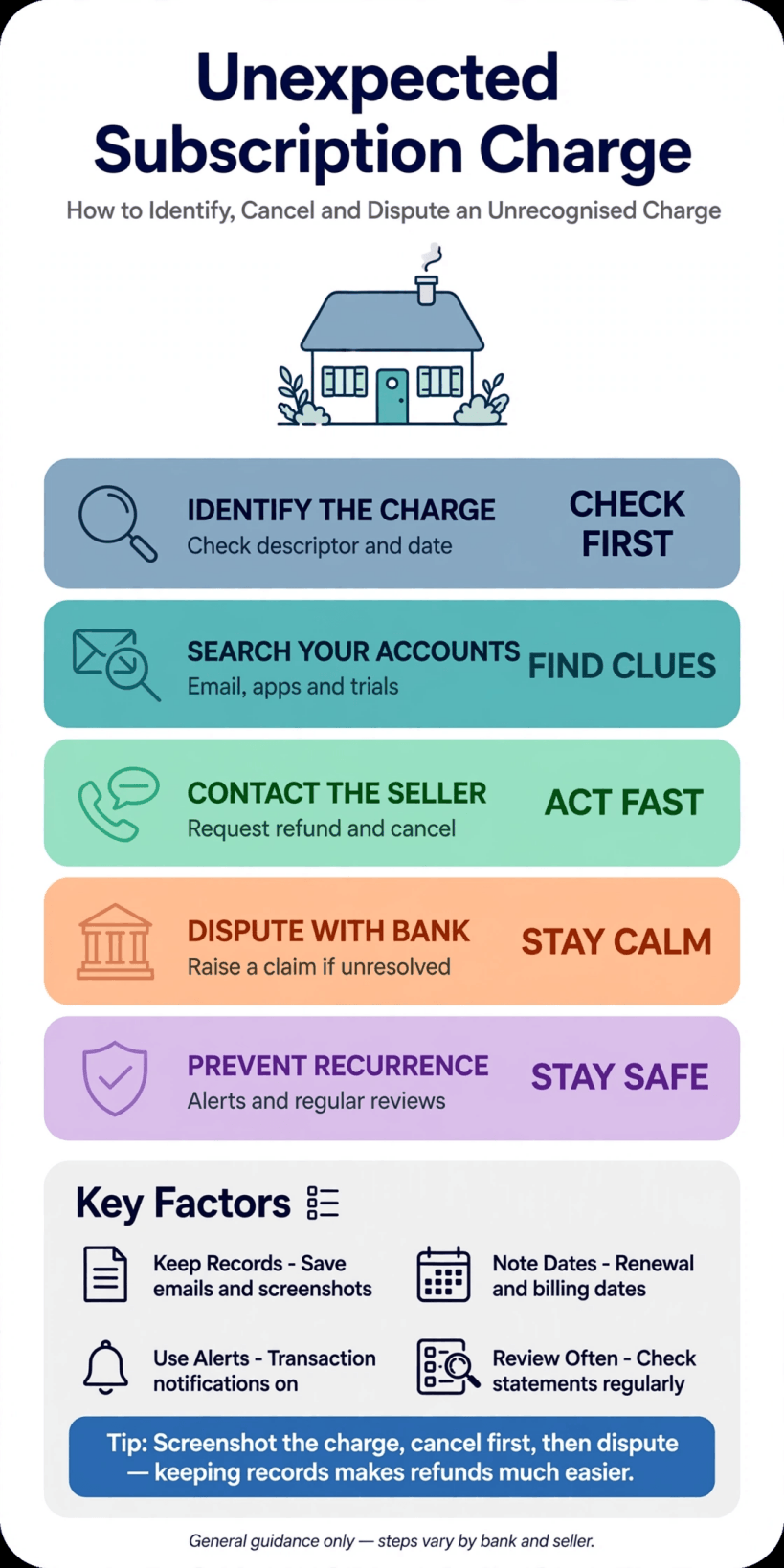
The five-step plan at a glance: record the charge, identify who sent it, contact the seller, cancel properly, and escalate to your bank only if you need to.
2. Check the Amount, Date and the Name Beside the Charge
The name printed beside a card charge is called the descriptor, and it is the single most useful clue you have. Descriptors are often shortened, abbreviated or shown under a parent or billing company name rather than the shop or service name you would recognise, which is why a legitimate purchase can look like a stranger’s charge at first glance. Copy the descriptor exactly, including any numbers or location fragments, and search for that exact wording in a search engine. Very often the results will connect the billing name to the brand it belongs to.
Amounts are clues too. A small, round amount that repeats monthly often belongs to a digital service, storage plan or membership. An amount that changes slightly each time may be a usage-based service or a subscription priced in another currency, converted at that day’s rate, which is something to check with your bank if the figures never quite match. A tiny charge of a few pence or cents can occasionally be a test transaction, which is worth raising with your bank promptly if you cannot connect it to anything you have done.
Finally, check the date against your own calendar rather than your memory. Charges can appear a day or two after the purchase, renewals can land on weekends, and annual subscriptions are famous for arriving eleven months after you forgot signing up. Scroll back through earlier statements for the same descriptor while you are there, the way you would audit any household system using the patient method in how to build your own tiny house guide: one careful pass now saves a bigger job later.
3. Search Your Memory, Your Inbox and Your Household
Before assuming anything is wrong, give the charge a fair chance to be yours. Search your email inbox for the descriptor, for the amount, and for words such as receipt, renewal, subscription and trial. Many services send a receipt at sign-up and a reminder before a renewal, and those messages often land in promotions or spam folders and are never seen. Check app-store and platform subscription pages as well if you use them, because services started on a phone are commonly billed through the platform rather than directly, and they are managed there too.
Then widen the circle. If anyone else uses the card, shares the account, or has a linked profile on a shared service, ask them, kindly and without blame. A surprising number of mystery charges turn out to be a partner’s renewed membership, a teenager’s game subscription, a parent’s add-on, or a streaming upgrade nobody mentioned. Shared households run on shared systems, and a quick, friendly question is cheaper than a dispute, much like the shared-space honesty that makes tiny house kitchen and small-space design ideas work in practice.
Think back over the last year, not just the last week. Annual plans for software, delivery services, fitness, reading, music, cloud storage and breakdown or warranty-style products renew quietly by design. A free trial from months ago, a discount that rolled into a full price, or a service you cancelled on one device but not in the account itself can all explain a charge that feels brand new. If the charge is genuinely explained by this stage, decide calmly whether to keep or cancel it, and note the renewal date either way.
4. Work Out Whether It Was a Free Trial That Converted
The converted free trial is the classic explanation, and it deserves its own step because the fix and the lesson are specific. Trials usually ask for card details up front, with the first payment due automatically when the trial ends unless you cancel in time. If the charge date sits a neat trial-length after a day you remember downloading, joining or trying something, you have probably found your answer. Your email receipt from sign-up will usually state the trial length and the price that follows, so dig that message out before you contact anyone.
When you speak to the seller, be straightforward: say when you believe the trial started, that you did not knowingly agree to continue, and that you are asking for the subscription to be cancelled and the charge reviewed. Sellers deal with this conversation every day, and many will cancel immediately and consider a refund for a recent charge, particularly where the service has barely been used. Outcomes vary by seller and by the terms you agreed to, so ask clearly, stay polite, and write down what is promised, including any timeframe the seller gives you for money to return.
Whether or not this charge turns out to be a trial, change how you accept trials from now on. Set a reminder on your phone for a day or two before any trial ends, at the moment you sign up, not later. Keep a simple list of every trial and subscription you hold, with its renewal date and price, in the same spirit as the household lists that keep small homes running in tiny house closet design ideas. A trial you are tracking is a free sample; a trial you are not tracking is a bill with a delay.

5. Contact the Seller and Ask Directly
Once you believe you know who charged you, go to the seller first. It is usually the fastest route to both an explanation and a refund, and banks will normally ask whether you have tried. Use the seller’s official contact channels, found through their own website or app that you navigate to yourself, rather than through links in unexpected messages. Have your recorded details ready: the descriptor, amount, date, and the email address or account name the subscription might sit under.
Ask four questions, in this order. What is this charge for? When did the subscription start, and how was it agreed to? How do I cancel it completely? And will you refund this charge, and any earlier ones I did not recognise? If the answers are unclear, ask the person to explain again or to put it in writing. If you are speaking by phone, note the date, time and the name or reference you are given. If the seller has an online chat, save or screenshot the transcript. None of this is about being difficult; it is about creating the simple paper trail that protects you if the charge appears again.
Be wary of lookalike help. Search results and ads can include unofficial services that charge fees to cancel subscriptions you can cancel yourself for free, and scammers sometimes pose as support lines for well-known services. Navigate to the seller yourself, check the web address carefully, and never pay a third party to make a phone call you can make. The same healthy scepticism that serves you in the rest of household life, from the advice in Zen interior design ideas for tiny houses about buying less but better, applies to help too: the genuine route is usually the simplest one.

6. Cancel Properly, Not Just by Deleting the App
Cancelling is where many people stumble, because several things that feel like cancelling are not. Deleting an app from your phone does not cancel its subscription. Removing your card details may not be possible while a subscription is active, and where it is possible it may not end the agreement. Asking your bank to block one payment stops that payment attempt, but the subscription itself may remain open and keep trying. The cancellation has to happen in the place the subscription lives: inside the service’s account settings, the platform’s subscription page, or through the seller’s confirmed process.
Work through it methodically. Sign in to the service, find the subscription or membership area, and follow the cancellation steps to the very end, past any screens that ask you to stay. Sellers often add pause offers and discounts along the way; there is nothing wrong with accepting one if you genuinely want the service, but if your goal is to stop, keep going until you reach an explicit confirmation that the subscription is cancelled and note the date it ends. Services commonly let you use the remaining paid period, which is fair enough, but the next renewal should now be off.
Then capture proof. Save the confirmation screen or email, note any cancellation reference, and diarise a check for the date the next payment would have been due, so you can confirm it never leaves your account. Store the proof with the notes you started in step one, in one folder, the way a well-run small home stores its paperwork as described in tiny house and small-space interior design guide projects. If the payment still goes out after a confirmed cancellation, you now hold exactly the evidence your bank will want to see.

7. Ask for the Refund, and Know What to Expect
Cancelling stops the future; a refund deals with the past, and the two requests are separate, so make both explicitly. Ask the seller to refund the charge you did not recognise, and if the same subscription has taken earlier payments you were equally unaware of, ask about those too, while understanding that the further back a charge sits, the more the seller may rely on the terms that were agreed at sign-up. There is no promise anyone can honestly make you about the outcome, because it depends on the seller, the service and what was agreed, but a clear, documented, reasonable request succeeds far more often than silence.
Timing matters in a general sense: raise the charge as soon as you spot it. Recent charges are simpler for everyone to trace and discuss, and both sellers and card providers work to their own deadlines for raising issues, which vary, so do not sit on a charge you intend to query. If a refund is agreed, ask how it will arrive and roughly how long it should take, and then check your statement around that time. Refunds normally return to the original card, and a pending authorisation can look like a charge for a few days before dropping away, something your bank can clarify if a figure on your statement is confusing you.
Stay factual in every message. State what you bought or tried, what you were charged, what you are asking for, and what you have already done, including cancellation references. Avoid threats and exaggeration; they slow things down. If the first person cannot help, it is reasonable to ask whether there is a complaints route or a team that reviews billing decisions, and to use it politely. And keep your expectations proportionate: the goal is your money back and the subscription stopped, not a windfall, a distinction worth remembering on a stressful day.

8. If the Seller Will Not Help, Talk to Your Bank
Sometimes the seller cannot be found, will not respond, or insists the charge stands when you believe you never agreed to it. That is when your bank or card provider comes in. Providers have processes for querying transactions, often called disputes or chargebacks depending on the card and the circumstances, and they will ask what the charge is, what you have done about it, and what evidence you have. This is where your step-one notes, your cancellation proof and your messages with the seller earn their keep.
Contact the provider through the number on your card, your banking app, or the bank’s own website that you navigate to yourself, and explain the position plainly: the charge, why you do not recognise or accept it, and the steps you took with the seller. Ask what the process involves, what the provider needs from you, and what happens to the card in the meantime. Rules, protections and timelines differ between countries, card types and account types, so treat anything you read online, including this article, as general guidance only, and let your provider explain the position that applies to your account.
One caution: only dispute charges in good faith. Disputing a charge you actually agreed to can backfire, because the seller can present the sign-up record, and the amount may be reapplied. A dispute is for charges you genuinely did not authorise, subscriptions you cancelled that kept billing, amounts that differ from what was agreed, or sellers who have vanished. Used properly, it is an important consumer protection; the careful, keep-everything approach in tiny house landscaping ideas, where records of what was planted where prevent future arguments, is the right model for your paperwork too.

9. Protect the Card and the Accounts Around It
While you sort out one charge, take half an hour to make the next one less likely and less damaging. Start with the card itself. If your provider’s app lets you control online or recurring payments, review those settings, and consider whether the card that pays for casual sign-ups should be the same card that carries your essential bills. Some people keep one card or account for subscriptions and online trials, with a modest limit or balance, so a runaway renewal can only ever do limited harm. Ask your provider what options your account offers rather than assuming.
Then tidy the accounts. Go through the subscription pages of the platforms and services you use and cancel anything you no longer recognise as good value, including services you kept meaning to use. Change passwords where you have reused them, turn on two-step verification where it is offered, and check that the email address on your accounts is one you actually read, because renewal reminders sent to a dead inbox are no reminders at all. These are small, unglamorous jobs, in the same family as the maintenance routines in A-frame tiny house interior ideas: they protect the whole structure quietly.
If you ever conclude a charge is fraudulent rather than merely forgotten, act faster and differently: contact your provider immediately using its official channels, follow its advice about the card, and report the matter through whatever official route your area provides for fraud. Do not contact the supposed seller through details printed beside a fraudulent charge, and do not follow instructions in unexpected texts or emails about it. Your bank is the safe first call in that situation, every time.

10. Build the Habits That Stop It Happening Again
The final step is to make this a one-time project rather than a yearly surprise. Keep a single subscription register, on paper or in a notes app, listing every recurring payment you hold: what it is, what it costs, when it renews, and which card it uses. Add to it the moment you start anything, including free trials, and cross things off the moment you cancel. Five lines of admin at sign-up replace an afternoon of detective work later, as anyone who keeps a household notebook for the systems in tiny house kitchen design ideas to borrow will recognise.
Review the register on a rhythm you will actually keep: when a statement arrives is ideal, because the two documents check each other. Scan every statement line, however small, and query anything unfamiliar within days rather than weeks. Set calendar reminders a few days before annual renewals, which are the easiest to forget and the largest to swallow unnoticed. And before any trial, read the sentence that says what happens when it ends; if that sentence is hard to find, treat that as information in itself and think twice.
Finally, align the household. Agree that anyone signing up for a trial or subscription on a shared card mentions it, and that the register lives somewhere everyone can see it. Most subscription pain is not caused by bad actors but by ordinary forgetfulness in busy homes, and forgetfulness is a design problem, not a character flaw. Design the reminder, the list and the monthly glance, and the system will quietly protect you while you get on with everything else.
Final Considerations
An unexpected subscription charge feels personal, but the route out is procedural: record it, identify it, ask the seller, cancel in the right place, and involve your bank with your evidence in hand if you need to. Worked in that order, most mystery charges resolve into an explanation, a cancellation and, where the seller agrees or the provider’s process supports it, money returned to your account.
Take the prevention habits with you as well. A short subscription register, a reminder before every trial ends, and a monthly glance at your statement will catch the next surprise while it is still small. None of this needs special tools or expertise, just a notebook, a calendar and the decision that recurring payments deserve the same attention as any other bill leaving your home.




0 Comments