
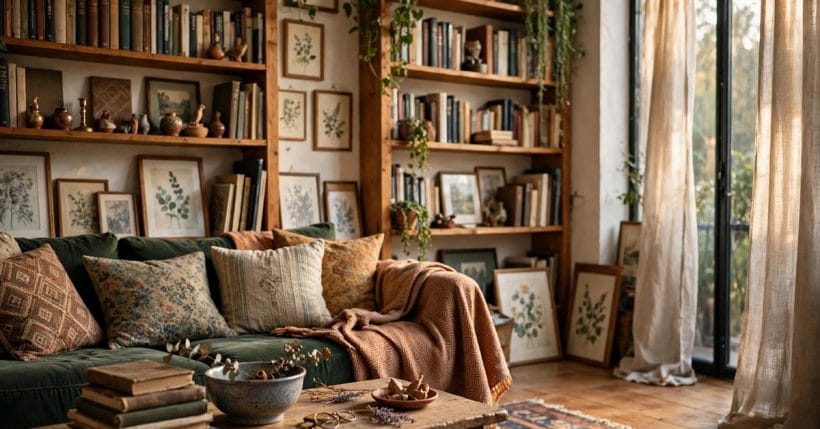
A cluttered room has a bad reputation, and much of it is unfair. The rooms that people remember most fondly are rarely the emptiest ones. They are the rooms with books stacked beside the chair, pictures crowding the wall, a throw folded over the sofa arm and a plant trailing from a shelf that was never quite meant to hold it. That kind of fullness has a name worth defending: beautiful clutter. It is not mess for its own sake. It is layering with intent, where every object has a reason to be there even if the reason is simply that it is loved, used or looked at often.
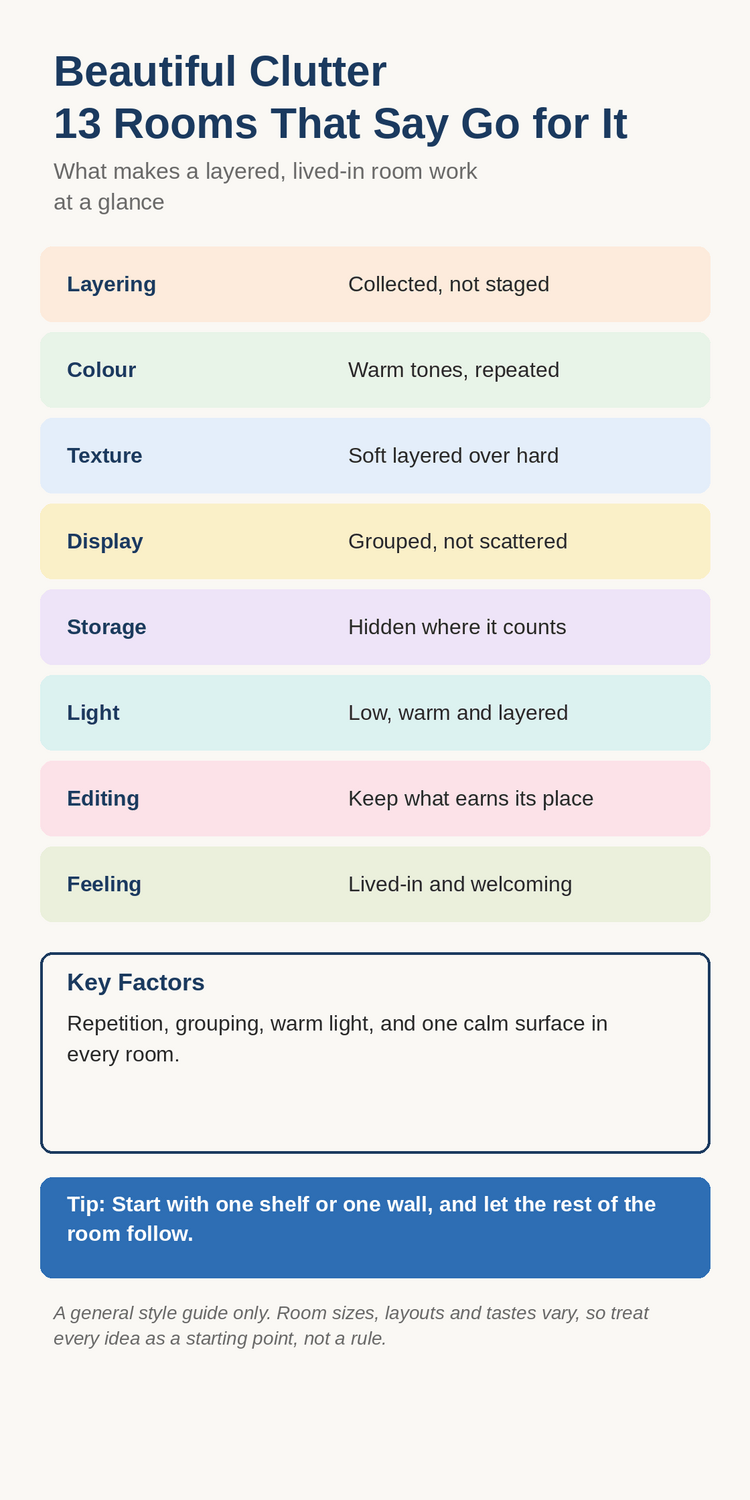
The difference between a cluttered room that works and one that does not is rarely the number of things in it. It is the way those things relate to each other. Rooms that feel good under a crowd of objects tend to share a few quiet habits: colours repeat from one corner to another, objects sit in groups rather than scattered singly, soft textures sit over hard surfaces, and somewhere in the room there is a calm surface where the eye can rest. When those habits are in place, a room can hold a great deal and still feel welcoming rather than overwhelming. When they are missing, even a small number of objects can feel chaotic.
This guide walks through thirteen rooms that make the case for going for it. Each room shows a different way to let fullness work: by grouping, by repeating colour, by layering light, by keeping one surface clear, or by letting a collection grow slowly over time. Nothing here requires a particular style, a particular budget or a particular size of home. The rooms are ordinary rooms, layered the way real rooms get layered, one object at a time.
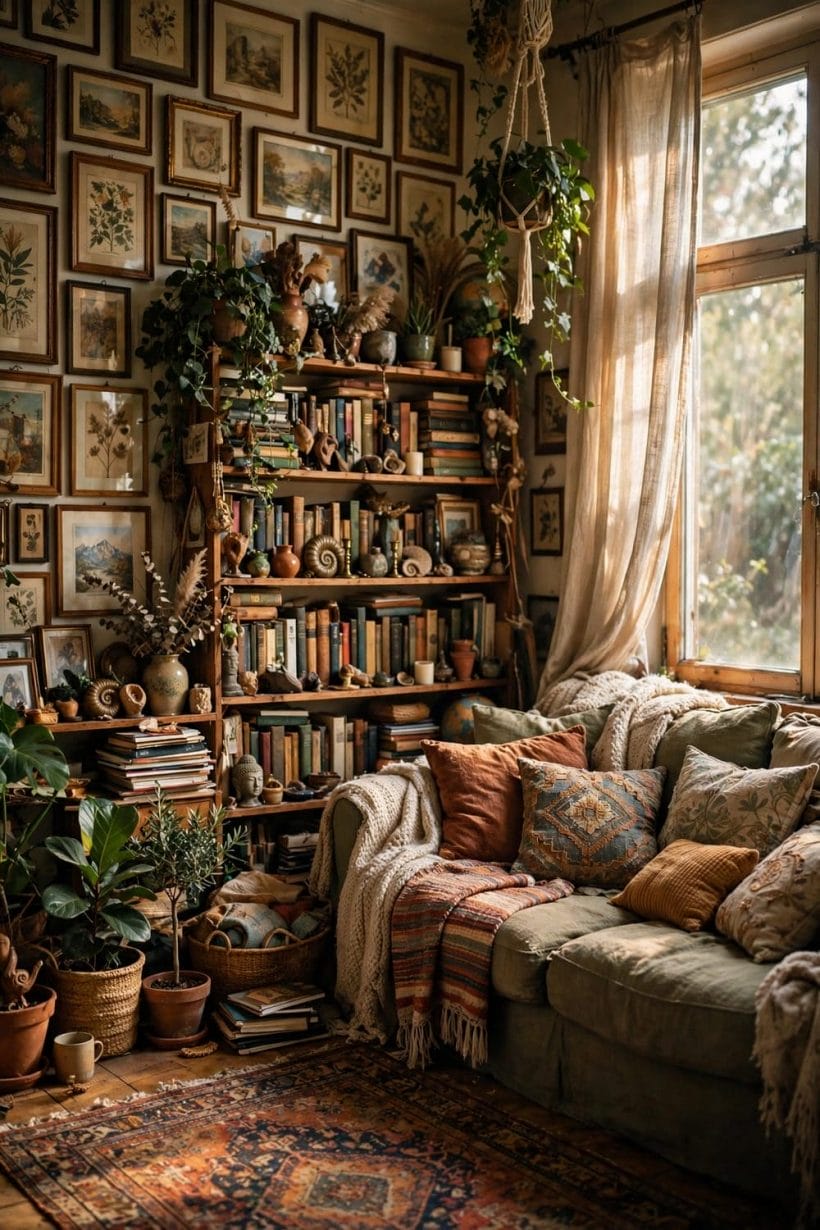
1. Start With the Living Room
Room 1: The Living Room
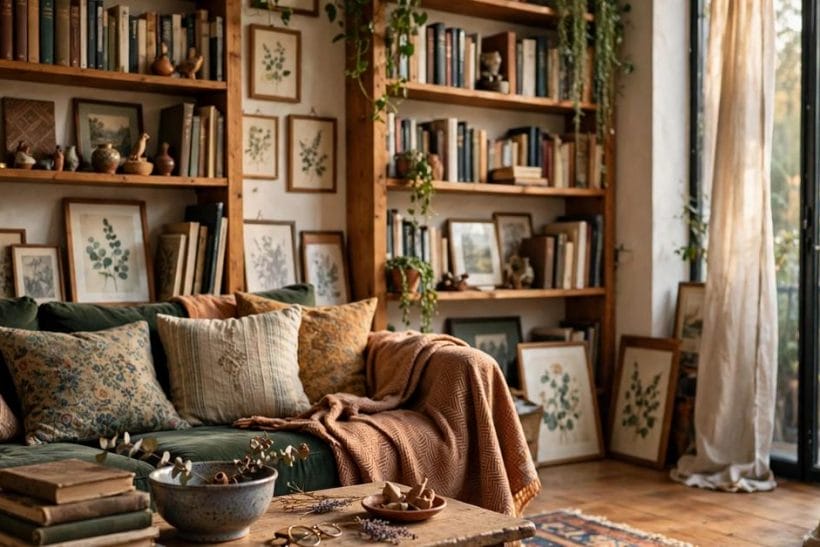
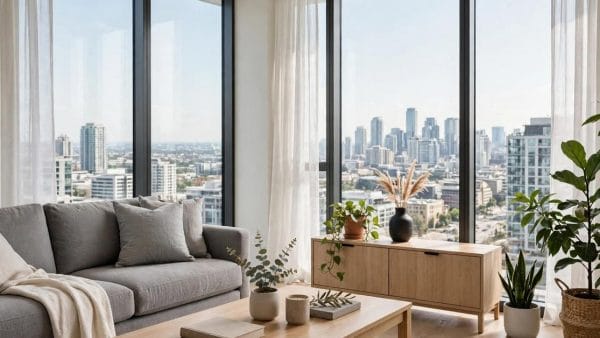
The living room is where beautiful clutter makes its strongest case, because it is the room that has to do the most. It hosts conversation, reading, resting and everyday family life, and the objects that support those activities tend to accumulate exactly where they are used. A stack of books beside the sofa, a basket of throws, a shelf of photographs and a plant on every available ledge are not failures of tidiness. They are evidence that the room is doing its job. The trick is to let those things gather in groups: books together, photographs together, plants together, so that the eye reads clusters rather than a scatter of unrelated items.
Colour does much of the quiet work in a layered living room. When the cushions, the rug, the throws and the art share a few warm tones, the room reads as one composition even when it is full. A single repeated colour across cushions, a vase and a picture frame can tie together objects that have nothing else in common. Texture matters just as much: wool over leather, linen over wood, a woven basket beside a smooth ceramic bowl. The contrast keeps a full room from feeling flat, and it gives the hand as much to enjoy as the eye. Broader living room ideas can help with the bones of the room, the layout and the seating, and the layering described here sits on top of those bones rather than replacing them. See the collection of tiny living room ideas for layouts that keep a full room easy to move through.
2. The Reading Corner
Room 2: The Reading Corner
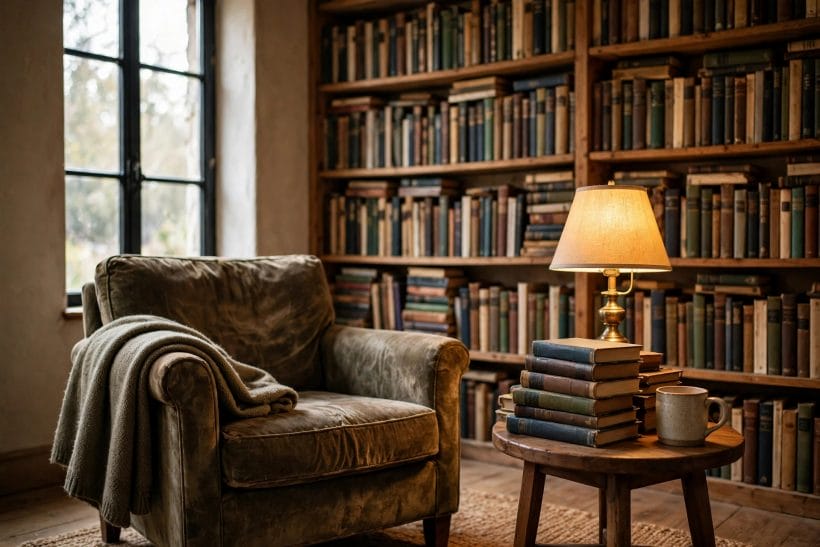
A reading corner is the smallest room in this guide and in some ways the most convincing. It needs only a chair, light and books, yet it is almost always the most cluttered spot in the house, and nobody minds. Books pile on the side table, more books wait on the floor beside the chair, a blanket drapes over the arm, and a cup waits to be collected. The clutter here is functional: everything within reach is everything the reader needs. Because the corner has a clear purpose, the fullness reads as focus rather than disorder.
The lesson of the reading corner travels well. Give a crowded spot a clear job and the crowd starts to make sense. A chair that is plainly for reading can hold a stack of books without apology, while the same stack on a chair that has no job looks like storage that lost its way. Light helps too: a lamp that pools warm light over the chair turns the corner into a destination, and the objects inside the pool of light look chosen rather than stranded. Even a corner that is barely wider than the chair itself can carry this kind of layering, provided the books stay in one or two stacks and the blanket has one home, on the chair arm or in a basket beside it.
3. The Sitting Room
Room 3: The Sitting Room
A sitting room is a living room with a slightly more formal manner, and it proves that beautiful clutter is not only for casual spaces. Here the layers tend to be more deliberate: a pair of lamps rather than one, pictures hung in a considered arrangement, a tray on the coffee table gathering smaller objects into one composed group. The room can still be full. The difference is that the fullness is arranged, with symmetry doing some of the work that colour does in a more casual room. Two matching lamps, two similar frames or two cushions in the same fabric give the eye a rhythm to follow through the crowd.
Trays are the sitting room’s secret weapon. A tray turns a scatter of small things into a single object with a boundary, and that boundary is what keeps a full surface from looking accidental. The same principle works on a side table, a console or an ottoman: gather, contain, and let the group read as one. For smaller sitting spaces, the discipline is the same but the scale tightens, and the small living room ideas collection shows how full rooms stay navigable when floor space is limited. Decorating guidance for compact living spaces also applies here, including the practical advice in how to decorate a tiny living room, where every piece must earn its footprint.
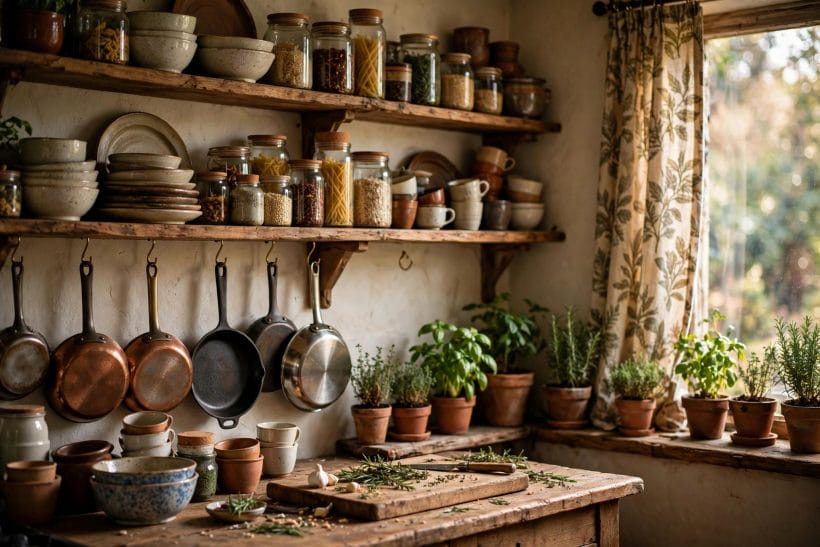
4. The Kitchen That Gets Used
Room 4: The Kitchen
No room argues for beautiful clutter quite like a kitchen that gets used every day. Open shelves crowded with crockery, jars of dry goods, hanging pans, herbs on the windowsill and a chopping board left out on the table are the visible signs of cooking, and a kitchen that hides all of that away can feel less like a working room and more like a showroom. The cluttered kitchen works when the things on display are the things that get reached for daily. A shelf of bowls that are used every evening reads very differently from a shelf of objects that are never touched.
Grouping is what keeps a busy kitchen calm. Plates together, glasses together, jars together, with each group given its own stretch of shelf. When groups are respected, the eye can find what it needs and the room feels organised even at full capacity. A single repeated material, such as wood or a single crockery colour, helps the groups feel like one family. The working surfaces deserve one concession: keep at least one stretch of counter clear for actual cooking, and let the layers live on the shelves, the walls and the table edges instead. That one clear surface is the difference between a kitchen that feels abundant and one that feels unworkable.
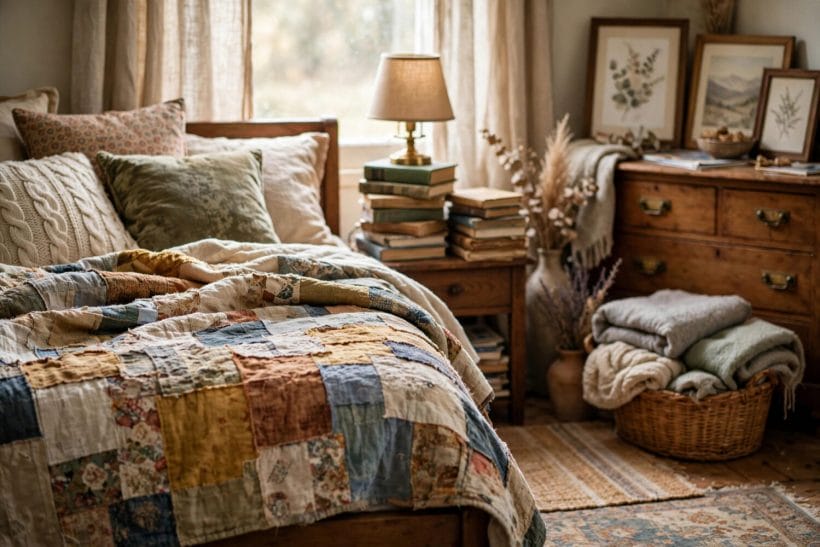
5. The Bedroom That Feels Collected
Room 5: The Bedroom
Bedrooms collect things slowly, and that slow accumulation is exactly what makes them feel personal. A quilt folded at the foot of the bed, cushions gathered over years rather than bought as a set, books on the bedside table, pictures leaning on the dresser and a basket of blankets by the chair: none of this arrives in a single shopping trip, and that is the point. A bedroom layered over time tells the story of the person who sleeps there, and a room that tells a story is a room that feels restful rather than staged.
The bedroom still benefits from one calm surface. The bed itself, once made, can be that surface, with the layers gathered around it rather than on it. Bedside tables work best when they hold only what belongs to the night: a lamp, a book or two, and a glass of water. Everything else, the photographs, the baskets, the leaning frames, can live on the dresser, the wall or the chair. Soft light matters enormously here, because warm lamplight forgives a crowd in a way that harsh overhead light never does. For bedroom layouts and storage that support this kind of layering, the tiny bedroom ideas collection is a useful companion, especially where space is tight and every layer must be chosen.
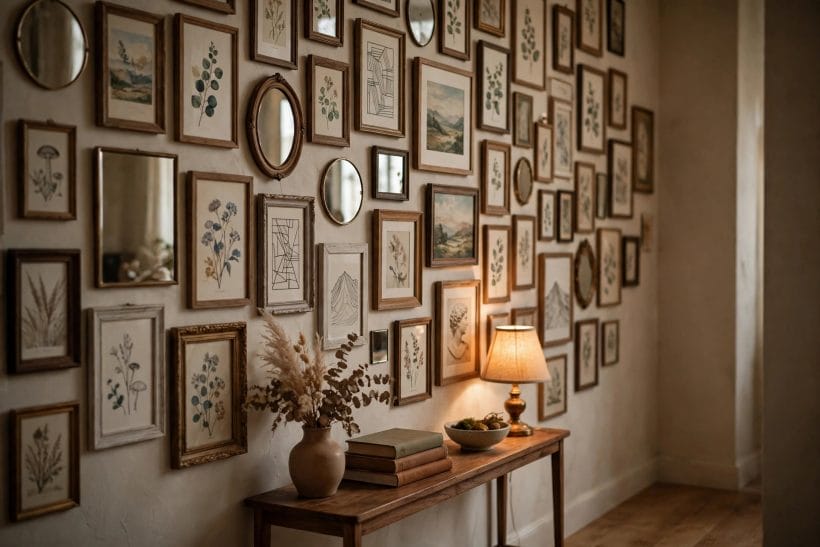
6. The Hallway Gallery
Room 6: The Hallway
A hallway is a passage, not a destination, and that is precisely why it can carry the densest display in the house. A wall covered floor to ceiling with framed pictures, prints and small mirrors turns a corridor into a gallery, and because nobody lingers in a hallway the way they linger in a living room, the density never becomes tiring. The hallway gallery is also the most forgiving place to start layering, since frames can be added one at a time over months or years without any need to plan the whole wall in advance.
Mixed frames are part of the charm here, but a little repetition keeps the wall from dissolving into noise. Repeating one frame colour, one mat colour or one size among the variety gives the arrangement a spine. A narrow console below the pictures gives the display a base and a place for a vase, a bowl and a small stack of books, which grounds the wall and stops it from floating. Wall decoration ideas in general, including the tiny house wall decor collection, show how even a short stretch of wall can carry a layered display when frames are grouped tightly and hung with a consistent rhythm.
7. The Dining Room
Room 7: The Dining Room
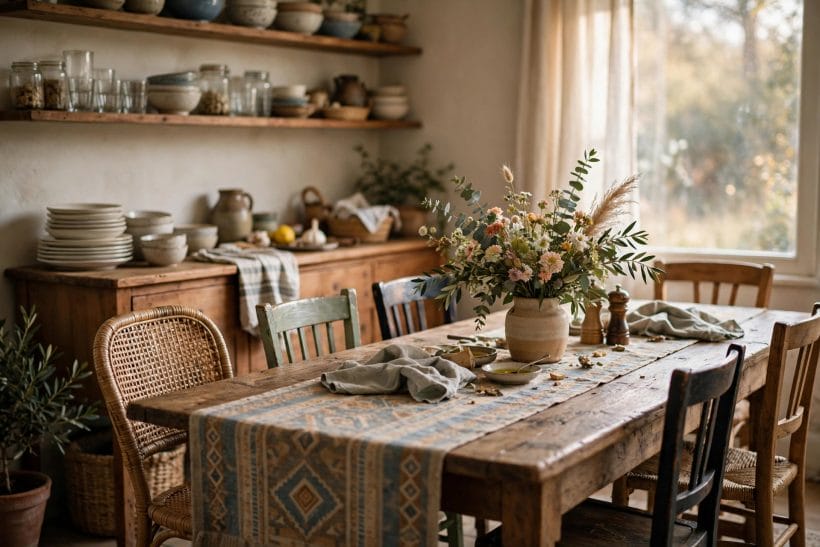
A dining room that is used for daily meals as well as gatherings will always be fuller than a dining room kept for occasions, and it is better for it. A table that carries a runner, a vase of flowers and a stack of placemats, a sideboard holding plates and glasses, shelves of bowls within reach: these layers say that the room is part of everyday life rather than a museum of entertaining. Mismatched chairs, gathered over time, add to the effect, because they suggest a table that grew around the people who sit at it.
The dining room’s layers work best when the table itself keeps one clear habit: a centre that can be cleared quickly for serving. A runner and a vase are easy to shift, and that ease is what lets the room move between daily breakfast and a full table of guests without a major reset. Sideboards and shelves do the heavy lifting of display, so the table can stay flexible. Warm daylight and a low-hanging light over the table both help, because a pool of light over the centre of the room draws the eye to the gathering place and lets the layers around the edges settle into a comfortable background.
8. The Guest Bedroom
Room 8: The Guest Bedroom
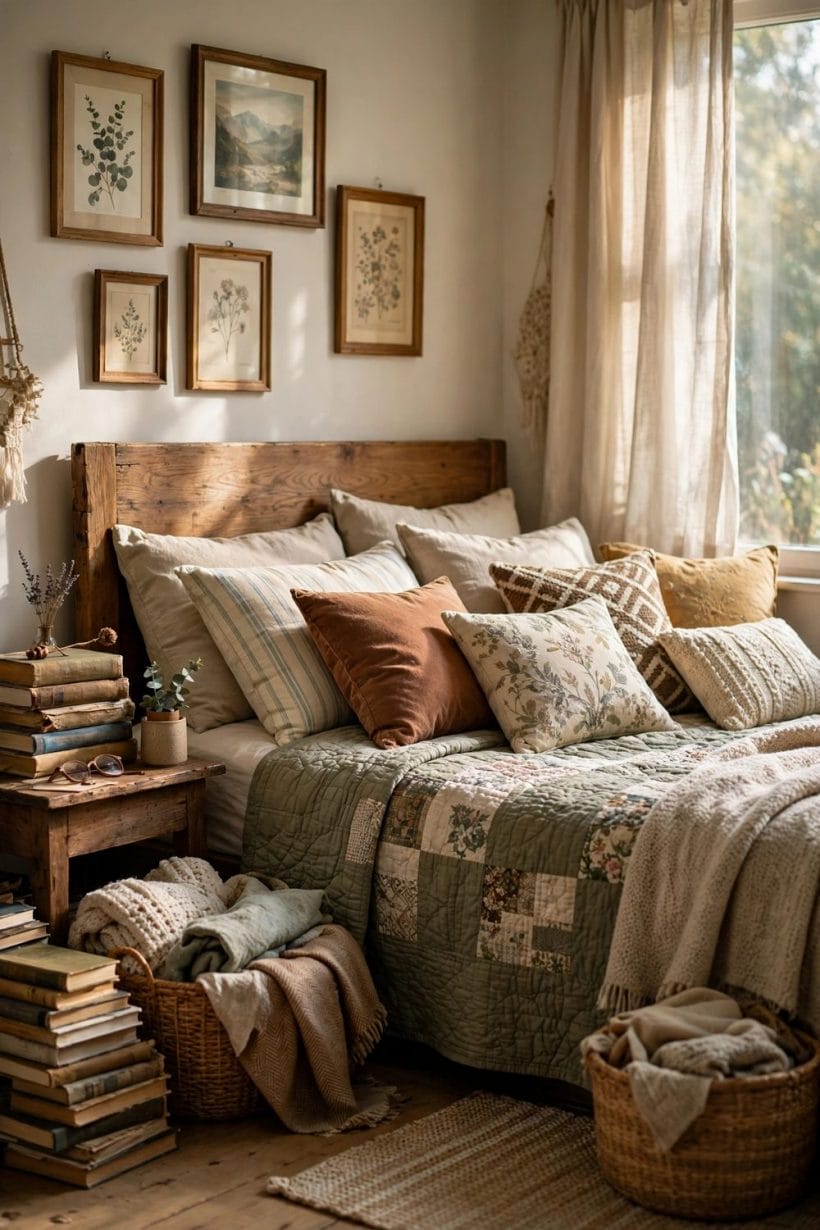
A guest bedroom is a generous place to practise beautiful clutter, because its layers are a form of hospitality. A bed made with a quilt and plenty of cushions, books stacked on the bedside table, a basket of extra blankets, a carafe of water and a few pictures on the wall tell a guest that the room was prepared with care rather than cleared in a hurry. The clutter here is curated rather than accumulated, but the effect is the same: a room that feels inhabited and welcoming from the first night.
The guest room also shows the value of leaving room for the guest’s own things. One clear surface, usually the top of the dresser or one side of the bedside table, lets a visitor unpack without disturbing the display. Hooks or a chair for clothes serve the same purpose. The balance is simple to state and worth keeping: layer the bed, the walls and the shelves generously, and keep one surface empty on purpose. A guest who finds both a full room and a place of their own in it will remember the stay fondly.
9. The Home Study
Room 9: The Home Study
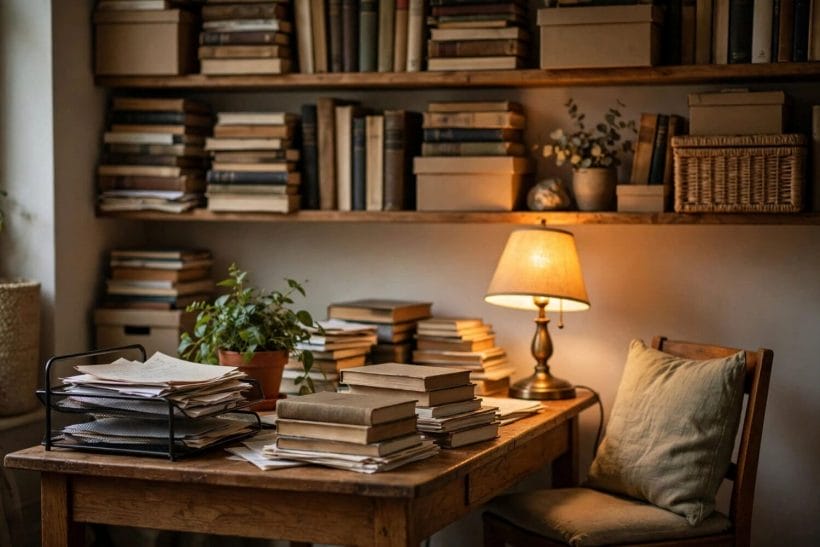
A study is the room where clutter is most easily mistaken for disorder, and most easily defended. A desk crowded with books, papers in trays, a lamp and a plant, with shelves above packed with books and boxes, is a desk in active use. The study’s layers are working layers, and the room feels right when the tools of the work are visible and within reach. Tidying a study into emptiness often makes it harder to work in, because the working materials have to be fetched and returned for every session.
What keeps a study’s fullness productive is containment by zone. Papers live in trays, books live on shelves, small tools live in a jar or a drawer, and the desk surface keeps one clear patch for the work in hand. That clear patch is the study’s version of the calm surface, and it is non-negotiable even in the fullest study. Shelves above the desk are ideal for the overflow, since they keep reference material visible without consuming desk space. A chair with a cushion and a lamp with warm light complete the room, because a study that is comfortable is a study that gets used.
10. Small, Shared and Sunlit Rooms
Room 10: The Bathroom
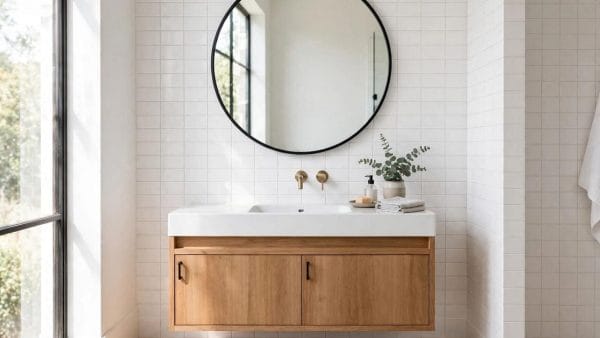
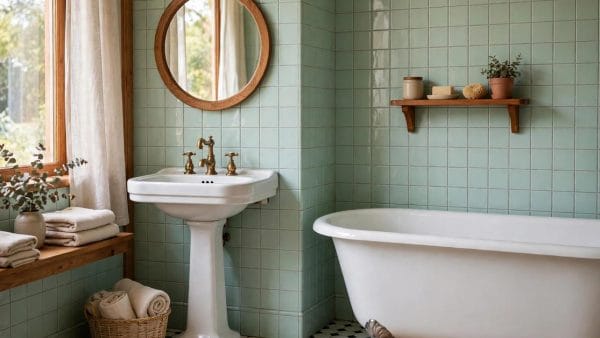
Even a bathroom can carry beautiful clutter, in miniature. A shelf of folded towels, a tray of everyday bottles gathered into one group, a plant on the windowsill and a picture on the wall turn a purely functional room into a cared-for one. The scale is smaller and the groups are tighter, but the principles are identical: repeat one colour across towels and accessories, gather small bottles on a tray so they read as one object, and keep the basin surround as the one clear surface. A bathroom layered this way feels generous rather than cramped, because the layers signal attention rather than neglect.
Room 11: The Entryway
An entryway is the smallest room in this guide, and it earns its layers through sheer usefulness. Hooks crowded with coats, a bowl for keys, a basket for shoes, a mirror and a few pictures on the wall: every object in a working entryway has a job, and the room is judged by whether those jobs get done, not by whether the wall is bare. Grouping again does the work, with coats on hooks, shoes in one basket and keys in one bowl, so that the busiest wall in the house still reads as organised. A small bench or a single chair gives the entryway a place to pause, and that pause is what turns a corridor into a room.
Room 12: The Family Room
A family room is the living room’s more relaxed sibling, and it is where beautiful clutter is at its most unselfconscious. Toys, games, throws, books and hobby materials share the room without ceremony, and the room works precisely because nobody is trying to keep it pristine. Baskets are the family room’s best friend: a basket for toys, a basket for throws, a basket for games. Baskets hide the detail while keeping the objects accessible, so the room can be full and still be tidied in minutes when guests arrive. The lesson generalises well beyond family rooms: any room that serves many activities benefits from containers that gather each activity’s objects into one movable group.
Room 13: The Sunroom
A sunroom closes the tour because it shows beautiful clutter at its most joyful. Plants of every size, cushions in faded colours, books left where they were finished, a chair angled toward the light and a small table holding a cup and a pair of reading glasses: the sunroom gathers the house’s most pleasant objects into one bright space. The light itself does much of the work here, because sunlight softens edges and makes even a crowded sill of plants look lush rather than chaotic. The sunroom’s rule is the simplest of all: let the plants lead, let the seating follow the sun, and let the small objects accumulate where they are used. A room built that way rarely needs editing, because the light edits it for you.
The thread running through all thirteen rooms is not abundance for its own sake. It is permission. Permission to keep the books, to hang the pictures close together, to let the shelves fill up, to choose comfort over emptiness. A home that shows the life lived in it is a home that welcomes people into that life, and that is a goal worth more than any bare surface. For the bones beneath the layers, the general interior guidance in tiny house interiors and the practical decorating collection at tiny house decorating ideas both show how layout and layering support each other in rooms of every size.
Final Considerations
Before embracing beautiful clutter in a room, it is worth pausing on a few habits that keep fullness on the right side of the line. First, repeat something: a colour, a material or a shape, carried through the room so that varied objects feel related. Second, group things rather than scattering them, using trays, baskets and shelves to give each group a boundary. Third, keep one calm surface in every room, a clear stretch of counter, table or wall where the eye can rest. Fourth, let light work for the room, favouring warm, low light in the evening over a single harsh source. And fifth, edit by feeling rather than by rule: if a room feels welcoming when entered and easy to use day to day, it is working, whatever the number of objects in it.
Beautiful clutter is also a slow project, and that is part of its charm. The rooms in this guide were not layered in a weekend. They grew as books were read, pictures were found, plants were given and blankets were folded into baskets. Starting with one shelf or one wall is enough, and the rest of the room will follow as objects find their groups. A cluttered room, layered with intent, is not a room that gave up on order. It is a room that chose a warmer kind of order, one built from the life that happens inside it.

0 Comments