

A small bedroom rarely fails because of its size. It fails because the bed, the storage and the walking space are all fighting for the same few square feet, and the room ends up feeling like a corridor with a mattress in it. The most useful tiny bedroom ideas start from the opposite direction: decide how the room should feel at night and in the morning, then let every choice about beds, colour, storage and light serve that feeling.
That is the approach taken in this roundup. The bedroom is treated as one complete room with a job to do — sleep, dressing, quiet storage and a few minutes of calm at both ends of the day. Each idea below is practical rather than decorative for its own sake, and each one names its trade-off honestly, because in a compact room every gain in one corner usually costs something in another.
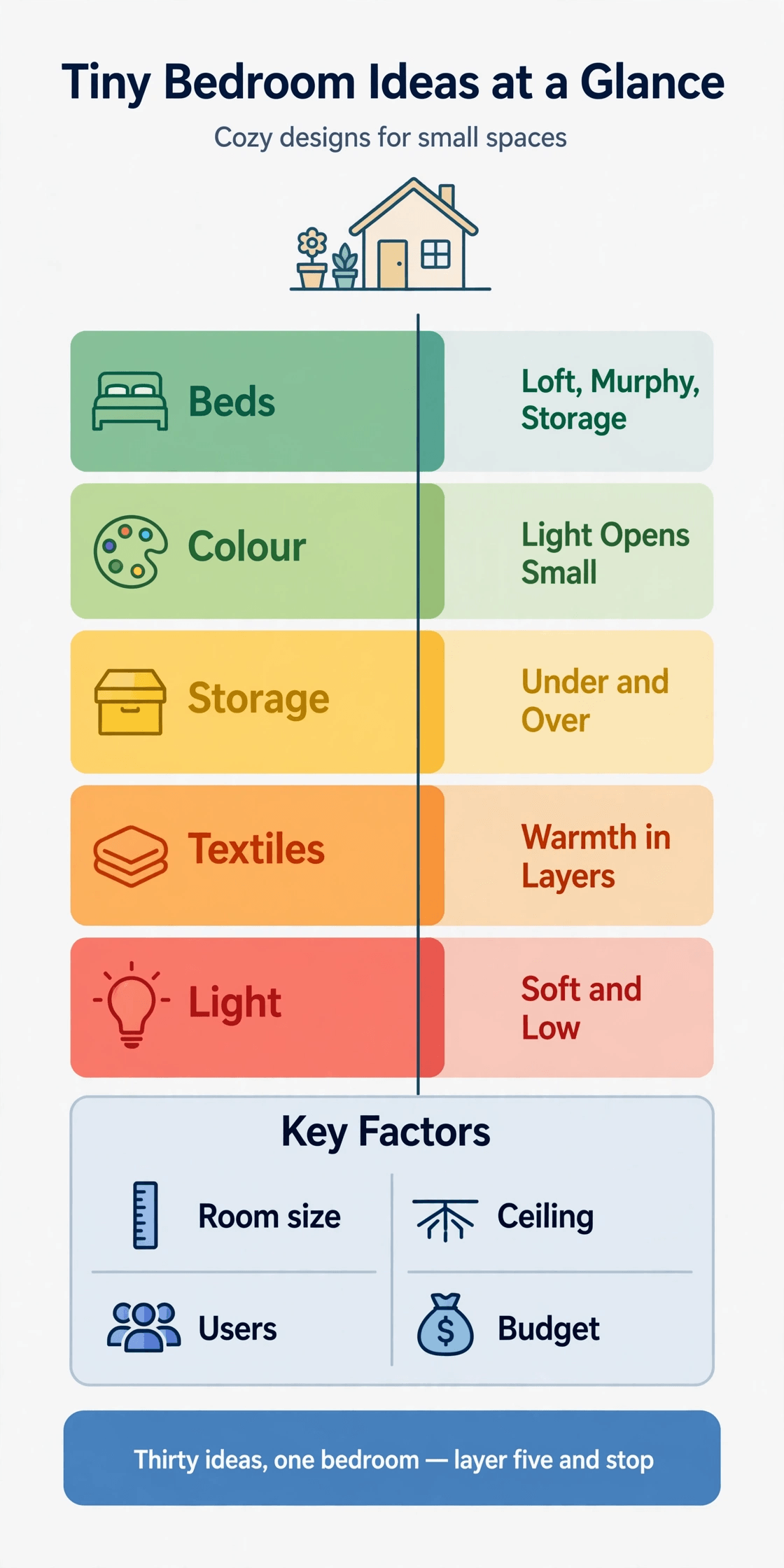
Tiny Bedroom Ideas at a Glance
| Part of the Bedroom | What It Covers | Ideas |
|---|---|---|
| Bed placement and layout | Loft, murphy and storage beds, and where the bed sits | 1–3 |
| Colour and painted surfaces | Light colour, ceilings and one calm accent | 4–6 |
| Storage under and over the bed | Drawers, headboard shelves and foot-of-bed pieces | 7–9 |
| Wardrobes and vertical storage | Slim wardrobes, peg rails and over-door space | 10–12 |
| Textiles and layered warmth | Bedding layers, throws and curtains | 13–15 |
| Lighting | Low lamps, warm bulbs and wall lights | 16–18 |
| Windows and visual space | Mirrors, sightlines and visible floor | 19–21 |
| Bedside space | Wall shelves, stool nightstands and charging corners | 22–24 |
| Clutter control | One-in-one-out, hampers and nightly resets | 25–27 |
| Comfort details | Rugs, art and quiet finishing touches | 28–30 |
1. Bedroom Bed Placement: Choosing How the Bed Earns Its Space
The bed is the largest object in the room, so its type and position decide everything else. Measure the room, mark the door swing and window line, then test the bed position on paper before moving anything heavy, as layouts in 200 sq ft tiny house layouts show how a few centimetres change a whole plan.
1. Loft Bed for Floor Space Below
Raising the bed on a loft frame frees the floor underneath for a desk, a dresser or a reading chair, which can make one room do the work of two. The trade-offs are real: climbing in the dark, changing sheets overhead, and reduced headroom that suits some sleepers and not others. Choose a loft only when the ceiling height lets you sit up comfortably in bed.
2. Murphy Bed That Folds Away
A wall bed folds up during the day so the room can become a workspace, a play space or simply a room you can walk across. It suits studio-style living where the bedroom must disappear on demand. The cost is discipline: the bed has to be made and folded daily, and anything stored on top of it has to move first, so the habit matters as much as the hardware.
3. Low Platform Bed with Storage Drawers
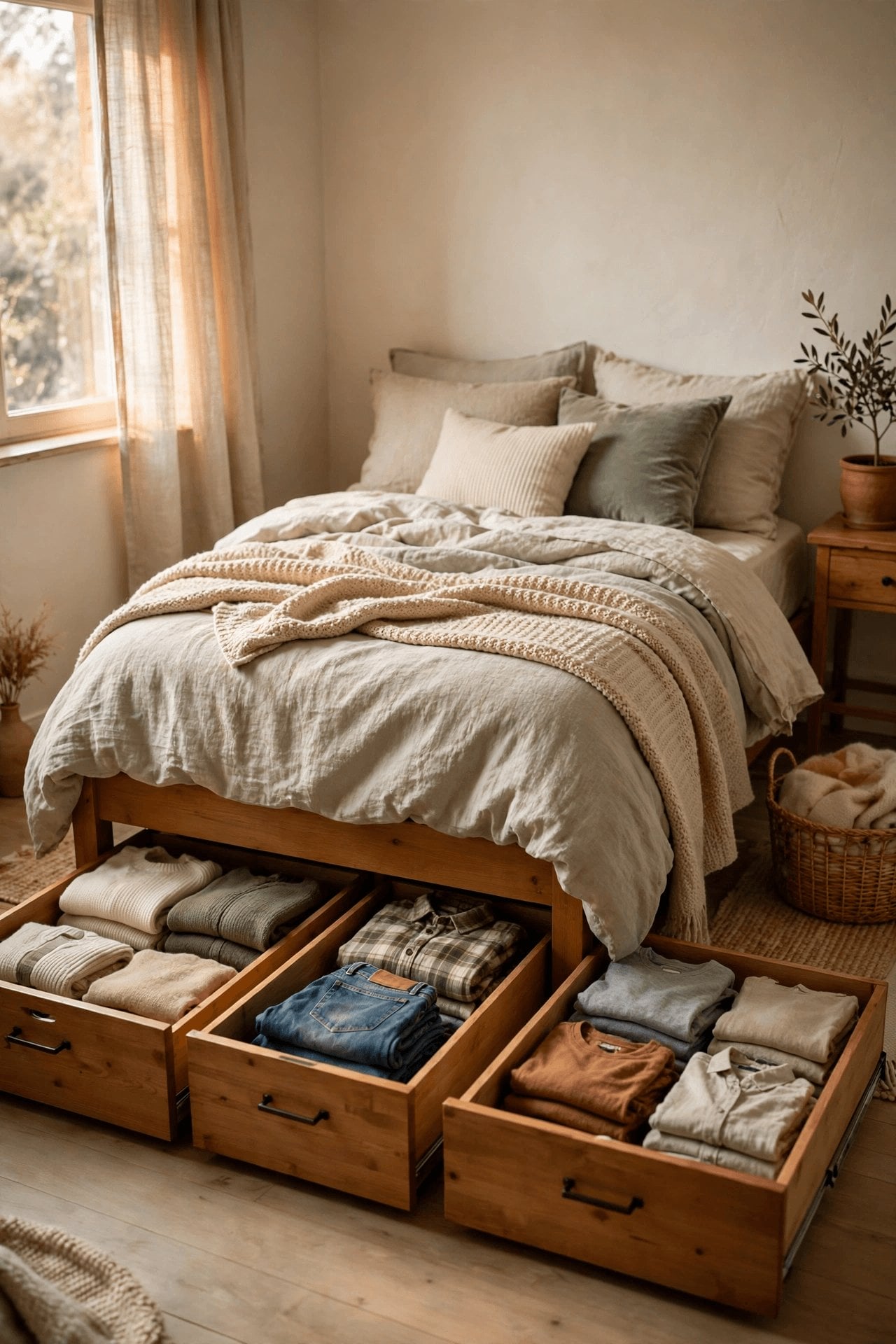
A low platform keeps sightlines open and makes a small room feel calmer than a tall frame does, while drawers built into the base turn wasted under-bed space into closed storage for bedding and off-season clothes. Check that drawers can open fully without hitting a wardrobe or wall, because a drawer that opens halfway quickly becomes a drawer nobody uses.
2. Bedroom Colour: Light Walls That Make the Room Breathe
Colour is the cheapest space-maker in a bedroom. Pale, warm tones reflect daylight around the room and soften the edges where walls meet, and they pair well with the lightweight interior wall finishes for tiny houses often used where every layer of build-up counts.
4. Light Colour Palette Across All Walls
Painting all four walls in one light colour stops the eye from reading the room as a set of small, separate planes. Warm whites, pale greys and soft stone tones all work; the right choice depends on the direction your window faces and how yellow or blue your daylight runs. Test a large patch and live with it through a full day before committing.
5. Ceiling Painted to Match the Walls
Carrying the wall colour across the ceiling removes the hard white lid that can make a low room feel lower. The boundary between wall and ceiling blurs, and the room reads as one soft shell rather than a box. This works best with matte finishes, which hide the joints and uneven light that compact rooms often have.
6. One Calm Accent, Not Four Busy Walls
If plain walls feel unfinished, put the deeper colour in one place only — behind the headboard, inside a shallow alcove, or on the wardrobe doors. A single accent gives the bed wall a focal point without shrinking the whole room the way four dark walls would. Keep the accent muted and greyed rather than bright, so it stays restful at night.
3. Bedroom Storage Under and Over the Bed
The space below and above a bed is usually the largest unused volume in a small bedroom. The storage plans in tiny house plans with hidden storage make the same point at house scale: the best storage is the kind built into space that was already there.
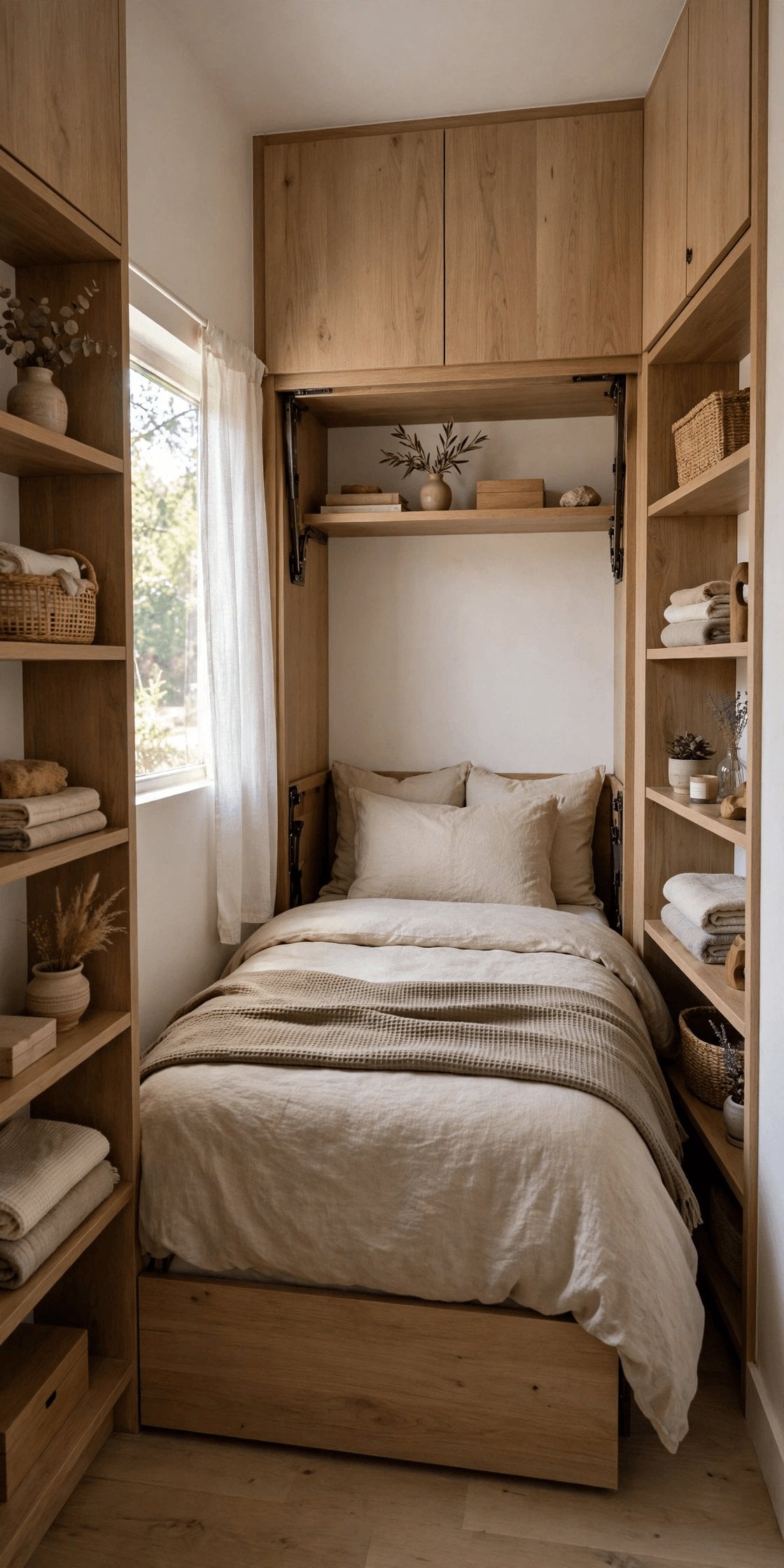
7. Under-Bed Drawers Instead of Loose Boxes
Drawers on runners beat loose plastic boxes every time, because they open with one hand, close flush, and do not collect dust on lids you have to lift. Divide them by category — spare bedding in one, off-season clothing in another — so the space under the bed stays a system rather than becoming a hiding place for things you meant to sort later.
8. Headboard with Shelves and Cubbies
A headboard with shallow shelves replaces both nightstands at once, holding books, glasses, a water glass and a small lamp within reach of the pillow. Keep the shelves shallow so nothing towers over your head, and reserve them for nightly items only. If a shelf starts holding paperwork and chargers and mugs, the calm of the bed wall disappears quickly.
9. Foot-of-Bed Bench with Hidden Storage
A narrow storage bench or trunk at the foot of the bed catches throws, cushions and the clothes that would otherwise land on the floor, and it gives you somewhere to sit while dressing. Measure the remaining walkway first: if the bench leaves you turning sideways to pass, choose a slimmer ottoman or skip the idea and keep the floor clear instead.
4. Bedroom Wardrobes: Slim, Vertical and Honest About Capacity
Clothing storage is where small bedrooms most often overreach, by fitting a wardrobe so large that the room becomes a cupboard you sleep in. The flexible thinking behind convertible furniture tiny house plans applies here too: every piece should justify its footprint twice over.
10. Slim Wardrobe Run on One Wall
One shallow wardrobe run along a single wall is usually better than deep cupboards on two walls, because it keeps the remaining floor in one usable shape. Hang short items in one section so the space below them can hold drawers or shoe shelves. Flat, handle-less doors in the wall colour help the whole run recede visually.
11. Peg Rail for Daily Clothes
A simple peg rail on a spare wall holds tomorrow’s outfit, a robe and a bag — the items that otherwise form the chair pile every small bedroom knows. Limit the rail to a handful of pegs so it stays a planned landing spot rather than becoming open storage for everything. Painted the wall colour, it looks intentional even when fully loaded.
12. Over-Door Storage for Small Items
The back of the bedroom door is a full-height panel that usually holds nothing. A slim over-door rack or a row of hooks can take scarves, belts, hats or a hanging organiser for small accessories. Fit soft pads where the rack meets the door so it does not rattle at night, and keep the load light so the hinges are not strained.
5. Bedroom Textiles: Layered Warmth Without Bulk
Textiles are what make a compact bedroom feel cozy rather than sparse, but they have to earn their place in layers you can adjust through the night and through the seasons. Natural, breathable fabrics tend to feel better in a small, warm room than heavy synthetic sets, and they wash and store more easily too.
13. Layered Bedding You Can Peel Back
Build the bed in thin layers — a sheet, a light blanket and a warmer quilt folded at the foot — instead of one heavy duvet that is either too warm or not warm enough. Layers let two sleepers with different preferences share one bed comfortably, and the folded quilt adds the finished, inviting look that makes a small room feel cared for.
14. One Washable Throw, Kept in One Place
A single throw across the foot of the bed adds colour and texture and is there for reading or naps, and because it is washable it can actually be used rather than protected. The discipline is in the singular: one throw lives on the bed, any others live in the under-bed drawer, so the room keeps its softness without sliding into textile clutter.
15. Curtains Hung High and Wide
Hanging curtains close to the ceiling and slightly beyond the window frame makes the window read taller and wider, and it lets the fabric clear the glass so daylight is not blocked when the curtains are open. Choose a weight that suits the room: blackout lining where street light is a problem, a lighter weave where privacy is the only need.
6. Bedroom Lighting: Soft, Low and Layered
A single ceiling light is the main reason small bedrooms feel stark. Lower, warmer light at the height where you actually live in the room — in bed, dressing, reading — changes the mood completely, in the same way that the tall glazing in tiny house plans with high ceilings changes how daylight reaches a room.
16. Low Bedside Lamps Instead of One Ceiling Light
Small lamps at pillow height put a pool of light exactly where reading and winding down happen, and leave the rest of the room in soft shadow, which reads as restful rather than dim. Matching lamps on both sides keep the bed wall balanced. If surface space is too tight, the headboard shelf from idea 8 can carry a compact lamp on each side.
17. Warm Bulbs on a Dimmer Where Possible
Warm-toned bulbs flatter skin, wood and bedding and signal to your body that the day is ending, where cooler light keeps a bedroom feeling like an office. A dimmer, or lamps with more than one brightness setting, lets the same room be bright enough for dressing in the morning and low enough for the last half hour of the evening.
18. Plug-In Wall Lights to Free the Nightstand
Wall lights that plug in rather than needing an electrician give you directed reading light without taking any table surface at all. Mounted just above and behind the pillow line, they aim light at the book instead of the room. Keep cords tidy with clips along the headboard edge so the clean look is not undone by dangling cable.
7. Bedroom Windows and Mirrors: Visual Space on a Budget
You cannot add square footage with decoration, but you can change how much of the room the eye takes in at once. Tall window ideas like those in clerestory window tiny house layouts work on the same principle: light placed well makes volume feel larger than it measures.
19. Mirror Placed to Catch Window Light
A mirror opposite or beside a window bounces daylight into the darker half of the room and doubles the view of something pleasant. One reasonably large mirror works better than several small ones, which can look fussy and fragment the reflection. Lean or hang it where it reflects the window or the bed’s calmest corner, not the laundry basket.
20. Low Furniture to Keep Sightlines Long
Keeping the bed, bench and dresser low lets you see over them to the full length and width of the room, and uninterrupted sightlines are what make a space feel open. Avoid tall pieces in the middle of the room entirely; if a tall wardrobe is unavoidable, it belongs flat against a wall at the room’s edge, as covered in section 4.
21. Floor Left Visible Around the Bed
A margin of visible floor around the bed is a signal to the eye that the room has breathing space, so resist filling every gap with baskets and boxes. Choose one side for the storage bench and keep the other side completely clear if you can. Rugs should sit partly under the bed rather than wall to wall, so the floor edge still shows.
8. Bedroom Bedside Space: A Home for the Nightly Essentials
Every sleeper needs a small set of things within arm’s reach: water, a book, glasses, a phone, perhaps medication. In shared rooms this matters twice over, a point also made in tiny house layouts for couples — each person needs their own small territory, even if it is only a shelf wide.
22. Wall-Mounted Nightstand Shelf
A small floating shelf beside the bed holds the nightly essentials and nothing more, and because it touches no floor it leaves the room easier to clean and visually lighter. Fit it at mattress height so a glass of water sits level with the bed. The limited surface is a feature: when the shelf is full, something has to leave.
23. Stool or Stack of Books as a Nightstand
Where even a shelf feels like too much furniture, a sturdy stool makes a perfectly good nightstand and can move to the foot of the bed or the doorway when needed. In a rented room, a neat stack of large books does the same job with no fixing at all. Either way, keep the top mostly empty so the improvisation looks deliberate.
24. One Charging Corner, Not Cables Everywhere
Give phones and e-readers a single charging spot — one socket, one short cable per device, ideally on a timer so charging ends overnight — instead of cables trailing to both sides of the bed and the dresser. A small tray or basket keeps the corner contained. Many people sleep better with the phone charging face-down and out of arm’s reach anyway.
9. Bedroom Clutter Control: Habits That Keep the Room Cozy
Design can only take a small room so far; after that, habits decide whether it stays calm. The systems in tiny house organization strategies come down to the same principle used here: everything needs a defined home, and returning it has to be easier than dropping it.
25. One In, One Out for Clothes and Books
A one-in-one-out rule keeps a small wardrobe and a small shelf at a stable size instead of on a slow path to overflow. When a new jumper arrives, an old one leaves; when a new book comes in, one is passed on. It sounds strict, but in a compact room it is the rule that protects every other idea in this list.
26. Lidded Hamper Inside the Bedroom
Laundry needs a home where it is worn, or it will live on the floor and the bed bench. A slim, lidded hamper that fits behind the door or beside the wardrobe keeps worn clothes out of sight and out of the room’s air. Choose one sized to your wash rhythm: full hamper, laundry day, no negotiation with yourself required.
27. Five-Minute Reset Before Bed
A short nightly reset — clothes to the hamper or peg rail, books to the shelf, glass to the kitchen — is what keeps a small bedroom waking up calm instead of chaotic. Five minutes is enough precisely because the room is small. Pair it with opening a window briefly or laying out tomorrow’s clothes on the peg rail, and the morning starts ahead of itself.
10. Bedroom Comfort Details: The Finishing Layer
Once layout, colour, storage and light are settled, comfort lives in small details underfoot, at eye level and in how quiet the room is. None of these need much space, and most can be tested cheaply before committing to anything permanent.
28. Soft Rug Where Your Feet Land
A rug does not need to cover the floor; it needs to be where your feet land when you get out of bed. A washable runner or a soft rug on the main side of the bed gives warmth and sound softening exactly where both are wanted. In a very small room, one well-placed rug beats a large one that disappears under every piece of furniture.
29. One Larger Piece of Art, Calmly Hung
A single larger picture above the bed or on the clearest wall gives the room a focal point and a personality without the visual noise of many small frames competing for attention. Hang it a little lower than instinct suggests, so it relates to the bed rather than floating near the ceiling, and choose an image you are happy to see half-asleep.
30. Quiet Touches: Doors, Drawers and Drafts
Small rooms amplify small noises, so soft-close pads on wardrobe doors, felt pads under the storage bench and a draft excluder at the door all pay off at night. None of these are visible, and that is the point: the room simply feels calmer and better made. Work through the room once, opening and closing everything, and fix whatever clicks, rattles or scrapes.
Final Considerations
A compact bedroom works when the bed type, the colour, the storage and the light are chosen as one set of decisions rather than four separate shopping trips. Start with the bed and its position, because that choice fixes the floor plan; then place storage into the spaces the bed creates — under it, over it, at its head and foot. Colour and textiles come next, since they are the cheapest way to change how the finished room feels, and lighting last, aimed at the pillow and the mirror rather than the ceiling.
Be honest about the trade-offs as you go. A loft bed buys floor space with a ladder; a folding bed buys a daytime room with a daily routine; closed storage buys calm with the discipline of putting things away. Pick the trade-offs that suit how you actually live, test changes in the order above, and a small bedroom can feel genuinely cozy — a room that happens to be small, rather than a small room you are putting up with.


0 Comments