
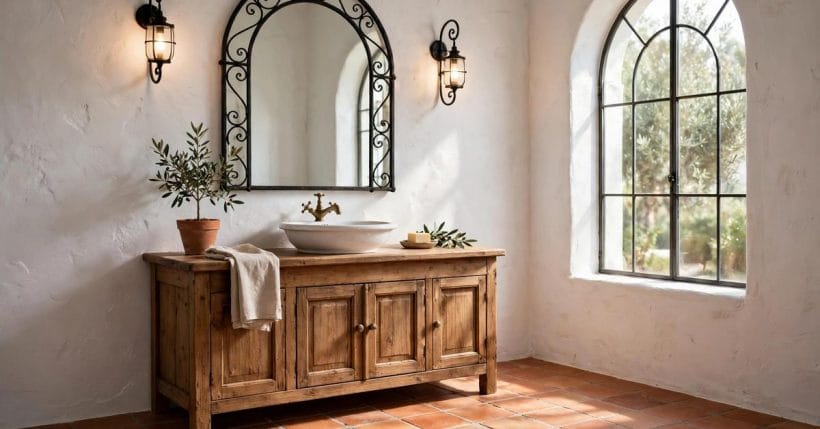
A Mediterranean bathroom is a warm room first and a washroom second. Sun-baked terracotta underfoot, whitewashed plaster on the walls, patterned tile in sea blue and white, and the soft curve of an arch over a mirror or a window give the room its character before a single fixture is chosen. These Mediterranean style bathroom ideas stay with that warm coastal language throughout, looking at layouts, vanities, tiles and space-saving fixtures that suit the style rather than borrowing from other bathroom styles.
The strength of the Mediterranean look is how forgiving it is. Plaster can be soft rather than perfectly smooth, wood can show its grain, and a patterned tile can carry a whole wall while everything around it stays plain. Readers looking for small bathroom ideas will recognise the same discipline: one strong surface, chosen well, leaves a small room feeling generous rather than busy.
What follows is a counted tour of seventy-five ideas, grouped so the room can be planned in order. Layouts come first, then vanities, tiles, arches and light, colour and materials, storage, showers and baths, small rooms, tiny houses and everyday care. Plumbing and waterproofing run through the whole guide as professional work only: nothing here teaches pipework, sealing or fitting, and any change to supply, waste or wet-area sealing belongs to a qualified professional.
1. Layouts With a Warm Centre
A good Mediterranean layout starts by giving the room a warm centre, usually the vanity wall or the bath, and letting everything else sit quietly around it. The ideas below move fixtures around the room, and each one keeps the same test in mind: can the room be entered, used and left without squeezing past furniture, and does the eye land on something warm rather than something crowded?
| Item | What it is |
|---|---|
| A Vanity Wall as the Warm Centre | Let one wall carry the vanity, the mirror and the light, and keep the rest of the room plain. |
| A Bath Beneath the Arched Window | Placing the bath beneath an arched window makes daylight the room's main decoration. |
| A Corner Shower That Keeps the Floor Open | A shower tucked into a corner leaves the main floor free and the room easy to move through. |
| A Basin Near the Door for Easy Mornings | A basin close to the door suits a busy household, since the first and last stop of the day is easy to reach without crossing the whole room. |
| A Long Room Split Into Wet and Dry Halves | In a long bathroom, let one end hold the shower and bath and the other hold the vanity and dressing space. |
| A Central Bath as the Room's Anchor | Where the room allows, a freestanding bath near the centre turns bathing into the room's event rather than its afterthought. |
| A Vanity and Bath on Opposite Walls | Placing the vanity and the bath on opposite walls balances a square room nicely, with the eye travelling from warm wood on one side to water and tile on the other. |
| A Layout That Leaves the Window Wall Bare | Resist the urge to fill the window wall. |
| A Reclaimed Wood Vanity With Open Grain | A vanity in reclaimed or visibly grained wood brings warmth that no painted unit can match. |
| A Hand-Painted Ceramic Basin as the Star | A basin painted with a blue and white pattern can carry the whole vanity wall on its own. |
| A Stone Basin on a Wooden Top | A basin carved or shaped from stone sits beautifully on a thick wooden top, the cool stone against the warm wood echoing the room's tile and timber pairing. |
| A Floating Vanity That Shows the Floor | A wall-hung vanity leaves the terracotta floor visible beneath it, which makes a small room feel larger and easier to sweep. |
| A Double Vanity for Shared Mornings | Two basins on one long wooden vanity suit a shared bathroom, giving each person a mirror and a stretch of counter. |
| A Corner Vanity for an Awkward Angle | A corner vanity turns an awkward angle into the hardest-working spot in the room. |
| A Vanity With Linen Storage Below | Open shelving beneath the vanity, stacked with folded linen towels, adds warmth and colour while keeping towels within reach. |
| A Vintage Washstand Given New Life | An old washstand or side table, adapted by a professional to hold a basin, brings a story into the bathroom that new furniture cannot. |
| Patterned Tile on One Hero Wall | Covering a single wall in blue and white patterned tile gives the room a postcard moment without overwhelming it. |
| Terracotta Floors Under Everything | Terracotta floor tiles ground the whole room in warmth, pairing with both patterned walls and plain plaster. |
| A Mosaic Splashback Behind the Basin | A mosaic splashback in sea blue and white protects the wall behind the basin while adding a jewel-like band of colour. |
| Patterned Floor Tile in a Small Room | In a small bathroom, a patterned floor can be the room's one bold gesture, with walls kept plain white to balance it. |
| A Tile Border at Waist Height | A single border strip of patterned tile running at waist height ties a room together without covering whole walls. |
| Fish-Scale Tile in the Shower Niche | Fish-scale tiles inside a shower niche add a soft, sea-like curve to a small space that is easy to overlook. |
| Plain Plaster With a Tiled Skirting | Where patterned tile would be too much, a tiled skirting along the base of plaster walls gives a clean, washable edge with a hint of colour. |
| Mixing Two Patterns With Plain Between | Two patterns can live in one room if plain plaster or plain tile separates them. |
| An Arched Mirror Above the Basin | An arched mirror echoes the room's windows and niches, tying the vanity wall into the architecture. |
| Twin Arched Mirrors Over a Double Vanity | Two arched mirrors over a double vanity give each person their own framed view while repeating the room's signature curve. |
| An Arched Niche for Bottles and Jars | A recessed arched niche in the shower or beside the bath holds bottles and jars without a shelf breaking the wall line. |
| An Arched Window That Frames the Sky | Where the room allows, an arched window turns a plain view into a picture, framing sky or garden in a curve that matches the mirrors. |
| Wrought-Iron Wall Lights Beside the Mirror | Wrought-iron sconces on either side of the mirror give warm, even light for faces, and their dark frames echo the mirror's own ironwork. |
| A Lantern Light Hung From a Beam | A lantern-style pendant hung from a beam or a high hook adds a focal glow over the bath or the centre of the room. |
| Daylight Through Frosted Glass | Frosted or reeded glass in the bathroom window keeps privacy while letting daylight flood in, which is the Mediterranean ideal: light without exposure. |
| Candlelight for Evening Baths | A few candles on a wooden stool or a tiled ledge turn an evening bath into a ritual, their flicker echoing the room's warm palette. |
| Whitewashed Plaster as the Quiet Backdrop | Whitewashed plaster, slightly uneven and soft to the eye, lets tile and wood take the stage. |
| Sea Blue as the Single Cool Note | Sea blue, used in tile, towels or a painted basin, is the Mediterranean bathroom's one cool note against all that warmth. |
| Olive Green in Plants and Linen | Olive green appears most naturally in plants, and an olive tree in a terracotta pot is the Mediterranean bathroom's classic living decoration. |
| Honey Wood Against Cool Tile | Honey-toned wood, in a vanity, a stool or a mirror frame, warms up cool blue tile the way sun warms a courtyard. |
| Terracotta Accents Beyond the Floor | Terracotta need not stop at the floor: a terracotta pot, a soap dish, or a small tiled panel carries the floor's warmth up to eye level. |
| Natural Stone for Sills and Shelves | A stone sill beneath the window or a stone shelf beside the bath adds a cool, solid note that balances warm wood and plaster. |
| Linen Towels in Warm Neutrals | Linen or linen-look towels in warm white, sand and soft clay keep the room's palette calm when the towels are on display. |
| Open Shelves Beside the Mirror | Open shelves flanking the mirror hold everyday jars and folded cloths within reach, and their contents become part of the room's colour. |
| Baskets for Laundry and Spares | Woven baskets hold laundry, spare towels and cleaning cloths in a material that suits the room far better than plastic boxes. |
| A Slim Cabinet That Hugs the Wall | A slim wall cabinet, painted in warm white or left in wood, stores tall bottles without jutting into the room. |
| A Wall-Hung Basin in the Tightest Corner | A small wall-hung basin frees floor space in the tightest corner, leaving the terracotta floor visible and the room easy to clean. |
| A Towel Rail Warmed by the Room | A simple towel rail, in dark iron or warm wood, holds towels where they dry best: in moving air near the window or the door. |
| A Mirror Cabinet With Hidden Depth | A mirror cabinet gives a small bathroom a whole shelf of hidden storage without a single extra piece of furniture. |
| A Stool That Works Three Ways | A small wooden stool beside the bath works as a towel perch, a candle stand and a step for reaching high shelves, all without looking like storage at all. |
| A Tiled Shower Alcove With a Niche | A shower alcove fully lined in patterned tile, with an arched niche for bottles, feels like a small tiled room within the room. |
| A Rainfall Shower Under a Plain Ceiling | A rainfall shower head under a plain plaster ceiling gives a gentle, rain-like fall of water that suits the room's relaxed mood. |
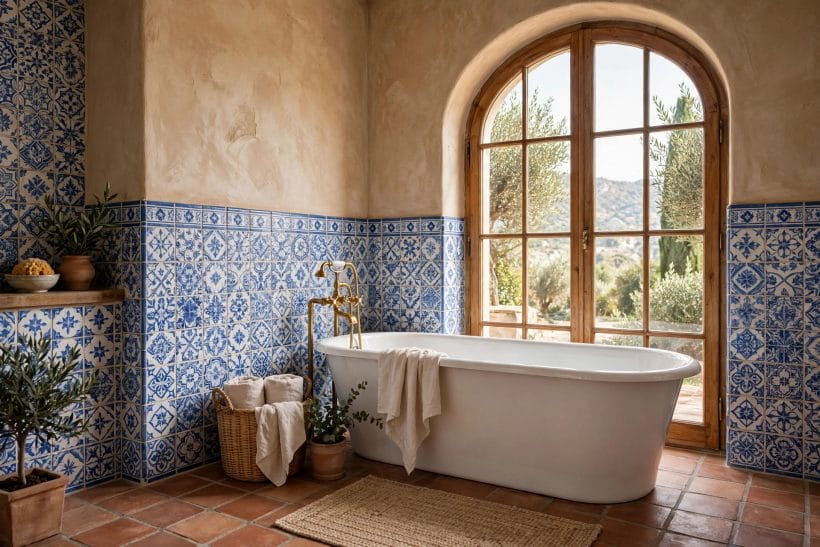
| A Freestanding Bath as the Centrepiece | A freestanding bath, with its curves echoing the room's arches, makes bathing the room's centrepiece. |
| A Built-In Bath With a Tiled Surround | A built-in bath with a tiled surround suits a room where a freestanding bath would crowd the floor. |
| A Bath Caddy in Warm Wood | A wooden bath caddy across the tub holds a book, a candle and a cup within reach, turning a bath into a proper rest. |
| A Hand Shower Beside the Bath | A hand shower on a wall bracket beside the bath makes rinsing hair and cleaning the tub far easier, especially in a household with children or pets. |
| A Shower Seat in Tiled Comfort | A tiled shower seat, built into the alcove wall, gives a place to sit, to shave legs, or to rest while the water runs. |
| One Pattern Wall in a Tiny Room | In a tiny bathroom, a single patterned wall behind the basin gives the whole room its identity, while the other walls stay whitewashed and plain. |
| A Corner Basin That Frees the Door Swing | A corner basin keeps the door swing clear in a room where every inch of floor matters. |
| A Large Mirror to Double the Light | A large mirror, ideally arched, doubles both light and the sense of space in a small Mediterranean bathroom. |
| Terracotta Floors Carried Into the Shower | Carrying the same terracotta floor tile into the shower, with proper professional waterproofing beneath, makes a small room read as one continuous space rather than two cramped zones. |
| Vertical Storage on the Door Wall | The wall behind the door, often wasted, holds a tall slim cabinet or a row of hooks in a small bathroom. |
| A Pocket of Green on the Sill | A single potted plant on the windowsill gives a small Mediterranean bathroom its living note without taking floor space. |
| Pale Plaster to Lift a Low Ceiling | Pale whitewashed plaster on walls and ceiling lifts a low ceiling in a small room, bouncing light that a darker finish would swallow. |
| A Folded Towel Stack as Decoration | In a room too small for decoration, a neat stack of folded towels in warm white and clay becomes the decoration. |
| A Wet Room That Is the Whole Bathroom | In a tiny house, treating the whole bathroom as a wet room, fully tiled with professional waterproofing throughout, removes the need for separate shower walls and doors. |
| A Vanity No Deeper Than a Shelf | A vanity as shallow as a shelf, with a small basin and a wall-mounted tap, gives a tiny house bathroom a proper wash zone without stealing floor space. |
| Patterned Tile as a Single Stripe | In a tiny house bathroom, a single vertical stripe of patterned tile, running from floor to ceiling beside the basin or the shower, gives the Mediterranean signal without covering a whole wall. |
| A Folding Stool Instead of a Chair | A folding wooden stool serves a tiny house bathroom as a seat, a step and a towel perch, then folds flat against the wall when not needed. |
| A Shower Curtain in Warm Linen Tones | Where a tiny house bathroom needs a shower curtain, a curtain in warm linen tones, rather than plastic-bright colour, keeps the Mediterranean mood intact. |
| Warm Wood Everywhere the Eye Rests | In a tiny house bathroom, warm wood on the vanity, the mirror frame and a single shelf gives the eye a continuous thread, making the small room feel designed rather than assembled. |
| A Tiny Window Dressed With a Shutter | A tiny bathroom window dressed with a single wooden shutter, rather than a curtain, keeps privacy, survives damp air and adds a Mediterranean shape to the smallest wall. |
| Wiping Tile After the Shower | A quick wipe of shower tiles after use keeps patterned tile bright and grout clean, since water left to dry leaves marks that build up over time. |
| Letting Wood Dry Between Uses | Wooden vanities, stools and mirror frames last longest when splashes are wiped and the room is aired after bathing. |
| Airing the Room After Every Bath | Airing the bathroom after bathing, by opening a window or running ventilation until surfaces dry, protects plaster, wood and grout alike. |
| Rotating Towels for Even Wear | Rotating towels between the display stack and the linen store keeps the colours even and the towels fresh, since the top towel of a stack wears fastest. |
| Caring for Plants in Humid Air | Bathroom plants need light, occasional water and a pot that drains, and they repay care by thriving in humid air that suits them. |
| Refreshing Grout Without Replacing Tile | Grout that has dulled can often be refreshed with a careful clean, restoring patterned tile without replacing a single piece. |
| A Seasonal Reset of the Whole Room | Once a season, reset the bathroom: launder curtains and baskets, restock the shelves, replace tired plants, and check seals and grout with a professional's eye where anything looks worn. |
1. A Vanity Wall as the Warm Centre
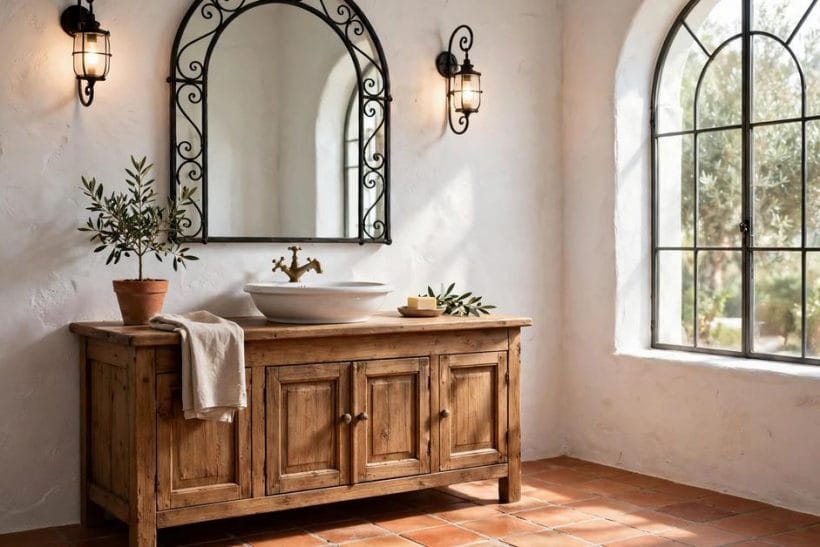
Let one wall carry the vanity, the mirror and the light, and keep the rest of the room plain. A wooden vanity against whitewashed plaster, with an arched mirror above it, gives the eye a single warm focus on entering. Keep the counter clear apart from a tray and a plant, and the wall reads as a calm composition rather than a crowded shelf.
2. A Bath Beneath the Arched Window
Placing the bath beneath an arched window makes daylight the room’s main decoration. Frosted glass or a high sill keeps privacy while letting light fall across the water and the tiles. A wooden stool beside the bath holds towels within reach, and the window frame itself, left in natural wood, becomes part of the Mediterranean language.
3. A Corner Shower That Keeps the Floor Open
A shower tucked into a corner leaves the main floor free and the room easy to move through. Patterned tile inside the shower marks it as a distinct zone without needing a door or a screen that breaks the view. Keep the floor outside the shower in plain terracotta, and the corner reads as a purposeful niche rather than a leftover space.
4. A Basin Near the Door for Easy Mornings
A basin close to the door suits a busy household, since the first and last stop of the day is easy to reach without crossing the whole room. A slim vanity here keeps the passage clear, and a small mirror above it means the basin zone works even when the rest of the room is in use. Towel storage beside the basin, rather than across the room, keeps the routine short.
5. A Long Room Split Into Wet and Dry Halves
In a long bathroom, let one end hold the shower and bath and the other hold the vanity and dressing space. A change of floor tile, from plain terracotta to patterned tile, can mark the boundary without a wall. The dry half stays warm and woody, the wet half stays tiled and washable, and each half can be cleaned and cared for on its own terms.
6. A Central Bath as the Room’s Anchor
Where the room allows, a freestanding bath near the centre turns bathing into the room’s event rather than its afterthought. Keep the floor around it clear so the bath can be approached from either side, and let a single arched window or a single plant be its companion. The rest of the room then arranges itself around that calm anchor.
7. A Vanity and Bath on Opposite Walls
Placing the vanity and the bath on opposite walls balances a square room nicely, with the eye travelling from warm wood on one side to water and tile on the other. A patterned tile strip at waist height can tie the two walls together without repeating the full pattern. Keep the middle of the floor empty, and the room feels larger than its walls suggest.
8. A Layout That Leaves the Window Wall Bare
Resist the urge to fill the window wall. A bare plaster wall beneath an arched window lets light and shadow become the decoration, changing through the day. A single plant on the sill is enough. This restraint is what keeps a Mediterranean bathroom feeling sunlit rather than staged, and it costs nothing but discipline.
2. Vanities in Wood and Ceramic
The Mediterranean vanity is a piece of furniture first and a fixture second. Warm wood, a ceramic basin that shows its glaze, and open space beneath or beside it give the vanity its character. The ideas below vary the wood, the basin and the storage, while keeping the same rule: the vanity should look like it belongs in a warm house, not a showroom.
9. A Reclaimed Wood Vanity With Open Grain
A vanity in reclaimed or visibly grained wood brings warmth that no painted unit can match. Knots, grain and a slightly uneven edge suit plaster walls and terracotta floors, because the whole room shares the same handmade feeling. Seal the wood for bathroom use with a finish suited to damp rooms, and wipe splashes promptly so the grain stays handsome.
10. A Hand-Painted Ceramic Basin as the Star
A basin painted with a blue and white pattern can carry the whole vanity wall on its own. Keep everything around it plain: a simple wooden top, a plain mirror, a single tap. The basin then reads as a piece of pottery rather than a fixture, and the room gains a focal point without gaining clutter.
11. A Stone Basin on a Wooden Top
A basin carved or shaped from stone sits beautifully on a thick wooden top, the cool stone against the warm wood echoing the room’s tile and timber pairing. Keep the top clear apart from a soap dish and a small plant. The weight of the stone means the vanity beneath it should be solid and well supported, which is a matter for the fitter, not an afterthought.
12. A Floating Vanity That Shows the Floor
A wall-hung vanity leaves the terracotta floor visible beneath it, which makes a small room feel larger and easier to sweep. A single drawer or an open shelf beneath keeps the look light. The plumbing behind a floating unit is hidden work for a professional, and the finished effect should be a vanity that appears to float, with no visible pipework breaking the line.
13. A Double Vanity for Shared Mornings
Two basins on one long wooden vanity suit a shared bathroom, giving each person a mirror and a stretch of counter. Keep the basins matching and the mirrors matching, so the pair reads as one piece of furniture rather than two competing stations. A shared tray between them holds what both people reach for.
14. A Corner Vanity for an Awkward Angle
A corner vanity turns an awkward angle into the hardest-working spot in the room. A compact corner unit leaves the main floor open, and a small arched mirror above it echoes the room’s curves. Keep the counter minimal, since a corner collects clutter faster than a straight wall, and let the tile behind it do the talking.
15. A Vanity With Linen Storage Below
Open shelving beneath the vanity, stacked with folded linen towels, adds warmth and colour while keeping towels within reach. Roll or fold towels in one colour family so the shelf reads as calm rather than chaotic. A basket on the lowest shelf holds spares out of sight, and the whole arrangement doubles as decoration.
16. A Vintage Washstand Given New Life
An old washstand or side table, adapted by a professional to hold a basin, brings a story into the bathroom that new furniture cannot. Check that the piece is stable, suited to damp air, and properly supported before it is adapted, since a washstand was never built to hold water. Done well, it becomes the room’s most talked-about piece.
3. Tiles That Carry the Style
Tile is the Mediterranean bathroom’s signature, and the discipline in these Mediterranean style bathroom ideas is to let it sing in one place at a time. A patterned wall, a terracotta floor, a mosaic splashback: each is strong enough alone. The ideas below show where pattern earns its keep and where plain tile does the quieter work.
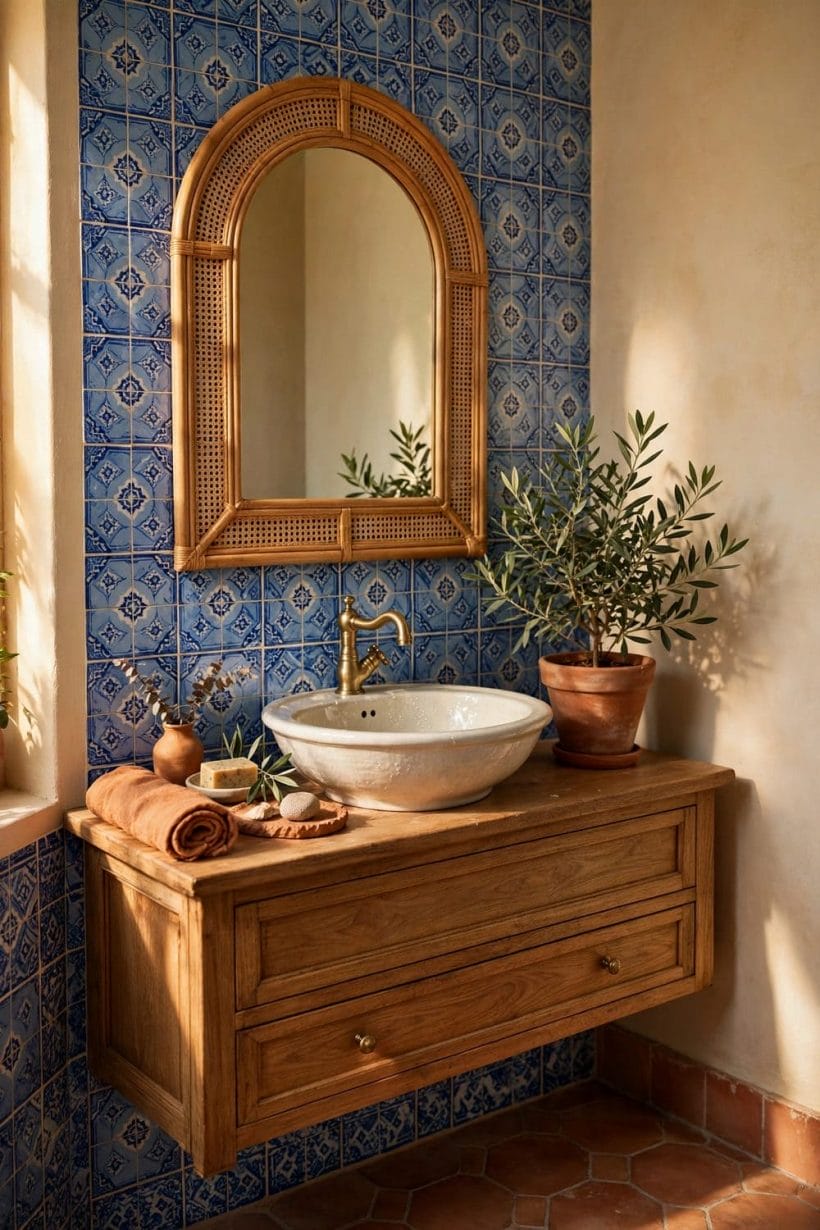
17. Patterned Tile on One Hero Wall
Covering a single wall in blue and white patterned tile gives the room a postcard moment without overwhelming it. Choose the wall the eye meets on entering, usually the vanity wall or the shower wall, and leave the other walls in plain plaster. The pattern then feels like a deliberate picture, not a room-wide shout.
18. Terracotta Floors Under Everything
Terracotta floor tiles ground the whole room in warmth, pairing with both patterned walls and plain plaster. Their earthy tone hides daily wear gracefully, and they feel warm underfoot in a way pale floors do not. Keep the grout tone close to the tile so the floor reads as one warm field rather than a grid.
19. A Mosaic Splashback Behind the Basin
A mosaic splashback in sea blue and white protects the wall behind the basin while adding a jewel-like band of colour. Keep the mosaic to the splashback zone only, framed by plain plaster above, so it reads as jewellery rather than wallpaper. Small mosaic pieces also curve gracefully around an arched mirror’s edge.
20. Patterned Floor Tile in a Small Room
In a small bathroom, a patterned floor can be the room’s one bold gesture, with walls kept plain white to balance it. The pattern draws the eye down and makes the floor feel intentional rather than merely functional. Keep the vanity simple and the towels plain, so the floor stays the star.
21. A Tile Border at Waist Height
A single border strip of patterned tile running at waist height ties a room together without covering whole walls. It can run behind the vanity, around the bath, or along the shower wall, giving a continuous thread of colour. The strip works best when the tiles above and below it are plain, so the border reads as a line drawn with intent.
22. Fish-Scale Tile in the Shower Niche
Fish-scale tiles inside a shower niche add a soft, sea-like curve to a small space that is easy to overlook. Keep the rest of the shower in a plainer tile so the niche becomes a small discovery rather than a competing pattern. A niche lined this way turns everyday bottles into objects displayed in a pretty frame.
23. Plain Plaster With a Tiled Skirting
Where patterned tile would be too much, a tiled skirting along the base of plaster walls gives a clean, washable edge with a hint of colour. The skirting protects the plaster from splashes while keeping the walls calm. Choose a tile that matches the floor, so the room’s base reads as one continuous warm line.
24. Mixing Two Patterns With Plain Between
Two patterns can live in one room if plain plaster or plain tile separates them. A patterned shower wall and a patterned floor, for example, need a stretch of plain wall or plain terracotta between them to breathe. Without that breathing space the room feels restless; with it, each pattern gets its own moment.
4. Arches, Mirrors and Light
The arch is the Mediterranean bathroom’s kindest shape. It softens mirrors, windows, niches and doorways, and it repeats gently through the room without needing ornament. Light, meanwhile, should feel like sunlight even on a grey day: warm, indirect and kind to faces. The ideas below pair the two.
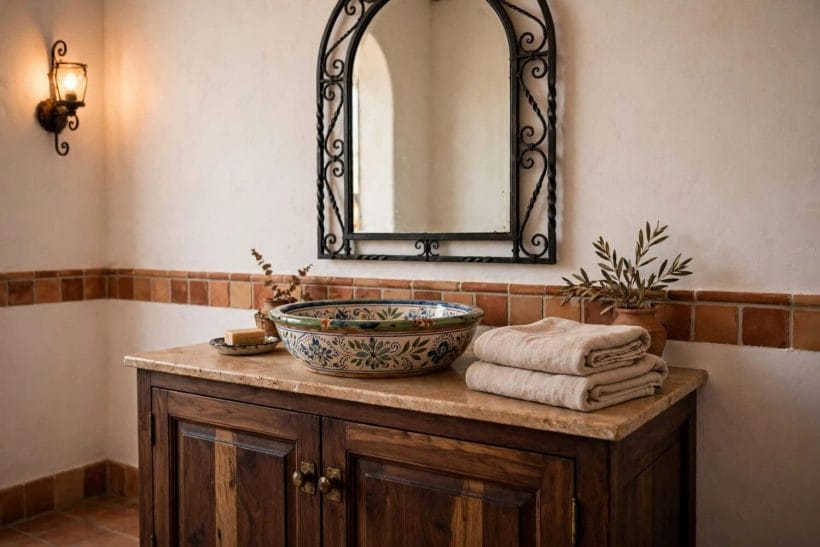
25. An Arched Mirror Above the Basin
An arched mirror echoes the room’s windows and niches, tying the vanity wall into the architecture. A wrought-iron or wooden frame keeps the arch feeling crafted rather than fussy. Hang the mirror so faces are lit from the front, not from above alone, and the arch becomes both beautiful and genuinely useful.
26. Twin Arched Mirrors Over a Double Vanity
Two arched mirrors over a double vanity give each person their own framed view while repeating the room’s signature curve. Keep the mirrors the same size and height so the pair reads as intentional. A small wall light between them warms both faces without casting harsh shadows.
27. An Arched Niche for Bottles and Jars
A recessed arched niche in the shower or beside the bath holds bottles and jars without a shelf breaking the wall line. Lining the niche in a contrasting tile makes it a feature, while keeping its contents corralled. The arch shape also sheds water gracefully, which suits a wet zone better than a square corner.
28. An Arched Window That Frames the Sky
Where the room allows, an arched window turns a plain view into a picture, framing sky or garden in a curve that matches the mirrors. Wooden shutters on an arched window add privacy without curtains that would dampen in bathroom air. Even a small arched window changes the whole room’s mood.
29. Wrought-Iron Wall Lights Beside the Mirror
Wrought-iron sconces on either side of the mirror give warm, even light for faces, and their dark frames echo the mirror’s own ironwork. Choose warm-toned bulbs so the light feels like late sun rather than office light. The iron itself needs no ornament beyond its curve to feel Mediterranean.
30. A Lantern Light Hung From a Beam
A lantern-style pendant hung from a beam or a high hook adds a focal glow over the bath or the centre of the room. Keep the lantern simple, with clear or softly frosted glass, so the light spreads rather than spots. Hung low over a bath it creates an evening mood; hung high it lights the whole room gently.
31. Daylight Through Frosted Glass
Frosted or reeded glass in the bathroom window keeps privacy while letting daylight flood in, which is the Mediterranean ideal: light without exposure. A high sill adds a perch for a small plant, and the frosted glass itself softens the view into a glow. Curtains become unnecessary, which suits damp air.
32. Candlelight for Evening Baths
A few candles on a wooden stool or a tiled ledge turn an evening bath into a ritual, their flicker echoing the room’s warm palette. Keep candles well away from towels, curtains and wooden surfaces, and never leave them burning unattended. The safest candlelight is brief, deliberate and enjoyed while present.
5. Colour and Materials That Stay Warm
Mediterranean colour is sun-warmed, not loud: whitewash, clay, olive, sea blue and the honey of old wood. The materials matter as much as the colours, since plaster, timber, stone and ceramic each carry warmth differently. The ideas below keep the palette warm and the materials honest.
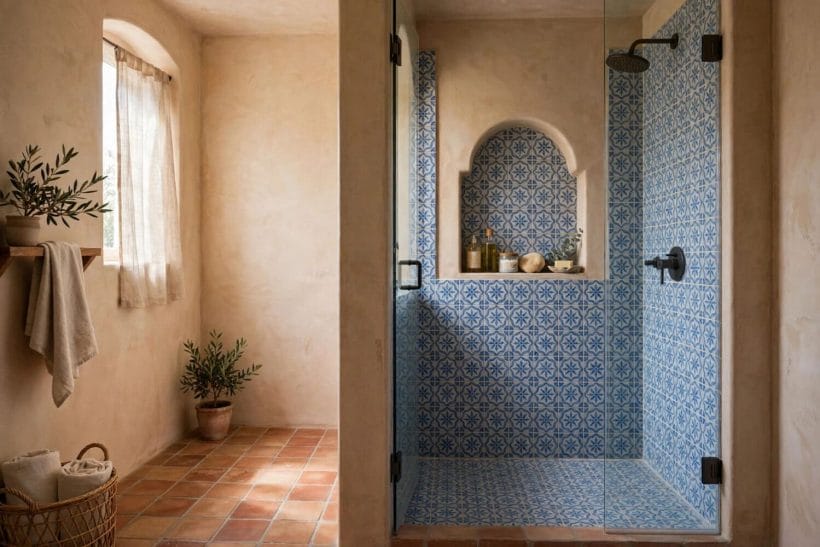
33. Whitewashed Plaster as the Quiet Backdrop
Whitewashed plaster, slightly uneven and soft to the eye, lets tile and wood take the stage. Its texture catches light differently through the day, so the room never looks flat. Keep plaster out of direct splash zones, where tile should take over, and let it cover the walls that stay dry.
34. Sea Blue as the Single Cool Note
Sea blue, used in tile, towels or a painted basin, is the Mediterranean bathroom’s one cool note against all that warmth. Used sparingly it refreshes the room; used everywhere it chills it. A blue tile band, a blue towel stack, or a blue basin is enough to suggest the sea without turning the bathroom into a theme.
35. Olive Green in Plants and Linen
Olive green appears most naturally in plants, and an olive tree in a terracotta pot is the Mediterranean bathroom’s classic living decoration. Olive-toned linen towels echo the plant without competing with it. Together they add a green note that feels grown rather than painted.
36. Honey Wood Against Cool Tile
Honey-toned wood, in a vanity, a stool or a mirror frame, warms up cool blue tile the way sun warms a courtyard. Keep the wood tone consistent across the room’s pieces so they read as a family. A single dark wood piece among honey pieces can anchor the room, but two competing wood tones will argue.
37. Terracotta Accents Beyond the Floor
Terracotta need not stop at the floor: a terracotta pot, a soap dish, or a small tiled panel carries the floor’s warmth up to eye level. Keep these accents few and chunky rather than many and small, so they read as pottery rather than clutter. Their earthy tone also pairs beautifully with olive plants.
38. Natural Stone for Sills and Shelves
A stone sill beneath the window or a stone shelf beside the bath adds a cool, solid note that balances warm wood and plaster. Keep stone pieces simple and unpolished in feel, so they sit comfortably with handmade tile. Stone also handles damp air gracefully, which suits sills and ledges near water.
39. Linen Towels in Warm Neutrals
Linen or linen-look towels in warm white, sand and soft clay keep the room’s palette calm when the towels are on display. Fold them in a single stack on an open shelf, and they become part of the decoration. Bright towels have their place, but in a Mediterranean room they tend to shout over the tile.
6. Storage and Space-Saving Fixtures
Storage in a Mediterranean bathroom should feel like furniture, not like a warehouse. Baskets, open shelves, wall niches and slim cabinets all have a place, provided they keep the room’s warm, uncluttered feeling. Space-saving fixtures, meanwhile, earn their keep by disappearing into the architecture.
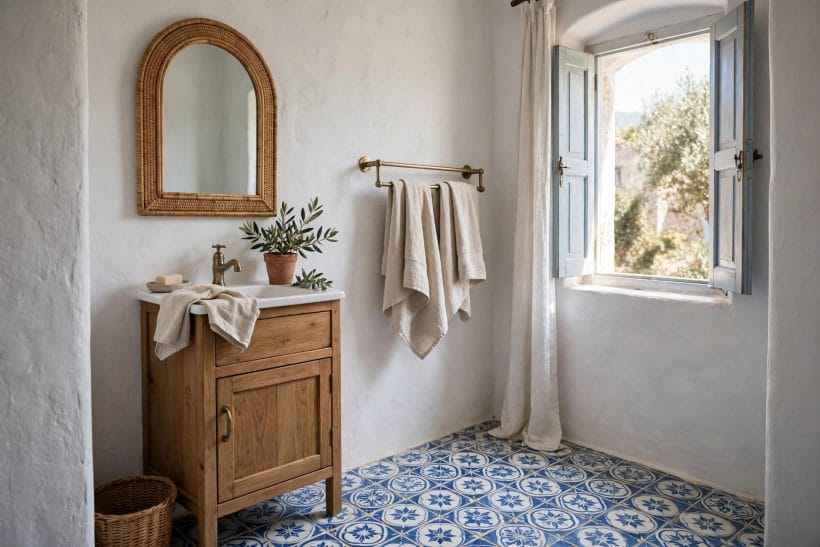
40. Open Shelves Beside the Mirror
Open shelves flanking the mirror hold everyday jars and folded cloths within reach, and their contents become part of the room’s colour. Keep each shelf to a few items, grouped by use, so the shelves read as curated rather than crammed. A trailing plant on the top shelf softens the whole arrangement.
41. Baskets for Laundry and Spares
Woven baskets hold laundry, spare towels and cleaning cloths in a material that suits the room far better than plastic boxes. A lidded basket keeps laundry out of sight, while an open basket near the vanity holds rolled hand towels. Choose baskets that can handle damp air, and empty laundry baskets often so damp cloth stays brief.
42. A Slim Cabinet That Hugs the Wall
A slim wall cabinet, painted in warm white or left in wood, stores tall bottles without jutting into the room. A mirrored door doubles its usefulness, reflecting light while hiding contents. Keep the cabinet shallow enough that the door opens without meeting the mirror or the light beside it.
43. A Wall-Hung Basin in the Tightest Corner
A small wall-hung basin frees floor space in the tightest corner, leaving the terracotta floor visible and the room easy to clean. A tiny shelf beside it, rather than a vanity, holds soap and a hand towel. The pipework for a wall-hung basin is professional work, and the finished basin should sit solidly with no visible clutter beneath.
44. A Towel Rail Warmed by the Room
A simple towel rail, in dark iron or warm wood, holds towels where they dry best: in moving air near the window or the door. Avoid draping towels over the bath edge or the vanity, where they stay damp and crowd the fixtures. Two rails, one for bath towels and one for hand towels, keep the household’s towels sorted.
45. A Mirror Cabinet With Hidden Depth
A mirror cabinet gives a small bathroom a whole shelf of hidden storage without a single extra piece of furniture. Keep its contents to daily essentials, and the mirror stays a mirror rather than a door to chaos. A cabinet with a wooden frame ties it into the room’s timber language.
46. A Stool That Works Three Ways
A small wooden stool beside the bath works as a towel perch, a candle stand and a step for reaching high shelves, all without looking like storage at all. Choose a stool in the room’s wood tone, sturdy enough to stand on safely. When not in use it tucks beneath a shelf or beside the vanity, out of the walkway.
7. Showers and Baths in the Mediterranean Manner
Water is the Mediterranean bathroom’s pleasure, and both shower and bath deserve the room’s best tile and light. A shower should feel like a tiled alcove, a bath like a quiet pool. The ideas below treat both as places to linger, while keeping all pipework, sealing and waterproofing firmly in professional hands.
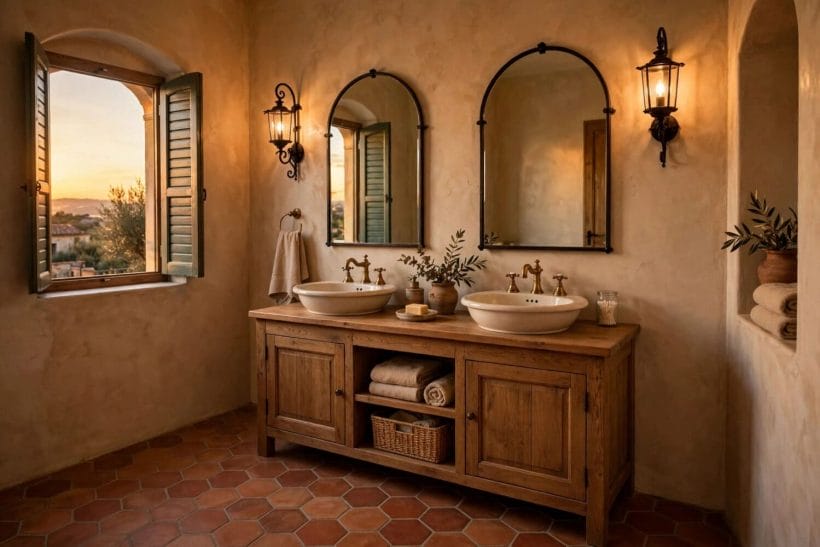
47. A Tiled Shower Alcove With a Niche
A shower alcove fully lined in patterned tile, with an arched niche for bottles, feels like a small tiled room within the room. The niche keeps bottles off the floor and out of the water’s path. All sealing and drainage in a tiled alcove is professional work, and the finished alcove should drain cleanly with no standing water.
48. A Rainfall Shower Under a Plain Ceiling
A rainfall shower head under a plain plaster ceiling gives a gentle, rain-like fall of water that suits the room’s relaxed mood. Keep the surrounding tile simple so the shower itself is the experience, not the decoration. The supply and fitting for any shower head is professional work, and water pressure should be checked by the fitter, not guessed.
49. A Freestanding Bath as the Centrepiece
A freestanding bath, with its curves echoing the room’s arches, makes bathing the room’s centrepiece. Place it where daylight reaches it, near a window or beneath a lantern light, and keep the floor around it clear. The bath’s waste and supply connections are professional work, hidden so the bath appears to stand alone.
50. A Built-In Bath With a Tiled Surround
A built-in bath with a tiled surround suits a room where a freestanding bath would crowd the floor. Tile the surround in the room’s hero pattern, and add a wide ledge for candles, a book or a plant. The ledge doubles as a seat for children and a perch for towels, making the bath easier for the whole household.
51. A Bath Caddy in Warm Wood
A wooden bath caddy across the tub holds a book, a candle and a cup within reach, turning a bath into a proper rest. Choose a caddy that spans the tub securely without wobbling, and keep candles away from towels and curtains. A caddy in the room’s wood tone ties the bath into the vanity’s language.
52. A Hand Shower Beside the Bath
A hand shower on a wall bracket beside the bath makes rinsing hair and cleaning the tub far easier, especially in a household with children or pets. Keep the hose tidy on its bracket when not in use, so it does not trail across the floor. Fitting any shower outlet is professional work, and the finished bracket should sit solidly on tile.
53. A Shower Seat in Tiled Comfort
A tiled shower seat, built into the alcove wall, gives a place to sit, to shave legs, or to rest while the water runs. Tile the seat in the same pattern as the alcove so it reads as part of the architecture. The seat’s drainage and sealing belong to the professional who builds the alcove, not to improvisation.
8. Small Mediterranean Bathrooms
Small rooms suit the Mediterranean style surprisingly well, and these Mediterranean style bathroom ideas keep the same discipline at small scale, only stricter: one pattern, one warm wood, one plant, and everything else plain.
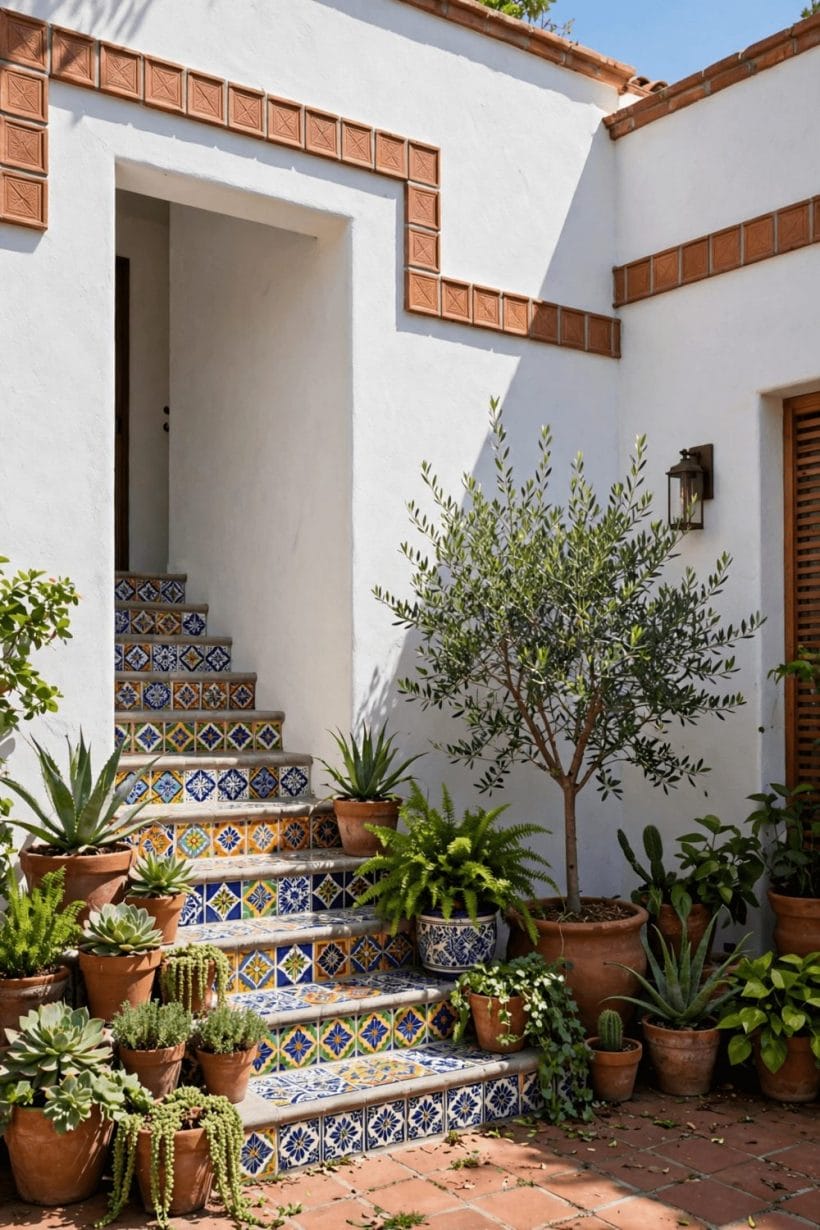
54. One Pattern Wall in a Tiny Room
In a tiny bathroom, a single patterned wall behind the basin gives the whole room its identity, while the other walls stay whitewashed and plain. The pattern should be the first thing seen on entering, so the room reads as designed rather than merely small. Keep towels and accessories plain so the wall stays the star.
55. A Corner Basin That Frees the Door Swing
A corner basin keeps the door swing clear in a room where every inch of floor matters. A small arched mirror above it and a single shelf beside it complete the zone without a vanity. The freed floor makes the room feel larger on entering, which is worth more than any extra counter space.
56. A Large Mirror to Double the Light
A large mirror, ideally arched, doubles both light and the sense of space in a small Mediterranean bathroom. Hang it opposite or beside the window so it catches daylight, not just lamplight. A mirror that reflects patterned tile doubles the pattern too, so keep the reflected wall plain to avoid doubling the busiest surface.
57. Terracotta Floors Carried Into the Shower
Carrying the same terracotta floor tile into the shower, with proper professional waterproofing beneath, makes a small room read as one continuous space rather than two cramped zones. The unbroken floor tricks the eye into seeing a larger room. The waterproofing layer is invisible professional work, and it must never be skipped for the sake of the look.
58. Vertical Storage on the Door Wall
The wall behind the door, often wasted, holds a tall slim cabinet or a row of hooks in a small bathroom. Hooks in dark iron hold robes and towels, while a slim cabinet hides tall bottles. Keep the door wall’s storage shallow so the door still opens fully, and the room gains storage without losing a single step of floor.
59. A Pocket of Green on the Sill
A single potted plant on the windowsill gives a small Mediterranean bathroom its living note without taking floor space. An olive sapling, a trailing herb or a small succulent all suit the style, provided the plant tolerates bathroom humidity and the light the window gives. One plant, thriving, beats a shelf of struggling ones.
60. Pale Plaster to Lift a Low Ceiling
Pale whitewashed plaster on walls and ceiling lifts a low ceiling in a small room, bouncing light that a darker finish would swallow. Keep beams, if any, in pale wood rather than dark, so the ceiling reads as one light plane. The room then feels taller, even though nothing structural has changed.
61. A Folded Towel Stack as Decoration
In a room too small for decoration, a neat stack of folded towels in warm white and clay becomes the decoration. Place the stack on an open shelf or a stool where it is seen but not in the way. The stack should be restocked from a linen store elsewhere, so the display stack stays tidy rather than dwindling into disorder.
9. Tiny House Mediterranean Bathrooms
A tiny house bathroom asks the Mediterranean style to work harder: every surface must earn its place, and the warm palette must do the work that space cannot. Readers exploring tiny house bathroom designs will find the same logic here, with the Mediterranean palette layered over compact planning. The ideas below keep the style intact at tiny scale.
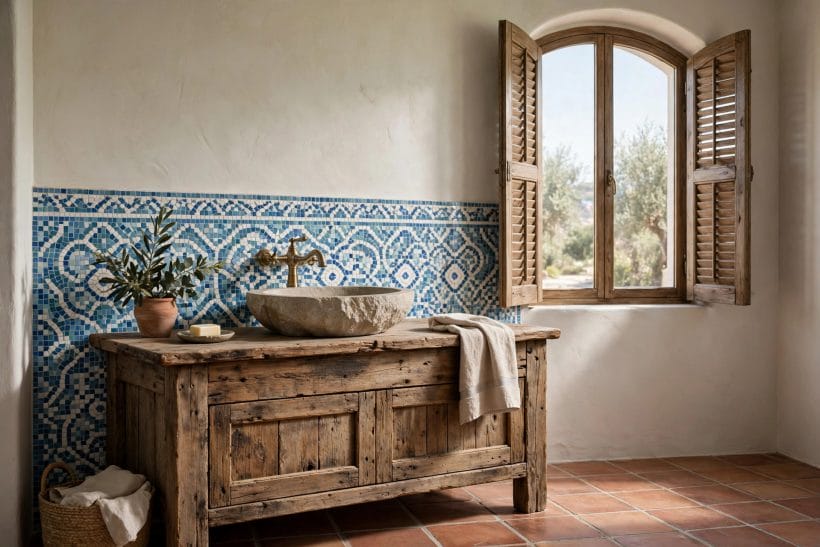
62. A Wet Room That Is the Whole Bathroom
In a tiny house, treating the whole bathroom as a wet room, fully tiled with professional waterproofing throughout, removes the need for separate shower walls and doors. The floor drains as one surface, and the room reads as a tiled courtyard rather than a cramped box. Every fitting in a wet room is professional work, since the waterproofing is the room itself.
63. A Vanity No Deeper Than a Shelf
A vanity as shallow as a shelf, with a small basin and a wall-mounted tap, gives a tiny house bathroom a proper wash zone without stealing floor space. A mirror cabinet above it holds the essentials. The shallow depth works because the basin is small and the tap rises from the wall, leaving the counter for a single tray.
64. Patterned Tile as a Single Stripe
In a tiny house bathroom, a single vertical stripe of patterned tile, running from floor to ceiling beside the basin or the shower, gives the Mediterranean signal without covering a whole wall. The stripe reads as a deliberate accent, like a ribbon, and the rest of the room stays plain plaster and wood. One stripe is enough; two would crowd the room.
65. A Folding Stool Instead of a Chair
A folding wooden stool serves a tiny house bathroom as a seat, a step and a towel perch, then folds flat against the wall when not needed. Choose a stool in the room’s wood tone so it disappears into the palette when folded. Fixed furniture in a tiny bathroom should be minimal, and folding pieces earn their place by vanishing.
66. A Shower Curtain in Warm Linen Tones
Where a tiny house bathroom needs a shower curtain, a curtain in warm linen tones, rather than plastic-bright colour, keeps the Mediterranean mood intact. Hang it high so the room reads taller, and let it fall outside the shower tray so water stays where it belongs. The curtain should be washed or replaced often, since damp fabric in a small room shows wear quickly.
67. Warm Wood Everywhere the Eye Rests
In a tiny house bathroom, warm wood on the vanity, the mirror frame and a single shelf gives the eye a continuous thread, making the small room feel designed rather than assembled. Keep the wood tone consistent, since a tiny room shows mismatches instantly. Readers planning the wider home will find the same thread in tiny house designs and tiny house interiors, where timber carries the whole interior.
68. A Tiny Window Dressed With a Shutter
A tiny bathroom window dressed with a single wooden shutter, rather than a curtain, keeps privacy, survives damp air and adds a Mediterranean shape to the smallest wall. The shutter can angle for light while blocking the view, which suits a tiny house parked near neighbours. A shutter also needs no washing, unlike a curtain in a damp room.
10. Care and Everyday Living
A Mediterranean bathroom stays beautiful through habits, not heroics. Tile, plaster, wood and linen each need a little regular care, and the room rewards a household that keeps water where it belongs and lets surfaces dry. The ideas below are about living in the room well.
69. Wiping Tile After the Shower
A quick wipe of shower tiles after use keeps patterned tile bright and grout clean, since water left to dry leaves marks that build up over time. A squeegee or a dry cloth, kept on a hook in the shower, makes the habit easy. The wipe takes moments, and it protects the room’s prettiest surface better than any deep clean.
70. Letting Wood Dry Between Uses
Wooden vanities, stools and mirror frames last longest when splashes are wiped and the room is aired after bathing. Open the window or run the fan until the mirror clears, and wood stays handsome for years. Wood that stays damp swells and darkens, so the drying habit is the real finish.
71. Airing the Room After Every Bath
Airing the bathroom after bathing, by opening a window or running ventilation until surfaces dry, protects plaster, wood and grout alike. Mediterranean rooms were built for moving air, and a modern bathroom needs that same airflow, especially where plaster meets tile. The habit also keeps towels drying properly rather than staying damp.
72. Rotating Towels for Even Wear
Rotating towels between the display stack and the linen store keeps the colours even and the towels fresh, since the top towel of a stack wears fastest. A household that rotates towels also notices wear early, replacing frayed towels before they spoil the room’s look. The rotation is a small chore with a visible reward.
73. Caring for Plants in Humid Air
Bathroom plants need light, occasional water and a pot that drains, and they repay care by thriving in humid air that suits them. Check the soil before watering, since bathroom humidity already gives plants moisture from the air. A plant that outgrows its pot can move to another room, and a new small plant can take its place on the sill.
74. Refreshing Grout Without Replacing Tile
Grout that has dulled can often be refreshed with a careful clean, restoring patterned tile without replacing a single piece. Use a cleaner suited to the tile and grout, test it in a hidden corner first, and work gently so the grout stays intact. Where grout is cracked or missing, a professional should repair it, since grout is part of the wet zone’s protection.
75. A Seasonal Reset of the Whole Room
Once a season, reset the bathroom: launder curtains and baskets, restock the shelves, replace tired plants, and check seals and grout with a professional’s eye where anything looks worn. The reset keeps the Mediterranean room feeling like a courtyard in spring rather than a room slowly filling up. It is also the moment to notice small repairs before they become large ones.
Final Considerations
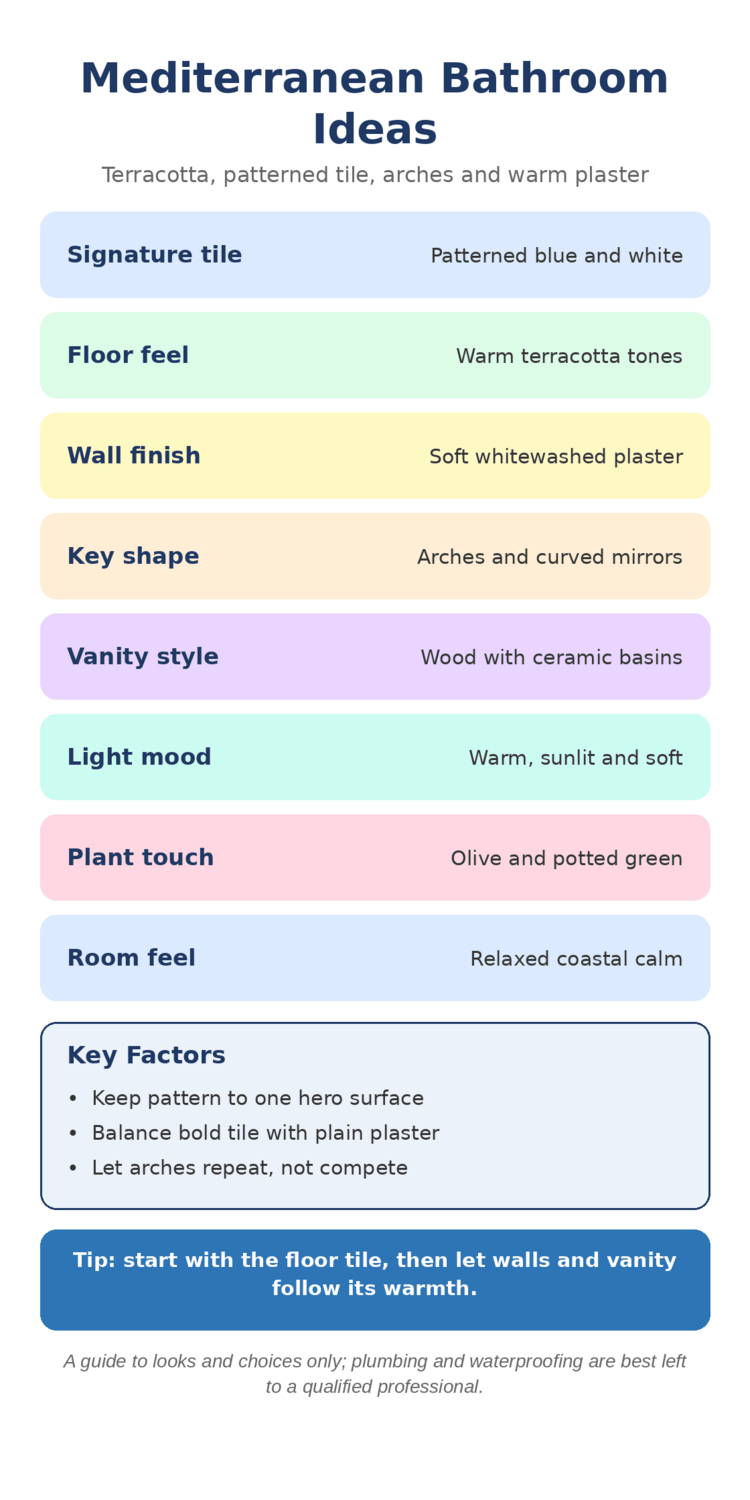
A Mediterranean bathroom succeeds when warmth leads and pattern follows. Start with the floor tile, let one patterned surface carry the colour, repeat the arch gently, and keep wood warm and plaster pale. The seventy-five ideas above all return to that discipline, whether the room is large, small, or part of a tiny house.
Before any change to pipes, waste, sealing or shower construction, bring in a qualified professional. The beauty of a Mediterranean bathroom sits on top of invisible waterproofing and sound plumbing, and those layers are never a place for improvisation. A professional’s eye also catches what a homeowner cannot: a slow leak, a tired seal, or a drain that needs attention before it becomes damage.
For the wider home around the bathroom, tiny house flooring ideas carry the same warm timber and tile language underfoot, while contemporary home design ideas show how warm materials sit in a more modern shell. Finishing touches belong to tiny house wall decor, where plaster, wood and simple art complete a room without crowding it. These Mediterranean style bathroom ideas are a starting point, not a finished room: take the ideas that fit the light, the size and the household, and let the room grow warm over time.

0 Comments