

A coastal house is not a house with shells on the shelf. It is a house built the way the shore builds: light colours that throw the sun back, materials that shrug at salt, rooms that open to the breeze and close kindly against the storm. Get those bones right and the house feels like the coast anywhere; get them wrong and it is a beach theme wearing a house as a costume.
This page takes the whole house — the full survey of coastal homes, from the weather-side wall to the dune garden. The single-room lanes live elsewhere in the cluster: the coastal living room goes deep on the sitting room alone. Here the subject is how the whole building takes the sea’s instruction — palette, materials, glass, rooms and outdoor life arranged as one argument.
1. Coastal Home Design Ideas at a Glance
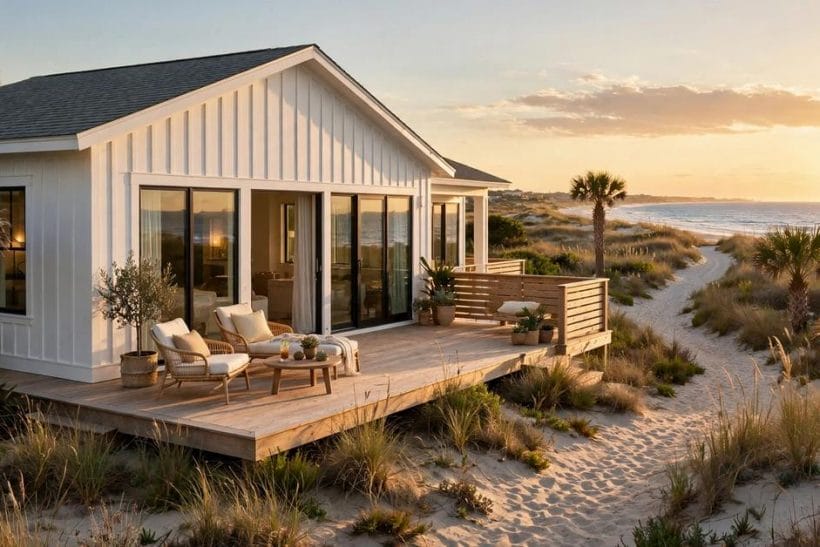
A coastal home is a house whose design answers a shoreline: a pale, light-returning palette; salt-tolerant materials on the weather side; generous glass and shade arranged around sun and breeze; relaxed, washable interiors; and outdoor rooms — porch, deck, garden — treated as first-class space. Its parts work as a system: the palette cools, the materials endure, the plan breathes. It is the whole-house parent of the cluster’s lanes, kin to the coastal bedroom in its rest and to the cottage and farmhouse families in its ease, and it is built as much against glare, damp and salt as toward the view.
| Question | Short answer |
|---|---|
| What makes a house coastal rather than just decorated coastal? | The bones, not the ornaments. A coastal house is planned around light, air and salt: pale colours, weatherproof materials, shaded glass, rooms that ventilate, floors that forgive sand and water. Rope, anchors and driftwood are decoration; a house that needs none of them to feel seaside is the genuine article. |
| Can a coastal house work away from the sea? | Yes — the style is really a climate answer, and any bright, breezy, summer-hard place can use it. Inland, the palette and ease travel well; what should be left behind is literal nautical dressing. A coastal house in a landlocked suburb reads best as a light, relaxed, natural-material house — the shore’s manners without the souvenir shop. |
| What colours define the coastal palette? | Whites and off-whites first, then sand, stone and weathered timber, with the sea’s own register — blue-greys, sea-glass greens, deep navy as punctuation — admitted in doses. The palette is drawn from the beach at noon: pale ground, water colour, one dark note for the horizon line. |
| What is the biggest mistake in coastal design? | Theme instead of climate: portholes, rope rails and captains’ wheels pasted onto an ordinary house whose windows still glare, whose porch still roasts and whose floors still fear wet feet. The coast is a set of conditions first and a look second; answer the conditions and the look arrives by itself. |
2. The Coastal Palette: Whites, Sands and Sea Colours
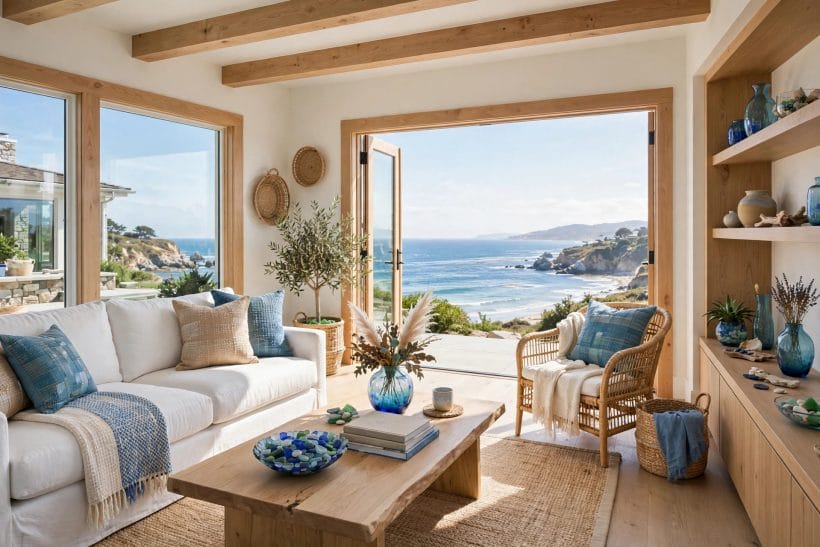
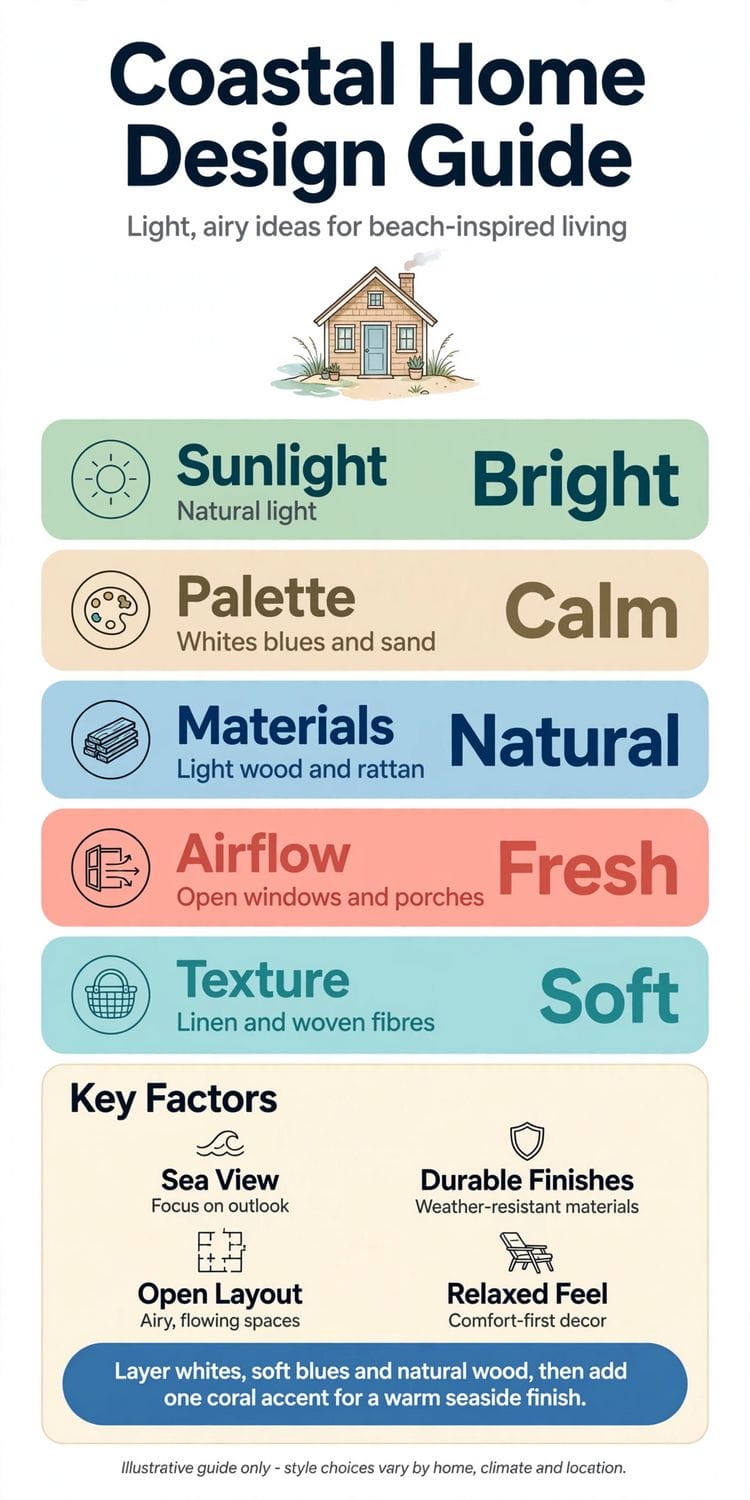
Every coastal decision begins with colour, because the shore’s light is the strongest in domestic life and it interrogates every surface. This section builds the palette — the pale ground, the sand register, the sea colours in their doses — that the rest of the house will be furnished inside.
1. Lay the pale ground first: white and its warm relations
The coastal ground is white in its softer registers — chalk, shell, warm ivory — chosen to return light without glare.
2. Admit sand as the palette’s middle register
Between the white and the sea colours sits sand: pale stone, linen, weathered oak, sisal, the colour of the beach at the waterline.
3. Dose the sea colours like weather, not like paint charts
Blue-grey, sea-glass green, faded denim: the water colours work in cushions, a painted island, shutters, a door — present everywhere, dominant nowhere.
4. Keep one deep note for the horizon
Navy, ink or deep teal, used sparingly — a door, a cabinet run, the porch floor in the old haint-blue family — gives the pale scheme its horizon line.
5. Let timber weather honestly or not at all
Coastal timber is either silvered by salt and sun — left to grey with dignity — or painted and kept painted.
6. Match the palette to the coast you actually have
A grey northern shore wants warmer whites and deeper blues; a bright southern coast can carry cleaner whites and glassy greens.
7. Use pattern the way the shore does: stripes and checks, sparingly
The coast’s native patterns are the awning stripe, the ticking stripe and the sailmaker’s check — working patterns, in working fabrics.
8. Keep metals in the marine register
Galvanised steel, brushed nickel, unlacquered brass that will patina, blackened iron: metals that either ignore salt or age gracefully in it.
9. Test colours at the glare hours, not the gentle ones
Coastal light at noon can bleach a chosen colour two shades paler, and evening can turn a fresh white cream.
10. Let the view be the strongest colour in the room
Where a real sea or water view exists, the palette’s first duty is deference: pale, quiet surfaces that hand the eye to the window.
11. Carry the palette outside before you finish it inside
The coastal house is read from the water or the road first: shutters, doors, porch ceilings and trim in the same family as the rooms behind them.
3. The Weather Side: Materials the Salt Air Approves
Salt, driven rain and ultraviolet run a materials audit on every coastal house, every year, without appeal. This section specifies the envelope — siding, roofing, trim and fastenings — in the materials that pass that audit, so the house’s beauty is a maintenance decision made once, not a rescue repeated every spring.
12. Choose siding for the corrosion zone, not the catalogue
Fibre-cement, quality vinyl, cedar shingles left to silver, and masonry all have honourable coastal records; the choice among them is local — the neighbours’ oldest houses are the evidence. The exterior home ideas survey works the same materials arithmetic for houses everywhere; the shore simply grades harder.
13. Treat every fastening as a marine fitting
Screws, nails, hinges and brackets in stainless or hot-dipped galvanised metal, specified in writing.
14. Build the porch as the house’s airlock and glory
A deep, roofed porch — ideally wrapping a corner — is the coastal house’s hardest-working element: shade for the glass, a dry threshold for wet feet, the summer’s living room and the storm’s viewing gallery.
15. Raise the house’s skirts above splash and flood talk
Plinths, piers and raised floors in masonry or treated material keep timber out of the splash zone and give the house its lifted, shore-wise stance.
16. Pick roofing for wind uplift and salt, in that order
The roof is the shore’s first argument: standing-seam metal and quality shingles with honest fixing patterns both serve, and pale roof colours return a measure of the heat the coast’s sun delivers.
17. Detail the drip, the flash and the overhang generously
Deep overhangs, honest flashings, gutters sized for the downpour rather than the drizzle: water management drawn boldly is what lets pale walls stay pale.
18. Let screens be architecture, not apology
Screened panels on the porch, screened doors with real timber frames, insect mesh chosen fine enough for the local midges: on the shore, screens are as architectural as windows, and the houses that treat them so keep their evenings.
19. Specify exterior paint as a system with a calendar
Coastal paintwork is a system — preparation, primer, the right film for salt exposure — married to a repaint calendar the household actually keeps.
20. Choose decking that forgives bare feet and salt water
Porch and deck floors in materials that stay splinter-free, drain fast and tolerate the hose: quality composites, dense hardwoods where budgets allow, painted boards in the tradition where they don’t.
21. Give outdoor showers and foot-washes their plumbing early
The sand strategy is won at the threshold: an outdoor shower, a foot tap, a bench for the peeling-off of beach kit.
22. Anchor everything the wind can interview
Shutters that actually close, furniture with weight or lashings, planters that cannot sail: the coastal garden and porch are specified for the gale as faithfully as for the gala.
4. Windows, Shutters and Glass: Framing the Light
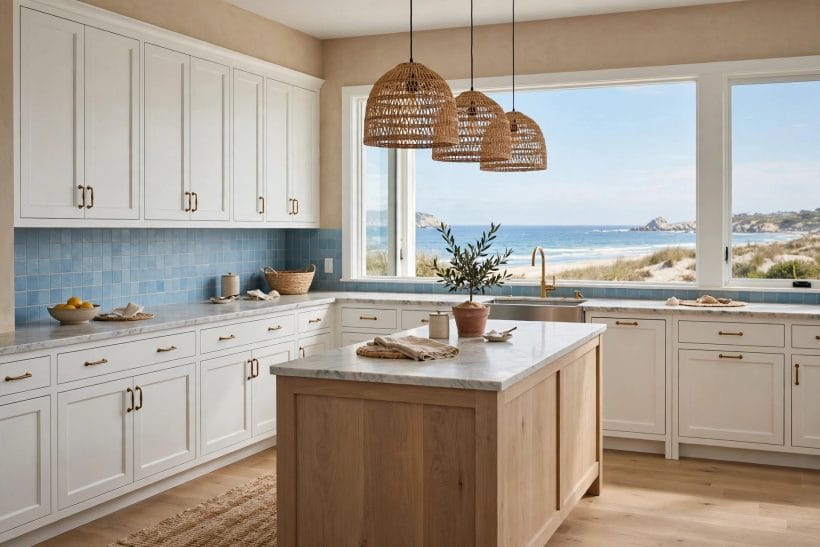
The coastal house’s glass is its glory and its liability: the same window that frames the water admits the glare, the heat and the storm. This section arranges glass, shutters and shade so the house takes the light’s gift and declines its invoice.
23. Orient the glass to the view and the shade to the sun
Big glass belongs where the view and the breeze are; the sun’s harsh faces get the porch’s shadow, the overhang, the shutter.
24. Make shutters work or leave them off
Real shutters, sized to cover their window, hinged and holdbacked, earn their place by closing against storm and glare.
25. Layer the interior shade: sheer, blind and blackout in their places
Inside, the glare is managed in layers — sheers for the bright hours, woven blinds for texture and privacy, blackout only where sleep demands it. In the spirit of the coastal tiny house decor approach, every layer is washable and light; heavy drapery is an inland habit the sea air mildews.
26. Clerestories and high vents for the stack of warm air
High openings let the day’s heat escape upward and pull the breeze through the rooms below — the old coastal houses ventilate like chimneys because they were built before air-conditioning made the knowledge optional.
27. Choose glazing for the shore’s temper: glare and storm
Tinted, coated or laminated glass where the exposure demands; frames in materials that salt cannot eat.
28. Frame views like pictures, including the imperfect ones
A window placed for the harbour, another for the dune grass, a small square one over the sink for the weather’s daily news: the house collects its outlooks deliberately.
29. Let the porch ceiling borrow the sky
The tradition of the pale blue porch ceiling — haint blue in the old language — survives because it works: it cools the eye, flatters the light and reads as open sky from the chair.
30. Give the front door the glass its welcome needs
A glazed or half-glazed front door in the palette’s deep note, with sidelights where the plan allows, announces the house’s terms at the threshold: bright inside, airy, unafraid of the weather it can see coming.
31. Keep window furniture in the marine register too
Catches, stays and handles in the same salt-proof family as the exterior fastenings — the window’s ironmongery lives half outdoors on the shore and corrodes on the same schedule.
32. Use mirrors to double the light, sparingly
A mirror opposite the glass doubles the view’s light in a dim corner; three mirrors make a funfair.
33. Plan the storm face before the first winter
Which windows take the driven rain, which door the wind worries at, where the shutters and boards live in summer: the coastal house keeps a storm plan the way it keeps a paint calendar.
5. Living Spaces That Open to the Air
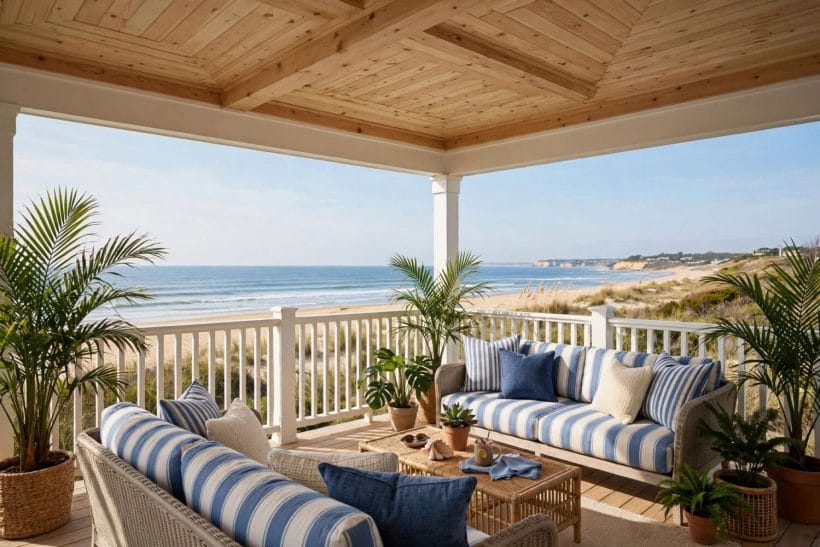
The coastal living room is a pavilion with furniture: shaded, cross-ventilated, floored for wet feet and arranged for the long look out. This section furnishes the main rooms — the sitting space, its seating, its floors — while the dedicated coastal living room lane takes the single-room depth further for those who want it.
34. Arrange seating for the view and the conversation in turns
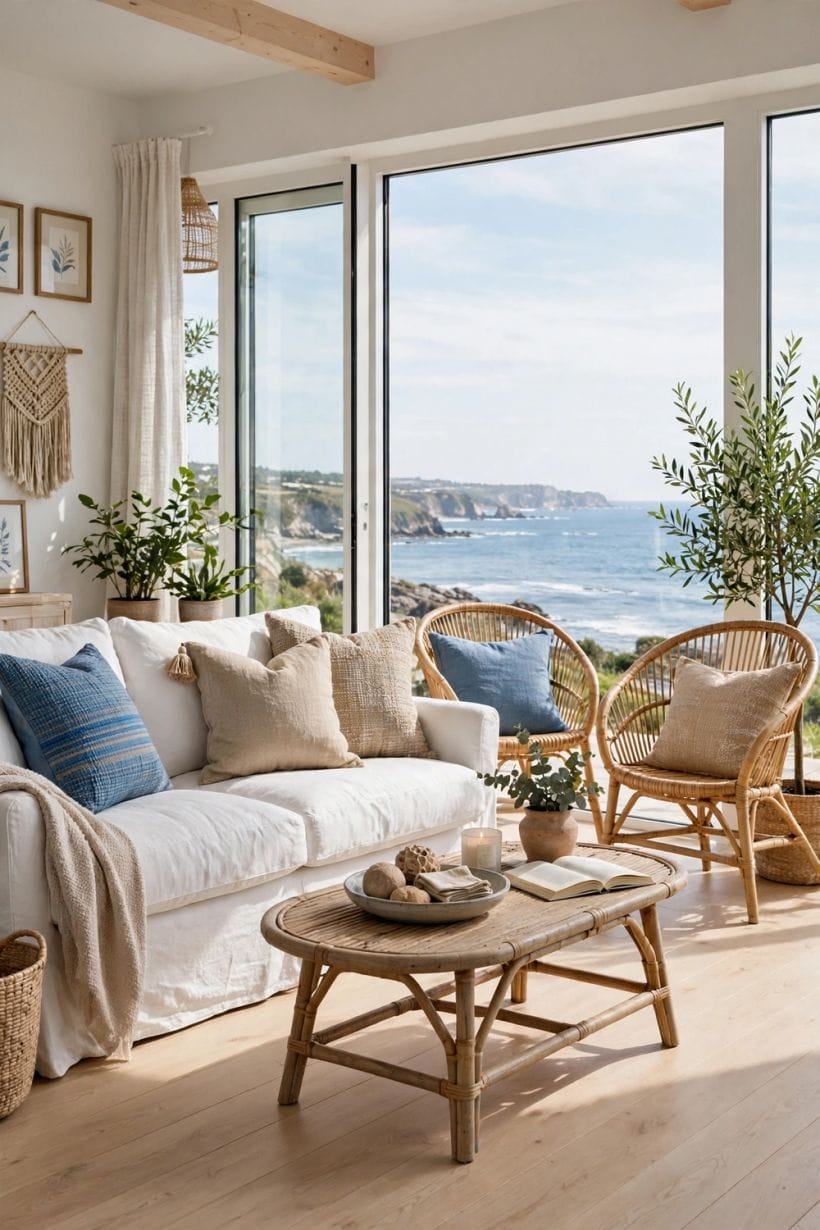
The coastal sofa faces the water and the room at once — an L or a pair in conversation across a low table, never a row of backs to the glass.
35. Floor for sand, water and bare feet
Boards, stone, tile or quality woven flooring that a wet foot cannot harm and a broom can redeem in a minute.
36. Furnish in the washable register: slips, covers and outdoor cloth
Slipcovered sofas, removable cushion covers, fabrics born for the outdoors doing indoor duty: the coastal room’s upholstery is specified by its laundry future.
37. Keep the big pieces pale and the small ones movable
Sofa and armchairs in the palette’s ground tones; stools, trays, baskets and side tables light enough to follow the shade around the porch.
38. Bring the ceiling into the design: beams, boards and fans
Exposed structure — painted beams, boarded ceilings, the slow theatre of a ceiling fan — gives the coastal room its pavilion air.
39. Store the beach on the room’s terms
Baskets for towels, a bench for the kit, hooks by the door that actually get used: the living space keeps a working border with the shore.
40. Let art be the coast itself, or quiet
Charts, weathered timber, a single marine painting, the family’s own shore photographs: art in the coastal register is either genuinely of the place or calm enough not to compete with the windows.
41. Layer lamplight for the storm-watching hours
Evenings on the coast are for watching weather and water; lamps at sitting height, in pools, with the glare kept from the glass so the dark outside stays visible.
42. Give the fireplace or stove its honest off-season
Many coastal houses keep a small hearth for the shoulder seasons; dress it in summer with the same ease — candles, a stack of pale logs, the screen stored kindly — rather than pretending the season away.
43. Keep a wet-weather constitution for the room
Rain weeks are the coast’s other season: the games cupboard, the reading chairs by the lamps, the table that seats everyone for cards.
44. Borrow the tiny-house discipline at any size
The small coastal houses teach the big ones: every piece earning its footprint, storage built into the architecture, nothing carried that the life doesn’t use. The new home exterior design ideas for tiny houses make the same argument from the outside — the shore rewards the edited house at every scale.
6. Kitchens and Dining in the Coastal Register

The coastal kitchen works like a galley that grew up: everything reachable, everything washable, and a table that seats whoever the day brings in from the water. This section specifies the cooking and eating rooms — materials, layout and the long table — in the shore’s practical hand.
45. Build the kitchen like a galley that grew up
Runs kept short, the working triangle tight, surfaces continuous and washable: the boat’s kitchen discipline suits the shore house, where cooks are often feeding a crowd straight off the beach with wet hair and no patience for a precious interior.
46. Choose cabinetry in painted timber or its honest equals
Painted wood in the palette’s whites and sea colours, with hardware in the marine register, carries the coastal kitchen.
47. Let the island earn the room’s centre
An island in a deep note — navy, ink, weathered timber — anchors the pale kitchen and seats the day’s traffic.
48. Specify worktops for fish, citrus and red wine
The coastal menu is an audit of surfaces: shellfish, lemons, berries, wine.
49. Open shelving only where the air is kind
Open shelves suit the shore’s easy register and punish it with salt film and dust where the house sits close to surf.
50. Seat dining like a long table at a harbour inn
One generous table, benches on the long sides, chairs at the ends: the coastal dining arrangement expands by squeezing affectionately, as harbour inns have always done.
51. Light the table for faces, not for photographs
Pendants low over the table in the palette’s metals, on dimmers, with the glass kept out of the sightlines to the water.
52. Give the mud-and-sand border a kitchen door
Where the plan allows, the kitchen’s own door to the porch or garden shortens the wet-feet route to a step.
53. Keep appliances in the working register
Finishes that wipe, handles that grip with wet hands, a fridge sized for the crowd the house actually hosts.
54. Store crockery like a boat: secured, sorted, near
Plate racks, drawer dividers, the everyday things at waist height in the order they’re used. The galley’s lesson is that a kitchen used hard by many hands must be findable by a stranger at midnight.
55. Let the dining room double as the storm room
The big table is also the coast’s wet-weather headquarters — puzzles, projects, laptops, the long lunch that outlasts the rain.
7. Bedrooms and Bathrooms in the Coastal Register
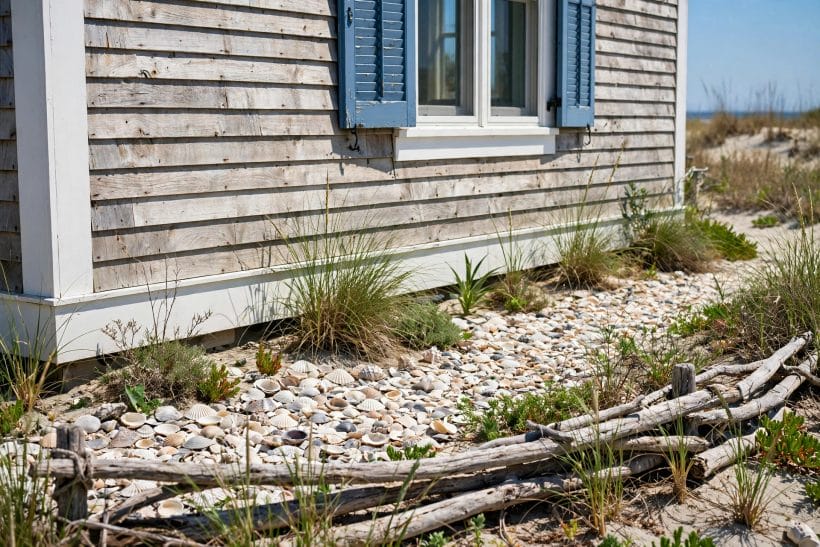
Upstairs, the coast quiets down: bedrooms built for sleep in moving air, bathrooms built like good ship’s heads — compact, washable and bright. This section takes the private rooms, whose deep lanes live at the coastal bedroom and the bathroom cluster pages.
56. Build bedrooms for sleep in moving air
Cross-ventilation first, blackout second, decoration third: the coastal bedroom’s windows are placed for the night breeze, its palette the palest in the house, its fabrics all washable cotton and linen.
57. Keep beds in the palette’s calm register
White and sand bedding, layered like a sailmaker’s stores — sheet, blanket, throw — so the sleeper adjusts to the night’s temperature by layers.
58. Give every bedroom a storm-night plan
A chair, a lamp, a shelf for the book and the torch: the coastal bedroom expects weather at the window and treats it as entertainment.
59. Tile the bathroom like a working boat’s head
Full-height tile or its waterproof equals where the spray lands, a floor that drains and grips, fittings in the marine metals.
60. Fit the vanity in painted timber with air around it
A raised, legged vanity in a sea colour keeps the floor washable and the room airy; vessel and undermount basins both serve, chosen by the household’s splash habits.
61. Shower with the view where the site allows
The coastal luxury is a shower that looks at weather: a high window, a glass panel to the light, the day’s sky as the room’s art. Where privacy forbids, a skylight gives the same gift from above.
62. Keep mirrors big and lighting kind
Bathroom light on the coast serves wet faces at dawn: a generous mirror, lamps at the sides rather than a glare from above, and the window’s daylight welcomed rather than frosted away.
63. Let guest rooms carry the house’s welcome
Hooks, a shelf, a chair for the bag, blackout for the lie-in: the coastal guest room is specified by the memory of being a guest.
64. Store linen like sails: dry, sorted, aired
An aired linen cupboard — slatted, ventilated, off the bathroom’s steam path — keeps the house’s whites white. On the coast, linen storage is a climate system; the sweet-smelling shelf is engineering, not housekeeping luck.
65. Carry the palette upstairs in its faintest register
The private rooms take the house’s palette diluted: the sea colours as a cushion or a painted chair, the deep note as a single door. Consistency at low volume lets the whole house feel like one weather system.
8. Outdoor Rooms: Porches, Decks and Dune Gardens
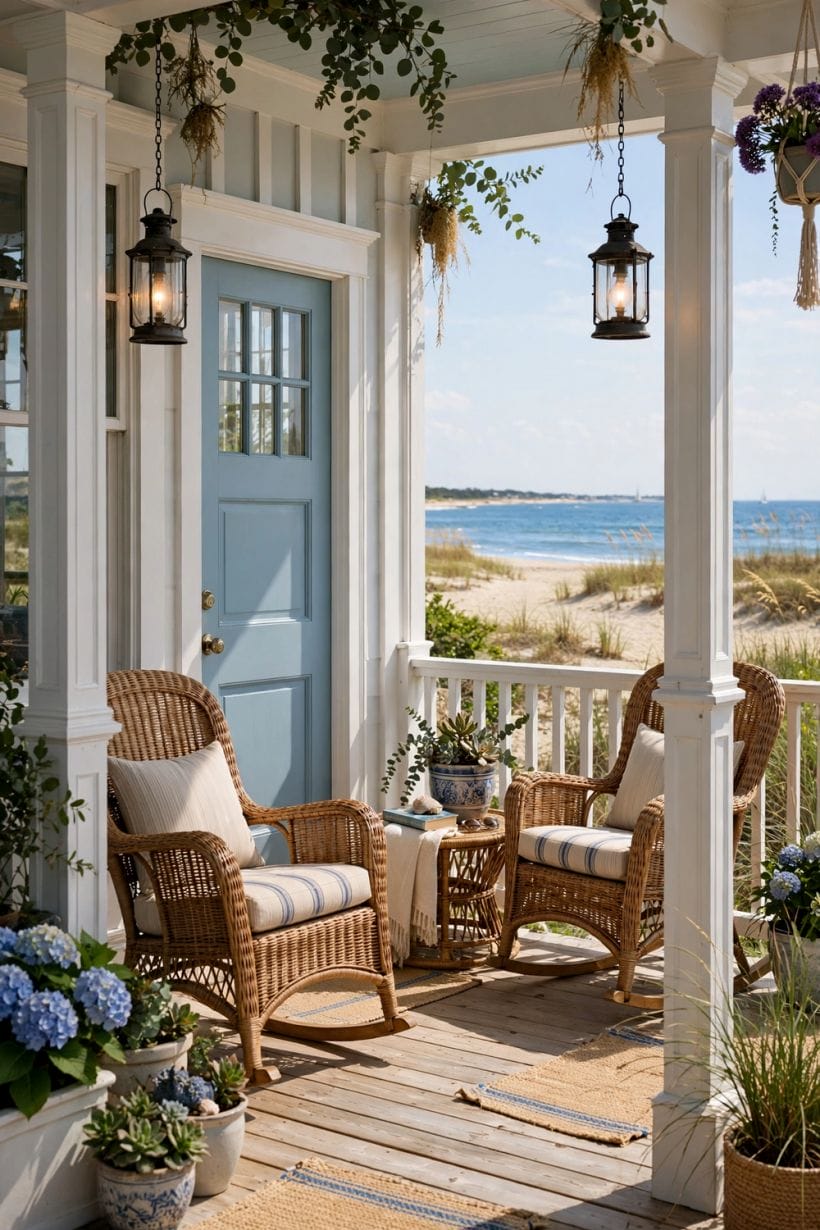
Half the coastal house’s life happens outside its walls: the porch at breakfast, the deck at dusk, the garden that must survive salt wind and call it spring. This section builds the outdoor rooms with the same seriousness as the indoor ones — they are rooms, with floors, ceilings and furniture specified to last.
66. Treat the porch as the house’s second living room
Furnished as seriously as the room inside — real seating, a table, lamps, a rug rated for weather — the porch earns its roof. The exterior home ideas survey makes the general case for porches; on the coast the porch is not an amenity but the house’s main summer address.
67. Screen the sitting side, open the view side
Where insects rule the evenings, screen the porch’s sitting end and leave the view end open to the air: the house gets its evenings back without living in a cage.
68. Furnish outside in the marine register
Teak and its honest successors, galvanised and powder-coated metals, rope and canvas that can be scrubbed: outdoor furniture is specified like boat gear, because the weather will grade it like boat gear.
69. Plant the dune garden with the shore’s own citizens
Grasses, salt-tolerant shrubs, the plants already thriving in the neighbours’ sand: the coastal garden is planted from the local evidence, not the catalogue.
70. Build paths that sand cannot defeat
Gravel, shell, stone and boardwalk surfaces that shed sand and drain fast; the path to the door is a sand-management system with good manners. A brush and a grate at the threshold finish what the path began.
71. Shade the deck like a sail: adjustable and strong
Pergolas, sails and awnings rated for the wind they will meet, angled for the afternoon sun.
72. Light the garden for the walk, not the floodlit pitch
Low, warm light at steps, paths and the table’s faces; darkness kept where the stars and the water are the show. The coast at night is the house’s best room — floodlighting it shut is a category error.
73. Give the outdoor shower its architecture
Screened by planting or a timber wall, plumbed with a drain that works, hooks for the towels: the outdoor shower graduates from joke to the house’s favourite room when it is built like one.
74. Store cushions and kit in a real harbour
A deck box or a porch cupboard, ventilated and vermin-honest, where cushions, games and beach kit live between uses.
75. Plan the garden’s winter face
Structure planting, the porch’s storm dress, furniture stacked or lashed: the coastal garden is designed for its February portrait as faithfully as its August one.
9. Checks and Mistakes: Before the First Purchase or the First Stone
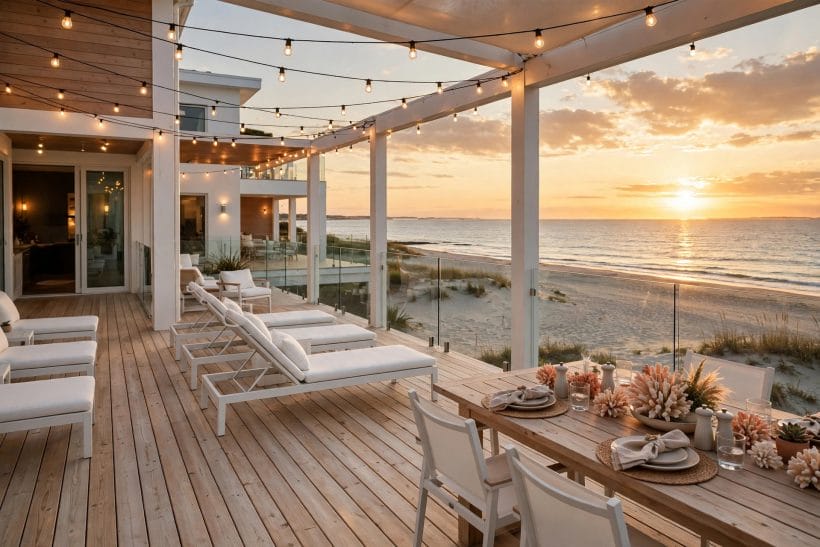
Before the first purchase, walk the checks in order: the palette tested on the sun wall through a full bright day; every exterior fastening specified in the marine register, in writing; the porch drawn as a furnished room, not a gesture; glass placed for view and breeze with its shade solved; floors throughout forgiving of sand and water; and the storm plan — shutters, lashings, the garden’s winter dress — agreed while the weather is still kind.
The faithful mistakes: theme dressing on an unadapted house — portholes on a box that still glares and roasts; undersized fake shutters; chrome and plated fittings furred by their second season; carpet anywhere a wet foot lands; a garden planted from the catalogue against the salt wind’s veto; and the view furnished with its back turned. Every one is a climate error wearing a costume — the coast grades the answer, not the outfit.
One check is about honesty: decide which maintenance contracts the household will truly keep — painted timber repainted on its calendar, timber left to silver without rescue, decks scrubbed, screens stored. The coastal house does not ask for much; it asks that the promises made at the drawing board be kept at the ladder.
10. Costs and Pulling It Together
Costs follow the coast’s own arithmetic: the palette is cheap paint, the palette’s discipline is free, and the serious money sits where the weather spends it — the envelope, the fastenings, the porch and the glass. Spend there first and the rooms can be furnished as simply as the shore itself suggests; save there and every later saving is spent twice on rescues.
Pulling it together: lay the pale palette and its one deep note; build the weather side in salt-approved materials; shade the glass and screen the porch; furnish in the washable register; and plant from the shore’s own evidence. The house then stands in the wider survey of home design ideas as the proof that a coastline is not a theme but a teacher — and its best houses are simply its best students.
Final Considerations
A coastal home is a long conversation between a family and its weather. Built pale, ventilated, washable and honest, it stops performing the seaside and starts inhabiting it — which is the difference between a house near the coast and a coastal home.
Begin with the porch and the palette. Every decision after that — siding, shutters, sofas, shrubs — is made easily by a household that has decided to answer its climate first and admire the result second.




0 Comments