

The white living room is the bravest quiet room a house can own. It trusts light instead of colour, texture instead of pattern, and the people in it to supply the life. Done well it is the calmest room in the house — a gallery for the day’s changing sky; done carelessly it is a waiting room. The difference is never the whiteness. It is the warmth arranged inside it.
This page is the white lane of the living room’s wide family, whose whole survey lives on the living room ideas pillar: shapes, layouts and every style are settled there. Here the subject is one colour, completely — choosing the white, warming it, furnishing in it, accenting it sparingly, and keeping it white in a house with children, dogs and red wine in it. Its nearest neighbour in the cluster, the gray living room, takes the same single-colour discipline one tone deeper.
1. White Living Room Ideas at a Glance
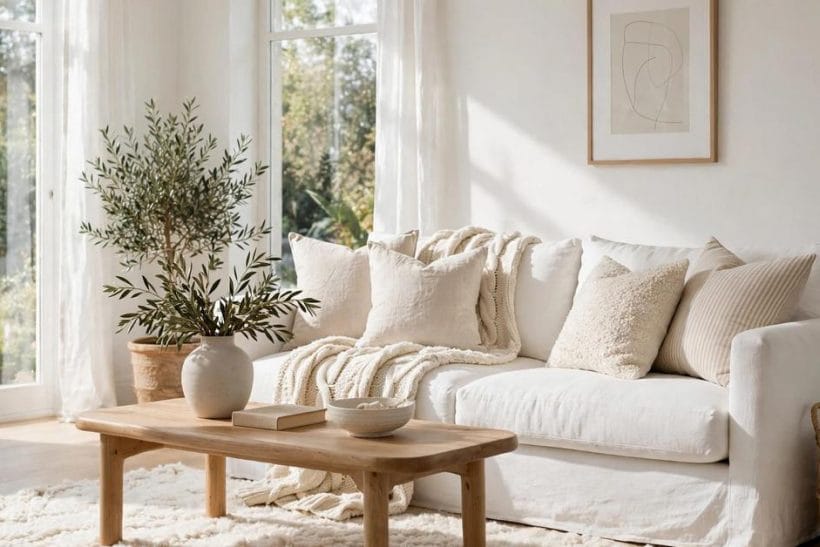
A white living room is a living room whose architecture and main pieces are white and its near relations — cream, ivory, chalk, pale stone — with warmth and interest supplied by texture, timber, metal and a small, deliberate cast of accent colour. Its working parts are the white itself, chosen for the room’s light; the layered fabrics and natural materials that keep the pale scheme from sterility; and light, daylight and lamplight, which in a white room are the true decoration. It is the serene member of the family room family, kin to the traditional living room in its manners, and the light-collecting opposite of the dark, cocooning schemes.
| Question | Short answer |
|---|---|
| Is a white living room practical with children and pets? | More practical than its reputation, if it is built honestly: washable covers, forgiving weaves, surfaces that wipe, and whites chosen in the warm, lived-in register rather than gallery-bright. The white room that pretends life away fails; the one designed around life — throws, covers, a no-shoes kindness at the door — thrives and merely asks a laundry rhythm of its owners. |
| Which white is the right white? | The one the room’s light approves. North-facing rooms need warm whites with a breath of cream or pink in them; sunny rooms can carry cooler, cleaner whites. The test is always the big sample, on the wall, watched at breakfast and at dusk — small cards lie in every direction. |
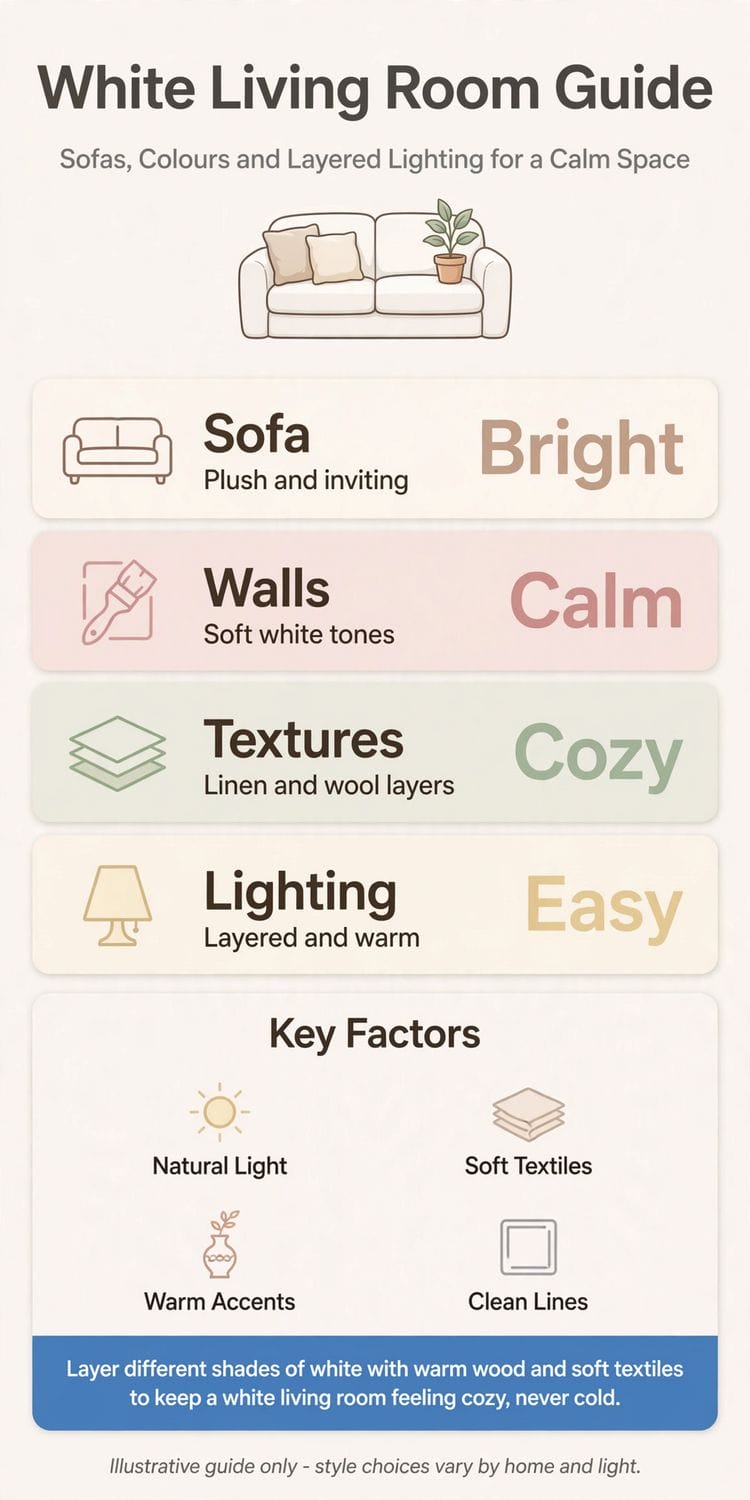
| How do you stop a white room feeling cold? | Texture and timber. Nubby weaves, wool, linen, rattan, pale and mid-tone woods, warm metals, and lamplight in pools: the white room is furnished in materials the hand can read. Cold white rooms are almost never too white — they are too smooth. |
| What colours accent a white living room best? | Few, and chosen like guests: one main accent in nature’s register — green from plants, blue from a single chair or the view, black as punctuation — repeated three times and then stopped. The white room’s discipline is that everything coloured must earn its place, and most things are not asked. |
2. The White Itself: Choosing the Right White for the Light
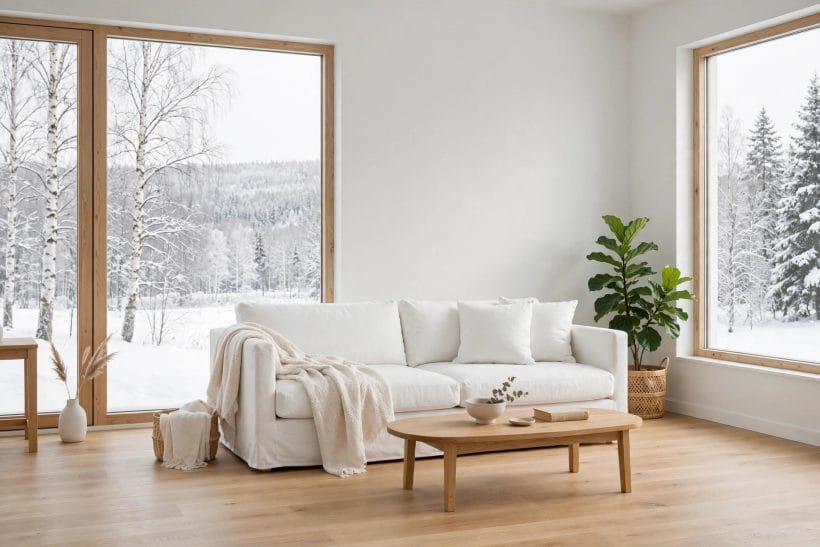
White is not one colour but a family of hundreds, from blue-chalk to warm ivory, and the family’s temper must match the room’s light or the whole scheme leans cold or dirty. This section chooses the white — by aspect, by sample, by the evidence of a watched day — before anything else in the room is allowed to be pale.
1. Read the room’s light before opening a colour card
North light is blue and honest; south light is golden and forgiving; the low western sun turns everything to honey at six. The white is chosen for the light the room actually lives in — which means the choosing is done in the room, at its hours, not under a shop’s fluorescent noon. The tiny house interior paint colours page works the same warm-and-cool arithmetic at small scale, where the light is even less forgiving.
2. Warm the white for north-facing and shaded rooms
Cool rooms make blue-whites look like a hospital corridor in February.
3. Let sunny rooms carry the cleaner whites
Where the sun does the warming, a cleaner, crisper white stays fresh instead of turning buttery.
4. Test with the biggest sample the shop allows, on two walls
Whites change their minds by the wall and by the hour.
5. Choose one white for walls, woodwork and ceiling, in different finishes
The serene white room is usually a single white family carried across every surface, its architecture drawn by finish rather than by colour: matte on walls, a soft sheen on woodwork, flat calm on the ceiling.
6. Let the floor set the white’s lower boundary
Pale painted walls behave differently over dark timber boards, pale oak, stone or carpet.
7. Keep a note of the chosen white like a medical record
The tin’s name, the brand, the finish, the date: recorded and kept with the house’s papers.
8. Beware the brilliant white that photographs better than it lives
The brightest optical whites throw a blue glare under artificial light and make every other white in the room — the sofa, the curtains, the teeth of the conversation — look faintly grubby by comparison.
9. Let one inherited piece veto the white if it must
The cream sofa that is staying, the grandmother’s ivory curtains, the pale rug with a decade left: the fixed pieces’ whites are facts, and the wall’s white is chosen to flatter them rather than to compete.
10. Decide the white’s register: gallery, coastal or country
The same colour serves three tempers: the gallery’s crisp minimalism, the coast’s soft bleached ease, the country’s warm chalky comfort.
11. Paint a whole corner before committing the room
The final audition: one corner, skirting to ceiling, furniture pushed back against it, a lamp lit at evening.
3. Walls, Woodwork and the Pale Architecture
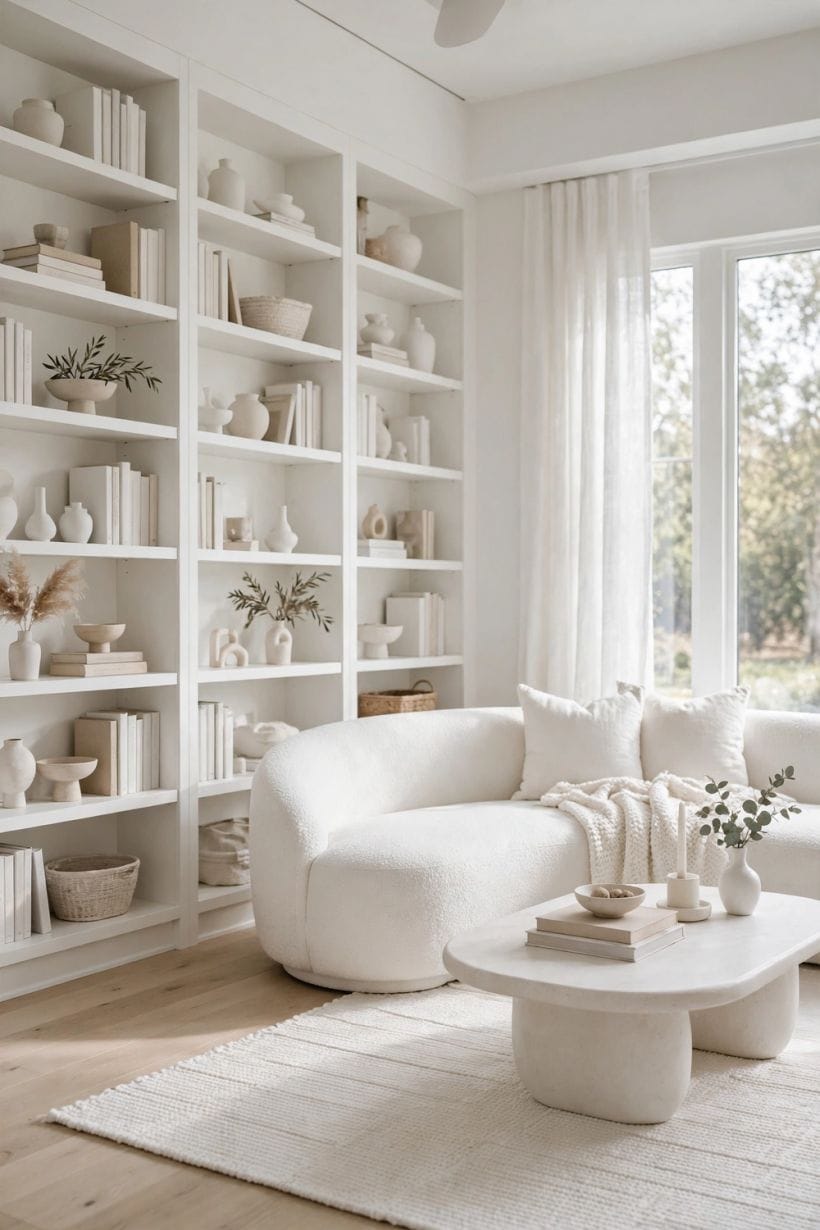
In a white room the architecture does the talking that colour does elsewhere: panelling’s shadows, the cornice’s line, the floor’s border, the fireplace’s pale mass. This section builds the room’s white bones — the surfaces and mouldings whose modelling in light and shade is the scheme’s true ornament.
12. Let panelling and mouldings draw the room’s pattern in shadow
A white room with panelled walls owns a pattern that changes all day: the mouldings’ shadows at morning, their flat calm at noon, their lamplight relief at night.
13. Keep the ceiling the calmest white in the room
The ceiling’s job is to return light without opinion.
14. Give the woodwork a soft sheen against the walls’ matte
Skirtings, architraves and doors in the same white at a satin finish catch the light’s edge and draw the room’s joinery like pencil lines.
15. Let a pale fireplace be the room’s white anchor
The fireplace in white-painted brick, pale stone or limewashed surround gives the room its composition’s centre: mass, shadow and the fire’s colour against the pale ground.
16. Use limewash or chalky finishes where the country register rules
Limewash’s cloudy, breathable depth suits old walls and the country white room beautifully — no two brushloads alike, the surface alive in raking light.
17. Panel one wall — the sofa’s — for the room’s quiet theatre
If the budget panels one wall, it is the one behind the main sofa: the backdrop every conversation and photograph will use.
18. Let the floor’s pale border or rug define the sitting ground
On darker floors, a large pale rug draws the room’s white down to ground level and gathers the furniture into the scheme; on pale floors, the rug’s texture does the same work in a near-white register.
19. Keep the window dressings white, sheer or natural, and full
Curtains in white linen, soft sheers, or natural woven blinds keep the windows in the room’s register while governing its glare.
20. Build in pale storage so the room’s life can be put away
White rooms show their clutter like a stage shows a broom.
21. Let stairs and hall continue the white if they open off the room
Where the living room flows into hall and stair, the white carried through unifies the house’s public floor and multiplies the light everywhere.
22. Accept the white room’s one demand: the surfaces kept honest
White paint shows the scuffed skirting and the grubby door edge that darker schemes forgive.
4. Sofas and Seating in White: Fabrics That Forgive
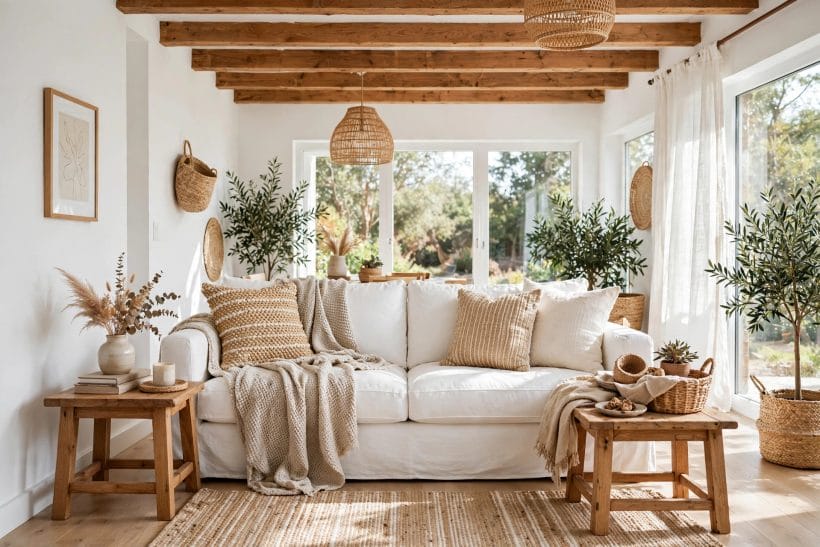
The white sofa is the scheme’s flag and its supposed folly. This section furnishes the room’s pale seating with the fabrics, covers and constructions that make white upholstery a practical joy — and arranges the seating so the room reads as a conversation, not a showroom for the colour’s courage.
23. Choose loose covers where the household is honest about life
The washable loose cover is the white sofa’s salvation and its secret: slipped off, washed, back on by evening.
24. Choose performance weaves where covers are not wanted
Modern upholstery fabrics woven to shrug off spills — wiped in the moment, cleaned without drama — carry white honourably in family service.
25. Let texture do the colour’s work on every seat
Bouclé’s loops, linen’s slub, wool’s nap, a knitted throw’s honest irregularity: in a white room the hand reads what the eye cannot.
26. Anchor the composition with the biggest piece in the truest white
The main sofa carries the scheme’s chosen white at full strength; the chairs and smaller pieces can step a half-tone into cream or natural.
27. Give every seat its throw, as uniform and as kindness
Throws in the room’s accent register — natural linen, a soft stripe, the one colour the scheme allows — dress the white seats for daily service and take the first of every spill, paw and chocolate.
28. Arrange the seats for conversation across a pale ground
Sofas and chairs facing each other over the rug’s pale field, at the distance voices like: the white room’s arrangement is a conversation pit in daylight. The television, if the room owns one, is a guest in the arrangement, not its host — the scheme’s serenity depends on it. The small living room tradition arranges the same conversation in half the footprint, and its seating lessons — fewer, better pieces, honestly spaced — apply at any size.
29. Add one chair in a natural material for the eye’s rest
A rattan, cane or pale timber chair among the upholstered whites gives the eye a different substance to rest on and keeps the room from reading as a furniture showroom’s pale corner.
30. Keep cushions in the whites and naturals, patterned by weave
Cushions are where a white room practises restraint: same family, varied weaves, perhaps one quiet stripe.
31. Let a leather piece in a pale tan warm the seating family
One pale leather chair or ottoman — honey, tan, the natural registers — warms the whites like timber warms a wall.
32. Protect the arms and the headrests, where white is actually lost
Sofas die at the arms and where heads rest.
33. Buy the seating for the room’s next decade, in the scheme’s own whites
Because the scheme is one colour, pieces bought years apart still join the family — the white room’s hidden economy.
5. Wood, Metal and Warmth: Keeping White from Cold
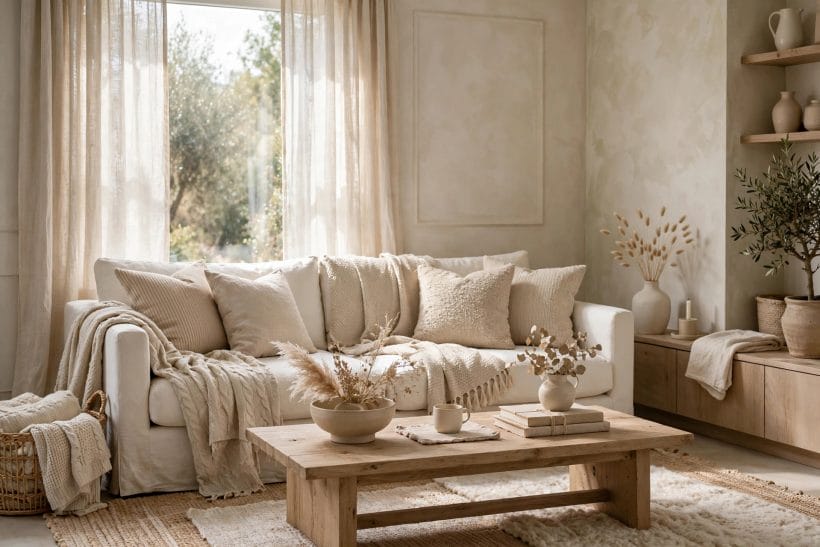
Every cold white room ever photographed was cold for the same reason: nothing in it was warm to the eye. Timber, warm metals, natural fibres and firelight are the scheme’s heating system. This section warms the white room at every surface until it glows like a room lit by late sun.
34. Let timber be the room’s second colour, everywhere
Floor, beams, the coffee table’s top, the bookshelves’ backs: one or two timber tones carried through give white its necessary counterweight.
35. Repeat each timber tone at least twice or not at all
A single orphan of dark wood in a pale room reads as a mistake with a removal date.
36. Use brass, bronze and warm metals for the room’s jewellery
Lamp bases, picture frames, the fireplace’s fender, curtain finials: warm metals glint against white like jewellery on skin.
37. Layer natural fibres underfoot and at the windows
Jute, sisal, wool and linen at floor and window bring the field and the flax into the room’s whiteness.
38. Bring the green of plants as the room’s living accent
In a white room, plants are not decoration; they are the colour scheme’s green heart, and they thrive in its light.
39. Let books supply the room’s permitted rainbow
Book spines are the white room’s traditional colour licence: a shelf of real books brings every colour in, in small, literate doses that no one can call a scheme-break.
40. Use firelight, candlelight and lamplight as materials
In the pale room, warm light is a building material: the fire’s glow on white walls, candles at the mantel, lamps in pools at the seats.
41. Add one black or near-black punctuation, sparingly
A black frame, the piano, a single dark chair or the fireplace’s interior: one dark note gives the whites their scale, the way a full stop gives a sentence its end.
42. Warm the room’s textiles seasonally without changing its colour
Winter’s white room takes wool, heavier knits, the sheepskin over the chair; summer’s takes linen and cotton at their palest.
43. Let the view be an accent: frame the garden like a painting
A white room is a frame factory: its pale walls turn every window into a picture of the garden’s greens and the sky’s blues.
44. Smell and sound count: the white room should feel like linen and quiet
The pale room’s serenity is multisensory — the hush of rugs and upholstery, the faint smell of beeswax, timber and clean cotton.
6. Colour Accents in a White Room: The Edited Guest List
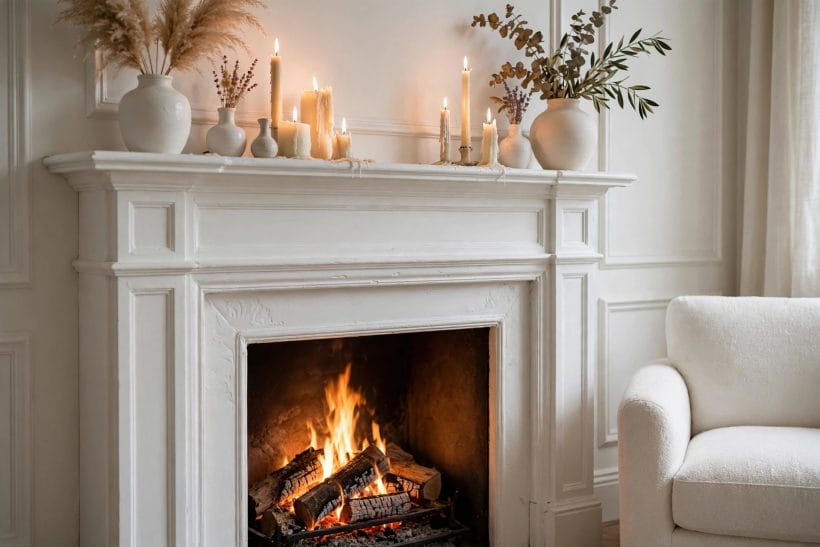
Accents in a white room are powerful precisely because they are rare: a single blue chair can carry a whole scheme, and a cushion’s red can shout. This section edits the guest list — choosing the room’s few colours, repeating them with discipline, and rotating them by season so the white room stays fresh without ever stopping being white.
45. Choose one accent colour and one supporting neutral, then close the list
The scheme’s whole discipline in one sentence.
46. Repeat the accent three times at three scales
A colour seen once is an accident; three times, at the scales of furniture, textile and object, it is a scheme.
47. Let art carry the accent where furniture should not
Pictures can be changed in an afternoon; sofas cannot.
48. Use the accent in the room’s smallest things for the budget version
Cushion covers, a throw, books’ jackets arranged, a bowl, candles: the accent applied at the scale of objects transforms the room for a shelf’s worth of money.
49. Rotate accents by season like a gallery rehang
Spring’s green and yellow, summer’s blues, autumn’s rust and ochre, winter’s deep red at the mantel: the white room is a gallery that rehangs four times a year from the same cupboard of textiles and objects.
50. Keep patterns quiet: stripes, checks and weaves in the accent
Pattern in a white room is admitted at low volume — the ticking stripe, the small check, the woven geometry — in the accent colour and white.
51. Let the accent be a material when colour feels too much
Some white rooms take their accent as substance instead: the copper bowl, the leather chair, the blackened steel of the fire tools.
52. Borrow the accent from the house’s other rooms for kinship
The colour that rules the kitchen’s tiles or the hall’s rug, repeated in the white room’s accents, makes the house read as one household thinking.
53. Exile the accidental colours to their own honest places
The plastic toy box, the technicolour board games, the post’s bright envelopes: every household owns colour it did not choose.
54. Judge every new object at the door with one question
Does it join the whites, the naturals, or the accent? If none — however lovely — it belongs to another room’s scheme.
55. Let one room in the house be gloriously coloured, so this one can rest
The white living room keeps its discipline best when the household’s colour appetite is fed elsewhere — the snug’s deep walls, the children’s rooms’ joy.
7. Light in a White Living Room: Day, Evening and Shadow
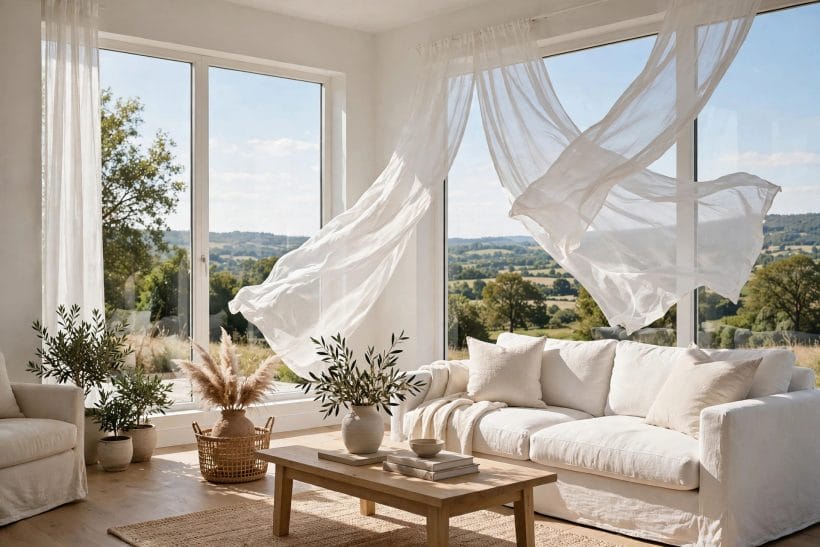
White rooms are light instruments: they collect the day, bounce it into corners, and turn lamplight into ambience with an efficiency coloured rooms envy. This section tunes the instrument — governing glare, layering the evening’s lamps, and using shadow as deliberately as brightness, because a white room without shadow is just a bright one.
56. Govern the glare before adding a single lamp
The white room’s first lighting problem is too much light, badly mannered: sun blasting the pale floor at noon, the screen’s face unreadable.
57. Bounce daylight deeper with the room’s own surfaces
Pale walls and ceiling are reflectors; the trick is aiming them.
58. Layer the evening in three pools: seats, centre, edges
Lamps at the reading seats, a low glow at the room’s centre, a wash at its edges — the layered scheme lets the white room be dimmed to any temper between conversation and cinema.
59. Choose warm bulbs throughout, and one temperature only
Mixed colour temperatures in a white room are instantly visible — one lamp’s gold against another’s blue-white reads as two households arguing.
60. Shade every lamp for faces, not for ceilings
Lampshades at seated eye height, glowing rather than glaring: in the white room the lamps are the furniture of the light.
61. Use the fireplace or candles as the room’s fourth layer
Living flame is the white room’s native light — the colour its walls were born under.
62. Keep the television’s glow from becoming the room’s lighting
When the screen is on, a soft lamp behind or beside it rests the eyes and keeps the room a room rather than a cave with a window.
63. Draw the day’s last light deliberately: curtains at dusk
The white room at dusk is a lantern seen from the garden and a cocoon from inside — but only if the curtains are drawn at the right moment, before the windows turn to black mirrors.
64. Light the art and the bookshelves a little, for the room’s evening face
A picture light over the main painting, a soft wash in the bookcase: these give the white room its evening portrait, the version its owners actually live with.
65. Let shadow have its corners: not every inch need glow
A white room lit to uniform brightness is a showroom.
8. Living With White: Children, Dogs, Dust and Keeping It
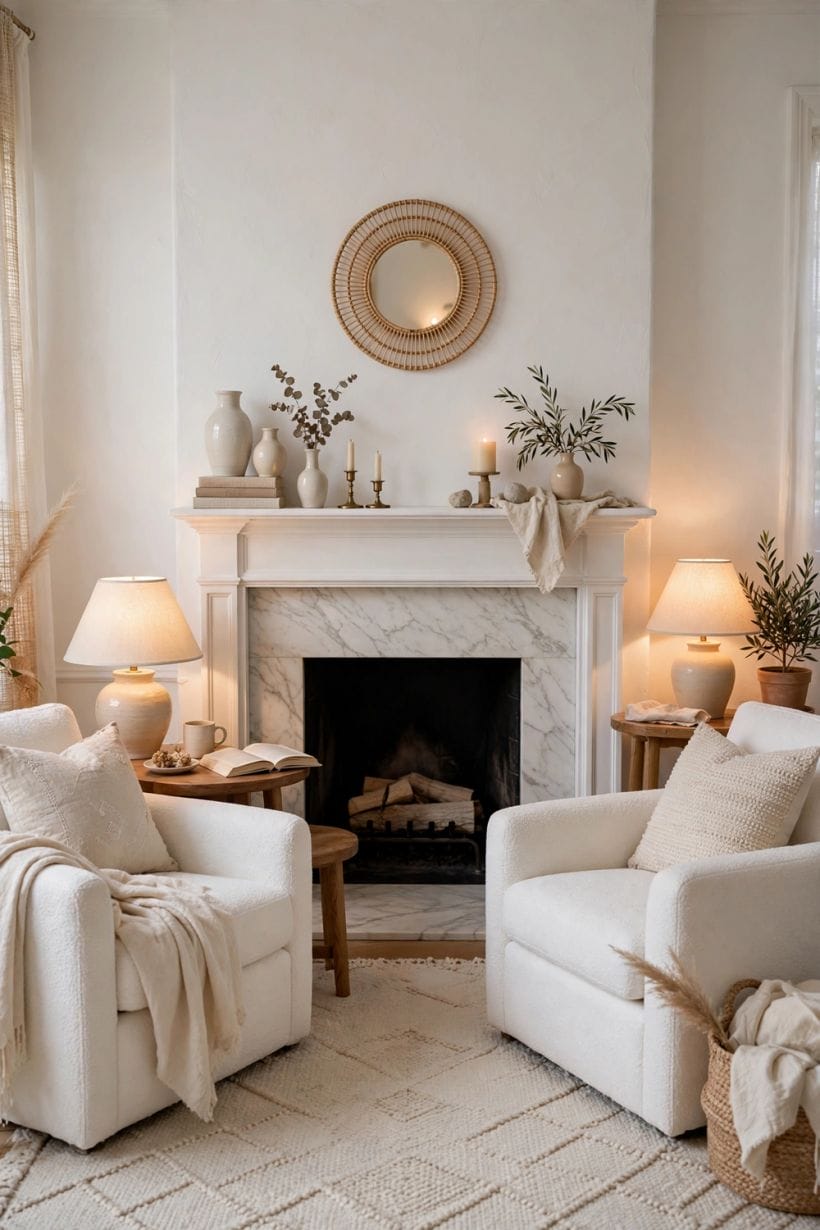
The last section is the truth section: how the white living room behaves under the actual conditions of a family’s life — the paw, the spill, the dust that shows, the toddler’s hand at skirting height — and the small, calm maintenance state that keeps it serene for decades without its owners becoming its servants.
66. Adopt the laundry rhythm and the room stays white by itself
Loose covers washed in rotation, throws laundered with the week’s bedding, cushion covers in the same load: white kept on a rhythm never becomes the emergency deep-clean of legend.
67. Keep the spot kit where the room can reach it in one minute
A cloth, the household’s chosen cleaner, a small brush, kept in the room’s own cupboard: spills in a white room are a one-minute event or a permanent souvenir, decided entirely by the kit’s distance.
68. Station the throws where life actually lands
The dog’s sofa corner, the children’s reading end, the seat by the door: throws live where the wear lands, not folded in a basket for guests.
69. Give the door its mat, its hooks and its small discipline
Most of a white room’s dirt arrives through its door, on feet and paws.
70. Choose the room’s lower walls and woodwork finishes for wiping
Skirting-height is the toddler-and-dog zone, and its finishes are specified for the cloth: washable wall paint below the dado’s ghost, satin woodwork, nothing precious within paw’s reach.
71. Let the vacuum and the duster have their quick weekly parliament
White shows dust sooner and forgives it faster: ten bright minutes weekly keep the room’s surfaces at their standard, where a darker room hides a month of the same dust in dignified gloom.
72. Forgive the scheme its life marks, chosen in the right register
The country and coastal whites — chalky, warm, textured — absorb a household’s small marks into their character; the gallery’s brilliant white indicts every one.
73. Refresh with paint’s small change, not renovation’s large one
A white room tired at year five usually needs one wall repainted, the covers washed, the accents rotated — an afternoon’s money.
74. Teach the room’s terms kindly and once
Shoes, snacks, the dog’s sofa rights, the red wine’s territory: every household runs on its treaties, and the white room’s are stated once, kindly, and kept by furniture and layout rather than by nagging — the mat, the throw, the side table placed so the terms are easy to keep.
75. Judge the room by its Tuesday, not its photograph
The final test of any white living room is an ordinary Tuesday: school bags down, dog in, rain at the windows — and the room still calm, still pale, still the house’s rest.
9. Checks and Mistakes: Before the First Purchase or the First Stone
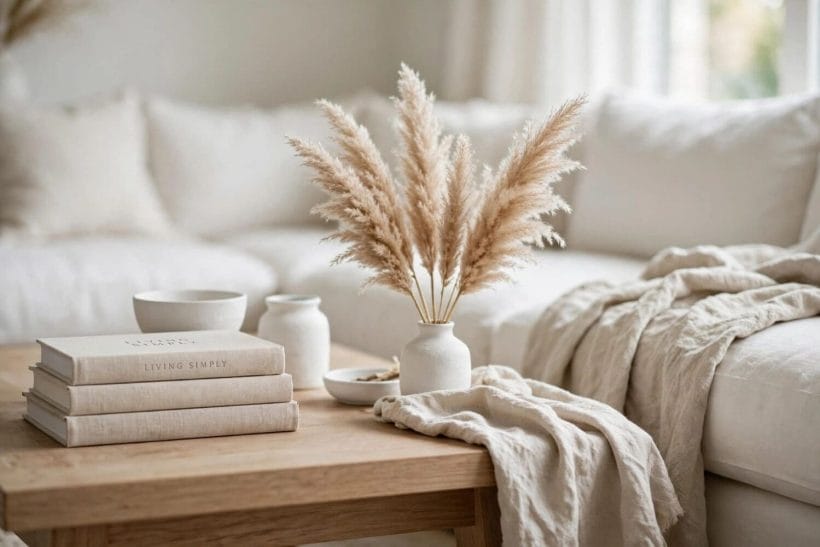
Before painting, walk the checks in order: the room’s light read at breakfast, noon and dusk; the candidate white sampled largely on two walls and lived with for a full day; the fixed pieces — floor, staying furniture, the view — listed as facts the white must flatter; the seating fabrics specified for the household’s real life, covers or performance weaves, in writing; and the accent list closed at one colour, one neutral, before the shops are allowed to improvise.
The faithful mistakes: the brilliant gallery white chosen for a north-facing family room; five near-whites quarrelling across walls, sofa and curtains; a room of smooth surfaces with no texture for the hand; the television enthroned as the pale room’s altar; accents admitted one cushion at a time until the scheme is confetti; and white upholstery bought without covers by a household with a dog, a toddler and a optimistic streak. Every one is a planning error, not a colour error — the white was fine.
One check is about the household’s constitution: agree the room’s terms — shoes, throws, the laundry rhythm, the dog’s rights — while everyone still likes the plan, and furnish so the terms are easy to keep. White rooms fail by negotiation far oftener than by staining; the kept treaty is the real fabric protection.
10. Costs and Pulling It Together
Costs follow the colour’s strange economics: the paint is the cheapest in the shop and the scheme built on it can be the house’s most economical — single-colour decorating, pieces that join the family across decades, refreshes measured in afternoons. The serious money sits where it should: in the seating’s fabrics and the floor, the two things the room’s life is actually spent on.
Pulling it together: choose the white by the room’s own light; build the pale architecture with shadow for pattern; seat it in textures that forgive; warm it with timber, natural fibre and firelight; admit one accent and close the list; layer the lamps for the evening the room was made for; and keep the whole on a laundry rhythm rather than a state of alarm. The room then stands in the wider survey of home design ideas as the calmest proof that a single colour, completely understood, is a complete decoration.
Final Considerations
A white living room is a house trusting its own light. Furnished with texture, warmed with timber and kept on a kind rhythm, it becomes the room the family photographs without tidying and rests in without thinking — the pale, quiet centre that the coloured rooms of the house are measured against, and usually found louder than.
Begin with the sample board and the full day’s watching. Every white decision after that — sofa, timber, accent, lamp — is made easily by a household that knows exactly which white its light has chosen.

0 Comments