

A coastal interior in a small home should feel like opening the door on the first morning of a holiday: bright, salt-clean and unhurried. The risk in a tiny footprint is theme-park drift, anchors and rope and shells on every surface until the room looks like a gift shop you sleep in. Real shore-side homes are plainer and better than that. The most convincing coastal tiny house decor is mostly white, sand and sea-blue, built from rattan, driftwood and linen, with its beach references kept few, useful and quietly confident.
This roundup gathers twenty of those restrained ideas, grouped so the breeziness is built properly: the white, sand and sea-blue palette first, then light and moving air, natural textures, stripes on a short leash, a simple kitchen and table, breathable sleep, a fresh small bathroom, basket-and-hook storage at the entry, a threshold to the outdoors, and the salt-air maintenance that keeps it all bright. It closes with a souvenir rule, because the shore gives generously and a tiny home must learn to say thank you and no.
Coastal Tiny House Decor at a Glance
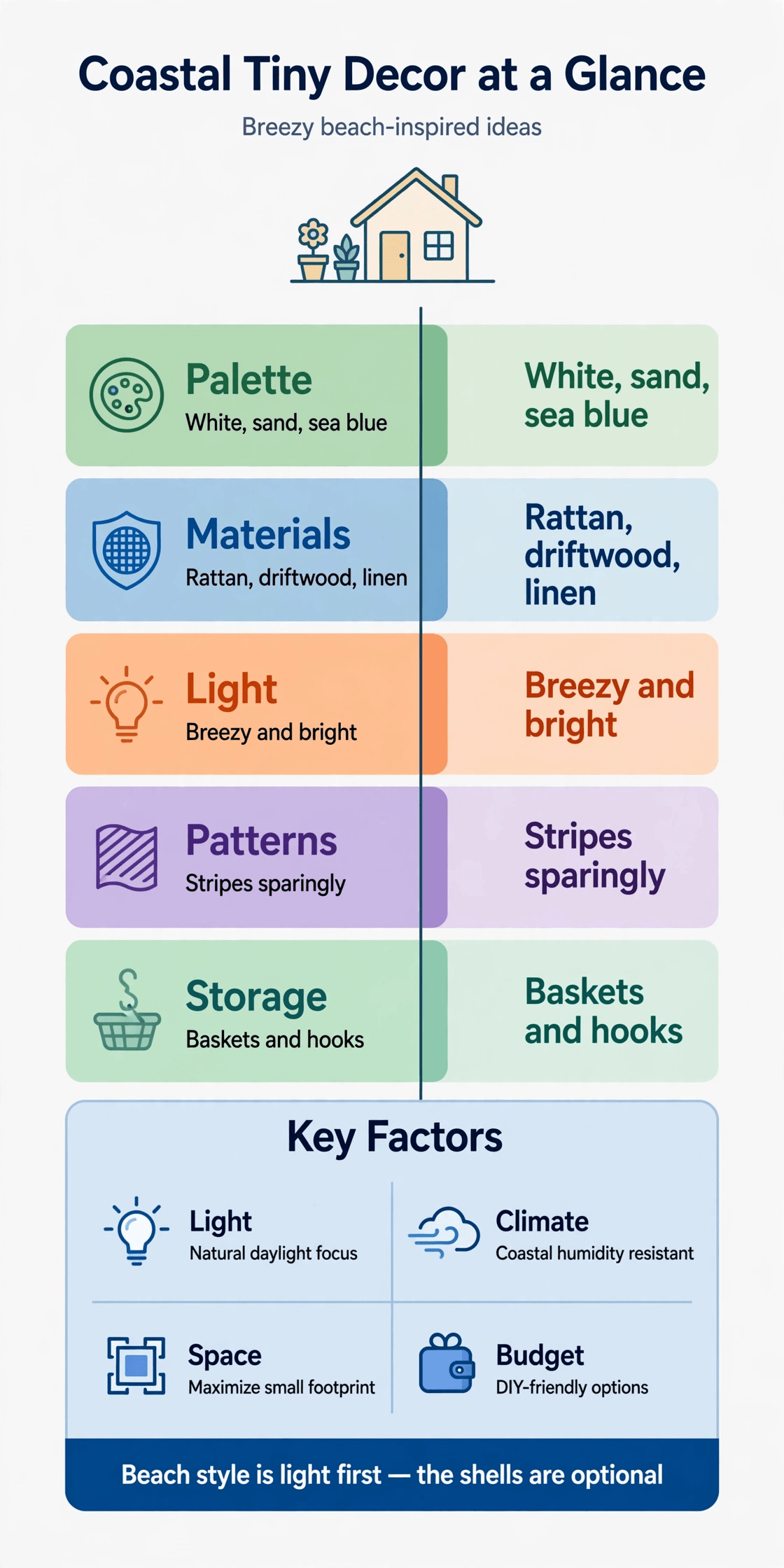
The summary table below maps the twenty ideas by theme, so you can start with the layer your room needs most. Every idea is then unpacked in its section, with the trade-offs stated honestly.
| Theme | Ideas | What It Solves |
|---|---|---|
| White, sand and sea-blue palette | 1 to 2 | Brightness with depth, and blue used like weather, not wallpaper |
| Breezy light and air | 3 to 4 | Sheers, clear glass and layouts that let daylight and air move |
| Rattan, driftwood and linen | 5 to 6 | Natural texture that warms white rooms without visual weight |
| Stripes, sparingly | 7 to 8 | One stripe family per room, rested by large areas of solid colour |
| Kitchen and table | 9 to 10 | Pale, simple surfaces and linens that wash and dry fast |
| Breathable sleep | 11 to 12 | White bedding, one blue layer and fibres that breathe |
| A fresh small bathroom | 13 to 14 | Towels, air and storage that defeat damp in a tiny wet room |
| Basket-and-hook entry storage | 15 to 16 | Beach-day kit contained at the door, off floors and chairs |
| The outdoor threshold | 17 to 18 | A step, deck or porch treated as the home’s extra room |
| Salt-air maintenance | 19 | Rinsed fabrics and rust-aware choices that keep the look bright |
| The souvenir rule | 20 | One-in, one-out for found objects, so the shore stays a memory |
1. White, Sand and Sea-Blue
Palette is destiny in this style. Get the proportions right, most of the room white, a warm third in sand tones, blue as the weather, and almost any plain furniture you own will read as coastal. The wall guidance in lightweight interior wall finishes for tiny houses suits the look well, since pale finishes in small homes need to be wipeable and light in every sense.
1. White and sand as the base covers walls and the largest pieces in warm whites, with sand, oatmeal and pale driftwood tones in rugs, upholstery and wood. Pure blue-white paint turns northern light icy, so choose whites with a warm undertone and test them at the hour you use the room most. Sand is the palette’s kindness: it hides the actual sand, dust and dog hair of shore-side life far better than white alone, which is why the base needs both.
2. Sea-blue in graded doses layers blue the way the sea itself does: palest in large soft things like a throw or curtain, mid-tones in cushions and crockery, and the deepest note in one small item only, a lamp base, a stool, a book’s worth of colour. Keep blues in one family, green-blue or grey-blue, not both, and repeat each tone at least twice so it reads as intention. When a room feels cold, the cure is more sand and texture, never more blue.
2. Breezy Light and Moving Air
Coastal rooms are defined less by objects than by what moves through them: daylight and air. In a small home both are finite resources, and furniture that blocks a window or a through-draught taxes the whole house for one chair’s convenience.
3. Sheers and clear glass dresses windows in simple sheer or voile panels that soften glare and give privacy while passing nearly all the light, with glass kept washed inside and out. In a tiny room, clean glass is a genuine brightness upgrade, cheaper than any lamp. Skip heavy curtains at small windows entirely; where evening privacy or darkness is needed, a plain blind in sand or white disappears by day. The trade-off is insulation, so in cold climates treat sheers as the summer layer and add the heavier curtain seasonally.
4. A layout that lets air through keeps the path between windows and doors walkable and breezy: low furniture under sills, nothing tall against the main window wall, and the largest piece placed along, not across, the room’s airflow. The health thinking behind tiny house ventilation, HRV and mould prevention backs the aesthetics here, because moving air is also what keeps a small sealed home fresh. Test the layout on a warm evening; if one corner stays stuffy, that corner, not the whole room, needs moving.
3. Rattan, Driftwood and Linen
Texture is how this style warms all that white without colour or clutter. Three materials do nearly all the work, each with a job: rattan for structure, driftwood tones for wood, linen for softness. Keep each material to a few honest pieces and let repetition, not variety, build the effect.
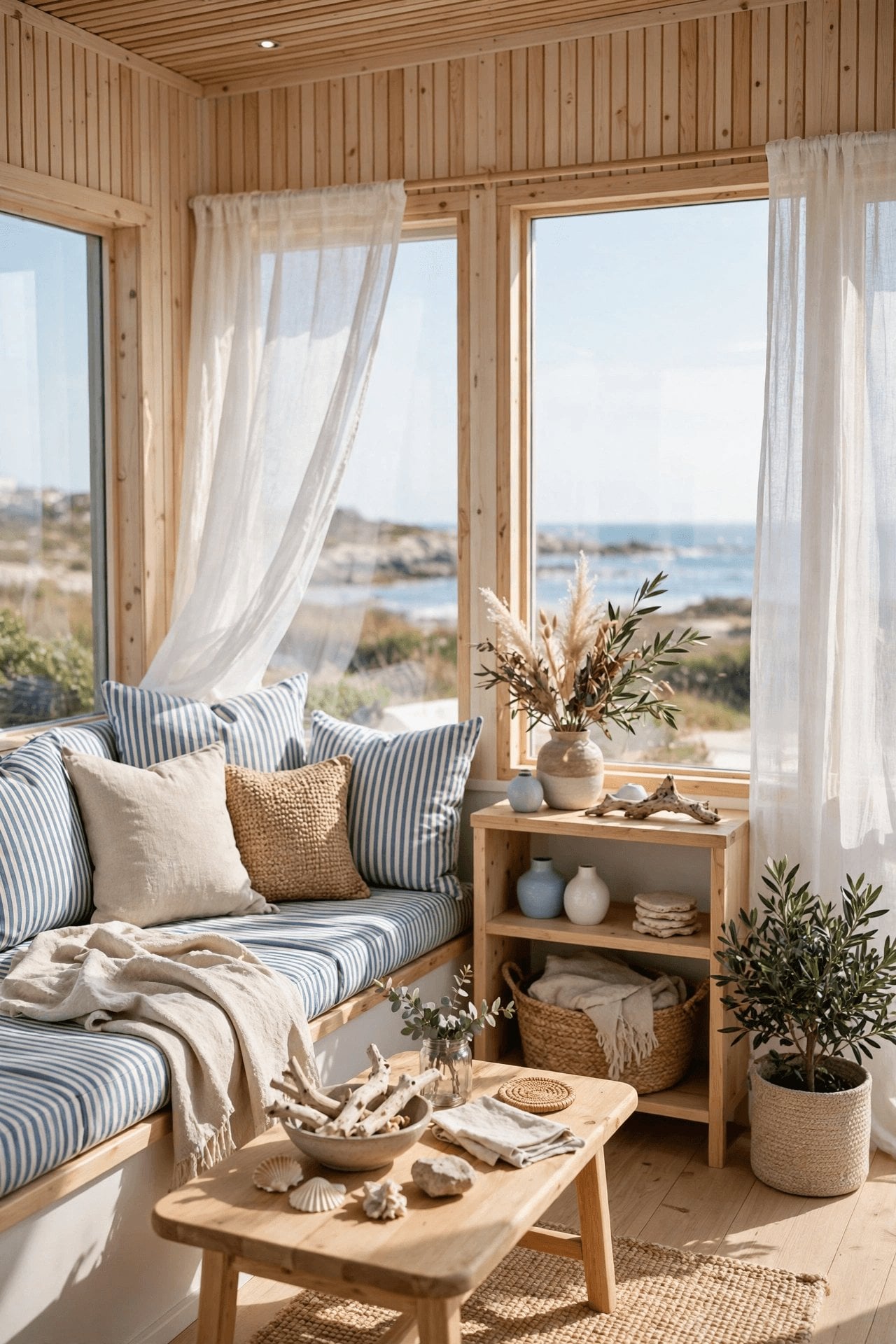
5. One rattan hero piece gives the room its woven signature in a single chair, headboard or pendant shade, well-made and generously sized, rather than a scatter of small rattan accessories that read as souvenirs. Woven structure shows light and shadow beautifully in bright rooms and weighs little, a virtue in any home that might move. Keep it out of damp corners, dust it with the weekly clean, and let every other woven thing in the room, baskets included, be plainer than the hero.
6. Driftwood tones and real linen sets the wood palette to pale, greyed, sun-softened finishes, whether on a small table, picture ledge or floor, and lets curtains, bedding and cushions be actual linen or linen-look cotton with a visible weave. Linen’s creases are the style’s honesty, so do not fight them. Buy the best linen you can for the pieces hands touch daily, and keep driftwood itself, found pieces, to one or two sculptural items; a room full of found wood stops looking serene and starts looking stranded.
4. Stripes on a Short Leash
Stripes are the palette’s pattern, and the whole discipline of this style is in their rationing. A coastal room needs stripes the way soup needs salt: definitely, measurably, and never by the handful.
7. One stripe family per room chooses a single stripe, its colours from the sea-blue grading of idea two, its scale suited to its job, broad on a rug or blind, narrow on cushions or towels, and bars every other stripe from that room. Two unrelated stripes in a small space set up a visual argument the eye cannot settle. If you inherit a second striped piece you love, it lives in a different zone of the home, with solid colours between it and its rival as a demilitarised strip.
8. Solids to rest the eye guarantees that most soft surfaces in the room are plain: the sofa, the bedcover, one full set of cushions. Rest is what makes the striped pieces read as fresh rather than busy, and plain natural fabrics are cheaper to replace when shore-side life stains them. Work to a simple visual ratio at the doorway squint-test: roughly three plain surfaces for every striped one. When the room feels loud, a plain throw over a striped chair fixes it in five seconds, which is the correct price of peace.
5. A Pale, Simple Kitchen and Table
The coastal kitchen in a small home should look like it belongs to someone who cooks simply and eats slowly: pale fronts, open air above the counter, and a table dressed in cloth rather than objects. Choose appliances as the best compact kitchen appliances for tiny houses advises, sized to the household, and let daylight be the decoration.
9. Pale fronts, plain shelves keeps kitchen cabinetry white or palest sand, with one short open shelf for daily crockery in white and sea-blue, and everything else behind doors. Handles in a simple, corrosion-tolerant finish matter more than their style near salt air. Display discipline from the other small kitchens applies: what is out is used daily, washed often and few. A clear counter with a bowl of lemons or a jug of water is the whole still life this kitchen needs.
10. Table linens doing the work dresses the small table with a washable cloth or runner in sand linen, blue-graded napkins and the room’s single stripe if it appears anywhere at meals. Cloth is the fastest room-changer in this style: a table set with linen reads as an occasion in a room that was a workspace an hour ago. Keep two sets so one can be in the wash, store them folded in the table’s own drawer or basket, and choose fibres that dry quickly in homes where laundry air-dries indoors.
6. Breathable, Blue-Layered Sleep
The sleeping corner should be the breeziest-feeling place in the house, all white and air with blue arriving like a cool evening. In lofts and small bedrooms this is as much about fibre as colour, because natural, breathable bedding is what actually sleeps cool.
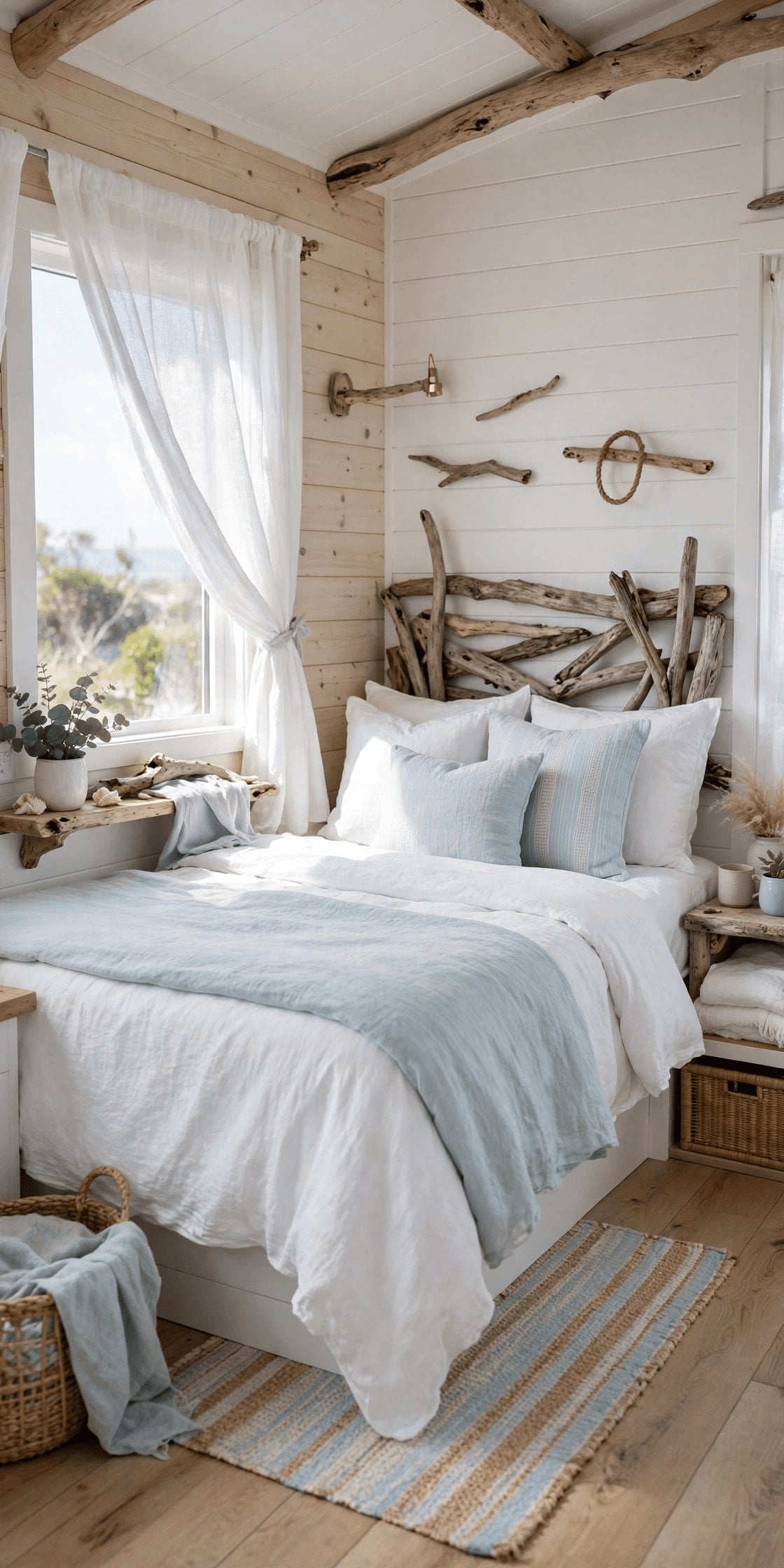
11. White bedding, one blue layer builds the bed on white or cream sheets and cover, then adds exactly one blue layer, a throw, a quilt or a pair of cushions in the graded tones, which can change with the season. White bedding is the honest choice in a small home precisely because it shows dirt and washes hot; dinginess has nowhere to hide, so the bed always looks and is clean. Keep spare white sets to two, since linen storage is precious, and rotate them ruthlessly.
12. Fibres that breathe chooses cotton and linen for everything against the skin and a light wool or open-weave layer for cool nights, avoiding heavy synthetic quilts that trap the humidity small sleeping lofts collect. Warmth in a well-sealed sleeping corner rarely needs bulk, a point how to insulate a tiny house explains through the building’s own layers. Air the bed back to the wall for an hour each morning if you can; it is the cheapest freshness habit there is, and the room will smell like the style promises.
7. A Fresh Small Bathroom
Tiny bathrooms are where coastal freshness is tested, because damp is the enemy of the whole look. White, air and ruthless towel discipline keep a small wet room smelling like a beach hut instead of a locker room.
13. Towels as the decor makes white and sea-blue towels, thick, few and washed hot, the bathroom’s main colour event, hung where air reaches them and swapped before they sour. Behind that simplicity sit unglamorous bones worth respecting, the falls and seals covered in tiny house plumbing layout and DWV design, because no towel scheme survives a leaking trap. Store spares rolled in one basket, keep the count honest, and let the mirror and glass carry the brightness.
14. Air, always, in the wet room runs ventilation during and after every shower, wipes the shower walls down in seconds, and leaves the door ajar so the small room dries fully each day. The mould guidance in tiny house ventilation, HRV and mould prevention is the serious version of this habit. Choose a simple natural-fibre or quick-dry bath mat that can hang to dry, and skip wooden bath accessories that live wet; in a tiny bathroom, everything either dries daily or becomes the smell.
8. Basket-and-Hook Storage at the Entry
Shore-side life generates gear: towels, hats, shoes full of sand, bags, bottles. In a tiny home that gear lands exactly where the door opens, so the entry, even if it is one wall, needs a station that receives it gracefully.
15. The basket station lines up two or three sturdy baskets under a bench or along the entry wall, one for beach and outdoor kit, one for shoes, one for the day’s overflow, all in natural weave plainer than the rattan hero. Sand is managed here, at the threshold, with a mat outside and a brush or tray for shoes, so the pale floors of idea one survive real life. Empty and shake the baskets weekly; a basket station that is never emptied is just prettier clutter.
16. A short row of hooks mounts four to six generous hooks at the entry for hats, bags, towels and the light layer everyone grabs, fixed into sound structure and spaced so things hang without piling. Hooks are this style’s honest alternative to a hall cupboard a tiny home does not have. Keep the row edited to what the season uses, and give each household member a hook that is theirs; shared hook rows collapse into a single textile landslide by the second week of any holiday.
9. The Outdoor Threshold
Coastal living points outward. Even the smallest step, deck or porch extends a tiny home’s living space for most of the year, and styling it with the same palette makes the whole home feel twice its size from the main seat.
17. The threshold as a room furnishes the step or deck with one comfortable seat, a small surface and the palette carried through in outdoor cushions, treating the threshold as the home’s second sitting room. The collection in tiny house plans with screened porches shows how powerfully even a modest covered edge changes small-home life, and a single shaded seat borrows some of that magic at any budget. Keep threshold furniture light enough to move with the sun or the storm.
18. Outdoor textiles, honestly chosen uses cushions and throws made or chosen for outdoor life, in the same sand and sea-blue family, stored in one lidded basket by the door when weather turns. Fade will happen; choose tones that fade gracefully toward the palette rather than away from it, and bring textiles in rather than letting damp make the storage decision for you. One outdoor rug in the single stripe can define the threshold beautifully, provided it dries fast and shakes clean.
10. Salt-Air Maintenance
Near the sea, or in a home that merely dreams of it, brightness is a maintenance habit before it is a colour choice. Salt, sun and damp all dull this palette faster than any other, so the style needs a cleaning rhythm equal to its ambitions.
19. Rinse, air and choose rust-aware sets the routine: shake and air textiles outdoors on dry days, rinse or wipe metal fittings and hooks before corrosion starts, prefer finishes and fittings that tolerate moisture on everything from curtain rods to basket frames, and wash the sheers and glass often enough that light stays honest. Exterior choices face the same weather, which is why tiny house siding options in cedar, metal and composite is useful reading alongside the interior ones. None of this is weekly heroics; it is ten minutes of prevention that stops the palette greying by degrees, the way this style usually dies.
Final Considerations
The shore is generous with gifts, and that generosity is the final problem. Every walk returns pockets of shells, driftwood, stones and glass, each one beautiful, each one a small claim on a home with no spare surface. A coastal interior stays serene only when found beauty is rationed as firmly as bought beauty.
20. The souvenir rule allows found and bought treasures one defined place, a single tray, ledge or bowl by the entry or on the kitchen shelf, operating one-in, one-out: a new shell earns its place by retiring an older one to the garden or back to the beach. It is the same discipline as tiny house living and decluttering for a move to 200 square feet, applied to the things with the strongest sentimental pull. Photograph the rest. The memory keeps beautifully, the room keeps breathing, and the collection stays a highlight instead of becoming the house.
Build the look from the palette outward, let light and air do the decorating first, and add objects last and fewest. A small coastal home will never have the sea’s scale, and it does not need it. It needs white that glows, sand that forgives, blue in weather-like doses, and the discipline to stop while the room still feels like a morning on the shore.


0 Comments