
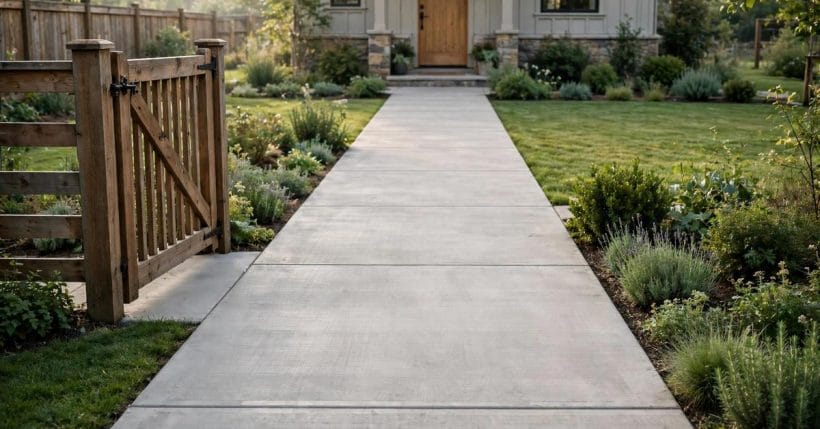
A concrete walkway asks for nothing and gives a great deal: a calm, even surface from the gate to the door, in every season and every weather.
This survey of concrete sidewalk designs gathers the layouts, colours and practical details that shape such a path, so you can picture what suits your own front garden before any ground is broken.
1. Concrete Walkways at a Glance
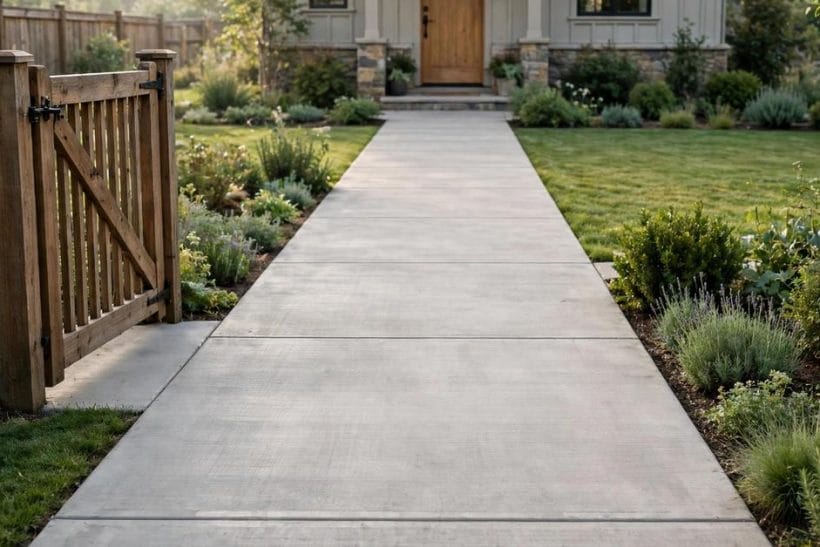
A concrete walkway is a path poured as a continuous surface, rather than assembled from separate units or scattered as loose material. The surface is shaped while it is still workable, given its texture and its joints, and then left to harden into a single firm route. That continuity is the whole character of the form: no gaps to fill, no units to lift, and a line that reads as one quiet gesture across the garden.
| Aspect | What to notice |
|---|---|
| Form | One poured surface from gate to door |
| Finish | Broom texture, exposed stone, or a pressed pattern |
| Colour | Natural grey, softened by tints and tones |
| Joints | Regular lines that let the slab move gently |
| Edges | A firm border that holds the line true |
| Setting | Front garden, side passage and garden route alike |
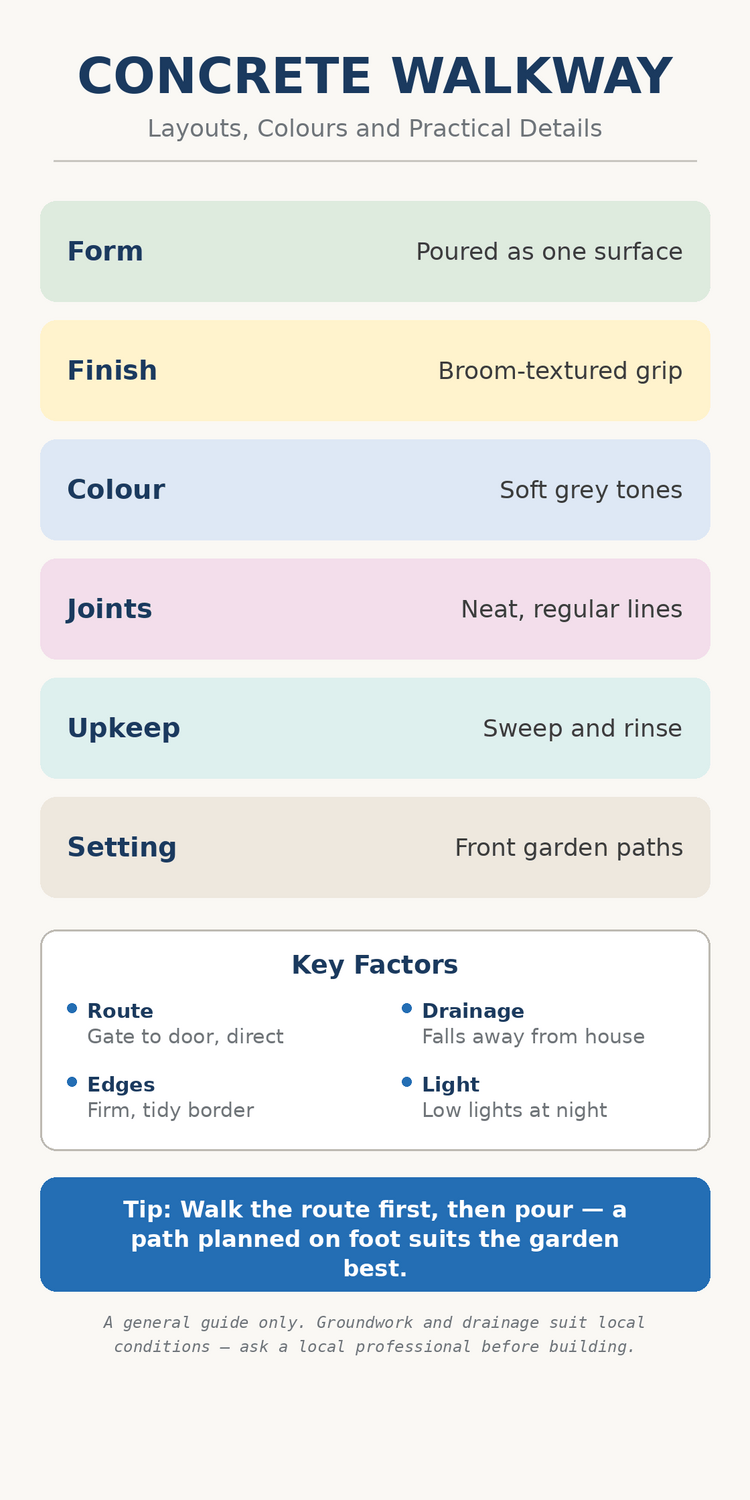
This survey of concrete sidewalk designs keeps its attention on the poured form alone, and on the choices that shape it: the route it takes, the finish underfoot, the colour it carries, and the details that keep it sound through the years. The pouring itself, and the groundwork beneath it, are professional work, and the survey treats them as things to understand and to specify, not as jobs to improvise. What the reader can decide, and decide well, is the shape, the surface and the setting of the path.
2. What Makes a Walkway a Concrete Walkway
The defining quality is continuity. Where a path made of separate units shows its construction in every joint, a concrete walkway shows almost nothing: a broad, even surface broken only by the slim control lines that divide it into bays. Those lines are not decoration, though they can look handsome. They give the slab somewhere to move as temperatures change, so that small shifts appear where they are expected rather than as cracks across the field.
The surface itself can vary a great deal within that continuity. A broom finish gives a fine, even texture that grips well underfoot. An exposed finish reveals the small stones within the mix, lending the path a speckled, natural character. A pressed pattern can suggest stone or brickwork in the surface itself, though the path remains a single pour beneath the pattern. In each case the walker feels one surface, firm and predictable, from the first step to the last.
The survey keeps its focus narrow on purpose. A concrete walkway is not a patio, which is a place to sit and gather, and it is not a driveway, which must carry vehicles. It is a route for feet, and everything about it, its width, its line and its colour, should serve the act of walking. A paver walkway belongs to a different family, made of separate units fitted together, and this survey leaves that form to its own post, staying with the poured surface throughout. Loose surfaces are another family again, and gravel landscaping shows how a soft, shifting surface changes the walk entirely, trading firmness for a rustling, informal feel.
That narrow focus helps when the path is judged by the standard that matters: does it carry the walker safely and pleasantly, in wet weather as well as dry, and does it sit calmly beside the house? A concrete walkway answers that standard with quiet confidence. It does not compete with the planting or the architecture. It frames them, giving the garden a clear, legible route and the house a dignified approach.
3. Straight Runs: The Direct Route
The straight concrete walkway is the most honest kind of path. It runs from gate to door without apology, and it suits houses where the front garden is shallow or the entrance is the clear focal point. A straight run asks for discipline: the edges must be true, the joints must stay regular, and the colour must be calm enough to carry the eye forward rather than distracting it.
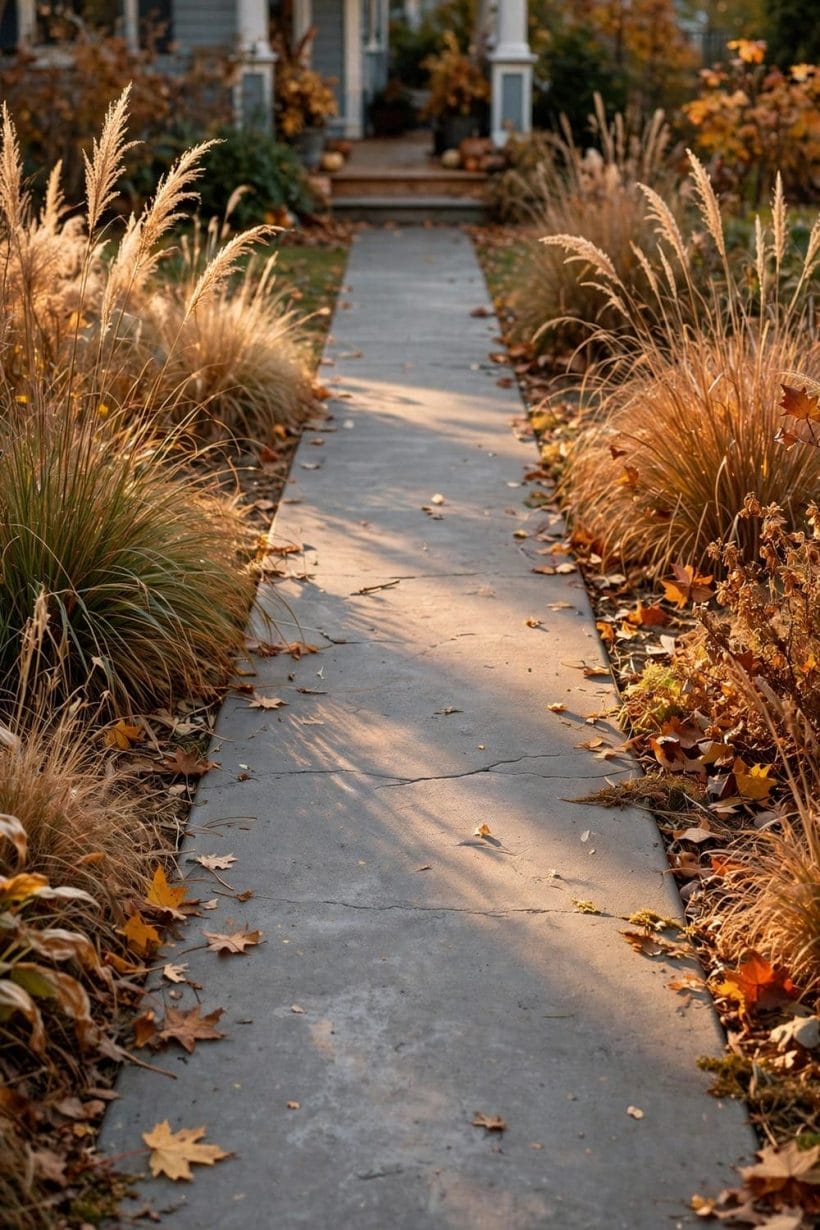
There is a quiet dignity in a straight path done well. Flanking it with low planting softens the geometry without hiding it, and a border in a contrasting tone can frame the route the way a mat frames a picture. The arrival matters here more than anywhere, because the walker sees the door from the first step. The porch, the lighting and the planting around the door should feel like a continuation of the path rather than a separate display.
Straight runs also suit side passages, where the route is constrained by walls or fences and there is no room for curves. In such a passage, a plain grey surface in a mid-tone keeps the space from feeling cramped, while a pale border can lift a shaded strip. Water deserves attention on a straight run, since it follows the line of the path; a gentle fall away from the house keeps the surface safe in rain, and the fall should be planned before the pour, not discovered after it.
The temptation with a straight path is to dress it up, adding inlays or medallions that break the calm. Restraint usually serves better. Let the finish and the colour do the work, and let the garden provide the ornament at the edges. A straight concrete walkway, well laid and simply finished, can be the most elegant route a house can offer.
4. Texture and Grip Underfoot
Texture is the quality a walker notices without looking. A concrete surface can be smooth, but a walkway rarely should be: a surface with a little tooth grips the shoe in rain, in frost and under fallen leaves. The most familiar way to give a poured path that grip is the broom finish, drawn across the surface while it is still workable, leaving fine parallel lines that catch the light and steady the foot.
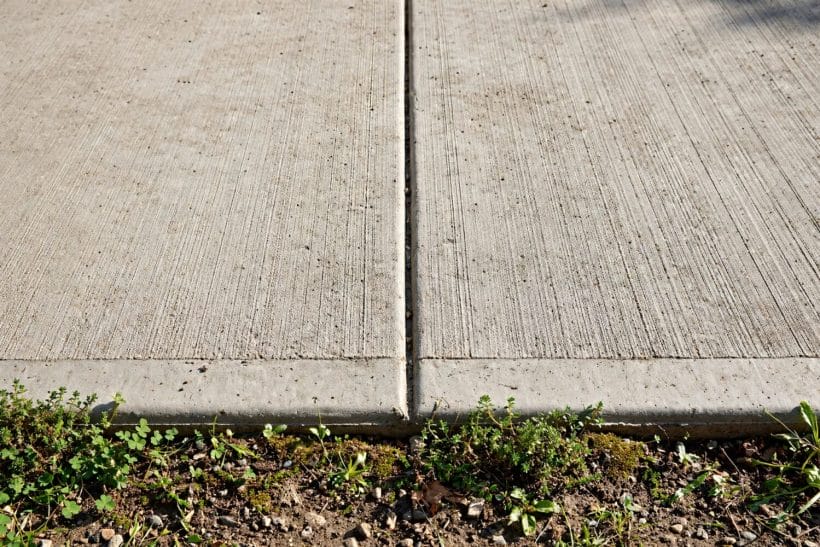
Other finishes trade grip for character. An exposed finish, washed to reveal the stones within, gives a richly speckled surface that looks at home beside gravel beds and natural planting. A polished or honed surface looks refined, though it asks more care in wet or shaded stretches, where it can grow slick. The choice among these finishes is a balance between appearance and the weather the path must face, and the balance should be struck with the wettest, darkest corner of the route in mind, not the sunniest.
Texture also changes how a path ages. A broom finish wears evenly and hides small marks well, while a smoother surface shows stains and scuffs more readily. Moss and algae settle fastest in shade and in hollows where water lingers, and a textured surface that drains freely resists them better than a smooth one that puddles. Sweeping keeps the texture open and the grip honest, and it takes only a few minutes when done often.
Accessibility deserves a word here. A walkway that serves the main entrance should be as even and as free of tripping edges as careful work can make it, with joints kept narrow and flush. A path that welcomes everyone, including visitors with wheels or unsteady feet, is a path that has done its job properly, and texture should serve that welcome rather than hinder it.
5. Curves That Slow the Walk Down
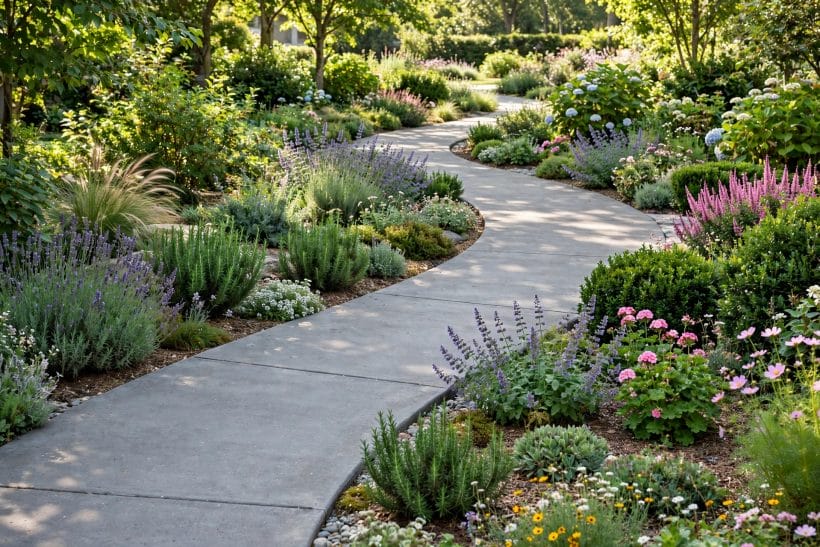
A curved concrete walkway changes the pace of arrival. Instead of delivering the walker straight to the door, it invites a slower look at the garden, revealing planting in stages and hiding the destination until the last turn. Curves suit deeper front gardens, where there is room for the path to wander, and they soften houses whose architecture is formal or imposing.
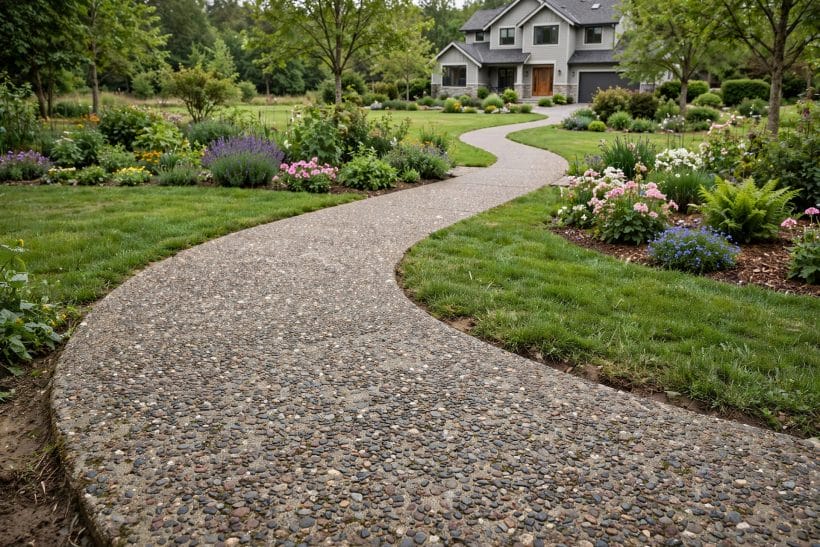
Pouring a curve asks for care at the edges, where the formwork must follow the bend smoothly so the finished line reads as one flowing gesture. A curve that kinks or flattens where it should sweep will show its fault every day, because the eye follows the edge as surely as the foot follows the surface. The result, when done well, looks effortless, as though the path grew where it was wanted rather than where it was drawn.
Curves also answer the shape of the ground. A front garden that rises toward the house, or one shaped by existing trees and beds, may suit a bending route better than a straight one. Raised planting can work with a curving path to shape the approach, lifting the garden into gentle mounds that the path winds between. The path and the planting then read as one composition rather than two separate features.
One caution applies to curves: they should feel intentional. A bend that serves no view, no tree and no change of level can look indecisive. Walk the proposed route, mark it with string or hose, and check that each turn reveals something worth seeing, a specimen plant, a seat, or the door itself appearing at last. A curve earns its place by what it shows, not by the mere fact of bending.
6. Pattern and Colour: Stamped, Tinted and Natural Tones
Colour is the most visible decision in a concrete walkway, and the most personal. Natural grey, the colour of the material itself, gives the path a calm, unified surface that lets the house and the planting take the lead. It suits formal fronts and small gardens, where a busy surface would compete with everything around it, and it weathers gracefully, softening rather than fading.
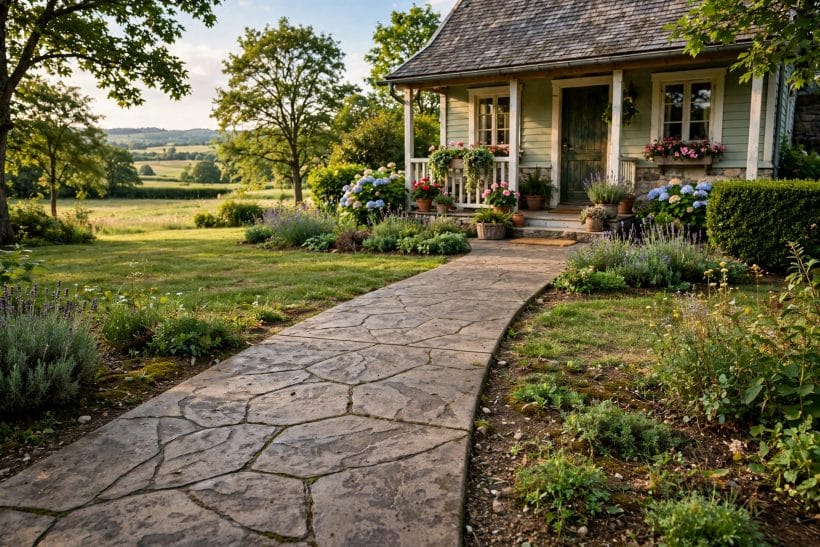
Tints widen the range without breaking the calm. Warm sandy tones suit brick and timber houses, while cooler greys sit well beside stone and painted weatherboard. A tint should be judged outdoors, in the light where the path will lie, and beside the actual house wall and soil. Colours chosen indoors under artificial light often surprise their owners on the first sunny morning, and a tint that looks rich in a sample can look loud across a whole route.
Pressed patterns add a further layer. A stamp pressed into the fresh surface can suggest stone flags or brickwork, giving the path a crafted appearance while keeping the continuity of a single pour. The pattern should stay subtle: a shallow, regular impression reads as texture, while a deep, high-contrast pattern can look like imitation rather than design. Where the walkway meets a patio of another material, the junction deserves the same restraint, and tiny house patio ideas show how a path and a sitting surface can meet without either pretending to be the other.
Weather changes colour too. Wet concrete darkens, shaded concrete stays muted, and sunlit concrete softens over time. Choosing a tone that looks right both wet and dry, and accepting that the surface will mellow, leads to fewer regrets than chasing a showroom shade. The most successful walkways are those whose colour feels inevitable beside the house, as though the path had always been there.
7. Joints, Edges and the Finished Line
Nothing separates a finished concrete walkway from an unfinished one so clearly as its joints and its edges. The control lines divide the slab into bays, and they should run straight and true, spaced evenly along the route. A joint that wanders or a bay that varies in length catches the eye at once, because the whole character of a poured path rests on its regularity.
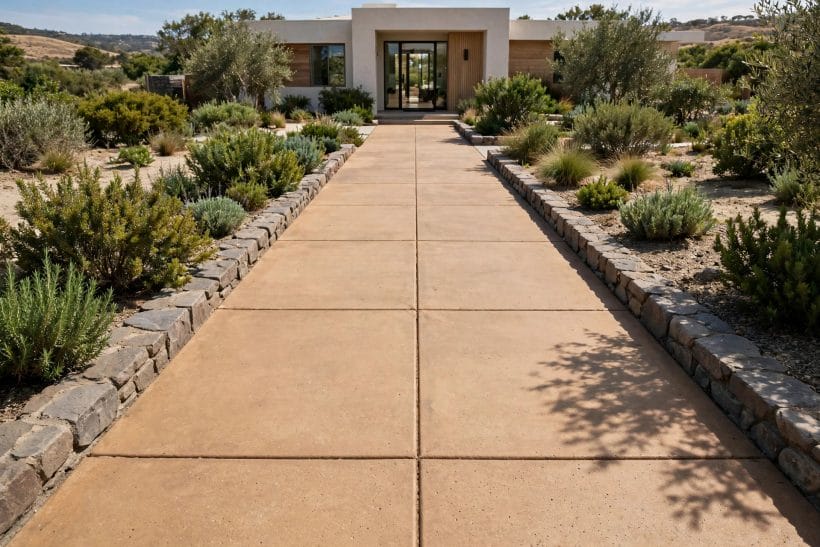
Edges carry the same discipline. A firm border, whether a low stone kerb, a timber edge or simply a neatly finished slab side, holds the line of the path against lawn or beds. Without it, soil and mulch wash onto the surface in rain, and the path loses its crisp outline week by week. The border is the line the eye follows and the part of the path most exposed to mowers, edging tools and feet stepping off the route, so it is the place to spend a little extra attention.
Planting beside the edge should be chosen with the same care. Low shrubs and grasses soften the line without hiding it, while vigorous ground cover that creeps across the surface makes the path feel narrower and less safe. Tiny house garden ideas offer planting that stays where it is put, framing the walk rather than colonising it. Fragrant planting near the path, lavender, rosemary or jasmine where the climate suits, rewards the walker without obstructing the way.
Where the walkway meets other surfaces, the edge needs equal care. The junction with a porch floor, a driveway or a garden step should be deliberate, level and safe, not an afterthought. A clean threshold, a short landing, or a change of finish can mark the meeting gracefully, and the levels should be checked so that no lip catches a toe or a wheel at the very point where attention relaxes.
8. Meeting the Door, the Gate and the Garden
A walkway is a sequence, and its two ends matter as much as its middle. At the gate, the path should announce itself clearly, wide enough to step onto comfortably, with a surface that reads as an invitation rather than an obstacle. At the door, it should arrive with a small landing, a place to pause, shake off rain and find the key, rather than stopping abruptly at the threshold.
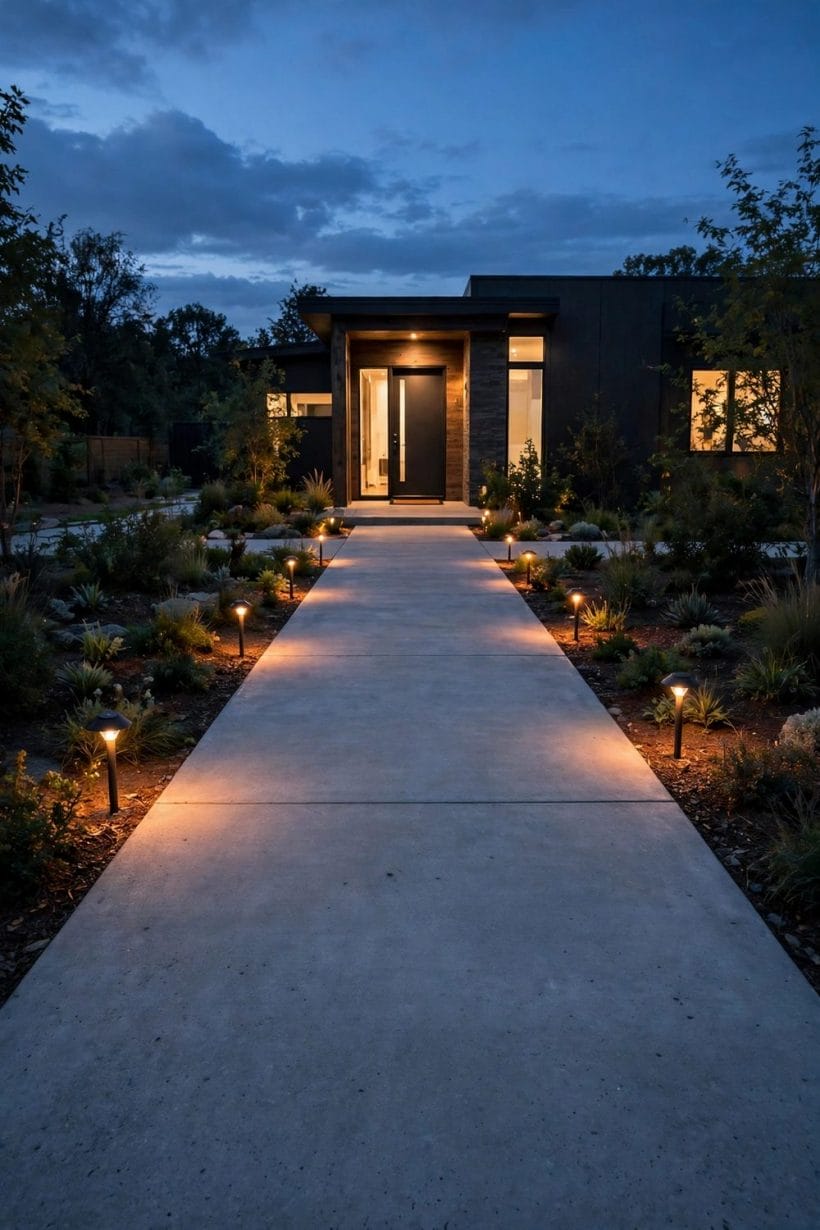
Shelter at the door changes how the path is used. A roof above the landing keeps the arrival dry and gives the walkway a natural destination, a roofed pause at the end of the route. Tiny house porch ideas show how that shelter can be shaped to the scale of a small house, so the landing feels like part of the home rather than an appendage. Where there is no porch, a wider landing and a well-lit doorway can serve the same purpose, giving the walker somewhere to stand that feels sheltered even in the open.
Between gate and door, the path meets the garden at every step. Planting that overhangs the route should be kept clear of head height and clear of the surface itself, since wet foliage dripping onto concrete makes it slippery and fallen petals stain pale surfaces. The best garden paths engage more than the eye: scent from nearby planting, birdsong from shrubs beside the route, and the sound of feet on a textured surface all belong to the walk.
Lighting completes the sequence. Low lights along the edge, or a lit doorway at the end, turn the walkway into a safe route after dark and show off the finish and colour that daylight revealed. Lights should wash the surface gently rather than glaring into the walker’s eyes, and they should be placed where they cannot be kicked or tripped over. A path that is welcoming after dark is a path that serves the house through the whole day, not only the sunny hours.
9. Water, Falls and the Threshold
Water is the quiet test of a concrete walkway. A path that sheds rain cleanly stays safe and stays clean, while a path that holds puddles grows moss, stains and ice in turn. The answer is fall: a gentle slope that carries water away from the house and off the surface, planned before the pour and checked as the work proceeds. The fall should be gentle enough that the walker never notices it, and certain enough that water never doubts where to go.
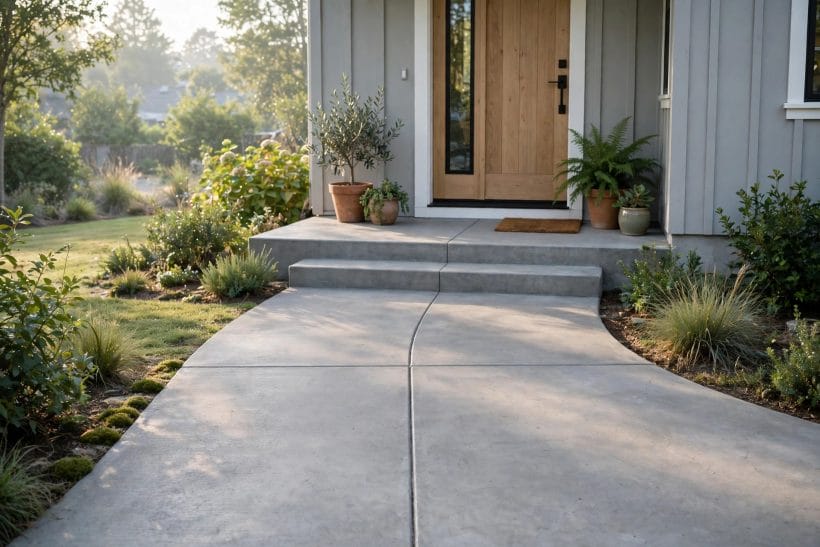
The threshold is where fall matters most. Water running toward the house will find its way under doors and into foundations, so the landing at the door should sit proud of the surrounding ground and shed water outward. Drains, channels and gaps in edging can help where a route crosses a low point, but they are details to be designed with the path, not remedies bolted on after the first heavy rain shows the fault.
The wider landscape shapes the answer too. A walkway does not drain in isolation; it drains into the garden around it, and the garden must be ready to receive the water. Backyard landscaping ideas show how planting beds, lawns and levels can work together, so that the path sheds its water into ground that welcomes it rather than onto a neighbour’s boundary or back against the house wall. Groundwork and drainage of this kind are professional matters, and the cost of getting them wrong far exceeds the trouble of planning them well.
Winter sharpens the lesson. Frost lifts a slab where water has pooled beneath it, and ice forms first where water lingers. A path that drains freely, with joints kept clear and edges that do not trap water, faces winter with far less risk than one that holds damp in its hollows. Spring is the season to walk the whole route slowly, noting any bay that has shifted, any joint that has opened, and any hollow that now holds water, and to have those faults put right before they grow.
10. Care Through the Seasons
A concrete walkway asks for modest, regular care rather than grand intervention. Sweeping keeps the surface clear and the texture open, and it takes only a few minutes when done often. Leaves left to rot on the surface stain pale concrete and feed moss in shaded stretches, so autumn sweeping matters most of all, especially under trees that drop heavily.
Winter brings its own cautions. Frost can lift a slab where water has pooled beneath it, and de-icing products should be chosen with the concrete in mind, since harsh treatments can mark or damage the surface. Gentle clearing, and a path that drains rather than puddles, do more for winter safety than any aggressive treatment. A plastic-edged shovel, used with care, clears snow without gouging the finish.
Summer care is mostly about the garden around the path: trimming overhang, keeping irrigation from constantly wetting one stretch, and enjoying the surface at its best. Tiny house landscaping ideas keep that surrounding care in proportion, so the path and its planting age together rather than one outgrowing the other. A walkway that is cared for in small, regular ways ages gracefully, its colour mellowing and its surface settling into the garden, rather than looking worn.
When a bay does crack or stain beyond what sweeping can fix, the concrete walkway shows its one real disadvantage against a path of separate units: repair means cutting out and re-pouring a section, not lifting a single piece. That is why the original groundwork matters so much, and why a well-prepared base is worth more than any surface dressing. Chosen well and laid well, a concrete walkway repays its owner with decades of quiet service, asking little and giving a great deal in return.
Final Considerations
Choosing a concrete walkway is choosing a path with a visible calm: one surface, one colour, one steady line from gate to door. The best examples share a few qualities: a route that suits the garden it crosses, a finish that grips in wet weather, a colour that sits quietly beside the house, joints and edges that hold true, and a fall that carries water away without fuss. Get those right, and the details take care of themselves.
Before committing, walk the route in all lights, mark its line on the ground, and picture the path wet, leaf-strewn and lamplit as well as clean and sunny. A walkway is used in every season and every weather, and the one that pleases in all of them is the one worth pouring. This survey is meant as a starting point for that decision, a gallery of forms to compare against your own garden, your own house and your own way of arriving home.



0 Comments