
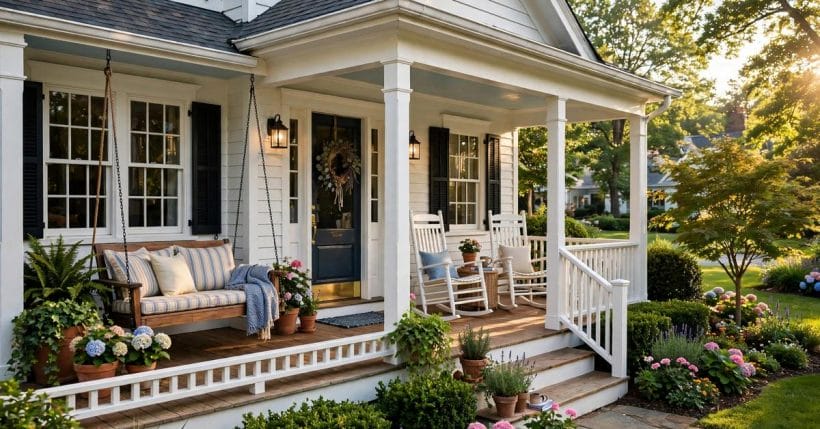
A porch railing is the handshake of the house — the first thing a visitor’s eye, and sometimes a visitor’s hand, actually meets.
These seventy-five wood railing porch ideas cover layouts, balusters, handrails, gates, furniture, swings and lighting, with the safety checks stated plainly at the end.
1. Wood Railing Porch Ideas at a Glance
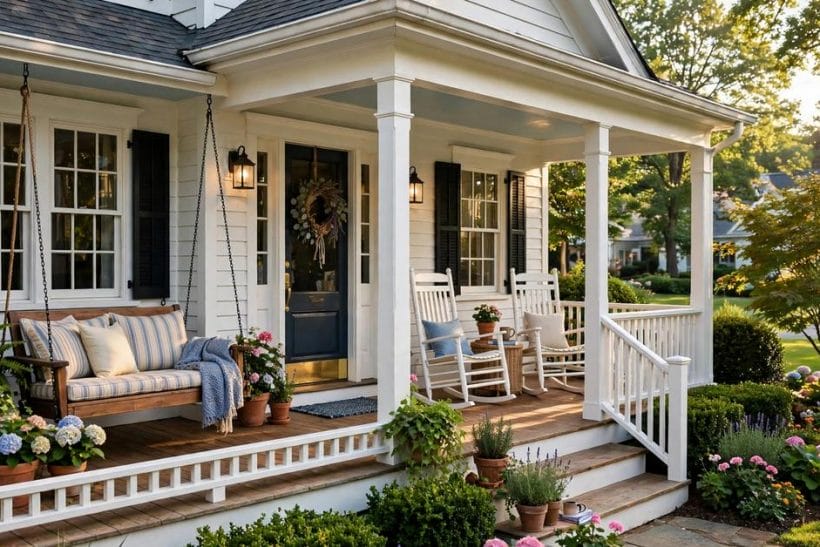
A wood railing does three jobs at once on a porch: it guards the edge, it frames the view from the chairs, and it carries much of the house’s character to the street. This post stays on the porch — an exterior railing on a raised deck-like platform — and belongs to the wider porch ideas family, not to the staircase posts it is sometimes shelved with.
| Question | Short answer |
|---|---|
| What makes a porch railing look right? | Proportion: a handrail at a comfortable height, balusters spaced evenly, and posts that align with the porch columns |
| Which wood suits a railing? | A durable, exterior-rated timber, finished and maintained for outdoor life — the local timber yard’s advice for your climate is the deciding voice |
| Are there rules for railings? | Yes — height, spacing and strength are covered by local building codes, which vary; check yours before building |
| Can a railing be partly open? | Many porches rail only the exposed edges and leave the entry run open, following the code and the porch’s height above ground |
2. Layouts and Proportions
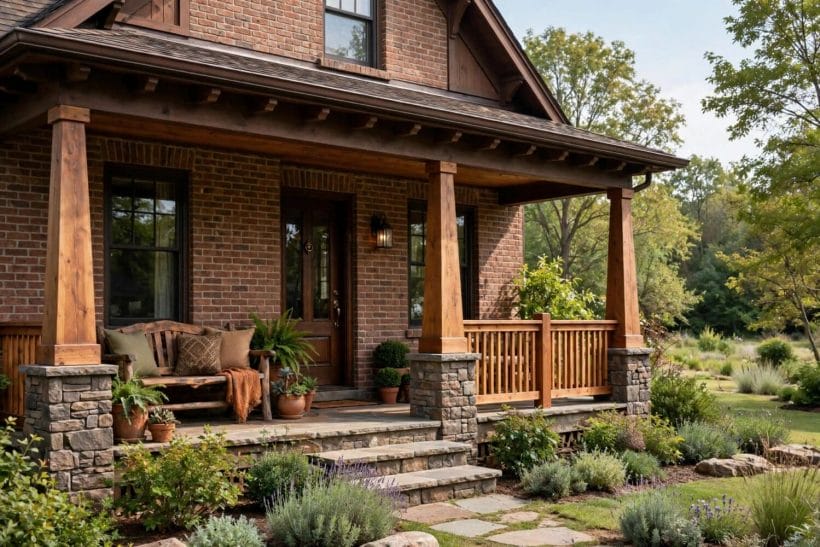
Get the layout right and even simple timber looks crafted: posts at the corners and at even intervals, a top rail that runs unbroken, and a bottom line that respects the porch floor’s edge.
1. A full perimeter railing with one open entry run
Rail every exposed edge and leave the steps’ run open for arrival: the classic arrangement, tidy from the street and welcoming at the door. The open run should line up with the front door’s path.
2. A railing only on the raised sides of a low porch
Where part of the porch sits near ground level, railing the higher edges and leaving the low side open keeps the porch relaxed and saves timber. Whether that is permitted depends on the drop and your local code — check first.
3. Half-railing panels between the porch columns
Running railing panels between existing porch columns uses the house’s own rhythm as the layout, so posts and columns share the work. The panels’ height should sit comfortably below the columns’ capitals.
4. A railing that steps down with the porch steps
Letting the railing follow the steps in level sections gives a crafted, architectural line. Each section stays level — only the junctions step — which is far easier to build well than a sloped wood rail.
5. A wide top rail that doubles as a shelf
A broad, flat top rail holds a coffee cup, a book or a row of small pots, and it is the detail visitors remember. Round its outer edge slightly so hands and cups both sit kindly.
6. A double-rail design with a mid rail for a cottage look
A second, lower rail halfway down the balusters gives cottage and farmhouse porches their friendly geometry. It also stiffens long runs of slender balusters visually and physically.
7. An asymmetrical layout keeping one corner open for chairs
Leaving the sunniest corner unrailed — where the porch is low and code allows — makes a natural chair nook that feels like a terrace. The railing’s end should finish with a proper post, never a raw cut.
8. A railing returned into the house wall at both ends
Returning the end panels into the house wall closes the composition and stops the railing looking like a fence that wandered in. A post against the wall carries the junction cleanly.
9. A low railing on a sleeping-porch style veranda
Deep verandas in the sleeping-porch tradition carry lower, simpler railings that keep the view from a daybed or hammock. Guarding duties still apply — low in style never means low where the code requires height.
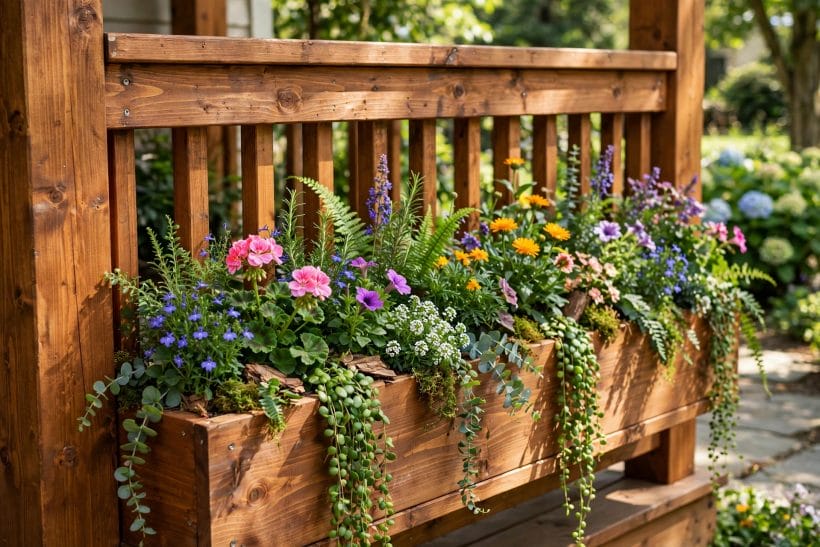
10. A railing with a built-in planter along its top
A planter trough integrated along the top rail plants the boundary between porch and garden. Keep drainage off the timber, or the prettiest idea on the porch becomes the first to rot.
3. Balusters, Spindles and Panels
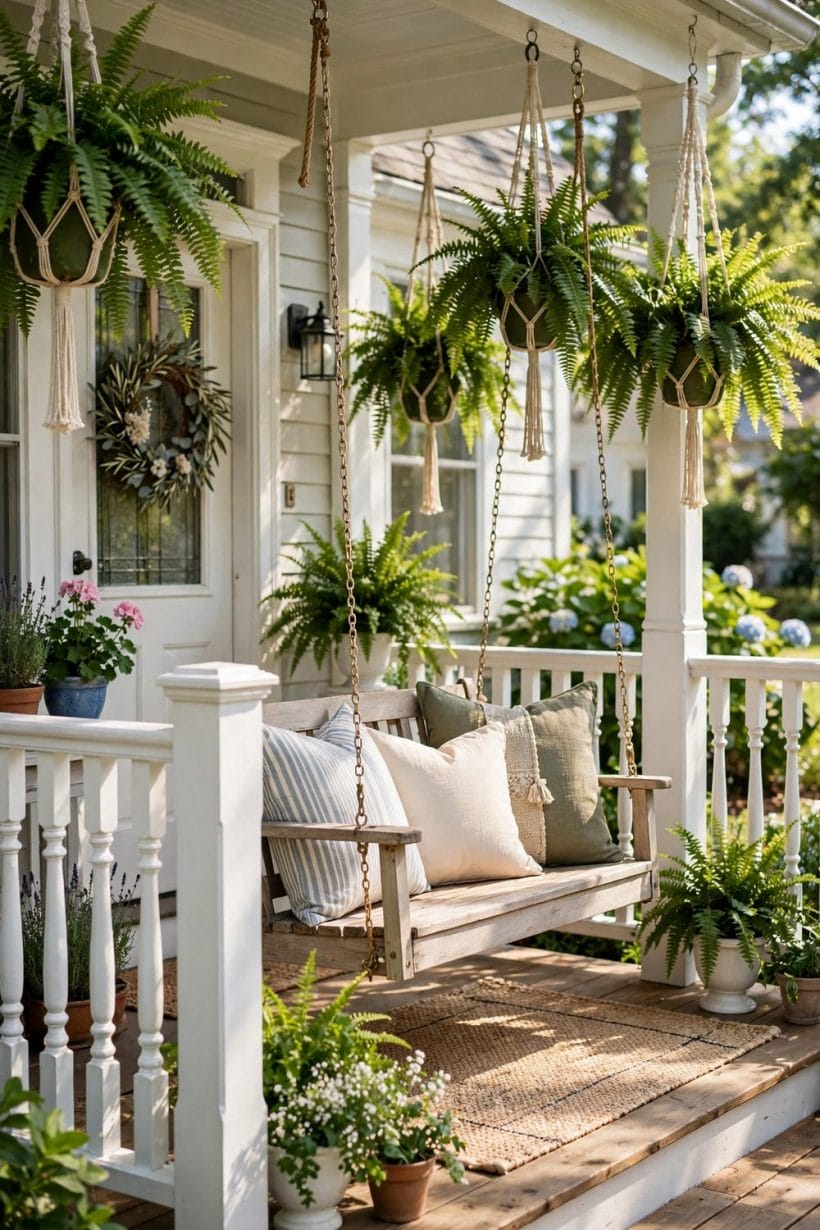
The infill is where a wood railing gets its personality: turned, square, crossed or boarded, it decides whether the porch reads formal, country or modern.
11. Classic turned spindles for a traditional porch
Turned balusters echo porch columns and Victorian trim, and they reward paint in a crisp light colour. Their curves collect weather, so the finish here works harder than anywhere else on the railing.
12. Plain square balusters for a clean, honest look
Square-section balusters are the farmhouse default: simple to make, simple to replace, and handsome in paint or stain. Even spacing is everything — one irregular gap shows from the street.
13. Wide flat balusters with a cut-out detail
Flat boards with a simple pierced shape — a diamond, a circle, a gentle arch — give folk character to a cottage porch. Keep the cut-outs modest so the boards keep their strength.
14. Cross-braced X panels for farmhouse character
X-braced panels between posts are sturdy-looking and quick to build, and they suit wide, low porches best. The crossing point is the visual centre, so centre it carefully in every panel.
15. Vertical board infill for privacy at a seating corner
Closely spaced vertical boards on one panel screen a seating corner from a close neighbour while the rest of the railing stays open. The porch gains a room-like corner without losing its air.
16. Horizontal slat infill for a modern porch
Wide horizontal boards read contemporary and pair with modern house lines. Exterior timber moves with the seasons, so slats need their fixings and gaps planned for that movement.
17. Chippendale-style lattice panels as the feature run
A fretwork panel on the front run only gives a formal porch its jewellery. It is the most demanding infill to build and maintain, which is exactly why one run is enough.
18. Slender metal balusters set into a wood top and bottom rail
Mixing slim dark metal balusters with warm wood rails lightens the whole railing and suits transitional houses. The wood still leads the character; the metal simply thins the screen.
19. Alternating wide and narrow balusters for rhythm
A patterned spacing — wide, narrow, wide — gives a plain railing a designed rhythm at no extra material cost. Lay the pattern out on the floor first and photograph it before committing.
20. Solid boarded panels on the windward side
Where a porch catches the prevailing wind, one or two solid panels make the sitting side usable on blustery days. Board the windward panels, spindle the rest, and the porch works in more weathers.
4. Top Rails, Handrails and Posts
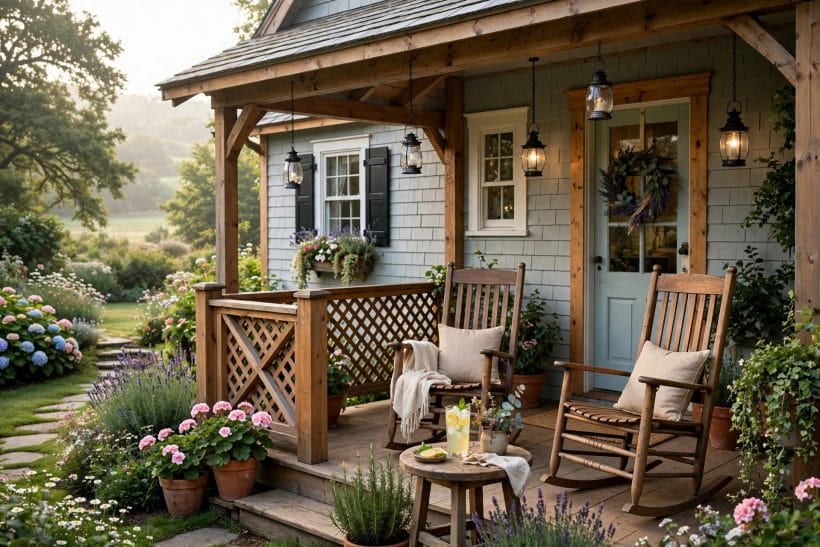
Hands judge a railing before eyes do. The top rail’s profile, the posts’ caps and the newel at the steps are the railing’s handshake, sleeve and shoes.
21. A rounded handrail profile that hands enjoy
A top rail shaped or sanded to a soft round is the difference between a railing people lean on and one they avoid. It is a small labour with a daily reward.
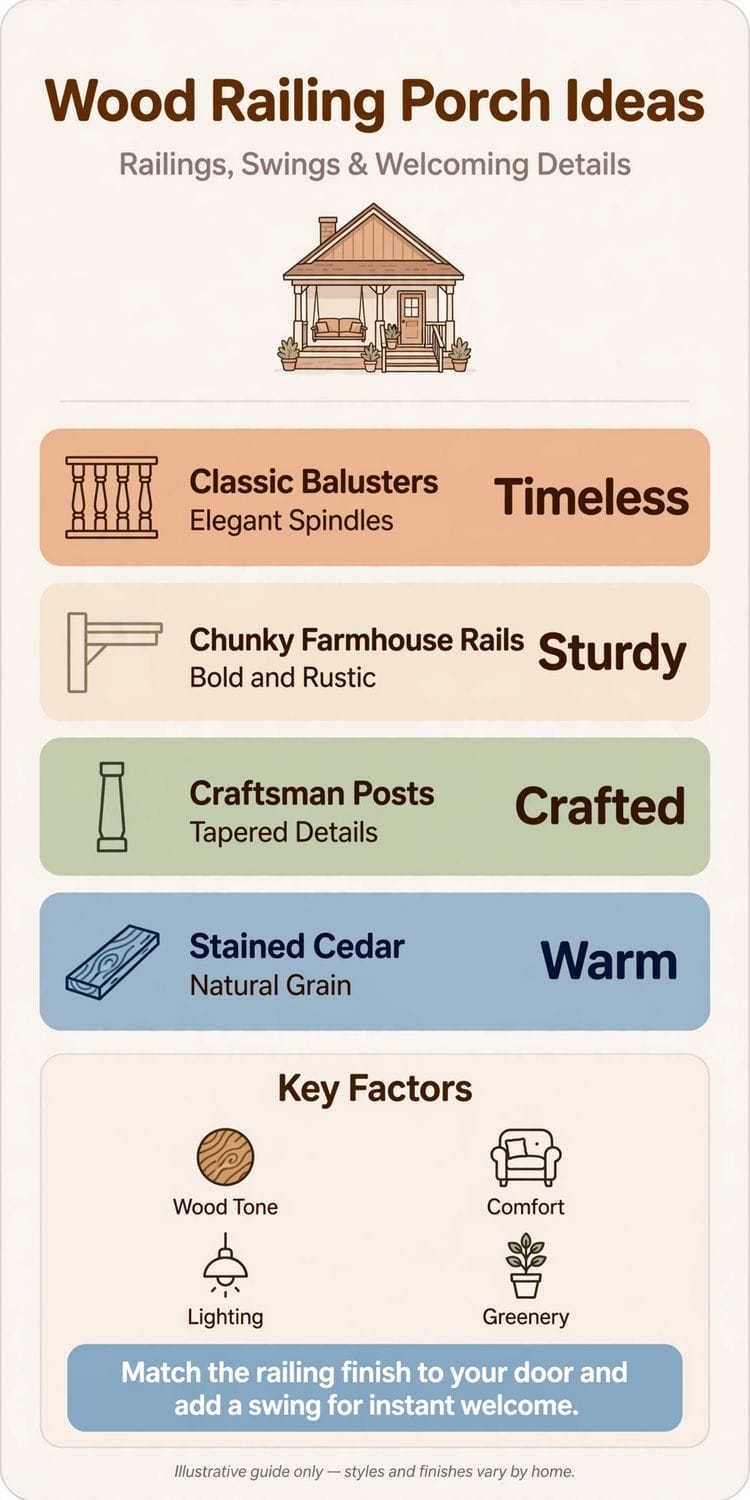
22. A chunky square top rail for a craftsman porch
Craftsman porches carry wide, flat, almost beam-like top rails, often with the posts rising slightly above them. The look is sturdy and honest, and it suits stain better than gloss paint.
23. Post caps in copper or painted wood
A cap sheds water off the post’s end grain — the railing’s most vulnerable point — and finishes the silhouette. Copper caps green with age; painted caps simply match, and both beat a raw flat top.
24. A substantial newel post anchoring the steps
The post at the steps takes hands, coats and the occasional bicycle: make it the biggest timber in the railing and fix it like you mean it. A ball or flat cap here is the porch’s full stop.
25. Posts aligned with the porch columns above
Where roof columns land on the porch, railing posts that share their spacing make one architecture of the whole front. Misaligned posts are the commonest porch-railing eyesore, and the easiest to avoid on paper.
26. A stained handrail over painted balusters
The two-tone railing — warm stained handrail and posts, painted spindles — gives contrast and hides hand-wear where hands actually go. It is the traditional scheme on many older porches for good reason.
27. A handrail returned neatly into the house wall
Where the railing meets the house beside the door, a returned end — mitred back into a wall post — finishes the run safely with no snagging end grain. Visitors’ sleeves will thank the detail.
28. Bench-height rail sections doubling as extra seating
On a deep, low porch, one section of railing built as a backed bench gives overflow seating for gatherings. It must still do its guarding job, so its height and strength follow the same code as the rest.
29. A gate in the railing line for garden access
A small gate where the porch meets a side path keeps the railing’s line unbroken while allowing passage. Hang it on exterior hinges, give it a latch a child cannot defeat casually, and match its infill to the panels.
30. Solar post-cap lights marking the railing’s corners
Cap lights on the corner and step posts give a gentle evening outline without wiring. Choose warm-toned caps and treat them as markers, not as the porch’s main lighting.
5. Steps, Entries and the Arrival Run
The railing’s hardest work happens at the steps, where hands look for support and the design meets the garden. This is also where the porch railing shakes hands with the staircase ideas and stair railing ideas posts — the exterior cousins of the same craft.
31. Handrails on both sides of wide porch steps
Wide steps deserve a rail each side: arrivals steady themselves, and the symmetry frames the front door. Keep the two rails’ heights and profiles matched exactly.
32. A single rail and a planted bank on low garden steps
For a short, low run of steps, one handrail plus a planted bank on the other side keeps the cottage informality. Local code decides whether one rail is enough — the planting never substitutes for a required rail.
33. Flared bottom steps with the railing splayed to match
Steps that widen at the bottom, with the railing posts splayed to follow, make the most gracious arrival a porch can offer. The flare also gives plant pots a natural stage either side.
34. A landing panel where the steps turn
Where porch steps turn a corner, a small level railing panel at the landing keeps hands supported through the turn. It is the detail that separates a built railing from a thoughtful one.
35. House numbers and a lantern on the newel post
The newel at the steps is the porch’s noticeboard: numbers readable from the street and a lantern for the evening belong there. Surface-fix both; the post’s strength is structural, not a mounting board.
36. A boot-scraper and mat recess kept clear of the rail
Arrival clutter — scrapers, mats, parcel boxes — should live inside the railing line, not leaning on it. A railing kept clear stays sound and looks cared for.
37. Contrasting nosing on the steps within the railing run
A pale or textured nosing strip on each step edge helps every visitor read the steps at dusk. It is a safety detail that costs little and photographs as a design line.
38. A railing gap aligned with a garden path, not the drive
Align the open run with the path guests actually walk, so nobody vaults the railing or cuts across planting. The porch, path and gate should tell one story.
39. Planting softening the railing’s outside face
A border planted against the railing’s outer face — grasses, lavender, low shrubs — softens the timber line and perfumes arrivals. Keep growth off the wood itself so air can dry the railing after rain.
40. A bench and hooks just inside the entry run
Just inside the railing’s opening, a small bench and a row of hooks catch bags, leads and umbrellas before they reach the door. The porch’s first metre becomes its hardest-working.
6. Furniture Behind the Railing
The railing frames the porch’s room; the furniture is the room. Arrange it for the view out through the balusters and the conversation inside them, as the arrangements in craftsman porch ideas demonstrate.
41. Rocking chairs angled toward each other behind the rail
Two rockers turned slightly inward make the porch’s classic conversation, with the railing as their shared outlook. Leave walking room behind them — rocking chairs travel backwards.
42. A porch sofa along the house wall facing out
A sofa against the house wall, facing the railing and the street beyond, gives the deepest seat on the porch. Cushions in outdoor fabrics echo the house’s trim colour for a composed look.
43. A dining table at the porch’s wide end
Where the porch widens, a table turns it into the summer dining room, and the railing becomes the room’s wainscot. Keep the table clear of the swing and steps’ traffic lines.
44. A daybed in the screened corner for afternoon naps
The corner panel’s shelter makes the natural daybed spot, with the railing at its foot. A washable throw and one good cushion are the whole furnishing.
45. Small side tables at every seat, without exception
A porch seat without a table beside it is a seat half-finished: drinks end up on the railing or the floor. Slim tables fit between chairs and keep the top rail for hands, not cups.
46. A storage bench hiding cushions from the weather
Porch cushions live short lives when left out; a bench with a dry interior doubles their seasons. Site it along the house wall where the roof’s drip line cannot reach it.
47. A tea trolley or bar cart for porch entertaining
A rolling cart turns any porch corner into a serving station and rolls away when the party ends. It is the flexible alternative to building a fixed counter against the railing.
48. Hanging baskets at the columns, clear of the railing
Baskets hung at the columns frame the porch from the street while leaving the railing’s own line clean. Water them with a can, not a hose jet, to keep the railing’s finish dry.
49. A rug under the seating defining the porch room
An outdoor rug under the chairs makes the porch a room and protects the floorboards from chair feet. Choose a flat weave that dries quickly after a driven rain.
50. A fireplace or fire-bowl corner on a deep porch
On porches deep enough to keep flames well clear of timber and furnishings, a fire bowl extends the porch season. Treat clearances, surfaces and local rules with complete seriousness — timber porches and fire are neighbours that need a fence of caution.
7. Swings and Hanging Seats
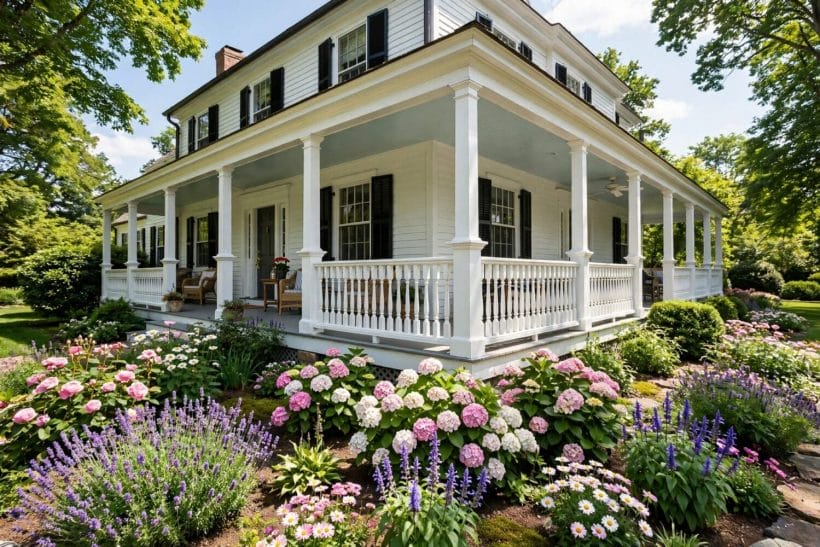
The porch swing is the railing’s natural partner: one guards the edge, the other rocks gently in front of it. Swing fixings belong in the porch’s structure, never in the railing.
51. A classic slatted porch swing facing the street
The traditional swing — slatted back, chain-hung, facing out through the railing — is the porch’s signature seat. Its swing arc must clear the railing comfortably, which sets the porch depth it needs.
52. A daybed swing at the porch’s quiet end
A wider, cushion-deep swing at the end bay gives a porch its holiday corner. Heavier than a standard swing, it deserves professional checking of its supports and fixings.
53. A pair of hanging chairs flanking the door
Two single hanging chairs either side of the door keep the middle of the porch open and give guests a gentle novelty. Their arcs, like the swing’s, are planned before the hooks go in.
54. Rope-hung swings for a coastal or cottage porch
Rope instead of chain softens the hardware and suits seaside and cottage schemes, and the rope’s knots become part of the craft. Exterior rope is a wear item — inspect and replace it on a schedule.
55. A swing painted to match the railing
One colour across swing, railing and trim composes the porch into a single photograph. The traditional choice is the trim colour; the brave choice is one deep accent used nowhere else.
56. Cushions and a throw making the swing a room
A swing with proper cushions, a back bolster and a throw stops being a garden ornament and becomes the house’s favourite seat. Store the soft things dry, as with all porch textiles.
57. A low table and rug completing the swing zone
The swing needs its own little territory: a rug under its arc and a table at its side. The railing behind completes the picture from the street.
58. A child’s swing seat on a sturdy porch corner
A small, properly rated child’s swing at a supervised corner delights the household’s smallest members. Its fixings and clearances get the same professional respect as the adult swing’s — more, if anything.
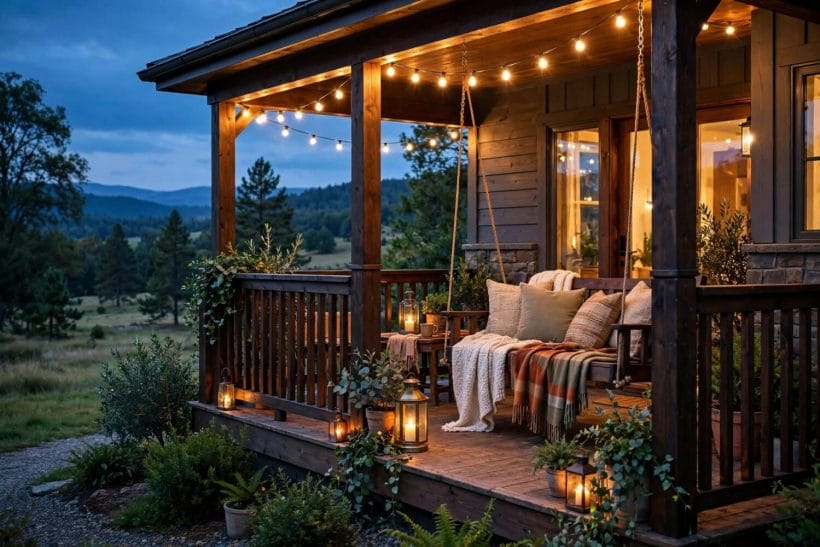
59. Evening on the swing: lanterns at the railing posts
A swing after dark, with low lantern light at the railing posts and a blanket, is the porch’s finest hour. Keep flames in proper lanterns and battery candles do the job with no risk at all.
8. Lighting and the Evening Porch
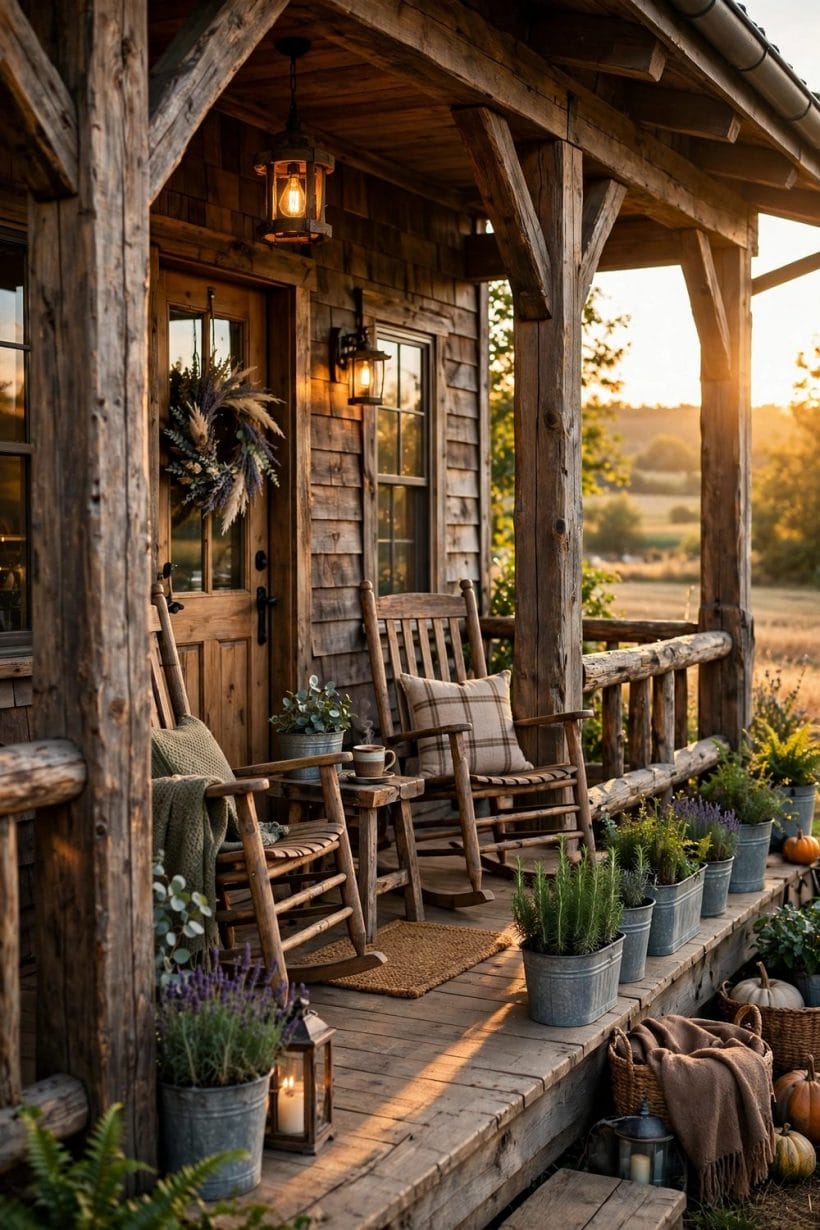
A porch is used most at the day’s edges, so its lighting is not decoration — it is what makes the railing, steps and seats work after sunset, a theme the front porch ideas post also develops.
60. A pendant or lantern centred over the seating
One good overhead light, warm and shaded, anchors the porch room and keeps faces kind. It should light the seating, not glare through the railing at the street.
61. Wall lanterns flanking the front door
The classic pair either side of the door lights arrivals’ faces and the key in the lock. Match their finish to the door hardware for a composed entry.
62. Step lights washing the treads within the railing
Low lights washing each tread make the steps safe and beautiful in equal measure. They are the highest-value lighting a porch can buy.
63. String lights along the porch beam, not the railing
Festoon lights belong on the beam or columns overhead, where they glow over the whole porch. Draped on the railing they tangle with hands and planting, and they cheapen the timber’s line.
64. A table lamp on the porch for a living-room feel
A weather-suitable lamp on the side table brings indoor comfort out and flatters everyone at the chairs. Battery lamps now do this with no cable across the floor at all.
65. Uplights in the border washing the railing’s face
Two soft uplights in the planting give the porch a gentle presence from the street and model the railing’s profile. Aim them at the porch, never at neighbours’ windows.
66. Candle lanterns grouped on the wide top rail
On the wide shelf rail, a group of enclosed lanterns is the evening styling the design promised. Enclosed is the operative word on a timber porch.
67. Motion-sensor light covering the steps for late arrivals
A discreet sensor light over the steps serves the practical hour — bins, late returns, guests leaving. Set it warm and brief so the porch’s calm survives it.
9. Colour, Plants and Welcoming Details
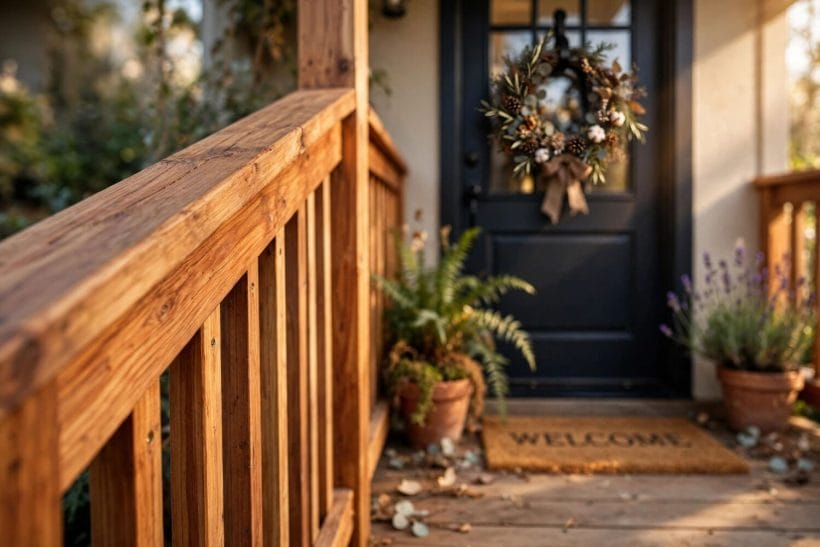
The last layer is the welcome: colour on the timber, green at its feet, and the small civilities that make a porch a household’s front parlour — the spirit of brick front porch ideas translated to a wood-railed porch, and of tiny house porch ideas at small scale.
68. A white painted railing for a crisp, classic front
White is the porch railing’s formal dress: it frames dark doors, green planting and coloured cushions perfectly. It also shows every mark, so it suits households that enjoy a paintbrush.
69. A stained railing showing the wood’s grain
Stain keeps the timber’s character visible and forgives the knocks of porch life more kindly than paint. Re-staining is the railing’s regular renewal, planned like a haircut, not a rescue.
70. A railing painted the door’s colour for one bold line
Matching railing and front door in one deep colour — green, red, ink blue — draws a single confident line across the house’s face. Keep the rest of the porch pale and let the line sing.
71. Planters on the porch floor inside the railing
Big pots inside the railing, at the posts’ feet, green the room without loading the top rail. Group them in threes and vary the heights, as florists do.
72. A wreath and seasonal dressing on the railing’s end post
The end post by the steps is the porch’s seasonal display point: wreath, garland, a basket of spring bulbs. Surface-hung and temporary, it never scars the timber.
73. House-name or number plaque on the railing gate
A small plaque on the gate or end post gives the house its signature at hand height. It is the detail delivery riders and first-time guests are quietly grateful for.
74. A doormat, a bench and a dog bowl: the working welcome
Hospitality is practical before it is pretty: somewhere to wipe feet, sit with parcels, and water the dog. A porch that handles arrivals gracefully is remembered longer than a merely beautiful one.
75. The full welcome: railing, light, green and a seat
The finished porch combines everything — a sound railing, a lit step, planting at its feet and a seat that invites lingering. None of it is expensive; all of it together is the difference between a house’s edge and a household’s embrace.
10. Safety, Code and Care Checks
A porch railing is a safety device with good manners, and its rules live in your local building code: the height of the rail, the spacing of balusters so a small child cannot pass through or become trapped, the strength of posts and fixings, and when a railing is required at all for a porch of a given height. Those requirements vary by place and they change, so this post states them generally on purpose — before building or replacing a railing, check the current local code or ask a local builder or inspector, and treat anything you read online, including here, as a starting conversation rather than permission.
Care is simpler. Exterior timber railings want an annual walk-around: finish peeling, soft spots at post bases and bottom rails, loose balusters, and fixings working proud. Paint and stain are the railing’s weatherproofing, renewed before they fail rather than after; end grain and horizontal surfaces fail first. Keep soil, mulch and planting off the timber, wash the railing down each spring, and tighten or replace anything that moves when it should not. A railing that is looked at yearly rarely surprises anyone — and a sound, handsome railing, like the porch it guards, repays the attention every single day.
Final Considerations
Measure twice, check the local code once more, and build the railing the porch deserves: posts where the columns land, a handrail a hand enjoys, and infill that suits the house’s character. Then furnish the room it frames, light the steps it guards, and plant at its feet. A wood railing asks for a yearly walk-around and an occasional coat of finish, and in exchange it gives the house its handshake, its picture frame and its welcome — seventy-five ideas deep, and every one of them starts with sound timber, honestly built.


0 Comments