
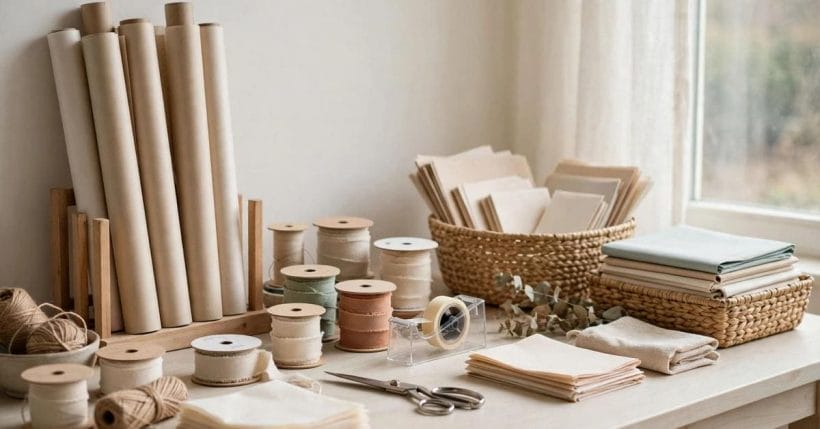
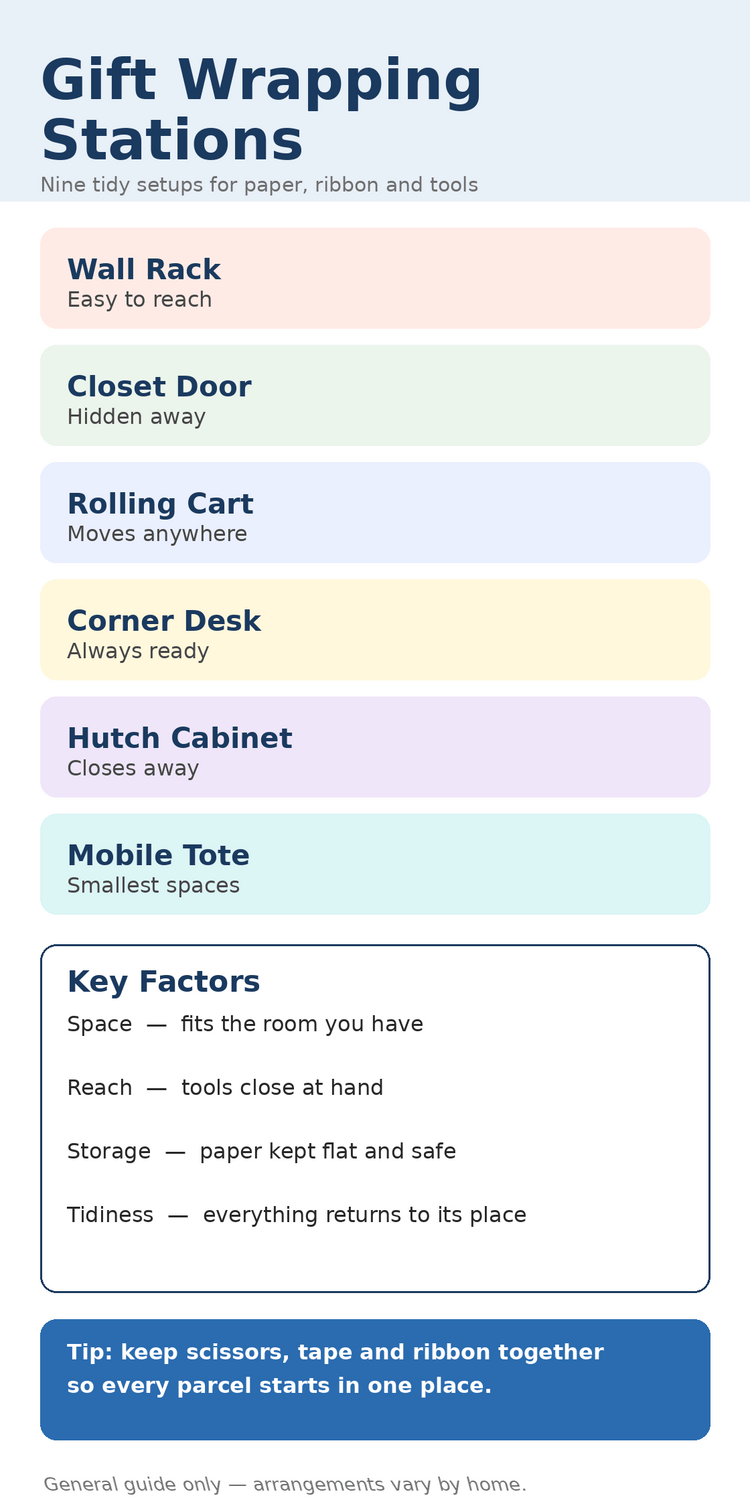
A good gift wrap station turns a scattered pile of paper, ribbon and tape into one calm place where every parcel begins. When the supplies live together, wrapping stops being a hunt through cupboards and drawers, and it becomes a short, pleasant job that can be finished at the table in one sitting. The stations below all work on the same simple idea, whether they fill a whole spare room or hide behind a door: paper kept where it will not crease, ribbon where it can be seen, and small tools where they can be reached without searching.
The best station for a home is the one that fits the room it lives in, not the largest one in the pictures. A small home may suit a cart that rolls away or a tote that lifts off a shelf, while a spare room may suit a table that stays set up all year. Think first about where parcels are usually wrapped, how much paper is kept at once, and who else uses the room. A station that blocks a doorway or crowds a sleeping space will be abandoned, however tidy it looks on the day it is made.
Every station below keeps the same small kit together: rolls or folded sheets of paper, ribbon and twine, tape, scissors, tags and a pen. Nothing here needs specialist skill or a dedicated room, and anything that involves fixing heavy fittings to a wall is best left to someone experienced with that kind of work. As with tiny house storage ideas elsewhere in the home, the aim is storage that earns its space every week, not storage that only looks good when it is empty.
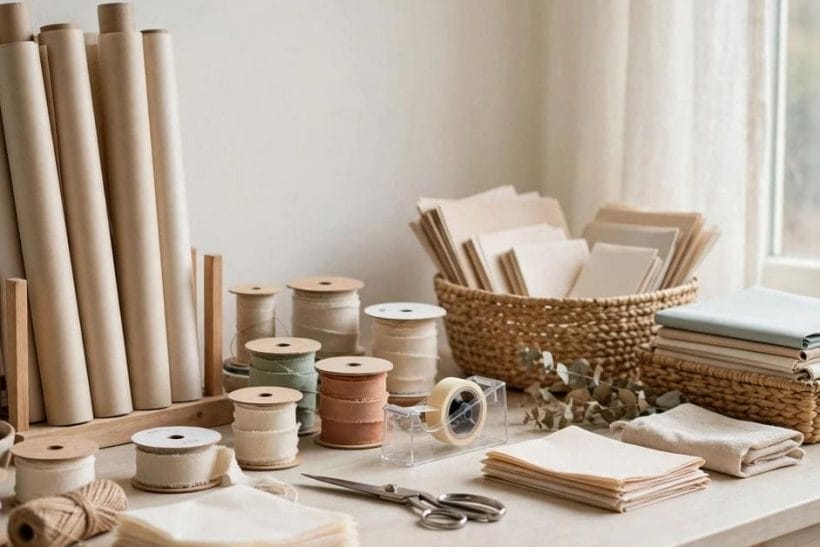
1. Spare-Room Table Station
A spare-room table is the most generous of the nine stations, because the whole surface can stay set up between parcels. Paper stands upright in a rack or basket at one end, ribbon spools sit in a row along the back, and the middle of the table stays clear for measuring, folding and tying. Keeping the table in a room that is not needed every day means a half-finished parcel can wait overnight without being moved, which suits larger parcels and paper crafts that take more than one sitting.
The habit that keeps a table station working is a clear middle. When finished parcels, incoming post and everyday clutter all drift onto the table, the wrapping space disappears and the station stops being used. A tray at each end helps: one for paper and ribbon waiting to be used, and one for finished parcels waiting to be collected. The table itself can be any sturdy table already in the home, and a washable cover protects its surface while paper is cut and folded.
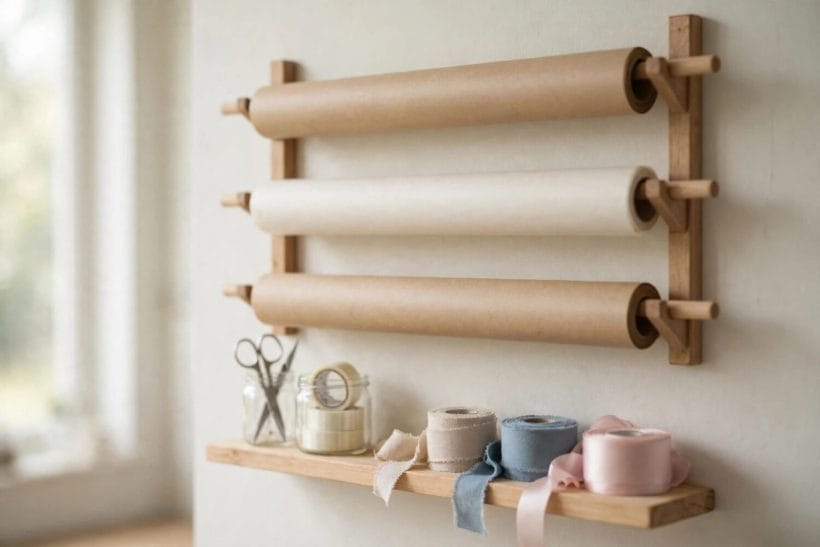
2. Wall-Mounted Roll Rack Station
A wall-mounted roll rack turns an empty stretch of wall into the heart of a wrapping station. Rolls hang horizontally on dowels or stand in a wall rack, so each roll can be pulled down, measured and cut without unrolling the whole lot across a table. Ribbon spools, scissors and tape live on a shelf below, which keeps the small tools at hand level and the paper above them. The arrangement suits a craft corner or a utility wall where floor space is scarce but wall space is free.
Because the paper is on show, this station rewards a small, well-chosen collection rather than a large one. A handful of plain and patterned papers that work together looks calmer than a wall crowded with rolls that are rarely used. As with small living room ideas in a shared room, the rack should sit where it will not be knocked by passing traffic, and heavy wall fittings should be fixed securely by someone experienced, so the rack stays steady when rolls are pulled.
3. Tabletop Tray Station
A tabletop tray station is the smallest fixed station of the nine, built around a tray or basket that lives on a table that is used for other things as well. The tray holds the essentials for one parcel at a time: a roll or two of paper, a spool of ribbon, tape, scissors and tags. When wrapping begins, the tray moves to the centre of the table, and when the parcel is finished, the tray returns to its corner and the table is free again.
This station suits homes where no surface can be given over to wrapping full time. Its strength is also its limit: it only works if the tray is kept small and complete. A tray that grows into a box of every paper ever bought becomes heavy and awkward, and it stops being lifted out at all. Choosing a few papers that suit most occasions, and returning the tray to the same place after every use, keeps the station ready without taking over the room.
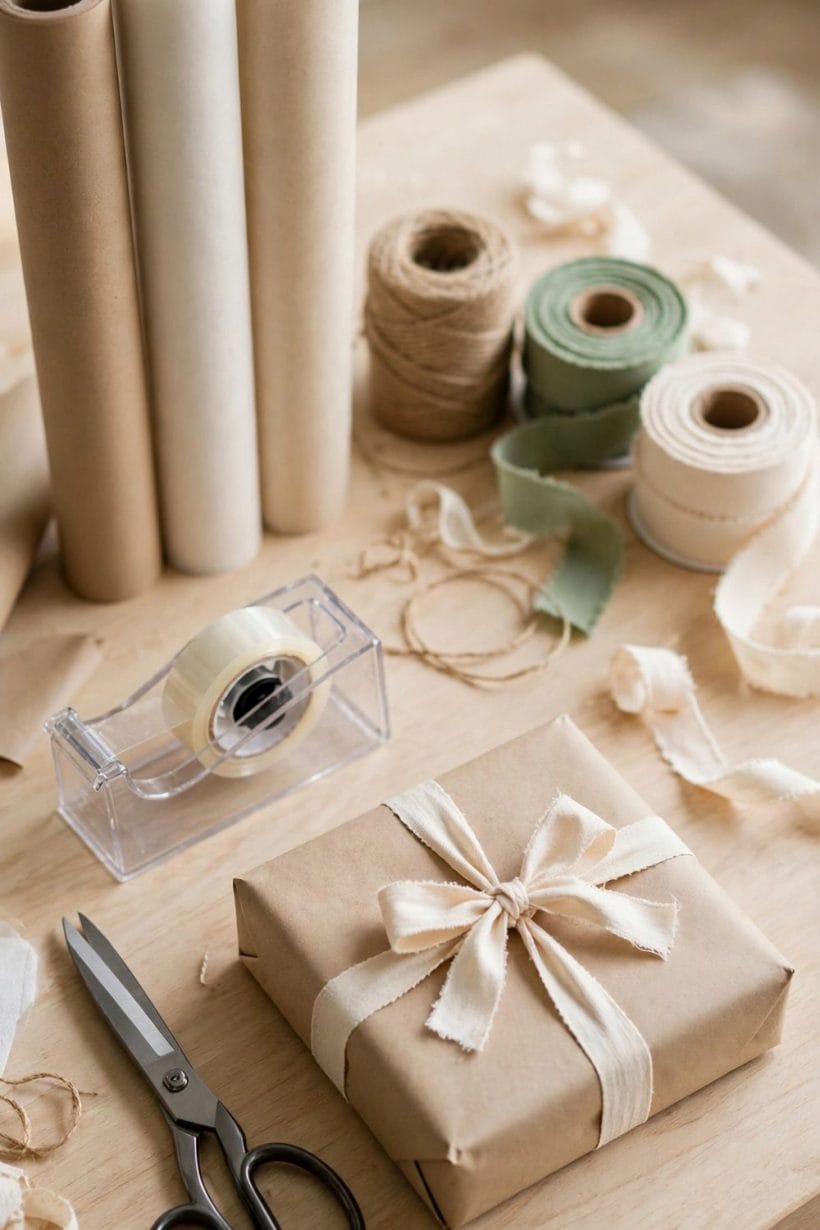
4. Closet-Door Station
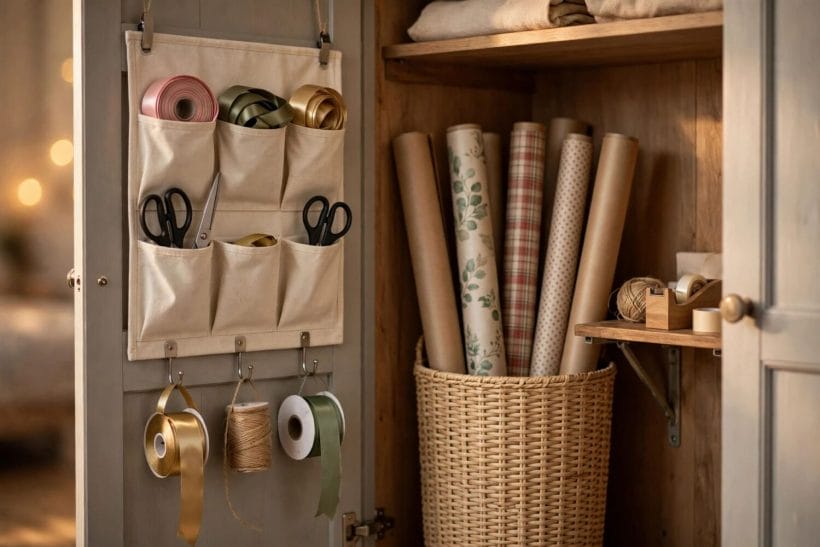
A closet-door station hides the whole kit behind a door that is already there. Pockets or hooks on the inside of the door hold ribbon, scissors and tape, while rolls stand upright in a tall basket or bin inside the closet, and a small folding shelf gives a surface for tying ribbon. With the door closed, nothing about the station shows in the room at all, which suits bedrooms and hallways where a wrapping display would feel out of place.
The door is the working part of this station, so it deserves care. Hooks and pockets should hang where they do not catch on clothes or stop the door closing, and the basket of rolls should stand where it can be lifted out without everything else falling over. As with tiny bedroom ideas for small sleeping spaces, keeping the kit slim matters more than keeping it large: a closet station that still closes easily will be used, while one that bulges and jams will be left shut.
5. Rolling Cart Station
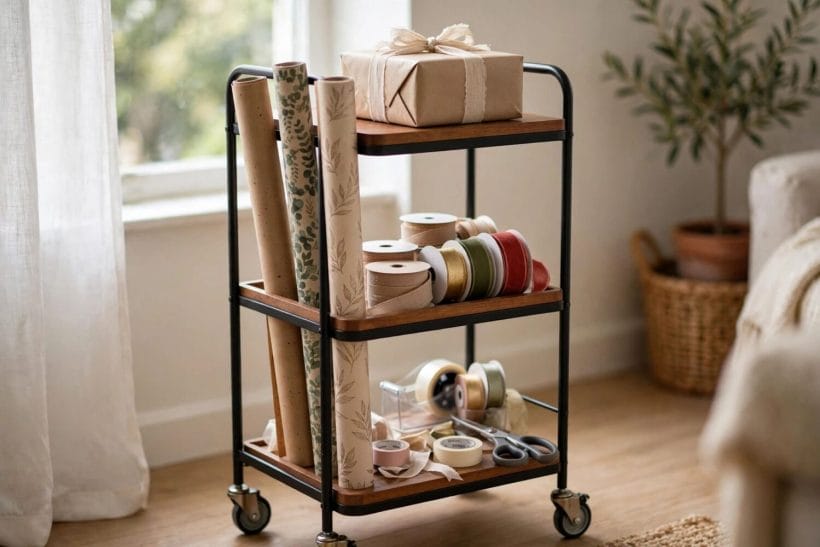
A rolling cart station carries the whole kit to wherever there is room to wrap. Paper rolls stand upright on the cart, ribbon spools sit on a middle tray, and tape, scissors and tags rest on the lowest tray, so the cart can be wheeled to a table, used, and wheeled back to its corner. It suits homes where the wrapping surface changes with the season or the occasion, and where a fixed station would block a room that is needed for something else.
A cart works best when its trays are given fixed jobs and those jobs do not drift. Paper on one level, ribbon on another and tools on the last means nothing has to be hunted for when the cart arrives at the table. As with tiny house interiors generally, wheels that lock keep the cart steady while paper is cut, and a cart that is parked in the same corner after every use is far easier to find than one left wherever the last parcel was wrapped.
6. Corner Desk Station
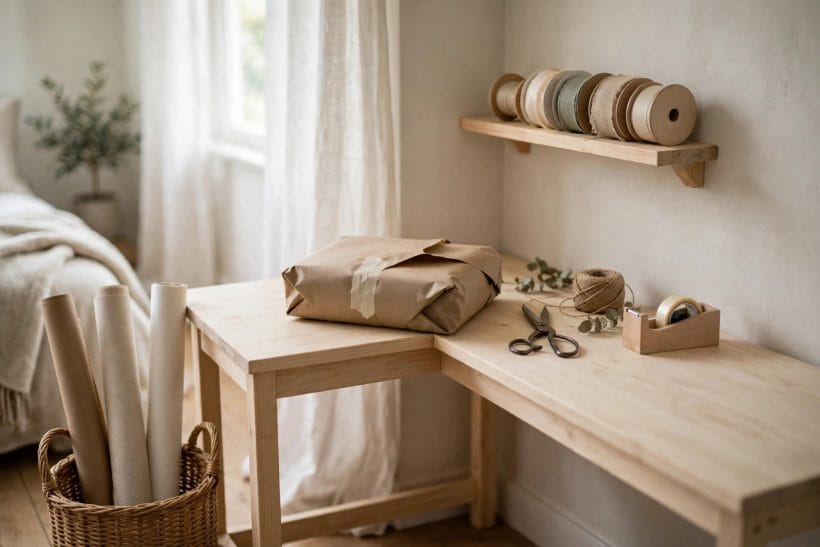
A corner desk station gives wrapping a permanent home in a corner that would otherwise sit empty. An L-shaped or small corner desk holds a parcel comfortably, a shelf above keeps ribbon spools in view, and a basket beside the desk holds rolls upright where they will not crease. Because the desk is always set up, wrapping can begin at once, which suits households that wrap often and like to keep paper crafts and card-making supplies in the same place.
The corner is what makes this station feel roomy without taking much floor. Light from a nearby window helps with matching paper and ribbon, and a chair that tucks under the desk keeps the corner tidy when the station is not in use. As with home office ideas for a shared work corner, the desk should keep one clear rule: the wrapping surface stays a wrapping surface, and everyday papers and parcels waiting to go out live in a tray rather than spreading across the desk.
7. Hutch Cabinet Station
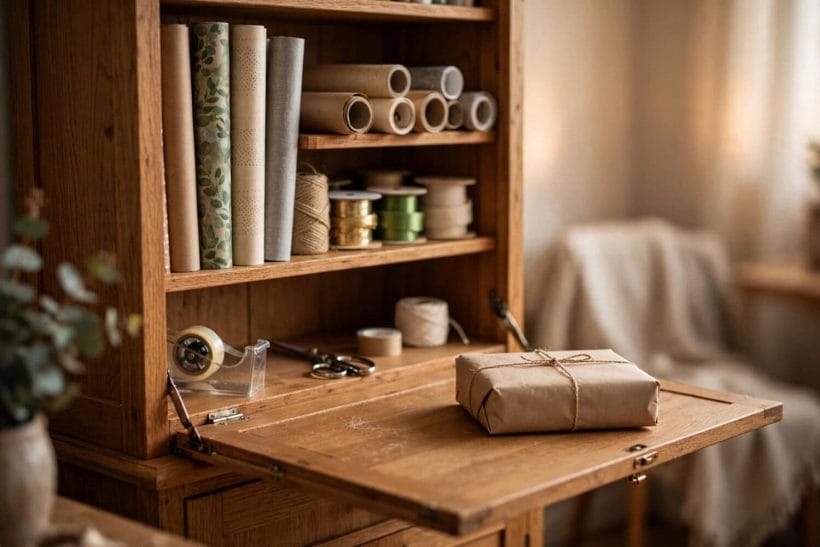
A hutch cabinet station closes the whole kit away inside a piece of furniture that looks at home in a living room or dining room. Shelves inside hold paper rolls upright, ribbon and twine in a row, and tape and scissors within reach, while a fold-down surface gives a table for wrapping that folds back up when the parcel is done. With the doors or front closed, the room shows only a cabinet, which suits homes where a wrapping display would clash with the rest of the furniture.
The fold-down surface is the part to judge before choosing this station. It should be deep enough for the largest parcel usually wrapped, and sturdy enough to lean on while paper is folded and ribbon is tied. Keeping the heaviest rolls low in the cabinet and the small tools on the fold-down surface itself means the station opens ready to use, rather than needing half an hour of unpacking before the first fold.
8. Pegboard Wall Station
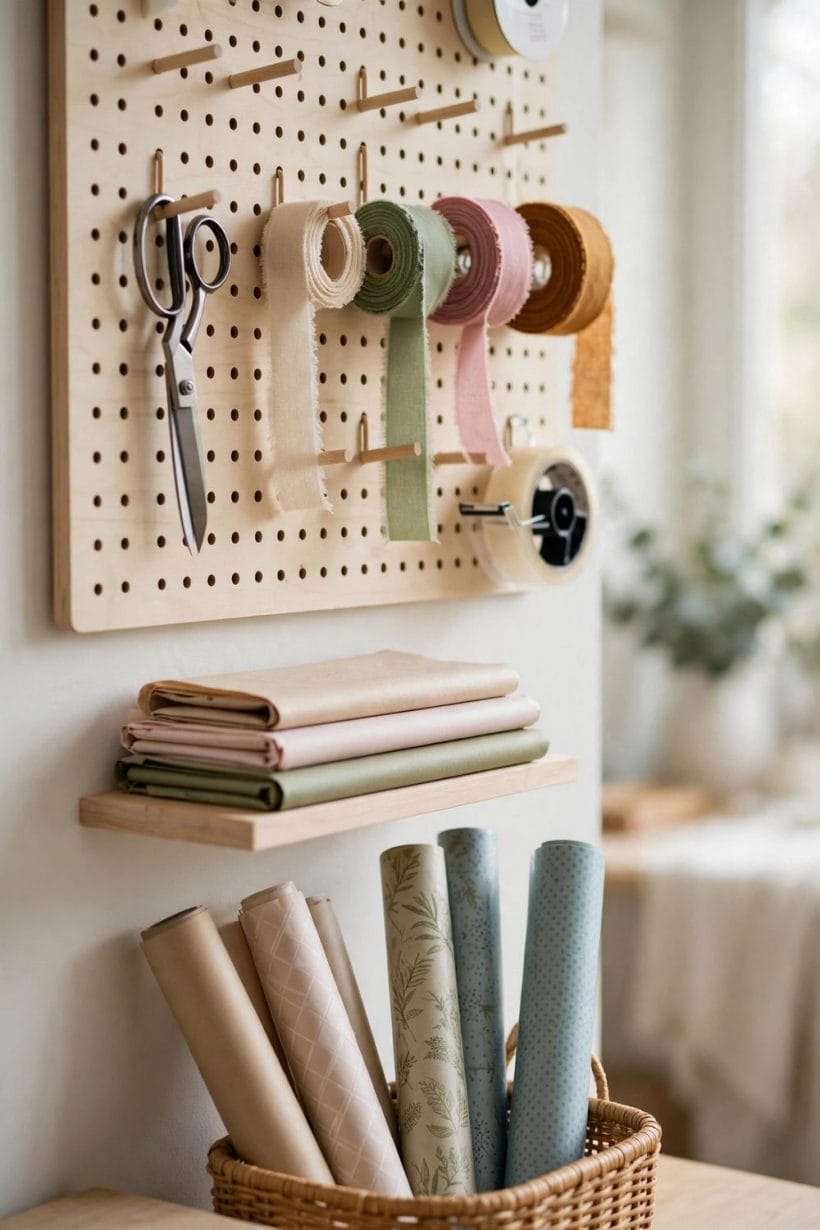
A pegboard wall station hangs the small tools where they can be seen and reached, with paper kept below. Hooks on the board hold scissors, ribbon spools and tape in plain sight, a shelf beneath holds folded paper, and a basket below that holds rolls upright. Seeing everything at once makes this station quick to use, because the right ribbon can be picked without opening a box or drawer, and anything missing is noticed straight away.
Pegboard suits craft supplies as well as wrapping, since paper, card and ribbon for small paper crafts can share the same hooks and shelves. The board should hang at a height where the most-used tools are reached without stretching, and sharp tools should hang where small children cannot reach them. A board that is kept to the tools actually used stays a pleasure to look at, while a board loaded with every spare item becomes a wall of clutter that is hard to use.
9. Mobile Tote Station
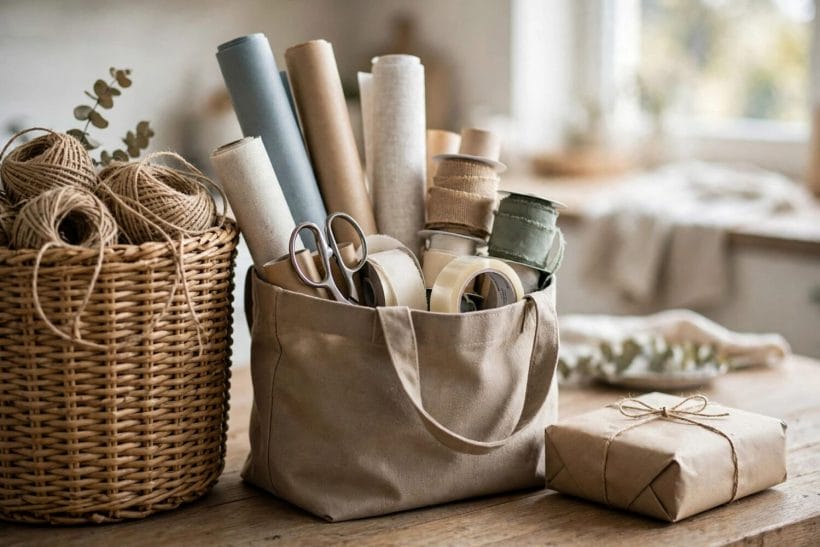
A mobile tote station is the lightest of the nine, built around a basket or tote bag that carries the kit from shelf to table and back again. Rolls, ribbon, tape, scissors and tags travel together in one container, so wrapping can happen at the kitchen table, in a spare room or wherever there is a clear surface that day. It suits the smallest homes, shared homes and anyone who wraps only now and then, because the station needs no wall, no desk and no corner of its own.
Because the tote is carried, its weight and size matter more than in any other station. A tote that is packed full of every paper owned becomes too heavy to lift and too awkward to set down, so the kit should stay small: a few versatile papers, two or three ribbons, and the small tools. As with kitchen ideas for a room that serves many jobs, the tote earns its shelf by returning to the same place after every use, ready to be picked up for the next parcel.
10. Keep the Station Tidy All Year
This is not a tenth station, but the habit that keeps the nine stations above working. Paper that is returned to its rack, basket or tote after every parcel stays flat and ready, while paper left on a table creases and tears. Ribbon that is wound back onto its spool does not tangle, and scissors and tape that go back to the same hook, tray or pocket are found at once next time. A short tidy-up at the end of each wrapping session takes less time than a long search before the next one.
Once in a while, the whole kit deserves a look through. Papers that no longer suit the household, ribbons that have run nearly to the end, and tags that have lost their mates can be set aside, leaving a smaller kit that is easier to store and quicker to use. A station that is reviewed now and then stays matched to the home it serves, whether that home wraps parcels every week or only a few times a year.
Final Considerations
Choosing between the nine stations comes down to three honest questions: how much space can wrapping have, how often parcels are wrapped, and whether the kit should be seen or hidden. A gift wrap station that is always ready suits frequent wrapping, a station that closes away suits a shared room, and a tote suits a home where space is shared and flexible. There is no single right answer, and the right station may change as a home changes.
Start small, with the kit that is already in the home, and let the station grow around what is actually used. A tray, a basket or a cart that is used every week is worth more than a grand setup that is admired once and avoided afterwards. Keep paper flat, ribbon visible, tools together and the working surface clear, and whichever of the nine stations is chosen will make wrapping calmer, tidier and far more enjoyable.
Whichever station is chosen, it will only stay useful if it is easy to reach and easy to put back. A station tucked at the back of a crowded cupboard will be forgotten, while one kept in its usual place, with its kit complete, invites use. Give the station a fixed home, keep its kit small and complete, and wrapping will stop feeling like a chore that needs preparation and start feeling like a short, satisfying part of giving.


0 Comments