
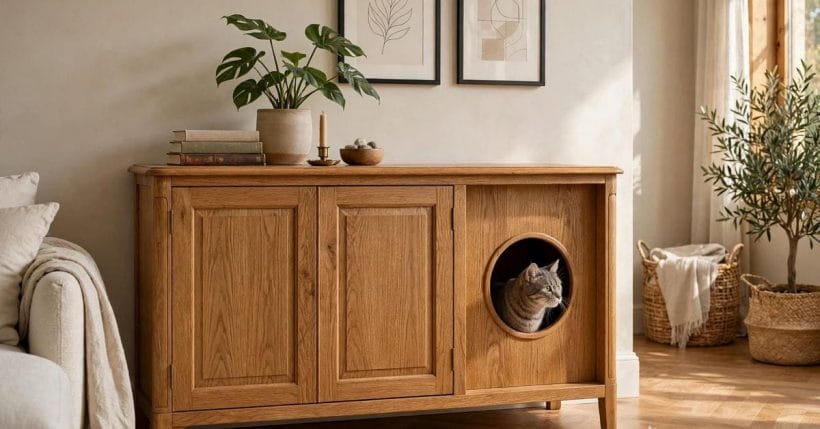
Every cat household knows the negotiation: the litter tray is essential, and it is also the least lovely object in the home — a plastic landscape of grit that announces itself to eyes and noses alike. The good news is that a tray does not have to live in the open. With a little furniture thinking, it can disappear into a cabinet, a bench or a cupboard the room already wanted.
These fifteen design-friendly places to hide the cat litter box cover furniture enclosures, benches and built-ins, bathroom and laundry cupboards, and disguises in plain sight — chosen with the cat’s comfort and the household’s hygiene kept honestly in view throughout, because a hidden litter box only works if the cat happily uses it and the people happily clean it.
1. Hidden Litter Box Places at a Glance
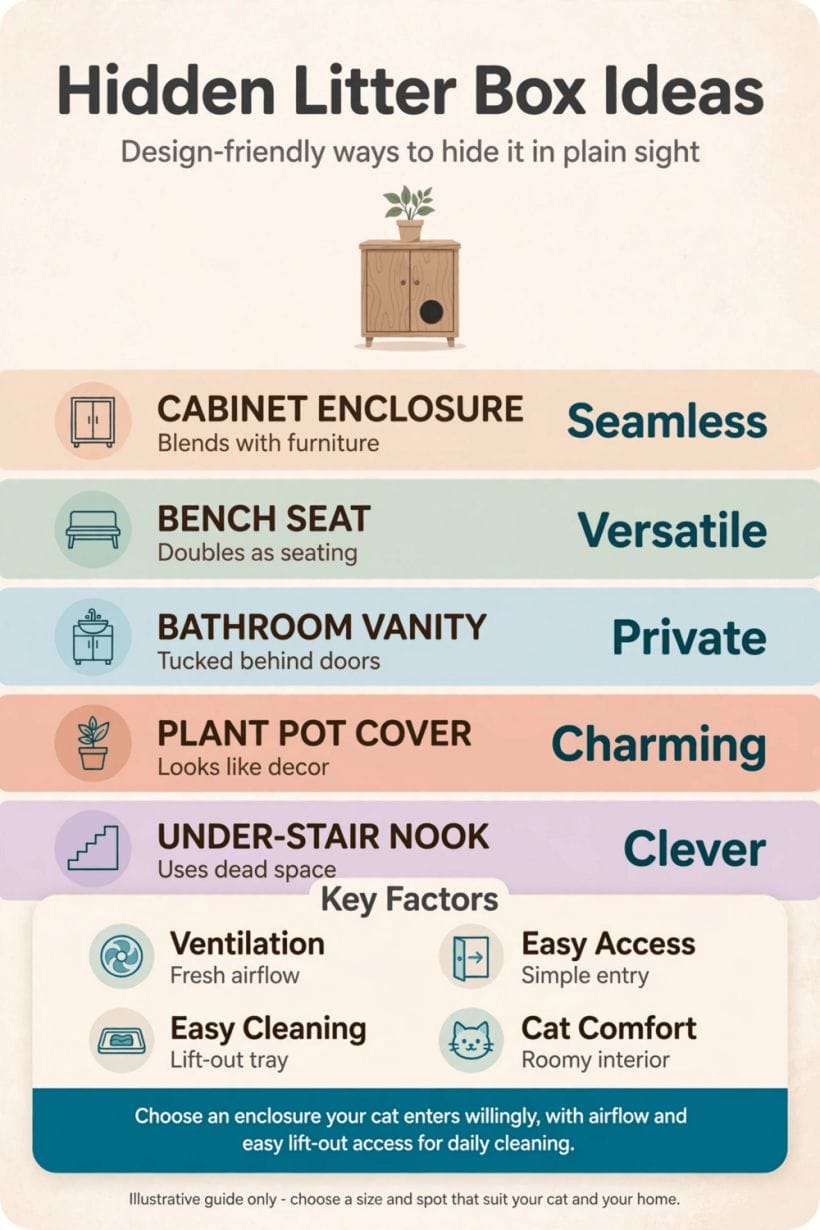
A hidden litter box is a tray given a room of its own inside a piece of furniture: an enclosure with an entrance the cat can use confidently, air that can move, and access a human can clean through without a wrestling match. This post gathers the fifteen places honestly — furniture first, then benches, bathrooms, built-ins and disguises — alongside the wider small-space storage thinking in tiny house storage ideas, because a litter hide is, at heart, a storage problem with a cat in it. The rules that govern all fifteen are the infographic’s key factors: ventilation, easy access, easy cleaning and cat comfort — and they outrank cleverness every time. A beautiful hide the cat refuses is just a cupboard; a plain one the cat loves is a success. Choose the place by the cat first and the room second, and the design will follow.
| Question | Short answer |
|---|---|
| What makes a litter hide work? | An entrance the cat uses confidently, room to turn and dig, moving air, and human access that makes cleaning effortless — design serves those four, never the reverse |
| Which rooms suit it best? | Laundry rooms, bathrooms and halls lead, because they already handle the household’s washing and coming-and-going; living rooms work with furniture enclosures |
| How many entrances? | Generally two routes are kinder than one where space allows — a cat that never feels cornered in its own bathroom stays a confident user |
| What about smell? | Honestly: hiding contains sight, not scent. Ventilation, suitable litter and a daily scoop do the real work — no cabinet repeals them |
| What does it cost? | Drivers only: whether the hide is bought, built or converted from furniture already owned, plus mats, liners and the litter itself |
2. Furniture Enclosures: Cabinets, Sideboards and Screens
Furniture is the first place to look, because the room was going to have furniture anyway. An enclosure earns its floor space twice — once as the piece the room needed, once as the tray’s disappearance.
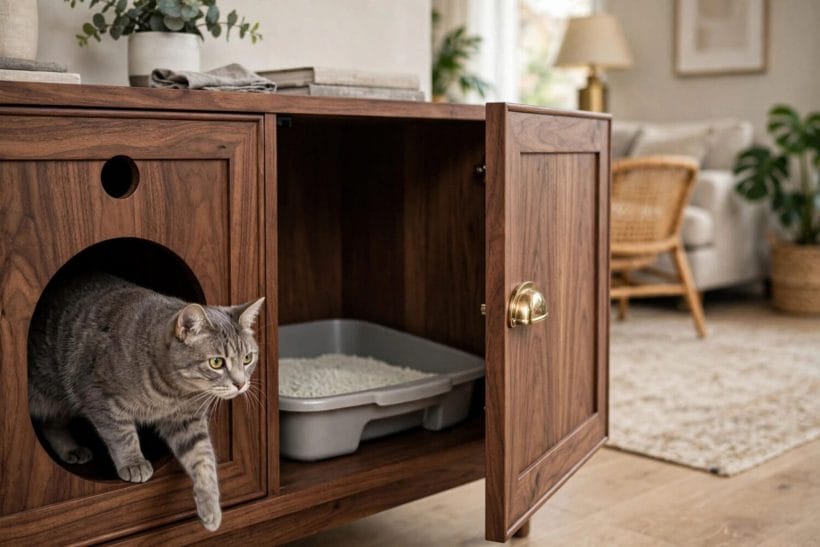
1. The cabinet enclosure, the classic hide
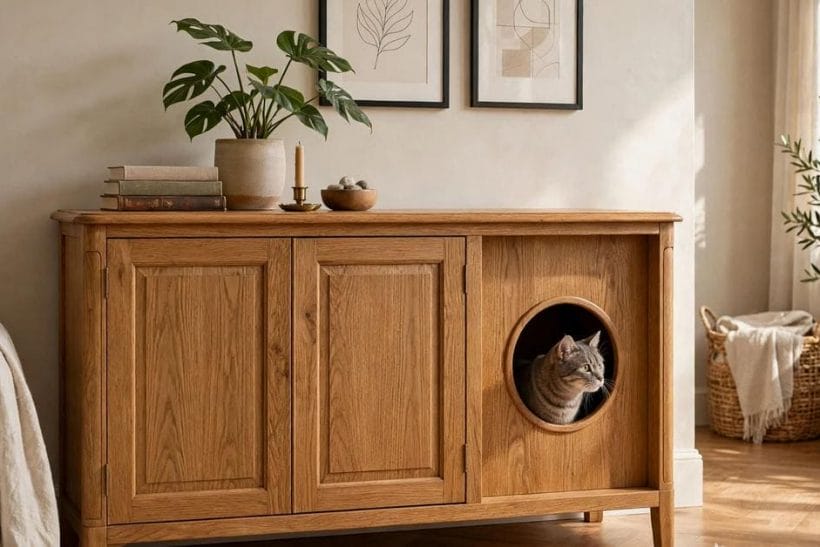
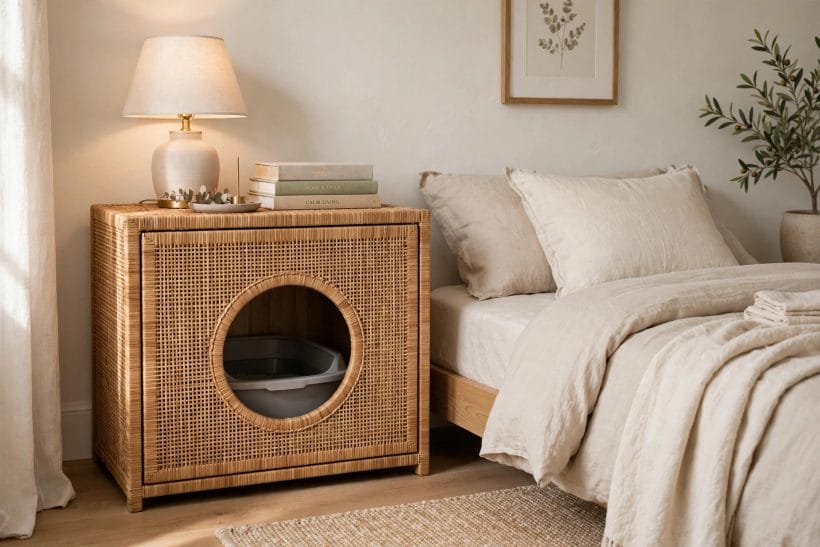
The feature photograph’s oak cabinet: panelled doors for the human, a round portal for the cat, a tray resting inside on the cabinet floor. It is the most complete answer in this post — the tray invisible, the top styled with books and a plant, the piece reading as the room’s best furniture. Doors that open wide make the daily scoop a one-handed job, which is precisely the detail that decides whether a hide survives its first month.
2. The converted sideboard or buffet
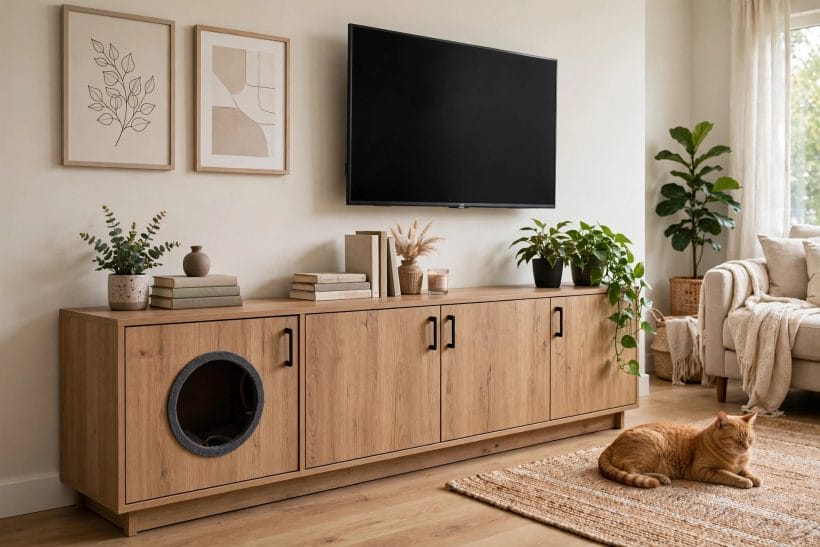
A second-hand sideboard converts beautifully: one end compartment becomes the litter bay, entered through a portal cut in the side panel, while the remaining cupboards keep their honest storage work. The conversion suits dining and living rooms where a purpose-bought cat cabinet would look like exactly what it is. Choose a piece whose interior height lets the cat sit up properly — measure the cat’s dignity, not just the tray.
3. The media-unit or bookcase bay
The lowest bay of a bookcase or media unit, screened by a curtain panel or a hinged front, hides a tray at ankle height where cats are content to go. It suits flats where every piece of furniture already exists and only its arrangement can change. Keep books and electronics in the bays above well clear of litter dust, and give the bay a washable liner — media furniture was not born waterproof.
3. Benches and Seating: The Hallway Workhorses
Benches hide trays in the rooms cats pass through anyway, and they pay their rent in perching, shoe-changing and bag-dropping every single day.
4. The entry bench with a secret
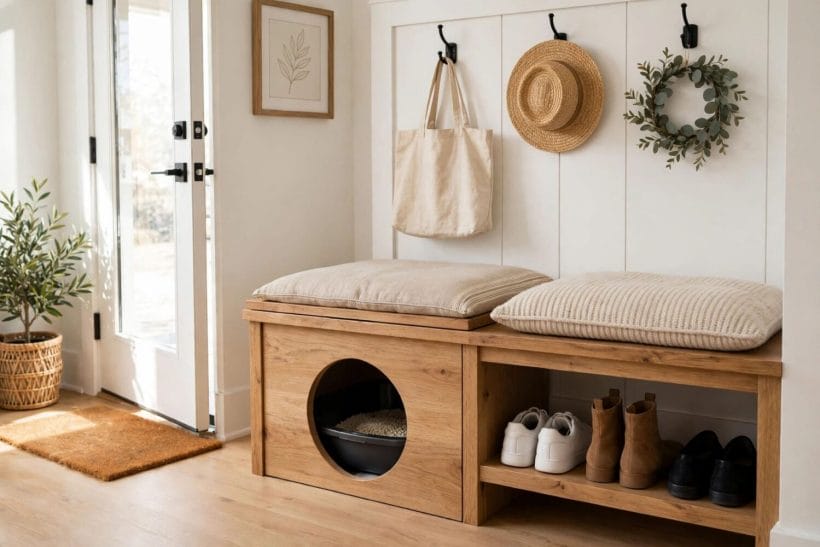
The gallery photograph’s bench by the door: cushions on top, shoes on the shelf, and behind the round portal at its end, the tray — visible in the photograph, invisible in life. Entry benches suit the litter hide because halls are the home’s natural in-between space: not where anyone eats or sleeps, easily aired, and already floored for muddy realities. The cat gains a quiet corner; the household gains a hall that works.
5. The window-seat box
A window seat is a lidded box the room already wants; dividing its interior gives the tray one end and the blanket store the other, with the cat entering through a portal in the seat’s front or side. Sun-warmed and out of the traffic line, it is many cats’ favourite of the fifteen. Build the divider honestly — litter and linen should never share air more than they must.
6. The storage ottoman or trunk
A large storage ottoman or blanket trunk with a portal cut in one end hides a tray in rooms too small for dedicated furniture. It is the lightest-touch hide here — best for a single cat and a household that scoops daily, since the volume is modest. Line it, ventilate it, and let its top keep working as footrest or coffee perch.
4. Bathrooms and Laundry Rooms: The Natural Homes
The rooms that already deal with water, washing and waste are the tray’s natural homes. The laundry schemes in laundry closet layouts and the combined rooms in bathroom laundry room ideas start from the same logic: put the cat’s bathroom where the house already keeps its cleaning things.
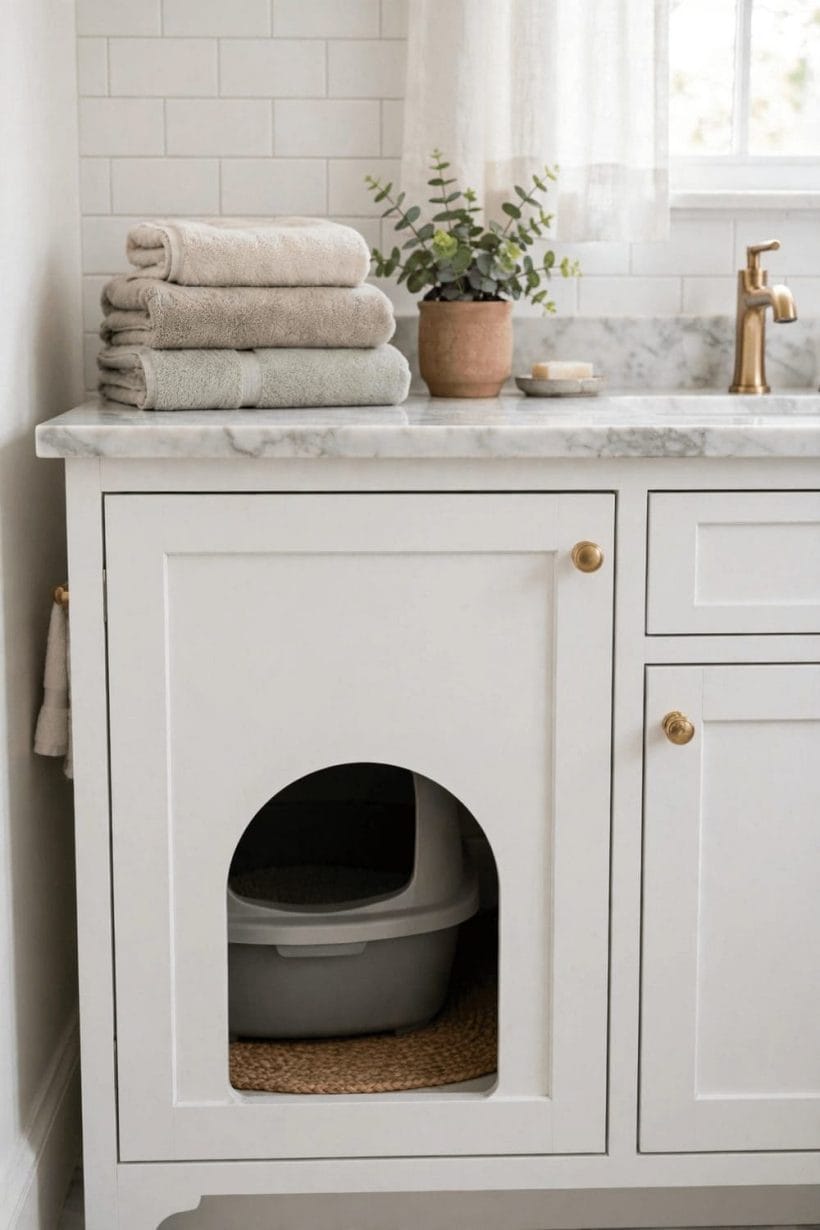
7. The bathroom vanity cupboard
The cupboard beneath a bathroom sink — plumbing permitting — is a ready-made enclosure with a door, in the room whose floor already wipes clean. A portal in the cupboard door or side gives the cat its entrance; the tray slides out for cleaning like a drawer. It is the hide guests are least likely ever to suspect, in the room where a litter tray surprises nobody.
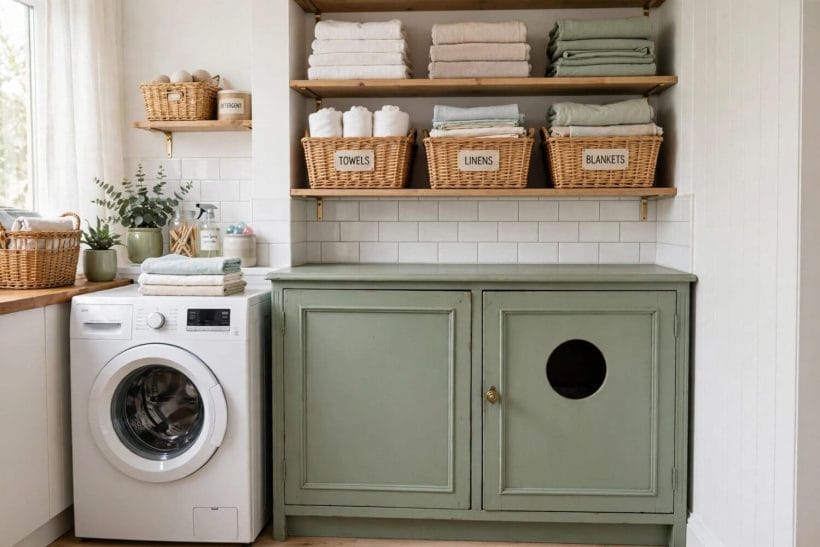
8. The laundry-room cupboard
A base cupboard in the laundry room, its door portalled or left with a cat-sized gap, puts the tray beside the machines whose noise already masks the household’s unlovely sounds. The compact arrangements in tiny laundry room ideas show how much a small laundry can hold when every cupboard is assigned. Add the litter supplies on the shelf above and the whole cat department lives behind two doors.
9. The under-sink or utility cupboard elsewhere
Kitchen under-sink cupboards divide households — many keep the cat’s tray firmly away from food preparation, and that instinct deserves respect. The utility cupboard, the under-stairs cupboard’s cousin in the hall, or a large airing cupboard with the door portalled offers the same mechanics without the argument. Wherever it is, the cupboard must stay a cat place first: cleaning bottles and a litter tray are poor shelf-mates, so give the tray a cupboard of its own.
5. Built-Ins and Architecture: Nooks the House Provides
Some hides need no furniture at all — the house itself provides them. The under-stair thinking in tiny house under stair storage applies directly: the awkward volumes of a house are exactly the right size for a cat’s private room.
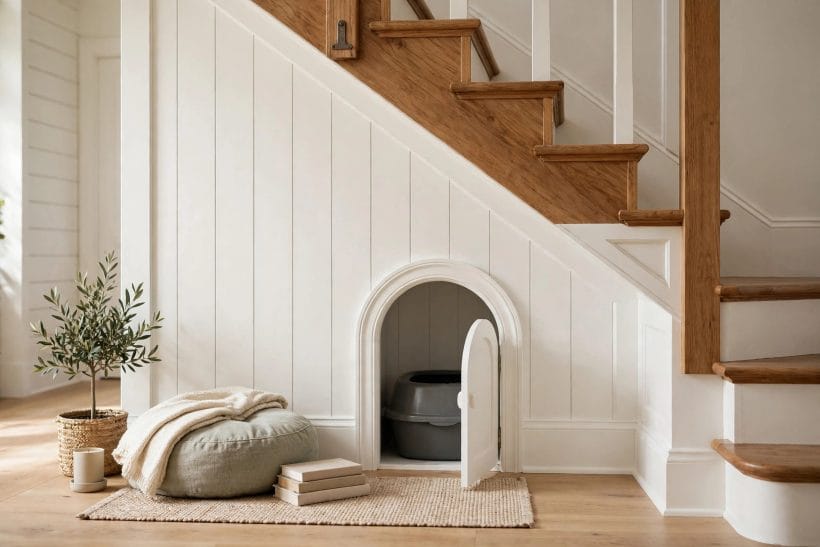
10. The under-stair nook
The triangle beneath a staircase — too low for people, perfect for a cat — becomes a litter room with a small door or portal in the stair’s side. It is out of every room’s way, acoustically private, and large enough for tray, mat and supplies together. Many cats choose under-stair corners even when offered grander options; building the hide where the cat already wants to be is the shortest route to success.
11. The closet or corner conversion
A hall closet’s floor, a bedroom corner cupboard, or the dead corner of a landing converts with a portal and a washable floor covering. The entryway discipline in Japanese genkan tiny house entryways — a defined zone for the house’s coming-and-going clutter — is the spirit here: give the cat a defined zone too, and the rest of the home stays serene. A closet hide must never be a closable trap: the portal, not the door, is the cat’s guarantee of exit.
12. The room-divider planter bench
In open-plan rooms, a low divider bench with planters above and a litter bay within screens the sitting zone while hiding the tray at its far end. It is the most architectural of the fifteen — a piece of the room’s structure rather than its furniture — and it suits confident renovations rather than quick fixes. Ventilation is designed in from the start, with openings that let air drift through the bay.
6. Disguises in Plain Sight
The last three places hide the tray behind a costume rather than a cupboard: the object is in the room, seen by everyone, recognised by no one.
13. The plant-pot cover
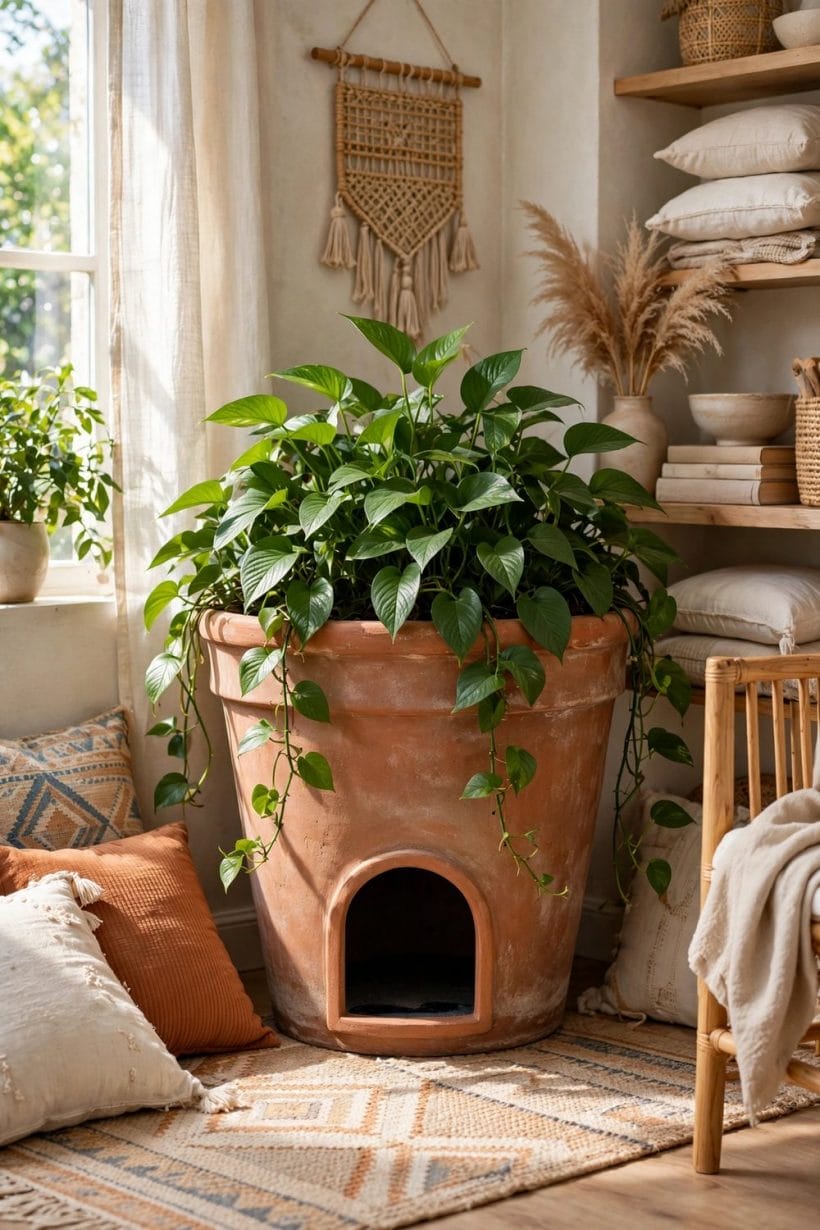
A generously sized planter — real plant above, tray within, portal at the back — is the disguise that appears in the feature photograph’s own styling language of pots and green. It suits sunrooms and halls where a large plant was wanted anyway. The plant must be chosen with a cat in the house in mind, and the arrangement kept stable: a disguise that can be knocked over is a secret waiting to spill.
14. The wicker chest or basket hide
A lidded wicker chest breathes as it hides — the most naturally ventilated disguise of the fifteen — and its texture suits the woven, basket-friendly rooms this site loves. Line it washably, portal its end, and let it sit where a blanket chest would sit. Wicker’s honesty is its charm: nobody interrogates a basket.
15. The covered utility or porch corner
A sheltered porch, utility corner or conservatory edge, given a covered tray with a hooded or screened surround, keeps the whole business at the home’s margin — near a door for air, under cover for weather, out of the living rooms entirely. It suits houses whose cats already patrol those edges, and households honest that the simplest hide is sometimes a good cover in the right corner.
7. Choosing by Cat and Home
Fifteen places, one cat: the choosing matters more than the catalogue. A kitten needs low thresholds and an unmissable location while it learns; an older cat needs step-free entry and room to turn without gymnastics; a large cat needs an enclosure measured against its real size, not the tray’s optimism. Timid cats want two ways out and a quiet position away from washing machines’ sudden spins and the dog’s patrol route; confident cats will use almost anything, almost anywhere. Multi-cat households generally do better with more than one station, in more than one place, so that no cat must queue past a rival to reach the bathroom. And every hide should be introduced kindly: tray in place, portal open, the cat allowed to discover it at its own pace, with the old tray retired only once the new one is genuinely in use. A fortnight of patience at the start buys years of a tray nobody sees.
8. Hygiene, Ventilation and Cleaning, Stated Honestly
Honesty first: hiding a tray changes what the room sees, not what the litter does. Odour is managed by ventilation, by the litter itself, and above all by the scoop — a hidden tray that gets cleaned daily stays fresher than an open one cleaned when someone remembers, and no cabinet in this post repeals that arithmetic. Every enclosure should let air move: the portal itself helps, and many hides add discreet vents high on a back or side panel, where they serve the air without advertising the purpose. Surfaces inside should be wipeable or lined with something washable or replaceable, because litter dust settles and trays occasionally miss their mark; a removable liner or mat turns the weekly clean from a scrub into a swap. The mat outside the portal is the unsung hero — it catches the grit on the cat’s paws before the room does. Wash hands after cleaning, keep the scoop and bags with the hide rather than in a kitchen drawer, and let the cat’s own behaviour audit the arrangement: a cat avoiding its hide is reporting a problem — too enclosed, too stale, too awkward — and the correct response is to fix the hide, not blame the cat.
9. Costs and DIY Versus Bought
The money in a hidden litter box goes to four honest drivers. The enclosure itself is the largest: purpose-made litter cabinets cost what small furniture costs, while a converted sideboard or bench can cost little more than the portal’s cutting and a tin of paint — the cheapest hides in this post are furniture the household already owns, reassigned. Building from scratch sits between: timber, hinges and time, worth it where an awkward nook — under a stair, in a closet corner — matches nothing a shop sells. The second driver is the washable interior: liners, mats and trays sized to the enclosure, replaced as they wear. The third is the litter itself, an ongoing cost unchanged by hiding, though an enclosure that suits the cat wastes less of it on the floor. The last is the small hardware of success — a second tray for washing rotation, a scoop that lives at the hide, a mat at the portal. DIY suits the conversions and nooks; bought suits the living-room cabinet that must pass as furniture. Either route, spend first on the cat’s access and the human’s cleaning access — the two features that decide whether the hide is still in use next year.
10. Mistakes to Avoid
The failures of hidden litter boxes are consistent enough to list as warnings. Hiding the tray somewhere the cat dislikes — beside the loud machine, down the steep stair, in the dog’s territory — and discovering the cat has chosen a corner of its own instead. Sealing the enclosure too well, so that air cannot move and the cat enters a fug it then avoids. Making cleaning awkward — a portal for the cat but no door for the human — until the scoop quietly stops happening daily. Sizing by the tray instead of the cat, so a grown animal must fold itself into a kitten’s cupboard. Changing everything at once — new hide, new litter, new room — when cats accept one novelty at a time. And the aesthetic mistake that undoes the rest: styling the hide so thoroughly into the room that its own household forgets the routine it exists to serve. The tray’s disappearance is the treat; the cat’s comfort and the daily scoop are the meal.
Final Considerations
Choose the place the way the cat would: quiet, reachable, aired, and easy to leave. Then choose as the household would: a door that opens wide for cleaning, surfaces that wipe, a mat at the door. The fifteen places in this post are fifteen negotiations between those two choosers — the cabinet and the bench for rooms that need furniture anyway, the bathroom and laundry cupboards for rooms already fluent in water, the nook and the closet for houses with awkward volumes to give, and the disguises for rooms that only had a corner to spare.
A hidden litter box succeeds invisibly: guests see a handsome cabinet, a bench by the door, a plant in a generous pot — and the cat sees a private room of its own, cleaned daily and never a spectacle. Keep the splits clean — the storage thinking in its own post, the laundry and entry schemes in theirs — and let this one be the pure article: the tray, decently disappeared. Done kindly, it is a small piece of design that improves the home for every species living in it.



0 Comments