

Laundry is the household job that small homes are worst designed for. The machines are a fixed, bulky size, the plumbing has to reach them, the air around them turns damp, and the job itself involves sorting, washing, drying, folding and carrying — five activities competing for what is often a single metre of floor. The most useful tiny laundry room ideas accept that reality and design around it: the right machine, in the one place it can actually work, with every stage of the job given a small, defined home.
This roundup treats the laundry space — whether it is a room, a closet, a bathroom corner or a kitchen run — as one complete system. Machines come first, then placement, stacking, ventilation, the fold-and-hang zones where clean clothes are processed, and finally the noise, storage and safety details that decide whether wash day is a background task or a household event. Every idea names its trade-off, because in a small home every laundry choice costs space, quiet or convenience somewhere else.
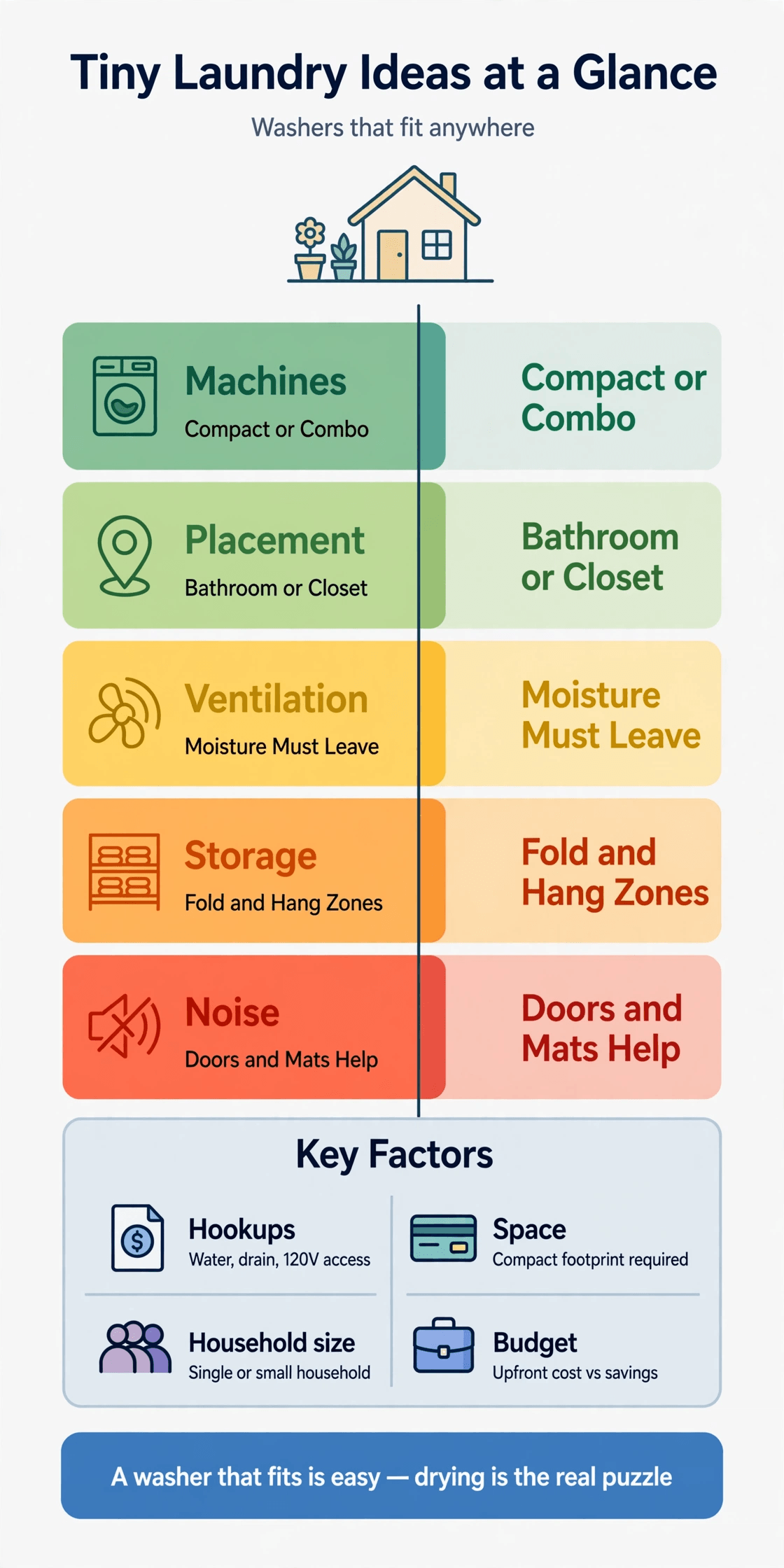
Tiny Laundry Room Ideas at a Glance
| Part of the Laundry | What It Covers | Ideas |
|---|---|---|
| Machines | Compact washers and washer-dryer combos, honestly sized | 1–2 |
| Placement | Bathroom zones and closet conversions | 3–4 |
| Stacking and layout | Stacked pairs and machines under a worktop | 5–6 |
| Ventilation | Dryer venting choices and room moisture | 7–8 |
| Fold-and-hang zones | Fold-down tables and hanging rails | 9–10 |
| Drying indoors | Ceiling airers and retractable lines | 11–12 |
| Storage | Shelves above machines and slim rolling carts | 13–14 |
| Noise control | Level machines, pads and wash timing | 15–16 |
| Sorting systems | Hampers that sort as you go and a safe detergent station | 17–18 |
| Floors, walls and light | Waterproof floors, leak trays and bright task light | 19–20 |
1. Laundry Machines: Compact, Combo and Honestly Sized
Everything in a laundry space is built around the machines, so choose them first and measure everything else afterwards. Sizing logic matters more than features, the same principle used when choosing the appliances in compact kitchen appliances for tiny houses: a machine that fits the household’s real wash load beats a bigger one that dictates the whole room.
1. Compact Washer Matched to the Real Wash Load
Compact washers are built narrower or shallower than standard machines so they can pass through doors and sit in closets and bathrooms where a full-size machine cannot. Size yours by your largest regular load — bedding day, not sock day — and remember that washing a little more often in a machine that fits is a better life than a big machine wedged somewhere it makes the whole home awkward. Check door swing and hose reach before falling for any particular model.
2. Washer-Dryer Combo Where Two Machines Cannot Go
A combined washer-dryer washes and dries in one drum, which halves the machine footprint and removes the wet-clothes transfer entirely — you load it, and later you unload dry clothes. For one or two people in a very small home, that can be the whole laundry solution in a single kitchen or bathroom unit. The honest trade-offs are longer total cycles and a smaller practical dry load than wash load, so the habit becomes smaller, more frequent washes rather than one weekly mountain.
2. Laundry Placement: Bathrooms, Closets and Kitchen Runs
In a small home the laundry rarely gets a room of its own, so placement means borrowing space from a room that already has water, drainage and a hard floor. Those services decide what is possible, which is why the runs and falls in tiny house plumbing layout and DWV design should be mapped before any cupboard is promised a machine — and the kitchen examples in tiny house kitchen ideas show how often the washer ends up sharing a run with the sink.
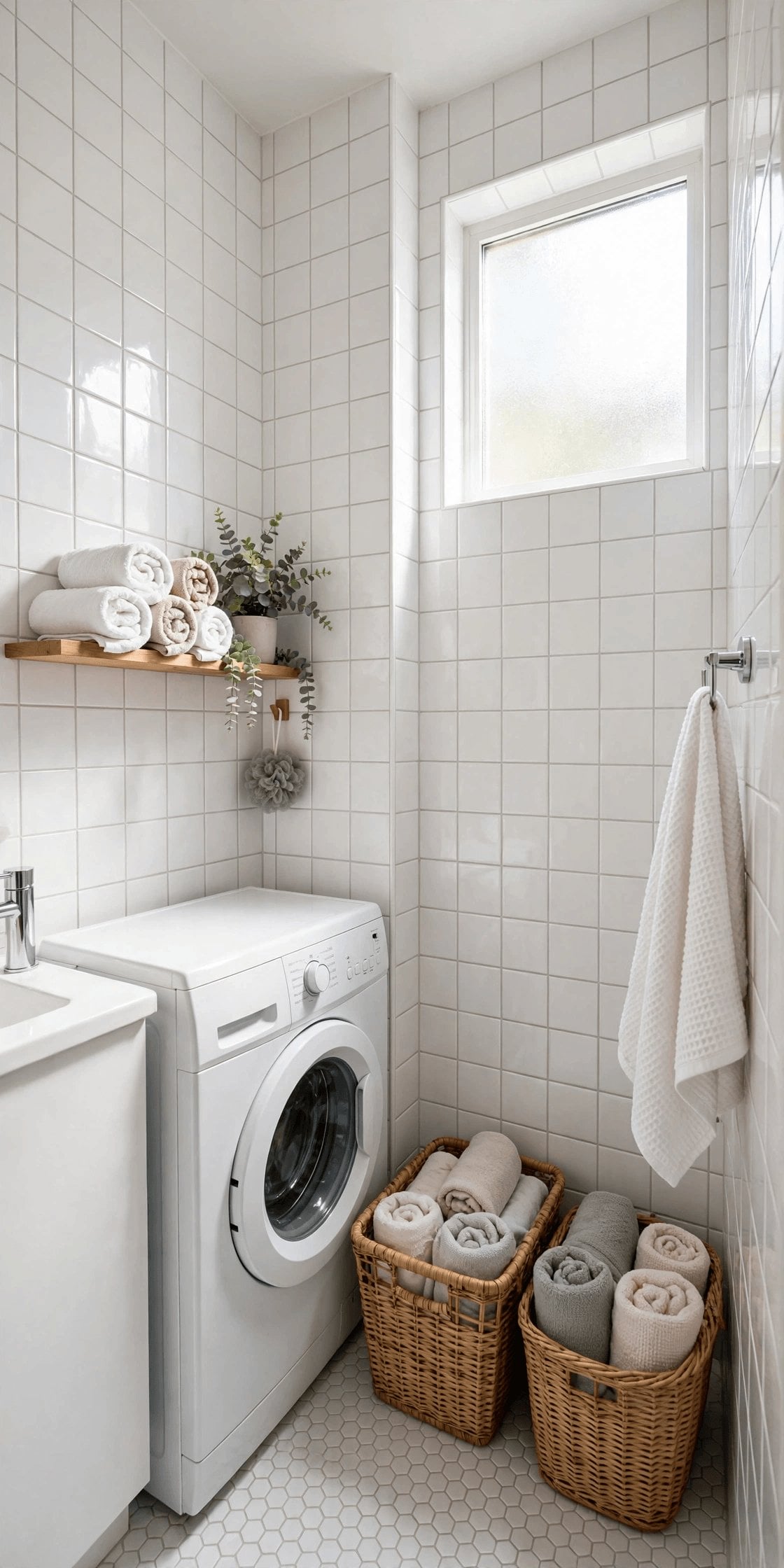
3. Bathroom Laundry Zone at the Dry End
A bathroom already has water in, waste out and surfaces that tolerate splashes, so a washer, or a stacked pair, at the dry end of the room is one of the most workable placements in a small home. Keep the machine clear of the shower’s splash zone, plan the door and the route to the basin around it, and accept the trade-off: laundry and bathing share one room, so timing becomes a household agreement rather than a private routine.
4. Closet Conversion with a Real Door and Airflow
A hall or bedroom closet near the bathroom plumbing can become a laundry cupboard: machines inside, supplies on a shelf above, and the whole job hidden when the door closes. The door matters — a solid, closable door doubles as noise control — and so does moving air, because a sealed cupboard full of damp laundry air will smell and suffer. A louvered section or a vent, plus the habit of leaving the door ajar after drying days, keeps the conversion healthy.
3. Laundry Layout: Stacking Up and Working Across
With machines and position decided, layout is about what happens above and beside them. Vertical thinking turns one machine’s footprint into two machines’ worth of function, and a continuous worktop turns a row of appliances into a processing line for sorting, treating stains and folding.
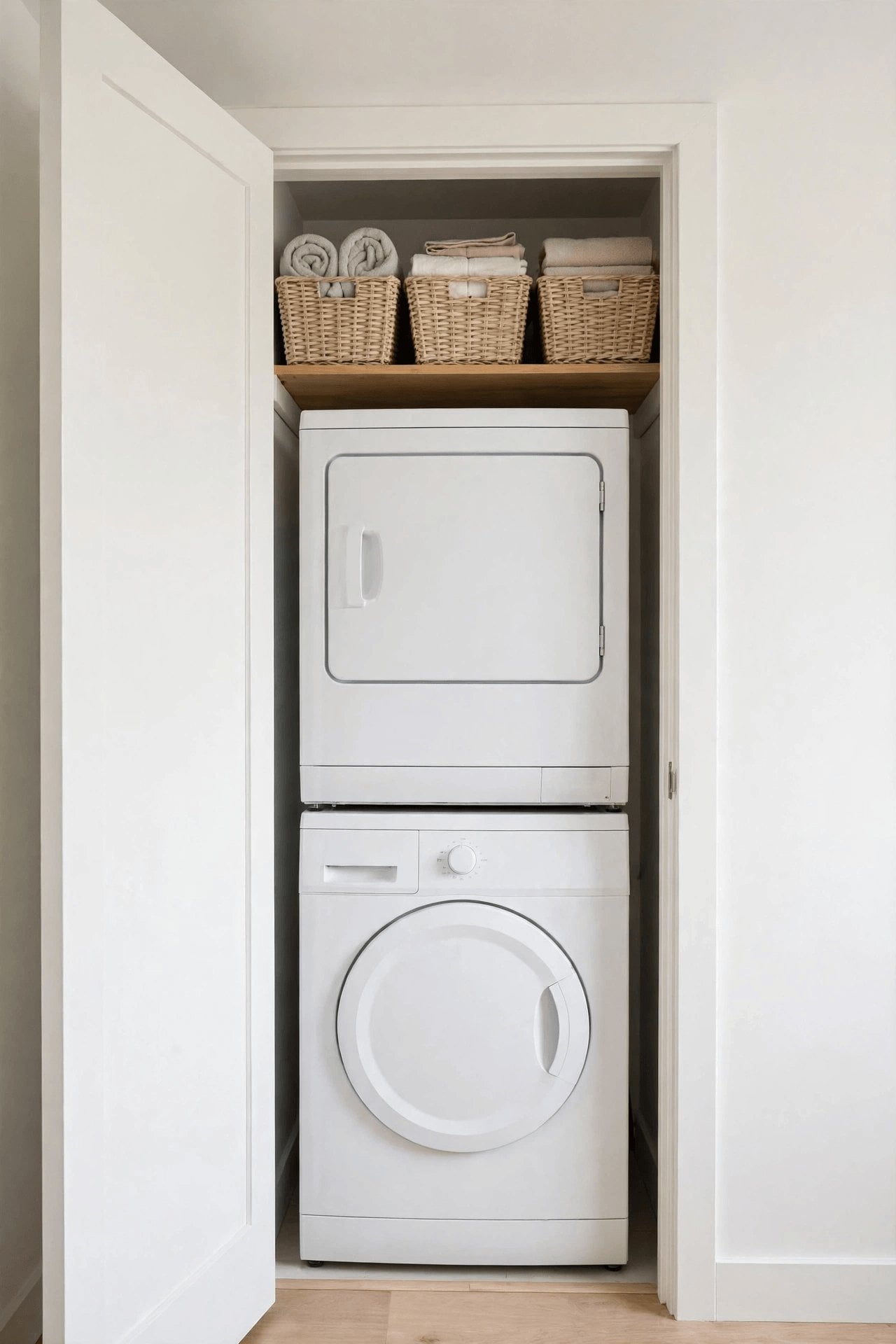
5. Stacked Washer and Dryer on One Footprint
Stacking the dryer above the washer, with the proper stacking kit and a safe way to reach the upper controls, gives you both machines on a single footprint — the classic move in closets and bathroom corners. It suits front-loading machines and households happy to load the dryer at chest height. The trade-off is access: filters and drums sit higher, repairs involve unstacking, and anything stored on top during an enthusiastic spin cycle will travel.
6. Side-by-Side Machines under One Worktop
Where floor width allows, machines side by side under a single worktop create the most useful surface in the laundry: a counter for sorting, stain treatment and folding, with baskets underneath or on top. The counter should be removable or sectioned so machines can be pulled out for servicing without dismantling the room. This layout is the one that makes laundry feel like a small workshop instead of an obstacle course.
4. Laundry Ventilation: Getting Damp Air Out of the House
Every load releases its water somewhere: into a drain, into a condenser tank, or into your room’s air. Managing that moisture is not an optional extra in a small home, where the same air is bedroom air an hour later. The background thinking in tiny house ventilation, HRV, ERV and mould guidance applies directly — damp air needs a planned exit, every wash, without relying on good intentions.
7. Dryer Venting Chosen Deliberately, Not by Default
A dryer that vents outside removes moisture from the home entirely but needs a route to an external wall, which can decide the machine’s position all by itself. Condenser and heat-pump style dryers collect water in a tank or drain instead, so they can live in a closet or bathroom — at the cost of emptying tanks and adding some warmth and humidity to the room while they run. Neither answer is wrong; choosing without thinking is the only mistake.
8. Room Ventilation for Wash-Day Moisture
Even with a well-chosen dryer, indoor drying and steamy wash days load the air with moisture, so the laundry space needs extraction or an openable window that actually gets used. Run extraction during and after drying, wipe condensation off cold walls and windows before it sits, and avoid drying clothes in the bedroom overnight, where the damp air is breathed for hours. Small habits, applied every wash, are what prevent the mould conversation later.
5. Laundry Fold-and-Hang Zones: Where Clean Clothes Get Processed
Most laundry spaces fail at the clean end of the job: clothes come out of the machine and land on a bed, a sofa or the floor, because there is nowhere designed to fold or hang them. The folding furniture thinking in convertible furniture tiny house plans is the right model here — surfaces that appear when the job happens and disappear when it is done.
9. Fold-Down Table that Vanishes after Wash Day
A wall-mounted, fold-down table gives you a full folding surface for the twenty minutes it is needed, then folds flat so the room returns to its usual size. Mount it at a comfortable standing height, opposite or beside the machines, so the path from drum to table to basket is two steps. When a fixed counter from idea 6 already exists, the fold-down table can live in the hallway or bedroom instead, wherever the baskets end up.
10. Hanging Rail for Clothes Straight from the Drum
Shirts and dresses folded late get ironed; shirts hung immediately often need no iron at all. A short rail above the counter, or a rod under a shelf near the machines, lets you hang clothes on hangers the moment they leave the washer or dryer, which saves both creases and time. Leave the rail’s length honest — enough for one load’s worth of hangables, not a second wardrobe quietly taking up residence.
6. Laundry Drying Indoors: Airers, Lines and Warm Corners
Not every home with a washer has a dryer, and not every load should be tumble-dried, so indoor air-drying needs a designed place rather than a chair in the bedroom. Warm, moving air is the whole secret: a drying setup in a ventilated spot will outperform a bigger rack in a still, cold corner every time.
11. Ceiling-Mounted Airer over the Bath or Landing
A pulley airer on the ceiling uses the warmest air in the house — the air at ceiling height — and keeps wet washing completely out of the walkway. Over a bath it can drip safely; on a landing or in the laundry closet it uses volume that nothing else wanted. Loading it is a small ritual of raising and lowering, which most households find a fair price for floor space that is never occupied by a rack.
12. Retractable Line plus a Drying Routine
A retractable line stretched across the bathroom or utility corner for wash day, then wound away, gives occasional drying capacity with zero permanent footprint. Pair it with routine: dry the heaviest items nearest the extraction or window, leave gaps between garments so air can move, and take washing down promptly once dry. The routine matters because a line left loaded all week quietly converts back into clutter, however retractable it is.
7. Laundry Storage: Detergent, Baskets and the Small Things
Laundry generates a supporting cast — detergent, stain treatments, pegs, spare baskets, the iron — that will spread across the home if the laundry space does not claim it. Borrowed-space thinking, like the compartments in tiny house plans with hidden storage, keeps this cast together and out of sight between wash days.
13. Shelves above the Machines, Sized to the Bottles
The wall above a washer or a stacked pair is usually blank, and one or two shelves there hold everything the job uses weekly: detergent, softener, stain treatment and a small basket of pegs and odd socks. Keep the shelves only as deep as the bottles, so nothing hides behind anything else, and put the heaviest container on the lowest shelf. One clear rule — if it is not used for laundry, it does not live here — keeps the zone from becoming general storage.
14. Slim Rolling Cart in the Gap Beside a Machine
The narrow gap between a machine and the wall, or between two machines, can fit a slim rolling cart that pulls out like a drawer: shelves for bottles and cloths, all visible at once, then gone again. It is one of the few storage ideas that works even in a laundry closet, because it needs no door swing and no reaching. Choose a cart that rolls smoothly on your floor, or it will be left pulled out and become an obstacle.
8. Laundry Noise Control: Keeping Spin Cycles out of the Bedroom
In a small home the washer is never far from a bed, a desk or a neighbour’s wall, so noise is a design issue, not just an appliance specification. Most noise is not the machine’s fault: it is vibration travelling into floors and walls, which means placement and setup solve more than shopping does.
15. Level Machine on a Firm Base with Anti-Vibration Pads
A washer that is level, with its feet adjusted and locked and its weight on a firm rather than springy floor, runs dramatically quieter than the same machine rocking on an uneven board. Anti-vibration pads under the feet absorb what is left. Before blaming a machine for noise, re-level it and check the load is balanced — a single heavy, soaked item can make any washer sound like it is leaving.
16. Doors, Distance and Wash Timing as Noise Policy
The cheapest noise control is a closed door between the machine and the beds — one more reason the closet conversion in idea 4 deserves a real door — and the second cheapest is timing: run the loudest spin cycles when the household is awake and active, and let delay-start features finish a wash as people get up rather than at 3 a.m. In flats and shared buildings this is also good citizenship, and in a one-room home it is simply how everyone keeps sleeping.
9. Laundry Sorting Systems: Order at the Dirty End Too
Sorting on wash day, on the floor, from one giant mixed basket, is where laundry time doubles. The systems thinking in tiny house organization strategies fixes it the usual way: sort at the moment clothes come off, into small defined places, so wash day starts with the job already half done.
17. Divided Hamper or Two Slim Baskets for Sort-As-You-Go
A hamper with two sections — or two slim baskets side by side — lets the household split lights and darks, or delicates and everything else, as clothes are changed, so a full section is simply a load ready to go. Size the system to your machine: one section should equal roughly one sensible load. In the bedroom this can replace the lidded hamper entirely; in the laundry space itself it can stand under the folding table.
18. One Detergent Station, Kept Safe and Dry
Keep the product you use every wash in one reachable spot at the machine, and store the rest — bulk refills, bleach, special treatments — higher up or in a closed box, especially where children or pets share the home. Powders and pods stay effective and safe when dry, and a single station ends the archaeology of searching cupboards mid-cycle. A small tray under the station catches the drips that otherwise mark every shelf below.
10. Laundry Floors, Walls and Light: Built for Water and Work
Laundry spaces get wet, get linty and get used in the early morning and late evening, so their finishes should be chosen like a bathroom’s, not a bedroom’s. The washable, light surfaces discussed in lightweight interior wall finishes for tiny houses are the right starting point, and the whole-home context of 300 sq ft tiny house plans shows how often this corner is planned last and regretted first.
19. Water-Resistant Floor and a Leak Tray under the Machine
Hoses age, pumps fail and filters get opened over the floor: sooner or later water escapes, so the floor under and around the machines should shrug it off, and a shallow leak tray under the washer can turn a flood into a puddle you mop up. Check hoses and filter seals when you think of it — twice a year is a sane rhythm — and never leave a first wash in a new position running while you are out.
20. Bright, Honest Light for Sorting and Stain-Spotting
Sorting socks and spotting stains are visual tasks, and a dim laundry corner makes both slower and worse. One bright, cool-neutral light over the machines and counter, ideally the light you also check clothes in before wearing them, ends the surprise of the stain discovered at the office. Pale walls bounce that light around and show lint and splashes so they get cleaned — in a laundry, a surface that hides dirt is not doing you a favour.
Final Considerations
Build a laundry solution in the order the job happens: choose a machine honestly sized to the household, place it where water, drainage and venting can actually reach, then design the stages around it — sorting at the dirty end, a fold-and-hang zone at the clean end, drying somewhere warm and ventilated, and storage borrowed from walls and gaps rather than floor. Noise and moisture are not afterthoughts in a small home; they are the two things that decide whether in-home laundry feels like freedom or like a weekly intrusion.
Above all, size the system to real life. A washer-dryer combo in a bathroom cupboard that runs small loads every other day beats a perfect laundry room that exists only in a floor plan, and a stacked pair behind a solid door beats an open-plan arrangement that wakes the house on every spin. Washers genuinely can fit anywhere — but only when placement, ventilation, noise and the fold-and-hang stages are designed with the machine, not after it.


0 Comments