
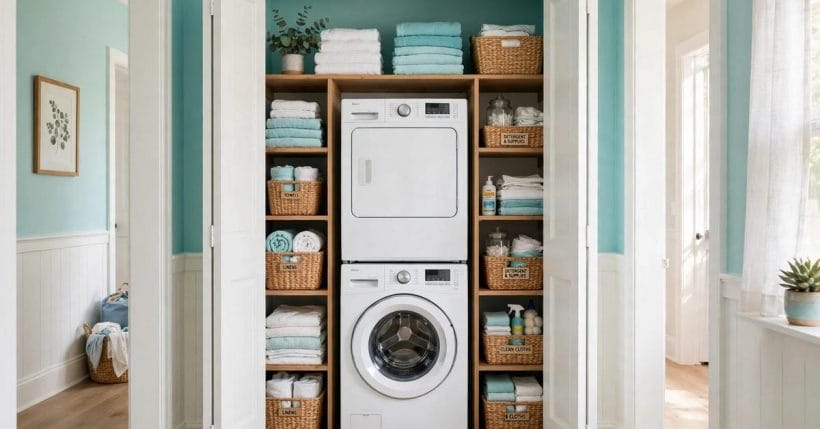
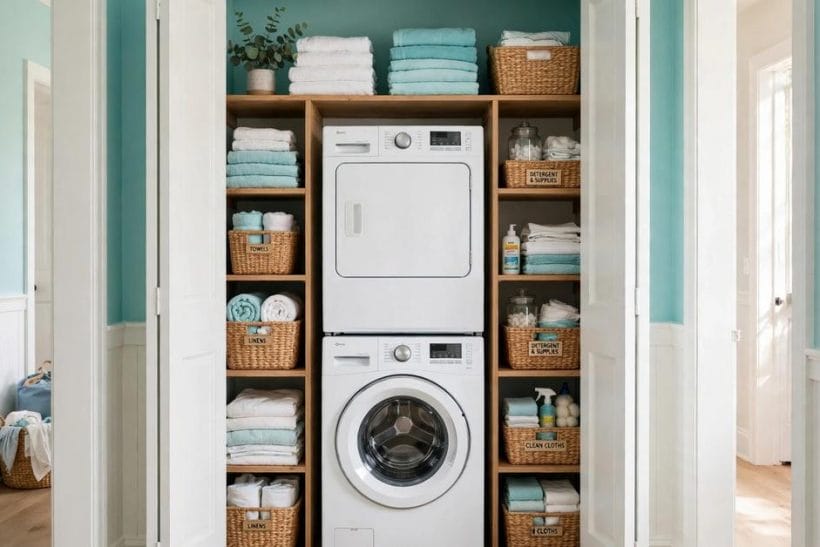
A whole laundry behind two doors: washer, dryer, shelves of folded linen, none on show — the laundry closet is the small home’s quietest magic trick.
These seventy-five laundry closet ideas cover layouts and doors, shelving, colours, folding and drying space, ventilation and light, plumbing access, apartment versions, and the cost drivers that make a closet laundry work.
1. Laundry Closet Ideas at a Glance
A laundry closet is a washer and dryer — stacked or side by side — fitted into a closet alcove behind doors, with shelving in the same footprint. This post stays with the closet configuration only. The wider survey lives in laundry room ideas, and the combined-room treatment — machines sharing space with a bath and shower — is its own post, bathroom and laundry room ideas. Here, everything fits behind the closet doors, or it does not make the list.
| Question | Short answer |
|---|---|
| What is a laundry closet? | A closet-depth alcove fitted with a washer and dryer, doors to close it away, and shelving in the same footprint |
| Stacked or side by side? | Stacked frees floor and shelf space in the narrowest closets; side by side gives a folding top and easier reach |
| What does it need to work? | Water, drainage and power connections, a dryer vent route or a ventless machine, ventilation for the closet itself, and a light |
| Where does it fit best? | Near bedrooms and bathrooms, where the laundry actually arises — hallways, landing cupboards and under-stair spaces are the classic homes |
| What needs checking first? | Machine dimensions against the closet’s real depth with doors closed, plus plumbing, venting and local rules — before anything is ordered |
2. Layouts: Fitting Machines Into a Closet
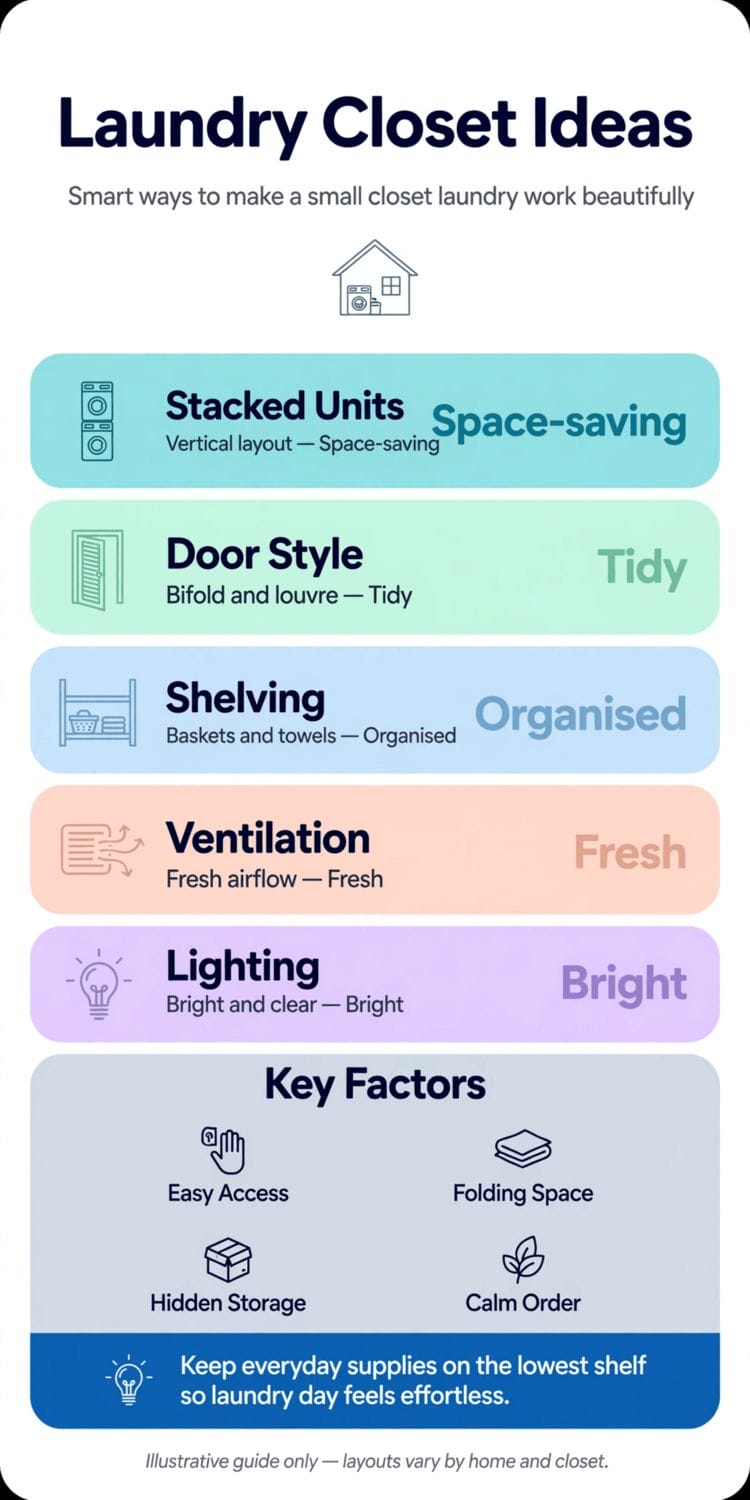
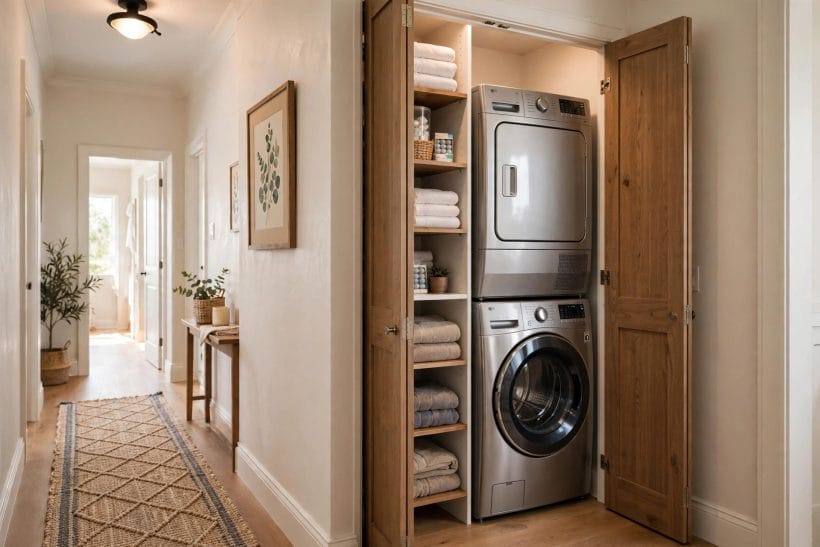
The infographic’s first row gives stacking its space-saving verdict, and the feature photograph shows the classic arrangement: a stacked pair in the middle, shelving wings either side. Layout is the closet’s whole game.
1. The stacked pair, centred, shelves either side
The canonical closet: stacking frees the flanks for shelving towers, as pictured. It suits the narrowest closets and puts detergent, baskets and linen within one step of the machines.
2. Side-by-side machines with a worktop over
Where the closet is wide rather than deep, a side-by-side pair under one continuous top gains a folding surface — the thing stacked layouts most miss.
3. Side by side, open above for shelving
Without a worktop, the wall above a side-by-side pair takes two or three full-width shelves. Keep the lowest shelf clear of the machines’ lids and controls, and the closet gains a real linen store.
4. A single combined washer-dryer in the smallest closet
Where even a stacked pair will not fit, one combined machine does both jobs in one footprint, freeing the rest of the closet for storage entirely. Cycles take longer; the closet it makes possible is the honest trade.
5. Machines to one side, a tall storage tower beside
Shift the pair to one flank and the other becomes a full-height tower: shelves, a hanging rail, the ironing board’s home. Asymmetry is the closet layout’s secret weapon — most closets are not wide enough for symmetry and storage both.
6. An L-shaped closet with a corner shelf run
Corner closets can wrap shelving around the turn, with the machines on the longer wall and the short return given to baskets and cleaning stores. Corner shelves should be shallower than they look in plan — reach is the real dimension.
7. A closet deep enough for a slim folding station
A little extra depth buys the luxury stacked layouts lack: a wall-mounted fold-down table or a pull-out shelf that appears for folding and vanishes for everything else. In a laundry closet, a folding surface that folds away is the only kind there is.
8. Under-stair laundry closets
The space under a staircase, near the hall, is a classic closet laundry home — plumbing often passes nearby, and the sloped headroom suits machines perfectly. The tall end takes the storage tower; the low end takes baskets.
9. Measure the closet, then choose the machines
The layout rule that precedes all others: measure the closet’s true internal depth — with the doors’ swing and the hoses’ bend included — before falling for any machine. Closet machines are a distinct, shallower family for a reason, as the closet survey in closet ideas shows across every closet type.
3. Doors: Bifold, Louvre, Sliding and More
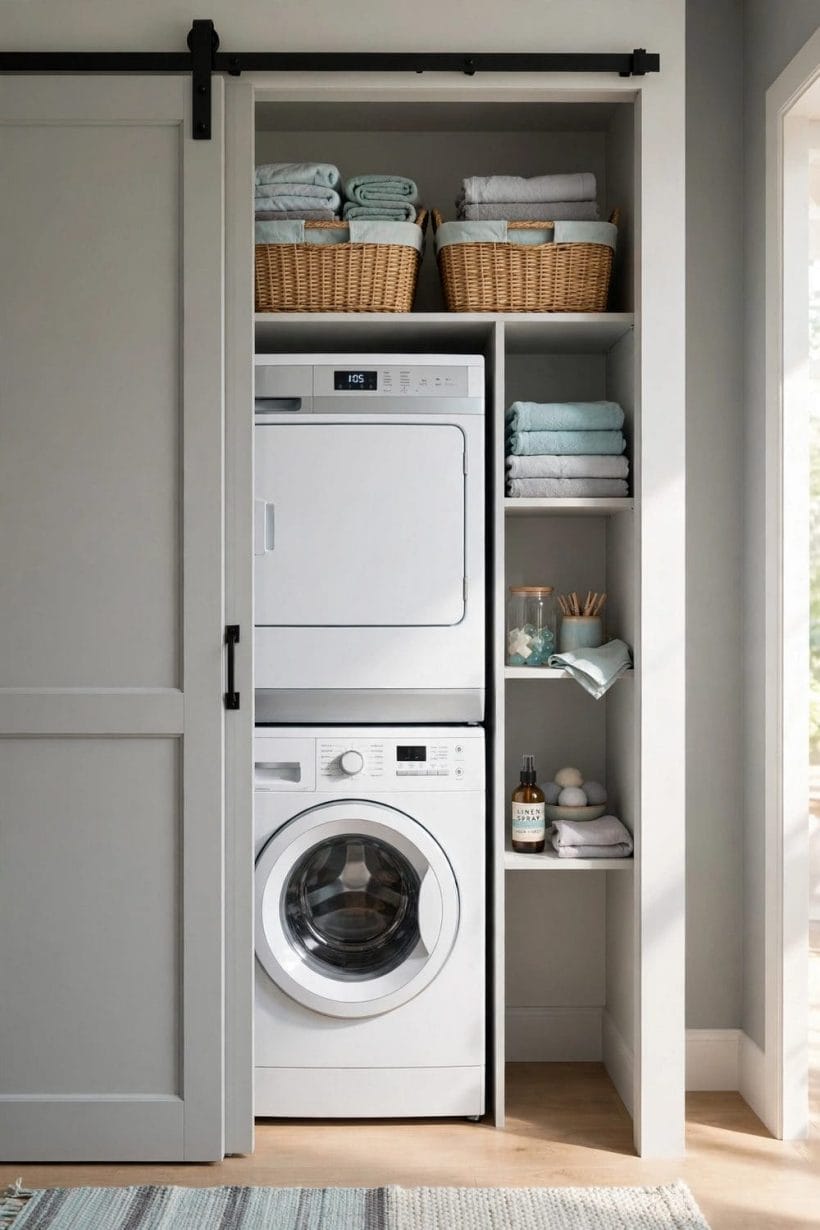
A laundry closet’s doors are its public face, its ventilation route and its sound muffler in one. The right doors make the laundry vanish; the wrong ones announce it from the hall.
10. Bifold doors that fold clear of the opening
The closet classic, pictured in the feature image: bifolds open the full width for loading, then fold flat against the jambs. They need no swing room in the hall, which is why they own this job in most homes.
11. Louvre doors that breathe
Slatted louvre doors let the closet’s warm, damp air escape continuously — a genuine working virtue in a laundry, where ventilation is not a detail. They suit painted schemes and traditional halls, and they never look like cupboard doors pretending to be walls.
12. Sliding doors for the tightest hallways
Where even bifolds crowd the passage, doors that slide along the wall — or into it — keep every inch of hall clear. Tracks must be planned before the closet is fitted; a sliding door retrofitted onto a finished frame rarely runs sweetly.
13. A pair of full doors for a wide closet
Wide closets take proper double doors, opening like a wardrobe to reveal the whole laundry at once. It is the most generous arrangement to use — everything visible, nothing reached for around a door edge.
14. Curtains for the softest close
A lined curtain on a track or rod closes a small closet softly, cheaply and with real charm in bedrooms and studio flats. It gives no sound insulation and no vapour barrier, so it suits ventless machines and relaxed households honestly.
15. No doors: the open alcove, deliberately styled
In a utility corner or a large bathroom-adjacent alcove, an open laundry can work — if it is styled like the feature photograph rather than left as an apology. Matching baskets, folded stacks and a calm palette are the whole trick.
16. Door colour that matches the hall
Paint the closet doors exactly as the room’s other doors and the laundry achieves its founding ambition: invisibility. The hall reads as a hall with doors; the washing happens in another dimension entirely.
17. Handles and hardware worth touching
These doors open daily, often with arms full of laundry. A handle that can be hooked with an elbow or a hip — a lever, a generous pull — is a working detail disguised as a hardware choice.
18. Ventilation grilles in solid doors
Where solid doors are preferred and the machines are vented types that warm the closet, a discreet grille — high or low in the door, per the machine maker’s guidance — keeps air moving without changing the door’s face.
4. Shelving and Storage Walls
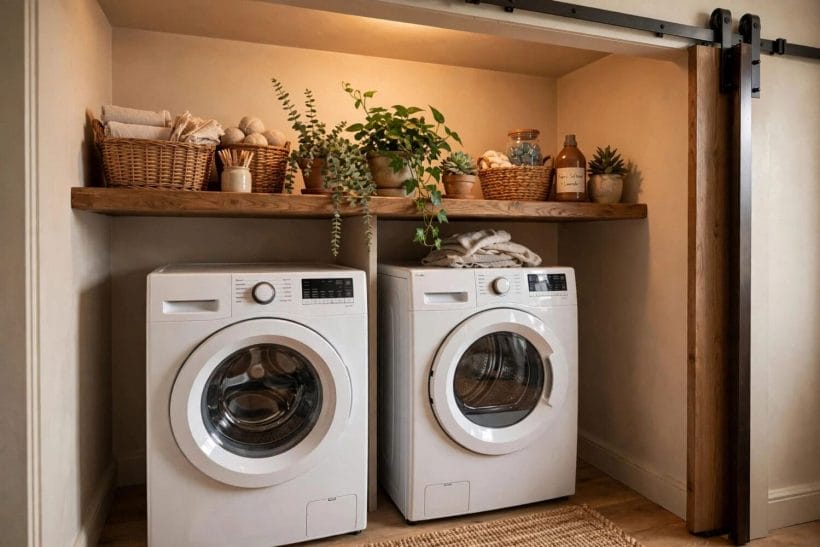
Look again at the feature photograph: the machines take the middle third, and shelving takes everything else. Storage is where a laundry closet is won — the machines merely wash.
19. Full-height shelving towers flanking the machines
Shelves from floor to ceiling on both flanks hold the whole laundry economy: detergents at working height, towels and linen above, rarely used stores at the top. Towers turn leftover inches into the closet’s hardest-working space.
20. A shelf directly above the machines
The single most valuable shelf in the closet sits just above a side-by-side pair or over a stacked unit’s top: detergents and the wash basket live there, mid-task, never set down on the floor or the hall carpet.
21. Labelled baskets that make shelves behave
The pictured wicker baskets — towels, linens, supplies — are not styling; they are the system. Baskets corral the small, the soft and the spillable, pull out like drawers, and make a shallow shelf hold twice its honest volume.
22. Open shelves for the daily, cupboards for the rest
Everyday items belong on open shelves at arm’s height; bleach, stain treatments and the household’s chemical shelf belong behind a closed door or high up, especially where children share the home. The closet’s storage should be zoned like its risks.
23. A pull-out shelf under a stacked pair’s neighbour
A sliding shelf or board beside the machines gives the laundry basket a landing strip while loading — the small luxury every closet user discovers they needed the first time they use one.
24. Back-of-door storage
The inside faces of the closet doors are free storage: slim racks for sprays and cloths, hooks for the dustpan, a pocket organiser for the small things. Respect the machines’ clearance when the doors close, and weigh nothing the hinges resent.
25. A rail for shirts straight from the dryer
A short hanging rail in the closet’s upper reaches — or across its top — takes shirts and dresses the moment the cycle ends, which is the only wrinkle treatment that costs nothing. It borrows the wardrobe logic of walk-in closet ideas at cupboard scale — even a tension rod across the closet earns its place.
26. The ironing board’s honest home
A slim board stored upright in the gap beside the machines, or on hooks inside the door, ends the ironing board’s life as hallway furniture. Measure the gap before the machines are chosen, not after.
27. Glass jars for powders, decanted and dry
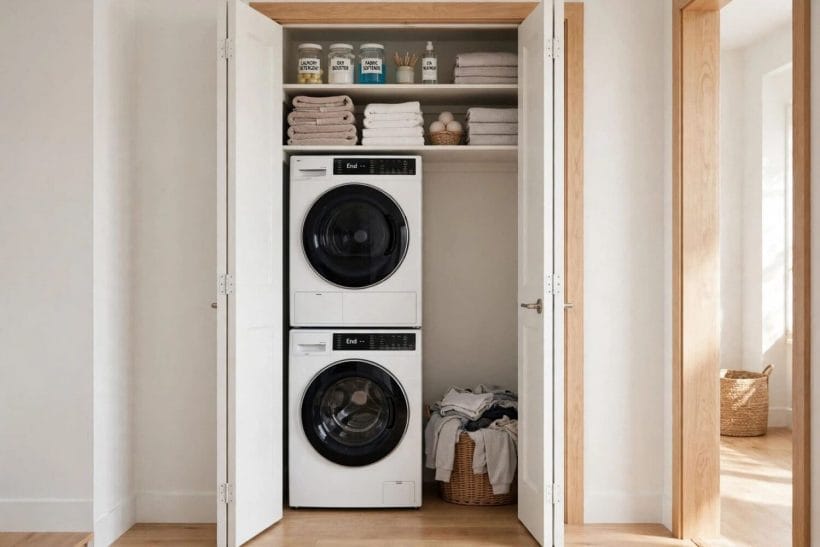
Decanting powders and pods into sealed, labelled jars keeps the shelf tidy, the contents dry in the closet’s warm air, and the scooping honest. Original labels or clear new ones — never anonymous jars of white powder in a family home.
5. Colours and Finishes Inside the Closet
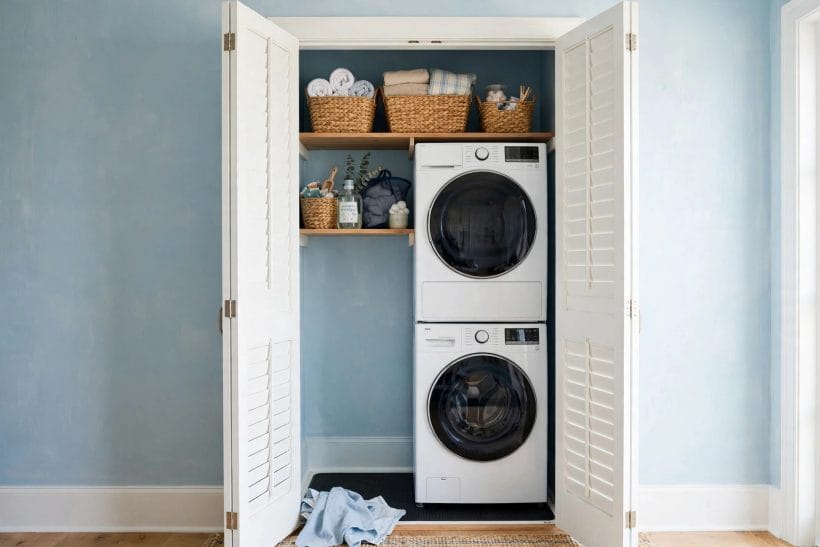
The feature closet wears aqua walls, white woodwork and pale timber — a small room’s palette in miniature. Colour inside a laundry closet is seen daily, at close range, usually in the morning.
28. A fresh aqua or sea-glass wall
Pale blue-greens are the laundry’s traditional colours for a reason: they read as water, cleanliness and cool air in a warm little space. Inside a closet they cost one small tin and repay it at every wash.
29. All white, for the brightest working light
White walls and shelving bounce the closet’s light into every basket and drum corner. In a windowless closet, white is less a colour choice than a lighting decision — and usually the right one.
30. A warm neutral that matches the hall
Where the closet opens off a calm, neutral hall, carrying the same tone inside makes the open doors look intentional rather than revealed. The laundry becomes a room the house admits to, not a cupboard it hides.
31. Timber shelving for warmth
Natural or lightly finished timber shelves warm the machines’ white enamel and give the closet a crafted, built-in feeling. Seal them against the laundry’s humidity per the finish maker’s guidance, and they will outlast several machines.
32. A patterned back wall, wallpaper or tile
The closet’s back wall is seen in one glance, whole — the perfect place for a pattern too lively for a room: a tile splashback behind the machines, a washable paper, a painted stencil. Small space, small risk, daily reward.
33. Black accents for a tailored look
Matte black handles, brackets and basket labels against white shelving give a closet a tailored, almost boutique order. It is the fastest route from cupboard to designed space, and it costs a pot of paint and an afternoon.
34. A coloured interior behind white doors
Keep the doors hall-white and paint the closet’s inside a colour with intent — deep green, warm clay, soft navy. Every opening becomes a small reveal, and the laundry’s working face is a pleasure rather than a confession.
35. Flooring that forgives water
The closet floor will meet water: drips, leaks, the occasional hose event. A water-tolerant, easily mopped floor — sheet vinyl, suitable tile — with a sealed skirting junction is the finish that lets the household stop worrying about the one room plumbed to get wet.
6. Folding, Hanging and Drying Space
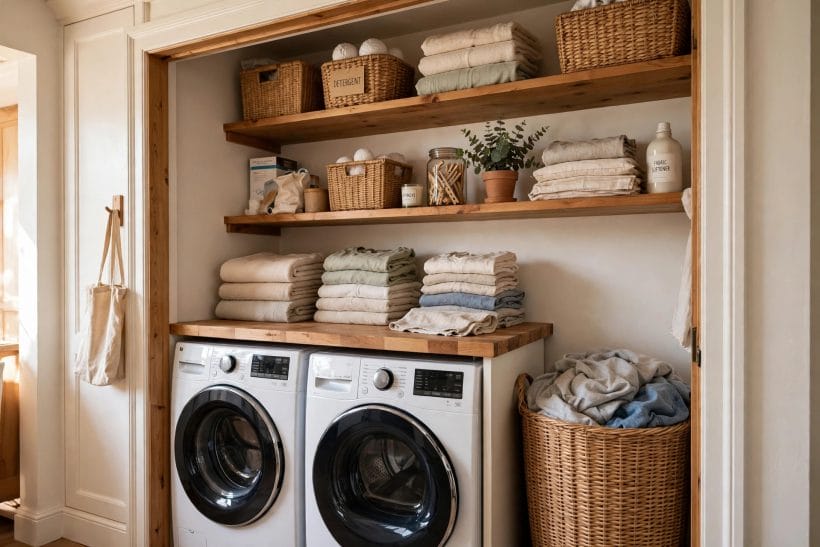
A laundry closet’s machines wash and dry; its owner still needs somewhere to fold, hang and air. These ideas steal that space from walls, doors and air — the only places a closet has left.
36. A fold-down table on the closet’s side wall
A hinged board that folds flat against the wall and drops to working height for folding is the closet’s transformer. Sturdy hinges and a support that cannot collapse mid-fold are its whole specification.
37. A pull-out folding shelf under the worktop
In side-by-side layouts, a shelf that slides out from under the counter extends the folding surface for big loads and vanishes for small ones. It is the drawer principle applied to laundry, and it works exactly as well.
38. The machines’ own top as the folding station
With a stacked pair there is no top to fold on — with a side-by-side pair, the worktop is the station. Keep it clear by rule: a folding surface that stores things is a shelf that lies about its job.
39. A hanging rail across the closet’s top
As in section four, a rail high in the closet catches garments straight from the dryer. Hang shirts on hangers the moment the cycle ends and most of the ironing simply never happens.
40. A retractable drying line inside the closet
A pull-out line or two across the closet’s width airs the delicates that shun the dryer, in the home’s warmest air. Retracted, it disappears; extended, it saves a rack from colonising the hall.
41. A slim airer that lives behind the door
A folding airer sized to the closet — stored flat behind the door or beside the machines, opened inside the closet or the nearest room — keeps occasional drying possible without a permanent rack. Size it to the closet, not to ambition.
42. Door-mounted hooks for hangers and bags
A row of hooks inside the closet door holds the laundry bag, the hanger bundle and the mesh wash bags in one glanceable place. Small things stored visibly are small things actually found.
43. A sorting shelf: three baskets, three fates
Whites, colours, delicates — a labelled trio of slim baskets on a low shelf turns sorting from a floor event into a standing habit. In a closet, the system that fits the shelves is the system that survives.
7. Ventilation, Moisture and Light
The infographic gives ventilation and lighting their own rows — fresh, and bright. A closet full of warm water needs both: stale air, damp and darkness are the three ways a laundry closet fails.
44. A vent route planned before the machines
A vented dryer needs its duct route — short, straight-ish, to outside air — designed with the closet, and a ventless condensing or heat-pump machine needs none. Which machine family you choose decides the closet’s building work, so choose first.
45. Louvre or grilled doors as standing ventilation
As section three noted, slatted or grilled doors keep closet air moving passively. In a small, warm closet this quiet airflow is often the difference between fresh linen and a cupboard that smells of its own weather.
46. An extractor for internal closets
A closet deep inside the home, with no outside wall, may need a small extractor fan to clear warm damp air — planned with the electrics, sized by a professional, and never an afterthought drilled through a finished wall.
47. Moisture discipline: doors open after cycles
The free ventilation: leave the closet and machine doors ajar after cycles so drums, seals and shelves dry out. It is a habit, not a fitting, and it prevents more mustiness than any product on the shelf.
48. A bright ceiling light, honestly placed
One good ceiling light that actually reaches into the drum and the back shelves — positioned for the open doors, not blocked by them. Sorting navy from black at midnight is the test every laundry light should pass.
49. Under-shelf lighting for the storage towers
A strip of light under a shelf turns the tower’s lower baskets from caves into drawers. Low-heat fittings, switched with the main light, cost little and are used at literally every wash.
50. A motion or door switch for full hands
Laundry is carried, not walked. A light that comes on when the doors open — by switch or sensor — is the closet’s kindest small automation, and the one nobody ever wishes away.
51. Warm light for a calm chore
Choose a pleasant, warm-neutral light temperature for the closet, as for the small bathrooms in tiny bathroom ideas: laundry is a daily chore, and kind light makes it a calmer one without costing a lumen of usefulness.
8. Plumbing, Power and Honest Access
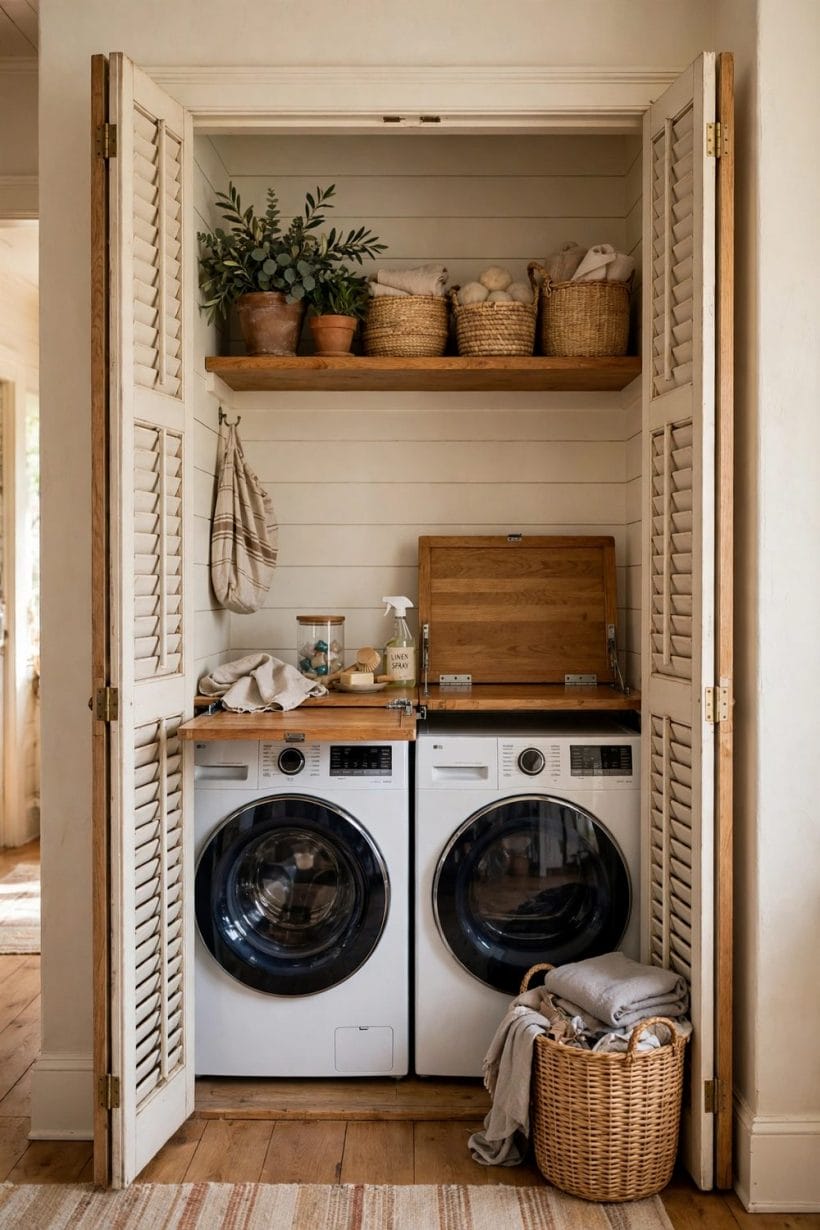
Beneath the baskets, a laundry closet is a small machine room: water in, water out, power, and a vent. Everything here is general, and the work itself belongs to qualified trades under the rules where you live.
52. Connections you can reach without moving machines
Valves, hoses and the waste standpipe should be reachable — a removable shelf section or a gap designed in — because the day a hose weeps, access is the whole repair. Closets fitted drum-tight against their plumbing are borrowed time.
53. A drip tray and a leak alarm under the machines
A shallow tray under the pair, with a simple water alarm, turns the closet’s worst accident into a mopping job. In upstairs closets especially, this small insurance is close to obligatory prudence.
54. Hoses and seals on a replacement rhythm
Washer hoses age whether they are looked at or not. Note their fitting date, inspect them when the closet is deep-cleaned, and replace on the maker’s guidance rather than on the evidence of a flood.
55. Power placed for the pair, protected properly
The machines’ sockets belong where the makers and local rules place them — dry, accessible, never buried behind a drum on an extension lead. Any new circuit or moved socket is an electrician’s work, full stop.
56. A floor drain or a plan for the water
Some closet laundries can include a floor drain; most cannot. Where there is none, the plan is the tray, the alarm, reachable valves and a household that knows where the main stopcock lives. Write the plan into the household, not the group chat.
57. Ventless machines for impossible vents
Where no duct route exists, condensing and heat-pump dryers remove the vent from the problem entirely, at the price of a water container to empty or a drain connection to plan. For many apartment closets they are not a compromise but the enabling choice.
58. Service clearance designed in
Machines need pulling out someday. A closet fitted with the machines’ removal in mind — hose length, door swing, a neighbour shelf that unclips — turns a future repair from carpentry into an appointment.
59. Leave the makers’ booklets in the closet
The installation and clearance requirements for your actual machines live in their booklets. Keep them in a labelled folder on the closet’s top shelf; every future decision in this section starts by reading them.
9. Small-Home and Apartment Laundry Closets
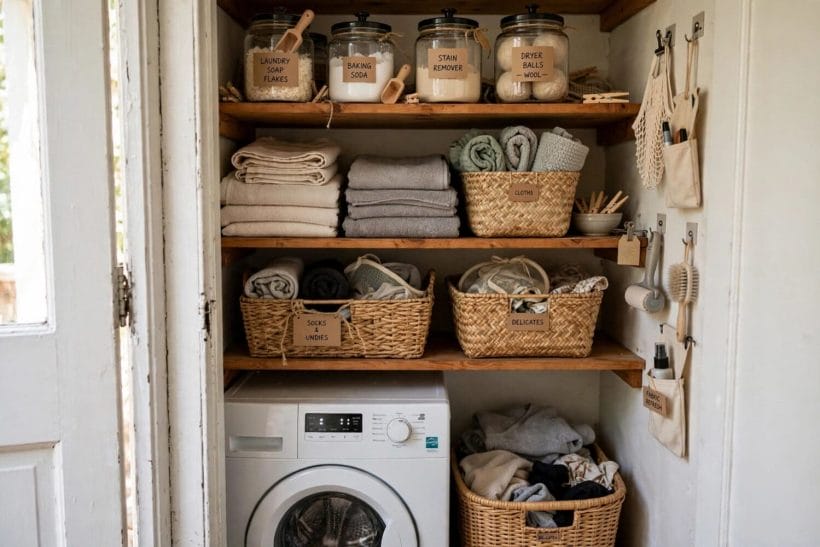
The laundry closet is the small home’s native laundry — most readers are gaining a laundry where none existed, not downsizing one. These ideas are for flats, tiny houses and tight halls, in the spirit of the compact homes in small closet ideas.
60. The hallway closet conversion
The classic flat conversion: a hall cupboard near the bathroom — where plumbing already lives — becomes the laundry. Sound carries down halls, so quiet machines and a solid door matter more here than anywhere.
61. A closet in the bathroom’s orbit, not in the bathroom
Near the bathroom keeps pipe runs short and laundry journeys shorter, while the closet’s own doors keep the machines out of the bathroom’s steam and sightlines. Near, separate, and plumbed sensibly is the apartment ideal — distinct from the combined rooms deliberately not covered here.
62. Bedroom-adjacent, with quiet in mind
A closet off the main bedroom is supremely convenient and one thin wall from the sleeper. Anti-vibration pads, a level floor and cycles timed for waking hours keep the convenience and lose the rumble.
63. Studio living: the laundry as furniture
In a studio, the closed closet should look like the room’s joinery — panelled doors, the room’s own handles, even a picture hung on it. The laundry disappears into the architecture, which in one room is the whole design brief.
64. Renters: the reversible closet laundry
Where alterations are limited, a closet laundry can be nearly reversible: freestanding shelving, machines on existing connections, curtain or existing doors kept. Agree everything with the landlord first, in writing — reversible is a promise, not a hope.
65. Compact and slimline machines, honestly assessed
Slim-depth and compact machines exist for exactly these closets. Their drums are smaller; the honest assessment is load size against household size — a compact that runs daily beats a standard pair that never fitted.
66. A closet shared with household storage
Many small homes ask the laundry closet to double as the cleaning cupboard. Zone it vertically — laundry low and daily, household chemicals high and closed — and keep the two economies from ever sharing a shelf.
67. The under-used airing cupboard, reborn
An airing cupboard near the hot water system is often the apartment’s best closet candidate: warm, plumbed-adjacent, already shelved. Its shelves, re-spaced, become the storage towers of section four with no new joinery at all.
10. Care, Costs and Choosing
The last section is the ledger: keeping a closet laundry fresh, what its cost is driven by, and how to choose among the seventy-five ideas in the order that matters.
68. Clean the closet like the small room it is
Dust, lint and detergent dust settle on every shelf. A monthly wipe of shelves, a vacuum of the vent area and the floor, and a check of the drip tray keep the closet fresh — lint management is also fire-sensible housekeeping, in general terms.
69. Machine seals and filters, on the calendar
Door seals wiped dry, filters cleared per the maker’s routine, drums left ajar — the small liturgy that keeps a closet laundry smelling like laundry, not like a cupboard that does laundry. In a closet, neglected machines perfume the whole store of linen.
70. Vent and duct care
A vented dryer’s duct and outlet need periodic clearing per the maker’s guidance; a ventless machine’s condensers and filters likewise. Airflow is a dryer’s whole talent — everything that narrows it is paid for in time, energy and damp.
71. Cost drivers, stated plainly
A closet laundry’s cost is driven by the machines chosen, plumbing and electrical work to reach the closet, any venting route, joinery and doors, and flooring. A closet beside existing plumbing is a different bill from one across the house — itemised local quotes are the only honest figures.
72. Choose the layout from the tape measure
The choosing order for this whole post: measure the closet truly, settle stacked or side by side, fix the vent question, then doors, then storage. Every regret in a laundry closet is a measurement that was estimated instead of taken.
73. Spend first on connections, then on calm
If the budget must choose, spend on sound plumbing, power and venting before shelving and paint. A beautiful closet with a weeping hose is a liability wearing baskets; a plain closet with perfect connections is a laundry for decades.
74. Plan the replacement before the installation
Machines will be replaced inside this closet’s life. Choosing standard closet-friendly sizes, keeping access honest and recording the closet’s true dimensions makes the future swap a delivery, not a rebuild.
75. The closed-door test
Finish with the only review that matters: close the doors. If the hall looks calm, the closet smells fresh, and tomorrow’s wash has a shelf, a rail and a light waiting for it — the laundry closet has done everything seventy-five ideas promised.
Final Considerations
A laundry closet succeeds by being measured honestly, connected properly, ventilated and lit like the small working room it is, and stored like the feature photograph — machines in the middle, a system on every side.




0 Comments